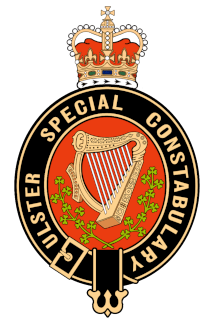
The USC is set up in October 1920, shortly before the partition of Ireland. It is an armed corps, organised partially on military lines and called out in times of emergency, such as war or insurgency. It performs this role most notably in the early 1920s during the Irish War of Independence (1920-22) and the Irish Republican Army (IRA) Border Campaign (1956-1962).
During its existence, 95 USC members are killed in the line of duty. Seventy-two of these are killed in conflict with the IRA in 1921 and 1922. Another eight die in air raids or IRA attacks during World War II. Of the remainder, most die in accidents but two former officers are killed during the Troubles in the 1980s.
The force is almost exclusively Ulster Protestant and as a result is viewed with great mistrust by Catholics. It carries out several revenge killings and reprisals against Catholic civilians during the Irish War of Independence. Unionists generally support the USC as contributing to the defence of Northern Ireland from subversion and outside aggression.
The abolition of the B Specials is a central demand of the Northern Ireland civil rights movement in the late 1960s. On April 30, 1970, the USC is finally stood down as a result of the Hunt Report, produced by a committee headed by John Hunt, Baron Hunt in 1969. Hunt concludes that the perceived bias of the Special Constabulary, whether true or not, has to be addressed. One of his other major concerns is the use of the police force for carrying out military style operations.
It has been argued that the USC’s failure to deal with the 1969 disturbances were due to a failure on behalf of the Northern Ireland government to modernise their equipment, weaponry, training and approach to the job. Upon the disbandment of the USC, many of its members join the newly established Ulster Defence Regiment (UDR), the part-time security force which replaces the B Specials. Unlike the Special Constabulary, the UDR is placed under military control. Other B Specials join the new part-time Reserve of the Royal Ulster Constabulary (RUC). The USC continues to do duties for a month after the formation of the UDR and RUC Reserve to allow both of the new forces time to consolidate.
In the final handover to the Ulster Defence Regiment, the B Specials have to surrender their weapons and uniforms. Despite the government’s concerns about the handover of weapons and equipment, every single uniform and every single weapon is surrendered.
After implementation of the Hunt report, the last night of duties for most B Men is March 31, 1970. On April 1, 1970 the Ulster Defence Regiment begins duties. Initially, the Regiment has 4,000 members who work part-time while the new special constabulary, the RUC Reserve which replaces the B-Specials, initially consists of 1,500 members.
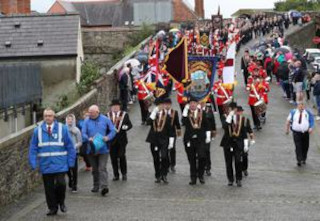
Since disbandment the USC has assumed a place of “almost mythic proportions” within unionist folklore, whereas in the Nationalist community they are still reviled as the Protestant only, armed wing of the unionist government “associated with the worst examples of unfair treatment of Catholics in Northern Ireland by the police force.” An Orange Order lodge is formed to commemorate the disbandment of the force called “Ulster Special Constabulary LOL No. 1970.” An Ulster Special Constabulary Association is also set up soon after the disbandment.
Eames spends his early years in Larne, with the family later moving to Belfast. He is educated at the city’s Belfast Royal Academy and Methodist College Belfast before going on to study at Queen’s University Belfast, graduating LL.B. (Upper Second Class Honours) in 1960 and earning a Ph.D. degree in canon law and history in 1963. During his undergraduate course at Queen’s, one of his philosophy lecturers is his future Roman Catholic counterpart, Cahal Daly.
Turning his back on legal studies for ordination in the Church of Ireland, Eames embarks on a three-year course at the divinity school of Trinity College, Dublin in 1960, but finds the course “intellectually unsatisfying.” In 1963 he is appointed curate assistant at Bangor Parish Church, becoming rector of St. Dorothea’s in Belfast in 1966, the same year he marries Christine Daly.
During his time at St. Dorothea’s, in the Braniel and Tullycarnet area of east Belfast, Eames develops a “coffee bar ministry” among young people but is interrupted by the Troubles. He turns down the opportunity to become dean of Cork and in 1974 is appointed rector of St. Mark’s in Dundela in east Belfast, a church with strong family links to C. S. Lewis.
On May 9, 1975, at the age of 38, Eames is elected bishop of the cross-border Diocese of Derry and Raphoe. Five years later, on May 30, 1980, he is translated to the Diocese of Down and Dromore. He is elected to Down and Dromore on April 23 and that election is confirmed on May 20, 1980. In 1986, he becomes the 14th Archbishop of Armagh and Primate of All Ireland since the Church of Ireland’s break with Rome. It is an appointment that causes some level of astonishment among other church leaders.
Drumcree Church, a rural parish near Portadown, becomes the site of a major political incident in 1996, when the annual Orangemen‘s march is banned by the Chief Constable of the Royal Ulster Constabulary from returning to the centre of Portadown via the nationalist Garvaghy Road after attending worship at Drumcree Church. Public unrest and violence escalate over the next three summers as other parades come under first police and later commission sanction.
Eames, as diocesan bishop and civil leader finds himself immersed in the search for a resolution to the issue. Within the wider Church of Ireland there is unease as it is a broad church in theology and politics including within its congregations nationalists in the south and unionists in the north. Eames, along with the rector of Drumcree, has to navigate this political and social controversy and seeks political assistance to diffuse tension. Some bishops in the Republic of Ireland call for Eames to close the parish church, including Bishop John Neill who later becomes Archbishop of Dublin. He refuses to do so, believing this action could precipitate greater unrest and possible bloodshed.
Eames is, for many years, a significant figure within the general Anglican Communion. In 2003, the self-styled ‘divine optimist’ is appointed Chairman of the Lambeth Commission on Communion, which examines significant challenges to unity in the Anglican Communion. The Commission publishes its report, the Windsor Report, on October 18, 2004.
At the Church of Ireland General Synod in 2006 Eames announces his intention to retire on December 31, 2006. Church law permits him to continue as primate until the age of 75 but he resigns, in good health, at the age of 69. On January 10, 2007, the eleven serving bishops of the Church of Ireland meet at St. Patrick’s Cathedral in Dublin and elect Alan Harper, Bishop of Connor, as Eames’s successor.
Herzog joins the British Army during World War II, operating primarily in Germany as a tank commander in the Armoured Corps. There, he is given his lifelong nickname of “Vivian” because the British could not pronounce the name, “Chaim.” A Jewish soldier had volunteered that “Vivian” is the English equivalent of “Chaim.”
After leaving the army, Herzog opens a private law practice. He returns to public life when the Six-Day War breaks out in 1967, serving as a military commentator for Kol Yisrael radio news. Following the capture of the West Bank, he is appointed Military Governor of East Jerusalem, and Judea and Samaria.
Herzog enters politics in the 1981 elections, winning a Knesset seat as a member of the Alignment. Two years later, in March 1983, he is elected to the largely ceremonial role of President. He serves two five-year terms before retiring in 1993. He dies on April 17, 1997, and is buried on Mount Herzl, Jerusalem. His son, Isaac Herzog, leads the Israeli Labour Party and the parliamentary Opposition in the Knesset from 2013 to 2018.
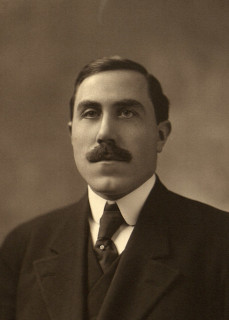
Sheppard is born to Simpson Sheppard, a sculptor, and Ellen White, of Ormond Quay, Dublin.
Sheppard is based in Dublin for almost all of his life, having travelled widely across Europe. He and his wife Rosie have several children. They live at Howth and 30 Pembroke Road in central Dublin. She dies in 1931.
From 1902 to 1937 Sheppard teaches sculpture at the Dublin Metropolitan School of Art, which is renamed the National College of Art in 1936. His annual stipend is £250 but for this he only has to lecture on three mornings per week, allowing him plenty of time for work on commissioned projects. One of his most famous students is the sculptor Kathleen Cox.
Sheppard is generally critical of the low standards of sculpture in Ireland, saying, “For the last sixty years or so thousands of figures and groups have been executed in Dublin for ecclesiastical purposes, and, with one or two exceptions…was not up to a reasonable standard. The making of a work of art hardly entered into it at all. The sculptor, well trained and properly encouraged, should collaborate with the architect.”
In 1890–1910 Sheppard is a part of the Celtic Revival movement, and, from his works such as Inis Fáil, is admired by his student William Pearse. Through him he meets his brother, Patrick Pearse, who later helps launch the Easter Rising in 1916. While most of the Revival’s artists are writers, playwrights and poets, Sheppard can claim to be the main sculptor working on themes similar to theirs.
Sheppard is in the minority of Irish Protestants who support independence, starting with support for the Irish Parliamentary Party in the 1880s, when he is an art student. After the Irish War of Independence (1919–21) he says, “They thought me too old to fight but I have tried to help in other ways. My politics are simple. I have always thought that this country should be a free country.” His opinions are not overly dogmatic, considering his work on the war memorials in 1920.
In the mid-1920s the first series of Irish Free State coinage is planned and is finally launched in 1928. Sheppard is one of the designers short-listed but his designs are not accepted.
Sheppard dies in Dublin on September 14, 1941.
(Pictured: “The Dying Cúchulainn,” sculpture by Oliver Sheppard, now at the General Post Office (GPO) in Dublin)
At the start of the twentieth century, the people of Ireland are divided into two mutually hostile factions. The much larger group (nationalists) are mostly Roman Catholic, identified primarily as Irish, and want some form of Irish home rule or independence from Britain. The smaller group (unionists), concentrated primarily in the province of Ulster, are mostly Protestant, identified primarily as British and are committed to remaining within the United Kingdom. In the years before World War I, both groups establish armed militias intended to enforce their aims and protect their communities from the other side’s militias. The British government resolves to partition Ireland in an effort to alleviate unionists and nationalists, with the six most Protestant counties of Ulster forming Northern Ireland while the rest of Ireland achieves self-rule. This is accepted by most unionists as the best deal they are likely to get, but bitterly disappoints many nationalists, especially those who live in the six counties which become Northern Ireland. Many nationalists on both sides of the border feel that their country has been unjustly divided, and for many decades the Irish government claims that Northern Ireland is rightfully its territory.
Partition is formally established with the Government of Ireland Act 1920. This also establishes the Parliament of Northern Ireland, which comes into being the following year. Partition is followed by high levels of inter-communal violence, especially in Belfast. The Irish Republican Army (IRA), although it spends most of these years fighting in the Irish Civil War, aims to use armed force to end partition and compel the United Kingdom to withdraw sovereignty from Northern Ireland.
The Special Powers Act is presented as being necessary to re-establish peace and law and order in Northern Ireland and enable the government to “take all such steps and issue all such orders as may be necessary for preserving the peace and maintaining order,” although it is specified that the ordinary course of law should be interfered with as little as possible. The Minister of Home Affairs is empowered to make any regulation felt necessary to preserve law and order in Northern Ireland. Anyone who breaks these regulations can be sentenced to up to a year in prison with hard labour, and in the case of some crimes, whipping. A special summary jurisdiction is enabled to hear cases involving such crimes. The Minister of Home Affairs is also permitted to forbid the holding of inquests if he feels this is required to preserve order and peace.
The Schedule to the Act specifies actions which the government can take in order to preserve peace, although the body of the Act enables the government to take any steps at all which it thinks necessary. Actions specified in the Schedule include the closing of licensed premises, the banning in any area of meetings and parades in public places, the closing of roads, the taking of any land or property, and the destruction of any building. The Schedule also forbids the spreading by word of mouth or text any “reports or…statements intended or likely to cause disaffection to subjects of His Majesty.”
Because it is presented as emergency legislation, the Special Powers Act is initially current for only one year and has to be renewed annually. In 1928, however, it is renewed for five years and when this period expires in 1933 the Act is made permanent. According to John Whyte, this happens because, from 1925, nationalist MPs begin sitting in the Stormont parliament which they had initially boycotted. Unsurprisingly, they object strenuously to the renewal of the Act, and it is felt by the Ulster Unionist Party Minister of Home Affairs that it would be better to make the Act permanent than for Parliament annually to “wrangle” over it.
Initially, regulations under the Act are used mostly to curb immediate violence and disorder. One of the most controversial of these is internment without trial, outlined in Paragraph 23 of the Schedule. In the period from May 1922 to December 1924, 700 republicans are interned under the Act.
Political violence declines dramatically by 1925, and the government gradually shifts its emphasis from broad measures designed to return civil order to the province to more preventative regulations aimed at suppressing the threat posed by republican aspirations. Regulations banning meetings and parades and restrictions on the flying of the Irish tricolour become more common. Between 1922 and 1950, the government bans nearly 100 parades and meetings, the vast majority of which are nationalist or republican. No loyalist gathering is ever directly banned under the Act, although a few are caught in blanket bans against parades or meetings in a particular area. From 1922 until 1972, 140 publications are banned, the vast majority of which express republican viewpoints.
After the troubles of the early 1920s has died down, the provision for internment is not used until the IRA’s border campaign of the 1950s, in which several hundred republicans are interned. Following the outbreak of the Troubles in 1968, many within the Protestant community call for the reintroduction of internment. This occurs in 1971 and authorises internment of those suspected to be involved in terrorism. Although there is loyalist as well as republican terrorists at this time, of the 1,981 men interned, only 107 are loyalists.
Internment ends in 1975 but is credited with increasing support and sympathy for the Provisional Irish Republican Army amongst the Catholic community and outside of Northern Ireland. It helps to create political tensions which culminate in the 1981 Irish Hunger Strike and the death of MP Bobby Sands. Imprisonment under anti-terrorism laws specific to Northern Ireland continue until the 1998 Good Friday Agreement, but these laws require the right to a fair trial be respected.
The Act encounters further controversy in the 1970s due to the deployment of the British Army in Northern Ireland and its role in maintaining order and similar policing-style duties. In 1972, the government is forced to amend the Act in order to legalise the detention of internees arrested by soldiers. Martin Meehan had been arrested after escaping from Crumlin Road Gaol and charged with escaping from lawful custody. At his trial he successfully argues that under the Special Powers Act a soldier has no power of arrest and, as such, he has the legal right to escape. He is awarded £800 in compensation for being illegally detained for twenty-three days.
Fifty members and one band take part in the parade but the Commission forbids any music to be played between the two bridges on the Ormeau Road. In its ruling, the Commission says that since the last parade in August 1999, there has been “clear evidence of considerable efforts” by the Apprentice Boys to reach agreement with the residents’ group, the Lower Ormeau Concerned Community (LOCC). It says the LOCC has, in turn, engaged in dialogue with them which has been “sustained and meaningful, notwithstanding spasmodic breaks.” The Commission adds, “It is regrettable that it has not produced agreement or acquiescence. With regard to this decision, the Commission stresses that it provides no guarantees for the future. The Commission will continue to look for evidence of ongoing commitment by LOCC and the Apprentice Boys to find their own resolution to the local issues on the Ormeau Road.”
Apprentice Boys’ spokesman Tommy Cheevers says they are disappointed that agreement has not been reached with the residents. “This is the second time in five years that we will have managed to parade along our traditional route on the Ormeau Road,” he tells BBC Radio Ulster. “We would just ask that everybody accepts the rule of law, as we have had to do in the past when it went against us, and make sure it is peaceful.”
However, the ruling is criticised by LOCC spokesman Gerard Rice. He says he is “absolutely shocked” by the decision, adding he had already asked the Parades Commission for it to be reviewed. “We believe this was the wrong decision. We will ask the Parades Commission to overturn this decision. Failing that, we may go to the courts and ask for a judicial review.” The residents’ group meets with the Commission in the evening to discuss the ruling.
In 2000, the chairman of the Parades Commission praised the behaviour of the Apprentice Boys, after they abided by the decision barring their parade from the lower Ormeau Road. However, there have been violent confrontations at previous parades.
The Parades Commission is established in 1997 to determine whether conditions should be placed on contentious parades in Northern Ireland.
(From: “Green light for contentious parade,” BBC News, news.bbc.co.uk, April 6, 2001)
O’Nolan writes prodigiously during his years as a student at University College, Dublin (UCD), where he is an active, and controversial, member of the well-known Literary and Historical Society. He contributes to the student magazine Comhthrom Féinne (Fair Play) under various guises, in particular the pseudonym Brother Barnabas. Significantly, he composes a story during this same period titled “Scenes in a Novel (probably posthumous) by Brother Barnabas”, which anticipates many of the ideas and themes later to be found in his novel At Swim-Two-Birds.
In 1934 O’Nolan and his student friends found a short-lived magazine called Blather. The writing here, though clearly bearing the marks of youthful bravado, again somewhat anticipates O’Nolan’s later work, in this case his Cruiskeen Lawn column as Myles na gCopaleen. Having studied the German language in Dublin, he may have spent at least parts of 1933 and 1934 in Germany, namely in Cologne and Bonn, although details are uncertain and contested.
A key feature of O’Nolan’s personal situation is his status as an Irish government civil servant, who, as a result of his father’s relatively early death, is obliged to support ten siblings, including an elder brother who is an unsuccessful writer. Given the desperate poverty of Ireland in the 1930s to 1960s, a job as a civil servant is considered prestigious, being both secure and pensionable with a reliable cash income in a largely agrarian economy. The Irish civil service is fairly strictly apolitical, prohibiting Civil Servants above the level of clerical officer from publicly expressing political views. This fact alone contributes to his use of pseudonyms, though he had started to create character-authors even in his pre-civil service writings. He rises to be quite senior, serving as private secretary to Seán T. O’Kelly and Seán McEntee.
Although O’Nolan is a well-known character in Dublin during his lifetime, relatively little is known about his personal life. On December 2, 1948, he marries Evelyn McDonnell, a typist in the Department of Local Government. On his marriage he moves from his parental home in Blackrock to nearby Merrion Street, living at several further locations in South Dublin before his death. The couple has no children.
O’Nolan is an alcoholic for much of his life and suffers from ill health in his later years. He suffers from throat cancer and dies from a heart attack in Dublin on the morning of April 1, 1966. He is buried in Deans Grange Cemetery in Dublin.
McGarrity’s family grows up in poverty, motivating his need to immigrate later in life. He grows up hearing his father discussing Irish politics, including topics such as the Fenians, the Irish Parliamentary Party (IPP), and Irish Home Rule. By the time he is an adult, he has developed a keen interest in politics himself.
McGarrity immigrates to the United States in 1892 at the age of 18. He is reputed to have walked to Dublin before boarding a cattle boat to Liverpool disguised as a drover, and then sailing to the United States using a ticket belonging to someone else. He settles in Philadelphia, Pennsylvania and becomes successful in the liquor business. His business fails, however, on three occasions, twice due to embezzlement by his business partner.
In 1893 McGarrity joins Clan na Gael, an Irish organisation based in the United States committed to aiding the establishment of an independent Irish state. Clan na Gael had been heavily involved with the Fenian Brotherhood that McGarrity had grown up hearing about, and by the latter half of the 19th century had become a sister organisation of the Irish Republican Brotherhood (IRB). In the decade just before McGarrity joins, Clan na Gael and the Fenian movement had waged the Fenian dynamite campaign, where they attempted to force the British state to make concessions in Ireland by bombing British Infrastructure. However, this had caused a split within Clan na Gael that is not mended until seven years after McGarrity joins when, in 1900, the factions reunite and plead to support “the complete independence of the Irish people, and the establishment of an Irish republic.” In the years that follow the 1880s and 1890s, he is, amongst others, credited with helping to stitch the organisation back together and bring it renewed strength.
McGarrity helps sponsor several Irish Race Conventions and founds and runs a newspaper called The Irish Press from 1918-22 that supports the Irish War of Independence. He is the founder of the Philadelphia chapter of Clan Na Gael.
When Éamon de Valera arrives in the United States in 1919 they strike up an immediate rapport and McGarrity manages de Valera’s tour of the country. He persuades de Valera of the benefits of supporting him and the Philadelphia branch against the New York branch of the Friends of Irish Freedom organisation led by John Devoy and Judge Daniel F. Cohalan. He becomes president of the American Association for the Recognition of the Irish Republic. He christens his newborn son Éamon de Valera McGarrity, although their relationship becomes strained upon de Valera’s entry back into Dáil Éireann in the Irish Free State.
The Irish Civil War sees a split in Clan na Gael just as it had split Sinn Féin back in Ireland. McGarrity and a minority of Clan na Gael members support the anti-treaty side but a majority support the pro-treaty side, including John Devoy and Daniel Cohalan. Furthermore, in October 1920 Harry Boland informs the Clan na Gael leadership that the IRB will be cutting their ties to the Clan unless the IRB is given more influence over their affairs. Devoy and Cohalan resist this, but McGarrity sees the Clan’s connection with the IRB as vital. While McGarrity’s faction is initially labelled “Reorganised Clan na Gael,” they are able to inherit total control of the Clan na Gael name as Devoy is not able to keep effective organisation of the group. In general, however, the in-fighting amongst the Irish on both sides of the Atlantic is quite disheartening for Irish Americans and in the years to come neither pro or anti-treaty sides of Clan na Gael see much in the way of donations.
With the scope of Clan na Gael now narrowed, and Devoy and Cohalan removed from the picture, McGarrity becomes chairman of the organisation. He does not support the founding of Fianna Fáil in 1926 and opposes the party’s entry into the Dáil in 1927. Even after the Irish Civil War, he still supports the idea that a 32-county Irish Republic can be achieved through force. in the spring of 1926, he receives Chief of Staff of the Irish Republican ArmyAndrew Cooney to the United States. Cooney and Clan na Gael formally agree that each organisation will support the other and that Clan na Gael will raise funds, purchase weapons and build support for the IRA in the United States.
Going into the late 1920s though Clan na Gael, as are most Irish American organisations, is struggling. Having limped past the split caused by the Irish Civil War, the rejection of Fianna Fáil has caused a second split in the membership. Many Irish Americans see the IRA and Fianna Fáil as one and the same at that point and Clan na Gael and McGarrity’s hostility to them causes much friction.
By July 1929, the Clan’s membership in one of its strongholds, New York City, is down to just 620 paid members. Then in October of that same year Wall Street crashes and the Great Depression hits. In 1933 McGarrity is left almost bankrupt after he is found guilty of “false bookkeeping entries.” His livelihood is saved when he becomes one of the main ticket agents in the United States for the Irish Hospitals’ Sweepstake. He is a personal friend of Joseph McGrath, one of the founders of the Sweepstake. The sweepstakes allow him to turn his fortunes around.
Despite the trying times of both Clan na Gael and his personal life, McGarrity holds fast in his belief in physical force Irish Republicanism. In 1939 he supports the demand from Seán Russell for the “S-Plan” bombing campaign in Britain, which proves disastrous. He allegedly meets Hermann Göring in Berlin in 1939 to ask for aid for the IRA, which leads indirectly to “Plan Kathleen.”
McGarrity is a lifelong friend of fellow Carrickmore native and avid Republican, Patrick McCartan. When he dies on September 4, 1940, a mass is held in the St. Mary’s Pro-Cathedral in Dublin. He remains an unrepentant physical force republican all his life. A number of McGarrity’s papers are in the National Library of Ireland. He donates his personal Library to Villanova University.
The IRA signs all its statements ‘J.J. McGarrity’ until 1969 when the organisation splits into the ‘Official‘ and ‘Provisional‘ movements. Thereafter the term continues to be used by the Officials while the Provisionals adopt the moniker ‘P.O’Neill.’
The government had set this date as a final deadline for a restoration of power-sharing before direct rule from London is restored permanently and now has to rush emergency legislation through the House of Commons to prevent this.
“After a long and difficult time in our province, I believe that enormous opportunities lie ahead for our province,” Paisley tells reporters, as he sits at a conference table next to Adams. The agreement “marks the beginning of a new era of politics on this island,” Adams agrees, but adds that he finds it “disappointing” that Northern Ireland‘s political institution cannot be restored immediately.
British prime minister Tony Blair hails the agreement, saying “This is a very important day for the people of Northern Ireland but also for the people and the history of these islands.” After talking by phone with his Irish counterpart, Taoiseach Bertie Ahern, he tells reporters, “In a sense, everything we have done over the last ten years has been a preparation for this moment, because the people of Northern Ireland have spoken through the election. They have said we want peace and power-sharing, and the political leadership has then come in behind that and said we will deliver what people want.”
In Ireland, Ahern calls the day’s developments “unprecedented and very positive,” and says both governments will cooperate with the new May 8 date for devolution.
The Secretary of State for Northern Ireland, Peter Hain, says a one clause emergency bill will be put through parliament with the agreement of opposition parties, and will need royal assent before midnight the following evening to prevent the dissolution of the Stormont assembly. He describes the day’s events as “really, really momentous.”
“Today the clouds have lifted, and the people can see the future,” Hain tells BBC Radio 4‘s The World at One. “These pictures of Ian Paisley and Gerry Adams will resonate around the world. They are a graphic manifestation of the power of politics over bigotry and conflict, bitterness and horror.”
The crucial meeting sees delegations from the DUP and Sinn Féin spend an hour together inside a room at Stormont to hammer out the final agreement for a return to power-sharing. Afterwards, both leaders talk about the work still needing to be done, including regular meetings between Paisley and Sinn Féin’s Martin McGuinness as the de facto first and deputy first ministers.
Clearly conscious of the historical significance of their talks, Paisley and Adams speak of the suffering caused by the decades of inter-community violence and their responsibility to ensure permanent peace and reconciliation. Northern Ireland’s politicians must “never forget those who have suffered during the dark period from which we are, please God, emerging,” Paisley says. “I want to make it clear that I am committed to delivering not only for those who voted for the DUP but for all the people of Northern Ireland. We must not allow our justified loathing for the horrors and tragedies of the past to become a barrier to creating a better and more stable future for our children,” he adds.
Adams says there is now new hope for the future, following the previous “sad history of orange and green.” He adds, “There are still many challenges, many difficulties, to be faced. But let us be clear: the basis of the agreement between Sinn Féin and the DUP follows Ian Paisley’s unequivocal and welcome commitment to support and participate fully in the political institutions on May 8. We’ve all come a very long way in the process of peace making and national reconciliation. We are very conscious of the many people who have suffered. We owe it to them to build the best future possible.”
The proposal for the historic meeting comes after a frantic weekend of consultation in Belfast and Berlin, where Blair and Ahern are attending a ceremony to mark 50 years of the European Union. Both prime ministers had repeatedly insisted the assembly would be dissolved if no agreement on an executive had been reached by today’s legal deadline. Britain is forced into a last-minute change of strategy after Paisley’s DUP agrees in principle on March 24 to share power with Sinn Féin but demands an extension of the deadline for the formation of the executive until May.
The DUP, which is badly split, says they need the additional time to see if Sinn Féin will comply with its commitment to cooperate with the Police Service of Northern Ireland. Until now Paisley’s DUP has always refused to meet Sinn Féin. Each represents what used to be seen as the two extremes of Northern Ireland sectarian politics.
(From: “Paisley and Adams agree deal” by Peter Walker and Owen Bowcott, The Guardian (www.theguardian.com), March 26, 2007 | Pictured: Ian Paisley and Gerry Adams hold their first face-to-face talks. Photograph: Paul Faith/ PA)
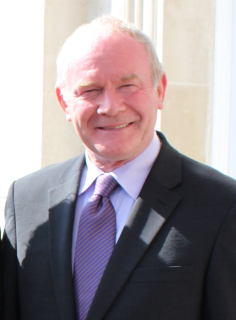
McGuinness is born James Martin Pacelli McGuinness on May 23, 1950 in Derry. He attends St. Eugene’s Primary School and later the Christian Brothers technical college, leaving school at the age of 15.
McGuinness joins the IRA about 1970, and by 1971 he is one of its leading organizers in Derry. In 1973 a Special Criminal Court in the Republic of Ireland sentences him to six months in prison after he is caught in a car containing large quantities of explosives and ammunition. Although the IRA keeps secret the membership of its seven-person Army Council, few doubt that McGuinness is one of its most important members from the 1970s through the 1990s. Even while reportedly planning attacks on civilians in Northern Ireland and on the British mainland, McGuinness is involved in spasmodic secret talks with British government ministers and officials to end the conflict. In 1972 McGuinness, with fellow IRA leader Gerry Adams, privately negotiates with British Secretary of State for Northern IrelandWilliam Whitelaw, but these and other talks over the next two decades are unsuccessful.
McGuinness contests seats in the British House of Commons on several occasions, losing in 1983, 1987, and 1992. However, in 1997 he is elected to the House of Commons to represent the constituency of Mid Ulster and, in line with party policy, he does not take his seat. He subsequently wins reelection to the seat in 2001, 2005, and 2010.
McGuinness is the IRA’s chief negotiator in the deliberations, also secret at first, that culminate in the Good Friday Agreement in 1998. This pact finally ends the conflict and eventually brings Sinn Féin into a coalition government to rule Northern Ireland. He is elected to the new Northern Ireland Assembly and in 1999 is appointed Minister of Education. In this post he eliminates the controversial eleven-plus examination, which determines which type of secondary school a child should attend. The test had been abolished in most of the rest of the United Kingdom more than 25 years earlier.
Disagreements over such issues as policing and the decommissioning of arms causes Northern Ireland’s Executive and Assembly to be suspended for some years, but a fresh agreement in 2006 paves the way for them to be revived. In elections in March 2007, both Sinn Féin and the antirepublican Democratic Unionist Party (DUP) gain seats, becoming the two largest parties in the Northern Ireland Assembly. McGuinness becomes Deputy First Minister, working with First Minister Ian Paisley, leader of the DUP. The two men, previously bitter enemies, perform so well together that they are dubbed the “Chuckle brothers.”
When Paisley retires in 2008, he is succeeded by the DUP’s Peter Robinson, who is considered to be even more militantly antirepublican. Once again, however, a shared need to rebuild the economy and attract international investment leads to cooperation between former opponents. In 2009 their government is in jeopardy as Sinn Féin and the DUP argue over the devolution of the police and justice system in Northern Ireland. McGuinness and Robinson are involved in the ensuing negotiations, and in February 2010 an agreement is reached for the transfer of powers from Britain to Northern Ireland in April.
In the Assembly elections in May 2011, McGuinness and Robinson are a formidable pair, and voters respond to their call for stability in a time of economic uncertainty. Sinn Féin gains an additional seat and increases its overall share of the vote, and McGuinness is assured an additional term as Deputy First Minister. In the autumn he steps down to run as Sinn Féin’s candidate for the presidency of Ireland. After finishing third in the election held on October 28, he returns to the position of Deputy First Minister a few days later. On June 27, 2012, in an event widely seen as having great symbolic importance for the ongoing reconciliation efforts in Northern Ireland, McGuinness and Elizabeth II shake hands twice, once in private and again in public, during a visit by the British monarch to Belfast.
In January 2017 McGuinness resigns as Deputy First Minister in response to First Minister Arlene Foster’s refusal to temporarily step down from her position during the investigation of a scandal relating to the government’s Renewable Heat Incentive (RHI), a mishandled program under which large amounts of state funds allegedly had been squandered. Foster had served as head of the department that oversaw the RHI before becoming First Minister. Under the power-sharing agreement the posts of First Minister and Deputy First Minister constitute a single joint office so that the resignation of one minister results in termination of the other’s tenure. When Sinn Féin chooses not to nominate a replacement for McGuinness within the required seven-day period, authority reverts to the British government’s Secretary of State for Northern Ireland in advance of a snap election on March 2.
Even before McGuinness’s resignation there had been speculation late in 2016 that he might step down for health reasons, and soon after resigning he confirms that he is suffering from amyloidosis, a rare disease brought about by deposits of abnormal protein in organs and tissue. With McGuinness removing himself from “frontline politics,” Michelle O’Neill leads Sinn Féin into the election. The disease claims McGuinness’s life only months later on March 21, 2017.