Sinn Féin, a left-wingIrish republican political party active in both the Republic of Ireland and Northern Ireland, is founded on November 28, 1905, when, at the first annual Convention of the National Council, Arthur Griffith outlines the Sinn Féin policy, “to establish in Ireland’s capital a national legislature endowed with the moral authority of the Irish nation.”
The phrase “Sinn Féin” is Irish for “ourselves” or “we ourselves,” although it is frequently mistranslated as “ourselves alone.” The meaning of the name itself is an assertion of Irish national sovereignty and self-determination, i.e., the Irish people governing themselves, rather than being part of a political union with Great Britain under the Westminster Parliament.
Around the time of 1969–1970, owing to the split in the republican movement, there are two groups calling themselves Sinn Féin, one under Tomás Mac Giolla, the other under Ruairí Ó Brádaigh. The latter becomes known as Sinn Féin (Kevin Street) or Provisional Sinn Féin, and the former becomes known as Sinn Féin (Gardiner Place) or Official Sinn Féin. The “Officials” drop all mention of Sinn Féin from their name in 1982, instead calling itself the Workers’ Party of Ireland. The Provisionals are now generally known as Sinn Féin. Supporters of Republican Sinn Féin, which comes from a 1986 split, still use the term “Provisional Sinn Féin” to refer to the party led by Gerry Adams.
Sinn Féin is a major party in both Northern Ireland and the Republic of Ireland. It is the largest nationalist party in the Northern Ireland Assembly, and the second-largest overall. It has four ministerial posts in the most recent power sharingNorthern Ireland Executive. It holds seven of Northern Ireland’s eighteen seats, the second largest bloc after the Democratic Unionist Party (DUP), at Westminster, where it follows a policy of abstentionism, refusing to attend parliament or vote on bills. It is the third-largest party in the Oireachtas, the parliament of the Republic of Ireland. As Ireland’s dominant parties of Fine Gael and Fianna Fáil are both centre-right, Sinn Féin is the largest left-wing party in Ireland.
Sinn Féin members have also been referred to as Shinners, a term intended as a pejorative.
The Gaiety is extended by theatre architect Frank Matcham in 1883, and, despite several improvements to public spaces and stage changes, it retains several Victorian era features and remains Dublin’s longest-established, continuously producing theatre.
Patrick Wall and Louis Elliman purchase the theatre in 1936 and run it for several decades with local actors and actresses. They sell it in 1965, and in the 1960s and the 1970s the theatre is run by Fred O’Donovan and the Eamonn Andrews Studios, until Joe Dowling, former artistic director of the Abbey Theatre, becomes director of the Gaiety in the 1980s. In the 1990s Groundwork Productions take on the lease and the theatre is eventually bought by the Break for the Border Group. The Gaiety is purchased by music promoter Denis Desmond and his wife Caroline in the late 1990s, who undertake a refit of the theatre. The Department of Arts, Sport and Tourism also contributes to this restoration fund.
The theatre plays host to the 1971 Eurovision Song Contest, the first to be staged in Ireland, during the Gaiety’s centenary year. Clodagh Rodgers, a contestant in that particular contest, later presents her RTÉ television series The Clodagh Rodgers Show from the theatre in the late 1970s.
Aeneas Coffey, Irish inventor and distiller, dies in England on November 26, 1852. He is born in Calais, France, to Irish parents in 1780. He is educated at Trinity College, Dublin, and enters the excise service around 1799–1800 as a gauger. He marries Susanna Logie in 1808, and they have a son, also named Aeneas, who may have been their only child.
According to British customs and excise records, Coffey is a remarkable man with widespread interests and multiple talents who rises quickly through the excise service ranks. He is appointed sub-commissioner of Inland Excise and Taxes for the district of Drogheda in 1813. He is appointed Surveyor of Excise for Clonmel and Wicklow in 1815. In 1816 he is promoted to the same post at Cork. By 1818 he is Acting Inspector General of Excise for the whole of Ireland and within two years is promoted to Inspector General of Excise in Dublin.
Coffey is a strong, determined upholder of the law, but aware of its shortcomings. He survives many nasty skirmishes with illegal distillers and smugglers, particularly in County Donegal in Ulster and in the west of Ireland, where moonshining is most rife. On several occasions he proposes to the government simple, pragmatic solutions to rules and regulations which have hampered legal distillers. Not all of his ideas are accepted. Between 1820 and 1824 he submits reports and gives evidence to Parliamentary Commissions of Inquiry on many aspects of distilling, including formalising the different spellings of Irish whiskey and Scotch whisky. His 1822 report is solidly backed by the Irish distillers. He believes in making it viable to distill legally, and illegal distilling might largely disappear.
He assists the government in the drafting of the 1823 Excise Act which makes it easier to distill legally. It sanctions the distilling of whiskey in return for a licence fee of £10, and a set payment per gallon of proof spirit. It also provides for the appointment of a single Board of Excise, under Treasury control, for the whole of the United Kingdom, replacing the separate excise boards for England, Scotland and Ireland. The 1823 Excise Act also provides for not more than four assistant commissioners of excise to transact current business in Scotland and Ireland, under the control of the board in London. Coffey resigns from government excise service at his own request in 1824.
Between his Dublin education and his work as an excise officer, Coffey has ample opportunity to observe the design and workings of whiskey stills, as Ireland is the world’s leading producer of whiskey in the 19th century, and Dublin is at the center of that global industry. This is how Coffey becomes familiar with a design differing from the traditional copper pot alembic still commonly used in Ireland, the continuous, or column, still. First patented by a Cork County distillery in 1822, the column still remains a relatively inefficient piece of equipment, although it points the way towards a cheaper and more productive way to distill alcohol. It is that last point that captures Coffey’s imagination. He makes his own modifications to existing column still designs, so as to allow a greater portion of the vapors to re-circulate into the still instead of moving into the receiver with the spirit. The result is more efficient, producing a lighter spirit at higher alcohol content. Coffey patents his design in 1830, and it becomes the basis for every column still used ever since.
On his retirement from service, Coffey goes into the Irish distilling business. For a short time he runs the Dodder Bank Distillery, Dublin and Dock Distillery in Grand Canal Street, Dublin, before setting up on his own as Aeneas Coffey Whiskey Company in 1830. The development of the Coffey still makes distillation of his own whiskey much more economical.
Nothing is known of the final years and last resting place of Aeneas Coffey. His only son, also called Aeneas Coffey, emigrates to South Africa and manages a distillery. He marries but his wife dies childless. He returns to England and spends his final years near London.
Henry Charles Sirr, Irish soldier, police officer, wine merchant and collector, is born in Dublin Castle on November 25, 1764. He is the founder of the Irish Society for Promoting Scriptural Education in the Irish Language.
Sirr is the son of Major Joseph Sirr, the Town Major (chief of police) of Dublin from 1762 to 1767. He serves in the British Army from 1778 until 1791 and is thereafter a wine merchant. In 1792 he marries Eliza D’Arcy, the daughter of James D’Arcy. He is the father of Rev. Joseph D’Arcy Sirr, MRIA and of Henry Charles Sirr.
In 1802 Sirr is mulcted £150 damages, and costs, for the assault and false imprisonment of John Hevey. His lawyer in this case refers to his “very great exertions and laudable efforts” to crush the Irish Rebellion of 1798. The opposing lawyer, John Philpot Curran, tells a long tale of a grudge held by Sirr against Hevey, the latter a prosperous businessman and a Yeoman volunteer against the Rebellion, who has happened to be in court during a treason case brought by Sirr. Hevey recognises the witness for the prosecution, describes him in court “a man of infamous character,” and convinces the jury that no credit is due to the witness. The treason case collapses. Sirr and his colleague had then subjected Hevey to wrongful arrest, imprisonment incommunicado, extortion of goods and money, and condemnation to hanging. Curran implies that these techniques are typical of the methods used by Sirr and by others to suppress the Rebellion.
In 1808 the Dublin police is re-organised and his post is abolished, but he is allowed to retain the title. Niles’ Register of March 24, 1821 remarks that “Several persons have been arrested at a public house in Dublin, by major Sirr, charged with being engaged in a treasonable meeting, and committed to prison. We thought that this old sinner, given to eternal infamy by the eloquence of Curran, had gone home.”
Sirr is an avid collector of documents and curios. He sells McCormac’s Cross and other valuable antiquities in exchange for second-rate copied paintings. The remains are given by his older son, Joseph, to Trinity College, Dublin at some time between 1841 and 1843. It now forms the Sirr Collection of the Trinity College Library, Dublin.
Henry Charles Sirr dies in 1841 and is buried in the churchyard of St. Werburgh’s Church, while his victim, Lord Edward FitzGerald, is buried in the vaults of the same church.
The London-born son of a British scholar and an Irish mother, Childers is a lifelong Protestant, itself an anomaly since Irish nationalism maps strongly to Catholicism. In his early years his loyalty was with the British Empire. In his twenties, Childers volunteers for the Second Boer War, and he later says the rank savagery and underlying injustice of England’s war “changed the whole current of my life and made me a Liberal and a Nationalist.”
Laying down the sword, Childers takes up the pen and writes several books of military history. He also writes a novel, The Riddle of the Sands, that has a claim of being the first spy novel. The Riddle of the Sands has never gone out of print since it was published in 1903.
Both in fiction and nonfiction, Childers’ warnings against the German challenge to British hegemony are prophetic, but he is himself becoming a man divided. In 1914 he runs German guns to Irish nationalists aboard his yacht Asgard and then signs up for the royal navy when World War I erupts. The British crackdown on the Easter Rising during the war completes his radicalization. He moves to Dublin and turns his eloquence against the British.
After Collins’s assassination, emergency laws promulgate the death sentence for anyone caught armed without authorization. Childers is a writer, not a partisan, but he is arrested in early November with a small sidearm, a gift Collins had given him back when they were on the same side. It is a time of bloody justice, and they throw the book at him.
Childers knows as well as Collins had that the internecine conflict would have to end. He faces his execution with awe-inspiring forgiveness. Summoning his 16-year-old son to prison the night before his execution, Childers extracts a promise from the boy that he will find everyone who signed his death warrant and shake their hands. This son, young Erskine Hamilton Childers, eventually becomes President of Ireland.
Childers himself likewise shakes the hands of his own firing squad, one by one. His last words, reported in a number of slightly different variations, are lightheartedly addressed to them: “Take a step or two forwards, lads. It will be easier that way.”
The Irish Citizen Army (ICA) is formed on November 23, 1913, at the height of the Dublin Lockout. Its purpose is to enable the locked-out men to defend themselves in clashes with the Dublin Metropolitan Police and to counteract the demoralizing effects of unemployment by providing discipline, cohesion and purpose. The idea of forming a force apparently is first formally proposed in 1913 by Captain James Robert “Jack” White, an ex-army officer from County Antrim, who had been educated at Winchester College and Royal Military College, Sandhurst. During a speech in August, James Larkin had already suggested that the workers form a force. He publicly repeats this instruction on November 13. James Connolly likewise urges the men to train “as they are doing in Ulster.” Two weeks later drilling begins. According to the ICA constitution, its members are to “work for an Irish republic and for the emancipation of labour.” Larkin is anxious that those who enlist should not only espouse these principles but also be members of unions recognised by the Irish Trades Union Congress.
Despite competition from the Irish Volunteers, which launches on November 25, 1913, ICA membership quickly surpasses 1,000. However, after the dispute is over in January 1914 and the men return to work, the “army” all but disappears. But it is Connolly above all who, after his appointment as its commandant and as leader of the Irish Transport and General Workers Union, rescues it from terminal decline and welds it into a potent force and potential weapon for his own use. He determines its structure, vets its officers and imposes a rigid discipline. He also demands an ideological commitment to revolution and the goal of an independent Irish socialist republic. The force’s guiding principle is that “the ownership of Ireland, moral and material, is vested by right in the people of Ireland.” Its membership remains small, but it is otherwise superior to the much larger Irish Volunteers in its unity of purpose, lack of factional and ideological division and in the quality of its training.
After the outbreak of World War I, Connolly has become increasingly committed to fomenting an insurrection in Ireland. This is reflected in his military preparations with the ICA. He uses its headquarters, Liberty Hall, as his base. Fearing he might act on his own, and recognising the merits of collaboration, the Irish Republican Brotherhood Military Council informs him of their own clandestine plans for a rising and an agreement is reached.
During Easter week of 1916, 219 ICA men fight alongside over 1,300 from the Irish Volunteers. As the appointed leader of both forces in Dublin, Connolly skillfully ensures that the ideological and social divisions and personality clashes, which have hitherto blighted their relationship, are largely overcome. ICA forces are mainly concentrated at the General Post Office (GPO), the College of Surgeons and Dublin’s City Hall. They win volunteer admiration for their professionalism, dedication, and ruthlessness. Two of their leaders are subsequently executed – Connolly and Michael Mallin, the ICA Chief of Staff. Constance Markievicz, Mallin`s second-in command, is reprieved. Others are imprisoned or interned. The ICA is not revived after the insurrection. The new leadership of the ITGWU focuses instead on building up the union, safeguarding members’ wages and improving working conditions.
Lewis is born in Belfast on November 29, 1898. When he is seven, his family moves into “Little Lea,” the family home of his childhood, in the Strandtown area of East Belfast. He was schooled by private tutors until age 9, when his mother dies from cancer. His father then sends him to live and study at Wynyard School in Watford, Hertfordshire. The school closes soon afterwards due to a lack of pupils. He then attends Campbell College in the east of Belfast about a mile from his home, but leaves after a few months due to respiratory problems. He is then sent to the health-resort town of Malvern, Worcestershire, where he attends the preparatory school Cherbourg House. It is during this time that Lewis abandons his childhood Christian faith and becomes an atheist. In September 1913, he enrolls at Malvern College, where he remains until the following June. After leaving Malvern, he studies privately with William T. Kirkpatrick, his father’s old tutor and former headmaster of Lurgan College.
Lewis and fellow novelist J.R.R. Tolkien are close friends. They both serve on the English faculty at Oxford University, and are active in the informal Oxford literary group known as the Inklings. According to Lewis’s memoir Surprised by Joy, he is baptised in the Church of Ireland, but fell away from his faith during adolescence. He returns to Anglicanism at the age of 32, owing to the influence of Tolkien and other friends, and he becomes an “ordinary layman of the Church of England.” His faith profoundly affects his work, and his wartime radio broadcasts on the subject of Christianity bring him wide acclaim.
Lewis writes more than 30 books, which have been translated into more than 30 languages and have sold millions of copies. The books that make up The Chronicles of Narnia have sold the most and have been popularised on stage, TV, radio, and cinema. His philosophical writings are widely cited by Christian apologetics from many denominations.
In early June 1961, Lewis begins suffering from nephritis, which results in blood poisoning. His illness causes him to miss the autumn term at Cambridge, though his health gradually begins improving in 1962 and he returns that April. His health continues to improve and he is fully himself by early 1963. On July 15 of that year he falls ill and is admitted to hospital. At 5:00 PM the following day he suffers a heart attack and lapses into a coma, unexpectedly awaking the following afternoon. After he is discharged from the hospital he is too ill to return to work. As a result, he resigns from his post at Cambridge in August. His condition continues to decline, and in mid-November he is diagnosed with end-stage renal failure. On November 22, exactly one week before his 65th birthday, he collapses in his bedroom at 5:30 PM and dies a few minutes later. He is buried in the churchyard of Holy Trinity Church, Headington, Oxford.
Media coverage of Lewis’s death is almost completely overshadowed by news of the assassination of U.S. President John F. Kennedy, which occurs on the same day approximately 55 minutes following Lewis’s collapse, as does the death of English writer Aldous Huxley, author of Brave New World.
In 2013, on the 50th anniversary of his death, Lewis is honoured with a memorial in Poets’ Corner in Westminster Abbey. His works enter the public domain in 2014 in countries where copyright expires 50 years after the death of the creator, such as Canada.
Niall Tóibín, Irish comedian and actor, is born into an Irish speaking family in Cork, County Cork, on November 21, 1929. He is the sixth of seven children born to Siobhán (née Ní Shúileabháin) and Seán Tóibín.
Tóibín’s father is born in Passage West, County Cork, and his parents come from Waterford and West Cork. His father is a teacher in the School of Commerce in Cork city and the author of two books, Blátha an Bhóithrín and Troscán na mBánta, on wayside and meadowland flowers, both written in the Irish language. His mother comes from Beaufort, County Kerry.
Tóibín is born on the south side of Cork city in Friars’ Walk. He is raised with Irish and uses the language in his professional career, notably in the film Poitín. As a child he sings in the cathedral choir and the Opera House in Cork. In his teens he joins a drama society attached to the Keating Branch of the Gaelic League. He is educated by the Irish Christian Brothers at the North Monastery after which he leaves Cork in January 1947 for a job in the Civil Service in Dublin.
Tóibín plays Dr. Paul O’Callaghan in the first series of the Irish TV programme The Clinic. He also plays Judge Ballaugh, alongside Cate Blanchett, in Jerry Bruckheimer‘s film Veronica Guerin. He also acts for the radio, such as his guest appearance in the BBC Radio 4 series Baldi.
Rothwell is born to James and Elizabeth and is the oldest of their seven children. He trains to become a painter at the Dublin Society‘s school from 1814 until 1820 and wins a silver medal for his work. At the age of 24, he is made a member of the newly established Royal Hibernian Academy (RHA) and exhibits portraits there from 1826 to 1829. He subsequently moves to London and works as a studio assistant to Thomas Lawrence. When Lawrence dies in 1830, Rothwell completes many of his unfinished works and is poised to become the next foremost portrait painter in Britain and Ireland.
According to Leoneé Ormond’s biographical article in the Grove Dictionary of Art, Rothwell “was at the height of his powers from 1829 to 1831” and he “was much influenced by Lawrence, but he lacked the incisiveness and flair of his master.” According to Fintan Cullen‘s biographical entry in the Oxford Dictionary of National Biography, Rothwell’s “portraits are highly accomplished” and “fine examples” including those of novelist Gerald Griffin and Mary Shelley.
From 1831 to 1834, Rothwell tours Italy to study Italian art so that he can paint history paintings. In the 1830s, he starts painting genre pictures, such as The Poor Mendicants (1837). He usually paints Italian-inspired pieces, such as his semi-nude study Calisto, a work he considers to be his masterpiece. He is furious when the painting is poorly hung at the 1862 International Exhibition in London and publishes a pamphlet on the topic.
When Rothwell returns to London, his popularity has evaporated. He lives and exhibits works in Ireland, the United States, London, and Italy, but he never again achieves the same level of popularity he had reached in the late 1820s.
In 1842 Rothwell marries Rosa Marshall. The couple has several children. Rothwell contracts a fever while working in Rome and dies on September 13, 1868. Joseph Severn, who painted a portrait of the Romantic poetJohn Keats, arranges for Rothwell’s funeral and tomb in the Protestant Cemetery, Rome.
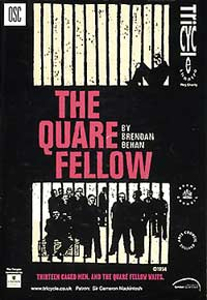
The Quare Fellow is initially offered to Dublin’s Abbey Theatre but is turned down. The play has its London première in May 1956 at Joan Littlewood‘s Theatre Workshop at the Theatre Royal Stratford East. On July 24, 1956, it transfers to the Comedy Theatre, London. In September 1956 the Abbey Theatre finally performs The Quare Fellow. It has such success that the Abbey’s artistic director, Ria Mooney, pushes the next play back to allow The Quare Fellow to run for six weeks. Its first New York performance is on November 27, 1958, at the Circle in the Square Theatre.
The play is set in Mountjoy Prison, Dublin. The antihero of the play, the Quare Fellow, is never seen or heard but rather functions as the play’s central conceit. He is a man condemned to die on the following day, for an unmentioned crime. Whatever it is, it revolts his fellow inmates far less than that of the Other Fellow, a very camp, almost Wildean, gay man.
There are three generations of prisoners in Mountjoy including boisterous youngsters who can irritate both other inmates and the audience and the weary old lags Neighbour and “methylated martyr” Dunlavin.
The first act is played out in the cramped area outside five cells and is comedic, sometimes rather like an Irish episode of Porridge. After the interval, the pace slows considerably and the play becomes much darker, as the time for the execution approaches. The focus moves to the exercise yard and to the workers who are digging the grave for the soon-to-be-executed Quare Fellow.
The play is a grimly realistic portrait of prison life in Ireland in the 1950s, and a reminder of the days in which homosexuality was illegal and the death penalty relatively common. The play is based on Behan’s own prison experiences, and highlights the perceived barbarity of capital punishment, then in use in Ireland. The play also attacks the false piety in attitudes to sex, politics and religion.
“The Auld Triangle“, a song from the opening of the play, has become an Irish music standard and is known by many who are unaware of its link to The Quare Fellow.
In 1962 the play is adapted for the screen by Arthur Dreifuss and stars Patrick McGoohan, Sylvia Syms and Walter Macken. Although the film receives some favourable reviews, it is not regarded as a faithful adaptation of the play.



 seamus dubhghaill