Since 1995, Mitchell has been active in the Northern Ireland peace process, having served as the United States Special Envoy for Northern Ireland under President Bill Clinton. He first leads a commission that establishes the principles on non-violence to which all parties in Northern Ireland have to adhere and subsequently chairs the all-party peace negotiations, which lead to the Belfast Peace Agreement signed on Good Friday 1998, known since as the “Good Friday Agreement.” Mitchell’s personal intervention with the parties is crucial to the success of the talks. He is succeeded as special envoy by Richard Haass.
For his involvement in the Northern Ireland peace negotiations, Mitchell is awarded the Presidential Medal of Freedom on March 17, 1999, and the Philadelphia Liberty Medal on July 4, 1998. In accepting the Liberty Medal, he states, “I believe there’s no such thing as a conflict that can’t be ended. They’re created and sustained by human beings. They can be ended by human beings. No matter how ancient the conflict, no matter how hateful, no matter how hurtful, peace can prevail.”
After finishing his education, Childers works for a period in a tourism board in Paris. In 1931, Éamon de Valera invites him to work for his recently founded newspaper, The Irish Press, where Childers becomes advertising manager. He becomes a naturalised Irish citizen in 1938. That same year, he is first elected as a Fianna Fáil Teachta Dála (TD) for Athlone–Longford. He remains in the Dáil Éireann until 1973, when he resigns to become President.
Childers joins the cabinet in 1951 as Minister for Posts and Telegraphs in the de Valera government. He then serves as Minister for Lands in de Valera’s 1957–59 cabinet, as Minister for Transport and Power under Seán Lemass, and, successively, as Transport Minister, Posts and Telegraphs Minister, and Health Minister under Jack Lynch. He becomes Tánaiste in 1969.
Fine Gael TD Tom O’Higgins, who had almost won the 1966 presidential election, is widely expected to win the 1973 election when he is again the Fine Gael nominee. Childers is nominated by Fianna Fáil at the behest of de Valera, who pressures Jack Lynch in the selection of the presidential candidate. He is a controversial nominee, owing not only to his British birth and upbringing but to his Protestantism. However, on the campaign trail his personal popularity proves enormous, and in a political upset, Childers is elected the fourth President of Ireland on May 30, 1973, defeating O’Higgins by 635,867 votes to 578,771.
Childers quickly gains a reputation as a vibrant, extremely hard-working president, and becomes highly popular and respected. However, he has a strained relationship with the incumbent government, led by TaoiseachLiam Cosgrave of Fine Gael. Childers had campaigned on a platform of making the presidency more open and hands-on, which Cosgrave views as a threat to his own agenda as head of government. Childers considers resigning from the presidency but is convinced to remain by Cosgrave’s Minister for Foreign Affairs and Trade, Garret FitzGerald.
Francis Danby, Irish painter of the Romantic era, is born near Killinick, County Wexford, on November 16, 1793. His imaginative, dramatic landscapes are comparable to those of John Martin. Danby initially develops his imaginative style while he is the central figure in a group of artists who have come to be known as the Bristol School. His period of greatest success is in London in the 1820s.
The death of Danby’s father in 1807 causes the family to move to Dublin. He begins to practice drawing at the Royal Dublin Society‘s schools and, under an erratic young artist named James Arthur O’Connor, he begins painting landscapes. Danby also makes acquaintance with George Petrie.
In 1813 Danby leaves for London together with O’Connor and Petrie. This expedition, undertaken with very inadequate funds, quickly comes to an end, and they have to get home again by walking. At Bristol they make a pause and Danby, finding he can get trifling sums for watercolor drawings, remains there working diligently and sending pictures of importance to the London exhibitions. There his large oil paintings quickly attract attention.
Around 1819, Danby becomes a member of the informal group of artists which become known as the Bristol School, taking part in their evening sketching meetings and sketching excursions visiting local scenery. He remains connected with members of the Bristol School for about a decade, even after leaving Bristol in 1824.
The group initially forms around Edward Bird, and Danby eventually succeeds Bird as its central figure. The Bristol artists, particularly the amateur Francis Gold, are also important in influencing Danby towards a more imaginative and poetical style. George Cumberland, another of the amateurs, has influential London connections. In 1820 when Danby exhibits The Upas Tree of Java at the British Institution, Cumberland uses his influence to promote its favourable reception. Danby’s atmospheric work An Enchanted Island, successfully exhibited in 1825 at the British Institution and then back in Bristol at the Bristol Institution, is in turn particularly influential on other Bristol School artists.
The Upas Tree of Java (1820) and The Delivery of Israel (1825) bring him his election as an Associate Member of the Royal Academy of Arts. He leaves Bristol for London, and in 1828 exhibits his Opening of the Sixth Seal at the British Institution, receiving from that body a prize of 200 guineas.
In 1829 Danby’s wife deserts him, running off with the painter Paul Falconer Poole. Danby leaves London, declaring that he will never live there again. For a decade he lives on the Lake Geneva in Switzerland, becoming a Bohemian with boat-building fancies, painting only occassionaly. He later moves to Paris for a short period of time. He returns to England in 1840.
Francis Danby lives his final years at Exmouth in Devon, where he dies on February 9, 1861. Along with John Martin and J. M. W. Turner, Danby is considered among the leading British artists of the Romantic period.
When Clifford is three years old, his family moves to Limerick. He attends CBS Sexton Street secondary school, where he participates in the school hurling team.
Clifford, at the age of fifteen, makes his senior début for Young Munster at fullback in a friendly match against Constitution. He makes his Munster Senior Cup début in 1943 as a wing forward. During his time at the club, Young Munster wins the Munster Senior League on two occasions, 1944 and 1952 and twice reaches the final of the Munster Senior Cup in 1947 and 1948, but loses both times.
Clifford makes his début for Ireland against France at Landsdowne Road on January 29, 1949 in Ireland’s first game of the 1949 Five Nations Championship. He plays in all four of Ireland’s matches in the 1949 tournament which ends with Ireland being crowned the champions and winning the Triple Crown. He also plays in all of Ireland’s games during the 1950 Five Nations Championship.
Clifford is named in the squad for the 1950 British Lions tour to New Zealand and Australia, the first post-war tour by a British Isles combined team and the first where the team is officially called British Lions. The touring party travels by boat, departing in April and not returning until October. Out of the 29 games played during the tour, Clifford is featured in twenty of them, including all five test matches – three against New Zealand and two against Australia. On his return to Limerick, a crowd of around 8,000 people turn out at Limerick railway station to greet him.
The 1951 Five Nations Championship is again won by Ireland, with Clifford playing in the games against France and England. Clifford’s only appearance at home outside of the Five Nations Championship comes in December 1951, as South Africa plays Ireland as part of their European tour. His final international appearances come during the 1952 Five Nations Championship, with his last game being against Wales on March 8.
Clifford retires from playing rugby in 1957. He dies in Phippsboro on October 1, 1990, at the age of 66. Young Munster’s home group, Tom Clifford Park, is named after him.
Martin Fay, Irish fiddler and bones player, and a former member of The Chieftains, dies on November 14, 2012. The Chieftains collaborate with musicians from a wide range of genres and cultures and bring in guest performers such as Mick Jagger, Van Morrison and James Galway. Yet traditional tunes lay at the heart of the band, with Fay’s fiddle a vital part of their distinctive sound.
Fay is born in Cabra, Dublin, where his mother teaches him to play the piano. As a boy, he is captivated by the music in the film The Magic Bow (1946), about the life of Niccolò Paganini, and he changes instrument. He progresses well in his classical violin lessons and at fifteen is playing in a Butlins holiday camp orchestra. After leaving school at eighteen, Fay works in an office by day and in the evenings plays in the Abbey Theatre orchestra, where he meets the Abbey’s musical director, Seán Ó Riada.
In the 1950s, traditional music is regarded as distinctly old-fashioned in Ireland, but Ó Riada’s success with a film score, and a play at the Abbey, encourage him to establish a folk orchestra which includes Fay, piperPaddy Moloney and the tin whistle player Seán Potts. Instead of all the musicians playing together in unison, as in the established cèilidh bands, Ó Riada wants to create a chamber orchestra, playing arrangements of folk music. Fay’s classical music background is essential for this approach. The resulting ensemble, Ceoltóirí Cualann, enjoys radio success and, in 1961, plays the soundtrack for a film of The Playboy of the Western World. Fay was soon earning more playing traditional music than in his day job.
Garech Browne, a member of the Guinness family and founder of Claddagh Records, asks Moloney to record some traditional Irish music. Moloney brings in Fay, Potts and Michael Tubridy on flute, and uses a similar approach to arranging the tunes. Their eponymous album, The Chieftains, is released in 1964, before they first perform in public. The success of this new approach to traditional Irish music leads to radio and television work, and they attract celebrity fans. Browne is a great thrower of parties, where the guests included Jagger, Princess Grace of Monaco, Peter O’Toole and Sean Connery, with The Chieftains invariably playing through the night.
By 1968, Moloney is working full time for Claddagh Records, and when he, Potts and Fay are offered a recording contract by a rival company, Gael Linn, Moloney refuses to sign. Potts and Fay believe that their future lay with Gael Linn, and they leave The Chieftains, only to return a year later. In the meantime, Seán Keane has joined to play fiddle, but on Fay’s return the pair work well together.
The Chieftains’ popularity is extending far beyond folk enthusiasts, but they are still playing only in their spare time. That changes in 1975 when they provide music for the Oscar-winning score of Stanley Kubrick‘s film Barry Lyndon and the promoter Jo Lustig books the group into the Royal Albert Hall in London on St. Patrick’s Day. The sell-out concert is a triumph, and Fay and his fellow Chieftains finally give up their day jobs.
The relentless international touring takes its toll on band members with young families, and Tubridy and Potts leave, to be replaced by the flautist Matt Molloy. Fay is happy to continue. A reserved and modest man with a great sense of humour, he is unfazed by the pressures of extensive touring. He is the only Chieftain not to be racked by nerves when playing to well over a million people at Phoenix Park during Pope John Paul II‘s visit to Dublin in 1979.
Although he has a classical training, Fay has a natural understanding of traditional music. He is a master of changing the mood at Chieftains concerts from the lively onstage parties to a more tranquil atmosphere, through his emotional interpretations of the slow airs. In total, Fay records more than 30 albums with the group before he withdraws from touring in 2001 and retires altogether in 2002.
Martin Fay dies in Cabra, Dublin, on November 14, 2012, after a lengthy illness.
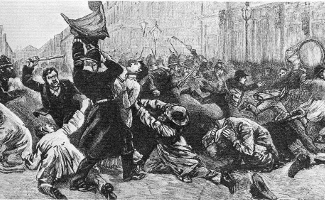
Bloody Sunday takes place in London on November 13, 1887, when a march against unemployment and coercion in Ireland, as well as demanding the release of Member of Parliament (MP) William O’Brien, is attacked by the Metropolitan Police Service and the British Army. The demonstration is organised by the Social Democratic Federation (SDF) and the Irish National League. Violent clashes take place between the police and demonstrators, many “armed with iron bars, knives, pokers and gas pipes.” A contemporary report notes that 400 are arrested and 75 persons are badly injured, including many police, two policemen being stabbed, and one protester bayonetted.
The Long Depression, starting in 1873 and lasting almost to the end of the century, creates difficult social conditions in Britain, similar to the economic problems that drive rural agitation in Ireland. Falling food prices create rural unemployment, which results in both emigration and internal migration. Workers move to the towns and cities in thousands, eroding employment, wages and working conditions. By November 1887, unemployed workers’ demonstrations from the East End of London have been building up for more than two years. There have already been clashes with the police and with the members of upper-class clubs. Trafalgar Square is seen symbolically as the point at which the working-class East End meets the upper-class West End of London, a focus of class conflict and an obvious flashpoint.
This attracts the attention of the small but growing socialist movement – the Marxists of both the Social Democratic Federation and Socialist League, and the reformist socialists of the Fabian Society. Police and government attempt to suppress or divert the demonstrations also bring in the radical wing of the Liberal Party and free speech activists from the National Secular Society.
Some 30,000 persons encircle Trafalgar Square as at least 10,000 protesters march in from several different directions, led by Elizabeth Reynolds, John Burns, William Morris, Annie Besant and Robert Bontine Cunninghame Graham, who are primarily leaders of the Social Democratic Federation. Also marching are the Fabian playwright George Bernard Shaw and Charlotte Wilson. Two thousand police and 400 troops are deployed to halt the demonstration. Burns and Cunninghame Graham are arrested and imprisoned for six weeks. Annie Besant, who is a Marxist, Fabian and secularist, speaks at the rally and offers herself for arrest, but the police decline to do so. Of the 400 arrested, 50 are detained in custody.
In the fighting, many rioters are injured by police truncheons and under the hooves of police horses. There are both infantry and cavalry present. Although the infantry is marched into position with bayonets fixed, they are not ordered to open fire and the cavalry are not ordered to draw their swords.
The following Sunday, November 20, sees another demonstration and more casualties. According to a report in the partisan Socialist Review, among them is a young clerk named Alfred Linnell, who is run down by a police horse, dying in hospital a fortnight later from complications of a shattered thigh.
The funeral of Linnell on December 18 provides another focus for the unemployed and Irish movements. William Morris, leader of the Socialist League, gives the main speech and advocates a holy war to prevent London from being turned into a huge prison. A smaller but similar event marks the burial of another of those killed, W. B. Curner, which takes place in January. The release of those imprisoned is celebrated on February 20, 1888, with a large public meeting. Henry Hyndman, leader of the SDF, violently denounces the Liberal Party and the Radicals who are present.
(Pictured: Bloody Sunday, 1887. This engraving from The Illustrated London News depicts a policeman being clubbed by a demonstrator as he wrests a banner from a female protester.)
Ellis Island, the gateway to America, shuts it doors on November 12, 1954, after processing more than 12 million immigrants, including an estimated two million Irish, since opening in 1892. Today, an estimated 40 percent of all Americans can trace their roots through Ellis Island, located in New York Harbor off the New Jersey coast and named for merchant Samuel Ellis, who owned the land in the 1770s.
On January 2, 1892, 15-year-old Annie Moore, from County Cork, becomes the first person to pass through the newly opened Ellis Island, which President Benjamin Harrison designates as America’s first federal immigration center in 1890. Prior to the opening of Ellis Island the processing of immigrants has been handled by individual states.
Not all immigrants who sail into New York have to go through Ellis Island. First- and second-class passengers submit to a brief shipboard inspection and then disembarked at the piers in New York or New Jersey, where they pass through customs. People in third class, though, are transported to Ellis Island, where they undergo medical and legal inspections to ensure they do not have a contagious disease or some condition that might make them a burden to the government. Only two percent of all immigrants are denied entrance into the United States.
Immigration to Ellis Island peaks between 1892 and 1924, during which time the 3.3-acre island is enlarged with landfill and additional buildings are constructed to handle the massive influx of immigrants. During the busiest year of operation, 1907, over 1 million people are processed at Ellis Island.
With the United States’ entrance into World War I, immigration declines and Ellis Island is used as a detention center for suspected enemies. Following the war, Congress passes quota laws and the Immigration Act of 1924, which sharply reduces the number of newcomers allowed into the country and also enables immigrants to be processed at U.S. consulates abroad. After 1924, Ellis Island switches from a processing center to serving other purposes, such as a detention and deportation center for illegal immigrants, a hospital for wounded soldiers during World War II and a Coast Guard training center. In November 1954, the last detainee, a Norwegianmerchant seaman, is released and Ellis Island officially closes.
Beginning in 1984, Ellis Island undergoes a $160 million renovation, the largest historic restoration project in U.S. history. In September 1990, the Ellis Island Immigration Museum opens to the public and today is visited by almost 2 million people every year.
Shaw’s influence on Western theatre, culture and politics extends from the 1880s to his death and beyond. He writes more than sixty plays, including major works such as Man and Superman (1902), Pygmalion (1912) and Saint Joan (1923). With a range incorporating both contemporary satire and historical allegory, Shaw becomes the leading dramatist of his generation, culminating in 1925 with his awarding of the Nobel Prize in Literature.
Shaw moves to London in 1876, where he struggles to establish himself as a writer and novelist and embarks on a rigorous process of self-education. By the mid-1880s he has become a respected theatre and music critic. Following a political awakening, he joins the gradualistFabian Society and becomes its most prominent pamphleteer. He has been writing plays for years before his first public success, Arms and the Man, in 1894. Influenced by Henrik Ibsen, he seeks to introduce a new realism into English-language drama, using his plays as vehicles to disseminate his political, social and religious ideas. By the early twentieth century his reputation as a dramatist is secured with a series of critical and popular successes that included Major Barbara, The Doctor’s Dilemma and Caesar and Cleopatra.
Shaw’s expressed views are often contentious. He promotes eugenics and alphabet reform and opposes vaccination and organised religion. He courts unpopularity by denouncing both sides in World War I as equally culpable, and although not a republican, castigates British policy on Ireland in the postwar period. These stances have no lasting effect on his standing or productivity as a dramatist. The inter-war years see a series of often ambitious plays, which achieve varying degrees of popular success. In 1938 he provides the screenplay for a filmed version of Pygmalion for which he receives an Academy Award.
Shaw’s appetite for politics and controversy remains undiminished. By the late 1920s he has largely renounced Fabian gradualism and often writes and speaks favourably of dictatorships of the right and left. He expresses admiration for both Benito Mussolini and Joseph Stalin. In the final decade of his life, he makes fewer public statements, but continues to write prolifically until shortly before his death on November 2, 1950, refusing all state honours including the Order of Merit in 1946.
Since Shaw’s death scholarly and critical opinion has varied about his works, but he has regularly been rated as second only to William Shakespeare among British dramatists. Analysts recognise his extensive influence on generations of English-language playwrights. The word “Shavian” has entered the language as encapsulating Shaw’s ideas and his means of expressing them.
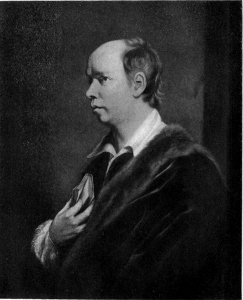
The location of Goldsmith’s birth is uncertain. He is born either in the townland of Pallas, near Ballymahon, County Longford, where his father is the Anglicancurate of the parish of Forgney, or at the residence of his maternal grandparents, at the Smith Hill house near Elphin, County Roscommon. When Goldsmith is two years old, his father is appointed the rector of the parish of Kilkenny West in County Westmeath. The family moves to the parsonage at Lissoy, between Athlone and Ballymahon, and continues to live there until his father’s death in 1747.
In 1744 Goldsmith enters Trinity College, Dublin. Neglecting his studies in theology and law, he falls to the bottom of his class. In 1747, along with four other undergraduates, he is expelled for a riot in which they attempt to storm the Marshalsea Prison. He graduates in 1749 as a Bachelor of Arts, but without the discipline or distinction necessary to gain entry into a profession in the church or the law. He lives for a short time with his mother, tries various professions without success, studies medicine desultorily at the University of Edinburgh from 1752 to 1755, and sets out on a walking tour of Flanders, France, Switzerland and Northern Italy, living by his wits.
Goldsmith settles in London in 1756, where he briefly holds various jobs, including an apothecary‘s assistant and an usher of a school. Perennially in debt and addicted to gambling, Goldsmith produces a massive output as a hack writer on Grub Street for the publishers of London, but his few painstaking works earn him the company of Samuel Johnson, with whom he is a founding member of “The Club.” There, through fellow Club member Edmund Burke, he makes the acquaintance of Sir George Savile, who later arranges a job for him at Thornhill Grammar School. During this period, he uses the pseudonym “James Willington” to publish his 1758 translation of the autobiography of the Huguenot Jean Marteilhe.
In character Goldsmith has a lively sense of fun, is totally guileless, and never happier than when in the light-hearted company of children. The money that he sporadically earns is often frittered away or happily given away to the next good cause that presents itself so that any financial security tends to be fleeting and short-lived. His talents are unreservedly recognised by Samuel Johnson whose patronage aids his eventual recognition in the literary world and the world of drama.
Goldsmith is described by contemporaries as prone to envy, a congenial but impetuous and disorganised personality who once planned to emigrate to America but failed because he missed his ship. At some point around this time he works at Thornhill Grammar School, later basing the character Squire Thornhill in The Vicar of Wakefield on his benefactor Sir George Savile and certainly spending time with eminent scientist Rev. John Mitchell, whom he probably knows from London. Mitchell sorely misses good company, which Goldsmith naturally provides in spades.
Oliver Goldsmith’s premature death in 1774 may have been partly due to his own misdiagnosis of his kidney infection. He is buried in Temple Church in London. There is a monument to him in the centre of Ballymahon, also in Westminster Abbey with an epitaph written by Samuel Johnson.
In 1910, at the age of 17, he starts an apprenticeship in O’Neill’s hardware trade in Mitchelstown, where he joins the Gaelic League and the Ancient Order of Hibernians. Later he works at Barry’s Timber Merchants in Fermoy. In the aftermath of the 1916 Easter Rising, he witnesses the shooting and arrest of David, Thomas and Richard Kent of Bawnard House by the Royal Irish Constabulary. After this, he determines to dedicate his life to Irish republicanism. In 1917 he is elected First Lieutenant of the Irish Volunteer Company, which resides in Fermoy.
In Cork in 1919, Lynch re-organises the Irish Volunteers, the paramilitary organisation that becomes the Irish Republican Army (IRA), becoming commandant of the Cork No. 2 Brigade of the IRA during the guerrilla Irish War of Independence. He is captured, along with the other officers of the Cork No. 2 Brigade, in a British raid on Cork City Hall in August 1920. He provides a false name and is released three days later. In September 1920, he and Ernie O’Malley command a force that takes the British Army barracks at Mallow. The arms in the barracks are seized and the building is partially burned. In April 1921, the IRA is re-organised into divisions based on regions. Lynch’s reputation is such that he is made commander of the 1st Southern Division.
The war formally ends with the signing of the Anglo-Irish Treaty between the Irish negotiating team and the British government in December 1921. Lynch is opposed to the Treaty, on the ground that it disestablishes the Irish Republic proclaimed in 1916 in favour of Dominion status for Ireland within the British Empire. He becomes Chief of Staff of the IRA in March 1922, much of which is also against the Treaty.
Although Lynch opposes the seizure of the Four Courts in Dublin by a group of hardline republicans, he joins its garrison in June 1922 when it is attacked by the newly formed National Army. This marks the beginning of the Irish Civil War. The ‘Munster Republic’ falls in August 1922, when Free State troops land by sea in Cork and Kerry. The Anti-Treaty forces then disperse and pursue guerrilla tactics.
Lynch contributes to the growing bitterness of the war by issuing what are known as the “orders of frightfulness” against the Provisional government on November 30, 1922. This General Order sanctions the killing of Free State Teachta Dála (TDs) and Senators, as well as certain judges and newspaper editors in reprisal for the Free State’s killing of captured republicans. Lynch is heavily criticised by some republicans for his failure to co-ordinate their war effort and for letting the conflict peter out into inconclusive guerrilla warfare. Lynch makes unsuccessful efforts to import mountain artillery from Germany to turn the tide of the war.
In March 1923, the Anti-Treaty IRA Army Executive meets in a remote location in the Nire Valley. Several members of the executive propose ending the civil war. However, Lynch opposes them and narrowly carries a vote to continue the war.
On April 10, 1923, a National Army unit is seen approaching Lynch’s secret headquarters in the Knockmealdown Mountains. Lynch is carrying important papers that could not fall into enemy hands, so he and his six comrades begin a strategic retreat. To their surprise, they run into another unit of 50 soldiers approaching from the opposite side. Lynch is hit by rifle fire from the road at the foot of the hill. Knowing the value of the papers they carry, he orders his men to leave him behind.
When the soldiers finally reach Lynch, they initially believe him to be Éamon de Valera, but he informs them, “I am Liam Lynch, Chief-of-Staff of the Irish Republican Army. Get me a priest and doctor, I’m dying.” He is carried on an improvised stretcher manufactured from guns to “Nugents” pub in Newcastle, at the foot of the mountains. He is later brought to the hospital in Clonmel and dies that evening. He is laid to rest two days later at Kilcrumper Cemetery, near Fermoy, County Cork.

 Former United States Senator George J. Mitchell submits his final report into the Good Friday Agreement in Belfast on November 18, 1999. He urges the Irish Republican Army (IRA) to appoint its representative to discuss disarmament on the same day the new power-sharing government is set up.





 seamus dubhghaill