Sullivan, the second of six sons of Daniel Sullivan, house painter, and his wife, Catherine (née Baylor), a teacher, is born on May 15, 1829, in Bantry, County Cork. A popular date for Sullivan’s birth appears in many histories as 1830, but his gravestone reads 1829. He is educated in the local national school. One of his brothers is Timothy Daniel Sullivan, the Lord Mayor of Dublin from 1886 to 1888.
During the Great Famine of 1845 to 1847, Sullivan is employed as a clerk in connection with the relief works started by the government. Deeply influenced by the distress he witnesses, he afterward joins the Confederate Club formed in Bantry in support of the revolutionary movement of the Young Irelanders and is the organiser of the enthusiastic reception given by the town to William Smith O’Brien in July 1848 during the insurgent leader’s tour of the southern counties. Early in 1853, he goes to Dublin to seek employment as an artist. An exhibition of the arts and industries of Ireland is held in Dublin that year, and he is engaged to supply pencil sketches to the Dublin Expositor, a journal issued in connection with the exhibition. Subsequently, he obtains a post as a draughtsman in the Irish valuation office, and afterward as a reporter on the Liverpool Daily Post.
In 1855, Sullivan becomes assistant editor of The Nation, and subsequently editor and proprietor. From 1861 to 1884, in conjunction with his elder brother, T. D. Sullivan, he makes The Nation one of the most potent factors in the Irish Nationalist cause and also issues the Weekly News and Zozimus. Called to the Irish bar in 1876, he is a “special call” of the Inner Temple in 1877 and is made QC in 1881. He mainly practices at the English bar, though he acts in some political cases in Ireland.
As a member of the Dublin Corporation, Sullivan secures a magnificent site for the Grattan Monument, toward which he donates £400, the amount of a subscription by his admirers while he is undergoing imprisonment for a political offence in 1868. The monument is formally unveiled in January 1876. Between 1878 and 1882 he is engaged in many notable trials. His last great case is on November 30, 1883, when he is a colleague of Lord Russell in the defence of Patrick O’Donnell for the murder of James Carey, an informer.
Sullivan suffers another heart attack while on holiday in Bantry in September 1884 and spends his last days with William Martin Murphy at Dartry, County Dublin. Murphy regards him as a father figure, attributing his success to Sullivan’s early advice and journalistic training. Sullivan dies on October 17, 1884, at Dartry Lodge, Rathmines, Dublin. He is buried at Glasnevin Cemetery. With his wife, Frances Genevieve Donovan, whom he marries on April 27, 1861, and who outlives him by nearly forty years, he has a family of three sons and five daughters. His second son and namesake, Alexander Martin Sullivan, is the last to hold the rank of Serjeant-at-law (Ireland).
In addition to his labours, Sullivan is a great temperance reformer. He also writes two notable books, The Story of Ireland and New Ireland and contributes many sketches (including some verse) to Irish Penny Readings (1879–85). Some of his correspondence is located in the Isaac Butt papers in the National Library of Ireland.
Gray is the third son of John and Elizabeth Gray of Mount Street. He is educated at Trinity College Dublin and obtains the degree of M.D. and Master of Surgery at the University of Glasgow in 1839. Shortly before his marriage in the same year, he settles in Dublin and takes up a post at a hospital in North Cumberland Street. He is admitted as a licentiate of the Royal College of Physicians in due course.
Gray is publicly minded and contributes to periodicals and the newspaper press. In 1841, he becomes joint proprietor of the Freeman’s Journal, a nationalist paper which is then published daily and weekly. He acts as political editor of the Journal for a time, before becoming sole proprietor in 1850. As owner, he increases the newspaper’s size, reduces its price and extends its circulation.
Gray enters politics at a relatively young age and attaches himself to Daniel O’Connell‘s Repeal Association. As a Protestant Nationalist, he supports the movement for the repeal of the Acts of Union with Britain. In October 1843, he is indicted with O’Connell and others in the Court of the Queen’s Bench in Dublin on a charge of sedition and “conspiracy against the queen.” The following February, he, together with O’Connell, is condemned to nine months imprisonment, but in early September 1844 the sentence is remitted on appeal. The trial has a strong element of farce, as the hot-tempered Attorney-General for Ireland, Sir Thomas Cusack-Smith, challenges Gray’s counsel, Gerald Fitzgibbon, to a duel, for which he is sternly reprimanded by the judges. From then on Gray is careful to distance himself from the advocacy of violence in the national cause, though he is sympathetic to the Young Ireland movement without being involved in its 1848 rebellion. Through the growing influence of the Freeman’s Journal, he becomes a significant figure in Dublin municipal politics. He is also active in national politics during an otherwise quiet period of Irish politics up until 1860. With the resurgence of nationalism after the famine, he helps to organise the Tenant’s League founding conference in 1850, standing unsuccessfully as the League’s candidate for Monaghan in the 1852 United Kingdom general election.
Later Gray originates and organises the “courts of arbitration” which O’Connell endeavours to substitute for the existing legal tribunals of the country. Following O’Connell’s death, in 1862 he inaugurates an appeal for subscriptions to build a monument to O’Connell on Sackville Street (now O’Connell Street). Independent from O’Connell, he continues to take a prominent part in Irish politics and in local affairs.
In municipal politics, Gray is elected councillor in 1852 and alderman of Dublin Corporation and takes an interest in the improvement of the city. As chairman of the committee for a new water supply to Dublin, he actively promotes what becomes the “Vartry scheme.” The Vartry Reservoir scheme involves the partial redirection and damming of the River Vartry in County Wicklow, and the building of a series of water piping and filtering systems (and related public works) to carry fresh water to the city. This work is particularly important in the improvement of conditions in the city, and to public health, as it improves sanitation and helps reduce outbreaks of cholera, typhus and other diseases associated with contaminated water. On the opening of the works on June 30, 1863, he is knighted by the Earl of Carlisle, then Lord Lieutenant of Ireland. Partially in recognition of these efforts, he is later be nominated for the position of Lord Mayor of Dublin for the years 1868–69, but he declines to serve.
In national politics, the Liberal government at the time is keen to conciliate an influential representative of the moderate nationalists to support British Liberalism and who will resume O’Connell’s constitutional agitation. In an unusual alliance with the CatholicArchbishop of Dublin, Paul Cullen, a man devoted to O’Connell’s memory, Gray’s newspaper exploits this shift in government policy. It supports the archbishop’s creation, the National Association of Ireland, established in 1864 with the intention of providing a moderate alternative to the revolutionary nationalism of the Fenians. The Freeman’s Journal adopts the aims of the Association as its own: it advocates the disestablishment of the AnglicanChurch of Ireland, reform of the land laws, educational aspirations of Irish Catholicism and free denominal education.
In the 1865 United Kingdom general election Gray is elected MP for Kilkenny City as a Liberal candidate. In this capacity he campaigns successfully at Westminster and in Ireland for the reforms also advocated in his paper. His newspaper’s inquiry into the anomalous wealth of the established church amidst a predominately Catholic population contributes considerably to William Ewert Gladstone‘s Irish Church Act 1869. He helps to furnish the proof that Irish demands are not to be satisfied by anything other than by radical legislation. He fights for the provision in the new Landlord & Tenant (Ireland) Act 1870 for fixity of tenure, which Gladstone eventually concedes. The Act’s other weaknesses, however, result in its failure to resolve the “land question,” the accompanying coercion, the disappointment with Gladstone’s handling of the university question and national education, causing Gray to deflect from the Liberals and become mistrusted in Britain. In the 1874 United Kingdom general election he is re-elected as a Home Rule League MP for Kilkenny, joining its Home Rule majority in the House of Commons, and holds his seat until his death the following year.
Gray dies at Bath, Somerset, England, on April 9, 1875. His remains are returned to Ireland, and he is honoured with a public funeral at Glasnevin Cemetery. Almost immediately afterwards public subscriptions are sought for the erection in O’Connell Street, of a monument to Gray. The monument is completed in 1879 and is dedicated to the “appreciation of his many services to his country, and of the splendid supply of pure water which he secured for Dublin.” His legacy also includes his contributions to the passage of the Irish Church and Land Bills, his advocacy for tenant’s rights and his support of the Home Rule movement.
(Pictured: Statue to Sir John Gray on Dublin’s O’Connell Street, designed by Thomas Farrell and unveiled on June 24, 1879. Photo credit: Graham Hickey)
O’Donnell is born in an army barracks in Devon, England, where his father, Sergeant Bernard MacDonald, is stationed. His mother, Mary Kain, is a native of Ballybane, close to Galway city. He is educated at the Erasmus Smith School in Galway, Coláiste Iognáid (the “Jes”), and later enrolls in Queen’s College Galway, where he studies English literature, history and political economy. While a student at the college, he acquires a considerable reputation as an orator, and is a frequent contributor to meetings of the college’s Literary and Debating Society, of which he becomes vice-auditor for the 1864–65 session.
Even in his student days, O’Donnell seems to be quick to voice his opinions, and revells in controversy. In November 1866, addressing the Literary and Debating Society on the question “Was the character of Warren Hastings as Governor-General of India praiseworthy?” he causes uproar by denouncing “the principle and the system which have lain at the root of the international and intercolonial policy of England, from the days when Elizabeth, the Infamous, chartered for profit two of the first ships which opened the African slave trade.” His remarks cause the chairman of the meeting, Professor Thomas Moffett, to prevent him from continuing his speech, stating that “such an epithet ought not to be applied to any predecessor of our present gracious Queen.” O’Donnell regards such action as an unwarranted restriction on his freedom of speech, and in a letter published in the local press gives an early example of his high-flown literary style:
“I hold that Debating Societies are the nurseries of independent thought, and the training schools of sober criticism. I believe in the power and impartiality of an enlightened studenthood … I have followed the mind of Austin. I have sat at the feet of Cairnes. I have drunk of the philosophy of Mill. I claim for Judicial Science, for Economic Science, for the Philosophy of History, a place in the discussions of our society, I pity, and I scorn the formidable confederacy of fools who dare not call a spade a spade.”
This incident, combined with the reluctance of the society to prevent O’Donnell from addressing its meetings, eventually leads to the suspension of the society from the Queen’s College and its temporary migration to rooms in the city of Galway.
O’Donnell graduates from the Queen’s College with an M.A. degree in 1868, winning several gold medals for his academic performance. By this stage, he has begun to style himself ‘Frank Hugh O’Donnell,’ believing himself to be a descendant of Hugh O’Donnell, 2nd Earl of Tyrconnell.
Leaving Galway, O’Donnell moves to London, where he embarks on a career in journalism, following his college contemporary T. P. O’Connor. O’Connor’s knowledge of modern European languages has helped him to establish himself as a correspondent on European affairs, and he assists O’Donnell in developing a similar reputation. He spends a brief period on the staff of The Morning Post.
In the 1874 United Kingdom general election, O’Donnell is elected Member of Parliament (MP) for Galway Borough but is unseated by the courts in what appears to be a politically inspired judgment which uses certain unsavoury campaigning tactics in which O’Donnell had indulged as its basis. He is succeeded in the seat by his election agent, Dr. Michael Francis Ward, who is himself succeeded in 1880 by T. P. O’Connor in an unusual succession, all three having been either auditor or vice-auditor of the Queen’s College Literary and Debating Society in the same era.
In 1875, O’Donnell is a founding member of the Constitutional Society of India, a group promoting political autonomy for India. In 1877, he secures a more permanent election to the House of Commons of the United Kingdom as MP for Dungarvan. He holds the seat until 1885, when the constituency is abolished. He strikes a colourful and controversial figure in parliament and becomes renowned for his declamatory speech-making. He is a prominent obstructionist and claims credit for inventing the tactic of obstructionism which is to yield such results for the Home Rule League under Charles Stewart Parnell. Indeed, he sees himself as a natural leader and becomes disillusioned when Parnell is selected in May 1880 to succeed William Shaw as leader of the Irish Parliamentary Party. He calls the British ‘Imperial pirates’ and inaugurates the Constitutional Society of India. Its aim is Home Rule for India, “Mr. O’Donnell’s grand passion in politics was a confederation of all the discontented races of the Empire under the lead of the Irish party. He once brought down some scores of dusky students of all the races and creeds of Hindustan to the House of Commons.”
Parnell refuses to let O’Donnell be nominated in 1885. He leaves the Irish Parliamentary Party and conventional politics, but not its general aims of promoting home rule and tenant farmers’ rights. His last and perhaps most important contribution to the fortunes of the party is the libel case he launches against The Times in 1888 over the series “Parnellism and Crime.” Though the case is lost, it results in the establishment of the Parnell Commission which exonerates Parnell from condoning the Phoenix Park Murders and exposes the Pigott Forgeries.
In his later years O’Donnell begins investigating misconduct by both the British Civil Service and the Roman Catholic church in Ireland. His Paraguay on Shannon (1908) is an amusing but serious critique of unethical practices by the Catholic clergy in local politics, education, and their involvement in the Congested Districts Board for Ireland that is financed by Parliament in order to improve the depressed economy of western Ireland. Parliament believes that by improving the living standards of the Irish peasant class, they can “kill Home Rule with kindness.”
After careful investigation, O’Donnell accuses members of the Catholic clergy of illegally diverting Government money earmarked for economic development into new Cathedrals, parish churches, and other ecclesiastical building projects. He argues that the British Government needs to provide better oversight of how the Congested Districts Board’s funds are being used. He believes that “in Ireland material ruin has accompanied clerical despotism.” His hostility to the Church draws the ire of Catholic historians who systematically undermine his credibility.
Ernest Belfort Bax writes that O’Donnell’s “matter is better than his manner.”
O’Donnell dies a bachelor in London on November 2, 1916, and is buried in Glasnevin Cemetery, Dublin.
Martin first meets John Mitchel while attending Dr. Henderson’s private school in Newry. He receives an Arts degree at Trinity College Dublin in 1832 and proceeds to study medicine but has to abandon this in 1835 when his uncle dies, and he has to return to manage the family landholding.
In 1847 Martin is moved by the Great Famine to join Mitchel in the Repeal Association but subsequently leaves it with Mitchel. He contributes to Mitchel’s journal, United Irishman, and then following Mitchel’s arrest on May 27, 1848, he continues with his own anti-British journal, The Irish Felon, and establishes “The Felon Club.” This leads to a warrant for his arrest, and he turns himself in on July 8, 1848. He is sentenced on August 18, 1848, to ten years transportation to Van Diemen’s Land.
Martin arrives on the Elphinstone with Kevin Izod O’Doherty in Hobart, Tasmania, in November 1849. He accepts a “ticket of leave” which allows him to live in relative freedom at Bothwell, provided he promises not to escape.
While in Tasmania, Martin continues to meet in secret with his fellow exiles Kevin Izod O’Doherty, Thomas Francis Meagher, William Smith O’Brien, and John Mitchel. He and Mitchel live together before the arrival of Mitchel’s wife, Jenny. He chooses not to join Mitchel when Mitchel revokes his ticket of leave and escapes. Instead, he remains in Tasmania until he is granted a “conditional pardon” in 1854. This allows him to leave for Paris, and he returns to Ireland on being granted a full pardon in 1856.
On return to Ireland Martin becomes a national organiser for the Tenant Right League. He begins to write for The Nation in 1860. He forms the National League with others in January 1864 – it is mainly an educational organisation but Fenians disrupt its meetings. He remains in contact with Mitchel in Paris through 1866. He opposes the Fenians’ support of armed violence, yet, together with Alexander Martin Sullivan in December 1867, he heads the symbolic funeral march honouring the Manchester Martyrs as it follows the MacManus route to Glasnevin Cemetery, Dublin. He is briefly arrested for these activities, but the charges are dropped.
Martin is in the United States in December 1869 when he is nominated by Isaac Butt and his nationalists as the Irish nationalist Home Rule candidate to oppose Reginald Greville-Nugent, who is supported by the Catholic clergy, in the Longfordby-election. Greville-Nugent initially wins the vote, but the result is nullified by Judge Fitzgerald on the grounds that voters had been illegally influenced in the non-secret voting process. In the May 1870 re-run, Butt’s second candidate, Edward Robert King-Harman, like Martin a Protestant landlord, is also defeated, but this time legally.
Contradictions and factionalism are symptomatic of the struggle for influence and leadership at the time between the waning Church of Ireland and the rising Irish Catholic Church. Hence a secular Protestant land-owning, non-violent elite reformist nationalist who desires Home Rule like Martin, can find himself both sympathetic to and at odds with a militant organisation like the Fenians with their Jacobin– and American-influenced ideas of revolutionary republicanism and different social roots. Until Charles Stewart Parnell, the Isaac Butt-originated Home Rule forces could not obtain the support of the Catholic Church under the anti-Fenian CardinalPaul Cullen or manage to achieve more than short-term tactical alliances with Fenians, leading to a split and uncoordinated opposition to British rule. Protestants such as Martin and John Mitchel, with their early political roots in Young Ireland, are, whatever their political ideals, not part of the majority Catholic mainstream, which consists largely of tenants rather than landlords.
In the January 1871 by-election, Martin is elected by a margin of 2–1 to the seat of Meath in the British parliament as the first Home Rule MP, representing first Isaac Butt’s Home Government Association and from November 1873 the Home Rule League. This is unusual for a Protestant in a Catholic constituency, and is a measure of the popular esteem Martin is held in. He retains his seat in the 1874 United Kingdom general election as one of 60 Home Rule members. He is commonly known as “Honest John Martin.” In parliament he speaks strongly for Home Rule for Ireland and opposes Coercion Bills.
Martin dies in Newry, County Down, on March 29, 1875, homeless and in relative poverty, having forgiven tenant fees during preceding years of inflation and low farm prices. His parliamentary seat of County Meath is taken up by Charles Stewart Parnell.
Martin marries Henrietta Mitchel, the youngest sister of John Mitchel, on November 25, 1868, after twenty years of courtship. She shares her husband’s politics, and after his death campaigns for home rule believing this to be a continuation of the Young Ireland mandate. After the split in the party, she sides with Charles Stewart Parnell. She dies at her home in Dublin on July 11, 1913, and is buried in Newry.
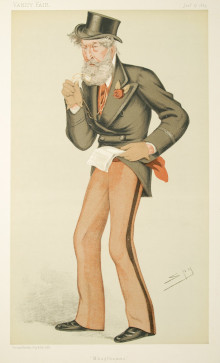
Mahon, the eldest of four children, is the son of Patrick Mahon of New Park, who took part in the Irish Rebellion of 1798, and Barbara, a considerable heiress and the only daughter of James O’Gorman of Ennis. He studies at Clongowes Wood College, where he is one of the earliest pupils, and at Trinity College Dublin, where he takes his BA in 1822 and his MA in law in 1832. Following his father’s death in 1821, he inherits half the family property and becomes a magistrate for Clare.
In 1830, Mahon marries Christina, the daughter of John O’Brien of Dublin. She is an heiress and has property valued at £60,000 in her own right, which gives him the resources to seek election to parliament. The couple spends little time together, and she dies apart from him in Paris in 1877. They have one son who dies in 1883.
As a result, when Mahon is elected for Clare at the 1830 United Kingdom general election, he is entitled to take his seat. However, during the election campaign he quarrels with O’Connell, and after his election he is unseated for bribery. He is subsequently acquitted and stands again at the 1831 United Kingdom general election, but is defeated by two O’Connell-backed candidates, one of whom is his old schoolfriend Maurice O’Connell, Daniel O’Connell’s son. He gives up on politics, becomes deputy lieutenant of Clare, and captain of the local militia.
Following his defeat in the 1852 election, Mahon returns to Paris, then travels on to Saint Petersburg, where he serves in the Imperial Bodyguard. During this period, he journeys through lands from Finland to Siberia. He then travels across China, India and Arabia. His finances largely exhausted, he serves as a mercenary in the Ottoman and Austrian armies before returning to England in 1858. Late that year, he leaves for South America, where he attempts to finance the construction of a canal through Central America.
Mahon is a close associate of Charles Stewart Parnell, who he successfully nominates for the leadership of the League in 1880 but is dropped in 1885 as a party candidate because of his age and his tendency to vote with the Liberal Party in Parliament. He is also embroiled in a court case disputing the will of his son.
Mahon had served alongside William O’Shea as an MP, and the two were close friends. He introduced him and Katharine O’Shea, his wife, to Parnell. After Parnell is named in the O’Sheas’ divorce case in 1890, Mahon splits with Parnell, siding with the Irish National Federation. However, Parnell attends Mahon’s funeral in Glasnevin Cemetery a few months later.
(Pictured: Caricature of James Patrick Mahon by Sir Leslie Matthew Ward under the pseudonym “Spy” published in Vanity Fair in 1885)
A supporter of Benjamin Disraeli‘s one-nation conservatism, Guinness’s politics are typical of “constructive unionism,” the belief that the union between Ireland and Britain should be more beneficial to the people of Ireland after centuries of difficulties. In 1872 he is a sponsor of the “Irish Exhibition” at Earlsfort Terrace in Dublin, which is arranged to promote Irish trade. Correcting a mistake about the exhibition in the Freeman’s Journal leads to a death threat from a religious extremist, which he does not report to the police. In the 1890s he supports the Irish Unionist Alliance.
After withdrawing from the Guinness company in 1876, when he sells his half-share to his brother Edward for £600,000, Guinness is in 1880 raised to the peerage as Baron Ardilaun, of Ashford in County Galway. His home there is at Ashford Castle on Lough Corrib, and his title derives from the GaelicArd Oileáin, a ‘high island’ on the lake.
Between 1852 and 1859, Guinness’s father acquires several large Connacht estates that are up for sale. With these purchases, he becomes landlord to 670 tenants. With his father’s death in 1868, Guinness continues in his father’s footsteps, purchasing vast swaths of Galway. When his acquisitions are combined with those of his father, total acreage for the Ashford estate is 33,298 acres, with Guinness owning most of County Galway between Maam (Maum) Bridge and Lough Mask.
Like many in the Guinness family, Guinness is a generous philanthropist, devoting himself to a number of public causes, including the restoration of Marsh’s Library in Dublin and the extension of the city’s Coombe Lying-in Hospital. In buying and keeping intact the estate around Muckross House in 1899, he assists the movement to preserve the lake and mountain landscape around Killarney, now a major tourist destination.
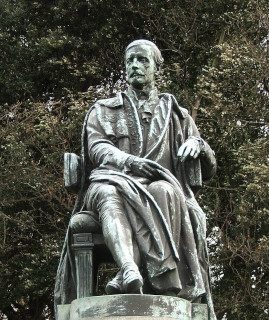
In his best-known achievement, Guinness purchases, landscapes, and donates to the capital, the central public park of St. Stephen’s Green, where his statue commissioned by the city can be seen opposite the Royal College of Surgeons in Ireland. To do so he sponsors a private bill that is passed as the Saint Stephen’s Green (Dublin) Act 1877, and after the landscaping it is formally opened to the public on July 27, 1880. It has been maintained since then by the Commissioners of Public Works in Ireland, now the Office of Public Works.
Guinness dies on January 20, 1915 at his home at St. Anne’s, Raheny, and is buried at All Saints Church, Raheny, whose construction he had sponsored. Those present at the funeral include representatives of the Royal Dublin Society, of which he is president for many years, the Royal Horticultural Society of Ireland, the Irish Unionist Alliance, and the Primrose League. His barony becomes extinct at his death, but the baronetcy devolves upon his nephew Algernon.



 seamus dubhghaill