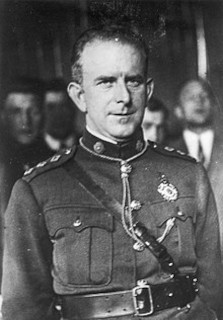
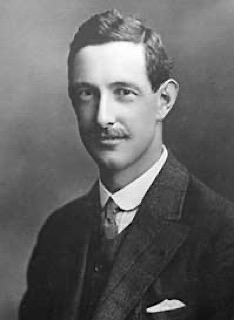
seamus dubhghaill

Promoting Irish Culture and History from Little Rock, Arkansas, USA


Leave a comment

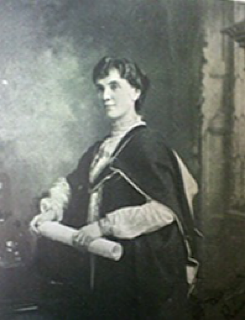
Birth of Helena Concannon, Historian, Writer & Politician

Helena Concannon (née Walsh), Irish historian, writer, language scholar and Fianna Fáil politician, is born in MagheraCounty Londonderry, on October 28, 1878.

Concannon is educated by the Loreto nuns in Coleraine, County Londonderry. In 1897, she studies modern languages at the Royal University of Ireland on a three-year scholarship. She studies abroad during these years as in 1899, she travels to Germany and studies German in Berlin University accompanied by her friend, Mary Macken. She then travels to France to study French at Sorbonne University. In 1900, she graduates Bachelor of Arts with first class honours and goes on to study Master of Arts in 1902 at the Royal University of Ireland. She is fortunate to being one of the first generation of educated women.

In 1906, Concannon marries Tomás Bán Ó Conceanainn, who she met in 1900 when he arrived home from the United States. They settle down in County Galway where they share the same love for the Irish language and write many Irish texts. They have no children. In Galway, she is a professor at University College Galway where she teaches history, which mainly involves the history of Irish women. In 1909, she is offered a lectureship at University College Dublin, in Italian, but the offer is then withdrawn before she can accept it, so she decides to pursue a writing career.

Concannon produces over twenty books, including works on religion, the history of Ireland and Irish women’s history. Her works are highly impacted by her political and nationalist views. Her analyses of Irish history is based on Catholicism and patriotism. She is also an advocate of Irish language restoration. Her first writings are love poems to her husband. These poems are ”simple, sensuous and passionate.”

Concannon also produces a number of imaginative historical text for children. She uses her married name for her publications and her first book, entitled A Garden of girls, or the famous schoolgirls of former days, is published in 1914. It is about “school life and education of real little girls” Her next well known piece is the Life of St. Columban in 1915, which is a study about the Irish ancient monastic life and a biography of a sixth-century saint.

Two of Concannon’s books, Daughters of Banba (1922) and St. Patrick (1932), receive the Tailteann Medal for Literature, and The Poor Clares in Ireland (1929) wins the National University Prize, a D.Litt. higher doctorate degree for historical research.

Concannon’s most common publication, Women of ‘Ninety Eight, is dedicated to all the dead women and all the living ones who have given their loved ones. This book emerges on the ideologies of Catholicism and patriotism “praising the devotion of Irish nationalist women while emphasising the centrality of women’s spiritual and domestic role in the home to the well-being of the nation.” As this work is written during the time of the Irish War of Independence, she stresses the importance of women help during the rebellion as “they acted as messengers and intelligence officers,” and in some cases, they fought as any men.

Concannon was elected to the 8th Dáil for Fianna Fáil at the 1933 Irish general election for the National University of Ireland constituency, serving from February 8, 1933 until June 14, 1937.

Concerning the Land Purchase (Guarantee Fund) Bill 1935, which according to George Cecil Bennett will negatively impact the rural middle class of which he is a representative, Bennett accuses Concannon and her fellow Dublin men of not caring about the people of the country. Concannon goes on to vote that the Dáil should disagree with the Seanad Éireann-proposed bill with 71 others.

Though Concannon is a TD as a university representative, she votes with her party to remove university representation from the Dáil, leading one TD to say, “I am very much surprised to see such a distinguished scholar and such a great contributor to Irish literature as Deputy Mrs. Concannon voting for the disfranchisement of the University that she has so well and so ably represented.”

Concannon speaks on behalf of Irish women in the Dáil in 1936. She speaks on how Irish women play a fundamental role in Ireland’s agricultural economy and therefore more money should be put toward educating these women.

Concannon is one of the minority voices against the role appointed to women in Éamon de Valera‘s constitution. She does not contest the Dáil election of 1937.

After the adoption of the Constitution of Ireland in 1937, the National University of Ireland constituency is reconstituted in the new Seanad Éireann. The first election takes place in 1938, and Concannon is elected. She is a popular figure and is re-elected each election in the Seanad until she dies in office on February 27, 1952.
Leave a comment

The Copley Street Riot

The Copley Street riot occurs on August 13, 1934, at the Copley Street Repository, Cork, County Cork, after Blueshirts opposed to the collection of annuities from auctioned cattle ram a truck through the gate of an ongoing cattle auction. The Broy Harriers open fire and one man, 22 year old Michael Lynch, is killed and several others injured.

Following the Irish War of Independence (1919–21), Britain relinquishes its control over much of Ireland. However, aspects of the Anglo-Irish Treaty, which had marked the end of the war, lead to the Irish Civil War (1922–23). The aftermath leaves Ireland with damaged infrastructure and hinders its early development.

Éamon de Valera, who had voted against the Anglo-Irish treaty and headed the Anti-Treaty movement during the civil war, comes to power following the 1932 Irish general election and is re-elected in 1933. While the treaty stipulates that the Irish Free State should pay £3.1 million in land annuities to Great Britain, and despite advice that an economic war with Britain could have catastrophic consequences for Ireland (as 96% of exports are to Britain), de Valera’s new Irish government refuses to pay these annuities – though they continue to collect and retain them in the Irish exchequer.

This refusal leads to the Anglo-Irish trade war (also known as the “Economic War”), which persists until 1935, when a new treaty, the Anglo-Irish Trade Agreement, is negotiated in 1938. During this period, a 20% duty is imposed on animals and agricultural goods, resulting in significant losses for Ireland. Specifically, poultry trade declines by 80%, butter trade by 50% and cattle prices drop by 50%. Some farmers are forced to kill and bury animals because they cannot afford to maintain them.

In 1933, Fine Gael emerges as a political party—a merger of Cumann na nGaedheal and the National Centre Party. Fine Gael garners substantial support from rural farmers who are particularly affected by the Economic War. They strongly object to the collection of land annuities by the Fianna Fáil government. The Blueshirts, a paramilitary organisation founded as the Army Comrades Association in 1932 and led by former Garda Commissioner Eoin O’Duffy, transforms into an agrarian protest organisation, mobilising against seizures, cattle auctions, and those tasked with collecting annuities.

O’Duffy, a key figure in Irish politics, encourages farmers to withhold payment of land annuities to the government. Arising from this stance, Gardaí start to seize animals and farm equipment, auctioning them to recover the outstanding funds. While seized cattle are auctioned, local farmers rarely participate. Instead, Northern Ireland dealers, often associated with the name O’Neill, are the primary buyers. These auctions are protected by the Broy Harriers, an armed auxiliary group linked to the police.

By 1934, tensions escalate, and a series of anti-establishment incidents are attributed to the Blueshirts. These incidents range from minor acts of violence, such as breaking windows, to more serious offenses like assault and shootings.

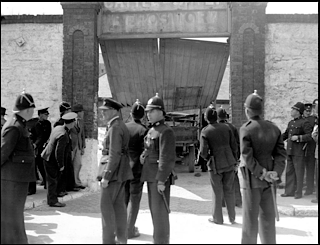
On August 13, 1934, an auction takes place at Marsh’s Yard on Copley Street in Cork, featuring cattle seized from farms in Bishopstown and Ballincollig. The police establish a cordon by 10:00 a.m., with 300 officers on duty. Lorries arrived at 11:00 a.m.

Around noon, three thousand protestors assemble. Within twenty-five minutes, an attempt is made to breach the yard gate by ramming it with a truck. According to Oireachtas records, there are approximately 20 men in the truck which they run against the gate. The Minister for Justice P. J. Ruttledge, says that the truck “with those people in it charged through those cordons of Guards; that several Guards jumped on to the lorry and tried to divert the driver by catching hold of the steering wheel and trying to twist it.” Some contemporary news sources suggest that the ramming truck knocked down the surrounding police cordon “like ninepins and crush[ed] a police inspector against a gate.” Later sources suggest that the senior officer (a superintendent) was injured in a fall, while attempting to avoid being struck, rather than being hit directly by the truck.

A man named Michael Lynch, wearing the distinctive blue shirt, and approximately 20 others reportedly manage to enter the yard. As soon as they enter the yard they are fired upon by armed “special branch” police detectives who are in the yard. Lynch later succumbs to his injuries at the South Infirmary. Thirty-six others are wounded. Despite the violence, the auction proceeds after a one-hour delay.

Following the shooting, a riot ensues, but when news of Lynch’s death reaches the participants, they cease rioting, kneel, and recited a Rosary.

The funeral of Michael Lynch occurs on August 15, 1934. The funeral procession is planned to depart from Saints Peter and Paul’s Church, Cork at 2:30 PM.

The occasion allows for a significant show of force for Eoin O’Duffy and the Blueshirts, and features Roman salutes and military drills. Farmers in Munster reportedly stop work for an hour, and Blueshirt members ask shopkeepers to close their businesses, as a show of respect for the “martyr.” Lynch is afforded a “full Blueshirt burial,” and the coffin is adorned with the flag of the Blueshirts (the Army Comrades Association).

According to the  Minister for Justice, at the funeral W. T. Cosgrave stands beside O’Duffy as the Blueshirt leader gives an oration saying, “We are going to carry on until our mission is accomplished […] those 20 brave men, whose deed will live for ever, not only in Cork but in every county in Ireland, broke through in the lorry […] all Blueshirts should try to emulate his bravery and nobleness. Every Blueshirt is prepared to go the way of Michael for his principles.”

The court grants the family £300 in 1935. This is appealed to the High Court, followed by the Supreme Court, which dismisses the case. In the Supreme Court, Henry Hanna describes the Broy Harriers as “an excrescence” upon the Garda Síochána.

When the matter is discussed in the Seanad in September 1934, and before a vote is taken to “[condemn] the action of the members of the special branch of the Gárda Síochána […] on Monday, the 13th August 1934,” the senators who support Éamon de Valera’s government walk out.

In August 1940, a memorial is unveiled on the tomb of Lynch in Dunbulloge Cemetery in Carrignavar, County Cork, consisting of a limestone Celtic cross and pedestal. The pedestal is engraved with a quote from the American orator, William Jennings Bryan: “The humblest citizen of all the land, when clad in the armour of a righteous cause is stronger than all the hosts of error.”

(Pictured: Aftermath of the ramming of Marsh’s Yard, Copley Street, that leads to the death of Michael Lynch and the Copley Street Riot on August 13, 1934)


Leave a comment

Birth of Pierce McCan

Pierce McCan, Sinn Féin politician, is born at Prospect Lodge, Ballyanne Desmesne, County Wexford, on August 2, 1882. 

McCan is the son of Francis McCan, a land agent, and Jane Power. He is the nephew of Patrick Joseph Power, MP for East Waterford from 1885 to 1913. He attends Clongowes Wood College and Downside School. He resides at Ballyowen House, Dualla, Cashel, County Tipperary, and is an “extensive farmer” and is a member of the Tipperary Hunt.

McCan is a founder member of Sinn Féin in 1905. He joins the Gaelic League in 1909 and is a member of the Irish Volunteers from 1914 onward.

After more than 2,000 German and Austrian prisoners are imprisoned at Richmond BarracksTemplemore, County Tipperary, following the first battles of World War I in 1914, he plots to engineer a mass escape but is thwarted when the prisoners are removed to Leigh, Lancashire in 1915. He is interned in 1916 after the Easter Rising for several months in Richmond Barracks, Dublin, and KnutsfordEngland. In May 1918, he is arrested under the German Plot and detained in Gloucester Gaol.

McCan is president of the East Tipperary executive of Sinn Féin. While incarcerated, he is elected as a Sinn Féin MP for the East Tipperary constituency at the 1918 United Kingdom general election in Ireland.

In January 1919, Sinn Féin MPs refuse to recognise the Parliament of the United Kingdom and instead assembles in the Mansion House, Dublin as a revolutionary parliament called Dáil Éireann. McCan never sits in Dáil Éireann, dying in prison on March 6, 1919, during the Spanish flu pandemic. On March 9, 1919, he is buried in Dualla, Cashel, County Tipperary.

No by-election is called to replace him in the UK constituency. After April 1, 1922, the Irish Free State (Agreement) Act 1922 prohibits any by-election, and the constituency is abolished when parliament is dissolved on October 26, 1922, for the general election on November 15.

The First Dáil also considers how to fill the vacancy. A select committee in April recommends that the local Sinn Féin organisation which nominated him should nominate his replacement. A June proposal to postpone action, either for six months or until a Westminster by-election is held, is referred to another committee, which recommends that “in view of the circumstances which occasioned the vacancy, it was due to the memory of the late Pierce McCann that his place should not be filled at present.”

On April 10, 1919, Cathal Brugha tells the First Dáil: “Before I formally move the motion, as I have mentioned the name of Pierce McCan, I would ask the Members of the Dáil to stand up as a mark of our respect to the first man of our body to die for Ireland, and of our sympathy with his relatives. We are sure that their sorrow is lightened by the fact that his death was for the cause for which he would have lived, and that his memory will ever be cherished in the hearts of the comrades who knew him, and will be honoured by succeeding generations of his countrymen with that of the other martyrs of our holy cause.” The McCan Barracks in Templemore, County Tipperary, is named after him.

In the 1933 Irish general election, McCan’s brother, Joseph, a member of the National Farmers’ and Ratepayers’ Association, stands unsuccessfully for the National Centre Party in the Tipperary constituency.


Leave a comment

Birth of Tom Hales, IRA Volunteer & Fianna Fáil Politician

Thomas Hales, Irish Republican Army (IRA) volunteer and Fianna Fáil politician, is born in Knocknacurra House, Ballinadee, near Bandon, County Cork, on March 5, 1892.

Hales is born on a family farm owned by his father, Robert Hales, an activist in the Irish Land War and a reputed member of the Irish Republican Brotherhood (IRB) and his wife, Margaret (née Fitzgerald). He is the sixth of nine children (five sons and four daughters). He is educated at Ballinadee national school and Warner’s Lane school, Bandon. After leaving school he works at Harte’s timber yard, Bandon.

Hales joins and is involved with the Irish Volunteers movement from its inception in November 1913. Elected a delegate at the Volunteer national convention in the Abbey Theatre in 1915, he is among the majority who vote for the election of the national executive.

Hales is a part of a group of volunteers who are mobilised and plan to rise up in Cork during the 1916 Easter Rising. He sends a number of dispatches to Cork requesting further instructions. However, they receive last minute orders to stand down and there is no uprising in Cork to match that in Dublin. The Volunteers give up their arms and are later arrested.

By May 1916, Hales and his brothers, Seán, Bob, and William, are fighting with the IRA in west Cork during the Irish War of Independence. Terence MacSwiney is arrested in Hales’ home on May 3, 1916, and Hales himself escapes and goes on the run. He states that he was listed as “wanted” in the Hue and Cry police gazette.

In 1918, Hales takes part in a raid on a British gunboat and holds 25 armed Royal Irish Constabulary (RIC) members prisoner at Snugmore Castle. He takes part in a decoy in assisting his elder brother, Seán, to escape after his arrest in connection with the German Plot. He is elected Battalion Commandant of the 1st (Bandon) Battalion (1917–19), and Brigade Commandant of Cork 3rd Brigade, IRA, in January 1919.

In December 1919, Hales takes part in an ambush against the RIC at Kilbrittain and Bandon and is involved in the manufacture of gunpowder for IRA munitions. By this point he is the commander of the Third Cork Brigade of the IRA. In July 1920, he along with Harte is arrested by soldiers from the Essex Regiment.

The pair are taken to a nearby military barracks, where they are severely beaten while being interrogated by officers of the regiment. Hales has his fingernails pulled out, an event that later inspires a scene in the film The Wind That Shakes the Barley. However, neither Hales nor Harte give up any information and are eventually sent to a military hospital to recuperate. Hales is tried and is eventually sentenced to two years’ penal servitude, which he serves in Pentonville and Dartmoor prisons in England. He is commander of the Irish prisoners at Pentonville, but is released following a general amnesty after the Anglo-Irish Treaty in December 1921. According to Tom Barry, Harte suffers brain damage and goes insane before dying in Broadmoor Hospital.

A fifth Hales brother, Donal, settles in Genoa from 1913, and is appointed Irish Consular and Commercial Agent for Italy in February 1919. In this capacity he plays a leading propaganda role. Several letters from Michael Collins to Donal Hales still exist which are used by Hales to promote international awareness of the Irish conflict in Italian publications. Donal oversees a failed attempt to import a substantial number of Austrian weapons and ammunition captured from World War I, from Genoa in the spring of 1921, through the person of Gabriele D’Annunzio.

During the Irish Civil War, Tom and Seán Hales fight on opposite sides, with Hales fighting against the Anglo-Irish Treaty with the Anti-Treaty IRA while Seán joins the newly formed National Army of the Irish Free State. While the bothers end up on opposite sides of the war, they never openly criticise one another for their rival political stances.

Hales is elected to the anti-Treaty IRA executive in March 1922, but resigns in June over a proposal to prevent the Free State’s first general election in June 1922. He resumes his old rank during the Irish Civil War as commander of Cork 3 Brigade.

During the Irish Civil War in July 1922, Hales takes part in the raid and capture of Skibbereen Barracks and Ballineen by anti-Treaty forces. He is also involved in a skirmish with Free State troops at Newcestown. He is arrested in November 1922 and imprisoned first in Cork and then at the Curragh. He is released in December 1923, having taken part in a hunger strike for fourteen days. He mentions in his application for a military pension that he was a member of the Supreme Council of the IRB at this time.

In December 1922, Hales’s brother Seán is assassinated by the anti-Treaty IRA in Dublin, in reprisal for the Free State government’s execution of IRA prisoners. Hales later applies to the Irish government for a service pension under the Military Service Pensions Act, 1934 and is awarded nine years’ service in 1935 at Grade B for his service with the Irish Volunteers and the IRA between April 1, 1917, and September 30, 1923.

Hales is elected to Dáil Éireann as a Fianna Fáil Teachta Dála (TD) for the Cork West constituency at the 1933 Irish general election. He resigns from Fianna Fáil in June 1936 stating he cannot support their policy on interning IRA members. He fails to retain his seat as an independent candidate at the 1937 Irish general election. He also unsuccessfully contests the 1944 Irish general election as an independent candidate and the 1948 Irish general election as a candidate for Clann na Poblachta, receiving 2,287 votes (7.93%).

Hales makes his living as farmer. A member of the Mallow area board of the beet growers’ association from 1934 to 1942, he is also connected with other farming organisations. He marries Ann Lehane from Tirelton, Macroom, on April 30, 1927. They have five children, Seán, Robert, Thomas, Eileen, and Margaret.

Hales dies on April 29, 1966, at St. Finbarr’s Hospital, Cork, and is buried at St. Patrick’s Cemetery, Bandon.


Leave a comment

Birth of Margaret Mary Pearse, Politician & Teacher

Margaret Mary Pearse, Fianna Fáil politician and teacher, is born on August 24, 1878, at 27 Great Brunswick Street (now Pearse Street) in Dublin. She is a sister of Patrick Pearse, one of the leaders of the 1916 Easter Rising, and Willie Pearse, both of whom are executed for their part in the Rising.

Pearse is the eldest child of James Pearse and Margaret Pearse (née Brady), who serves as a Teachta Dála (TD) in the 1920s. She is educated at the Holy Faith Convent in Glasnevin. After leaving school, she trains as a teacher. She helps to found St. Enda’s School with her brothers Patrick and Willie. Following the executions of her brothers in the aftermath of the Easter Rising, she continues to run St. Enda’s, along with Fergus De Búrca, until 1933.

Following in her mother’s footsteps, Pearse is first elected to Dáil Éireann as a Fianna Fáil TD for the Dublin County constituency at the 1933 general election. She is defeated at the 1937 general election on the 7th count of votes but is elected to the Administrative Panel of the 2nd Seanad. She serves in the Seanad until her death in 1968, however, she and her mother are never considered to be more than figureheads for the party. She is a founding member of the teaching staff of Ardscoil Éanna in Crumlin, Dublin, upon its establishment in 1939.

Illness forces Pearse into the Linden Convalescent Home in Blackrock, County Dublin when she is in her 80s. In 1967, when she is 89 years old, her condition is described to be deteriorating. However, in 1968 during the months leading up to her 90th birthday, she leaves the Linden Convalescent Home for a short while in order to spend her birthday at St. Enda’s in Rathfarnham. The president of Ireland at the time, Éamon de Valera, visits her at St. Enda’s to congratulate her on her upcoming 90th birthday.

Margaret Pearse dies, unmarried, at the Linden Convalescent Home in Blackrock, County Dublin, on November 7, 1968, and is given a state funeral. President de Valera, the church and the state all pay tribute to her at the funeral. She is buried beside her parents and sister at Glasnevin Cemetery. The Taoiseach, Jack Lynch, says that Margaret Mary Pearse is the last remaining member of the noble Pearse family. He says her life, like her patriotic brothers, was dedicated to Ireland.

As per her mother’s wishes, Pearse bequeaths St. Enda’s to the people of Ireland as a memorial to her brother’s sacrifice. The school is now home to the Pearse Museum.


Leave a comment

Passage of the Constitution (Removal of Oath) Act 1933

The Constitution (Removal of Oath) Act 1933 (act no. 6 of 1933, previously bill no. 2 of 1932), an Act of the Oireachtas of the Irish Free State amending the Constitution of the Irish Free State and the Constitution of the Irish Free State (Saorstát Eireann) Act 1922, is passed on May 3, 1933. The Act removes the Oath of Allegiance required of members of the Oireachtas and of non-Oireachtas extern ministers.

The oath, pledging allegiance to the Constitution and fidelity to George V as King of Ireland, is required by the Anglo-Irish Treaty signed in 1921, and has been the symbolic focus of Irish republican opposition to the Treaty in the 1922–23 Irish Civil War. When Fianna Fáil is founded in 1926 by veterans of the losing anti-Treaty side in the Civil War, abolishing the oath is a core aim. It is a main item in the manifesto for its successful 1932 Irish general election campaign, after which it forms a minority government whose first action is to introduce the Constitution (Removal of Oath) Bill 1932. Seanad Éireann has more ex-unionists and others conciliatory towards the United Kingdom and vote to reject the bill unless the Treaty can be amended by agreement. After the 1933 Irish general election, the Fianna Fáil majority government is able to override the Seanad and enact the law.

As well as amending the Constitution, the 1933 act also amends the Constitution of the Irish Free State (Saorstát Eireann) Act 1922, which had both created the Constitution in Irish law and also prohibited any Constitutional amendment incompatible with the Treaty. Since the Free State cannot unilaterally amend the Treaty, Fianna Fáil amends the 1922 act to remove the Treaty’s precedence over the Constitution. Later constitutional amendments are also incompatible with the terms of the Treaty, in particular by weakening and ultimately abolishing the office of Governor-General of the Irish Free State. There is legal controversy over whether the Oireachtas has the power to amend the 1922 act, because it had been passed by the Third Dáil sitting as a constituent assembly before the Oireachtas had come into being. In 1935 the Judicial Committee of the Privy Council (JCPC) in London rules that, in British law, the Oireachtas does have the power, under the Statute of Westminster 1931. Irish jurisprudence takes issue with many of the assumptions underlying the 1935 decision.

The question is rendered moot with the adoption of the Constitution of Ireland in 1937 which repeals the Free State Constitution. The 1933 act is itself repealed as spent by the Statute Law Revision Act 2016.

(Pictured: Great Seal of the Irish Free State)


Leave a comment

Death of Eoin O’Duffy, Activist, Soldier & Police Commissioner

Eoin O’Duffy, Irish nationalist political activist, soldier and police commissioner, dies in Dublin on November 30, 1944.

O’Duffy is born near Castleblayney, County Monaghan on January 28, 1890. Trained initially as an engineer, he later becomes an auctioneer. He becomes interested in Irish politics and joins Sinn Féin, later becoming a member of the Irish Republican Army (IRA).

During the Irish War of Independence, O’Duffy commands the Monaghan Brigade and in February 1920 he successfully captures the Royal Irish Constabulary (RIC) barracks at Ballytrain taking from it weapons and explosives. Also present at this victory is Ernie O’ Malley, who goes on to organize flying columns, and the socialist guerrilla fighter Peadar O’Donnell.

In the 1921 Irish elections, O’Duffy becomes TD for Monaghan. By 1922, he has been promoted to Chief of Staff of the IRA and is one of Michael Collins foremost supporters when he accepts the Anglo-Irish Treaty and fights in the Irish Civil War as a general of the Free State Army.

As commander of the 2nd Northern Division of the IRA, O’Duffy sees action in Belfast when defending Catholic ghettoes from attacks by Protestant pogromists. He also leads the Free State forces into Limerick city.

In September 1922, following the mutiny in Kildare by Civic Guard recruits, O’Duffy replaces Michael Staines as commissioner. Under him the police force is renamed the Garda Síochána, disarmed and is later merged with the Criminal Investigation Department (CID) and the Dublin Metropolitan Police (DMP). His fervent Catholicism is greatly reflected in the ethos of the Garda Síochána.

In 1933, O’Duffy becomes associated with Cumann na nGaedheal by taking on the leadership of their security organization the Army Comrades Association, later to be known colloquially as the Blueshirts. This organization is to become a participant in many street brawls with anti-treaty sympathizers who try to break up pro-treaty political meetings. When the pro-treaty parties merge in 1933 to become Fine Gael, he is the party President for a short period of time.

It is believed that O’Duffy unsuccessfully encourages W. T. Cosgrave to consider a coup-de’etat in the event of Fianna Fáil winning the 1932 Irish general election. Cosgrave, in the event, puts his trust in a democracy when Fianna Fáil does, in fact, form a government, led by Éamon de Valera, with the help of the Labour Party.

After the 1933 Irish general election, which again sees de Valera in power, O’Duffy is dismissed from his post as Garda Commissioner on the grounds that due to his past political affiliations, he will be unable to carry out his duties without bias.

In Europe, the new phenomenon of fascism is gaining ground and O’Duffy, like many of his pro-treaty colleagues, is drawn to it. His Army Comrades Association is renamed the National Guard, and they begin to take on many of the symbols of fascism such as the outstretched arm salute and the blue uniforms.

When O’Duffy plans a massed march for August 1933 in Dublin to commemorate the deaths of Arthur Griffith and Michael Collins, de Valera, fearing a coup, has it banned. Possibly de Valera is also testing the loyalty of the army and the Garda Síochána. In September the National Guard itself is banned although it reforms under the title The League of Youth.

In 1934 O’Duffy suddenly and inexplicably resigns as president of Fine Gael although it is known that many of its members are growing worried by his actions and statements. The Blueshirt movement begins to unravel at the seams. That same year he forms his own fascist movement, the National Corporate Party.

In 1936, supported by the Catholic Church in Ireland, O’Duffy leads 700 of his followers to Spain to help General Francisco Franco in the Spanish Civil War against the republican government. They form part of the XV Bandera Irlandesa del Terico, a part of the Spanish Legion. The Bandera sees little or no action and are returned to Ireland in 1937.

Although O’Duffy has some low-level dalliance with the Nazis he never does regain any of his political influence. His health is on the decline, and he dies on November 30, 1944. De Valera grants him a state funeral and he is interred in Glasnevin Cemetery in Dublin.


Leave a comment

Birth of Michael Hayes, Politician & Professor

michael-hayes

Michael Joseph Hayes, Fine Gael politician and professor of Irish, is born in Dublin on December 1, 1889. He serves as Ceann Comhairle of Dáil Éireann from 1922 to 1932, Minister for Foreign Affairs from August 1922 to September 1922 and Minister for Education January 1922 to August 1922. He serves as a Teachta Dála (TD) for the National University of Ireland constituency from 1921 to 1933. He is a Senator from 1938 to 1965.

Hayes is educated at the Synge Street CBS and at University College Dublin (UCD). He later becomes a lecturer in French at the University. In 1913, he joins the Irish Volunteers and fights in Jacob’s biscuit factory during the Easter Rising in 1916. He escapes capture but is arrested in 1920 and interned at Ballykinlar, County Down.

Hayes is first elected to Dáil Éireann as a Sinn Féin TD for the National University of Ireland constituency at the 1921 Irish elections. At the 1922 general election he is elected as a Pro-Treaty Sinn Féin TD. He serves as Minister for Education from January to September 1922, as part of the Dail Aireacht ministry as opposed to the Provisional Government. He has special responsibility for secondary education. He is also acting Minister for Foreign Affairs from August to September 1922. He supports the Anglo-Irish Treaty during the crucial debates in 1922. That same year he is elected Ceann Comhairle of the First Dáil of the Irish Free State. He holds that post for ten years until 1932.

At the 1923 general election, Hayes is elected as a Cumann na nGaedheal TD for two constituencies, Dublin South and National University of Ireland. He resigns his seat in Dublin South following the election.

Hayes loses his Dáil seat at the 1933 general election but is elected to Seanad Éireann in 1938 for Fine Gael. He remains a Senator until 1965, acting as leader of government and opposition there.

Hayes becomes Professor of Irish at University College Dublin in 1951.

Michael Hayes dies at the age of 86 on July 11, 1976, in Dublin.


Leave a comment

Death of Margaret Mary Pearse

margaret-mary-pearse

Margaret Mary Pearse, Fianna Fáil politician and teacher, dies at Linden Convalescent Home in Dublin on November 7, 1968. She is a sister of Patrick Pearse, one of the leaders of the 1916 Easter Rising, and Willie Pearse, both of whom are executed for their part in the Rising.

Pearse is born on August 24, 1878, at 27 Great Brunswick Street (now Pearse Street) in Dublin, the eldest child of James Pearse and Margaret Pearse (née Brady), who serves as a Teachta Dála (TD) in the 1920s. She is educated at the Holy Faith Convent in Glasnevin. After leaving school, she trains as a teacher. She helps to found St. Enda’s School with her brothers Patrick and Willie. Following the executions of her brothers in the aftermath of the Easter Rising, she continues to run St. Enda’s, along with Fergus De Búrca, until 1933.

Following in her mother’s footsteps, Pearse is first elected to Dáil Éireann as a Fianna Fáil TD for the Dublin County constituency at the 1933 general election. She is defeated at the 1937 general election on the 7th count of votes but is elected to the Administrative Panel of the 2nd Seanad. She serves in the Seanad until her death in 1968, however, she and her mother are never considered to be more than figureheads for the party. She is a founding member of the teaching staff of Ardscoil Éanna in Crumlin, Dublin, upon its establishment in 1939.

Illness forces Pearse into the Linden Convalescent Home in Blackrock, County Dublin when she is in her 80s. In 1967, when she is 89 years old, her condition is described to be deteriorating. However, in 1968 during the months leading up to her 90th birthday, she leaves the Linden Convalescent Home for a short while in order to spend her birthday at St. Endas in Rathfarnham. The president of Ireland at the time, Éamon de Valera, visits her at St. Endas to congratulate her on her upcoming 90th birthday.

Margaret Pearse dies, unmarried, at the Linden Convalescent Home in Blackrock, County Dublin, on November 7, 1968, and is given a state funeral. President de Valera, the church and the state all pay tribute to her at the funeral. She is buried beside her parents and sister at Glasnevin Cemetery. The Taoiseach, Jack Lynch, says that Margaret Mary Pearse is the last remaining member of the noble Pearse family. He says her life, like her patriotic brothers, was dedicated to Ireland.

As per her mother’s wishes, Pearse bequeaths St. Enda’s to the people of Ireland as a memorial to her brother’s sacrifice. The school is now home to the Pearse Museum.