The attack seems to be part of a general “hit-up” by the Republicans in the city. Other military barracks around the city are also attacked in the same week.
The Barracks’ orderly clerk is attending the morning parade, where National Army soldiers, mostly unarmed, are listening to the orders of the day, read by the regimental sergeant major. When he hears machine gun fire, the clerk first believes it to be practice firing. Then he sees puffs of dust spring up from the ground as bullets land around him. He throws himself to the ground.
Another soldier tells The Irish Times, “The first outburst crashed in on us just like a flash of lightning and did most of the damage. All of us that could crawled around for cover, it was simply death to walk in the square at that time.”
The IRA has occupied the upper stories and roofs of the houses across the Grand Canal, at the rear of the barracks. From there, they rake the parade square with gunfire. The sound is deafening to the stricken soldiers. One says, “It seemed as if marbles were being rained down from an immense height.”
A total of eighteen soldiers are hit. One is killed instantly and fourteen wounded, seven of whom require surgery. As the firing starts, a butcher’s van owned by one R. McGurk of Harold’s Cross is making a delivery to the barracks. The storm of bullets peppers the unfortunate deliverymen, killing their horse and mortally wounding the driver. According to the soldier, “the whole thing lasted about 15 minutes, the rest of the soldiers came out then and started some Lewis guns going.”
One hundred soldiers had been lined up on the square shoulder to shoulder. The National Army believes the IRA used a Lewis machine gun and tells the press there were up to forty attackers armed with rifles and machine guns. But in fact, IRA reports show that their squad, a party from the Dublin Brigade active service unit (ASU), led by William Roe, has only eleven men, broken up into four parties, with only two of the parties firing ninety rounds with a Thompson submachine gun and fifteen with a “Peter the Painter” Mauser automatic.
The IRA volunteers make their escape across country, through the villages of Kimmage and Crumlin, pursued by Irish Free State troops. They are seen carrying two badly wounded men of their own. The Army later claims the two were killed in the firefight, but there is no indication that this is true.
(From: “Wellington Barracks, Dublin, 1922 – A Microcosm of the Irish Civil War” by John Dorney, The Irish Story, http://www.theirishstory.com, June 2010)
Twomey is born on November 5, 1919, on Marchioness Street in Belfast, and lives at 6 Sevastopol Street in the Falls district. Known as “Thumper” owing to his short temper and habit of banging his fist on tables, he receives little education and is a bookmaker‘s “runner.” His father is a volunteer in the 1920s. In Belfast he lives comfortably with his wife, Rosie, whom he marries in 1946. Together they have sons and daughters.
Twomey begins his involvement with the Irish Republican Army in the 1930s and is interned in Northern Ireland during the 1940s on the prison ship HMS Al Rawdah and later in Crumlin Road Gaol in Belfast. Rosie, his wife, is also held prisoner at the women prison, Armagh Jail, in Northern Ireland. He opposes the left-wing shift of Cathal Goulding in the 1960s, and in 1968, helps set up the breakaway Andersonstown Republican Club, later the Roddy McCorley Society.
In 1969, Twomey is prominent in the establishment of the Provisional Irish Republican Army. By 1972, he is Officer Commanding (OC) of the Provisional IRA Belfast Brigade when it launches its bomb campaign of the city, including Bloody Friday when nine people are killed. During the 1970s, the leadership of the Belfast Brigade of the IRA is largely in the hands of Twomey and Ivor Bell.
In March 1973, Twomey is first appointed IRA Chief of Staff after the arrest of Joe Cahill. He remains in this position until his arrest in October 1973 by the Garda Síochána. Three weeks later, on October 31, 1973, the IRA organises the helicopter escape of Twomey and his fellow IRA members J. B. O’Hagan and Kevin Mallon, when an active service unit hijacks and forces the pilot at gunpoint to land the helicopter in the training yard of Mountjoy Prison. After his escape, he returns to his membership of IRA Army Council.
By June/July 1974, Twomey is IRA Chief of Staff for a second time. He takes part in the Feakle talks between the IRA and Protestant clergymen in December 1974. In the IRA truce which follows in 1975, he is largely unsupportive and wants to fight on in what he sees as “one big push to finish it once and for all.”
IRA informer Sean O’Callaghan claims that on January 5, 1976, Twomey and Brian Keenan give the go-ahead for the sectarian Kingsmill massacre, when ten unarmed Ulster Protestant workmen are executed by the Provisional IRA in retaliation for a rash of loyalist killings of Catholics in the area. It is Keenan’s view, O’Callaghan claims, that “The only way to knock the nonsense out of the Prods is to be ten times more savage.”
Twomey is dedicated to paramilitarism as a means of incorporating Northern Ireland into the Republic of Ireland. In an interview with French television on July 11, 1977, he declares that although the IRA had waged a campaign for seven years at that point, it can fight on for another 70 against the British state in Northern Ireland and in England. He supports the bombing of wealthy civilian targets, which he justifies on class lines. On October 29, 1977, for example, a no-warning bomb at an Italian restaurant in Mayfair kills one diner and wounds 17 others. Three more people are killed in similar blasts in Chelsea and Mayfair the following month. He says, “By hitting Mayfair restaurants, we were hitting the type of person that could bring pressure to bear on the British government.”
In December 1977, Twomey is captured in Sandycove, Dublin, by the Garda Síochána, who had been tipped off by Belgian police about a concealed arms shipment, to be delivered to a bogus company with an address in the area. They swoop on a house in Martello Terrace to discover Twomey outside in his car, wearing his trademark dark glasses. After a high-speed pursuit, he is recaptured in the centre of Dublin. The Gardaí later find documents in his possession outlining proposals for the structural reorganisation of the IRA according to the cell system. His arrest ends his tenure as IRA chief of staff. In the 1986 split over abstentionism, Twomey sides with the Gerry Adams leadership and remains with the Provisionals.
After a long illness from a heart condition, Twomey dies in Dublin on September 12, 1989. He is buried in the family plot in Milltown Cemetery, Belfast. His funeral is attended by about 2,000 people.
In 1971, during the Troubles, after two years engaged in violence based on a defensive strategy in Irish communal districts of Northern Ireland, the Provisional IRA launches an offensive against the United Kingdom. At a meeting of the IRA Army Council in June 1972 the organization’s Chief of Staff, Seán Mac Stíofáin, first proposes making bombing attacks in England. The Army Council does not at first agree to the suggestion, but in early 1973 after its negotiations with the British Government for a truce the previous year had failed to advance the political objective of the removal of Northern Ireland from the United Kingdom by the application of the threat of violence, it re-engages its paramilitary campaign and sanctions Mac Stíofáin’s proposal. Mac Stíofáin had put the strategy forward on the basis that extending the urban paramilitary violence of the Northern Ireland state into England would help to relieve pressure being exerted by the British Army on the IRA’s strongholds of Irish communal support in districts in the province, such as west Belfast and Derry, by diverting British security strength from them back into England, while at the same time increasing strategic pressure upon the British Government to resolve the conflict by political concessions to the IRA’s demands. He also believes that a successful bombing campaign in London, as the capital city of the United Kingdom, will offer substantial propaganda value for paramilitary Irish Republicanism, and provide a morale boost to its supporters.
The effects of the previous 1973 Old Bailey bombing appear to give some credence to the idea of the propaganda value of extending violence into London as, although it is considered almost routine in Northern Ireland by the mid-1970s and draws only brief media notice, being carried out instead in London, a global capital city, makes the event world news headlines. However, although the bombing of the Old Bailey is successfully carried out, and gains media attention, increasing political pressure upon the British Government to address the issue of the conflict in Northern Ireland with more urgency, it is costly to the IRA, as 10 out of the 11-man active service unit that carry it out are arrested by the British police while trying to leave England before the bombs they had planted detonate. Drawing the tactical lesson that large teams are a security liability, for the second wave of bombings in England later in 1973, instead of sending a large team to carry it out with orders to withdraw back to Ireland immediately afterwards, smaller detached “cell” units of 3-4 personnel are sent to carry out the operation, with instructions to remain in England afterward and wage a campaign of bombings around England upon a variety of targets.
There are bombings on September 8, 1973, including one at London Victoria station which injures four civilians.
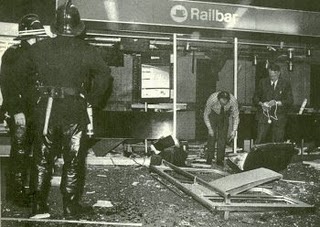
On September 10, 1973, a bomb (with no warning issued beforehand) explodes at King’s Cross railway station in the booking hall at 12:24 p.m. when a youth of around 16 to 17 years of age walks up to the entrance of the station’s old booking hall and throws a bag into it which contains a 3 lb. (1.4 kg) device, which detonates, shattering glass throughout the hall and throwing a baggage trolley several feet into the air. The youth then flees into the station’s crowd and escapes the scene.
Approximately 45 minutes after the attack at King’s Cross, after a telephone call warning to the Press Association five minutes beforehand by a man with an Irish accent, a second bomb detonates in a snack bar at Euston railway station, injuring another eight civilians. One witness at Euston says, “I saw a flash and suddenly people were being thrown through the air – it was a terrible mess, they were bleeding and screaming.” A total of 13 civilians are injured in the two attacks. The Metropolitan Police issue a photofit picture of a 5 ft. 2 in. (157 cm) tall youth they are seeking in regard to the King’s Cross attack.
On September 12, 1973, two more bombs explode, one in Oxford Street and another in Sloane Square, targeting retail shopping centres. Police subsequently announce that they are looking for five people in connection with this second wave of bomb attacks in England.
Judith Ward is later wrongly convicted of having been involved in the late 1973 London bombings, along with the M62 coach bombing. She is later acquitted. No one else is brought to trial for this IRA bombing campaign.
McCorley is one of three children born to Roger Edmund McCorley, a meat carver in a hotel, and Agnes Liggett. He has two elder brothers, Vincent and Felix. He joins the Fianna in his teens. His family has a very strong republican tradition, and he claims to be the great-grandson of the United Irishmen folk hero Roddy McCorley, who was executed for his part in the Irish Rebellion of 1798.
McCorley is noted for his militancy, as he is in favour of armed attacks on British forces in Belfast. The Brigade’s leaders, by contrast, in particular, Joe McKelvey, are wary of sanctioning attacks for fear of loyalist reprisals on republicans and the Catholic population in general. In addition, McCorley is in favour of conducting an armed defense of Catholic areas, whereas McKelvey does not want the IRA to get involved in what he considers to be sectarian violence. McCorley writes later that in the end, “the issue settled itself within a very short space of time, when the Orange mob was given uniforms, paid for by the British, and called the Ulster Special Constabulary (USC).” The role of the USC, a temporary police force raised for counter-insurgency purposes, in the conflict is still debated, but republicans maintain that the organization was responsible for the indiscriminate killings of Catholics and nationalists.
On January 26, 1921, McCorley, is involved in the fatal shooting of three Auxiliary Division officers in their beds in the Railway View hotel in central Belfast. Shortly afterwards, he and another IRA man, Seamus Woods, organize an active service unit (ASU) within the first battalion of the Belfast Brigade, with the intention of carrying out attacks, with or without the approval of the Brigade leadership. The unit consists of 32 men. McCorley later writes, “I issued a general order that, where reprisal gangs [State forces] were cornered, no prisoners were to be taken.” In March 1921, he personally leads the ASU in the killing of three Black and Tans in Victoria Street in central Belfast. He is responsible for the deaths of two more Auxiliaries in Donegall Place in April. In reprisal for these shootings, members of the RIC assassinate two republican activists, the Duffin brothers in Clonard Gardens in west Belfast. On June 10, 1921, both and Woods and McCorley units are involved in the killing a RIC man who is suspected in the revenge killings of the Duffin brothers. Two RIC men and a civilian are also wounded in that attack.
Thereafter, there is what historian Robert Lynch has described as a “savage underground war” between McCorley’s ASU and RIC personnel based in Springfield Road barracks and led by an Inspector Ferris. Ferris is accused of murdering the Lord Mayor of Cork Thomas MacCurtain and had been posted to Lisburn for his safety. Ferris himself is among the casualties, being shot in the chest and neck, but surviving. McCorley claims to have been one of the four IRA men who shot Ferris. In addition, his men bomb and burn a number of businesses including several cinemas and a Reform Club. In May 1921, however, thirteen of his best men are arrested when surrounded by British troops during an operation in County Cavan. They are held in Crumlin Road Gaol and sentenced to death.
On June 3, McCorley organizes an attack on Crumlin Road Gaol in an attempt to rescue the IRA men held there before they are executed. The operation is not a success; however, the condemned men are reprieved after a truce is agreed between the IRA and British forces in July 1921. On Bloody Sunday (July 10, 1921), he is a major leader in the defense of nationalist areas from attacks by both the police and loyalists. On that day twenty people are killed before he negotiates a truce beginning at noon on July 11. At least 100 people are wounded, about 200 houses are destroyed or badly damaged – most of them Catholic homes, leaving 1,000 people homeless.
In April 1922, McCorley becomes leader of the IRA Belfast Brigade after Joe McKelvey goes south to Dublin to join other IRA members who are against the Anglo-Irish Treaty. With McKelvey’s departure, Seamus Woods becomes Officer Commanding of the IRA’s 3rd Northern Division, which has up to 1,000 members, with McCorley designated as Vice Officer Commanding. McCorley for his part, supports the Treaty, despite the fact that it provides for the partition of Ireland and the continued British rule in Northern Ireland. The reason for this is that Michael Collins and Eoin O’Duffy have assured him that this is only a tactical move and indeed, Collins sends men, money and weapons to the IRA in the North throughout 1922.
However, McCorley’s command sees the collapse of the Belfast IRA. In May 1922, the IRA launches an offensive with attacks all across Northern Ireland. In Belfast, he carries out an assault on Musgrave Street RIC barracks. He also conducts an arson campaign on businesses in Belfast. His men also carry out a number of assassinations, including that of Ulster Unionist PartyMPWilliam J. Twaddell, which causes the internment of over 200 Belfast IRA men.
To escape from the subsequent repression, McCorley and over 900 Northern IRA men flee south, to the Irish Free State, where they are housed in the Curragh. McCorley is put in command of these men. In June 1922, the Irish Civil War breaks out between Pro and Anti-Treaty elements of the IRA. He takes the side of the Free State and Michael Collins. After Collins is killed in August 1922, his men are stood down. About 300 of them join the National Army and are sent to County Kerry to put down anti-Treaty guerrillas there. In the Spring of 1923, bitterly disillusioned by the brutal counterinsurgency against fellow republicans, he resigns his command.
McCorley later asserts that he “hated the Treaty” and only supported it because it allowed Ireland to have its own armed forces. Both he and Seamus Woods are severe critics of the Irish Free State inertia towards Northern Ireland after the death of Michael Collins. He comments that when Collins was killed “the Northern element gave up all hope.”
In 1936 McCorley is instrumental in the establishment of the All-Ireland Old IRA Men’s Organization, serving as Vice-President with President Liam Deasy (Cork No. 3 Brigade) and Secretary George Lennon (Waterford No. 2 Brigade).
Cooney is the second of three children of John Cooney and Mary Ann Cooney (née Gleeson), middling farmers. While his grandfather, Patrick Cooney, from nearby Garrykennedy, is reputed to have been a member of the Irish Republican Brotherhood (IRB) and an Irish National Land League activist, his father does not have any inclination towards radical politics. He is educated at Lissenhall national school and St. Joseph’s CBS, Nenagh. In October 1916, he commences studies in medicine at University College Dublin (UCD) just as the Irish War of Independence is getting underway. He plays briefly with the College’s hurling club.
In 1917, Cooney joins the Third Battalion of the Dublin Brigade of the Irish Republican Army (IRA). A year later he is jailed for two months in Mountjoy Prison and Crumlin Road Gaol, Belfast, for illegal drilling. Joining the IRB at the end of 1918, he assists in the December 1918 election by protecting candidates and acts as a guard at sittings of the First Dáil. On June 26, 1920, he plays a major role in the attack on BorrisokaneRoyal Irish Constabulary (RIC) barracks. He takes part in the Bloody Sunday operations of November 21, 1920, at 28 Upper Pembroke Street where a number of British agents are killed and attends Croke Park afterwards. He then goes on the run as a full-time Volunteer and serves with the Dublin Brigade active service unit (ASU).
After the Anglo-Irish truce of July 1921, Cooney is appointed Officer Commanding (O/C) of the 1st Kerry Brigade, IRA, reorganising it and forming a flying column. Opposing the Anglo-Irish Treaty of 1921, he does not immediately break with GHQ, who sends him to organise the 1st Eastern Division. Later in January 1922, the Chief of Staff, Eoin O’Duffy, asks him to become O/C of the 3rd Eastern Division, but later rescinds the appointment. In March 1922 he is appointed O/C of the 1st Eastern Division of the anti-Treaty IRA during the Irish Civil War.
That same year he is captured by Free State forces and interned in Mountjoy Prison, where he becomes O/C of the prisoners in C Wing. He accepts responsibility for an attempted escape bid on October 10, 1922, in which a fellow prisoner, Peadar Breslin, is killed and another man is wounded. After sojourns in Newbridge and Arbour Hill Prison, he is moved with the other leaders to Kilmainham Gaol, where he spends forty-one days on hunger strike. Removed to Harepark Camp, the Curragh, on January 1, 1924, he is among the last to be released on May 29, 1924.
Cooney succeeds Frank Aiken as Chief of Staff of the IRA on November 18, 1925. Central to the reorganisation scheme he puts in place is the need to secure American funds for the IRA and to combat Frank Aiken’s fundraising work in the United States since December 1925 on behalf of the embryo Fianna Fáil organisation. Receiving permission on April 21, 1926, he departs on a fund-raising trip to the United States but returns to Ireland in October. He resigns as chief of staff in favour of Maurice Twomey but retains his position as chairman of the IRA executive until November 21, 1927, when he obtains leave to complete his medical studies.
After internship in the Mater Hospital, Dublin, Cooney finds temporary employment in London, but remains in touch with GHQ. On September 27, 1929, he marries the German-educated Frances (‘Frank’) Brady, daughter of a wealthy Belfast linen family and former Cumann na mBan activist and hunger-striker. The marriage is not a success. Failing to secure employment due to police harassment and the loyalty test then in force, he and his wife are obliged to emigrate to London, where he practises as a GP, still maintaining his IRA links. Their only child, Seán, is born there in 1931. He returns to Ireland in August 1932, after Fianna Fáil’s accession to power.
An intimate friend of Maurice Twomey, who is still Chief of Staff, Cooney remains in the upper echelons of the IRA and attends its conventions. Signifying his standing in republican circles, he is chosen to unveil, inter alia, the Fenian memorial in Glasnevin Cemetery and the Seán Treacy plaque in Talbot Street, Dublin, and is a regular speaker at commemorations. In March 1940, he attempts to intercede with Éamon de Valera on behalf of hunger-striking republicans, and is later arrested, but released.
After the discovery of a German spy ring in the hospitals commission’s subsidiary, the Dublin Hospitals Bureau, Cooney is forced to resign in April 1942 on refusing to take a loyalty pledge to the state. He returns to private practice. He becomes active in the unsuccessful campaign to save Charlie Kerins, Chief of Staff, from being hanged in 1944. In anticipation of emigrating, he finally resigns from the IRA in 1944, though military and police surveillance continue until March 1945.
In August 1945, Cooney joins the United Nations Relief and Rehabilitation Administration, working with displaced persons in the American zone in Germany, and gains rapid promotion. After joining the International Refugee Organisation (UNRRA’s successor) on July 1, 1947, he becomes the chief medical officer of an area including the American sector of Berlin and containing 150,000 displaced persons. He later holds a similar post in Bavaria.
Appointed a part-time member of the hospitals commission by the inter-party government in September 1949 and in severe financial straits, Cooney emigrates alone to the United States on December 2, 1950, and never returns. While employed in a tuberculosissanatorium in New Jersey, he obtains by examination his licence to practise medicine in Maryland on January 14, 1954. Admitted a member of the American College of Chest Physicians, again by examination, on November 23, 1954, he secures, at the age of 57, his first ever permanent post in medicine, in a similar hospital in Pikesville, Maryland. His republican activities continue through Clan na Gael during his U.S. years, and he is a frequent speaker at commemorative events.
(Pictured: Liam Lynch with some of his Divisional Staff and Officers of the Brigades, including the 1st Southern Division, who attend as delegates to the Army Convention at the Mansion House, Dublin, on April 9, 1922. Cooney is first on the right in the 3rd row back.)
The 1973 Old Bailey bombing, a car bomb attack carried out by the Provisional Irish Republican Army (IRA) and dubbed as Bloody Thursday by newspapers in Britain, takes place outside the Central Criminal Court of England and Wales, commonly referred to as the Old Bailey, in London on March 8, 1973. This is the Provisional IRA’s first major attack in England since the Troubles began in the late 1960s. The unit also explodes a second bomb outside the Ministry of Agriculture building near Whitehall at around the same time the bomb at the Old Bailey explodes.
England had been relatively untouched by the violence up until the beginning of 1973, but the IRA Army Council draws up plans for a bombing campaign to take place in England some time early in 1973. In the late 1960s and early 1970s, loyalist paramilitaries had bombed Dublin and other parts of the Republic of Ireland a number of times before the IRA began its bombing campaign in England. Following the Dublin bombings in late 1972 and in January 1973 carried out by Loyalists which killed three people and injured over 150, the media attention these bombings received helped the IRA decide to take its campaign to Britain in return. The arrest of top IRA personnel in both the Republic and Northern Ireland like Máire Drumm, Seán Mac Stíofáin, Ruairí Ó Brádaigh and Martin McGuinness in late 1972 help to convince the IRA to bomb England to take the heat off of the IRA in Ireland.
The IRA selects the volunteers who constitute the Active Service Unit (ASU) for the England bombing operation, which is scheduled to take place on March 8, 1973, the same day that a border poll, boycotted by Nationalists and Roman Catholics, is being held in Belfast. Volunteers from all three of the IRA’s Belfast Brigade Battalions are selected for the bombing mission. The team includes Gerry Kelly (19), Robert “Roy” Walsh (24), an expert bomb maker from Belfast, Hugh Feeney, a Belfast-born IRA volunteer and explosives expert, and two sisters, Marian (19) and Dolours Price (22) from Belfast and are from a staunchly Republican family, along with five other lesser-known volunteers from Belfast: Martin Brady (22), William Armstrong (29), Paul Holmes (19), William McLarnon (19), and Roisin McNearney (18).
Several days before the bombing, the leaders of the IRA ASU, which includes sisters Marian and Dolours Price, go to London and pick out four targets: the Old Bailey, the Ministry of Agriculture, an army recruitment office near Whitehall and New Scotland Yard. They then report back to their Officer Commanding (OC) in Belfast, and the IRA Army Council gives the go ahead. The bombs are made in Ireland and transported to London via ferry, according to Marian Price.
The Royal Ulster Constabulary (RUC) warns the British that the ASU is traveling to England, but are unable to provide specifics as to the target.
The drivers and the volunteers who are to prime the bombs wake up at 6:00 a.m. and drive the car bombs to their various targets. Gerry Kelly and Roy Walsh drive their car bomb to the Old Bailey. It is planned that by the time the bombs go off around 3:00 p.m., the ASU will be back in Ireland. The bomb at New Scotland Yard is found at 8:30 a.m. by a policeman who notices a discrepancy in the licence plate. The bomb team starts lifting out 5-pound (2.3 kg) bags of explosives and separates them, so that if the bomb does go off, the force of the explosion will be greatly reduced. The bomb squad eventually finds the detonating cord leads, which run under the front passenger seat of the car. Peter Gurney, a senior member of New Scotland Yard, cuts the detonator cord leads, defusing the bomb.
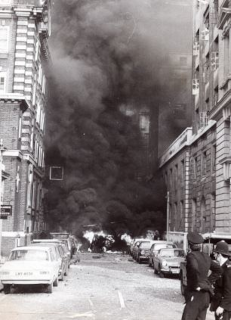
However, at the Old Bailey the bomb explodes, injuring many and causing extensive damage. Scotland Yard states it had warned the City of London police at 2:01 p.m. to search near the Old Bailey for a green Ford Cortina. The car is not located until 2:35 p.m. and explodes at 2:49 p.m. while police are evacuating the area. Several more people are injured by the car bomb near the Ministry of Agriculture, which brings the total number injured to over two hundred. A British man, Frederick Milton (60), dies of a heart attack. Dolours Price writes in her memoir, “There were warnings phoned in but people had stood about, curious to see… If people ignored the warnings and stood around gawking, they were stupid. The numbers of injured came about through curiosity and stupidity.” The ASU is caught trying to leave the country at Heathrow Airport prior to the explosions, as the police had been forewarned about the bombings and are checking all passengers to Belfast and Dublin. All ten give false names that do not match their documents and they are detained. The IRA Volunteer who gave a warning about the bombs an hour before they exploded is the only one not captured.
The IRA volunteers have to be tried at Winchester Crown court in Winchester Castle as the Old Bailey is wrecked by the car bomb. The trial takes ten weeks and is set amid extremely strict security. William McLarnon pleads guilty to all charges on the first day of the trial. On November 14, 1973, a jury convicts six men and two women of the bombings. The jury acquits Roisin McNearney in exchange for information and she is given a new identity. As her verdict is handed down, the other defendants begin to hum the “Dead March” from Saul, and one throws a coin at her, shouting, “Take your blood money with you” as she leaves the dock in tears. Six of the nine people convicted admit to Provisional IRA membership.
The judge sentences the eight to life imprisonment for the bombings and 20 years for conspiracy, while William McLarnon, whose family was forced out of their home in August 1969, is sentenced to 15 years. When his sentence is read he shouts, “Up The Provisional IRA.” As the eight are led to the cells below the court, several give raised fist salutes to relatives and friends in the public gallery. The Price sisters immediately go on hunger strike, soon followed by Feeney and Kelly, for the right not to do prison work and to be repatriated to a jail in Ireland. The bombers on hunger strike are eventually moved to jails in Ireland as part of the 1975 IRA truce agreed with the British. In 1983, Kelly escapes from Maze Prison and becomes part of an IRA ASU in the Netherlands. He is recaptured three years later by the Dutch authorities and extradited.
The Old Bailey bomb is the beginning of a sustained bombing campaign in England. The next major bombing by the IRA in England is the King’s Cross station and Euston station bombings which injured 13 people and do widespread damage. Another significant attack that year is the 1973 Westminster bombing which injures 60 people. Two more people die in England from IRA bombings in 1973, bringing the total to three for the year in that part of United Kingdom. The next year, 1974, is the bloodiest year of the Troubles outside of Northern Ireland with over 70 people being killed in the Republic of Ireland and England combined. Thirty-four are killed in the Dublin and Monaghan bombings, 21 from the Birmingham pub bombings, 12 from the M62 coach bombing, and several people are killed by the IRA’s Balcombe Street Gang.
One of the Old Bailey bombers, Marian Price, explains the IRA’s reasoning for bombing England. “It doesn’t seem to matter if it’s Irish people dying.” So if the armed struggle was to succeed then it was necessary to “bring it to the heart of the British Establishment.” Hence symbolic targets such as the Old Bailey “were carefully chosen.”
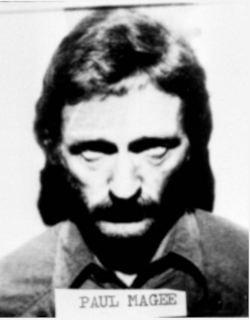
Magee joins the Belfast Brigade of the IRA and receives a five-year sentence in 1971 for possession of firearms. He is imprisoned in Long Kesh, where he holds the position of camp adjutant. In the late 1970s and early 1980s he is part of a four-man active service unit, along with Joe Doherty and Angelo Fusco, nicknamed the “M60 gang” due to their use of an M60general-purpose machine gun. On April 9, 1980, the unit lures the Royal Ulster Constabulary (RUC) into an ambush on Stewartstown Road, killing Constable Stephen Magill and wounding two others. On May 2 the unit is planning another attack and has taken over a house on Antrim Road, when an eight-man patrol from the British Army‘s Special Air Service (SAS) arrives in plain clothes, after being alerted by the RUC. A car carrying three SAS members goes to the rear of the house, and another car carrying five SAS members arrives at the front of the house. As the SAS members at the front of the house exit the car the IRA unit opens fire with the M60 machine gun from an upstairs window, hitting Captain Herbert Westmacott in the head and shoulder. Westmacott is killed instantly and is the highest-ranking member of the SAS killed in Northern Ireland. The remaining SAS members at the front of the house, armed with Colt Commando automatic rifles, submachine guns and Browning pistols, return fire but are forced to withdraw. Magee is apprehended by the SAS members at the rear of the house while attempting to prepare the IRA unit’s escape in a transit van, while the other three IRA members remain inside the house. More members of the security forces are deployed to the scene, and after a brief siege the remaining members of the IRA unit surrender.
The trial of Magee and the other members of the M60 gang begins in early May 1981, with them facing charges including three counts of murder. On June 10 Magee and seven other prisoners, including Joe Doherty, Angelo Fusco and the other member of the IRA unit, take a prison officer hostage at gunpoint in Crumlin Road Jail. After locking the officer in a cell, the eight take other officers and visiting solicitors hostage, also locking them in cells after taking their clothing. Two of the eight wear officer’s uniforms while a third wears clothing taken from a solicitor, and the group moves toward the first of three gates separating them from the outside world. They take the officer on duty at the gate hostage at gunpoint and force him to open the inner gate. An officer at the second gate recognises one of the prisoners and runs into an office and presses an alarm button, and the prisoners run through the second gate towards the outer gate. An officer at the outer gate tries to prevent the escape but is attacked by the prisoners, who escape onto Crumlin Road. As the prisoners are moving toward the car park where two cars are waiting, an unmarked RUC car pulls up across the street outside Crumlin Road Courthouse. The RUC officers open fire, and the prisoners return fire before escaping in the waiting cars. Two days after the escape, Magee is convicted in absentia and sentenced to life imprisonment with a minimum recommended term of thirty years.
Magee escapes across the border into the Republic of Ireland. Eleven days after the escape he appears in public at the Wolfe Tone commemoration in Bodenstown Graveyard, County Kildare, where troops from the Irish Army and the Garda‘s Special Branch attempt to arrest him but fail after the crowd throws missiles and lay down in the road blocking access. He is arrested in January 1982 along with Angelo Fusco and sentenced to ten years imprisonment for the escape under extra-jurisdictional legislation. Shortly before his release from prison in 1989, he is served with an extradition warrant, and he starts a legal battle to avoid being returned to Northern Ireland. In October 1991, the Supreme Court of Ireland in Dublin orders his return to Northern Ireland to serve his sentence for the murder of Captain Westmacott, but Magee jumps bail, and a warrant is issued for his arrest.
Magee flees to England, where he is part of an IRA active service unit. On June 7, 1992, Magee and another IRA member, Michael O’Brien, are traveling in a car on the A64 road between York and Tadcaster, when they are stopped by the police. Magee and O’Brien are questioned by the unarmed police officers, who become suspicious and call for back-up. Magee shoots Special Constable Glenn Goodman, who dies later in hospital, and then shoots the other officer, PC Kelly, four times. Kelly escapes death when a fifth bullet ricochets off the radio he is holding to his ear, and the IRA members drive away. Another police car begins to follow the pair and comes under fire near Burton Salmon. The lives of the officers in the car are in danger, but Magee and O’Brien flee the scene after a member of the public arrives. A manhunt is launched, and hundreds of police officers, many of them armed, search woods and farmland. Magee and O’Brien evade capture for four days by hiding in a culvert, before they are both arrested in separate police operations in the town of Pontefract.
On March 31, 1993, Magee is found guilty of the murder of Special Constable Goodman and the attempted murder of three other police officers and sentenced to life imprisonment. O’Brien is found guilty of attempted murder and receives an eighteen-year sentence. On September 9, 1994, Magee and five other prisoners, including Danny McNamee, escape from HM Prison Whitemoor. The prisoners, in possession of two guns that had been smuggled into the prison, scale the prison walls using knotted sheets. A guard is shot and wounded during the escape, and the prisoners are captured after being chased across fields by guards and the police. In 1996 Magee stages a dirty protest in HM Prison Belmarsh, in protest at glass screens separating prisoners from their relatives during visits. He has refused to accept visits from his wife and five children for two years, prompting Sinn Féin to accuse the British government of maintaining “a worsening regime that is damaging physically and psychologically.”
In January 1997, Magee and the other five escapees from Whitemoor are on trial on charges relating to the escape for a second time, as four months earlier the first trial had been stopped because of prejudicial publicity. Lawyers for the defendants successfully argued that an article in the Evening Standard prejudiced the trial as it contained photographs of Magee and two other defendants and described them as “terrorists,” as an order had been made at the start of the trial preventing any reference to the background and previous convictions of the defendants. Despite the judge saying the evidence against the defendants was “very strong”, he dismisses the case stating, “What I have done is the only thing I can do in the circumstances. The law for these defendants is the same law for everyone else. They are entitled to that, whatever they have done.”
On May 5, 1998, Magee is repatriated to the Republic of Ireland to serve the remainder of his sentence in Portlaoise Prison, along with Liam Quinn and the members of the Balcombe Street Gang. He is released from prison in late 1999 under the terms of the Good Friday Agreement and returns to live with his family in Tralee, County Kerry. On March 8, 2000, he is arrested on the outstanding Supreme Court extradition warrant from 1991 and remanded to Mountjoy Prison. The following day he is granted bail at the High Court in Dublin, after launching a legal challenge to his extradition. In November 2000 the Irish government informs the High Court that it is no longer seeking to return him to Northern Ireland. This follows a statement from Secretary of State for Northern IrelandPeter Mandelson saying that “it is clearly anomalous to pursue the extradition of people who appear to qualify for early release under the Good Friday Agreement scheme, and who would, on making a successful application to the Sentence Review Commissioners, have little if any of their original prison sentence to serve.” In December 2000 Magee and three other IRA members, including two other members of the M60 gang, are granted a Royal Prerogative of Mercy which allows them to return to Northern Ireland without fear of prosecution.
Twomey lives at 6 Sevastopol Street in the Falls district. Known as “Thumper” owing to his short temper and habit of banging his fist on tables, he receives little education and is a bookmaker‘s “runner.” His father is a volunteer in the 1920s. In Belfast he lives comfortably with his wife, Rosie, whom he marries in 1946. Together they have sons and daughters.
Twomey begins his involvement with the Irish Republican Army in the 1930s and is interned in Northern Ireland during the 1940s on the prison ship HMS Al Rawdah and later in Crumlin Road Jail in Belfast. Rosie, his wife, is also held prisoner at the women prison, Armagh Jail, in Northern Ireland. He opposes the left-wing shift of Cathal Goulding in the 1960s, and in 1968, helps set up the breakaway Andersonstown Republican Club, later the Roddy McCorley Society.
In 1969, Twomey is prominent in the establishment of the Provisional Irish Republican Army. By 1972, he is Officer Commanding (OC) of the Provisional IRA Belfast Brigade when it launches its bomb campaign of the city, including Bloody Friday when nine people are killed. During the 1970s, the leadership of the Belfast Brigade of the IRA is largely in the hands of Twomey and Ivor Bell.
In March 1973, Twomey is first appointed IRA Chief of Staff after the arrest of Joe Cahill. He remains in this position until his arrest in October 1973 by the Garda Síochána. Three weeks later, on October 31, 1973, the IRA organises the helicopter escape of Twomey and his fellow IRA members J. B. O’Hagan and Kevin Mallon, when an active service unit hijacks and forces the pilot at gunpoint to land the helicopter in the training yard of Mountjoy Prison. After his escape, he returns to his membership of IRA Army Council.
By June/July 1974, Twomey is IRA Chief of Staff for a second time. He takes part in the Feakle talks between the IRA and Protestant clergymen in December 1974. In the IRA truce which follows in 1975, he is largely unsupportive and wants to fight on in what he sees as “one big push to finish it once and for all.”
IRA informer Sean O’Callaghan claims that on January 5, 1976, Twomey and Brian Keenan give the go-ahead for the sectarian Kingsmill massacre, when ten unarmed Ulster Protestant workmen are executed by the Provisional IRA in retaliation for a rash of loyalist killings of Catholics in the area. It is Keenan’s view, O’Callaghan claims, that “The only way to knock the nonsense out of the Prods is to be ten times more savage.”
Twomey is dedicated to paramilitarism as a means of incorporating Northern Ireland into the Republic of Ireland. In an interview with French television on July 11, 1977, he declares that although the IRA had waged a campaign for seven years at that point, it can fight on for another 70 against the British state in Northern Ireland and in England. He supports the bombing of wealthy civilian targets, which he justifies on class lines. On October 29, 1977, for example, a no-warning bomb at an Italian restaurant in Mayfair kills one diner and wounds 17 others. Three more people are killed in similar blasts in Chelsea and Mayfair the following month. He says, “By hitting Mayfair restaurants, we were hitting the type of person that could bring pressure to bear on the British government.”
In December 1977, Twomey is captured in Sandycove, Dublin, by the Garda Síochána, who had been tipped off by Belgian police about a concealed arms shipment, to be delivered to a bogus company with an address in the area. They swoop on a house in Martello Terrace to discover Twomey outside in his car, wearing his trademark dark glasses. After a high-speed pursuit, he is recaptured in the centre of Dublin. The Gardaí later find documents in his possession outlining proposals for the structural reorganisation of the IRA according to the cell system. His arrest ends his tenure as IRA chief of staff. In the 1986 split over abstentionism, Twomey sides with the Gerry Adams leadership and remains with the Provisionals.
After a long illness from a heart condition, Twomey dies in Dublin on September 12, 1989. He is buried in the family plot in Milltown Cemetery, Belfast. His funeral is attended by about 2,000 people.
On April 9, 1980, the unit lures the Royal Ulster Constabulary (RUC) into an ambush on Stewartstown Road, killing one constable and wounding two others. On May 2 the unit is planning another attack and has taken over a house on Antrim Road, when an eight-man patrol from the SAS arrive in plain clothes, after being alerted by the RUC. A car carrying three SAS members goes to the rear of the house, and another car carrying five SAS members arrives at the front of the house. As the SAS members at the front of the house exit their car the IRA unit opens fire with the M60 machine gun from an upstairs window, hitting Captain Herbert Westmacott in the head and shoulder, killing him instantly. He is the highest-ranking member of the SAS killed in Northern Ireland. The remaining SAS members, armed with Colt Commando automatic rifles, submachine guns and Browning pistols, return fire but are forced to withdraw. Magee is apprehended by the SAS members at the rear of the house while attempting to prepare the IRA unit’s escape in a transit van, while the other three IRA members remain inside the house. More members of the security forces are deployed to the scene, and after a brief siege the remaining members of the IRA unit surrender.
The trial of Fusco and the other members of the M60 gang begins in early May 1981, with them facing charges including three counts of murder. On June 10 Fusco and seven other prisoners, including Joe Doherty and the other members of the IRA unit, take a prison officer hostage at gunpoint in Crumlin Road Jail. After locking the officer in a cell, the eight take other officers and visiting solicitors hostage, also locking them in cells after taking their clothing. Two of the eight are wearing officer’s uniforms while a third wears clothing taken from a solicitor, and the group moves towards the first of three gates separating them from the outside world. They take the officer on duty at the gate hostage at gunpoint and force him to open the inner gate. An officer at the second gate recognises one of the prisoners and runs into an office and presses an alarm button, and the prisoners run through the second gate towards the outer gate. An officer at the outer gate tries to prevent the escape but is attacked by the prisoners, who escape onto Crumlin Road. As the prisoners are moving towards the car park where two cars are waiting, an unmarked RUC car pulls up across the street outside Crumlin Road Courthouse. The RUC officers open fire, and the prisoners returned fire before escaping in the waiting cars. Two days after the escape, Fusco is convicted in absentia and sentenced to life imprisonment with a minimum recommended term of thirty years.
Fusco escapes across the border into the Republic of Ireland before being arrested in January 1982 and is sentenced to ten years imprisonment for the escape and firearms offences under extra-jurisdictional legislation. A further three years are added to his sentence in 1986 after he attempts to escape from Portlaoise Prison, and he is released in January 1992. Upon his release, he is immediately served with extradition papers from the British government for his return to the Maze Prison in Northern Ireland to serve his sentence for the murder conviction. The extradition is granted by a District Court but Fusco appeals, and in 1995 he wins a legal victory when a judge at the High Court in Dublin rules it would be “unjust, oppressive and invidious” to order his extradition due to the time lag involved. Fusco settles in Tralee with his wife and three children until February 1998, when the Supreme Court of Ireland brings an end to the six-year legal battle by ordering his extradition, but he has already fled on bail and a warrant is issued for his arrest.
Fusco is arrested at a Garda checkpoint in Castleisland, County Kerry, on January 3, 2000. The following day he is being escorted back to Northern Ireland to be handed over to the RUC, when his handover is halted by a successful court appeal by Sinn Féin. The arrest and abortive return of Fusco undermines the Northern Ireland peace process, with Unionist politicians including Ken Maginnis criticising the extradition being halted. Republicans are critical of Fusco’s arrest, with leading Sinn Féin member Martin Ferris stating, “The Irish government should immediately move to rescind the warrant against Angelo Fusco. The action will cause great anger and resentment within the nationalist community,” and graffiti in one republican area reads “Extradite Bloody Sunday war criminals, not Fusco.” On January 6 Fusco is refused bail and remanded to prison in Castlerea, County Roscommon, to await a legal review of his extradition, prompting scuffles outside the court between police and Sinn Féin supporters.
Fusco is freed on bail on March 21 pending the outcome of his legal challenge, and in November 2000 the Irish government informs the High Court that it is no longer seeking to return him to Northern Ireland. This follows a statement from Secretary of State for Northern IrelandPeter Mandelson saying that “it is clearly anomalous to pursue the extradition of people who appear to qualify for early release under the Good Friday Agreement scheme, and who would, on making a successful application to the Sentence Review Commissioners, have little if any of their original prison sentence to serve.” After the court hearing Fusco states, “I’m relieved it’s over,” and that he will continue to live in Tralee with his family and work for Sinn Féin.
In December 2000 Fusco and three other IRA members, including two other members of the M60 gang, are granted a royal prerogative of mercy which allows them to return to Northern Ireland without fear of prosecution.
On July 30, 1919, the first assassination authorised by Michael Collins is carried out by The Squad, also known as the Twelve Apostles, when Detective Sergeant “the Dog” Smith is shot near Drumcondra, Dublin.
On April 10, 1919, the First Dáil announces a policy of ostracism of Royal Irish Constabulary (RIC) men. At the time Sinn Féin official policy is against acts of violence. Boycotting, persuasion and mild intimidation succeed against many officers. However, others escalate their activities against republicans and in March 1920 Collins asks Dick McKee to select a small group to form an assassination unit.
When The Squad is formed, it comes directly under the control of the Director of Intelligence or his deputy and under no other authority. The Squad is commanded by Mick McDonnell.
The original “Twelve Apostles” are Mick McDonnell, Tom Keogh, Jimmy Slattery, Paddy Daly, Joe Leonard, Ben Barrett, Vincent Byrne, Sean Doyle, Paddy Griffin, Eddie Byrne, Mick Reilly and Jimmy Conroy. After some time, The Squad is strengthened with members Ben Byrne, Frank Bolster, Mick Keogh, Mick Kennedy, Bill Stapleton and Sam Robinson. Owen Cullen, a member of 2nd Battalion, is driver for a short time, and Paddy Kelly of County Clare for a short time. They are employed full-time and received a weekly wage.
Sometimes, as occasion demands, The Squad is strengthened by members of the IRA Intelligence Staff, the Active Service Unit, munition workers and members of the Dublin Brigade, TipperaryFlying Column men, Dan Breen, Séumas Robinson, Seán Treacy and Seán Hogan, and also Mick Brennan and Michael Prendergast of County Clare. The IRA Intelligence Staff consists of the Director of Intelligence Michael Collins, the Deputy Director of Intelligence Liam Tobin, the Second Deputy Director of Intelligence Tom Cullen, the Third Director of Intelligence Frank Thornton, and members Joe Dolan, Frank Saurin, Ned Kelleher, Joe Guilfoyle, Paddy Caldwell, Paddy Kennedy, Charlie Dalton, Dan McDonnell and Charlie Byrne. The munitions workers include Mat Furlong, Sean Sullivan, Gay McGrath, Martin O’ Kelly, Tom Younge and Chris Reilly.
Other members include Mick Love, Gearoid O’Sullivan, Patrick Caldwell, Charlie Dalton, Mick O’Reilly, Sean Healy, James Ronan, Paddy Lawson, John Dunne, Johnny Wilson and James Heery. Seán Lemass and Stephen Behan, the father of Irish writers Brendan and Dominic Behan, have also been listed as members of the Apostles. There is no hard evidence to support the inclusion of many of the names, but those who subsequently serve in the Irish Army have their active service recorded in their service records held in the Military Archives Department in Cathal Brugha Barracks, Rathmines. Andrew Cooney is also reported to have been associated with The Squad. Stephen Behan’s involvement is first made public in 1962, when the BBC broadcasts an episode of This Is Your Life dedicated to Behan. During the broadcast, remaining members of the squad joined Behan on the set of the show.
Following “The Dog” Smith’s assassination, The Squad continues to target plainclothes police, members of the G Division of the Dublin Metropolitan Police, and, occasionally, problematic civil servants. Organisationally it operates as a subsection of Collins’ Intelligence Headquarters. Two of the executions by The Squad are the killing on January 21, 1920, of RIC Inspector William Redmond of the DMP “G” Division and on March 2, 1920, a British double agent John Charles Byrnes.
One of the Apostles’ particular targets is the Cairo Gang, a deep-cover British intelligence group, so called since it has either been largely assembled from intelligence officers serving in Cairo or from the Dublin restaurant called The Cairo, which the gang frequents. Sir Henry Wilson brings in the Cairo Gang in the middle of 1920, explicitly to deal with Michael Collins and his organization. Given carte blanche in its operations by Wilson, the Cairo Gang adopts the strategy of assassinating members of Sinn Féin unconnected with the military struggle, assuming that this will cause the IRA to respond and bring its leaders into the open.
The most well-known operation executed by the Apostles occurs on what becomes known as Bloody Sunday, November 21, 1920, when British MI5 officers, linked to the Cairo Gang and significantly involved in spying, are shot at various locations in Dublin with fourteen killed and six wounded. In addition to the The Squad, a larger number of IRA personnel are involved in this operation. The only IRA man captured during the operation is Frank Teeling. In response to the killings, the Black and Tans retaliate by shooting up a Gaelic football match between Dublin and Tipperary at Croke Park, the proceeds from which are for the Irish Republican Prisoners Fund. Fourteen civilians are killed including one of the players, Michael Hogan, and 68 are wounded. The Hogan stand at Croke Park is named after Hogan.
The elimination of the Cairo Gang is seen in Dublin as an intelligence victory, but British Prime MinisterDavid Lloyd George comments dismissively that his men “… got what they deserved, beaten by counterjumpers…”. Winston Churchill adds that they were “.. careless fellows … who ought to have taken precautions.”
Some members of The Squad are hanged in 1921 for the killings on Bloody Sunday, including Thomas Whelan and Patrick Moran. Moran had killed a vet, Patrick MacCormack, who seems to have been an innocent victim.
In May 1921, after the IRA’s Dublin Brigade takes heavy casualties during the burning of the Custom House, The Squad and the Brigade’s Active Service Unit are amalgamated into the Dublin Guard, under Paddy Daly. Under the influence of Daly and Michael Collins, most of the Guard take the Free State side and join the National Army in the Irish Civil War of 1922–23. During this conflict some of them are attached to the Criminal Investigation Department and are accused of multiple assassinations of Anti-Treaty fighters. They are also involved in several atrocities against Republican prisoners, particularly after the death of Collins, due to many of them having personal ties with him.
Bill Stapleton goes on to become a director in Bord na Móna, Charles Dalton and Frank Saurin become directors in the Irish Sweepstakes. In October 1923, Commandant James Conroy is implicated in the murder of two Jewish men, Bernard Goldberg and Emmanuel ‘Ernest’ Kahn. He avoids arrest by fleeing to Mexico, returning later to join the Blueshirts. A later application for an army pension is rejected. The killings are the subject of a 2010 investigative documentary by RTÉ, CSÍ: Murder in Little Jerusalem.






 seamus dubhghaill