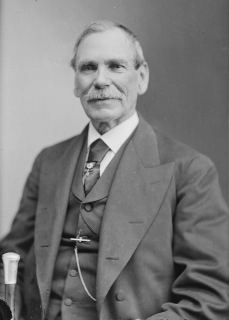
Born and initially educated in Ireland, Shields emigrates to the United States in 1826. He is briefly a sailor and spends time in Quebec before settling in Kaskaskia, Illinois, where he studies and practices law. In 1836, he is elected to the Illinois House of Representatives, and later as State Auditor. His work as auditor is criticized by a young Abraham Lincoln, who with his then fiancée, Mary Todd, publishes a series of inflammatory pseudonymous letters in a local paper. Shields challenges Lincoln to a duel, and the two nearly fight on September 22, 1842, before making peace and eventually becoming friends.
In 1848, Shields is appointed to and confirmed by the Senate as the first governor of the Oregon Territory, which he declines. After serving as Senator from Illinois, he moves to Minnesota and there founds the town of Shieldsville. He is then elected as Senator from Minnesota. He serves in the American Civil War and, at the Battle of Kernstown, his troops inflict the only tactical defeat of Stonewall Jackson in the war. He resigns his commission shortly thereafter. After moving multiple times, he settles in Missouri and serves again for three months in the Senate.
Shields dies unexpectedly in Ottumwa, Iowa on June 1, 1879, while on a lecture tour, after reportedly complaining of chest pains. His body is transferred to Carrollton, Missouri by train, where a funeral is held at the Catholic church, and his body escorted to St. Mary’s Cemetery by two companies of the Nineteenth Infantry, the Craig Rifles, and a twenty-piece brass band. His grave remains unmarked for 30 years, until the local government and the U.S. Congress fund a granite and bronze monument there in his honor.
Ford is born to Edward Ford (1805-1880) and Ann Ford (1815-1893), emigrating with his parents to Boston, Massachusetts in 1845, never returning to Ireland. He writes in the Irish World in 1886 that “I might as well have been born in Boston. I know nothing of England. I brought nothing with me from Ireland — nothing tangible to make me what I am. I had consciously at least, only what I found and grew up with in here.”
Ford leaves school at the age of thirteen and two years later is working as a printer’s devil for William Lloyd Garrison‘s The Liberator. He credits Garrison for his advocacy for social reform. He begins writing in 1855 and by 1861 is editor and publisher of the Boston Tribune, also known as the Boston Sunday Tribune or Boston Sunday Times. He is an abolitionist and pro-union.
Ford spends four years after the war in Charleston, South Carolina, editing the Southern Carolina Leader, printed to support newly freed slaves. He settles in New York City in 1870 and founds the Irish World, which becomes the principal newspaper of Irish America. It promises “more reading material than any other paper in America” and outsells John Boyle O’Reilly‘s The Pilot.
In 1878, Ford re-titles his newspaper, the Irish World and American Industrial Liberator. During the early 1880s, he promotes the writings of land reformer, Henry George in his paper.
In 1880, Ford begins to solicit donations through the Irish World to support Irish National Land League activities in Ireland. Funds received are tabulated weekly under the heading “Land League Fund.” Between January and September 1881 alone, more than $100,000 is collected in donations. British Prime MinisterWilliam Ewart Gladstone later states that without the funds from the Irish World, there would have been no agitation in Ireland.”
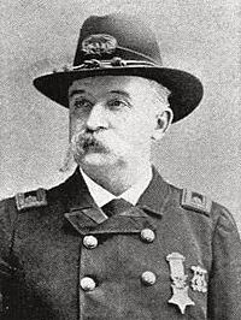
Although Mulholland later claims that at the Battle of Gettysburg on July 2, 1863, he personally took command of the 140th Pennsylvania Infantry and led it into action, this fact is mentioned in neither his own official report of the battle, nor that of the lieutenant colonel commanding the 140th. When the 116th is returned to full strength in early 1864, he is promoted to colonel. He is wounded a second time at the Battle of the Wilderness on May 5, 1864. At the Battle of Spotsylvania Court House, he is wounded a third time but remains in the hospital only ten days. Resuming his command, he is dangerously wounded again at the Battle of Totopotomoy Creek. He recovers rapidly and commands his brigade in all the actions around the Siege of Petersburg, particularly distinguishing himself by storming a fort on the Boydton Plank Road. He is mustered out of the volunteer service on June 3, 1865.
On May 4, 1866, PresidentAndrew Johnson nominates Mulholland for the brevet grade of brigadier general of volunteers to rank from March 13, 1865, for his conduct at the Battle of the Wilderness and the U.S. Senate confirms the appointment on May 18, 1866. On January 13, 1869, President Johnson nominates Mulholland for appointment to the brevet grade of major general of volunteers, to rank from March 13, 1865, for his actions on the Boydton Plank Road and the Senate confirms the appointment on February 16, 1869. The brevet is issued February 20, 1869. It is the last brevet of major general issued for service during the Civil War.
Returning to civilian life after the war, Mulholland is appointed Chief of Police in Philadelphia in 1868 and signalizes his administration by the good order in which he keeps both the force and the city. President Grover Cleveland appoints him United States Pension Agent, in which office he is continued by Presidents William McKinley and Theodore Roosevelt. He is considered an authority on the science of penology and also devotes much of his leisure time to art studies, and as a lecturer and writer on the Civil War and its records. He compiles a history of the 116th Regiment, and another of those to whom Congress voted the Medal of Honor. In the Catholic affairs of Philadelphia, he is always active and a leader among the best-known laymen.
St. Clair Augustin Mulholland dies on February 17, 1910, in Philadelphia, Pennsylvania. He is buried at Old Cathedral Cemetery, Philadelphia.
Born on St. Patrick’s Day, this native Irishman is nevertheless extremely loyal to his adopted country, saying, “if this [Confederacy] that is so dear to my heart is doomed to fail, I pray heaven may let me fall with it, while my face is toward the enemy and my arm battling for that which I know to be right.” Sadly, Cleburne ultimately receives his wish.
Cleburne begins his military career in an unlikely manner. When he fails the entrance exam at Trinity College, Dublin, he cannot face his family. He enlists in the 41st Regiment of Foot in the British Army. In 1849 he purchases his discharge and leaves for the United States, eventually settling in Helena, Arkansas in June 1850 and earning his citizenship in 1855. He loves his new country, taking part in many community projects, and even being one of the few volunteers to care for the sick during a yellow fever outbreak.
In January 1861 Cleburne joins the local militia company, the Yell Rifles. He leads the company in the seizure of the U.S. Arsenal in Little Rock in January 1861. When Arkansas left the Union, the Yell Rifles became part of the 1st Arkansas Infantry Regiment. By fall of 1861 he has risen to command the 2nd Brigade, Hardee’s Division, in the Army of Central Kentucky. His first major battle is at the Battle of Shiloh, April 6-7, 1862. At the Battle of Richmond (Kentucky) in August 1862, he is wounded in the mouth and loses several of his teeth. Still, he earns the thanks of the Confederate States Congress for his actions there. During the October 1862 Battle of Perryville he is wounded again – twice, yet stays in command during the battle. In December 1862 he is promoted to Major General.
At the December 1862 Battle of Stones River, Cleburne and his division earn the praise of General Braxton Bragg for their incredible skill and valor. Cleburne’s actions and character play a large role in his men’s determination during battle.
In 1863 Cleburne faces off against Union General George Henry Thomas at the Battle of Chickamauga. His and General John C. Breckinridge’s assaults force General Thomas to call repeatedly for reinforcements. In November 1863 the Confederate army is forced to retreat after the Chattanooga Campaign. However, Cleburne has defeated every assault against his men eventually charging his attackers. After the battle, he and his men are charged with covering the retreat.
On January 2, 1864, Cleburne makes his most controversial decision ever. He gathers the corps and division commanders in the Army of Tennessee to present his proposal. The Confederacy is unable to fill its ranks due to a lack of manpower. He states that slavery is their “most vulnerable point, a continued embarrassment, and in some respects an insidious weakness.” His proposed solution is for the Confederacy to arm slaves to fight in the army. In time, these soldiers would receive their freedom. The proposal is not well received at all. In fact, Jefferson Davis, President of the Confederate States of America, directs that the proposal be suppressed.
General Hood hopes to stop Union General John Schofield and his men before they can reach Nashville to reinforce General Thomas. Due to poor communications and nightfall, Schofield slips past the Army of Tennessee into Franklin.
The November 30, 1864 Battle of Franklin is a tragic loss for the Confederacy. Hood throws his men into well-fortified Union troops. The results are disastrous. About 6,000 men are killed or wounded including six generals who are killed or mortally wounded. Cleburne is one of these six, killed while attacking Union breastworks. He is last seen advancing on foot toward the Union line with his sword raised, after his horse had been shot out from under him. Accounts later say that he is found just inside the Federal line and his body is carried back to an aid station along the Columbia Turnpike. Confederate war records indicate he died of a shot to the abdomen, or possibly a bullet that went through his heart. When Confederates find his body, he has been picked clean of any valuable items, including his sword, boots and pocket watch.
Cleburne’s remains are first laid to rest at Rose Hill Cemetery in Columbia, Tennessee. At the urging of Army Chaplain Biship Quintard, Judge Mangum, staff officer to Cleburne and his law partner in Helena, his remains are moved to St. John’s Episcopal Church near Mount Pleasant, Tennessee, where they remain for six years. In 1870, he is disinterred and returned to his adopted hometown of Helena, Arkansas, with much fanfare, and buried in the Helena Confederate Cemetery located in the southwest corner of the Maple Hill Cemetery, overlooking the Mississippi River.
Irish fight Irish in one of the bloodiest days in Irish military history at Marye’s Heights in Fredericksburg, Virginia on December 13, 1862, during the American Civil War. The Union Army’s Irish Brigade, the Fighting 69th, is decimated by the Confederate States Army during multiple efforts to take Marye’s Heights. In his official report Thomas Francis Meagher writes, “of the one thousand and two hundred I led into action, only two hundred and eighty appeared on parade next morning.”
The Battle of Fredericksburg, fought December 11-15, 1862, is one of the largest and deadliest of the war. It features the first major opposed river crossing in American military history. Union and Confederate troops fight in the streets of Fredericksburg, the war’s first urban combat. And with nearly 200,000 combatants, no other Civil War battle features a larger concentration of soldiers.
The Union army’s main assault against Lt. Gen. Thomas J. “Stonewall” Jackson produces initial success and holds the promise of destroying the Confederate right, but lack of reinforcements and Jackson’s powerful counterattack stymies the effort. Both sides suffer heavy losses (totaling 9,000 in killed, wounded and missing) with no real change in the strategic situation.
In the meantime, Burnside’s “diversion” against veteran Confederate soldiers behind a stone wall produces a similar number of casualties but most of these are suffered by the Union troops. Wave after wave of Federal soldiers march forth to take the heights, but each is met with devastating rifle and artillery fire from the nearly impregnable Confederate positions.
As darkness falls on a battlefield strewn with dead and wounded, it is abundantly clear that a signal Confederate victory is at hand. The Army of the Potomac has suffered nearly 12,600 casualties, nearly two-thirds of them in front of Marye’s Heights. By comparison, Lee’s army has suffered some 5,300 losses. Lee, watching the great Confederate victory unfolding from his hilltop command post exclaims, “It is well that war is so terrible, or we should grow too fond of it.”
Roughly six weeks after the Battle of Fredericksburg, PresidentAbraham Lincoln removes Burnside from command of the Army of the Potomac.
In 1866 Monck becomes a peer with the title Baron Monck. When the Canadian colonies become a semi-independent confederation the next year, he becomes the country’s first Governor General. He is also responsible for establishing Rideau Hall as the residence of the Governor General in Ottawa.
The Irish Brigade of the Union Army fights in the Battle of Antietam, one of the most famous battles of the American Civil War, on September 17, 1862. The battle has the sad distinction of being the bloodiest single day of fighting in America’s bloodiest war. Combined casualties at the Battle of Antietam are 26,134. Few regiments suffered more than the Irish Brigade.
The Irish Brigade is the brainchild of their commanding officer Thomas Francis Meagher. The former Young Ireland rebel, creator of the Irish Tricolor of green, white and orange, escaped political prisoner, lawyer, newspaper editor and politician forms the brigade with the twin objectives of gaining respect for the Irish by their patriotism for their adopted country and developing a nucleus for a future fight for Ireland’s freedom. The Brigade is formed of the almost exclusively Irish American69th, 63rd and 88th New York and the “honorary Irish” of the 29th Massachusetts. The regiments of the Irish Brigade had already earned a formidable reputation as a crack unit, having distinguished themselves in every battle of the earlier Seven Days Battles. It is small wonder, many in the Brigade’s ranks had already distinguished themselves in the Mexican-American War or in fighting with the Papal forces in Italy against Giuseppe Garibaldi.
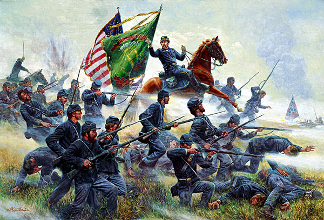
The Union Army is already heavily engaged, when the Irish Brigade is ordered to advance through an open field to take an area of high ground. Subjected to accurate Confederate rifle fire as they cross the field, the Brigade marches on in disciplined order, the National and the famed Green Regimental Colors (flags) fluttering overhead. When they encounter a fence across their line of march, eighty volunteers rush forward to knock it down, rather than see the whole Brigade slowed by the obstacle and exposed to fire. Over half of these volunteers are killed. Seeing the Irish continue to press forward, the Confederates fall back as the Irish advance up the hill.
What no one on the Union side knows is that on the other side of the hill is a farmer’s dirt road that years of rain has eroded into a ditch five feet below the surrounding ground level. The sunken road is a perfect rifle pit and is filled with Colonel John Brown Gordon’s Georgians. As the Irish crest the hill, they are met with a volley that decimates the Brigade, including killing or wounding every single standard-bearer. Seeing the flags fall from across the field, an aide to Union General George B. McClellan exclaims, “The battles lost, the Irish are fleeing!” only for McClellan to respond, “No, the flags are raised again, they are advancing.” Eight successive standard-bearers of the 69th New York alone fall that day as men pick up the flags from fallen comrades. Captain Patrick Clooney, though wounded himself, snatches up the colors from the 88th’s fallen standard-bearer only to be killed by multiple shots, the Green Flag wrapping around him like a shroud befitting a hero. Another standard-bearer, the staff of his Irish Brigade flag snapped in two by a rifle shot, drapes the flag over his shoulder like a sash and continues to move forward, personifying the Gaelic phrase on the flag he is carrying “Riamh Nar Dhruid O Spairn lann”, “Who never retreated from the clash of spears.”
The fire of the Confederates is so intense that the Irish Brigade cannot advance, but they do not flee either. Despite the failure of promised reinforcements that never materialize, the Brigade pours “Buck and Ball” (a 69-caliber ball and three 30 caliber buckshot) into the enemy at 300 paces, turning the “Sunken Road” into “Bloody Lane.” When their ammunition is depleted, the remnants of the Brigade, with drill ground precision, form and march back to the Union lines. The Irish Brigade never “ran” from the enemy. Another Union unit takes the “Bloody Lane,” but most credit the punishment that the Irish Brigade inflicted on the enemy, at a terrible cost to themselves, with making it possible. The New York Regiments take over 50% casualties. The Irish Brigade is now no bigger than a single regiment. As the depleted ranks of the 88th march passed, Union Major GeneralIsrael Bush Richardson salutes as it passes with the words “Bravo 88th, I shall never forget you!”
During the course of the War, the Irish Brigade suffers over 4,000 casualties, more men than the Brigade ever had at any one time. The Fighting 69th loses more men than any other New York regiment. The Battle of Antietam is remembered as the Union victory that allows President Abraham Lincoln to issue the Emancipation Proclamation, which frees the slaves in the Confederate states. It is all too often forgotten that this emancipation was secured in no small part with the blood of Irish immigrants, immigrants who were denied civil rights in their own country and faced discrimination in their adopted county before and after the Civil War.
In thinking of the Civil War, all Americans should remember the words of a defeated Confederate Officer to his Union counterpart at Appomattox, “You only won as you had more Irish than we did.”
(Credit: “The Irish Brigade at Antietam” by Neil F. Cosgrove, October 17, 2009)
McKinley is born on January 29, 1843, in Niles, Ohio, the seventh child of William McKinley Sr. and Nancy (née Allison) McKinley. The McKinleys are of English and Scots Irish descent and settled in western Pennsylvania in the 18th century, tracing back to a David McKinley who is born in Dervock, County Antrim, in present-day Northern Ireland.
McKinley is the last president to serve in the American Civil War and the only one to start the war as an enlisted soldier, beginning as a private in the Union Army and ending as a brevet major. After the war, he settles in Canton, Ohio, where he practices law and marries Ida Saxton. In 1876, he is elected to the United States Congress, where he becomes the Republican Party‘s expert on the protective tariff, which he promises will bring prosperity. His 1890 McKinley Tariff is highly controversial which, together with a Democratic redistricting aimed at gerrymandering him out of office, leads to his defeat in the Democratic landslide of 1890.
McKinley is elected Ohio’s governor in 1891 and 1893, steering a moderate course between capital and labor interests. With the aid of his close adviser Mark Hanna, he secures the Republican nomination for president in 1896, amid a deep economic depression. He defeats his Democratic rival, William Jennings Bryan, after a front porch campaign in which he advocates “sound money” and promises that high tariffs will restore prosperity.
Rapid economic growth marks McKinley’s presidency. He promotes the 1897 Dingley Act to protect manufacturers and factory workers from foreign competition, and in 1900, he secures the passage of the Gold Standard Act. He hopes to persuade Spain to grant independence to rebellious Cuba without conflict, but when negotiation fails, he leads the nation into the Spanish American War of 1898. The U.S. victory is quick and decisive. As part of the Treaty of Paris (1898), Spain turns over to the United States its main overseas colonies of Puerto Rico, Guam, and the Philippines. Cuba is promised independence, but at that time remains under the control of the U.S. Army. The United States annexes the independent Republic of Hawaii in 1898, and it became a U.S. territory.
As an innovator of American interventionism and pro-business sentiment, McKinley’s presidency is generally considered above average, though his highly positive public perception is soon overshadowed by Roosevelt.
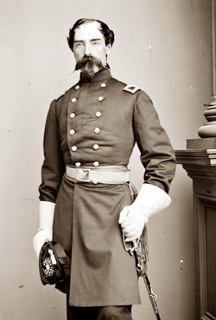
When the unit is originally mustered out of service, the 90-day enlistment terms having expired, Nugent accepts a commission as a captain in the regular army. He is immediately assigned to the 13th Infantry Regiment whose commanding officer, Colonel William Tecumseh Sherman, personally requests. Taking a leave of absence to return to New York, he assists Thomas Francis Meagher in organizing the Irish Brigade. The newly reformed 69th Infantry Regiment is the first unit assigned to the Irish Brigade and, with Nugent as its colonel, he leads the “Fighting 69th” at the Battles of Fair Oaks, Gaines’ Mill, Savage’s Station, White Oak Swamp, Glendale and Malvern Hill.
Nugent is shot in the stomach at the Battle of Fredericksburg and is eventually forced to resign his command. He is appointed acting assistant provost marshal for the southern district of New York, which includes New York City and Long Island, by the United States War Department. An Irishman and Democrat, his appointment is thought to assure the Irish American population that conscription efforts would be carried out fairly. The Irish American, a popular Irish language newspaper, writes that the selection is a “wise and deservedly popular one.” He encounters resistance from city officials wanting to remain uninvolved, however by mid-June reports to his superior officer and provost marshal general Colonel James Barnet Fry that conscription efforts are “nearing completion without serious incident.”
Understanding the seriousness of the situation, Nugent attempts to keep the draft selections quiet and in isolated parts of the city. In Manhattan however, lotteries are placed in the heart of Irish tenement and shanty neighborhoods where the draft is most opposed.
In the ensuing New York City draft riots, Nugent takes command of troops and attempts to defend the city against the rioters. Despite issuing the cancellation of the draft, the riots continue for almost a week. His home on West 86th Street is looted and burned by the rioters during that time, his wife and children barely escaping from their home. Upon breaking into his house, furniture is destroyed, and paintings of Nugent and Meagher are slashed, although a painting of Brigadier General Michael Corcoran is reportedly left untouched.
Nugent is brevetted Brigadier General for distinguished leadership of the 69th Regiment on March 13, 1865. The veterans of the Irish Brigade are honorably discharged and mustered out three months later. Nugent remains in the regular U.S. Army for the next twenty years, a formidable “Indian fighter” during the American Indian Wars with the 13th and 24th Infantry Regiments. In 1879, he retires at the rank of major and resides in New York where he is involved in the Grand Army of the Republic, the War Veterans’ Association of the 7th Regiment and an honorary member of The Old Guard.
Nugent becomes ill in his old age, complications arising from his wounds suffered at Fredericksburg, and remains bedridden for two months before his death at his McDonough Street home in Brooklyn on June 20, 1901. In accordance with his last wishes, he is buried at Cypress Hills National Cemetery.