seamus dubhghaill

Promoting Irish Culture and History from Little Rock, Arkansas, USA


Leave a comment

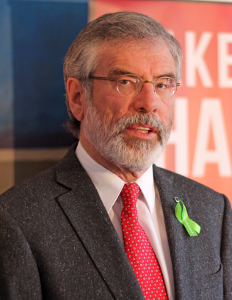
Birth of Sinn Féin President Gerry Adams

Gerard “Gerry” Adams, Irish republican politician who is the president of the Sinn Féin political party and a Teachta Dála (TD) for Louth since the 2011 general election, is born in Belfast, Northern Ireland, on October 6, 1948.

Adams attends St. Finian’s Primary School on the Falls Road, where he is taught by La Salle brothers. Having passed the eleven-plus exam in 1960, he attends St. Mary’s Christian Brothers Grammar School. He leaves St. Mary’s with six O-levels and becomes a barman. He is increasingly involved in the Irish republican movement, joining Sinn Féin and Fianna Éireann in 1964, after being radicalised by the Divis Street riots during that year’s general election campaign.

In the late 1960s, a civil rights campaign develops in Northern Ireland. Adams is an active supporter and joins the Northern Ireland Civil Rights Association in 1967. However, the civil rights movement is met with violence from loyalist counterdemonstrations and the Royal Ulster Constabulary. In August 1969, Northern Ireland cities like Belfast and Derry erupt in major rioting.

During the 1981 hunger strike, which sees the emergence of Sinn Féin as a political force, Adams plays an important policy-making role. In 1983, he is elected president of Sinn Féin and becomes the first Sinn Féin MP elected to the British House of Commons since Philip Clarke and Tom Mitchell in the mid-1950s. From 1983 to 1992 and from 1997 to 2011, he is an abstentionist Member of Parliament (MP) of the British Parliament for the Belfast West constituency.

Adams has been the president of Sinn Féin since 1983. Since that time the party has become the third-largest party in the Republic of Ireland, the second-largest political party in Northern Ireland and the largest Irish nationalist party in that region. In 1984, Adams is seriously wounded in an assassination attempt by several gunmen from the Ulster Defence Association (UDA), including John Gregg. From the late 1980s onwards, Adams is an important figure in the Northern Ireland peace process, initially following contact by the then-Social Democratic and Labour Party (SDLP) leader John Hume and then subsequently with the Irish and British governments.

In 1986, Sinn Féin, under Adams, changes its traditional policy of abstentionism towards the Oireachtas, the parliament of the Republic of Ireland, and later takes seats in the power-sharing Northern Ireland Assembly. In 2005, the Provisional Irish Republican Army (IRA) states that its armed campaign is over and that it is exclusively committed to democratic politics.

In 2014, Adams is held for four days by the Police Service of Northern Ireland for questioning in connection with the abduction and murder of Jean McConville in 1972. He is freed without charge and a file is sent to the Public Prosecution Service for Northern Ireland, which later states there is insufficient evidence to charge him.

In September 2017, Adams says Sinn Féin will begin a “planned process of generational change” after its November ardfheis and will allow his name to go forward for a one-year term as Uachtaran Shinn Fein (President Sinn Fein).


Leave a comment

Long Kesh Prison Hunger Strike Ends

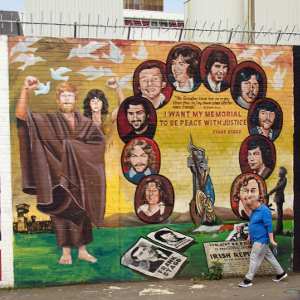
The Irish Republican Army (IRA) hunger strike is called off at Long Kesh prison – later known as HM Prison Maze – on October 3, 1981. While the IRA does not win immediate concessions, in some ways it is a Pyrrhic victory for Margaret Thatcher’s government. It galvanises support and membership for the IRA and generates huge sympathy for the strikers in the United States where fund-raising is a major priority. The death of the first hunger striker, Bobby Sands, creates a martyr and an iconic figure.

In January 1981, prison authorities begin to supply the prisoners with officially issued civilian clothing, whereas the prisoners demand the right to wear their own clothing. On February 4, the prisoners issue a statement saying that the British government has failed to resolve the crisis and declares their intention of a hunger strike. The hunger strike begins on March 1, when Bobby Sands, the IRA’s former officer commanding (OC) in the prison, refuses food. Unlike the first hunger strike the previous year, the prisoners join one at a time and at staggered intervals, which they believe would arouse maximum public support and exert maximum pressure on Prime Minister Margaret Thatcher.

The republican movement initially struggles to generate public support for the second hunger strike. The Sunday before Sands begins his strike, 3,500 people march through west Belfast. During the first hunger strike four months earlier, the marchers had numbered 10,000. Five days into the strike, Independent Republican MP for Fermanagh and South Tyrone Frank Maguire dies, resulting in a by-election. There is debate among nationalists and republicans regarding who should contest the election. After negotiations they agree not to split the nationalist vote by contesting the election and Sands stands as an Anti H-Block candidate against Ulster Unionist Party candidate Harry West. Following a high-profile campaign, the election takes place on April 9, and Sands is elected to the British House of Commons with 30,492 votes to West’s 29,046.

Sands’ election victory raises hopes that a settlement can be negotiated, but Thatcher stands firm in refusing to give concessions to the hunger strikers. The world’s media descends on Belfast, and several intermediaries visit Sands in an attempt to negotiate an end to the hunger strike, including Síle de Valera, granddaughter of Éamon de Valera, Pope John Paul II‘s personal envoy John Magee, and European Commission of Human Rights officials. With Sands close to death, the government’s position remains unchanged.

On 5 May, Sands dies in the prison hospital on the 66th day of his hunger strike, prompting rioting in nationalist areas of Northern Ireland. More than 100,000 people line the route of his funeral, which is conducted with full IRA military honours. Margaret Thatcher shows no sympathy for his death.

In the two weeks following Sands’ death, hunger strikers Francis Hughes, Raymond McCreesh and Patsy O’Hara die. Following the deaths of Joe McDonnell and Martin Hurson, the families of some of the hunger strikers attend a meeting on July 28 with Catholic priest Father Denis Faul. The families express concern at the lack of a settlement to the priest, and a decision is made to meet with Gerry Adams later that day. The following day Adams holds a meeting with six of the hunger strikers to outline a proposed settlement on offer from the British government should the strike be brought to an end. The six men reject the settlement, believing that accepting anything less than the “Five Demands” would be a betrayal of the sacrifice made by Bobby Sands and the other hunger strikers who had died.

The hunger strike begins to break on July 31, when the mother of Paddy Quinn insists on medical intervention to save his life. The following day Kevin Lynch dies, followed by Kieran Doherty on August 2, Thomas McElwee on August 8 and Michael Devine on August 20. On September 6, the family of Laurence McKeown becomes the fourth family to intervene and asks for medical treatment to save his life, and Cahal Daly issues a statement calling on republican prisoners to end the hunger strike.

The strike is called off at 3:15 PM on October 3, 1981. Three days later, James Prior, the new Secretary of State for Northern Ireland, announces partial concessions to the prisoners including the right to wear their own clothes at all times. The only one of the “Five Demands” still outstanding is the right not to do prison work. Following sabotage by the prisoners and the Maze Prison escape in 1983, the prison workshops are closed, effectively granting all of the “Five Demands” but without any formal recognition of political status from the government.

(Pictured: A Belfast mural of the Long Kesh hunger strikers)


Leave a comment

Birth of Artist Thomas James Carr

Thomas James Carr, British artist who is associated with the Euston Road School in the 1930s and has a long career as a painter of domestic scenes and landscapes, is born in Belfast to a well-to-do family on September 21, 1909.

Carr attends Oundle School where his art masters include E.M.O’R. Dickey and Christopher Perkins. In 1927 Carr moves to London where he studies at the Slade School of Fine Art. After two years at the Slade, he moves to Italy and spends six months in Florence. Upon returning to London, he establishes himself as a well-regarded painter of domestic scenes.

Although essentially a realist painter, Carr is included in the 1934 Objective Abstractionists exhibition at Zwemmer’s Gallery. In 1937, he shares an exhibition with Victor Pasmore and Claude Rogers at the Storran Gallery and subsequently becomes associated with the representational style of the Euston Road School. Starting in 1940, at Georges Wildenstein‘s gallery, he holds a series of one-man exhibitions at various galleries including at the Leicester Galleries, The Redfern Gallery and also at Thomas Agnew & Sons.

In 1939, Carr returns to Northern Ireland and settles in Newcastle, County Down. During the World War II, he receives a small number of commissions from the War Artists’ Advisory Committee to depict parachute manufacture and the Short Sunderland flying boats being built at the Short Brothers factory in Belfast.

After the war, Carr teaches at the Belfast College of Art and moves to Belfast in 1955. After the death of his wife in 1995, he moves to Norfolk, England to be nearer one of his three daughters and her family. He continues to paint into old age and tends to concentrate on landscape painting.

Carr is a regular exhibitor at the Royal Academy of Arts and is a member of the Royal Ulster Academy, the New English Art Club, the Royal Watercolour Society and is an honorary member of the Royal Hibernian Academy. Queen’s University awards him an honorary doctorate in 1991. For his services to art in Northern Ireland, he is awarded the MBE in 1974 and receives an OBE in 1993.

Thomas Carr dies at the age of 89 in Norwich, England on February 17, 1999.

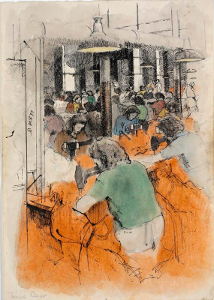
(Pictured: “Making Coloured Parachutes” by Thomas James Carr (http://www.iwm.org.uk/collections/item/object/4674) [Public domain], via Wikimedia Commons)


Leave a comment

Birth of Singer-Songwriter Van Morrison

Sir George Ivan Morrison, best known as Van Morrison, Northern Irish singer-songwriter, instrumentalist and producer, is born on August 31, 1945 in Bloomfield, Belfast, Northern Ireland. He is the only child of George Morrison, a shipyard electrician, and Violet Stitt Morrison, who had been a singer and tap dancer in her youth.
Known as “Van the Man,” Morrison starts his professional career when, as a teenager in the late 1950s, he plays a variety of instruments including guitar, harmonica, keyboards and saxophone for various Irish showbands, covering the popular hits of the time. He rises to prominence in the mid-1960s as the lead vocalist of the Northern Irish R&B band Them, with whom he records the garage band classic “Gloria.” His solo career begins under the pop-hit oriented guidance of Bert Berns with the release of the hit single “Brown Eyed Girl” in 1967. After Berns’ death, Warner Bros. Records buys out his contract and allows him three sessions to record Astral Weeks (1968). Though this album gradually garners high praise, it is initially a poor seller.

Moondance (1970) establishes Morrison as a major artist, and he builds on his reputation throughout the 1970s with a series of acclaimed albums and live performances. He continues to record and tour, producing albums and live performances that sell well and are generally warmly received, sometimes collaborating with other artists, such as Georgie Fame and The Chieftains.

Much of Morrison’s music is structured around the conventions of soul music and R&B, such as the popular singles “Brown Eyed Girl,” “Jackie Wilson Said (I’m in Heaven When You Smile),” “Domino” and “Wild Night.” An equal part of his catalogue consists of lengthy, loosely connected, spiritually-inspired musical journeys that show the influence of Celtic tradition, jazz and stream of consciousness narrative, such as the album Astral Weeks and the lesser-known Veedon Fleece and Common One. The two strains together are sometimes referred to as “Celtic soul.”

Van Morrison has received six Grammy Awards, the 1994 Brit Award for Outstanding Contribution to Music, and has been inducted into both the Rock and Roll Hall of Fame and the Songwriters Hall of Fame. In 2016, he is knighted for his musical achievements and his services to tourism and charitable causes in Northern Ireland.

(Pictured: Van Morrison performing at Glasgow Royal Concert Hall on January 26, 2015 | Image: Getty)


Leave a comment

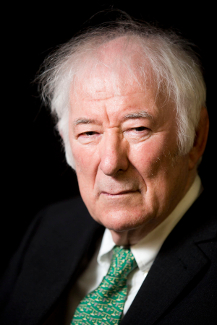
Death of Poet Seamus Heaney, Nobel Prize Recipient

Seamus Justin Heaney, Irish poet, playwright, translator and lecturer, dies in Dublin on August 30, 2013. He is the 1995 recipient of the Nobel Prize in Literature.

Heaney is born near Castledawson, County Londonderry, in Northern Ireland. The family moves to nearby Bellaghy when he is a boy. After attending Queen’s University Belfast, Heaney becomes a lecturer at St. Joseph’s College in Belfast in the early 1960s and begins to publish poetry. He lives in Sandymount, Dublin from 1976 until his death. He also lives part-time in the United States from 1981 to 2006. Heaney is recognised as one of the principal contributors to poetry during his lifetime.

Heaney is a professor at Harvard University from 1981 to 1997, and its Poet in Residence from 1988 to 2006. From 1989 to 1994, he is also the Professor of Poetry at the University of Oxford. In 1996, he is made a Commandeur de l’Ordre des Arts et des Lettres. Other awards that he receives include the Geoffrey Faber Memorial Prize (1968), the E. M. Forster Award (1975), the PEN Translation Prize (1985), the Golden Wreath of Poetry (2001), the T. S. Eliot Prize (2006) and two Whitbread Book Awards (1996 and 1999). In 2011, he is awarded the Griffin Poetry Prize and, in 2012, a Lifetime Recognition Award from the Griffin Trust for Excellence in Poetry. His literary papers are held by the National Library of Ireland.

American poet Robert Lowell describes Heaney as “the most important Irish poet since Yeats,” and many others, including the academic John Sutherland, have said that he is “the greatest poet of our age.” Robert Pinsky has stated that “with his wonderful gift of eye and ear Heaney has the gift of the storyteller.” Upon his death in 2013, The Independent describes him as “probably the best-known poet in the world.” One of his best-known works is Death of a Naturalist, published in 1966.

Seamus Heaney dies in the Blackrock Clinic in Dublin on August 30, 2013, aged 74, following a short illness. After a fall outside a restaurant in Dublin, he enters the hospital for a medical procedure, but dies at 7:30 the following morning before it takes place. His funeral is held in Donnybrook, Dublin, on the morning of September 2, 2013, and he is buried in the evening in the Cemetery of St. Mary’s Church, Bellaghy, County Londonderry, Northern Ireland, in the same graveyard as his parents, young brother, and other family members. His son Michael reveals at the funeral mass that his father texted his final words, “Noli timere” (Latin: “Do not be afraid”), to his wife, Marie, minutes before he died. Shortly after Heaney’s death, graffiti artist Maser paints a mural in Dublin referencing this message.

On September 1, the day after his death, a crowd of 81,553 spectators applaud Heaney for three minutes at a semi-final match of the 2013 All-Ireland Senior Football Championship. His funeral is broadcast live the following day on RTÉ television and radio and is streamed internationally at RTÉ’s website. RTÉ Radio 1 Extra transmits a continuous broadcast, from 8:00 AM until 9:15 PM on the day of the funeral, of his Collected Poems album, recorded in 2009. His poetry collections sell out rapidly in Irish bookshops immediately following his death.


Leave a comment

Death of Samuel Nielson, Society of United Irishmen Founder Member

Samuel Neilson, one of the founder members of the Society of United Irishmen and the founder of its newspaper the Northern Star, dies in Poughkeepsie, New York on August 29, 1803.

Neilson is born in Ballyroney, County Down, the son of Presbyterian minister Alexander, and Agnes Neilson. He is educated locally. He is the second son in a family of eight sons and five daughters. At the age of 16, he is apprenticed to his elder brother, John, in the business of woolen drapery in Belfast. Eight years later he establishes his own business.

Despite his commercial success, Neilson is naturally drawn to politics and is early on a member of the reformist Irish Volunteers movement. In 1791, inspired by the French Revolution, he suggests to Henry Joy McCracken the idea of a political society of Irishmen of every religious persuasion. He establishes the Society of United Irishmen in Belfast. The following year he launches the newspaper of the United Irishmen, the Northern Star, which effectively throws away his fortune. As its editor he is a high-profile target for the authorities and is prosecuted for libel several times, being twice imprisoned between 1796 and 1798.

Along with several other state prisoners, Neilson is released in February 1798 following several petitions by influential friends, on grounds of bad health. Upon release he immediately involves himself in the United Irishmen aligning with the radicals among the leadership who are pressing for immediate rebellion and oppose the moderates who wish to wait for French assistance before acting.

The United Irishmen are however, severely penetrated by informants who keep Dublin Castle abreast of their plans and discussions. In March 1798, information of a meeting of the United Irish executive at the house of Oliver Bond leads to the arrest of most of the leadership, leaving Neilson and Lord Edward FitzGerald as the only figures of national importance still at liberty. They decide to press ahead as soon as possible and settled on May 23 as the date for the rebellion to begin.

As the date looms closer, the authorities go into overdrive to sweep up the rump leadership and on May 18 Lord Edward is betrayed in his hiding place and critically wounded while resisting capture. Neilson, now with responsibility for finalising plans for the looming rebellion, decides that Fitzgerald is too valuable to do without, and decides to try and rescue him from Newgate Prison in Dublin. Wary of confiding his plans too early for fear of betrayal, Neilson goes on a reconnaissance of the prison but is spotted by chance by one of his former jailers and after a fierce struggle, he is overpowered and dragged into the prison.

Neilson is indicted for high treason and held in Kilmainham Gaol with other state prisoners for the duration of the doomed rebellion outside. After the execution of Oliver Bond, and the brothers John and Henry Sheares, Neilson and the remaining prisoners agree to provide the authorities with details of the organisation of the United Irishmen, plans for the rebellion, etc. in return for exile.

Following the suppression of the rebellion, Neilson is transferred to Fort George in Inverness-shire, Scotland, and in 1802 he is deported to the Netherlands. From there he makes his way to the United States, arriving in December 1802, and settling in Poughkeepsie, New York.  He has little time to enjoy his liberty before his sudden death on August 29, 1803, of yellow fever, or possibly a stroke.

Nielson is not idle during his short life in America as he completes plans to start a new evening newspaper in Poughkeepsie and also has plans in the works to establish a version of the Society of United Irishmen in the United States. Since his death, his remains have been moved to three different cemeteries before coming to rest in the Poughkeepsie Rural Cemetery in 1880.

(Photograph: (c) National Museums Northern Ireland; Supplied by The Public Catalogue Foundation)


Leave a comment

Launch of the RMS Oceanic

RMS Oceanic, the White Star Line‘s first liner built by Harland & Wolff in Belfast, is launched on August 27, 1870, arriving in Liverpool, England for her maiden voyage on February 26, 1871.

Three sister ships are constructed in rapid succession: RMS Atlantic, SS Baltic, and SS Republic. All are of the same approximate dimensions with differences in tonnage.

Powered by a combination of steam and sail, RMS Oceanic has twelve boilers generating steam for a single four-cylinder compound steam engine. A single funnel exhausts smoke and four masts carry sails. The hull is constructed of iron and divided into eleven watertight compartments. Passenger accommodations are located on the two decks concealed within the hull. RMS Oceanic can carry 166 First Class passengers, referred to as Saloon Passengers in the day and 1,000 Steerage Passengers, along with a 143-man crew. White Star spares no expense in her construction, and the contemporary press describes the ship as an “imperial yacht.”

RMS Oceanic leaves Liverpool for her maiden voyage on March 2, 1871 carrying only 64 passengers, under Captain Sir Digby Murray. Not long after departing, she has to return because of overheated bearings. Her voyage restarts on March 16. From that point onward, RMS Oceanic is a success for The White Star Line.

In January, 1872, RMS Oceanic undergoes a refit, during which a large forecastle is added to help prevent the bow being inundated during high seas. Two new boilers are added to increase steam pressure and thus engine power, and the four masts are shortened.

RMS Oceanic continues sailing with the White Star line on the Liverpool to New York City route until March 11, 1875, when she is chartered to the Occidental & Oriental Steamship Company, for service between San Francisco, Yokohama and Hong Kong. White Star provides the officers, while the crew is Chinese. The ship itself remains in White Star colours, but flies the O&O flag. During the repositioning voyage from Liverpool to Hong Kong, RMS Oceanic sets a speed record for that route. Later, she also sets a speed record for Yokohama to San Francisco in December 1876, and then breaks her own record over that route in November, 1889, with a time of 13 days, 14 hours and 5 minutes.

On August 22, 1888, RMS Oceanic collides with the coastal liner SS City of Chester just outside the Golden Gate. The SS City of Chester sinks, killing 16 on board.

On January 7, 1890, Nellie Bly boards RMS Oceanic in Yokohama to cross the Pacific as part of her voyage Around the World in Seventy-Two Days. She arrives in San Francisco on January 21, 1890, which is a day behind schedule as a result of rough weather.

In 1895, RMS Oceanic is returned to White Star, which plans to put her back into service. She is sent back to Harland and Wolff for re-engining, but when the ship is inspected closely, it is found to be uneconomical to perform all the work needed. Instead, RMS Oceanic is sold for scrap, leaving Belfast for the last time on February 10, 1896, under tow, for a scrapyard on the River Thames.


1 Comment

Death of James Napper Tandy, Irish Revolutionary

James Napper Tandy, Irish revolutionary and member of the Society of United Irishmen, dies in Bordeaux, France on August 24, 1803.

A Dublin Protestant and the son of an ironmonger, Tandy is baptised in St. Audoen’s Church on February 16, 1739. He attends the Quaker boarding school in Ballitore, County Kildare. He starts life as a small tradesman. Turning to politics, he becomes a member of Dublin Corporation and is popular for his denunciation of municipal corruption and his proposal of a boycott of English goods in Ireland in retaliation for the restrictions imposed by the government on Irish commerce.

Tandy and John Binns persuade Dublin Corporation to condemn by resolution William Pitt the Younger‘s amended commercial resolutions in 1785. He becomes a member of the Whig club founded by Henry Grattan, and he actively co-operates with Theobald Wolfe Tone in founding the Society of United Irishmen in 1791, of which he becomes the first secretary.

Sympathy with the French Revolution is rapidly spreading in Ireland. A meeting of some 6,000 people in Belfast votes a congratulatory address to the French nation in July 1791. In the following year, Tandy takes a leading part in organising a new military association in Ireland modelled after the French National Guard. Tandy also, with the purpose of bringing about a fusion between the Defenders and the United Irishmen, took the oath of the Defenders, a Roman Catholic society whose agrarian and political violence had been increasing for several years.

Tandy is about to be tried in 1793 for distributing a seditious pamphlet in County Louth when the government discovers he has taken the oath of the Defenders. Being threatened with prosecution for this step, and also for libel, he takes refuge by changing his Dublin address often until he flees to the United States in 1795, where he remains until 1798. In February 1798 he goes to Paris, where a number of Irish refugees are assembled and planning rebellion in Ireland to be supported by a French invasion but quarrelling among themselves over tactics.

Tandy accepts the offer of a corvette, the HMS Anacreon, from the French government and sails from Dunkirk accompanied by a few United Irishmen, a small force of men and a considerable quantity of arms and ammunition for distribution in Ireland. He arrives at the isle of Arranmore, off the coast of County Donegal, on September 16, 1798.

Tandy takes possession of the village of Rutland, where he hoists an Irish flag and issues a proclamation. He soon discovers that the French expedition of General Jean Joseph Amable Humbert to aid the Irish rebellion has failed. He sails his vessel around the north of Scotland to avoid the British fleet. He reaches Bergen in safety having brought with him a British ship captured along the way. Tandy then made his way with three or four companions to the free port of Hamburg but a peremptory demand from the British government to detain the fugitives was acceded to despite a counter-threat from the French Directory. In 1799 HMS Xenophon, under Commander George Sayer, brings Tandy and some of his associates back to England as state prisoners.

On February 12, 1800, Tandy is put on trial at Dublin and is acquitted. He remains in prison in Lifford Gaol in County Donegal until April 1801, when he is tried for the treasonable landing on Rutland Island. He pleads guilty and is sentenced to death although he is reprieved and allowed to go to France.

In France, where his release is regarded as a French diplomatic victory, he is received, in March 1802, as a person of distinction. When he dies on August 24, 1803, in Bordeaux, his funeral is attended by the military and an immense number of civilians. James Napper Tandy is buried in his family’s burial crypt, St. Mary’s churchyard, Julianstown, County Meath. His fame is perpetuated in the Irish ballad The Wearing of the Green.


2 Comments

The Central Hotel Fire

A fire breaks out at the Central Hotel at the seaside resort of Bundoran, County Donegal, on August 8, 1980, killing ten people including both locals and holiday makers.

Just after midnight on Friday, August 8, 1980, a call is made to the emergency services after a fire has been discovered in a small corridor to the back of the main bar, and spreading towards the main staircase used by the hotel’s guests. The fire breaks out at the height of the summer season, with sixty guests, mainly couples and families, booked in on the night, while a function is also taking place in the main dance hall of the hotel.

Initially, the town’s own fire brigade is dispatched, and is to be aided by other units from across the northwest including Ballyshannon, Donegal, Killybegs, Letterkenny and Manorhamilton. As panic spreads throughout the town, many locals and holiday makers rush to the hotel in an effort to rescue some of those who have been trapped inside, with people jumping from the upper floors of the building into blankets held by those below.

The fire spreads rapidly and burns so intensely that cars parked on the street outside burst into flames. Ambulances are sent from Ballyshannon and Sligo to bring the many injured to hospital, while the fire brigade fights the blaze throughout the night.

The fire brigade and Garda forensic experts launch an investigation into the blaze, as the remains of the hotel smoulder for several days afterwards. The fire kills five adults and five children, including the entire Brennan family from Naas, County Kildare, while the body of a Belfast baby, Nicola Lamont, is never found in the rubble.

Despite calls from the victims’ families and Dáil Éireann debates for a public enquiry into the circumstances surrounding the fire, similar to that held after the Stardust fire several months later, none is ever held. Calls for an investigation are made again in 2002, when Fine Gael Senator Jim Higgins calls for the Garda handling of the fire to be investigated as part of the Morris Tribunal, an enquiry into police corruption in County Donegal. Higgins says that the fire warrants inclusion in the tribunal’s work as claims had been made by the owner of the hotel that Gardaí had tampered with the evidence. However, the terms of reference are not extended to include the fire.

The tragedy is covered as part of the RTÉ television series Disaster in the summer of 2007.

At the time of the tragedy, it is one of the worst fires in Irish history. The Bundoran fire is not commemorated physically for a long time, although in the aftermath of the RTÉ programme the town council votes in favour of a memorial plaque to the ten victims. There is reluctance to place a plaque on the site of the fire from both councillors and members of the new hotel’s board. The site of the Central Hotel lay vacant for several years, but is now occupied by the Grand Central Hotel and Apartments.

However, on Sunday, August 8, 2010, a memorial to those who died in the hotel fire is unveiled in the town, exactly 30 years after the tragedy. Families and relatives of the victims attend prayer services in two churches and an unveiling of the memorial bench with the names of the victims inscribed on it.


Leave a comment

Birth of Poet Michael Longley

Michael Longley, one of Northern Ireland’s foremost contemporary poets, is born in Belfast on July 27, 1939. He is educated at the Royal Belfast Academical Institution and subsequently reads Classics at Trinity College, Dublin, where he edits the student literary magazine Icarus.

Longley is renowned for the quiet beauty of his compact, meditative lyrics. Known for using classical allusions to cast provocative light on contemporary concerns, including Northern Ireland’s “Troubles,” his poetry is also marked by sharp observation of the natural world, deft use of technique, and deeply felt emotion. His debut volume, No Continuing City (1969), heralds the arrival of a new talent from a region which has already produced recognized talents like Seamus Heaney and Derek Mahon. However, his early influences are English poets like Philip Larkin, Louis MacNeice, and the First World War poets, as well as masters from the classical tradition. The critic Langdon Hammer describes Longley’s poems as masterpieces of “lucidity, economy, sincerity…by means of meticulous, unpretentious technique.”

Longley’s work engages diverse subjects, including Homeric literature, the landscape of Carrigskeewaun, jazz, Walter Mitty, and the politics of Northern Ireland. On the public and political responsibilities of being a Northern Irish poet, he says, “Though the poet’s first duty must be to his imagination, he has other obligations, and not just as a citizen. He would be inhuman if he did not respond to tragic events in his own community, and a poor artist if he did not seek to endorse that response imaginatively.” Reviewing his Selected Poems (1993), critic Fran Brearton praises in particular Longley’s more political poems, noting his “use of a compassionate yet unsentimental voice, and an attention to detail which restores specificity at a point in history when it is most in danger of being lost in abstraction – numbers, dates, death-tolls counted beyond comprehension.”

After a 12-year publishing silence, Longley’s 1991 return, Gorse Fires, wins the Whitbread Poetry Prize. Subsequently, The Weather in Japan (2000) wins The Irish Times Literature Prize for Poetry, the Hawthornden Prize, and the T.S. Eliot Prize. Other publications include Snow Water (2004) and Collected Poems (2006). In 2001 Longley is awarded the Queen’s Gold Medal for Poetry. He is a fellow of the Royal Society of Literature.

Longley is Professor of Poetry for Ireland from 2007 to 2010, a cross-border academic post set up in 1998, previously held by John Montague, Nuala Ní Dhomhnaill, and Paul Durcan. He is succeeded in 2010 by Harry Clifton.