Whelan is the sixth of thirteen children born to farmer John Whelan and Bridget Price. He attends national school at Beleek and Clifden, before leaving school at the age of 15 to work on his father’s farm. He moves to Dublin at the age of 18, where he finds work as a railway man, and joins the Irish Volunteers as a member of ‘A’ Company, 3rd Battalion, Dublin Brigade. He lives at Barrow Street, Ringsend, Dublin, and works at a train depot.
Whelan is arrested on November 23, 1920, and, on February 1, 1921, is charged with the shooting death of Captain G.T. Baggallay, an army prosecutor who had been a member of courts that sentenced Volunteers to death under the Restoration of Order in Ireland Act on Bloody Sunday (1920).
Whelan is defended at his court-martial by Michael Noyk, through whom he protests his innocence of the charges. As in the case of Patrick Moran, there is eyewitness evidence that Whelan had been at Mass at the time the shooting had taken place.
The prosecution casts doubt on the reliability of the eyewitnesses, arguing that as Catholics they are not neutral. The defence complains that it is unfair to suggest the witnesses “were prepared to come up and perjure themselves on behalf of the prisoner” because “they belonged to a certain class and might hold certain political opinions.”
The military court does, however, trust the evidence of an army officer who lives in the same house as Baggallay and who has identified Whelan as the man covering him with a revolver during the raid. There is also testimony by a soldier who had passed by the house when he heard shots fired. This witness says he saw Whelan outside, attempting to start his motorcycle. Whelan is found guilty of murder and sentenced to death.
In Mountjoy Prison, Whelan is imprisoned with the writer and activist Ernie O’Malley, who describes him as “… smooth-faced, quiet and brown eyed with wavy hair; he smiled quietly and steadily. His voice was soft and when he laughed with the others one knew that the fibre was not as hard and that there was a shade of wistfulness about him.”
Whelan is quoted just before being hanged, “Give the boys my love. Tell them to follow on and never surrender. Tell them I am proud to die for Ireland.”
Whelan is hanged at 6:00 a.m. along with Patrick Moran, the first of six men to be executed in pairs that day. A crowd estimated at 40,000 gathers outside the prison to pray as the executions take place. His mother, Bridget, sees him before his execution and waits outside with the praying crowd holding candles. She tells a reporter that she had left her son “so happy and cheerful you would almost imagine he was going to see a football match.” He is 22 years old at the time of his death.
Following the Two for One policy that decrees the assassination of two members of the Royal Irish Constabulary (RIC) in retaliation for every executed Irish Volunteer, the Irish Republican Army (IRA) in Whelan’s native Clifden ambushes and fatally shoots RIC Constables Charles Reynolds and Thomas Sweeney at Eddie King’s Corner on March 16, 1921. In response to the RIC’s request for assistance over the wireless, a trainload of Black and Tans arrive in Clifden from Galway in the early hours of Saint Patrick’s Day, March 17, 1921, and proceed to “burn, plunder and murder.” During what is now called “The Burning of Clifden,” the Black and Tans kill one local civilian (John McDonnell), seriously injure another, burn down fourteen houses, and damaged several others.
Whelan is one of a group of men hanged in Mountjoy Prison in the period 1920-1921 who are commonly referred to as the Forgotten Ten. In 2001, he and the other nine, including Kevin Barry, are exhumed from their graves in Mountjoy Prison and given a full state funeral. He is now buried in Glasnevin Cemetery, Dublin. An annual commemoration is still held in Clifden in his honor.
(Pictured: Patrick Moran (left) and Thomas Whelan (right) before their executions, Mountjoy Prison, Dublin, March 14, 1921, courtesy of Kilmainham Gaol Museum.)
Christened as William O’Brien, the seventh child of Arthur O’Brien, clerk, and Mary O’Brien (née Christie), who is from County Meath, Ó Briain takes an interest in the Irish language from an early age and begins learning Irish by himself from a grammar book, as it is not encouraged by his teachers at the Christian Brothers’ O’Connell School nor spoken by his parents. While still at the O’Connell School, he starts using the Irish version of his name. He also attends meetings of the Gaelic League, then attends University College Dublin (UCD) on a scholarship, where he studies French, English and Irish, receiving a BA (1909) and an MA (1910).
UCD decides to start awarding one annual scholarship for overseas travel in 1911, and Ó Briain wins the first one, using it to visit Germany and study under Kuno Meyer and Rudolf Thurneysen. After three years, he returns home, where he rejoins the Gaelic League and begins teaching French at UCD. He also joins the Irish Volunteers then, the following year, Seán T. O’Kelly convinces him to join the Irish Republican Brotherhood (IRB).
Around this time, Ó Briain joins Sinn Féin, and he stands unsuccessfully for the party in Mid Armagh at the 1918 United Kingdom general election in Ireland, taking 5,689 votes. His campaign leads, indirectly, to his arrest and three months in jail in Belfast. In 1920, following his release, he is appointed a judge in the then-illegal republican court system in Galway, and visits both France and Italy to try to source weapons for the Irish Republican Army (IRA). In November 1920, he is arrested in the UCG dining room by Black and Tans, and is imprisoned for thirteen months, first in Galway and then in the Curragh camp in County Kildare, thereby missing the conclusion of the Irish War of Independence. By the time he is released, the Anglo-Irish Treaty has been signed. He supports the treaty and takes no further part in militant activity.
In the newly independent Ireland, Ó Briain remains a professor at Galway. He also stands in the 1925 Seanad election, although he is not successful. He is the founding secretary of the Taibhdhearc na Gaillimhe theatre, also acting in many of its productions, and spends much time translating works from English and the Romance languages into Irish. He stands to become president of UCG in 1945, but is not elected, and in the 1940s and 1950s is best known for his many appearances on television and radio.
From his retirement in 1959, Ó Briain lives in Dublin. In 1974, the National University of Ireland (NUI) confers an honorary doctorate on him. He dies on August 12, 1974, at St. Gabriel’s Hospital, Cabinteely, County Dublin. His funeral to Glasnevin Cemetery is almost a state occasion, with a huge attendance of public figures, and a military firing party at the graveside, where the oration is given by Micheál Mac Líammóir and a lesson is read by Siobhán McKenna. For days after his death, the newspapers carry tributes to his many-sided career and personality. On the one hundredth anniversary of his birth, Proinsias Mac Aonghusa and Art Ó Beoláin write commemorative articles in Feasta.
On September 1, 1921, Ó Briain marries Helen Lawlor, of Dublin, who dies two years before him. The couple’s only child is Eibhlín Ní Bhriain, who is a journalist for The Irish Times and other periodicals.
In effect a special extension of the Defence of the Realm Acts, the aim of the Act is to increase convictions of nationalist rebels while averting the need to declare martial law. Under Section 3(6) of the Act, military authorities are empowered to jail any Irish person without charge or trial. Secret courts-martial are established, and lawyers (appointed by Crown agents) can be present only if the death penalty is involved. Inquests of military or police actions are banned.
By the middle of 1920, Ireland is in the throes of a full-fledged rebellion that is barely recognized by the British Government in Ireland headquartered in Dublin Castle. The Irish Republican Army (IRA), the military arm of the Dáil Éireann revolutionary government, is engaged in a guerilla campaign to destroy elements of British power, particularly burning down courthouses and attacking members of the Royal Irish Constabulary (RIC), Britain’s police force in the countryside.
The British response to the increase in violence and the assassination of police officers is twofold. To suppress the IRA “murderers,” Major GeneralHugh Tudor, commander of the RIC and self-styled “Chief of Police,” begins supplementing that body with the employment of World War I veterans known as the “Black and Tans” because of the colour of their surplus World War I uniforms, and an additional temporary force of Auxiliaries. With little discipline and utter indifference to the plight or moral indignation of the Irish population, these groups raid and burn villages, creameries, and farm buildings to intimidate supporters of the IRA.
The second measure is the enactment of the Restoration of Order in Ireland Act (ROIA). The Act is envisioned as a remedy to the problem perceived by Chief Secretary for Ireland Sir Hamar Greenwood that “throughout the greater part of Ireland criminal justice can no longer be administered by the ordinary constitutional process of trial by judge and jury.”
The genesis of the Act may be seen in a Cabinet discussion on May 31, 1920, in which the members focus on the violence in Ireland. Rather than addressing violence as the product of rebellion, Greenwood insists that, “The great task is to crush out murder and arson.” He asserts that the violence is perpetrated by handsomely paid thugs. Commenting on a pending Irish bill, Secretary of State for WarWinston Churchill states, “You should include in the Bill a special tribunal for trying murderers. It is monstrous that we have some 200 murders, and no one hung.” The prime minister agrees that convicted murderers should be hanged but questions whether convictions can be obtained from Catholics. The concern of all is that the civil courts are incapable of strictly administering justice to the revolutionaries because the juries largely consisted of Irish Catholics. The ensuing discussion of possibly imposing court-martial jurisdiction is inconclusive.
After the May 31 meeting, Greenwood investigates the feasibility of imposing martial law in Ireland and raises martial law as the specific subject of a July 23, 1920, conference committee meeting of the Cabinet led by Prime MinisterDavid Lloyd George to which the key members of the Dublin Castle administration are invited. William E. Wylie, the law advisor at Dublin Castle, notes that the RIC is disintegrating through resignations brought on by terrorist attacks, and that with “regard to the Civil Courts, the entire administration of the Imperial Government had ceased.” The civilian participants from Dublin Castle, especially Wylie, maintain that martial law is counter-productive, and will only antagonize the Irish people. As an alternative to martial law, General Tudor argues for the imposition of court-martial jurisdiction. Tudor argues forcefully that court-martial jurisdiction over all crimes will support the Black and Tans and Auxiliaries that he is recruiting. He declaims that “not a single criminal had been brought to justice for murder.” Lloyd George closes the discussion directing the Dublin Castle participants to provide final proposals for enforcement of the laws.
A draft bill to establish military criminal jurisdiction is considered by the Cabinet on July 26. The prime minister’s most telling contribution is his question as to whether a convicted man would be shot or hanged. It appears that he is comforted by the response that the defendant will be tried under the ordinary law which implies death by hanging. The resulting bill is completed by July 30, 1920, and is then quickly pushed through Parliament and receives royal assent on August 9, 1920. The ROIA provides that all crimes punishable under the laws in Ireland can be brought before a court-martial. The court-martial will have the power to impose any punishment authorized by statute or common law including the death penalty. The final step is taken on August 20, 1920, when the final regulations for implementation go into effect.
The combination of growing police and military pressure and recourse to the ROIA lead to increased internments of known or suspected IRA members and a steady increase in convictions to 50-60 per week. This makes it more difficult for IRA soldiers to continue openly working day jobs while carrying on part-time guerrilla activities. As a result, the IRA shifts its approach to guerrilla warfare in the rural counties. Volunteers from IRA units are organized into elite, full-time, mobile flying columns of around 25 men who live off the land and on the run. These flying columns prove to be more suited to ambushes of patrols and convoys and other targets of opportunity, rather than attacks on barracks which had become better defended.
On December 10, 1920, martial law is proclaimed in counties Cork, Kerry, Limerick, and Tipperary. In January 1921 martial law is extended to counties Clare and Waterford.
In a crucial judgement, R (Egan) v Macready, the Irish courts rule that the Act does not give power to impose the death penalty. This would no doubt have proved politically contentious had not hostilities ended the same day.
Despite its name, the courts are of the view that ROIA applies in England as well. Following the creation of the Irish Free State, when the Act is repealed by implication, it is still used to deport ex-members of the Irish Self-Determination League to Ireland.
In September 1919, the Commander-in-Chief, Ireland, Sir Frederick Shaw, suggests that the police force in Ireland be expanded via the recruitment of a special force of volunteer British ex-servicemen. During a Cabinet meeting on May 11, 1920, the Secretary of State for War, Winston Churchill, suggests the formation of a “Special Emergency Gendarmerie, which would become a branch of the Royal Irish Constabulary.” Churchill’s proposal is referred to a committee chaired by General Sir Nevil Macready, Commander-in-Chief of the British forces in Ireland. Macready’s committee rejects Churchill’s proposal, but it is revived two months later, in July, by the Police Adviser to the Dublin Castle administration in Ireland, Major-General Henry Hugh Tudor. In a memo dated July 6, 1920, Tudor justifies the scheme on the grounds that it will take too long to reinforce the Royal Irish Constabulary (RIC) with ordinary recruits. Tudor’s new “Auxiliary Force” is to be strictly temporary with its members enlisting for a year. Their pay is to be £7 per week (twice what a constable is paid), plus a sergeant’s allowances, and are to be known as “Temporary Cadets.” At that time, one of high unemployment, a London advertisement for ex-officers to manage coffee stalls at two pounds ten shillings a week receives five thousand applicants.
The Auxiliary Division is recruited in Great Britain from among ex-officers who had served in World War I, especially those who had served in the British Army (including the Royal Flying Corps). Most recruits are from Britain, although some are from Ireland, and others come from other parts of the British Empire. Many have been highly decorated in the war and three, James Leach, James Johnson, and George Onions, have been awarded the Victoria Cross (VC). Enlisted men who had been commissioned as officers during the war often find it difficult to adjust to their loss of status and pay in civilian life, and some historians have concluded that the Auxiliary Division recruited large numbers of these “temporary gentlemen.”
Piaras Béaslaí, a former senior member of the Irish Republican Army (IRA) who supports the Anglo-Irish Treaty, while paying tribute to the bravery of the Auxiliaries, notes that the force is not composed exclusively of ex-officers but contains “criminal elements,” some of whom robbed people on the streets of Dublin and in their homes.
Recruiting began in July 1920, and by November 1921, the division is 1,900 strong. The Auxiliaries are nominally part of the RIC, but actually operate more or less independently in rural areas. Divided into companies, each about one hundred strong, heavily armed and highly mobile, they operate in ten counties, mostly in the south and west, where IRA activity is greatest. They wear either RIC uniforms or their old army uniforms with appropriate police badges, along with distinctive tam o’ shanter caps. They are commanded by Brigadier-General Frank Percy Crozier.
The elite ex-officer division proves to be much more effective than the Black and Tans especially in the key area of gathering intelligence. Auxiliary companies are intended as mobile striking and raiding forces, and they score some notable successes against the IRA. On November 20, the night before Bloody Sunday, they capture Dick McKee and Peadar Clancy, the commandant and vice-commandant of the IRA’s Dublin Brigade, and murder them in Dublin Castle. That same night, they catch Liam Pilkington, commandant of the Sligo IRA, in a separate raid. A month later, in December, they catch Ernie O’Malley completely by surprise in County Kilkenny. He is reading in his room when a Temporary Cadet opens the door and walks in. “He was as unexpected as death,” says O’Malley. In his memoirs, the commandant of the Clare IRA, Michael Brennan, describes how the Auxiliaries nearly capture him three nights in a row.
IRA commanders become concerned about the morale of their units as to many Volunteers the Auxiliaries seem to be “super fighters and all but invincible.” Those victories which are won over the Auxiliaries are among the most celebrated in the Irish War of Independence. On November 28, 1920, for example, a platoon of Auxiliaries is ambushed and wiped out in the Kilmichael Ambush by Tom Barry and the 3rd Cork Brigade. A little more than two months later, on February 2, 1921, another platoon of Auxiliaries is ambushed by Seán Mac Eoin and the North Longford Flying Column in the Clonfin Ambush. On March 19, 1921, the 3rd Cork Brigade of the IRA defeats a large-scale attempt by the British Army and Auxiliary Division to encircle and trap them at Crossbarry. On April 15, 1921, Captain Roy Mackinnon, commanding officer of H Company of the Auxiliary Division, is assassinated by the Kerry IRA.
Successes require reliable intelligence and raids often bring no result — or sometimes worse. In one case, they arrest a Castle official, Law Adviser W. E. Wylie, by mistake. In another, more notorious case, on April 19, 1921, they raid the Shannon Hotel in Castleconnell, County Limerick, on a tip that there are suspicious characters drinking therein. The “suspicious characters” turn out to be three off-duty members of the RIC. Both sides mistake the other for insurgents and open fire. Three people, an RIC man, an Auxiliary Cadet and a civilian, are killed in the shootout that follows.
The Auxiliary Division is disbanded along with the RIC in 1922. Although the 1921 Anglo-Irish Treaty requires the Irish Free State to assume responsibility for the pensions of RIC members, the Auxiliaries are explicitly excluded from this provision. Following their disbandment, many of its former personnel join the Palestine Police Force in the British-controlled territory.
The anti-insurgency activities of the Auxiliaries Division have become interchangeable with those conducted by the Black and Tans, leading to many atrocities committed by them being attributed to the Black and Tans. Nevertheless, both British units remain equally reviled in Ireland.
Timothy Lyons, an Irish Republican Army (IRA) soldier also known as Aero or Aeroplane, is killed on April 18, 1923, at Clashmealcon caves, County Kerry. He fights with the Anti-Treaty side during the Irish Civil War. After a three-day siege by Irish Free State forces at Clashmealcon, County Kerry, he died after falling from a cliff onto rocks and then being shot.
Lyons is born on December 4, 1895, in Garrynagore, County Kerry, to Margaret (née Sullivan) and Timothy Lyons senior, who is listed on his birth certificate as a cottier. He is the oldest of six siblings. Prior to the Irish Civil War, he works as a labourer. He fights with the IRA’s Kilflynn Company during the Irish War of Independence. He is described as being slight, “adventurous” as a column leader and a marksman who shoots at small birds. He shoots a British officer in an ambush led by captain George O’Shea at Shannow Bridge where the Kilflynn road joins the R557, forcing a retreat. He gains the nickname “Aeroplane” or “Aero” because of the way he would suddenly appear and his last-minute escapes. Because of regular searches by Black and Tans, his father fears the family home will be burned out and asks him to leave.
After the ratification of the Anglo-Irish Treaty, Lyons fights against Irish Free State forces. At the time of his death, he is commandant. He is involved in fighting in Listowel and Limerick, is captured near Athea, gaoled in Limerick and released in late 1922 with an undertaking not to rejoin the fight. Notwithstanding this, the column continues to operate, generally around Causeway and Ballyduff.
On April 15, 1923, Lyons’s column attacks an Irish Free State raiding party in Meenoghane, north Kerry. The raiding party receives reinforcements. He and his men are eventually surrounded at nearby Clashmealcon on April 16 by Michael Hogan’s 1st Western Division. They descend the rugged, Atlantic cliffs to the caves and hide in Dumfort’s Cave. He shoots out searchlights with his Lee-Enfield rifle and two Irish Free State soldiers are shot dead from the cave. The situation is under Army Emergency Powers.
With no escape for the men hiding in the cave, troops try to blast them out by dropping mines and smoke them out with petrol-soaked turf. On April 16, James McGrath, the brother of Tom McGrath, one of Lyons’s men, is arrested and taken to the cliffs in order to enter the cave and persuade the men to surrender. On the night of April 17-18, McGrath and Patrick O’Shea, his first cousin, fall trying to scale the cliffs to escape and drown. After offering to surrender himself on the morning of the April 18, Lyons falls several metres onto rocks from a rope that is provided by National troops. He is then shot multiple times by troops from the cliff top and is not recovered.
Three of Lyons’s men who surrender, Edmond Greaney, James McEnery and British deserter-turned-republican Reginald Walter Stenning, are executed in Ballymullen Barracks by gunshot on April 25, for breaking their undertaking not to take up arms against the Irish Free State, attacking troops at Clashmealcon, burning the Civic Guard station at Ballyheigue, stripping the same Civic Guards and robbing the post office at Ballyduff.
Lyons’s decomposing body, minus a leg, is washed up on May 5, identifiable by a boot. He is buried alongside George O’Shea and Timothy Tuomey, both killed at Ballyseedy, in the republican plot at Kilflynn Church (now St. Columba’s Heritage Centre).
(Pictured: Kilflynn IRA Flying Column, 1922. Back (L to R): Denis O’Connell (Lixnaw), Stephen Fuller (Kilflynn), William Hartnett (Mountcoal), Tim Twomey (Kilflynn). Front (L to R): Terry Brosnan (Lixnaw), John McElligott (Leam, Kilflynn), Danny O’Shea (Kilflynn), Timothy (Aero) Lyons (Garrynagore), Tim Sheehy (Lyre), Pete Sullivan (Ballyduff), Paddy Mahony (Ballyegan, Battalion O.C.).)
Following the ambush, the British carry out a sweep in which they capture three of the IRA volunteers involved and kill another who had not taken part.
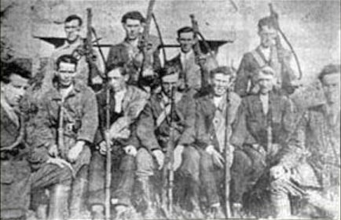
County Roscommon is not one of the more violent areas of Ireland during the conflict. The local IRA argues to their GHQ that it is very difficult to conduct guerrilla warfare in the flat open countryside there. Prior to the action at Scramogue, the biggest previous incident had been in October 1920, when four RIC officers were killed in an ambush near Ballinderry.
Sean Connolly is sent by IRA GHQ from Longford to re-organise the Roscommon IRA and chooses the ambush site at Scramoge. However, he is killed twelve days before the action, at the Selton Hill ambush in neighbouring County Leitrim.
Both the North and South Roscommon brigades of the IRA take part and are commanded by Patrick Madden. There are 39 volunteers in the flying column, but only 14 take part in the actual attack. The remainder are tasked with blocking roads to keep the IRA’s line of retreat open. The IRA party is armed with thirteen rifles (eleven Lee–Enfields, one Winchester and one sporting rifle), twenty shotguns (though some are in bad condition) and two or three Webley revolvers. This is the largest collection of arms that the IRA assembles in Roscommon during the war and some of them have been borrowed from IRA units in Longford.
Among the volunteers who take part are Martin Fallon, ‘Cushy’ Hughes, Frank Simons, Luke Duffy, Peter Casey, Peter Collins, Patrick Gallagher and Tom Compton. Several of the IRA men, including Hughes, had served in the Irish Guards (IG) in World War I, but had been persuaded by Pat Madden to join the IRA upon their return.
The ambush site is carefully prepared. It is located at a sharp bend on the Strokestown–Longford road. A farmhouse and barn at the bend have been taken over and loopholed, and a trench is dug behind a hedge alongside the road. Only a mile from the IRA’s position, the British 9th Queen’s Royal Lancers regiment is garrisoned in Strokestown House.
The IRA waits in their position all day for British forces to come from Strokestown. Just as a troop lorry finally appears, two civilians came up the road in a pony and trap and have to be frantically waved out of the way.
The lorry carries a nine-man British Army and Royal Irish Constabulary (RIC) patrol traveling on the Strokestown–Longford road. The British inquiry into the incident is to question why the lorry is unescorted, as their practice is not to travel in lone vehicles.
The IRA opens fire from very close range, killing the driver and halting the lorry in its tracks. Several of the soldiers and policemen are hit and they scrambled for cover behind a wall along the road. The lorry has a Hotchkiss machine gun bolted onto it, but its gunner gets off only one burst before being badly wounded and the gun is put out of action. The commander of the patrol, Captain Roger Grenville Peek, is hit in the lorry but tries to run to safety, only to be hit again and killed 400 yards down the road. The other officer with the party, Lieutenant Tennant, is also killed by a shotgun blast. After the death of the two officers, the surviving British, several of whom are wounded, surrender.
Just as the firing is dying down, another lorry, an RIC/Black and Tan patrol, approaches the ambush site but turns back after coming under fire.
Four of the British force are killed – this includes two British Army officers (Roger Grenville Peek and John Harold Anthony Tennant), a Royal Army Service Corps (RASC) driver, and one RIC man (Constable Edward Leslie).
Two men in civilian clothes are also found in the lorry. They turn out to be Black and Tans, Constable Buchanan and Constable Evans, who had been placed under arrest by the soldiers. They are made prisoners by the IRA. The ambush party takes the British arms, including the Hotchkiss gun, burn the lorry and make their escape over the hill of Slieve Bawn.
The IRA leaders, Pat Madden, Luke Duffy and Frank Simons, decide to murder the two Black and Tans, despite their offering to show the IRA how to use the captured machine gun. The IRA officers’ reason that if the prisoners identify the IRA men who had taken part in the ambush, the volunteers will be at risk of being executed if captured. The two are taken to remote locations and shot over the next two days.
The British garrison in Roscommon town mounts a sweep directly after the ambush with eight lorries and one Whippet tank. Three volunteers who had taken part are arrested afterward. Pat Mullooly and Brian Nagle of the North Roscommon Brigade are arrested as they try to get away from the scene of the ambush, as is “Cushy” Hughes, who is picked up when he is drawing his soldier’s pension in Roscommon. Mullooly and Nagle are badly beaten by their captors on the road to Roscommon. The next day, another volunteer, Michael Mullooly, brother of Pat Mullooly, is shot dead in his home by the RIC.
In late January, Richard O’Connell, commander of the Mid Limerick Brigadeflying column, along with Captains Sean Lynch and Morgan Portley, begin planning an ambush of an RIC convoy from the Pallas RIC headquarters. Observing their activities for several months, local Volunteer John Purcell, of Caherconlish, finds that the first Thursday of each month they send a convoy to Fedamore with the payroll for RIC constables there, about eleven miles away. They also seem to use the same route each time. Such predictability is often a fatal flaw in a guerrilla war. The ambush is set for February 3.
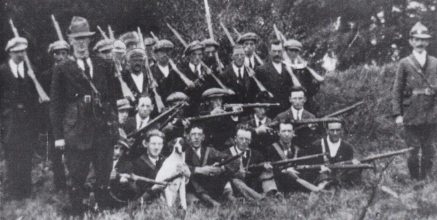
The ambush is carried out by the flying columns of the East Limerick and Mid Limerick Brigades of the IRA, some forty riflemen, under the command of Donnocha O’Hannigan, commander of East Limerick Brigade flying column, and Richard O’Connell, commander of the Mid Limerick Brigade flying column.
The ambush location is well selected. The lorries are to come from the west. There is a severe right-hand turn at Dromkeen House, where the road turns east for several hundred yards in a straight line, to an intersection that splits to the north and south. O’Hannigan puts D. Guerin, Sean Stapleton, and Maurice Meade, all of East Limerick Brigade, at the corner to be the lookouts for the convoy. There are low stonewalls along both sides of most of the road. About halfway down its length there is a cemetery and an old, ruined church on the south side.
O’Hannigan spreads his men along both sides of the road, behind the walls and in several homes along the road and sets up barricades on the forks on the eastern end of the ambush, set back so the driver will not see them until they get to the intersection. He takes up a command position in an old, ruined cottage at the intersection. In addition to O’Hannigan, John MacCarthy, David Clancy and a few other East Limerick Volunteers are in the ruined cottage.
At approximately 2:30 p.m. the lookouts near Dromkeen House let them know the lorries are approaching. The plan is to let the lead lorry reach the barricade before they open fire, expecting them to be widely spaced. They are closer together than expected, however, and the men lining the road and near Dromkeen House open fire first at the second lorry when it is near the ruins of the old church to prevent it being getting beyond them. Michael Hennessy, of the Kilfinane Company of the East Limerick Brigade, in a spot near one of the walls, later says he killed the driver of the second lorry, Constable Sidney Millin, on his first shot. Millin may have had his foot on the brake at that moment, as the lorry almost immediately stops in the middle of the road.
The sound of the firing causes the lead lorry to speed up. Turning to the left and seeing one barricade, the driver tries to turn to the right, but is going too fast. He runs into the wall and then slams into a donkey cart with a bog of flour in it, sending a cloud of flour into the air and coming to a halt.
The cloud of flour, along with the fact that they are the only RIC members in civilian clothes, apparently saves the lives of two RIC men, Constable Cox and District Inspector Sanson, who was in charge of the convoy, who are thrown clear of the cab. By the time the cloud of flour clears, two men in civilian clothes are seen running through the field. Given that Crown Forces have been known to have civilian hostages in their lorries, O’Hannigan had his men hold their fire for fear of killing a hostage, and the two escape. Many of the Volunteers later speak of Sanson with scorn for abandoning his men.
All the Volunteer participants say the firing only lasts about ten minutes, with the RIC and Black and Tans able to mount very little resistance before all eleven left in the two lorries are either dead or wounded. Of the three remaining in the first lorry, one is apparently killed very quickly by rifle fire and several grenades. The other two manage to get out and take cover but are quickly hit.
Two constables managed to get underneath the second lorry. They put up a short resistance before both are hit and killed by Volunteers Johnny Vaughan and Seán Carroll, who move into positions along the road. The only Volunteer casualty is Liam Hayes, who is later a general in the Free State Army. He has part of his left thumb and part of a finger shot off, probably by friendly fire. As the firing ends, the Volunteers come out from cover to collect the arms from the dead and wounded.
It has been claimed that three of the RIC dead were executed after they had surrendered. Particular suspicion for this alleged killing of prisoners has fallen on Maurice Meade, a former British soldier who was captured by the Germans in World War I and had joined Roger Casement‘s Irish Brigade. In reprisal, British forces burn ten homes and farms in the area.
In February 2009, up to 2,000 people turn out for the unveiling of a memorial to the ambush.
(From: “The Dromkeen Ambush: Down Into the Mire in County Limerick” by Joee Gannon, The Wild Geese, http://www.thewildgeese.irish, November 2017 | Pictured: The East Limerick Flying Column)
In 1968, O’Malley enters politics upon the sudden death of his uncle Donogh who, at that the time, is the sitting Minister for Education. He is chosen after Donogh’s widow, Hilda, still in shock at the sudden death of her husband, turns down the opportunity to contest the by-election necessitated by his death.
O’Malley is subsequently elected as a Fianna Fáil TD for the Limerick East constituency in the by-election. Perhaps the first sign of the defiance that would define his career materialises during the 1969 Irish general election when Hilda asks her nephew to step aside and allow her to contest in the Limerick East constituency as the main Fianna Fáil candidate. He refuses and places third in the four-seat constituency, with his aunt, running as an independent, coming in fifth.
Following the general election, O’Malley is appointed Parliamentary Secretary to both Minister for DefenceJim Gibbons and TaoiseachJack Lynch and serves as Government Chief Whip. In his role as a confidante of Lynch, the political lines within Fianna Fáil that put him on a collision course of over twenty years with Charles Haughey, are drawn. He plays a central role in the Arms Crisis prosecutions of Haughey and Neil Blaney in 1970. After their acquittals, the stage is set within Fianna Fáil for a long-term power struggle that eventually results in O’Malley’s expulsion from the party in 1984.
In the meantime, O’Malley’s next position within Lynch’s government comes when he is made Minister for Justice after Mícheál Ó Móráin is forced to resign due to ill-health. One of the most significant aspects of his legacy transpires during his tenure as Minister for Justice from 1970 to 1973. In response to the ongoing conflict in Northern Ireland, he tries and fails to introduce internment without trial for republicans within the State. He is, however, successful in reintroducing the Offences Against the State Act, which enables convictions for Irish Republican Amy (IRA) membership on the word of a Garda Superintendent, and the Special Criminal Court, a non-jury court presided over by three judges which tries cases of terrorism and serious organised crime.
In 1982, after Fianna Fáil loses its majority but stays in government by virtue of a confidence and supply agreement with Sinn Féin – The Workers Party and two independents, O’Malley is appointed Minister for Trade, Commerce and Tourism, but with the death of Colley and the loss of O’Donoghue’s seat, he becomes increasingly isolated within Fianna Fáil.
After the party whip is removed from him in 1984, amidst inter-party wrangling over the New Ireland Forum, O’Malley is expelled from the party the following year, the final straw being his famous “I stand by the Republic” speech in which he announces his intention to abstain on a vote regarding the liberalisation of the sales of contraceptives, which Fianna Fáil opposes.
O’Malley’s animus for Haughey does not stop him from entering coalition with Fianna Fáil after the 1989 Irish general election, with him once again appointed Minister for Industry and Commerce. While in government, he finally witnesses the downfall of Haughey in 1992, when he is forced to resign over the emergence of new evidence concerning his tapping of journalists’ phones in the 1980s. The coalition with Fianna Fáil does not last long under new Taoiseach Albert Reynolds, with the Government collapsing after Reynolds accuses O’Malley of dishonesty during the Beef Tribunal.
O’Malley retires as leader of the Progressive Democrats in 1993, and the party moves into opposition, only to re-enter government with Fianna Fáil in 1997, where it remains upon O’Malley’s retirement from politics in 2002.
While the Progressive Democrats no longer exist, they are generally credited with the breaking up of the Fianna Fáil versus Fine Gael dichotomy of Irish politics that had dominated since the founding of the Free State. Since 1922, Irish governments have tended to be either single-party Fianna Fáil cabinets, be they minority or majority, or Fine Gael-led coalitions, typically involving the Labour Party. A Fine Gael-Labour coalition is in power at the time of the founding of the Progressive Democrats, and a single-party government or clear majority has not been won in Ireland since.
O’Malley dies in Dublin on July 21, 2021, at the age of 82, having been in poor health for some time. He is predeceased by his wife, Pat, and survived by their six children, four daughters including the former TD Fiona O’Malley, and two sons.
Perhaps O’Malley’s greatest legacy is the political reality of Ireland today: the low-tax, pro-business economic policies of the Progressive Democrats have been the dominant ideology in the State since the 1990s. Sinn Féin, the party most affected by his measures as Minister for Justice, no longer vote against the retention of the Offences Against the State Act and Special Criminal Court.
Joyce is born on April 24, 1906, in Brooklyn, New York, the eldest of three sons of Michael Joyce, an Irish Catholic from a family of tenant farmers in Ballinrobe, County Mayo, and his wife, Gertrude (née Brooke), who although born in Shaw and Crompton, Lancashire, is from a well-off AnglicanAnglo-Irish family of physicians associated with County Roscommon. The Joyces return to Ireland in 1909. William, a precocious child, attends Coláiste Iognáid SJ, a Jesuit school in County Galway, from 1915 to 1921. At the age of fourteen, he abandons Catholicism for Anglicanism, apparently after being told that all non-Catholics, including his mother, would be damned. In adult life he is nominally anglican, though his adherence to Christianity is tenuous.
The Joyces are unionists and teach their children fervent imperialism. During the Irish War of Independence, Joyce openly associates with the Black and Tans and acts as a scout for them. An acquaintance claims that his views are so extreme even loyalists dislike him. On December 9, 1921, he flees to England to join the Worcestershire Regiment and is followed to England in 1923 by the rest of the family. When he enlists, he claims to be eighteen, but after he contracts rheumatic fever, his age is discovered, and he is discharged in March 1922. For a time, he studies mathematics and chemistry at Battersea Polytechnic Institute as a pre-medical student (1922–23), but he leaves of his own accord, with a reputation for laziness and violent political views. His studies in English and history at Birkbeck College are more successful. He is a brilliant linguist and mathematician and graduates BA with first-class honours in 1927. He publishes an academic article on philology and considers progressing to an MA. He later falsely claims that his research had been plagiarised by a Jewish academic. In 1932, he enrolls at King’s College, London, for a Ph.D. in educational psychology.
Joyce is disturbed by the difference between depressed post-war Britain and the imperial ideal that he had imbibed in Galway and is mocked for his outspoken patriotism and obvious Irishness. He identifies strongly with Thomas Carlyle, an earlier angry anti-liberal from the provinces. His life is marked by repeated episodes of hero worship, followed by disillusion and bitter denunciation. In 1923, he joins the British Fascists, an organisation that has a significant Irish loyalist membership, and in 1924 he allies himself with a militant splinter group, the National Fascists. Most British fascists see themselves as Tory auxiliaries, and they often provide a security presence at conservative meetings. On October 22, 1924, while stewarding a meeting addressed by a Jewish conservative candidate, he has his face slashed and is left with a prominent scar across his right cheek. He joins the Conservative Party in 1928 and is active in the Chelsea constituency until 1930, when he is forced out because of his eccentricities and sexual misbehaviour. On April 30, 1927, he marries Hazel Kathleen Barr. They have two daughters but separate in 1935, largely because of his infidelities, heavy drinking, and temper. The marriage is dissolved in 1937.
In November 1933, Joyce abandons his Ph.D. studies to work for Sir Oswald Mosley‘s British Union of Fascists (BUF). By early 1934 he has become its paid publicity director, traveling throughout Britain to organise meetings. He is a powerful, rabble-rousing speaker, driven by an instinctive awareness that vitriolic verbal abuse gives speaker and audience a sense of power and solidarity. MI5 sees him as a compelling, though deranged, personality. On February 8, 1937, he marries Margaret Cairns White, a BUF activist from Lancashire, with whom he had cohabited since 1936.
Joyce leads a BUF faction that favours a recruitment strategy based on uncompromising ideological assertion. This is challenged by populists who prioritise marches and displays and hold that indoctrination should follow membership. In February 1937, he is BUF candidate for the London County Council in Shoreditch. The party wins 14 per cent of the vote. In March 1937, he, along with many full-time BUF staff, are sacked when the BUF cuts expenses. But his dismissal also reflects Mosley’s awareness that his obsessive rhetoric repels “respectable” recruits and that he is no longer a biddable, slavish admirer of “the Leader.” He later falsely claims near-exclusive credit for the BUF’s escalating antisemitism, a view that Mosley eventually finds it convenient to adopt in order to evade his own responsibility.
In April 1937, Joyce founds the National Socialist League, helped by a wealthy patron. He supports himself as a private tutor, refusing to take Jewish pupils. He is active in various antisemitic and pro-Nazi groups such as the Right Club and engages in “peace” campaigns based on the view that British interests lay with Germany against Russia. Political marginalisation intensifies his admiration for Nazi Germany and hero worship of Adolf Hitler. By the time of the Munich crisis in 1938, he has decided that if war comes, he will go to Germany, though he also considers moving to Ireland. He renews his British passport for one-year terms in August 1938 and August 1939.
On August 26, 1939, Joyce and his wife leave London for Berlin. He is allegedly tipped off about his impending arrest and internment by an MI5 officer, to whom he had supplied information on communists. His siblings, whom he recruited into his fascist organisations, are variously penalised for his activities. At a loose end in Berlin, he is persuaded by a British associate to become a radio announcer with the English-language service of the Reichs-Rundfunk-Gesellschaft (RRG). He makes his first broadcast on September 6, 1939, and receives a contract in October. He finds in radio an outlet for his forceful style and delight in saying the unsayable, and in the early years of the war takes an exultant pride in recounting Nazi victories. His performances are admired by Joseph Goebbels, whom Joyce, to his regret, never meets. On September 26, 1940, he acquires German citizenship.
The novel experience of hearing the enemy in one’s own living room attracts wide audiences in Britain. Joyce’s practice of naming newly captured prisoners of war in his broadcasts is also a compelling motive for listening. In fact, he tries to recruit British prisoners of war as collaborators. The name “Lord Haw-Haw,” invented by the Daily Express radio critic in September 1939, initially applies to several English-language broadcasters but in time becomes associated with Joyce. He is initially a figure of fun, imitated by comedians, but there are sinister undercurrents of terrifying omnipotence, intensified by his sneering, gloating delivery and his delighted deployment of the “big lie” technique. It is widely believed that British-based fifth columnists supply him with information, that he predicts air raids, and shows minute local knowledge. In time, fear and his growing notoriety feed popular hatred of him in Britain, though his anti-British taunts allegedly win appreciative Irish audiences. He exults that he is daily committing treason and rendering himself liable to the death penalty.
In 1940, Joyce publishes a commissioned self-justifying propaganda work, Twilight over England. His representation of himself echoes that of Hitler in Mein Kampf – the provincial patriot, whose martial sacrifices are betrayed by corrupt elites, learning through poverty the hollowness of bourgeois patriotism and the need to synthesise socialism with nationalism. He shares with his hero a paranoid belief in his own ability to create an alternative reality through language and obstinacy. He dreams of becoming the English Führer.
In Berlin, the Joyces’ marriage comes under increasing strain, marked by drunken rows, domestic violence, and infidelity on both sides, though they retain a fierce mutual fascination. They divorce on August 12, 1941, but remarry on February 11, 1942, while continuing their previous behaviour. As the Axis powers begin to fail, his broadcasts become more defensive, focusing on the Soviet threat. On October 14, 1944, he is awarded the German War Merit Cross, first class. On October 22, he is sworn into the Volkssturm (territorial army) and begins drilling. The Joyces are evacuated from Berlin in March 1945, initially to Apen near the Dutch border and then to Hamburg, where he makes a last, drunken, defiant broadcast on April 30, 1945, the day of Hitler’s death. After an unsuccessful attempt to escape to Sweden, the Joyces hide at Flensburg near the Danish border. On May 28, 1945, he is shot and captured while gathering firewood.
Joyce is brought back to Britain on June 16 after Parliament passed legislation simplifying treason trial procedures. At his September 17-20 trial, he proves his American citizenship, but the court holds that his illegally acquired British passport incurred duties of allegiance. His appeals are rejected by the Court of Appeal and the House of Lords. His fate is influenced by British public opinion, and possibly by a desire to avoid antagonising the Soviet Union. In his death cell he blames the defeat of national socialism on German limitations. He also fantasises that he could have saved Hitler from his incompetent subordinates.
Joyce is hanged at Wandsworth Prison on January 3, 1946. Unlike most of his fellow Nazis, he proclaims to the end his allegiance to national socialism and hatred of Jews. He corresponds cheerfully with Margaret, joking evasively about the death camps and expressing a belief that his spirit will survive, watch over her, and continue his work. To neo-Nazis he becomes a martyr. Even among those to whom his activities had been repellent, a significant body of opinion holds he should not have been condemned on a questionable and innovative technicality. The historian A. J. P. Taylor maintains that Joyce was executed for making a false declaration to obtain a passport, a misdemeanour that normally incurs a £2 fine.
In 1976, Joyce is reinterred in Galway as it is feared that a grave in England might become a fascist shrine. Thomas Kilroy‘s play Double Cross (1986) juxtaposes Joyce and Brendan Bracken as Irishmen who reinvented themselves through fantasies of Britishness. The BBC Sound Archive has recordings of some of Joyce’s broadcasts and transcripts of others, collected during the war as evidence for a future treason trial.
(From: “Joyce, William Brooke (‘Lord Haw-Haw’)” by Patrick Maume, Dictionary of Irish Biography, http://www.dib.ie, October 2009)
IRA intelligence establishes that an Auxiliary patrol usually leaves Victoria Barracks (in the north of the city) each night at 8:00 p.m. and makes its way to the city centre via Dillon’s Cross. On December 11, IRA commander Seán O’Donoghue receives intelligence that two lorries of Auxiliaries will be leaving the barracks that night and travelling with them will be British ArmyIntelligence Corps Captain James Kelly.
A unit of six IRA volunteers commanded by O’Donoghue take up position between the barracks and Dillon’s Cross, a “couple of hundred yards” from the barracks. Their goal is to destroy the patrol and capture or kill Captain Kelly. Five of the volunteers hide behind a stone wall while one, Michael Kenny, stands across the road dressed as an off-duty British officer. When the lorries near he is to beckon the driver of the first lorry to slow down or stop.
At 8:00 p.m., two lorries, each carrying 13 Auxiliaries, emerge from the barracks. The first lorry slows when the driver spots Kenny and, as it does so, the IRA unit attacks with grenades and revolvers. The official British report says that 12 Auxiliaries are wounded and that one, Spencer Chapman, a former Officer in the 4th Battalion London Regiment (Royal Fusiliers), dies from his wounds shortly after. As the IRA unit makes its escape, some of the Auxiliaries fire on them while others drag the wounded to the nearest cover: O’Sullivan’s pub.
The Auxiliaries break into the pub with weapons drawn. They order everyone to put their hands over their heads to be searched. Backup and an ambulance are sent from the nearby barracks. One witness describes young men being rounded up and forced to lie on the ground. The Auxiliaries drag one of them to the middle of the crossroads, strip him naked and forced him to sing “God Save the King” until he collapses on the road.
Angered by an attack so near their headquarters and seeking retribution for the deaths of their colleagues at Kilmichael, the Auxiliaries gather to wreak their revenge. Charles Schulze, an Auxiliary and a former British Army Captain in the Dorsetshire Regiment during World War I, organizes a group of Auxiliaries to burn the centre of Cork.
At 9:30 p.m., lorries of Auxiliaries and British soldiers leave the barracks and alight at Dillon’s Cross, where they break into houses and herd the occupants onto the street. They then set the houses on fire and stand guard as they are razed to the ground. Those who try to intervene are fired upon and some are badly beaten. Seven buildings are set on fire at the crossroads. When one is found to be owned by Protestants, the Auxiliaries quickly douse the fire.
British forces begin driving around the city firing at random as people rush to get home before the 10:00 p.m. curfew. A group of armed and uniformed Auxiliaries surround a tram at Summerhill, smash its windows, and forced all the passengers out. Some of the passengers, including at least three women, are repeatedly kicked, hit with rifle butts, threatened, and verbally abused. The Auxiliaries then force the passengers to line up against a wall and search them, while continuing the physical and verbal abuse. Some have their money and belongings stolen. One of those attacked is a Catholicpriest, who is singled out for sectarian abuse. Another tram is set on fire near Father Mathew‘s statue. Meanwhile, witnesses report seeing a group of 14–18 Black and Tans firing wildly for upwards of 20 minutes on nearby MacCurtain Street.
Soon after, witnesses report groups of armed men on and around St. Patrick’s Street, the city’s main shopping area. Most are uniformed or partially uniformed Auxiliaries and some are British soldiers, while others wear no uniforms. They are seen firing into the air, smashing shop windows and setting buildings on fire. Many report hearing bombs exploding. A group of Auxiliaries are seen throwing a bomb into the ground floor of the Munster Arcade, which houses both shops and flats. It explodes under the residential quarters while people are inside the building. They manage to escape unharmed but are detained by the Auxiliaries.
The Cork City Fire Brigade is informed of the fire at Dillon’s Cross shortly before 10:00 p.m. and are sent to deal with it at once. On finding that Grant’s department store on St. Patrick’s Street is ablaze, they decide to address it first. The fire brigade’s Superintendent, Alfred Hutson, calls Victoria Barracks and asks them to tackle the fire at Dillon’s Cross so that he can focus on the city centre. The barracks take no heed of his request. As he does not the resources to deal with all the fires at once, he has to prioritize the order in which the fires are addressed. He oversees the operation on St. Patrick’s Street and meets The Cork Examiner reporter Alan Ellis. He tells Ellis that “all the fires were being deliberately started by incendiary bombs, and in several cases, he had seen soldiers pouring cans of petrol into buildings and setting them alight.”
British forces hindered the firefighter’s attempts to tackle the blazes by intimidating them and cutting or driving over their hoses. Firemen are also shot at, and at least two are wounded by gunfire. Shortly after 3:00 a.m. on December 12, reporter Alan Ellis comes upon a unit of the fire brigade pinned down by gunfire near City Hall. The firemen say that they are being shot at by Black and Tans who have broken into the building. They also claim to see uniformed men carrying cans of petrol into the building from nearby Union Quay barracks.
At about 4:00 a.m. there is a large explosion and City Hall and the neighbouring Carnegie Library go up in flames, resulting in the loss of many of the city’s public records. According to Ellis, the Black and Tans had detonated high explosives inside City Hall. When more firefighters arrive, British forces shoot at them and refuse them access to water. The last act of arson takes place at about 6:00 a.m. when a group of policemen loot and burn the Murphy Brothers’ clothes shop on Washington Street.
After the ambush at Dillon’s Cross, IRA commander Seán O’Donoghue and volunteer James O’Mahony make their way to the farmhouse of the Delaney family at Dublin Hill on the northern outskirts of the city, not far from the ambush site. Brothers Cornelius and Jeremiah Delaney are members of F Company, 1st Battalion, 1st Cork Brigade IRA. O’Donoghue hides some grenades on the farm and the two men go their separate ways.
At about 2:00 a.m., at least eight armed men enter the house and go upstairs into the brothers’ bedroom. The brothers get up and stand at the bedside and are asked their names. When they answer, the gunmen open fire. Jeremiah is killed outright, and Cornelius dies of his wounds on December 18. Their elderly relative, William Dunlea, is wounded by gunfire. The brothers’ father says the gunmen wore long overcoats and spoke with English accents. It is thought that, while searching the ambush site, Auxiliaries had found a cap belonging to one of the volunteers and had used bloodhounds to follow the scent to the family’s home.
Over 40 business premises and 300 residential properties are destroyed, amounting to over five acres of the city. Over £3 million worth of damage (1920 value) is caused, although the value of property looted by British forces is not clear. Many people become homeless and 2,000 are left jobless. Fatalities include an Auxiliary killed by the IRA, two IRA volunteers killed by Auxiliaries, and a woman who dies from a heart attack when Auxiliaries burst into her house. Several people, including firefighters, are reportedly assaulted or otherwise wounded.
Conservative Party leader Bonar Law says, “in the present condition of Ireland, we are much more likely to get an impartial inquiry in a military court than in any other.” Greenwood announces that a military inquiry would be carried out by General Peter Strickland. This results in the “Strickland Report,” but Cork Corporation instructs its employees and other corporate officials to take no part. The report blames members of the Auxiliaries’ K Company, based at Victoria Barracks. The Auxiliaries, it is claimed, burned the city centre in reprisal for the IRA attack at Dillon’s Cross. The British Government refuses to publish the report.
(Pictured: Workers clearing rubble on St. Patrick’s Street in Cork after the fires)