seamus dubhghaill

Promoting Irish Culture and History from Little Rock, Arkansas, USA


Leave a comment

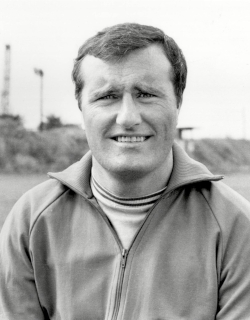
Birth of Noel Cantwell, Irish Footballer & Cricketer

Noel Euchuria Cornelius Cantwell, Irish football player and sometime cricketer, is born at 2 Illen Villas, Mardyke Walk, Cork, County Cork, on February 28, 1932.

Cantwell is one of five sons and a daughter of Michael Cantwell, a master tailor, and his wife Hannah (née Daly). He is educated at St. Joseph’s national school and the Presentation Brothers College in Cork. He plays as a full-back for Western Rovers, Cork Athletic, West Ham United and Manchester United.

While at West Ham, Cantwell features in the London XI side that competes in the 1955–58 Inter-Cities Fairs Cup final on May 1, 1958. He captains the Hammers to winning the Division Two championship in the 1957–58 season thereby leading the club into the topflight for the first time since 1932.

In November 1960, Cantwell joins Manchester United for £29,500 which at the time is a record for a full-back. He helps the club win the 1965 and 1967 league titles and captains United when winning the 1963 FA Cup Final – just as his fellow countryman Johnny Carey had done in United’s previous FA Cup win fifteen years earlier.

Cantwell also serves as Chairman of the Professional Footballers’ Association.

During his International career (1953-67), Cantwell wins 36 full International caps for the Republic of Ireland, typically playing at left full-back and on several occasions at centre-forward. He makes his debut against Luxembourg in October 1953, with his final appearance coming away to Turkey in February 1967. He scores fourteen goals including five from penalties and also captains the Republic on several occasions including a match against England at Wembley Stadium.

In his first managerial role at Coventry City, Cantwell has the onerous task of following Jimmy Hill who had taken the club into the First Division for the first time in their history. He narrowly keeps the Sky Blues in the top in his first two seasons before taking them to a sixth-place finish in 1969–70, earning them qualification for the Inter-Cities Fairs Cup (a year before it is replaced by the UEFA Cup).

Cantwell departs Highfield Road on March 12, 1972, but within seven months is back in English football as manager of Peterborough United. He helps Peterborough win the Fourth Division title in his first full season as manager, before leaving on May 10, 1977, to manage the New England Tea Men.

Cantwell returns to Peterborough on November 19, 1986, for a second stint as manager, remaining in this role until he becomes general manager on July 12, 1988. He is general manager at London Road for a year until he quits football to become licensee of the New Inn at Peterborough, where he remains for ten years until he retires in 1999. He also is landlord of the Bull and Swan in Stamford, Lincolnshire.

Cantwell also plays cricket for Cork Bohemians Cricket Club and Ireland as a left-handed batsman and a right-arm medium bowler. He plays five times for Ireland, making his debut in what is his sole first-class match versus Scotland at Edinburgh in 1956, scoring 31 and 17. His last match for Ireland is against Lancashire in July 1959.

Cantwell dies from cancer at Addenbrooke’s Hospital, Cambridge, not far from his home in Peterborough, on September 8, 2005. He is survived by his wife Maggie, a native of Belfast, and two daughters, Liz and Kate. A 22-year-old son, John Robert, is killed in a car crash thirteen years earlier.

Cantwell’s former teams each hold a moment of silence for him before their next matches.


Leave a comment

Birth of Mark Kelly, Neo-Progressive Rock Keyboardist

Mark Colbert Kelly, Irish keyboardist and a member of the neo-progressive rock band Marillion, is born in Dublin on April 9, 1961.

Kelly is raised in Ireland until he moves to England with his parents in 1969.

Kelly is an electronics student while performing part-time in the progressive/psychedelic band Chemical Alice, who releases their EP Curiouser and Curiouser in 1981. He is invited to join Marillion when they supported Chemical Alice, replacing founding keyboardist Brian Jelliman. His first performance with the band is at the Great Northern at Cambridge on December 1, 1981. He appears on every Marillion studio album. He also appears on John Wesley‘s album Under the Red and White Sky in 1994 and on Jump’s album Myth of Independence in 1995 on production and keyboards.

Kelly plays keyboards with Travis for their headlining set at the Isle of Wight Festival (June 10-12, 2005), and at T in the Park in 2005. He plays keyboards for Edison’s Children‘s new album In the Last Waking Moments…, featuring fellow Marillion member Pete Trewavas and Eric Blackwood, for the song “The ‘Other’ Other Dimension” as well as performing vocals with Steve Hogarth and Andy Ditchfield (DeeExpus) on the Edison’s Children track “The Awakening” in 2011.

Kelly is credited with inventing online crowdfunding to fund the recording of Marillion’s 2001 album Anoraknophobia, following a fan funded Marillion tour of the United States in 1997, and pioneers many of the ideas copied by other music artists since. He is made Co-CEO of the Featured Artists’ Coalition (FAC), an organization which represents the interests of music artists in the digital age. He stands down as a director of the FAC in 2018. From 2009 until 2020 he is an elected performer-director of Phonographic Performance Limited (PPL).

In 2016, Kelly is cast as a guest keyboardist in Ayreon‘s 2017 album The Source.

In September 2020, Kelly releases a single “Amelia” with his new solo band, Mark Kelly’s Marathon. The debut album is released in November 2020.


Leave a comment

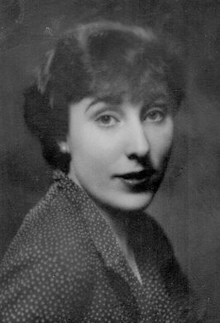
Birth of Mary Manning, Novelist, Playwright & Film Critic

Mary Manning Howe Adams, Irish novelist, playwright and film critic, is born in Dublin on June 30, 1905.

Raised in Dublin, Manning goes to school in Morehampton House and Alexandra College, Dublin. She gets her theatre training in Sara Allgood‘s teaching class in the Abbey Theatre.

Prior to her career as a writer and filmmaker, Manning works as a film critic throughout the 1920s and 30s. She works as a film critic for The Irish Statesman for a year during that time until it goes out of business. She is known to disapprove of Hollywood‘s “unimaginable stories and its stereotypical portrayal of Ireland and the Irish.” She also works as a writer for the Gate Theatre. She adapts the short story “Guests of the Nation” for a film directed by Denis Johnston. She also helps found the Dublin Film Society in 1930 and co-founds the Gate Theatre arts magazine Motley in 1932.

From 1914 to 1926, Ireland experiences a surge of new film styles being produced, consisting of historical melodramas and romantic comedies. Following this, 1930 to 1935 births a second wave of industry produced silent films that are intended to be less cliche compared to the first wave. The films produced under the second wave are much more experimental and deal less with the commercial appeals of the first wave. There’s minimal information on how Manning specifically contributed to the second wave, however, it is stated that she plays an important role producing five out of the six films to come out of that wave.

In 1935, Manning moves to Boston where she marries Harvard Law School professor Mark De Wolfe Howe. They have three daughters, Fanny, Susan and Helen. When her husband dies, she returns to Dublin in 1967 and lives in Monkstown, County Dublin, for another ten years. During this time she writes for various publications such as The Hibernia Magazine, The Irish Times and The Atlantic. She later returns to live in Cambridge, Massachusetts.

Manning is a founder of the Poets’ Theatre in Cambridge, Massachusetts, and works as drama director at Radcliffe College during World War II. She marries Faneuil Adams of Boston, Massachusetts, in 1980.

Manning dies at the age of 93 on June 27, 1999, at Mt. Auburn Hospital in Cambridge, Massachusetts.


Leave a comment

Death of Composer Brian Patrick Boydell

Brian Patrick Boydell, Irish composer whose works include orchestral pieces, chamber music, and songs, dies on November 8, 2000. He is Professor of Music at Trinity College Dublin for 20 years, founder of the Dowland Consort, conductor of the Dublin Orchestral Players, and a prolific broadcaster and writer on musical matters. He was also a prolific musicologist specialising in 18th-century Irish musical history.

Boydell is born on March 17, 1917, in Howth, County Dublin, into a prosperous Anglo-Irish family. His father James runs the family maltings business while his mother, Eileen Collins, is one of the first women graduates of Trinity College. Following their son’s birth, the Boydells move from Howth and live in a succession of rented houses before settling in Shankill, County Dublin. The young Boydell begins his formal education at Monkstown Park in Dublin and is subsequently sent to the Dragon School at Oxford, England. From there he goes to Rugby School, where he comes under the influence of Kenneth Stubbs, the music master. Although he later speaks of his resentment at the anti-Irish attitude he experiences at Rugby, he appreciates the very good education in science and music he receives there.

Having completed his secondary education, Boydell spends the summer of 1935 developing his musical knowledge at Heidelberg, Germany, where he writes his first songs and also studies organ. He wins a choral scholarship to Clare College, Cambridge, where, perhaps through parental pressure, he studies natural science, graduating in 1938 with a first-class degree.

However, his love of music leads him next to the Royal College of Music where he studies composition under Patrick Hadley, Herbert Howells and Vaughan Williams. Already a good pianist, he also becomes a proficient oboe player during this time.

Upon the outbreak of World War II, Boydell returns to Dublin and achieves further academic success in 1942 with a Bachelor of Music degree from Trinity College. He also takes further lessons in composition from John F. Larchet.

Boydell’s busy working life combines teaching, performing and composing. Following a brief stint in his father’s business, he plunges himself into Dublin’s classical music scene. In 1943, he succeeds Havelock Nelson as conductor of the Dublin Orchestral Players, beginning an association with the amateur orchestra that endures for a quarter of a century (until 1966). In 1944, he is appointed Professor of Singing at the Royal Irish Academy of Music, a position he holds for eight years. Along with fellow composers Edgar M. Deale, Aloys Fleischmann, and Frederick May he founds the Music Association of Ireland in 1948 as a vehicle to promote classical music throughout the country.

Boydell’s interest in Renaissance music, in particular the madrigal, leads in 1959 to founding the Dowland Consort, a vocal ensemble with which he performs for many years and records an LP. In 1962, having obtained a Doctorate in Music, he is appointed Professor of Music at Trinity College, a position he holds until 1982. He immediately revamps the course making it more relevant to the second half of the twentieth century. He also finds time to sit on the Arts Council throughout the 1960s, 70s, and early 80s.

Boydell’s communication skills combined with his infectious enthusiasm makes him a natural broadcaster. The appeal of his programmes on the history and performance of music, first on RTÉ Radio 1 and later on Telefís Éireann, go beyond a specialist audience and are, for many people, their introduction to a new world of aural pleasure.

Boydell has many interests beyond music. As a surrealist painter in the 1940s, having taken lessons from Mainie Jellett, he is a member of The White Stag Group. He is also passionate about cars and photography.

Following retirement from Trinity as Fellow Emeritus, Boydell devotes himself to musical scholarship, writing two books on the music of 18th century Dublin. He also contributes to The New Grove Dictionary of Music and Musicians.

Boydell dies at his home in Howth on November 8, 2000, at the age of 83 and in the company of his wife of 56 years, Mary (née Jones) and their sons, Cormac and Barra. A third son, Marnac, predeceases him.

Boydell is awarded several honorary titles in recognition of his services to music, including the Honorary Doctorate of Music from the National University of Ireland (1974), the Order of Merit of the Italian Republic (1983), the election to Aosdána, Ireland’s academy of creative artists (1984), and Honorary Fellowship of the Royal Irish Academy of Music (1990).


Leave a comment

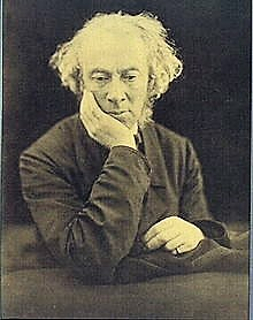
Birth of Thomas Steele, Engineer & Political Activist

Thomas (Tom) Steele, engineer and political activist, is born on November 3, 1788, at Derrymore, County Clare, the son of William Steele, gentleman, and Catherine Steele (née Bridgeman).

In July 1805 Steele enters Trinity College Dublin, graduating BA in the spring of 1810. He then studies at Magdalene College, Cambridge, where he graduates MA in 1820, becoming an associate member of the Institution of Civil Engineers in the same year. In 1821 he inherits Cullane House, near Craggaunowen, County Clare, on the death of his uncle. Of an enthusiastic and adventurous nature, in 1823 he decides to support the cause of the liberals in Spain who had rebelled against the autocratic rule of Ferdinand VII in 1820. Mortgaging the house and lands at Cullane, he purchases a large quantity of arms and ships them to Spain on board the ship Iris. Commissioned in the Legion Estrenjera of the liberal army, he distinguishes himself in the Battle of Trocadero and the defence of Madrid. He later publishes an account of his experiences, Notes on the war in Spain (London, 1824).

Returning from Spain with his fortunes ruined, Steele begins experiments with underwater diving apparatus, patenting “Steele’s improved diving-bell” in 1825. In the same year he becomes a partner in the Vigo Bay Co., which attempts to recover gold and silver bullion from Spanish ships which sank in Vigo Bay in 1702. After extensive diving operations using Steele’s diving-bell, the company is wound up at an acrimonious meeting of shareholders in September 1826. Despite claims by some of the shareholders that bullion had been found, the scheme is a total failure.

Steele is involved in the Catholic Association and, a close friend of Daniel O’Connell, is active in the emancipation campaign although himself a protestant. In 1828 he seconds O’Connell’s nomination for Clare in the general election of that year. Appointed by O’Connell as ‘Head Pacificator,’ he tours the country collecting weapons and discouraging the rural population from engaging in faction fighting. There is a certain irony in this appointment, as Steele’s own volatile temper is well known. A noted duelist, he fights an inconclusive duel in 1829 with William Smith O’Brien, who had opposed O’Connell’s second candidature for County Clare. In 1828 he is a founder of the Limerick Independent Club.

An associate of the diving pioneers John and Charles Deane, Steele dives on the wreck of the Intrinsic, off the Clare coast in January 1836, using their new diving helmet. He then begins developing equipment to provide underwater illumination, and in 1840 dives with the Deane brothers off Plymouth on the wreck of Henry VIII‘s ship, the Mary Rose. Yet he is in serious financial difficulties, which are not helped by some of his more eccentric building projects. It is said of him that “he seemed utterly incapable of rationally estimating the value of money in his own case.” He begins renovating, at great expense, a ruined castle that stands on his land at Cullane. He also later has a large standing stone, known as the ‘Umbilicus Hiberniae’ (‘Navel of Ireland’), removed from Birr, King’s County (now County Offaly), and taken to his house. At Cullane it is set up as an altar and used for mass whenever O’Connell or members of the Catholic Association visit. It is not returned to Birr until 1974.

Known as “Honest Tom Steele,” Steele is deeply devoted to O’Connell, and is one of his key lieutenants during the repeal campaigns of the 1830s and 1840s. He takes his title and responsibilities as O’Connell’s “Head Pacificator” so seriously and generally expresses himself with such long-winded pomposity that he becomes something of a figure of fun for opponents of O’Connell and for many of the younger men in the Repeal Association. Tried on conspiracy charges after the prohibition of the Clontarf monster meeting, he is one of the six “traversers” imprisoned with O’Connell in Richmond jail from May to September 1844. Strongly supporting O’Connell’s repudiation of physical force, he chairs and takes a prominent part in the peace resolution debates of July 1846 in which the Young Ireland group walks out of the Repeal Association.

After the death of O’Connell on May 15, 1847, Steele falls into a deep depression and, financially ruined, jumps from Waterloo Bridge in London on April 19, 1848. Pulled from the river by a Thames boatman, he survives for a number of weeks. Former political opponents, including Lord Brougham, offer financial help but he refuses. He dies on June 15, 1848, and his remains are taken to Dublin, where he is waked at Conciliation Hall, the headquarters of the Repeal Association, on Burgh Quay. He is buried in Glasnevin Cemetery, beside O’Connell’s tomb. He appears as one of the figures on the O’Connell memorial in O’Connell Street, Dublin.

Steele never marries but harbours an unrequited passion for a Miss Eileen Crowe of Ennis, County Clare, and is often to be seen standing on a large rock, which comes to be known as “Steele’s Rock,” on the banks of the River Fergus in Ennis as he tries to catch a glimpse of Miss Crowe, who lives across the river.

(From: “Steele, Thomas (Tom)” by David Murphy, Dictionary of Irish Biography, http://www.dib.ie | Pictured: (L to R) Thomas Steele, Daniel O’Connell and O’Gorman Mahon by Joseph Patrick Haverty)


Leave a comment

Birth of Bob Tisdall, Olympic Gold Medalist

bob-tisdall

Robert (“Bob”) Morton Newburgh Tisdall, gold medalist in the 400 metres hurdles at the 1932 Summer Olympics in Los Angeles, is born on May 16, 1907, in Nuwara Eliya, Ceylon (now Sri Lanka).

Born to a family of Irish landed gentry, he lives on his father’s plantation in Ceylon until the age of five, when they return to the family home in Nenagh, County Tipperary. Following prep school at Mourne Grange, he goes on to Shrewsbury School, where he wins the Public Schools 402 metres, and at Gonville and Caius College, Cambridge, where he wins a record four events – 402 metres and 110 metres hurdles, long jump and shot put – in the annual match against Oxford. This record is only equaled nearly 60 years later.

Tisdall sets South African and Canadian records in the 201 metres low hurdles in 1929, a year later setting Greek records in the same event. While at Cambridge in March 1932, he decides to try for a place on the Irish Olympic squad and, after he runs a record 54.2 seconds for the Irish Championship 402 metres hurdles in June that year, the authorities agree to let him run in his new event at the Los Angeles Olympic Games.

Tisdall had run only six 400 metres hurdles when he wins the gold medal at the 1932 Olympic Games in a world record time of 51.7 seconds, which is not recognised under the rules of the time because he had a hit a hurdle. Later, because of the notoriety of this incident, the rules are changed and the President of the International Olympic Committee, Juan Antonio Samaranch, presents Tisdall with a Waterford Crystal rose bowl with the image of him knocking over the last hurdle etched into the glass. Though the International Amateur Athletic Federation (IAAF) did not recognise the record at the time, they now recognise the mark, giving Tisdall credit for setting the milestone of being the first man under 52 seconds.

Following his victory, Tisdall is invited to a dinner in Los Angeles where he is seated next to Amelia Earhart on one side and Douglas Fairbanks, Jr. on the other.

Later in life, Tisdall lives in South Africa, where he runs a gymnasium during the day, which he converts to a night club after dark. He grows coffee in Tanzania, but moves to Nambour, Queensland in 1969 with his wife Peggy, where he farms fruit crops and cattle. He admits to running his last race at the age of 80, though he runs in the Sydney Olympics torch relay at age 93. At that point he is the oldest living recipient of an individual track and field Olympic medal。

At the age of 96 Tisdall falls down a steep set of rock stairs and breaks his shoulder, ribs and ruptures his spleen. He never completely recovers and dies on July 27, 2004. At that time, he is the world’s oldest track and field Olympic Gold medalist. He does not want a funeral because “they are altogether too sad.” His wake is attended by family and a few friends.

In 2002, three statues honouring Olympic champions with links to Nenagh, Matt McGrath, Johnny Hayes and Bob Tisdall, are unveiled in front of the Nenagh Courthouse.


Leave a comment

Birth of Aubrey Thomas de Vere, Critic & Poet

aubrey-de-vere

Aubrey Thomas de Vere, a critic and poet who adapts early Gaelic tales, is born on January 10, 1814, at Curraghchase House, now in ruins at Curraghchase, Kilcornan, County Limerick.

Hunt de Vere is the third son of Sir Aubrey de Vere, 2nd Baronet and his wife Mary Spring Rice, daughter of Stephen Edward Rice and Catherine Spring, of Mount Trenchard, County Limerick. He is a nephew of Thomas Spring Rice, 1st Baron Monteagle of Brandon and a younger brother of Sir Stephen de Vere, 4th Baronet. His sister Ellen marries Robert O’Brien, the brother of William Smith O’Brien. In 1832, his father drops the original surname “Hunt” by royal licence, assuming the surname “de Vere.”

de Vere is strongly influenced by his friendship with the astronomer Sir William Rowan Hamilton through whom he comes to a knowledge and reverent admiration for William Wordsworth and Samuel Taylor Coleridge. He is educated privately at home and in 1832 enters Trinity College, Dublin, where he reads Immanuel Kant and Coleridge. Later he visits Oxford, Cambridge, and Rome, and comes under the potent influence of John Henry Newman. He is also a close friend of Henry Taylor.

The characteristics of de Vere’s poetry are high seriousness and a fine religious enthusiasm. His research in questions of faith leads him to the Roman Catholic Church where in 1851 he is received into the Church by Cardinal Henry Edward Manning in Avignon. In many of his poems, notably in the volume of sonnets called St. Peters Chains (1888), he makes rich additions to devotional verse. For a few years he holds a professorship, under Newman, in the Catholic University in Dublin.

In A Book of Irish VerseW. B. Yeats describes de Vere’s poetry as having “less architecture than the poetry of Ferguson and Allingham, and more meditation. Indeed, his few but ever memorable successes are enchanted islands in gray seas of stately impersonal reverie and description, which drift by and leave no definite recollection. One needs, perhaps, to perfectly enjoy him, a Dominican habit, a cloister, and a breviary.”

de Vere also visits the Lake Country of England, and stays under Wordsworth’s roof, which he calls the greatest honour of his life. His veneration for Wordsworth is singularly shown in later life, when he never omits a yearly pilgrimage to the grave of the poet until advanced age makes the journey impossible.

de Vere is of tall and slender physique, thoughtful and grave in character, of exceeding dignity and grace of manner, and retains his vigorous mental powers to a great age. According to Helen Grace Smith, he is one of the most profoundly intellectual poets of his time. His census return for 1901 lists his profession as “Author.”

Aubrey de Vere dies at Curraghchase on January 20, 1902, at the age of eighty-eight. As he never married, the name of de Vere at his death becomes extinct for the second time and is assumed by his nephew.


4 Comments

Birth of Philip Embury, Methodist Preacher

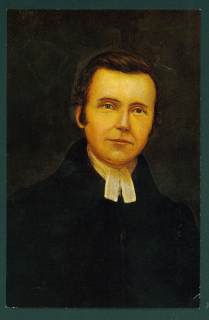
Philip Embury

Philip Embury, Methodist preacher and a leader of one of the earliest Methodist congregations in the United States, is born in Ballingrane, County Limerick on September 21, 1729.

Embury’s parents are members of the colony of Germans that emigrate from the Palatinate to Ireland early in the eighteenth century, and in which Methodism co-founder John Wesley labors with great success. The colony forms from refugees from the War of the Spanish Succession. Embury is educated at a school near Ballingrane and learns the carpentry trade. He is converted on Christmas day 1752, becomes a local preacher at Court-Matrix in 1758 and marries Margaret Switzer that fall.

In 1760, due to rising rents and scarce land, he goes to New York City and works as a schoolteacher. In common with his fellow emigrants, he begins to lose interest in religious matters and does not preach in New York until 1766 when, moved by the reproaches of his cousin Barbara Heck, sometimes called the “mother of American Methodism,” he begins to hold services first in his own house on Barrack Street, now Park Place, and then in a rigging loft on what is now William Street. The congregation thus forms what is probably the first Methodist congregation in the United States, though it is a disputed question whether precedence should not be given to Robert Strawbridge, who begins laboring in Maryland about this time. Before this, he and Barbara Heck worship along with other Irish Palatines at Trinity Church in Manhattan, where three of his children are baptized.

The first Methodist church is built under Embury’s charge in 1768, in association with Thomas Webb and others, on the site of the present John Street United Methodist Church. He himself works on the building as a carpenter and afterward preaches there gratuitously. In 1769, preachers sent out by John Wesley arrive in New York City, and Embury goes to work in the vicinity of Albany at Camden Valley, New York, where he continues to work at his trade during the week and preaches every Sunday. He and several others receive a grant of 8,000 acres to develop for the manufacture of linen. He organizes among Irish emigrants at Ashgrove, near Camden Valley, the first Methodist society within the bounds of what becomes the flourishing and influential Troy Conference.

Philip Embury dies suddenly in Camden, New York in August 1775, in consequence of an accident in mowing. He is buried on a neighboring farm but in 1832 his remains are removed to Ashgrove churchyard and in 1866 to Woodland cemetery, Cambridge, New York, where a monument to him is unveiled in 1873, with an address by Bishop Matthew Simpson.

(Pictured: Portrait of Philip Embury by John Barnes, Salem, 1773)


Leave a comment

Birth of Fanny Parnell, Poet & Nationalist

Fanny Parnell, Irish poet and Nationalist, is born Frances Isabelle Parnell in Avondale, County Wicklow on September 4, 1848. She is the sister of Charles Stewart Parnell, an important figure in nineteenth century Ireland.

Parnell is the eighth child out of eleven and fourth daughter born to John Henry Parnell, a landowner and the grandson of the last Chancellor of the Exchequer of Ireland, and Delia Tudor Stewart Parnell, an Irish American and the daughter of Admiral Charles Stewart (1778–1869) of the United States Navy. Her mother hates British rule in Ireland, a view presented through her children’s works. She is an intelligent girl and before she is through her teen years, she has studied mathematics, chemistry, and astronomy, and she can speak and write fluently in almost all the major European languages. She also has talents in music and painting and drawing in oil and water colours. Her parents separate when she is young. Soon afterwards, in July 1859, her father dies at the age of forty-eight and she and her mother move to Dalkey. A year later they move to Dublin, and in 1865 they move to Paris where Fanny studies art and writes poetry. In 1874 they move to Bordentown, New Jersey in the United States.

Parnell is known as the Patriot Poet. She shows interest in Irish politics and much of her poetry is about Irish nationalism. While she is living in Dublin in 1864, she begins publishing her poetry under the pseudonym “Aleria” in The Irish People, the newspaper of the Fenian Brotherhood. Most of her later work is published in The Pilot in Boston, the best-known Irish newspaper in America during the nineteenth century. Two of her most widely published works are The Hovels of Ireland, a pamphlet, and Land League Songs, a collection of poems. Her best-known poem is “Hold the Harvest,” which Michael Davitt refers to as the “Marseillaise of the Irish peasant.”

Parnell’s brother, Charles, becomes active in the Irish National Land League, an organisation that fights for poor tenant farmers, in 1879 and she strongly supports him. She and her younger sister, Anna Parnell (1852–1911), co-found the Ladies’ Land League in 1880 to raise money in America for the Land League. In 1881 the Ladies’ Land League continues the work of the men in the Land League while they are being imprisoned by the British government. In Ireland Anna becomes the president of the Ladies’ Land League, and the women hold many protests and quickly become more radical than the men, to the resentment of the male leaders. Fanny stays in America and works to raise money for the organisation. Most of the Land League’s financial support comes from America because of the campaigning done by Fanny Parnell.

Fanny Parnell dies on July 20, 1882, at the young age of 33, of a heart attack at the family mansion in Bordentown, New Jersey. She is buried at the Tudor family plot at Mount Auburn Cemetery in Cambridge, Massachusetts.


Leave a comment

Lord Killanin Becomes President of the International Olympic Committee

Michael Morris, 3rd Baron Killanin, journalist, author, and sports official, becomes the first Irish president of the International Olympic Committee (IOC) on August 23, 1972.

Morris is born in London on July 30, 1914, the son of Irish Catholic Lt. Col. George Henry Morris who is from Spiddal in County Galway. The Morrises are one of the fourteen families making up the “Tribes of Galway.”

Morris is educated at Summerfields, St. Leonards-on-Sea, Eton College, the Sorbonne in Paris and then Magdalene College, Cambridge, where he is President of the renowned Footlights dramatic club. He succeeds his uncle as Baron Killanin in the Peerage of the United Kingdom in 1927, which allows him to sit in the House of Lords at the Palace of Westminster as Lord Killanin upon turning 21. In the mid-1930s, he begins his career as a journalist on Fleet Street, working for the Daily Express, the Daily Sketch and subsequently the Daily Mail.

In November 1938, Lord Killanin is commissioned into the Queen’s Westminsters, a territorial regiment of the British Army, where he is responsible for recruiting fellow journalists, including future The Daily Telegraph editor Bill Deedes, and friends who are musicians and actors. He reaches the rank of major and takes part in the planning of D-Day and the Invasion of Normandy in 1944, acting as brigade major for the 30th Armoured Brigade, part of the 79th Armoured Division. He is appointed, due to the course of operations, a Member of the Order of the British Empire (MBE). After being demobilised, he goes to Ireland. He resigns his TA commission in 1951.

In 1950, Lord Killanin becomes the head of the Olympic Council of Ireland (OCI) and becomes his country’s representative in the IOC in 1952. He becomes senior vice-president in 1968, and succeeds Avery Brundage, becoming President-elect at the 73rd IOC Session (August 21–24) held in Munich prior to the 1972 Summer Olympics. He takes office soon after the Games.

During Lord Killanin’s presidency, the Olympic movement experiences a difficult period, dealing with the financial flop of the 1976 Summer Olympics in Montreal and the boycotts of the 1980 Summer Olympics in Moscow. Denver, originally selected to host the 1976 Winter Olympics, withdraws and has to be replaced by Innsbruck. The cities of Lake Placid, New York and Los Angeles are chosen for 1980 Winter Olympics and 1984 Summer Olympics by default due to a lack of competing bids. He resigns just before the Moscow Olympics in 1980, and his position is taken over by Juan Antonio Samaranch. He is later unanimously elected Honorary Life President.

Lord Killanin serves as Honorary Consul-General of Monaco in Ireland from 1961 to 1984 and as Chairman of the Race Committee for Galway Racecourse from 1970 to 1985. A keen horse racing enthusiast, he also serves as a steward of the Irish Turf Club on two occasions and on the National Hunt Steeplechase Committee. In his business life Lord Killanin is a director of many companies including Irish Shell, Ulster Bank, Beamish & Crawford and Chubb Ireland. He is a founder member of An Taisce (The National Trust for Ireland) and is chairman of the National Monuments Advisory Council until his death.

Lord Killanin dies at his home in Dublin on April 25, 1999, at the age of 84 and, following a bilingual funeral Mass at St. Enda’s Church in Spiddal, County Galway, he is buried in the family vault in the New Cemetery, Galway.

(Pictured: Lord Killanin by Bert Verhoeff / Anefo (Nationaal Archief) [CC BY-SA 3.0 nl (http://creativecommons.org/licenses/by-sa/3.0/nl/deed.en)%5D, via Wikimedia Commons)