seamus dubhghaill

Promoting Irish Culture and History from Little Rock, Arkansas, USA


Leave a comment

Birth of Novelist Jennifer Johnston

jennifer-johnston

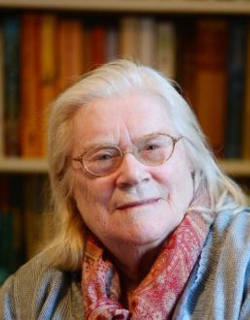
Jennifer Prudence Johnston, Irish novelist whose works deal with political and cultural tensions in Ireland with an emphasis on the problems of the Anglo-Irish people, is born in Dublin on January 12, 1930. Rich in dialogue, Johnston’s novels often concern interpersonal relationships and the difficult transition from childhood to adulthood.

Johnston is born to Irish actress and director Shelah Richards, and Irish playwright Denis Johnston. A cousin of actress and film star Geraldine Fitzgerald, via Fitzgerald’s mother, Edith (née Richards), she is educated at Trinity College Dublin. Other cousins include the actresses Tara Fitzgerald and Susan Fitzgerald.

Born into the Church of Ireland, many of Johnston’s novels deal with the fading of the Protestant Anglo-Irish ascendancy in the 20th century.

Johnston’s first published book, The Captains and the Kings (1972), is actually written after The Gates (1973). Both novels feature the Anglo-Irish setting of a decaying manor house. Johnston’s third novel, How Many Miles to Babylon? (1974), concerns the complex and tragic friendship of two young men who are sentenced to death during World War I. Shadows on Our Skin (1977) and The Railway Station Man (1984) focus on violence in Northern Ireland, and The Old Jest (1979 and filmed as The Dawning, 1988) and Fool’s Sanctuary (1987) are set during the emergence of modern Ireland in the 1920s. The protagonist of The Christmas Tree (1981) attempts to salvage her troubled life before it is cut short by leukemia.

Johnston’s other novels include The Invisible Worm (1991), The Illusionist (1995), Two Moons (1998), This Is Not a Novel (2002), and Foolish Mortals (2007). She also writes short stories and plays, such as Three Monologues: Twinkletoes, Mustn’t Forget High Noon, Christine (1995) and The Desert Lullaby: A Play in Two Acts (1996).

Johnston marries a fellow student at Trinity College, Ian Smyth in 1951. She is a mother of four and currently lives near Dublin. She is also a member of Aosdána.


Leave a comment

Birth of James Ussher, Primate of All Ireland

james-ussher

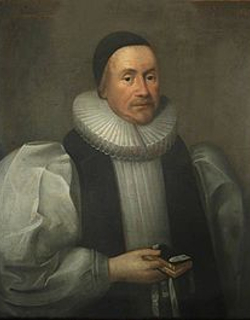
James Ussher, Archbishop of Armagh and Primate of All Ireland, is born in Dublin on January 4, 1581. He is best known for his massive compendium of ancient history, The Annals of the World, in which he attempts to calculate the number of years that had elapsed since creation.

Early in life Ussher is determined to pursue a career with the Church of England, a resolve quite similar to that of the Biblical Judge, Samuel.

A gifted polyglot, Ussher enters Dublin Free School and then the newly founded Trinity College, Dublin on January 9, 1594, at the age of thirteen (not an unusual age at the time). He receives his Bachelor of Arts degree by 1598 and is a fellow and MA by 1600. In May 1602, he was ordained in the Trinity College Chapel as a deacon (and possibly priest on the same day) in the Protestant Church of Ireland by his uncle Henry Ussher, the Archbishop of Armagh and Primate of All Ireland.

At the age of 26, Ussher becomes Professor and Chairman of the Department of Divinity at Dublin University, and he holds his professorship from 1609 to 1621. In 1625, he becomes Archbishop of Armagh, an office he apparently holds until his death. In 1628, King James I makes him a Privy Councillor.

Ussher is considered well-read and well-versed in history, a subject that soon becomes his primary focus. He writes several histories of the doings of the Irish and English churches dating back to Roman times. He also makes himself an expert in Semitic languages, an expertise that informs his argument in favor of the Masoretic Text of the Bible in preference to the Septuagint.

Ussher’s Confessions appear in 1643, followed in 1646 by his fifth work, Here I Stand. His most famous work, the dating of the creation as calculated from the Biblical record, appears in writing in the 1650s.

In 1656, Ussher goes to stay in the Countess of Peterborough’s house in Reigate, Surrey. On March 19, he feels a sharp pain in his side after supper and takes to his bed. His symptoms seem to have been those of a severe internal haemorrhage. Two days later, on March 21, 1656, he dies at the age of 75. His last words are reported as: “O Lord, forgive me, especially my sins of omission.” His body is embalmed and is to have been buried in Reigate, but at Oliver Cromwell‘s insistence he was given a state funeral on April 17 and was buried in the chapel of St. Erasmus in Westminster Abbey.

Ussher’s extensive library of manuscripts, many of them Middle Eastern originals, become part of the collection at Dublin University.


Leave a comment

Birth of Sir John Parnell, 2nd Baronet

john-parnell

Sir John Parnell, 2nd Baronet, an Anglo-Irish Member of Parliament, is born on December 25, 1744.

A Church of Ireland landowner, his family had originally migrated to Ireland from Congleton in Cheshire. Although not from an Irish Roman Catholic background, Parnell, the only son of Sir John Parnell, 1st Baronet, is renowned in Irish history for his efforts to bring about a more emancipated country. He is the great-grandfather of Charles Stewart Parnell, known as the uncrowned king of Ireland and best known for opposing the Acts of Union 1800 between the two kingdoms of Great Britain and Ireland.

From a line of politically astute ancestors who had moved to Ireland in the 17th century, Parnell rises to the highest positions in Irish politics as Commissioner of the Revenue (1780), Chancellor of the Exchequer of Ireland (1787), and Lord of the Treasury (1793).

Parnell first serves in the Parliament of Ireland as one of the members for Bangor, from 1767 to 1768. He later sits for Queen’s County from 1783 until the Union with Great Britain creates the United Kingdom of Great Britain and Ireland in 1801. After the Union, he gains a seat in the Parliament of the United Kingdom for a short time as member for Queen’s County but dies suddenly in London in December 1801.

Henry Grattan describes Parnell as “an honest, straightforward, independent man, possessed of considerable ability and much public spirit; as Chancellor of the Exchequer, he was not deficient, and he served his country by his plan to reduce the interest of money. He was amiable in private, mild in disposition, but firm in mind and purpose. His conduct at the Union did him honour, and proved how warmly he was attached to the interests of his country, and on this account, he was dismissed.”

(Pictured: Oil painting on canvas, The Right Hon. Sir John Parnell, 2nd Bt (1744–1801) by Pompeo Girolamo Batoni (Lucca 1708 – Rome 1787))


Leave a comment

The Birth of John Toland, Philosopher & Freethinker

john-toland

John Toland, Irish rationalist philosopher and freethinker, and occasional satirist, is born in Ardagh on the Inishowen peninsula, a predominantly Catholic and Irish-speaking region in northwestern Ireland, on November 30, 1670. He writes numerous books and pamphlets on political philosophy and philosophy of religion which are early expressions of the philosophy of the Age of Enlightenment.

Very little is known of Toland’s early life. His parents are unknown. He later writes that he had been baptised Janus Junius, a play on his name that recalls both the Roman two-faced god Janus and Lucius Junius Brutus, reputed founder of the Roman Republic. According to his biographer, Pierre des Maizeaux, he adopts the name John as a schoolboy with the encouragement of his schoolteacher.

Having formally converted from Catholicism to Protestantism at the age of 16, Toland gets a scholarship to study theology at the University of Glasgow. In 1690, at age 19, the University of Edinburgh confers a master’s degree on him. He then gets a scholarship to spend two years studying at Leiden University in the Netherlands, and subsequently nearly two years at the University of Oxford in England (1694–95). The Leiden scholarship is provided by wealthy English Dissenters who hope Toland will go on to become a minister for Dissenters.

In Toland’s first and best-known book, Christianity not Mysterious (1696), he argues that the divine revelation of the Bible contains no true mysteries. Rather, all the dogmas of the faith can be understood and demonstrated by properly trained reason from natural principles. For this argument he is prosecuted by a grand jury in London. As he is a subject of the Kingdom of Ireland, members of the Parliament of Ireland propose that he should be burned at the stake. In his absence three copies of the book are burned by the public hangman in Dublin as the content is contrary to the core doctrines of the Church of Ireland. Toland bitterly compares the Protestant legislators to “Popish Inquisitors who performed that Execution on the Book, when they could not seize the Author, whom they had destined to the Flames.”

After his departure from Oxford, Toland resides in London for most of the rest of his life but is also a somewhat frequent visitor to Continental Europe, particularly Germany and the Netherlands. He lives on the Continent from 1707 to 1710.

John Toland dies in Putney on March 10, 1722. Just before he dies, he composes his own epitaph: “He was an assertor of liberty, a lover of all sorts of learning … but no man’s follower or dependent. Nor could frowns or fortune bend him to decline from the ways he had chosen.” The 1911 Encyclopædia Britannica says of him that at his death in London at age 51 “he died… as he had lived, in great poverty, in the midst of his books, with his pen in his hand.”

Very shortly after his death a lengthy biography of Toland is written by Pierre des Maizeaux.

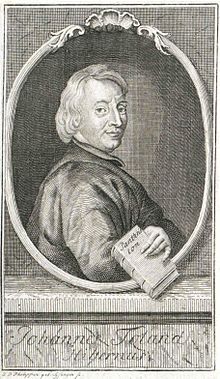
(Pictured: The only known image of John Toland)


Leave a comment

Birth of Novelist Rosina Bulwer Lytton

rosina-bulwer-lytton

Novelist Rosina Bulwer Lytton (née Rosina Doyle Wheeler) is born in Ballywhire, County Limerick on November 4, 1802. She writes and publishes fourteen novels, a volume of essays and a volume of letters. Her husband is Edward Bulwer-Lytton, a novelist and politician. She spells her married surname without the hyphen used by her husband.

Rosina Doyle Wheeler’s mother is Anna Wheeler, the advocate of women’s rights and daughter of the Rev. Nicholas Milley Doyle, a Church of Ireland clergyman, Rector of Newcastle, County Tipperary. Her father is Francis Massey Wheeler, an Anglo-Irish landowner. One of her mother’s brothers, Sir John Milley Doyle (1781–1856), leads British and Portuguese forces in the Peninsular War and the War of the Two Brothers.

Rosina Doyle is educated at Reading Abbey Girls’ School in part by Frances Arabella Rowden, who is not only a poet, but, according to Mary Russell Mitford, “had a knack of making poetesses of her pupils.” This ties Rosina to other of Rowden’s pupils such as Caroline Posonby, later Lady Caroline Lamb, the poet Letitia Elizabeth Landon (“L.E.L.”), Emma Roberts, the travel writer and Anna Maria Fielding, who publishes as S.C. Hall.

Rosina Doyle Wheeler marries Edward Bulwer-Lytton, at that time surnamed simply Bulwer, on August 29, 1827. This is against the wishes of his mother, who withdraws his allowance, so that he is forced to work for a living.

His writing and efforts in the political arena take a toll upon their marriage, and the couple legally separates in 1836. Her children are taken from her. In 1839, her novel, Cheveley, or the Man of Honour, in which Edward Bulwer-Lytton is bitterly caricatured, is published.

In June 1858, when her husband is standing as parliamentary candidate for Hertfordshire, she appears at the hustings and indignantly denounces him. To silence her, Edward has her committed “insane.” Under the supervision of Robert Gardiner Hill, a British surgeon who specialises in the treatment of lunacy, she is incarcerated in a psychiatric hospital. She is liberated a few weeks later following a public outcry. This is chronicled in her book A Blighted Life. For years she continues her attacks upon her husband’s character. She outlives him by nine years.

Rosina Bulwer Lytton dies in Upper Sydenham, London, England on March 12, 1882.


Leave a comment

The Whiteboys

the-whiteboys

The Whiteboys, a secret Irish agrarian organisation in 18th-century Ireland which uses violent tactics to defend tenant farmer land rights for subsistence farming, is created on October 1, 1761. Their name derives from the white smocks the members wear in their nightly raids. They seek to address rack-rents, tithe collection, excessive priests’ dues, evictions and other oppressive acts. As a result they target landlords and tithe collectors. Over time, Whiteboyism becomes a general term for rural violence connected to secret societies. Because of this generalisation, the historical record for the Whiteboys as a specific organisation is unclear. There are three major outbreaks of Whiteboyism: 1761–64, 1770–76 and 1784–86.

Between 1735 and 1760 there is an increase in land used for grazing and beef cattle, in part because pasture land is exempt from tithes. The landlords, having let their lands far above their value, on condition of allowing the tenants the use of certain commons, now enclose the commons, but do not lessen the rent. As more landlords and farmers switch to raising cattle, labourers and small tenant farmers are forced off the land. The Whiteboys develop as a secret oath-bound society among the peasantry. Whiteboy disturbances had occurred prior to 1761 but were largely restricted to isolated areas and local grievances, so that the response of local authorities had been limited.

Their operations are chiefly in the counties of Waterford, Cork, Limerick, and Tipperary. This combination is not political. It is not directed against the government, but against the local landlords. Members of different religious affiliations take part.

The first major outbreak occurs in County Limerick in November 1761 and quickly spreads to counties Tipperary, Cork, and Waterford. A great deal of organisation and planning seems to have gone into the outbreak, including the holding of regular assemblies. Initial activities are limited to specific grievances and the tactics used non-violent, such as the levelling of ditches that closed off common grazing land, although cattle hamstringing is often practised as the demand for beef prompts large landowners to initiate the process of enclosure. As their numbers increase, the scope of Whiteboy activities begins to widen, and proclamations are clandestinely posted stipulating demands such as that rent not be paid, that land with expired leases not be rented until it has lain fallow for three years, and that no one pay or collect tithes demanded by the Anglican Church. Threatening letters are also sent to debt collectors, landlords, and occupants of land gained from eviction, demanding that they give up their farms.

March 1762 sees a further escalation of Whiteboy activities, with marches in military array preceded by the music of bagpipes or the sounding of horns. At Cappoquin they fire guns and march by the military barracks playing the Jacobite tune “The lad with the white cockade.” These processions are often preceded by notices saying that Queen Sive and her children will make a procession through part of her domain and demand that the townspeople illuminate their houses and provide their horses, ready saddled, for their use. More militant activities often follow such processions with unlit houses in Lismore attacked, prisoners released in an attack on Tallow jail and similar shows of strength in Youghal.

The events of March 1762, however, prompt a more determined response, and a considerable military force under Charles Moore, 1st Marquess of Drogheda is sent to Munster to crush the Whiteboys.

On April 2, 1762 a force of 50 militia men and 40 soldiers set out for Tallow. By mid-April at least 150 suspected Whiteboys have been arrested. Clogheen in County Tipperary bears the initial brunt of this assault as the local parish priest, Fr. Nicholas Sheehy, had earlier spoken out against tithes and collected funds for the defence of parishioners charged with rioting. An unknown number of “insurgents” are reported killed in the “pacification exercise” and Fr. Sheehy is unsuccessfully indicted for sedition several times before eventually being found guilty of a charge of accessory to murder, and hanged, drawn and quartered in Clonmel in March 1766.

In the cities, suspected Whiteboy sympathisers are arrested and in Cork, citizens form an association of about 2,000 strong which offer rewards of £300 for capture of the chief Whiteboy and £50 for the first five sub-chiefs arrested. They often accompany the military on their rampages. The leading Catholics in Cork also offer similar rewards of £200 and £40 respectively.

Acts passed by the Parliament of Ireland (to 1800) and Parliament of the United Kingdom of Great Britain and Ireland (from 1801) to empower the authorities to combat Whiteboyism are commonly called “Whiteboy Acts.”


Leave a comment

Passage of the First Penal Laws

penal-laws

Penal Laws are passed on September 7, 1695, which restrict the rights of Irish Catholics to have an education, to bear arms, or to possess a horse worth more than five pounds. This is the price the Irish have to pay for their support of King James II in his war against William of Orange.

The Catholic James flees to Ireland and raises an army after he is deposed during England’s Glorious Revolution. His successor, William of Orange, wages war in Ireland from 1689 to 1691, eventually defeating James’s armies and causing the ex-monarch to flee to France. It is Ireland’s last great episode of resistance to British rule until the Society of United Irishmen emerges in the 1790s.

Originally it looks as though the terms will be rather lenient. The draft of the Treaty of Limerick, which ends the war between William and James, contains generous terms for the latter’s defeated supporters in Ireland. Soldiers who fought in James’s army are offered free passage to France to join James in exile. James’s supporters in Ireland are to be allowed to keep their lands and to practice their trades and professions. Finally, Catholics are promised freedom of religion.

William supports these lenient terms because he wants to end the struggle in Ireland. It is costing a great deal of money and diverting military resources he wants to use in his ongoing war against France. Irish Protestants, however, bitterly oppose the treaty’s concessions to Catholics, and successfully water down or remove key provisions from the final draft of the Treaty. They also successfully push for a series of anti-Catholic measures known as the Penal Laws.

The first of the Penal Laws are passed on September 7, 1695. Many more follow over the next 30 years. These “popery laws,” as they are popularly known, sharply curtail the civil, religious, and economic rights of Catholics in Ireland. The most important ones make it illegal for Catholics to marry Protestants, inherit land from Protestants, buy land, carry weapons, teach school, practice law, vote in parliamentary elections, hold public office, practice their religion, own a horse worth more than 5 pounds, and hold a commission in the army or navy.

One particularly devastating law forces Catholic landowners to divide their estates among all their sons, in contrast to the preferred practice of handing most or all of the land to the eldest, unless they convert to the Church of Ireland. This leaves them with a choice between two evils: abandon their Catholic faith in order to save their holdings or allow them to be successively subdivided into oblivion.

It is this law, along with continued land forfeitures, that over the next century and a half push Ireland’s people onto smaller and smaller plots of land. Smaller holdings force Irish peasants to turn to the potato, a high yield crop, for the bulk of their daily diet. By the eve of the Great Famine, more than 60 percent of the Irish people depend on the potato for the main source of food. Thus, the Penal Laws create the conditions that turn an accident of nature — the fungus that ravages Ireland’s potato crop between 1845 and 1850 — into a monumental human tragedy.

Some Penal Laws are either repealed or simply ignored in the course of the eighteenth century. By the late-1700s, for example, Catholics are allowed to buy land and practice their religion. But the most debilitating laws, those that deny Irish Catholics basic political, economic, and civil rights, are kept in full force until Daniel O’Connell launches his successful campaign for Catholic Emancipation in the 1820s.

(Source: The Irish Echo, oldest Irish American newspaper in the United States, February 16, 2011)


Leave a comment

Birth of Novelist Shan Fadh Bullock

shan-fadh-bullock

Novelist Shan Fadh Bullock is born on May 17, 1865, at Inisherk, County Fermanagh just outside the County Cavan border near Belturbet. His works include fourteen novels set in Ulster and he is admired by James Matthew Barrie and Thomas Hardy.

Bullock’s father, Thomas Bullock, is a strict man who has eleven children and drives several to emigration because of his stern demeanour. Thomas Bullock works on the Crom Castle estate which runs along the Cavan/Fermanagh border and has both Catholic and Protestant workers. Protestant workers have the prime jobs and are employed as craftsmen and supervisors while Catholics work in the outer area of the estate at unskilled jobs. Folk memories of the Battle of Newtownbutler in 1689 remain long in the memory in the area where up to 1,500 Jacobite troops are hacked down or drowned in Upper Lough Erne when pursued by the Williamite cavalry. Many of the Williamite army is drawn from the local Protestant population.

Bullock is educated at Crom estate primary school run by the Church of Ireland and Farra School near Bunbrosna, County Westmeath. He fails the entrance exams at the University of Dublin. He tries his hand at farming but finds he is not suited. He moves to London in 1883 and becomes a Civil Service clerk. He takes to journalism to supplement his salary and publishes his first book of stories, The Awkward squads, in 1893. His stories are centered on Irish Catholic and Protestant small farmers and labourers and their struggles and tensions. He marries Emma Mitchell in 1899 and they have a son and daughter.

Bullock is well respected in literary circles, but his books are never successful enough for him to become a full-time writer. He says that the English are not interested in Irish stories and that there is no reading public in Ireland. He dislikes Orange sectarianism and is ambivalent to Irish nationalism. His novel The Red Leaguers looks at sectarianism conflict and Robert Thorne examines the lives of London clerks which is a popular theme at the time. His last and best novel The Loughsiders is published in 1924 and is the story of a conniving smallholder based on William Shakespeare’s Richard III.

Shan Bullock’s wife dies in 1922. He spends the final years of his life in Sutton, Surrey and dies there on February 27, 1935.


Leave a comment

Birth of William King, Archbishop of Dublin

william-king

William King, Anglican divine in the Church of Ireland and Archbishop of Dublin from 1703 to 1729, is born in County Antrim on May 1, 1650. He is an author and supports the Glorious Revolution. He has considerable political influence in Ireland, including for a time what amounts to a veto on judicial appointments.

King is educated at The Royal School, Dungannon, County Tyrone, and thereafter at Trinity College, Dublin, graduating BA on 23 February 23, 1670, and MA in 1673.

On October 25, 1671, King is ordained a deacon as chaplain to John Parker, Archbishop of Tuam, and on July 14, 1673, Parker gives him the prebend of Kilmainmore, County Mayo. King, who lives as part of Parker’s household, is ordained a priest on April 12, 1674.

King’s support of the Glorious Revolution in 1688 serves to advance his position. He becomes Bishop of Derry in 1691. His years as a bishop are marked by reform and the building of churches and glebe houses, and by the dispensing of charity. His political influence is considerable. He is always consulted on judicial appointments and at times seems to have an effective veto over candidates he considers unsuitable.

He is advanced to the position of Archbishop of Dublin in 1703, a post he holds until his death. He gives £1,000 for the founding of “Archbishop King’s Professorship of Divinity” at Trinity College in 1718. His influence declines after the appointment of Hugh Boulter as Archbishop of Armagh in 1724.

William King dies in May 1729. Much of his correspondence survives and provides a historic resource for the study of the Ireland of his time.


Leave a comment

The Murder of Outlaw Redmond O’Hanlon

redmond-ohanlon

Redmond O’Hanlon, Irish guerrilla outlaw and an important figure in the Irish Rebellion of 1641, is shot and killed by his foster brother on April 25, 1681.

O’Hanlon is born in 1620 near Poyntzpass, County Armagh, in what is now Northern Ireland, the son of Loughlin O’Hanlon, rightful heir to Tandragee Castle. As a young man he is sent for a “proper” education in England and later works as a footman to Sir George Acheson of Markethill, but is dismissed for stealing horses. After the Irish Rebellion of 1641, he joins the Irish Catholic rebel forces. He serves under Owen Roe O’Neill at the Irish victory at the Battle of Benburb in 1646 but flees to France after the defeat of the Irish Confederation in the Cromwellian conquest of Ireland. O’Hanlon’s family lands are confiscated under the Act for the Settlement of Ireland 1652.

O’Hanlon spends several years in exile as an officer with the French army and is awarded the title of Count of the French Empire. He returns to Ireland around 1660, after the Restoration of King Charles II of England. After realizing there will be no restitution of his family’s lands, he takes to the hills around Slieve Gullion and becomes a notorious highwayman.

Although O’Hanlon is often compared to a real-life Robin Hood, the truth is more complex. Protestant landlords, militia officers, and even Anglican and Catholic priests work as informal members of the O’Hanlon gang, giving him information and scouting sites for him to rob. He also forces the landlords and merchants of northern Ireland to pay protection money. It is stated that the criminal activities of O’Hanlon are bringing in more money than the King’s revenue collectors.

In 1674 the colonial authorities in Dublin put a price on O’Hanlon’s head with posters advertising for his capture, dead or alive. The Anglo-Irish landowner Henry St. John, who had been granted the traditional lands of the O’Hanlon clan, receives O’Hanlon’s undying hatred when he begins evicting his clansmen in large numbers. St. John responds by waging a private war against the O’Hanlon Gang. The loss of his 19-year-old son while pursuing O’Hanlon only makes Henry St. John increasingly brutal toward anyone suspected of aiding Redmond O’Hanlon. On September 9, 1679, St. John is riding on his estate with a manservant and the Reverend Lawrence Power, the Church of Ireland Rector of Tandragee. A party of O’Hanlon’s associates ride into view and seize him, warning that he would be killed if a rescue is attempted. Then, a group of the family’s retainers ride into view and open fire on the kidnappers. As a result, Henry St. John receives two pistol balls in the forehead.

At the landlord’s funeral, an outraged Reverend Power denounces the outlaws and the landowners who do business with them. Outraged, James Butler, 1st Duke of Ormond, the Lord Deputy of Ireland, orders the assassination of O’Hanlon.

Count Redmond O’Hanlon is murdered in his sleep by his foster brother and close associate Art MacCall O’Hanlon at Eight Mile Bridge near Hilltown, County Down, on April 25, 1681. Art receives a full pardon and two hundred pounds from the Duke of Ormond for murdering his leader. William Lucas, the militia officer who had recruited Art and arranges the killing, receives a Lieutenant’s commission in the British Army.

As is the custom of the day, there are gruesome displays of his body parts including his head which is placed on a spike over Downpatrick jail. His remains are eventually removed to lie in a family plot in Conwal Parish Church cemetery in Letterkenny, County Donegal, where his parents had fled from Henry St. John. His bones, however, are not left to rest in peace there and his grave is constantly desecrated by the duke’s supporters. His remains are finally removed by his family and interred in his final secret resting place, somewhere within Lurgan Parish.