seamus dubhghaill

Promoting Irish Culture and History from Little Rock, Arkansas, USA


Leave a comment

Death of St. Ruadhán of Lorrha

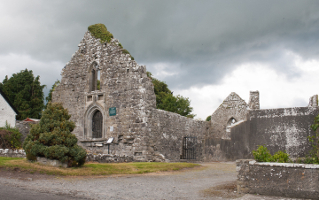
St. Ruadhán mac Fergusa Birn, also known as Rowan and Rodan, Irish Christian abbot who founds the monastery of Lorrha near Terryglass in County Tipperary, dies at the monastery on April 5, 584. Known for his prophesies, he is venerated as a saint and as one of the “Twelve Apostles of Ireland” after his death.

Ruadhán is educated in Clonard, County Meath, by St. Finnian and is known as one of the Twelve Apostles of Ireland. He is said to replace St. Brendan the Navigator at Lorrha after Brendan precedes to cross the River Shannon and set up his monastery at ClonfertCounty Galway.

Ruadhán founds a monastic settlement at Lorrha that consists of a monastery and various other buildings including cells for the many monks that live there. Also a ditch or large mound is built around the settlement to keep animals in and intruders out, the outlines of which remain visible today. Life for the monks is tough but simple, rising early from their beds which consist of rushes or straw placed on the bare ground. They then pray and fast between their domestic chores. The settlement is self-sufficient providing everything from food, clothing, to shelter. Villages and towns, such as the village of Lorrha, often pop up around monastic settlements as trade and refuge attracts the local people.

His embassy in 556 to King Diarmait mac Cerbaill at Tara, is worked into a legend known as the “Curse of Tara”, but the high-king continues to reside at Tara until his death in 564. Diarmuid Mac Cerbhaill violates the sanctity of the church by taking a hostage from its protection. The downfall of Tara from a once thriving royal residence is credited to Ruadhán.

Ruadhán gives the prophecy that Diarmait will be killed by the roof-beam of his hall at Tara. Diarmait has the beam cast into the sea. Diarmait then asks his druids to find the manner of his death, and they foretell that he will die of slaughter, drowning, and burning, and that the signs of his death will be a shirt grown from a single seed of flax and a mantle of wool from a single sheep, ale brewed from one seed of corn, and bacon from a sow which has never farrowed.

On a circuit of Ireland, Diarmait comes to the hall of Banbán at Ráith Bec, and there the fate of which he is warned comes to pass. The roof beam of Tara has been recovered from the sea by Banbán and set in his hall, the shirt, mantle, ale, and bacon are duly produced for Diarmait. Diarmait goes to leave Banbán’s hall, but Áed Dub mac Suibni, waiting at the door, strikes him down and sets fire to the hall. Diarmait crawls into an ale vat to escape the flames and is duly killed by the falling roof beam. Thus, all the prophecies are fulfilled.

The bell of St. Ruadhán is found in a well named after the Saint and is preserved in the British Museum. This well is situated across the road from the present day Church of Ireland.

(Pictured: Lorrha Priory of St. Ruadhán)


Leave a comment

Birth of William Edward Hartpole Lecky, Historian & Theorist

William Edward Hartpole Lecky, Irish historian and political theorist, is born at Newtown Park, near Dublin, on March 26, 1838. His major work is an eight-volume History of England during the Eighteenth Century.

Lecky is educated at Kingstown, Armagh, at Cheltenham College, and at Trinity College, Dublin, where he graduates BA in 1859 and MA in 1863, and where he studies divinity with a view of becoming a priest in the Church of Ireland.

In 1860, Lecky publishes anonymously a small book entitled The Religious Tendencies of the Age, but upon leaving college he turns to historiography. In 1861 he publishes Leaders of Public Opinion in Ireland, containing brief sketches of Jonathan SwiftHenry FloodHenry Grattan, and Daniel O’Connell, originally anonymous and republished in 1871. The essay on Swift, rewritten and amplified, appears again in 1897 as an introduction to an edition of Swift’s works. Two surveys follow: A History of the Rise and Influence of Rationalism in Europe (2 vols., 1865), and A History of European Morals from Augustus to Charlemagne (2 vols., 1869). The latter arouses criticism, with its opening dissertation on “the natural history of morals.”

Lecky then concentrates on his major work, A History of England during the Eighteenth Century, Vols. i. and ii. which appear in 1878, and Vols. vii. and viii., which complete the work, in 1890. In the “cabinet” edition of 1892, in twelve volumes, A History of Ireland in the Eighteenth Century is separated out.

A volume of Poems (1891) is less successful. In 1896, he publishes two volumes entitled Democracy and Liberty, in which he considers modern democracy. The pessimistic conclusions at which he arrives provoked criticism both in the UK and the United States, which is renewed when he publishes in a new edition (1899) his low estimate of William Ewart Gladstone, then recently dead.

In The Map of Life (1899) Lecky discusses in a popular style ethical problems of everyday life. In 1903 he publishes a revised and enlarged edition of Leaders of Public Opinion in Ireland, in two volumes, with the essay on Swift omitted and that on O’Connell expanded into a complete biography. A critic of the methods by which the Act of Union is passed, Lecky, who grew up as a moderate Liberal, is opposed to Gladstone’s policy of Home Rule and, in 1895, he is returned to parliament as Unionist member for University of Dublin constituency in a by-election. In 1897, he is made a privy councillor, and among the coronation honours in 1902, he is nominated an original member of the new Order of Merit.

William Edward Hartpole Lecky dies in London on October 22, 1903.


Leave a comment

Fifth Amendment of the Constitution of Ireland

constitution-of-ireland-2

The Fifth Amendment of the Constitution of Ireland, which is effected by the Fifth Amendment of the Constitution Act, 1972, is approved by referendum on December 7, 1972, and signed into law on January 5, 1973.

The amendment deletes the entirety of Article 44.1.2 which allowed the State to recognise the special position of the Holy Catholic Apostolic and Roman Church as the guardian of the Faith professed by the great majority of the citizens.

Also deleted by the amendment is Article 44.1.3 which allowed the State to also recognise the Church of Ireland, the Presbyterian Church in Ireland, the Methodist Church in Ireland, the Religious Society of Friends in Ireland, as well as the Jewish Congregations and the other religious denominations existing in Ireland at the date of the coming into operation of this Constitution.

In drafting the Irish constitution in 1936 and 1937, Éamon de Valera and his advisers choose to reflect what has been a contemporary willingness by constitution drafters and lawmakers in Europe to mention and in some ways recognise religion in explicit detail. This contrasts with many 1920s constitutions, notably the Constitution of the Irish Free State of 1922, which, following the secularism of the initial period following World War I, simply prohibits any discrimination based on religion or avoids religious issues entirely.

De Valera, his advisers, and the men who put words to de Valera’s concepts for the constitution face conflicting demands in his drafting of the article on religion. In contemporary terms, the Amendment marks a defeat for conservative Catholics and Pope Pius XI explicitly withholds his approval from it.

Though perceived in retrospect as a sectarian article, Article 44 is praised in 1937 by leaders of Irish Protestant churches, notably the Church of Ireland Archbishop of Dublin, and by Jewish groups. Conservative Catholics condemn it as “liberal.”

When the contents of Article 44 are put to Pope Pius XI by Cardinal Eugenio Pacelli, then Cardinal Secretary of State, later Pope Pius XII, the pope states in diplomatic language, “We do not approve, nor do we not disapprove – we will remain silent.” It is said that the Vatican is privately more appreciative of the constitution, and Pius XII later praises it.

The Fifth Amendment is introduced by the Fianna Fáil government of Jack Lynch and supported by every other major political party. The Catholic Church does not voice any objection to the amendment, but it is opposed by some conservative Catholics. Some leading members of the Church of Ireland and the Jewish Community say during the campaign that while they appreciate the Article’s recognition of their existence in 1937, it is no longer needed in the 1970s and has lost its usefulness.

The referendum on the amendment occurs on the same day as the referendum on the Fourth Amendment which lowers the voting age to eighteen. The Fifth Amendment is approved by 721,003 (84.4%) in favour and 133,430 (15.6%) against.

Having completed its passage through the Oireachtas and been adopted by the people, it is enacted by being signed into constitutional law by the President of Ireland, the man who had drafted the original article, Éamon de Valera.


Leave a comment

Birth of Playwright & Poet Lennox Robinson

lennox-robinson

Esmé Stuart Lennox Robinson, playwright, poet, theatre producer, and director who is involved with the Abbey Theatre, is born in Westgrove, Douglas, County Cork, on October 4, 1886.

Robinson is raised in a Protestant and Unionist family in which he is the youngest of seven children. His father, Andrew Robinson, is a middle-class stockbroker who in 1892 decides to become a clergyman in the Church of Ireland in the small Ballymoney parish, near Ballineen in West Cork. A sickly child, Robinson is educated by private tutor and at Bandon Grammar School. In August 1907, his interest in the theatre begins after he goes to see an Abbey production of plays by W.B. Yeats and Lady Gregory at the Cork Opera House. He publishes his first poem that same year. His first play, The Cross Roads, is performed in the Abbey in 1909 and he becomes manager of the theatre towards the end of that year. He resigns in 1914 as a result of a disastrous tour of the United States but returns in 1919. He is appointed to the board of the theatre in 1923 and continues to serve in that capacity until his death. His Abbey career and production involvement can be found in the Abbey archives.

As a playwright, Robinson shows himself as a nationalist with plays like Patriots (1912) and Dreamers (1915). On the other hand, he belongs to a part of Irish society which is not seen as fully Irish. This division between the majority native Irish (Roman Catholics) on one side and the Anglo-Irish (Protestants) on the other can be seen in a play such as The Big House (1926), which depicts the burning of a Protestant manor home by the Irish Republican Army (IRA). Robinson’s most popular play is The Whiteheaded Boy (1916).

Other plays include Crabbed Youth and Age (1924), The Far Off Hills (1928), Drama at Inish (1933), and Church Street (1935). Drama at Inish, which is presented in London and on Broadway as Is Life Worth Living?, is revived as part of the 2011 season at the Shaw Festival at Niagara-on-the-Lake, Ontario, Canada, with Mary Haney in the role of Lizzie Twohig. Robinson’s fiction includes Eight Short Stories (1919). In 1931 he publishes a biography of Bryan Cooper, who had recently died. In 1951, he publishes Ireland’s Abbey Theatre, the first full-length history of the company.

He publishes an edited edition of Lady Gregory’s diaries in 1947. In 1958 he co-edits with Donagh MacDonagh The Oxford Book of Irish Verse. He is also a director and producer, in 1930 producing a play by Irish playwright Teresa Deevy called The Reapers. In 1931 he is co-director of A Disciple along with W.B. Yeats and Walter Starkie.

Melancholic and alcoholic in later years, Lennox Robinson dies in Monkstown, County Dublin, on October 15, 1958. He is buried St. Patrick’s Cathedral.


Leave a comment

Death of Irish Dramatist Seán O’Casey

Seán O’Casey, Irish dramatist and memoirist, dies of a heart attack in Torquay, Devon, England on September 18, 1964. A committed socialist, he is the first Irish playwright of note to write about the Dublin working classes.

O’Casey is born John Casey at 85 Upper Dorset Street, in the northern inner-city area of Dublin on March 30, 1880. He is a member of the Church of Ireland, baptised on July 28, 1880 in St. Mary’s parish and confirmed at St. John the Baptist Church in Clontarf. He is an active member of Saint Barnabas until his mid-twenties, when he drifts away from the church.

As O’Casey’s interest in Irish nationalism grows, he joins the Gaelic League in 1906 and learns the Irish language. At this time, he Gaelicises his name from John Casey to Seán Ó Cathasaigh. He also learns to play the Uilleann pipes and is a founder and secretary of the St. Laurence O’Toole Pipe Band. He joins the Irish Republican Brotherhood, and becomes involved in the Irish Transport and General Workers Union, established by James Larkin to represent the interests of the unskilled labourers who inhabit the Dublin tenements. In March 1914 he becomes General Secretary of Larkin’s Irish Citizen Army. On July 24, 1914 he resigns from the ICA, after his proposal to deny dual membership to both the ICA and the Irish Volunteers is rejected.

In 1917, his friend Thomas Ashe dies in a hunger strike and it inspires him to write. He spends the next five years writing plays. O’Casey’s first accepted play, The Shadow of a Gunman, is performed at the Abbey Theatre in 1923. This is the beginning of a relationship that is to be fruitful for both theatre and dramatist but which ends in some bitterness. It is followed by Juno and the Paycock (1924) and The Plough and the Stars (1926).

The Plough and the Stars is not well received by the Abbey audience. There is a riot reported on the fourth night of the show. His depiction of sex and religion offends some of the actors who refused to speak their lines. W.B. Yeats intervenes and describes the audience as “shaming themselves.”

In 1928, Yeats rejects O’Casey’s fourth play, The Silver Tassie, for the Abbey. It is an attack on imperialist wars and the suffering they cause. The Abbey refuses to perform it. The plays O’Casey writes after this include the darkly allegorical and highly controversial Within the Gates (1934), which is set within the gates of a busy city park based on London’s Hyde Park. It closes not long after opening and is another box office failure.

Over the next twenty years, O’Casey writes The Star Turns Red (1940), Purple Dust (1943), Red Roses for Me (1943), Oak Leaves and Lavender (1945), Cock-a-Doodle Dandy (1949), The Bishop’s Bonfire (1955), and The Drums of Father Ned (1958). In 1959, O’Casey gives his blessing to a musical adaptation of Juno and the Paycock by American composer Marc Blitzstein. The musical, retitled Juno, is a commercial failure, closing after only 16 Broadway performances. Also in 1959, George Devine produces Cock-a-Doodle Dandy at the Royal Court Theatre and it is also successful at the Edinburgh International Festival and has a West End run.

On September 18, 1964, at the age of 84, O’Casey dies of a heart attack, in Torquay, Devon. He is cremated at the Golders Green Crematorium.


Leave a comment

Birth of the Liberator, Daniel O’Connell

daniel-oconnell

Daniel O’Connell, Irish political leader often referred to as The Liberator or The Emancipator, is born on August 6, 1775, at Carhan near Cahersiveen, County Kerry, to the O’Connells of Derrynane, a once-wealthy Roman Catholic family, that has been dispossessed of its lands.

Raised by his uncle, Daniel learns the Irish language and Irish lore in Kerry. O’Connell does part of his schooling in France during the revolution. On May 19, 1798, O’Connell is called to the Irish Bar and becomes a barrister. Four days later, the United Irishmen stage their rebellion which is put down by the British with great bloodshed. O’Connell does not support the rebellion. He believes that the Irish need to assert themselves politically rather than by force. The violent excesses he witnesses in France, the slaughter of the 1798 Rising, and finally his own killing of a man in a duel in 1815 leads him to renounce violence forever.

Moving into politics, O’Connell founds the Catholic Association in 1823, creating one of the first massive political movements in Europe or the Americas. The Catholic Association embraces other aims to better Irish Catholics, such as electoral reform, reform of the Church of Ireland, tenants’ rights, and economic development.

When he is elected to Parliament in 1828, he is unable to take his seat as members of parliament have to take the Oath of Supremacy, which is incompatible with Catholicism.  Fear of the reaction of his millions of followers leads to the passage of the Roman Catholic Relief Act 1829. O’Connell works for Home Rule for Ireland for the rest of his days but never achieves it. The British ban his mass Repeal of the Union rallies in 1843 and jail him for a time. The movement loses momentum at that point and the long years of hard work wear “The Liberator” down.

O’Connell dies at the age of 71 of cerebral softening on May15, 1847, in Genoa, Italy, while on a pilgrimage to Rome. His time in prison seriously weakens him and the appallingly cold weather he has to endure on his journey is likely the final blow. According to his dying wish, his heart is buried in Rome at Sant’Agata dei Goti, then the chapel of the Irish College, and the remainder of his body in Glasnevin Cemetery in Dublin, beneath a round tower.


Leave a comment

Founding of the Gaelic League

conradh-na-gaeilge-logo

The Gaelic League (Irish: Conradh na Gaeilge), a social and cultural organisation which promotes the Irish language in Ireland and worldwide is founded in Dublin on July 31, 1893.

Conradh na Gaeilge is founded by Douglas Hyde, the son of a Church of Ireland rector from Frenchpark, County Roscommon, with the aid of Eugene O’Growney, Eoin MacNeill, Thomas O’Neill Russell, and others. The organisation develops from Ulick Bourke‘s earlier Gaelic Union and becomes the leading institution promoting the Gaelic Revival, carrying on efforts like the publishing of the Gaelic Journal. The League’s first newspaper is An Claidheamh Soluis (The Sword of Light) and its most noted editor is Patrick Pearse. The motto of the League is Sinn Féin, Sinn Féin amháin (Ourselves, Ourselves alone).

The League encourages female participation from the start and a number of women play a prominent role. They are not restricted to subordinate roles, but play an active part in leadership, although males are in the overwhelming majority. Local notables, such as Lady Gregory in Galway, Lady Esmonde in County Wexford, and Mary Spring Rice in County Limerick, and others such as Norma Borthwick, found and lead branches in their communities. At the annual national convention in 1906 women are elected to seven of the forty-five positions on the Gaelic League executive. Executive members include Máire Ní Chinnéide, Úna Ní Fhaircheallaigh (who writes pamphlets on behalf of the League), Bean an Doc Uí Choisdealbha, Máire Ní hAodáin, Máire de Buitléir, Nellie O’Brien, Eibhlín Ní Dhonnabháin, and Eibhlín Nic Néill.

Though apolitical, the organisation attracts many Irish nationalists of different persuasions, much like the Gaelic Athletic Association. It is through the League that many future political leaders and rebels first meet, laying the foundation for groups such as the Irish Volunteers. However, Conradh na Gaeilge does not commit itself entirely to the national movement until 1915, causing the resignation of Douglas Hyde, who feels that the culture of language should be above politics. Most of the signatories of the 1916 Proclamation are members. It still continues to attract many Irish Republicans. Seán Mac Stíofáin, the first chief of staff of the Provisional IRA was a prominent member in his later life.

After the foundation of the Irish Free State in 1922, the organisation has a less prominent role in public life as Irish is made a compulsory subject in state-funded schools. It does unexpectedly bad in the Irish Seanad election of 1925, when all the candidates it endorses are defeated, including Hyde.


Leave a comment

Birth of Cecil Day-Lewis, Poet & Poet Laureate of the U.K.

Cecil Day-Lewis, poet, novelist, critic, and the Poet Laureate of the United Kingdom from 1968 to 1972, is born in Ballintubbert, County Laois, on April 27, 1904. He also writes mystery stories under the pseudonym of Nicholas Blake and is the father of actor Daniel Day-Lewis and documentary filmmaker and television chef Tamasin Day-Lewis.

Day-Lewis is the son of Frank Day-Lewis, Church of Ireland Rector of the parish, and Kathleen Blake. His father takes the surname “Day-Lewis” as a combination of the surnames of his own birth father (Day) and his adoptive father (Lewis). After the death of his mother in 1906, Day-Lewis is brought up in London by his father, with assistance of an aunt, spending summer holidays with relatives in County Wexford. He is educated at Sherborne School and at Wadham College, Oxford. In Oxford, Day-Lewis becomes part of the circle gathered around W. H. Auden and helps him to edit Oxford Poetry 1927. His first collection of poems, Beechen Vigil, appears in 1925.

In 1928, Day-Lewis marries Constance Mary King, the daughter of a Sherborne teacher, and works as a schoolmaster in three schools, including Larchfield School in Helensburgh, Scotland. During the 1940s he has a long and troubled love affair with the novelist Rosamond Lehmann. His first marriage is dissolved in 1951, and he marries actress Jill Balcon, daughter of Michael Balcon.

During World War II he works as a publications editor in the Ministry of Information, an institution satirised by George Orwell in his dystopian Nineteen Eighty-Four. During this time his work is now no longer as heavily influenced by Auden, and he develops a more traditional style of lyricism. Some critics believe that he reaches his full stature as a poet in Word Over All (1943), when he finally distances himself from Auden. After the war he joins the publisher Chatto & Windus as a director and senior editor.

In 1946, Day-Lewis is a lecturer at Cambridge University, publishing his lectures in The Poetic Image (1947). He later teaches poetry at the University of Oxford, where he is Professor of Poetry from 1951 until 1956. He is the Norton Professor at Harvard University from 1962 to 1963, and is appointed Poet Laureate in 1968, in succession to John Masefield.

Day-Lewis is chairman of the Arts Council Literature Panel, vice-president of the Royal Society of Literature, an Honorary Member of the American Academy of Arts and Letters, a Member of the Irish Academy of Letters, and a Professor of Rhetoric at Gresham College, London.

Cecil Day-Lewis dies of pancreatic cancer on May 22, 1972, at Lemmons, the Hertfordshire home of Kingsley Amis and Elizabeth Jane Howard, where he and his family are staying. Being a great admirer of Thomas Hardy, he arranges to be buried as close as possible to the author’s grave at St. Michael’s Church in Stinsford, Dorset.


Leave a comment

Creation of The Honourable The Irish Society

irish-society-coat-of-arms

On January 28, 1613, The Honourable The Irish Society, a consortium of livery companies of the City of London, is created by Royal Charter of James I of England to undertake the Plantation in the North West of Ulster that is then being driven by the English Crown.

Following the Gaelic defeat in the Nine Years’ War in 1603 and the Flight of the Earls in 1607, northwest Ulster is left open to colonisation. James I sets out to defend against a future attack from within or without. He finds that the town of Derry can become either a great asset as a control over the River Foyle and Lough Swilly, or it can become an inviting back door should the people of the area turn against him. He pressures the guilds of the City of London to fund the resettlement of the area, including the building of a new walled city. This results in the creation of the Society.

The city of Derry is renamed Londonderry in recognition of the London origin of the Irish Society. County Coleraine is enlarged and renamed County Londonderry after its new county town. The rural area of the county is subdivided between the Great Twelve livery companies, while the towns and environs of Londonderry and Coleraine are retained by the Irish Society.

In January 1635, the Irish Society, as well as the City of London, are found guilty of mismanagement and neglect of Derry plantation. They are sentenced to a fine of £70,000 and forfeiture of Derry property. The Society is suppressed in 1637 but is revived by Oliver Cromwell in 1650 and again after the Restoration by Londonderry’s 1662 royal charter.

The Society is involved in several controversies over the years including a dispute over fishing rights with the Church of Ireland and Bishop of Derry and a lawsuit brought by The Skinners’ Company in 1832 over the distribution of profits. The Society also has some disputes with the corporations over ownership and development of property. During the 17th and 18th centuries, four of the twelve livery companies sell their estates, with the Irish Society requiring a bond of indemnity in each case. Leases to middlemen granted by the remaining companies expire at various times during the nineteenth century, after which the companies “enormously increased the rental.”

The Society finances the building of the Guildhall in Derry. Construction begins in 1887 and it is opened in July 1890, at a cost of £19,000.

The Society remains in existence today as a relatively small grant-giving charitable body. Its educational grants are funded by its remaining property, including the Walls of Derry, a tourist attraction and heritage site, and fisheries on the River Bann. The Society is based in London, but maintains a “representative” resident in County Londonderry.