seamus dubhghaill

Promoting Irish Culture and History from Little Rock, Arkansas, USA


Leave a comment

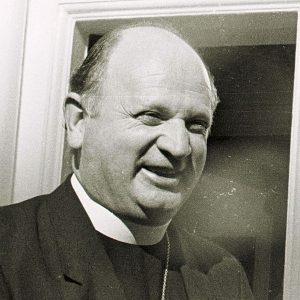
Birth of Bishop Eamonn Casey

Eamonn Casey, Irish Roman Catholic prelate who serves as bishop of Galway and Kilmacduagh in Ireland from 1976 to 1992, is born in FiriesCounty Kerry on April 24, 1927.

Casey is educated in Limerick and in St. Patrick’s College, Maynooth. He is ordained a priest for the Diocese of Limerick on June 17, 1951, and appointed Bishop of Kerry on July 17, 1969. He holds this position until 1976, when he is appointed Bishop of Galway and Kilmacduagh and apostolic administrator of Kilfenora. While in Galway, he is seen as a progressive. It is a significant change in a diocese that has been led for nearly forty years by the very conservative Michael Browne.

Casey is well known for his work aiding Irish emigrants in Britain. In addition, he supports the Dunnes Stores‘ staff, who are locked out from 1982 to 1986 for refusing to sell goods from apartheid South Africa.

Casey attends the funeral of the murdered Archbishop of San SalvadorMonsignor Óscar Romero. He witnesses firsthand the massacre of those attending the funeral by government forces. He then becomes a vocal opponent of United States foreign policy in Central America, and, as a result, opposes the 1984 visit of United States President Ronald Reagan to Ireland, refusing to meet him when he comes to Galway.

Casey is highly influential in the Irish Catholic hierarchy and serves as bishop until his resignation in 1992. He is a friend and colleague of another highly prominent Irish priest, Father Michael Cleary.

In 1992, newspapers discover that Casey has had a sexual relationship with Annie Murphy, an American divorcée. Together they have a son, Peter, born in 1974 in Dublin. Murphy later claims that Casey had attempted to persuade her to give the child up for adoption at birth. She chooses not to do so and raises him with the help of her parents. When Murphy decides to go public about the relationship and informs The Irish Times, Casey tenders his resignation and leaves the country.

Casey’s resignation is regarded as a pivotal moment when the Roman Catholic hierarchy begins to lose its considerable influence over the society and politics of Ireland. He is succeeded by his Secretary, Bishop James McLoughlin, who serves in the post until his own retirement on July 3, 2005.

Casey opts to embrace the life of a foreign missionary in South America. He works with members of the Missionary Society of St. James in a rural parish in Ecuador, despite his lack of knowledge of the Spanish language. During this time, he travels long distances to reach the widely scattered members of his parish. After his missionary period is completed, instead of returning to Ireland, Casey takes a position in the parish of St. Pauls, Haywards Heath, in South East England. He returns to Ireland in 2006.

In 2005, Casey is investigated in conjunction with the sexual abuse scandal in Galway, Kilmacduagh and Kilfenora diocese. He is subsequently cleared of any wrongdoing.

Casey suffers four mini strokes in 2002 and begins to experience memory issues. In August 2011, he is admitted to a nursing home in County Clare. Eamonn Casey dies on March 13, 2017, at the age of 89.


Leave a comment

Birth of Michael D. Higgins, Ninth President of Ireland

Michael Daniel Higgins, politician, human rights activist, university lecturer, poet, and the ninth and current President of Ireland, is born in LimerickCounty Limerick, on April 18, 1941. He takes office on November 11, 2011, following victory in the 2011 Irish presidential election.

At age five Higgins is separated from his parents, whose struggle to make ends meet is partly the product of his father’s ill health. He is raised in modest means by relatives in County Clare and starts his working life as a clerk in a bank. With a loan from a benefactor, he enters University College Galway, now National University of Ireland, Galway, at age 20 and continues his study with the benefit of scholarships. He serves as president of the student council and becomes involved with the Fianna Fáil party. Under the influence of politician Noël Browne, he soon switches allegiance to socialism and the Labour Party. An unashamed intellectual, Higgins continues his studies at Indiana University Bloomington and the University of Manchester. Before beginning a career in politics, he lectures in sociology and political science at Galway and is a visiting professor at Southern Illinois University Carbondale.

Twice Higgins runs unsuccessfully for a seat in the Dáil Éireann, the lower house of the Oireachtas, before being appointed to Seanad Éireann, the upper house, by Taoiseach Liam Cosgrave in 1973. Higgins is then elected to represent Galway West in the Dáil (1981–82) and serves another term in the Seanad (1983–87), representing the National University of Ireland, before becoming a fixture in the Dáil in the seat for Galway West (1987–2011). He also serves two terms as the mayor of Galway (1982–83, 1991–92). Early on he earns a reputation as a leftist firebrand who opposes participation in coalition government. His radical commitment to human rights and to peace and justice in places such as NicaraguaEl Salvador, and Cambodia, as well as his advocacy of progressive issues such as equal pay for women and the rights of people with disabilities, remain constant, but he mellows over the years to accept coalition rule.

In 1993, in the Fianna Fáil–Labour coalition government led by Albert Reynolds, Higgins becomes the minister for arts, culture, and the Gaeltacht (the districts in which the Irish language and the traditional national culture are best preserved). In that capacity he champions the Irish film industry and is responsible for the creation of the first Irish-language television station, Teilifís na Gaeilge (TG4). A poet who publishes four books of poetry before his election as president, Higgins earns a reputation as an impassioned and eloquent orator in both Irish and English.

By 2003, when he takes over the leadership of the Labour Party, the diminutive Higgins has become something of a national icon, known to most people simply as “Michael D.” He seeks Labour’s nomination for the presidency in 2004 unsuccessfully, but in 2011 he is elected the ninth president of Ireland with some 40 percent of the first-preference votes. In the process he bests heavily favoured independent Seán Gallagher, who stumbles badly in a televised debate just before the election, as well as Martin McGuinness, a former Irish Republican Army (IRA) leader who steps down temporarily as the deputy first minister of Northern Ireland to run.


Leave a comment

Birth of Engineer John Philip Holland

john-philip-holland

John Philip Holland, Irish engineer who develops the first submarine to be formally commissioned by the U.S. Navy, and the first Royal Navy submarine, HMS Holland 1, is born on February 24, 1841.

Holland, the second of four siblings, all boys, is born in a coastguard cottage in Liscannor, County Clare, where his father, John Philip Holland, Sr., is a member of the British Coastguard Service. His mother, a native Irish speaker from Liscannor, Máire Ní Scannláin, is John Holland’s second wife. His first wife, Anne Foley Holland, believed to be a native of Kilkee, dies in 1835. The area is heavily Irish-speaking and Holland learns English properly only when he attends the local English-speaking St. Macreehy’s National School, and from 1858, in the Christian Brothers in Ennistymon.

Holland joins the Irish Christian Brothers in Limerick and teaches in CBS Sexton Street in Limerick and many other centres in the country, including North Monastery CBS in Cork, St. Joseph’s CBS in Drogheda, and as the first Mathematics teacher in Coláiste Rís in Dundalk. Due to ill health, he leaves the Christian Brothers in 1873 and emigrates to the United States. Initially working for an engineering firm, he returns to teaching again for an additional six years in St. John’s Catholic school in Paterson, New Jersey.

While a teacher in Cork, Holland reads an account of the battle between the ironclads USS Monitor and USS Merrimack in the Battle of Hampton Roads during the American Civil War. He realizes that the best way to attack such ships would be through an attack beneath the waterline. He draws a design, but when he attempts to obtain funding, he is turned away. After his arrival in the United States, Holland slips and falls on an icy Boston street and breaks a leg. While recuperating from the injury in a hospital, he uses his time to refine his submarine designs and is encouraged by a priest, Isaac Whelan.

In 1875, his first submarine designs are submitted for consideration by the U.S. Navy, but are turned down as unworkable. The Fenians, however, continue to fund Holland’s research and development expenses at a level that allows him to resign from his teaching post. In 1881, Fenian Ram is launched, but soon after, Holland and the Fenians part company on bad terms over the issue of payment within the Fenian organization, and between the Fenians and Holland. The submarine is now preserved at Paterson Museum in New Jersey.

Holland continues to improve his designs and works on several experimental boats, prior to his successful efforts with a privately built type, launched on May 17, 1897. This is the first submarine having power to run submerged for any considerable distance, and the first to combine electric motors for submerged travel and gasoline engines for use on the surface. The submarine is purchased by the U.S. Navy on April 11, 1900, after rigorous tests and is commissioned on October 12, 1900 as USS Holland (SS-1). Six more of her type are ordered and built at the Crescent Shipyard in Elizabeth, New Jersey. The company that emerges from under these developments is called The Electric Boat Company, founded on February 7, 1899. Isaac Leopold Rice becomes the company’s first President with Elihu B. Frost acting as vice president and chief financial officer. The company eventually evolves into the major defense contractor General Dynamics.

The USS Holland design is also adopted by others, including the Royal Navy in developing the Holland-class submarine. The Imperial Japanese Navy employs a modified version of the basic design for their first five submarines, although these submarines are at least 10 feet longer at about 63 feet. These submarines are also developed at the Fore River Ship and Engine Company in Quincy, Massachusetts. Holland also designs the Holland II and Holland III prototypes. The Royal Navy ‘Holland 1’ is on display at the Submarine Museum in Gosport, England.

After spending 56 of his 73 years working with submersibles, John Philip Holland dies on August 12, 1914 in Newark, New Jersey. He is interred at the Holy Sepulchre Cemetery in Totowa, New Jersey.


Leave a comment

Birth of Thomas Dermody, Scholar & Poet

thomas-dermody

Thomas Dermody, classical scholar and poet, is born in Ennis, County Clare, on January 15, 1775. He writes under several pseudonyms including Mauritius Moonshine and Marmaduke Myrtle.

Dermody is scholarly but lives hard and makes little of his life. At the age of nine he is employed as a classical teacher in his father’s school, and has already acquired from his father a love for literature and the bottle.

Dermody has the genius of a poet, and writes fairly good poetry, but his genius is not enough. He lives for 27 years, half his life a promising boy and half a ne’er-do-well. His promise brings him generous patrons in his early days in Ireland, but he scorns the hand that feeds him, denies the friends who could nurse his genius, and runs away to England to keep bad company.

At the age of nineteen, he enlists in the army and behaves uncommonly well under military discipline. He becomes corporal, sergeant, and eventually second lieutenant, serving with distinction. He is wounded in France, and upon his return to England, is retired on half-pay.

He gains and loses friend after friend and abuses patron after patron. They clothe and clean him and make him presentable, but he then drinks himself to nakedness and rags and behaves like a brute. Such from day to day and year to year is his life, and in the end he drinks himself to death and perishes in a miserable cottage near Lewisham on July 15, 1802. He is filled with conceit and a slave to his desires, but the lines that are fading away on the stone above his grave show that he was a poet. Dermody is buried in the churchyard of St. Mary’s Church Lewisham.

Dermody publishes two books of poems which, after his death, are collected as The Harp of Erin. Some 56 of his sonnets have been published in various works, from his first 1789 collection Poems to those published in 1792, with a few posthumously published verses in the biography by James Grant Raymond. Samuel Taylor Coleridge takes an interest in some of his verse which has been included in the literary magazine The Anthologia Hibernica.


Leave a comment

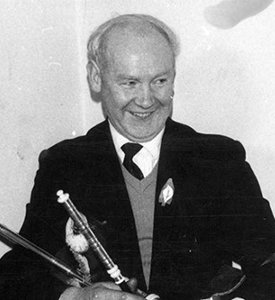
Birth of Uilleann Piper Willie Clancy

willie-clancy

Willie Clancy, an Irish uilleann piper, is born into a musical family at Islandbawn near Milltown Malbay, County Clare, on December 24, 1918.

Clancy’s parents, Gilbert Clancy and Ellen Killeen, both sing and play concertina, and his father also plays the flute. Clancy’s father has been heavily influenced by local blind piper Garret Barry and passes much of Barry’s music on to his son.

Clancy starts playing the whistle at age five, and later takes up the flute. He first lays eyes on a set of pipes in 1936 when he sees Johnny Doran playing locally. He obtains his first set of pipes two years later. His influences include Leo Rowsome, Séamus Ennis, John Potts, and Andy Conroy. Clancy wins the Oireachtas competition in 1947. Unable to earn a living from music he emigrates to London where he works as a carpenter.

Returning to Milltown Malbay shortly after the death of his father in 1957, Clancy records some influential 78 rpm recordings for the Gael Linn label, among them the classic reel selection “The Old Bush/The Ravelled Hank of Yarn.” He develops a highly distinctive and individual style of piping. From 1957 until 1972 the Summer music sessions in the West Clare town become widely renowned, with Clancy as one of the main attractions. Pipe-making, reed-making, and all things connected with the instrument are explored and advanced by the Clancy influence. He gives many performances on both radio and television as well as live sessions in his local area.

He lives out the remainder of his life in Milltown Malbay. Clancy marries Dóirín Healy in 1962. He dies suddenly in a hospital in Galway on January 24, 1973, and is widely mourned among friends and musicians alike. He is buried in Ballard Cemetary just outside Miltown Malbay.

Later that year the Willie Clancy Summer School is established in his honour by his friends Junior Crehan, Martin Talty, Sean Reid, Paddy Malone, Paddy McMahon, Frankie McMahon, Jimmy Ward, JC Talty, Harry Hughes, Michael O Friel, Séamus Mac Mathúna, and Muiris Ó Rócháin. He is also the subject of a major television documentary “Cérbh É? Willie Clancy” on TG4, first broadcast in November 2009. In this programme, one of a series in which major figures in contemporary traditional music, profile and pay homage to a master of their craft from a bygone age, Peter Browne traces the life and legacy of Clancy.

A statue of Clancy is unveiled on November 9, 2013 on the Main Street in Miltown Malbay.


2 Comments

Disappearance of Father Michael Griffin

father-michael-griffin

Father Michael Griffin, a Catholic priest, disappears on November 14, 1920, after he leaves his residence at St. Joseph’s Church, in Galway. His housekeeper hears him talking to someone at the door and assumes that Fr. Griffin is going to visit a sick parishioner. He never returns.

Griffin is born in Gurteen, East Galway and ordained at St. Patrick’s College, Maynooth in 1917. A priest of the Diocese of Clonfert, he serves in the Diocese of Galway, Kilmacduagh and Kilfenora. In June 1918, the curate is transferred from the parish of Ennistymon, County Clare, to Rahoon, Galway City.

Fr. Griffin is known to the Crown Forces as a republican sympathiser. On the night of September 8, 1920, he is called out to attend Seamus Quirke, a First Lieutenant in the local Irish Republican Army (IRA) after he is shot seven times at the docks. He also takes part in the funeral mass of Michael Walsh of the Old Malt House following his murder on the night of October 19, 1920.

On November 14, Fr. Griffin is lured from the presbytery by British forces. He is taken to Lenaboy Castle where he is questioned. After being interrogated, he is shot through the head and his body is taken away by lorry and buried in an unmarked grave at Cloghscoltia near Barna. His disappearance is reported to the police the following day.

Fr. Griffins’ remains are discovered by a local man, William Duffy, while he is attending cattle on November 20.

Frank Percy Crozier, commander of the Auxiliary Division of the Royal Irish Constabulary, travels to Galway on November 22 and finds that Fr. Griffin has been murdered by his men, and that a plot is afoot to murder Dr. Michael Fogarty, Bishop of Killaloe. Crozier writes in Ireland For Ever:

“I found out that the military inquiry into the murder of Father Griffin (held in lieu of an inquest) was fast with a ‘frame up’ and that a verdict of murder against persons, or somebody ‘unknown’ would result. I told the military commander this and the name of the real murderer but was informed that a senior official of Dublin Castle had been to Galway in front of me to give instructions as to ‘procedure’ in this murder investigation. At Killaloe next day I received further evidence that the hidden hand was still at work and was told in confidence that instructions had been received to kill Dr. Fogarty, Roman Catholic Bishop of Killaloe, by drowning him in a sack from the bridge over the River Shannon, so as to run no further risk of detection by having his body found.”

On November 23, Fr. Griffin’s funeral mass takes place at St. Joseph’s Church, Presentation Road. The funeral cortege moves through the streets of Galway, with three bishops, 150 priests, and in excess of 12,000 mourners participating. The priest is buried in the grounds of Loughrea Cathedral.

A group of enthusiasts gather together in Galway in the spring of 1948 to form a football club and they decide unanimously to name the club “Father Griffins” and they grow and flourish to be a major force in Galway football. There is also a road in Galway City called “Father Griffin Road.”


Leave a comment

Opening of the Catholic University of Ireland

The Catholic University of Ireland in Dublin is opened, and lectures commence on November 3, 1854, with the registration of seventeen students, the first being Daniel O’Connell, grandson of the notable Catholic politician Daniel O’Connell.

The university is founded in 1851 following the Synod of Thurles in 1850, and in response to the Queen’s University of Ireland and its associated colleges which are non-denominational. Cardinal Paul Cullen has previously forbidden Catholics from attending these “godless colleges.” On May 18, 1854, the university is formally established with five faculties of law, letters, medicine, philosophy, and theology with John Henry Newman as the Rector.

In 1861, Dr. Bartholomew Woodlock, the rector from 1860–1879, tries to secure land for a building near Holy Cross College Clonliffe, the establishment to be known as St. Patrick’s University. Plans are drawn up by architect J.J. McCarthy and a foundation stone laid. Cardinal Cullen is against the idea of educating lay and clerical students on the same premises. However, this plan is shelved because of the expansion of the railway line. A church and monastery are eventually built on the site. Under the name St. Patrick’s University night classes are advertised by the University under Dr. Woodlock’s name.

Some feeder secondary schools are established for the Catholic University of Ireland. The nearby Catholic University School is joined by St. Flannan’s College in County Clare and Catholic University High School in Waterford.

The Catholic University is neither a recognised university so far as the civil authorities are concerned, nor an institution offering recognised degrees. Newman has little success in establishing the new university, though over £250,000 has been raised from the laity to fund it. Though they hold the foundation money as trustees, the hierarchy in 1859 spends most of it to support an Irish Brigade led by Myles O’Reilly to help defend Rome in the Second Italian War of Independence. Newman leaves the university in 1857.

Subsequently the school goes into a serious decline, with only three students registered in 1879. The situation changes in 1880 when the recognised Royal University of Ireland comes into being and students at the Catholic University are entitled to sit the Royal University examinations and receive its degrees.

In 1909 the Catholic University essentially comes to an end with the creation of the National University of Ireland, with University College Dublin as a constituent, however the Catholic University of Ireland remains a legal entity until 1911.

(Pictured: J. J. McCarthy’s design for the Catholic University of Ireland)


Leave a comment

Founding of the Gaelic Athletic Association

gaelic-athletic-associationThe Gaelic Athletic Association (GAA) is founded on November 1, 1884, by a group of Irishmen gathered in the billiard room of the Hayes’ Hotel in Thurles, County Tipperary. The architects and founding members are Michael Cusack of County Clare, Maurice Davin, Joseph K. Bracken, Thomas St. George McCarthy, P.J. Ryan of Tipperary, John Wyse Power, and John McKay. Their goal is to to formulate a plan and establish an organisation to foster and preserve Ireland’s unique games and athletic pastimes.

The GAA focuses primarily on promoting Gaelic games, which include the traditional Irish sports of hurling, camogie, Gaelic football, handball, and rounders. The Association also promotes Irish music and dance, as well as the Irish language.

It has more than 500,000 members worldwide, assets in excess of €2.6 billion, and declares total revenues of €94.8 million in 2010, with a total gross profit of €78.5 million.

Gaelic football and hurling are the most popular activities promoted by the organisation, and the most popular sports in the Republic of Ireland in terms of attendances. Gaelic football is also the largest participation sport in Northern Ireland. GAA competitions, activities, and structures are organised on an all-Ireland basis, without reference to the border drawn in 1921. The women’s version of these games, ladies’ Gaelic football and camogie, are organised by the independent but closely linked Ladies’ Gaelic Football Association and the Camogie Association respectively. GAA Handball is the Irish governing body for the sport of handball, while the other Gaelic sport, rounders, is managed by the GAA Rounders National Council.

Since its foundation in the late 19th century, the Association has grown to become a major influence in Irish sporting and cultural life with considerable reach into communities throughout Ireland and among the Irish diaspora.


Leave a comment

First Aircraft Lands at Rineanna Airfield (Shannon Airport)

rineanna-airport

The first aircraft, an Irish Air Corps Aero Anson A43, lands at the newly opened Rineanna Airfield, which is later to become known as Shannon International Airport, on May 18, 1939.

Transatlantic aviation in the Shannon Estuary first commences with a seaplane base at Foynes. In October 1935, the Irish Government makes a decision to initiate a survey to find suitable bases for the operation of seaplanes and land planes on a transatlantic service. The Department of Defence, which provides technical advice on aviation to the Civil Aviation Section of the Department of Industry, is given the task.

On November 21, 1935, a survey party sets out and surveys sites as far north as Athlone and south to Askeaton. Among the sites for a seaplane base to be considered are the Shannon just below Limerick, Lough Derg, Lough Corrib, Tralee Bay, Kenmare Bay, Lough Ree, and Valentia. Foynes, near the mouth of the Fergus River, is finally selected due to its sheltered anchorage and its proximity to long open stretches of water.

The first priority is drainage to remove surface water from the site and to construct embankments to prevent flooding of the airfield due to its proximity to the tidal River Shannon. Several hundred men are employed to dig narrow lateral drains for the approximately 135 miles of pipes which are laid in parallel lines 50 feet apart over almost the entire area of the airfield site. They also excavate catchment drains to collect water from the surface of the site.

At this time all indications are that regular aerial travel between Europe and the United States will be initially by flying boat and accordingly, the base at Rineanna is designed to cater to both land planes and flying boats.  Construction work commences to build embankments and a breakwater to provide for a seaplane base and to protect the airfield site from flooding from the River Shannon.

Developments in aviation during World War I ensure land planes and not flying boats are to be the future of aviation, therefore the mooring basin and the east breakwater which are being constructed for flying boats at Rineanna are never quite finished.  Construction of the embankments continue to protect the site from the River Shannon and to form a drainage lagoon for surface water from the western headland of the airport site.

When World War II ends, the airport is ready to be used by the many new post-war commercial airlines of Europe and North America. On September 16, 1945, the first transatlantic proving flight, a Pan Am DC-4, lands at Shannon from New York City. On October 24, the first scheduled commercial flight, an American Overseas Airlines DC-4, passes through Shannon Airport. An accident involving President Airlines on September 10, 1961 results in the loss of 83 lives. The Douglas DC-6 aircraft crashes into the River Shannon while leaving Shannon Airport for Chicago.

The number of international carriers rises sharply in succeeding years as Shannon becomes well known as the gateway between Europe and the Americas as limited aircraft range necessitates refueling stops on many journeys. Shannon becomes the most convenient stopping point before and after a trip across the Atlantic. Additionally, during the Cold War, many transatlantic flights from the Soviet Union stop here for refueling, because Shannon is the westernmost non-NATO airport.

Shannon Airport is one of Ireland’s three primary airports, along with Dublin Airport and Cork Airport, and includes the longest runway in Ireland at 10,495 feet. It is a designated emergency landing site for the Space Shuttle during the U.S. shuttle program. In 2015, 1.715 million passengers pass through the airport, making it the third busiest airport in the country after Dublin and Cork. Shannon Airport is in Shannon, County Clare, and mainly serves Limerick, Ennis, Galway, and the south-west of Ireland.


Leave a comment

Death of Brendan the Navigator

brendan-the-navigator

Saint Brendan of Clonfert, called “the Navigator” and one of the early Irish monastic saints, dies on May 16, 577, in Annaghdown, County Galway.

In 484, Brendan is born in Tralee, County Kerry, in the province of Munster. He is born among the Altraige, a tribe originally centred around Tralee Bay, to parents called Finnlug and Cara. He is baptised at Tubrid, near Ardfert by Saint Erc, and is originally to be called “Mobhí” but signs and portents attending his birth and baptism lead to him being christened “Broen-finn” or “fair-drop.” For five years he is educated under Saint Ita, “the Brigid of Munster.” When he is six, he is sent to Saint Jarlath‘s monastery school at Tuam to further his education. Brendan is one of the “Twelve Apostles of Ireland,” one of those said to have been tutored by the great teacher, Finnian of Clonard.

At the age of twenty-six, Brendan is ordained a priest by Saint Erc. Afterwards, he founds a number of monasteries. Brendan’s first voyage takes him to the Aran Islands, where he founds a monastery. He also visits Hinba, an island off Scotland where he is said to meet Columcille. On the same voyage he travels to Wales, and finally to Brittany, on the northern coast of France. Between the years 512 and 530 Brendan builds monastic cells at Ardfert and, at the foot of Mount Brandon, Shanakeel— Seana Cill, usually translated as “the old church.” From here he supposedly sets out on his famous seven-year voyage for Paradise.

St. Brendan is chiefly renowned for his legendary journey to the Isle of the Blessed as described in the ninth century Voyage of St. Brendan the Navigator. Many versions exist that tell of how he sets out onto the Atlantic Ocean with sixteen pilgrims searching for the Garden of Eden. One of these companions is said to be Saint Malo, the namesake of Saint-Malo. This occurs sometime between 512 and 530 AD, before his travel to the island of Great Britain. On the trip, Brendan supposedly sees Saint Brendan’s Island, a blessed island covered with vegetation. He also encounters a sea monster, an adventure he shares with his contemporary, Saint Columba. The most commonly illustrated adventure is his landing on an island which turns out to be a giant sea monster called Jasconius or Jascon. This too, has its parallels in other stories, not only in Irish mythology but in other traditions, from Sinbad the Sailor to Pinocchio.

Brendan travels to Wales and the holy island of Iona, off the west coast of Scotland. Returning to Ireland, he founds a monastery at Annaghdown, where he spends the rest of his days. He also founds a convent at Annaghdown for his sister Briga. Having established the bishopric of Ardfert, St. Brendan proceeds to Thomond and founds a monastery at Inis-da-druim, in the present parish of Killadysert, County Clare, about the year 550. He then journeys to Wales and studies under Saint Gildas at Llancarfan, and then to Iona, for it is said that he leaves traces of his apostolic zeal at Kil-brandon and Kil-brennan Sound. After a three years’ mission in Britain, he returns to Ireland, and does more proselytising in various parts of Leinster, especially at Dysart, Killiney, and Brandon Hill. He establishes churches at Inchiquin, County Clare and at Inishglora, County Mayo, and founds Clonfert in County Galway around 557 AD.

Brendan dies on May 16, 577 at Annaghdown, while visiting his sister Briga. Fearing that after his death his devotees might take his remains as relics, Brendan arranges before his death to have his body secretly carried back to the monastery he founded at Clonfert concealed in a luggage cart. He is buried in Clonfert Cathedral.