seamus dubhghaill

Promoting Irish Culture and History from Little Rock, Arkansas, USA


Leave a comment

The Rose of Tralee Festival

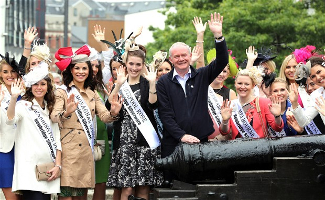
rose-of-traleeThe first Rose of Tralee festival is held in Tralee, County Kerry, on August 25, 1959.

The Rose of Tralee festival is held every August in Tralee to choose a young woman to be crowned the Rose. The winner is the woman deemed to best match the attributes “lovely and fair” relayed in the song. She is selected based on her personality and should be a good role model for the festival and ambassador for Ireland during her travels around the world. It is not a beauty pageant, and the participants are not judged on their appearance but on their personality and suitability to serve as ambassadors for the festival. The festival bills itself as a celebration of the “aspirations, ambitions, intellect, social responsibility, and Irish heritage” of modern young women.

The festival has its origins in the local Carnival Queen, once an annual town event, fallen by the wayside due to post-war emigration. In 1957, the Race Week Carnival is resurrected in Tralee and it features a Carnival Queen. The idea for the Rose of Tralee International Festival comes when a group of local business people meet in Harty’s bar in Tralee to come up with ideas to bring more tourists to the town during the horse racing meeting and to encourage expats back to their native Tralee. Led by Dan Nolan, then Managing Director of The Kerryman newspaper, they hit on the idea of the Rose of Tralee Festival. The event starts in 1959 on a budget of just £750.

The founders of the organisation are Billy Clifford, an accountant with the Rank Organisation, who is one of the first recipients of the Golden Rose award, Dan Nolan, involved with the Tralee Races, Jo Hussey, a shopkeeper in Tralee, and Ted Keane, Sr., a local restaurateur.

Originally, only women from Tralee are eligible to take part. In the early 1960s it is extended to include any women from Kerry and, in 1967, it is further extended to include any women of Irish birth or ancestry. In 2004 Regional Finals are introduced to offer more people an opportunity to participate in the Rose of Tralee International Festival. It is held every year until 2015 in Portlaoise, County Laois, on the June Bank Holiday weekend. In 2014 it is announced that the 2015 Regional Finals will be the last, in favour of a revamped selection process held in Tralee.


Leave a comment

Birth of the Liberator, Daniel O’Connell

daniel-oconnell

Daniel O’Connell, Irish political leader often referred to as The Liberator or The Emancipator, is born on August 6, 1775, at Carhan near Cahersiveen, County Kerry, to the O’Connells of Derrynane, a once-wealthy Roman Catholic family, that has been dispossessed of its lands.

Raised by his uncle, Daniel learns the Irish language and Irish lore in Kerry. O’Connell does part of his schooling in France during the revolution. On May 19, 1798, O’Connell is called to the Irish Bar and becomes a barrister. Four days later, the United Irishmen stage their rebellion which is put down by the British with great bloodshed. O’Connell does not support the rebellion. He believes that the Irish need to assert themselves politically rather than by force. The violent excesses he witnesses in France, the slaughter of the 1798 Rising, and finally his own killing of a man in a duel in 1815 leads him to renounce violence forever.

Moving into politics, O’Connell founds the Catholic Association in 1823, creating one of the first massive political movements in Europe or the Americas. The Catholic Association embraces other aims to better Irish Catholics, such as electoral reform, reform of the Church of Ireland, tenants’ rights, and economic development.

When he is elected to Parliament in 1828, he is unable to take his seat as members of parliament have to take the Oath of Supremacy, which is incompatible with Catholicism.  Fear of the reaction of his millions of followers leads to the passage of the Roman Catholic Relief Act 1829. O’Connell works for Home Rule for Ireland for the rest of his days but never achieves it. The British ban his mass Repeal of the Union rallies in 1843 and jail him for a time. The movement loses momentum at that point and the long years of hard work wear “The Liberator” down.

O’Connell dies at the age of 71 of cerebral softening on May15, 1847, in Genoa, Italy, while on a pilgrimage to Rome. His time in prison seriously weakens him and the appallingly cold weather he has to endure on his journey is likely the final blow. According to his dying wish, his heart is buried in Rome at Sant’Agata dei Goti, then the chapel of the Irish College, and the remainder of his body in Glasnevin Cemetery in Dublin, beneath a round tower.


Leave a comment

Roger Casement Hanged for Treason

roger-casement

Sir Roger David Casement, Irish diplomat who is knighted by King George V in 1911, is executed on August 3, 1916, for his role in the 1916 Easter Rising.

Casement is an Irish Protestant who serves as a British diplomat during the early part of the 20th century. He wins international acclaim after exposing the illegal practice of slavery in the Congo and parts of South America. Despite his Ulster Protestant roots, he becomes an ardent supporter of the Irish independence movement and, after the outbreak of World War I, travels to the United States and then to Germany to secure aid for an Irish uprising against the British.

Germany, which is at war with Great Britain, promises limited aid, and Casement is transported back to Ireland in a German submarine. On April 21, 1916, just a few days before the outbreak of the Easter Rising in Dublin, he lands in County Kerry and is picked up by British authorities almost immediately. By the end of the month, the Easter Rising has been suppressed and a majority of its leaders executed.

Casement is tried separately because of his illustrious past but nevertheless is found guilty of treason on June 29. On August 3, he is hanged by John Ellis and his assistants at Pentonville Prison in London. Casement is the last to be executed as a result of the Easter Rebellion.


Leave a comment

Death of Antarctic Explorer Tom Crean

Tom Crean

Thomas “Tom” Crean, Irish seaman and Antarctic explorer, dies on July 27, 1938 from complications of appendicitis.

Crean was born 1877 in the farming area of Gurtuchrane near the village of Annascaul on the Dingle Peninsula in County Kerry. He leaves the family farm to enlist in the Royal Navy at the age of fifteen. In 1901, while serving on Ringarooma in New Zealand, he volunteers to join Captain Robert Falcon Scott‘s 1901–04 Discovery Expedition to Antarctica, thus beginning his exploring career.

He is a member of three major expeditions to Antarctica during the Heroic Age of Antarctic Exploration, including Captain Scott’s 1911–13 Terra Nova Expedition. This sees the race to reach the South Pole lost to Roald Amundsen and ends in the deaths of Scott and his polar party. During this expedition, Crean’s 35 statute miles solo walk across the Ross Ice Shelf to save the life of Edward Evans leads to him receiving the Albert Medal for Lifesaving.

After his Terra Nova experience, Crean’s third and final Antarctic venture is as second officer on Ernest Shackleton‘s Imperial Trans-Antarctic Expedition, on Endurance. After Endurance becomes beset in the pack ice and sinks, Crean and the ship’s company spend months drifting on the ice before a journey in boats to Elephant Island. He is a member of the crew which makes an open boat journey of 800 nautical miles from Elephant Island to South Georgia, to seek aid for the stranded party.

Crean’s contributions to these expeditions seals his reputation as a polar explorer and earns him a total of three Polar medals. After the Endurance expedition, he returns to the navy. When his naval career ends in 1920 he moves back to County Kerry. In his home town of Annascaul, Crean and his wife Ellen live quietly and unobtrusively and open a pub called The South Pole Inn.

In 1938 Crean becomes ill with a ruptured appendix. He is taken to the nearest hospital in Tralee, but as no surgeon is available to operate, he is transferred to the Bon Secours Hospital in Cork where his appendix is removed. Because of the delay of the operation an infection develops and after a week in the hospital he dies on July 27, 1938, shortly after his sixty-first birthday. He is buried in his family’s tomb at the cemetery in Ballynacourty.

Crean’s name is commemorated in at least two places – 8,630 foot Mount Crean in Victoria Land and the Crean Glacier on South Georgia. A one-man play, Tom Crean – Antarctic Explorer, has been widely performed since 2001 by its author Aidan Dooley, including a special showing at the South Pole Inn, Annascaul, in October 2001. In July 2003, a bronze statue of Crean is unveiled across from his pub in Annascaul. It depicts him leaning against a crate whilst holding a pair of hiking poles in one hand and two of his beloved sled dog pups in the other.


Leave a comment

Birth of Theobald Wolfe Tone

theobald-wolfe-tone

Theobald Wolfe Tone, posthumously known as Wolfe Tone, a leading Irish revolutionary figure and one of the founding members of the United Irishmen, is born on June 20, 1763, in Dublin. He is regarded as the father of Irish republicanism and leader of the Irish Rebellion of 1798.

The son of a coach maker, Tone studies law and is called to the Irish bar in 1789 but soon gives up his practice. In October 1791 he helps found the Society of United Irishmen, initially a predominantly Protestant organization that works for parliamentary reforms, such as universal suffrage and Roman Catholic emancipation. In Dublin in 1792 he organizes a Roman Catholic convention of elected delegates that force Parliament to pass the Catholic Relief Act of 1793. Tone himself, however, is anticlerical and hopes for a general revolt against religious creeds in Ireland as a sequel to the attainment of Irish political freedom.

By 1794, he and his United Irishmen friends begin to seek armed aid from Revolutionary France to help overthrow English rule. After an initial effort fails, Tone goes to the United States and obtains letters of introduction from the French minister at Philadelphia to the Committee of Public Safety in Paris. In February 1796 Tone arrives in the French capital, presents his plan for a French invasion of Ireland, and is favourably received. The Directory then appoints one of the most brilliant young French generals, Lazare Hoche, to command the expedition and makes Tone an adjutant in the French army.

On December 16, 1796, Tone sails from Brest with 43 ships and nearly 14,000 men. The ships are badly handled and, after reaching the coast of west Cork and Kerry, are dispersed by a storm. Tone again brings an Irish invasion plan to Paris in October 1797, but the principal French military leader, Napoleon Bonaparte, takes little interest. When insurrection breaks out in Ireland in May 1798, Tone can only obtain enough French forces to make small raids on different parts of the Irish coast. In September he enters Lough Swilly, County Donegal, with 3,000 men and is captured there.

At his trial in Dublin on November 10, 1798, he defiantly proclaims his undying hostility to England and his desire “in fair and open war to produce the separation of the two countries.” He is found guilty and is sentenced to be hanged on November 12. Early in the morning of the day he is to be hanged, Tone cuts his throat with a penknife.

Theobald Wolfe Tone dies of his self-inflicted wound on November 19, 1798, at the age of 35 in Provost’s Prison, Dublin, not far from where he was born. He is buried in Bodenstown, County Kildare, near his birthplace at Sallins, and his grave is in the care of the National Graves Association.


Leave a comment

Birth of Sister Stanislaus Kennedy

stanislaus-kennedy

Sister Stanislaus Kennedy, campaigner against poverty and homelessness and a member of the congregation of Religious Sisters of Charity since 1958, is born in Dingle, County Kerry, on June 19, 1939. She is affectionately known as Sr. Stan.

At the age of 18, Sr. Stan, then Treasa Kennedy, decides to become a nun. Following in the footsteps of Mary Aikenhead, founder of the Religious Sisters of Charity, she too is drawn to work on behalf of the poor in the towns and cities of Ireland. For over fifty years she has pioneered, campaigned, explored, and developed a range of inspiring social innovations to benefit thousands of people who have experienced exclusion in its many forms.

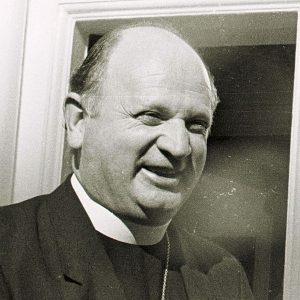
In the 1960s, Sr. Stan is missioned to Kilkenny to work alongside Bishop Peter Birch in developing Kilkenny Social Services. For nineteen years Peter Birch is both guide and mentor to Sr. Stan as the Kilkenny social services develop into an innovative, comprehensive model of community care becoming a blue-print for the rest of Ireland.

In 1974, the Irish Government appoints Sr. Stan as the first chair of The National Committee on Pilot Schemes to Combat Poverty, and in 1985 the European Commission appoints her as trans-national coordinator in the European rural anti poverty programme working across Europe.

Moving to Dublin in the early 1980s, Sr. Stan tackles one of Ireland’s most neglected social inequalities – homelessness. In 1985, she establishes Focus Point which is now Focus Ireland, the biggest national, voluntary organisation helping people to find, create, and maintain a home.

Sr. Stan founds The Sanctuary in 1998, a meditation/spirituality centre in the heart of Dublin, a place where people can find a quiet space and time for themselves to explore and develop their inner world and wisdom and find stillness.

Sr. Stan establishes two other initiatives in 2001, the Immigrant Council of Ireland (ICI), an independent national organisation working to promote the rights of immigrants through information, advocacy, and legal aid and the Young Social Innovators (YSI), a national showcase providing an opportunity for students to become involved in social issues.

Sr. Stan has also written thousands of articles that have been published in Ireland and elsewhere. She lectures on social issues and policies, is a frequent keynote speaker at many events, and regularly gives talks to many diverse groups in Ireland, Europe, and outside of Europe.


Leave a comment

The Jeanie Johnston Begins 4-Month Voyage Around Ireland

jeanie-johnston

The Jeanie Johnston, a replica of a three-masted barque that was originally built in 1847 in Quebec, Canada, by the Scottish-born shipbuilder John Munn, begins a four-month voyage around Ireland on June 9, 2004.

The original Jeanie Johnston makes her maiden emigrant voyage on April 24, 1848, from Blennerville, County Kerry to Quebec with 193 emigrants on board who are fleeing the effects of the Great Famine that is ravaging Ireland. Between 1848 and 1855, the Jeanie Johnston makes sixteen voyages to North America, sailing to Quebec, Baltimore, and New York. Ships that transport emigrants out of Ireland during this period become known as “famine ships” or “coffin ships.”

The project to build a replica is conceived in the late 1980s, but does not become a reality until November 1993 when a feasibility study is completed. In May 1995, The Jeanie Johnston (Ireland) Company Ltd. is incorporated. The ship is designed by Fred Walker, former Chief Naval Architect with the National Maritime Museum in Greenwich, England.

The original plans are to launch the ship from her shipyard in Blennerville, but a 19th-century shipwreck is discovered by marine archaeologists while a channel is being dredged. To preserve the find, on April 19, 2000 the hull of the Jeanie Johnston is hauled to the shore and loaded onto a shallow-draft barge. There she is fitted with masts and sails, and on May 4 is transported to Fenit, a short distance away. On May 6 the barge is submerged and the Jeanie Johnston takes to the water for the first time. The next day she is officially christened by President Mary McAleese.

In 2003, the replica Jeanie Johnston sails from Tralee to Canada and the United States visiting 32 U.S. and Canadian cities and attracting over 100,000 visitors.

The replica is currently owned by the Dublin Docklands Development Authority who bought it in 2005 for a reported 2.7 million Euro, which were used to clear outstanding loans on the vessel guaranteed by Tralee Town Council and Kerry County Council. It is docked at Custom House Quay in the centre of Dublin.


Leave a comment

John Joseph “Jack” Doyle Becomes First Major League Pinch Hitter

jack-doyle

John Joseph “Jack” Doyle, Irish-American first baseman of the Cleveland Spiders in Major League Baseball, becomes the first to pinch hitter in a baseball game on June 7, 1892. He comes through with a game-winning single against the Brooklyn Dodgers.

Doyle is born in Killorglin, County Kerry, on October 25, 1869, and emigrates with his family to the United States when he is a child, settling in Holyoke, Massachusetts. After attending Fordham University, Doyle embarks on a baseball career that lasts 70 years. He makes his first appearance at the major league level by signing and playing two years for the Columbus Solons of the American Association. Doyle plays for ten clubs between 1889 and 1905, batting .299 in 1,564 games with 516 stolen bases. He begins as a catcher–outfielder and becomes a first baseman in 1894. His best years are in 1894, when he bats .367 for the New York Giants, and in 1897, when he hits .354 with 62 stolen bases for the Baltimore Orioles.

Because of his aggressive playing style, Doyle is known as “Dirty Jack”, often feuding with umpires, fans, opposing players, and even at times, his own teammates. He carries on a lengthy feud with John McGraw that starts when they are teammates in Baltimore. McGraw, of course, has to have the last word. In 1902, McGraw is appointed manager of the Giants and his first act is to release Doyle, even though he is batting .301 and fielding .991 at the time. Even with these seemingly out-of-control traits, Doyle is deemed a natural leader and is selected as team captain in New York, Brooklyn and Chicago, and serves as an interim manager for the Giants in 1895 and Washington Senators in 1898.

In 1905, after playing one game with the New York Highlanders, Doyle becomes manager of Toledo of the Western Association. One year later, he is named the manager of the Des Moines Champions, so named because they won the league championship the previous year, and they win it again under Doyle’s helm. Following his championship season at Des Moines, he manages Milwaukee in 1907.

In 1908–1909, the only years of his adult life spent outside of baseball, Doyle serves as police commissioner of his hometown of Holyoke. He returns to baseball as an umpire and works in the National League for 42 games in 1911. He later joins the Chicago Cubs as a scout in 1920. He remains in that capacity until his death at age 89 on New Year’s Eve 1958. Doyle is buried at St. Jerome Cemetery in Holyoke.


Leave a comment

Death of Brendan the Navigator

brendan-the-navigator

Saint Brendan of Clonfert, called “the Navigator” and one of the early Irish monastic saints, dies on May 16, 577, in Annaghdown, County Galway.

In 484, Brendan is born in Tralee, County Kerry, in the province of Munster. He is born among the Altraige, a tribe originally centred around Tralee Bay, to parents called Finnlug and Cara. He is baptised at Tubrid, near Ardfert by Saint Erc, and is originally to be called “Mobhí” but signs and portents attending his birth and baptism lead to him being christened “Broen-finn” or “fair-drop.” For five years he is educated under Saint Ita, “the Brigid of Munster.” When he is six, he is sent to Saint Jarlath‘s monastery school at Tuam to further his education. Brendan is one of the “Twelve Apostles of Ireland,” one of those said to have been tutored by the great teacher, Finnian of Clonard.

At the age of twenty-six, Brendan is ordained a priest by Saint Erc. Afterwards, he founds a number of monasteries. Brendan’s first voyage takes him to the Aran Islands, where he founds a monastery. He also visits Hinba, an island off Scotland where he is said to meet Columcille. On the same voyage he travels to Wales, and finally to Brittany, on the northern coast of France. Between the years 512 and 530 Brendan builds monastic cells at Ardfert and, at the foot of Mount Brandon, Shanakeel— Seana Cill, usually translated as “the old church.” From here he supposedly sets out on his famous seven-year voyage for Paradise.

St. Brendan is chiefly renowned for his legendary journey to the Isle of the Blessed as described in the ninth century Voyage of St. Brendan the Navigator. Many versions exist that tell of how he sets out onto the Atlantic Ocean with sixteen pilgrims searching for the Garden of Eden. One of these companions is said to be Saint Malo, the namesake of Saint-Malo. This occurs sometime between 512 and 530 AD, before his travel to the island of Great Britain. On the trip, Brendan supposedly sees Saint Brendan’s Island, a blessed island covered with vegetation. He also encounters a sea monster, an adventure he shares with his contemporary, Saint Columba. The most commonly illustrated adventure is his landing on an island which turns out to be a giant sea monster called Jasconius or Jascon. This too, has its parallels in other stories, not only in Irish mythology but in other traditions, from Sinbad the Sailor to Pinocchio.

Brendan travels to Wales and the holy island of Iona, off the west coast of Scotland. Returning to Ireland, he founds a monastery at Annaghdown, where he spends the rest of his days. He also founds a convent at Annaghdown for his sister Briga. Having established the bishopric of Ardfert, St. Brendan proceeds to Thomond and founds a monastery at Inis-da-druim, in the present parish of Killadysert, County Clare, about the year 550. He then journeys to Wales and studies under Saint Gildas at Llancarfan, and then to Iona, for it is said that he leaves traces of his apostolic zeal at Kil-brandon and Kil-brennan Sound. After a three years’ mission in Britain, he returns to Ireland, and does more proselytising in various parts of Leinster, especially at Dysart, Killiney, and Brandon Hill. He establishes churches at Inchiquin, County Clare and at Inishglora, County Mayo, and founds Clonfert in County Galway around 557 AD.

Brendan dies on May 16, 577 at Annaghdown, while visiting his sister Briga. Fearing that after his death his devotees might take his remains as relics, Brendan arranges before his death to have his body secretly carried back to the monastery he founded at Clonfert concealed in a luggage cart. He is buried in Clonfert Cathedral.


Leave a comment

Postponement of the Easter Rising

general-post-office

On Saturday, April 22, 1916, the Easter Rising, originally planned for the following day, Easter Sunday, is postponed for one day.

At dawn a messenger from the Kerry Volunteers arrives in Dublin and informs James Connolly, Commandant of the Dublin Brigade, that Roger Casement had been arrested in County Kerry the previous day during a failed attempt to smuggle arms into Ireland on board the German ship Aud. A meeting of the Military Council is hastily organised, and the decision is made not to inform Chief-of-Staff of the Irish Volunteers, Eoin MacNeill, about Casement’s arrest.

Later in the morning, after attempting to escape the area, Karl Spindler, captain of the Aud, makes the decision to scuttle his ship after it is intercepted by the Royal Navy. Although Spindler and the crew are rescued, the armaments on board the Aud are lost. By early afternoon the Military Council is made aware of the loss of their arms shipment.

At 6:00 PM, Sean Fitzgibbon, Colm O’Loughlin, and Michael Joseph O’Rahilly arrive at Woodtown Park and inform MacNeill of the arrests and the loss of the Aud. After confronting Patrick Pearse at St. Enda’s School, a bilingual school for boys founded by Pearse, MacNeill and others, including O’Rahilly and Bulmer Hobson, gather at the house of Seumas O’Kelly on Rathgar Road and a decision is made to issue countermanding orders cancelling the Rising planned for Easter Sunday. To make sure that the countermanding order is received and understood, James Ryan is sent overnight to Cork, Colm O’Loughlin to Dundalk and Coalisland, Sean Fitzgibbon to Waterford, and Min Ryan to Wexford. O’Rahilly travels to Limerick, Kerry, Cork, and Tipperary. This succeeds in delaying the rising for only one day, although it greatly reduces the number of Volunteers who turn out.

During the evening, Major-General Sir Lovick Friend, General Officer Commanding of British forces in Ireland, travels to London on leave in wake of the capture of the Aud believing that any potential insurgency has been stopped. Chief Secretary Augustine Birrell is also in London having attended a Cabinet meeting. Both men remain in London through Easter, leaving Under Secretary Matthew Nathan as the most senior British official remaining in Dublin. Lord Lieutenant of Ireland, Ivor Churchill Guest, 1st Viscount Wimborne, urges Nathan to order the arrest of a large number of rebel leaders however he is unwilling to do so without the authorisation of Chief Secretary Birrell.