seamus dubhghaill

Promoting Irish Culture and History from Little Rock, Arkansas, USA


Leave a comment

Death of Cecil Ffrench Salkeld, Painter, Printmaker, Critic & Writer

Cecil Ffrench Salkeld, Irish painter, printmaker, critic and writer dies in Dublin on May 11, 1969.

Salkeld is born in Assam, India on July 9, 1904. His parents are Henry Lyde Salkeld, a member of the Indian Civil Service (ICS), and Blanaid Salkeld (née Mullen), a poet. He returns to Ireland with his mother in 1910 following the death of his father in 1909. He attends Mount St. Benedict’s, Gorey, County Wexford, and the Dragon School in Oxford, England. He wins a scholarship to Oundle School in Oundle, North Northhamptonshire, but returns to Dublin where he enters the Dublin Metropolitan School of Art in 1919 to study under Seán Keating and James Sleator. He marries Irma Taesler in Germany in 1922. They have two daughters, Celia and Beatrice. The latter marries Brendan Behan in 1954.

Salkeld works in tempera and oil, as well as etching and wood engraving. In 1921 he travels to Germany to study under Ewald Dulberg at the Kassell Kunstschule. He attends the Union of Progressive International Artists in Düsseldorf in May 1922, and is exhibited at the Internationale Kunstausstellung. Upon his return to Dublin in 1924, he holds his first solo exhibition in the Society of Dublin Painters gallery. He becomes a member of the Dublin Painters in 1927. With Francis Stuart, he co-edits the first two issues of To-morrow in 1924. His studio is in a converted labourer’s cottage at Glencree, County Wicklow. He also exhibits with the New Irish Salon and the Radical Painters’ Group.

Salkeld wins the 1926 Royal Dublin Society‘s Taylor scholarship, and has his first exhibited work with the Royal Hibernian Academy (RHA) in 1929. He lives in Berlin for a year in 1932. He exhibits in Daniel Egan’s Gallery in Dublin in 1935. He has a wide circle of literary friends, including Samuel Beckett and Flann O’Brien. In O’Brien’s At Swim-Two-Birds, the character of Michael Byrne is designed for Salkeld, reflecting his debilitating alcoholism. He also teaches at the Dublin Metropolitan School of Art, teaching artists such as Reginald Gray.

From 1937 to 1946 Salkeld runs a private press called Gayfield Press. This is co-founded with his mother, and operates from a garden shed at their home, 43 Morehampton Road. The press is a small Adana wooden hand press. He illustrates her 1938 The Engine Left Running, as well as Ewart Milne‘s Forty North Fifty West (1938) and Liam O’Flaherty‘s Red Barbara and Other Stories (1928). In 1951, he loans the press to Liam and Josephine Miller to found the Dolmen Press.

Salkeld’s most famous public work is his 1942 three-part mural in Davy Byrne’s pub. He is a co-founder of the Irish National Ballet School in the 1940s in his capacity as a pianist. In 1946 he is appointed an associate member of the RHA. In 1953 his play Berlin Dusk is staged at 37 Theatre Club, Dublin. During the 1950s he is a broadcaster with Radio Éireann as well as a director of cultural events for An Tóstal. He dies on May 11, 1969 in St. Laurence’s Hospital, Dublin.

The National Gallery of Ireland holds a portrait by Salkeld of his daughter, Celia.

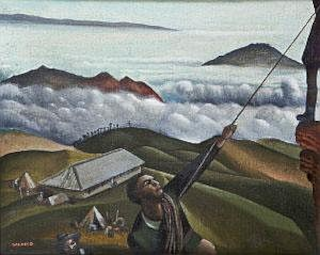
(Pictured: “The Climber” by Cecil Ffrench Salkeld, oil on canvas)

Leave a comment

Death of Molly Keane, Novelist & Playwright

Molly Keane, Irish novelist and playwright who writes as M. J. Farrell, dies on April 22, 1996 in Ardmore, County Waterford.

Keane is born Mary Nesta Skrine on July 20, 1904 in Ryston Cottage, Newbridge, County Kildare. Her mother is a poet who writes under the pseudonym Moira O’Neill. Her father is a fanatic for horses and hunting. She grows up at Ballyrankin House on the banks of the River Slaney, a few miles southeast of Bunclody, County Wexford and refuses to go to boarding school in England as her siblings had done. She is educated by her mother, governesses, and at a boarding school in Bray, County Wicklow. Relationships between her and her parents are cold and she states that she had no fun in her life as a child. Her own passion for hunting and horses is born out of her need for fun and enjoyment. Reading does not feature much in her family, and, although her mother writes poetry, it is of a sentimental nature, “suitable to a woman of her class.”

Keane claims she had never set out to be a writer, but at seventeen she is bed bound due to suspected tuberculosis, and turns to writing out of sheer boredom. It is then she writes her first book, The Knight of Cheerful Countenance, which is published by Mills & Boon. She writes under the pseudonym “M. J. Farrell,” a name over a pub that she had seen on her return from hunting. She explains writing anonymously because “for a woman to read a book, let alone write one was viewed with alarm: I would have been banned from every respectable house in County Carlow.”

In her teenage years Keane spends much of her time in the Perry household in Woodruff, County Tipperary. Here she befriends the two children of the house, Sylvia and John Perry. She later collaborates with John in writing a number of plays. Among them is Spring Meeting, directed by John Gielgud in 1938, and one of the hits of the West End that year. She and Gielgud become life long friends.

It is through the Perry family that Keane meets Bobby Keane, whom she marries in 1938. He belongs to a Waterford squirearchical family, the Keane baronets. The couple goes on to have two daughters, Sally and Virginia.

Keane loves Jane Austen, and like Austen’s, her ability lay in her talent for creating characters. This, with her wit and astute sense of what lay beneath the surface of people’s actions, enables her to depict the world of the big houses of Ireland in the 1920s and 1930s. She “captured her class in all its vicious snobbery and genteel racism.” She uses her married name for her later novels, several of which (including Good Behaviour and Time After Time) have been adapted for television. Between 1928 and 1956, she writes eleven novels, and some of her earlier plays, under the pseudonym “M. J. Farrell.” She is a member of Aosdána.

Keane’s husband dies suddenly in 1946, and, following the failure of a play, she publishes nothing for twenty years. In 1981 Good Behaviour comes out under her own name. The manuscript, which had languished in a drawer for many years, is loaned to a visitor, the actress Peggy Ashcroft, who encourages Keane to publish it. The novel is warmly received and is short-listed for the Booker Prize.

Following the death of her husband, Keane moves to Ardmore, County Waterford, a place she knows well, and lives there with her two daughters. She dies on April 22, 1996 in her Cliffside home in Ardmore at the age of 91. She is buried beside the Church of Ireland church, near the centre of the village.


Leave a comment

Birth of Neil Shawcross, Post-Impressionist Artist

Neil Shawcross MBE, RHA, HRUA, Post-Impressionist artist, is born in Kearsley, Lancashire, England, on March 15, 1940. He has been a resident of Northern Ireland since 1962.

Shawcross studies at Bolton College of Art from 1955 to 1958, and Lancaster College of Art from 1958 to 1960, before moving to Belfast in 1962 to take up a part-time lecturer’s post at the Belfast College of Art, becoming full-time in 1968. He continues to lecture there until his retirement in 2004.

Primarily a portrait painter, his subjects include Nobel Prize winning poet Seamus Heaney, novelist Francis Stuart (for the Ulster Museum), former Lord Mayor of Belfast David Cook (for Belfast City Council), footballer Derek Dougan and fellow artists Colin Middleton and Terry Frost. He also paints the figure and still life, taking a self-consciously childlike approach to composition and colour. His work also include printmaking, and he has designed stained glass for the Ulster Museum and St. Colman’s Church, Lambeg, County Antrim.

Shawcross’s academic career includes a residency at Virginia Center for the Creative Arts in Amherst, Virginia in 1987, a residency at Vermont Studio Center in Johnson, Vermont in 1991, and a visiting assistant professorship at Pennsylvania State University in 1993.

Shawcross has exhibited nationally, with one-man shows in London, Manchester, Dublin and Belfast, and internationally in Hong Kong and the United States, and his work is found in many private and corporate collections.

Shawcross is elected an Associate of the Royal Ulster Academy of Art in 1975, and is made a full Academician in 1977. He wins the Academy’s Conor Award in 1975, its gold medal in 1978, 1982, 1987, 1994, 1997 and 2001, and its James Adam Prize in 1998. He is also a member of the Royal Hibernian Academy (RHA). He is awarded the Gallaher Portrait Prize in 1966.

Shawcross is conferred an honorary doctorate by Queen’s University Belfast in 2007. He is appointed Member of the Order of the British Empire (MBE) in the 2014 New Year Honours for services to arts in Northern Ireland.

In 2010, the Merrion Hotel, Dublin, hosts a private collection of the works of Shawcross. In 2015, he exhibits a collection of six foot tall book covers inspired by original Penguin paperbacks at the National Opera House in Wexford, County Wexford. In 2018, he donates to Belfast City Council a collection of 36 paintings dedicated to ‘Writers of Belfast’ in a show of appreciation to his adopted home city. A major retrospective of his works are exhibited at the F. E. McWilliam Gallery and Studio, Banbridge, County Down, in the same year.

Shawcross is a Patron of the charity YouthAction Northern Ireland. He lives in Hillsborough, County Down, Northern Ireland.


Leave a comment

Birth of George Plant, Member of the Irish Republican Army

George Plant, Irish Republican Army (IRA) member who is executed by the Irish Government in 1942, is born into a Church of Ireland farming family in Fethard, County Tipperary, on January 5, 1904.

Plant is the second eldest child and son in a family of six children. His parents are John William Albert Plant, a farmer, and Catherine Hayden.

One Sunday in 1916 George and his older brother Jimmy are arrested by the Royal Irish Constabulary (RIC) after being seen speaking to two well-known republicans, Seán Hayes and Dan Breen. In custody the two brothers are beaten and mistreated resulting in a hatred of the RIC. He serves with the Irish Republican Army during the Irish War of Independence and with the Anti-Treaty IRA in the Irish Civil War.

In 1923 George and Jimmy leave Ireland for Canada and the United States but continue as active IRA members. In 1929 they return to Ireland and carry out a bank raid in Tipperary on behalf of the IRA. They are arrested two days later at the family farm and subsequently sentenced to 7 years in prison. They are released in a general amnesty after the Fianna Fáil and Éamon de Valera election victory in 1932. He is a strong supporter of Seán Russell. In 1939 following the outbreak of World War II, known in Ireland as The Emergency, de Valera is determined to maintain Irish neutrality and is not going to allow the IRA to jeopardize this. The IRA links with Germany and campaign in Britain are severely straining Anglo-Irish relations so emergency legislation is introduced.

Russell, the IRA Chief of Staff, dies in August 1940 after taking ill on board a U-boat and Stephen Hayes from County Wexford becomes IRA Chief of Staff. In late August 1940 an address on Lansdowne Road Dublin is raided by the Garda Síochána. Among the men arrested is Michael Devereux, a 24-year-old married truck driver from County Wexford who is also Quartermaster of the IRAs Wexford Brigade. He is released after three days without charge. Shortly afterwards Gardaí in County Wexford find an IRA arms dump. Many in the IRA suspect that Devereux had turned informer, so Stephen Hayes orders Devereux’s execution. George Plant and another man, Michael Walsh from County Kilkenny, are ordered to carry out the order. Devereux meets Plant and Walsh who tell Devereux that Tom Cullimore, the Wexford Brigade’s OC is blamed for the arms dump and that they have shot him. They order Devereux to drive them to an IRA safe house at Grangemockler in south County Tipperary. Devereux, believing he is the prime suspect in a murder, stays willingly at the safe house. A week later, on September 27, 1940, Devereux is invited to go for a walk with Plant and Paddy Davern, the owner of the safe house. Somewhere along the walk Plant accuses Devereux of being an informer and shoots him dead. Plant is arrested nine weeks later on suspicion of IRA membership and brought before the Special Criminal Court in Dublin. On February 10, 1941, Radio Éireann broadcasts a radio appeal for Michael Devereux on behalf of his wife.

In September 1941 Stephen Hayes is accused of being an informer by a group of Northern IRA members led by Seán McCaughey. He manages to escape to a garda station. Shortly afterwards a large force of Garda Síochána and Irish Army descend on the area around the Davern farmhouse where they find Devereux’s car buried under an onion bed and eventually discover Devereux’s body, a year to the day after his death. Two weeks later, Plant, already in prison on IRA membership charges, is charged with Devereux’s murder. A trial is held with a senior IRA officer, Joseph o’Connor, also charged with Devereux’s murder. The first trial collapses after two days when Paddy Davern and Micheal Walsh, two of the prosecution witnesses, refuse to give evidence. This result leads to the court issuing a nolle prosequi order which should have meant the end of the affair, however both men are rearrested and recharged with the same offence, under Emergency Order 41f. Minister for Justice Gerald Boland transfers the case to a Special Military Court with army officers acting as judges. In addition to Plant, Paddy Davern and Michael Walsh are also now charged with Devereux’s murder. The second trial begins at Collins Barracks, Dublin in February 1942 with Seán MacBride, a former IRA Chief of Staff and future government minister as the defendant’s barrister. Davern states his original statement was given at gunpoint but under the new order even statements given under duress are admissible. The court only has two sentencing options – death or acquittal. Joseph O’Connor is acquitted and despite MacBride’s best efforts the other three are sentenced to death. Davern and Walsh have their sentences commuted to life imprisonment and are both released in 1946.

Just one week after sentence is passed, Plant is executed in Portlaoise Prison by a six-man firing squad drawn from the Irish Army. Much bitterness is caused by the treatment of Plant’s relatives. Neither his wife or mother or infant son are allowed to visit him in the week before his execution. Censorship ensures there is little mention in the newspapers, so his family only learns of his execution from a brief radio broadcast shortly before they receive a telegram. He is buried in the grounds of Portlaoise Prison, but is reinterred in 1948, when he is buried with full IRA military honours in his local church St. Johnstown in County Tipperary, and a Celtic cross is erected over his grave.

Plant’s wife moves to the United States where she remarries. His brother Jimmy dies in London in 1978. The Plant’s family farm is now part of the Coolmore Estate.


2 Comments

Death of Stephen Hayes, Member & Leader of the IRA

Stephen Hayes, a member and leader of the Irish Republican Army (IRA) from April 1939 to June 1941, dies in Enniscorthy, County Wexford, on December 28, 1974.

Hayes is born in Enniscorthy on December 26, 1902. During the Irish War of Independence (1919-21), he is commandant of the Wexford Brigade of Fianna Éireann. He takes the Anti-Treaty side during the Irish Civil War (1922-23), during which he is interned.

Hayes is active in Gaelic Athletic Association circles in Wexford. In 1925, he helps Wexford win the Leinster Senior Football Championship. He also serves as secretary to the county board for ten years, from the 1920s to 1930s.

Hayes joins the IRA and is on the IRA Army Council in January 1939 when it declares war on the British government. When IRA Chief of Staff Seán Russell departs on IRA business to the United States, and subsequently to Nazi Germany, Hayes becomes IRA Chief of Staff. His time in office is marred by controversy and it is widely believed that he serves as an informer to the Garda Síochána.

Hayes sends a plan for the invasion of Northern Ireland by German troops to Germany in April 1940. This plan later becomes known as Plan Kathleen. He is also known to have met with German agent Hermann Görtz on May 21, 1940, in Dublin shortly after the latter’s parachuting into Ireland on May 5, 1940, as part of Operation Mainau. He is known to have asked Görtz for money and arms to wage a campaign in Northern Ireland, although shortly after this meeting the original Plan Kathleen is discovered. The discovery of the plan leads to the acceleration of joint British and Irish military planning for a German invasion known as Plan W.

Another meeting on August 15, 1940, on Rathgar Road, Dublin organised by Hayes and attended by senior IRA men Paddy McGrath, Tom Harte and Tom Hunt, is also raided by the Garda Síochána.

McGrath and Harte are both arrested and tried by Military Tribunal, established under the Emergency Powers Act 1939. They challenge the legislation in the High Court, seeking a writ of habeas corpus, and ultimately appeal to the Supreme Court of Ireland. They are represented in the courts by Seán MacBride. The appeal is unsuccessful, and they are executed by firing squad at Dublin’s Mountjoy Prison on September 6, 1940.

On June 30, 1941, Northern-based IRA men kidnap Hayes, accusing him of being a spy. By his own account, he is tortured and “court-martialed” for “treason” by his comrades, and would have been executed, but he buys himself time composing an enormously long confession. He manages to escape on September 8, 1941, and hands himself in to the Garda for protection.

The Officer Commanding (O/C) of the IRA Northern Command, Seán McCaughey, is convicted on September 18, 1941, of the kidnapping. After a long hunger and thirst strike in Portlaoise Prison, he dies on May 11, 1946.

Hayes is later sentenced to five years’ imprisonment by the Special Criminal Court on account of his IRA activities.

Within IRA circles, Hayes is still considered a traitor and an informer. One of the main allegations against him is that he informed the Garda Síochána about IRA arms dumps in Wexford. However, this is later blamed on a Wexford man named Michael Deveraux, an officer of the Wexford Battalion of the IRA who is subsequently abducted and executed by an IRA squad in County Tipperary on Hayes’ orders. George Plant, a Protestant IRA veteran, is later executed in Portlaoise Prison for Devereux’s murder.

After his release, Hayes resumes his clerical position at Wexford County Council. He dies in Enniscorthy on December 28, 1974.


Leave a comment

Birth of Lady Jane Francesca Wilde, Poet & Nationalist

jane-wilde

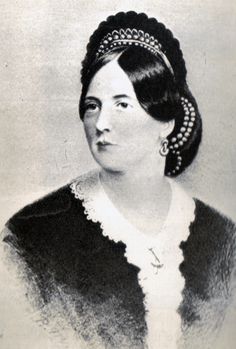
Jane Francesca Agnes, Lady Wilde, Irish poet who writes under the pen name “Speranza” and a supporter of the nationalist movement, is born on December 27, 1821, in Wexford, County Wexford.

Jane is the last of the four children of Charles Elgee, the son of Archdeacon John Elgee, a Wexford solicitor, and his wife Sarah (née Kingsbury). Her great-grandfather is an Italian who had come to Wexford in the 18th century. She has a special interest in Irish folktales, which she helps to gather. She marries Sir William Wilde on November 12, 1851, and they have three children, William Charles Kingsbury Wilde (1852–1899), Oscar Fingal O’Flahertie Wills Wilde (1854–1900), and Isola Francesca Emily Wilde (1857–1867).

Wilde, who is the niece of Charles Maturin, writes for the Young Ireland movement of the 1840s, publishing poems in The Nation under the pseudonym of “Speranza.” Her works include pro-Irish independence and anti-British writing. She is sometimes known as “Speranza of the Nation.” Charles Gavan Duffy is the editor when “Speranza” writes commentary calling for armed revolution in Ireland. The authorities at Dublin Castle shut down the paper and bring the editor to court. Duffy refuses to name who has written the offending article. “Speranza” reputedly stands up in court and claims responsibility for the article. The confession is ignored by the authorities. But in any event the newspaper is permanently shut down by the authorities.

Wilde is an early advocate of women’s rights, and campaigns for better education for women. She invites the suffragist Millicent Fawcett to her home to speak on female liberty. She praises the passing of the Married Women’s Property Act 1882, preventing women from having to enter marriage “as a bond slave, disenfranchised of all rights over her fortune.”

William Wilde is knighted in January 1864, but the family celebrations are short-lived, for in the same year Sir William and Lady Wilde are at the centre of a sensational Dublin court case regarding a young woman called Mary Travers, the daughter of a colleague of Sir William’s, who claims that he had seduced her and who then brings an action against Lady Wilde for libel. Mary Travers wins the case and costs of £2,000 are awarded against Lady Wilde. Then, in 1867, their daughter Isola dies of fever at the age of nine. In 1871 the two illegitimate daughters of Sir William are burned to death and in 1876 Sir William himself dies. The family discovers that he is virtually bankrupt.

Lady Wilde leaves Dublin for London in 1879, where she joins her two sons, Willie, a journalist, and Oscar, who is making a name for himself in literary circles. She lives with her older son in poverty, supplementing their meagre income by writing for fashionable magazines and producing books based on the researches of her late husband into Irish folklore.

Lady Wilde contracts bronchitis in January 1896 and, dying, asks for permission to see Oscar, who is in prison. Her request is refused. It is claimed that her “fetch” appears in Oscar’s prison cell as she dies at her home, 146 Oakley Street, Chelsea, on February 3, 1896. Willie Wilde, her older son, is penniless, so Oscar pays for her funeral, which is held on February 5, at Kensal Green Cemetery in London. A headstone proves too expensive and she is buried anonymously in common ground. A monument to her, in the form of a Celtic cross, is erected at Kensal Green Cemetery by the Oscar Wilde Society in 1999.


Leave a comment

Birth of James Matthew Dillon, Fine Gael Politician

James Matthew Dillon, Fine Gael politician who serves as Leader of the Opposition and Leader of Fine Gael from 1959 to 1965 and Minister for Agriculture from 1948 to 1951 and 1954 to 1957, is born in Drumcondra, Dublin on September 26, 1902. He also serves as a Teachta Dála (TD) from 1932 to 1969.

Dillon is the son of John Dillon, the last leader of the Irish Parliamentary Party, and Elizabeth Mathew. He is educated at Mount St. Benedict’s, in Gorey, County Wexford, University College Galway and King’s Inns. He qualifies as a barrister and is called to the Bar of Ireland in 1931. He studies business methods at Selfridges in London. After some time at Marshall Field’s in Chicago he returns to Ireland where he becomes manager of the family business known as Monica Duff’s in Ballaghaderreen, County Roscommon.

Between 1932 and 1937, Dillon serves as a TD for the Donegal constituency for the National Centre Party and after its merger with Cumann na nGaedheal, for the new party of Fine Gael. He plays a key role in instigating the creation of Fine Gael and becomes a key member of the party in later years. He remains as TD for Monaghan from 1937 to 1969. He becomes deputy leader of Fine Gael under W. T. Cosgrave.

Dillon temporarily resigns from Fine Gael in 1942 over its stance on Irish neutrality during World War II. While Fine Gael supports the government’s decision to stay out of the war, he urges the government to side with the Allies. A passionate anti-Nazi, he describes the Nazi creed as “the devil himself with twentieth-century efficiency.” His zeal against Adolf Hitler draws him the ire of the German Minister to Ireland Eduard Hempel, who denounces him as a “Jew” and “German-hater.” Even Éamon de Valera, then Taoiseach, is not spared the fierceness of Dillon’s rhetoric. When the Taoiseach ridicules his stark support for the Allies, noting this means he has to adopt a Pro-British stance, Dillon defiantly retorts, “My ancestors fought for Ireland down the centuries on the continent of Europe while yours were banging banjos and bartering budgies in the backstreets of Barcelona.”

In 1942, while holidaying in Carna, County Galway, Dillon meets Maura Phelan of Clonmel on a Friday. By that Monday the two are engaged and six weeks after that the pair are married. He is 40 and Maura is 22 years of age.

Dillon is one of the independents who supports the first inter-party government (1948–1951) and is appointed Minister for Agriculture. As Minister, he is responsible for huge improvements in Irish agriculture. Money is spent on land reclamation projects in the areas of less fertile land while the overall quality of Irish agricultural produce increases.

Dillon rejoins Fine Gael in 1953. He becomes Minister for Agriculture again in the second inter-party government (1954–1957). In 1959, he becomes leader of Fine Gael, succeeding Richard Mulcahy. He becomes president of the party in 1960. In 1965, Fine Gael loses the general election to Seán Lemass and Fianna Fáil. The non-Fianna Fáil parties win 69 seats to Fianna Fáil’s 72. Had the other parties won four more seats between them, they would have been able to form a government. Having narrowly failed to become Taoiseach, Dillon stands down as Fine Gael leader after the election.

On Northern Ireland, while Dillon stands against Partition, he equally opposes any “armed solution” or militant nationalist policy, stating, “We have got to win, not only the barren acres of Ulster, but the hearts of the people who live in it.”

Dillon is a colourful contributor to Dáil proceedings and is noted for his high standard of oratory. He remains a TD until 1969, when he retires from politics. He dies in Malahide, Dublin on February 10, 1986, at the age of 83.


Leave a comment

Birth of Novelist & Playwright Molly Keane

Molly Keane, née Mary Nesta Skrine, Irish novelist and playwright who writes as M. J. Farrell, is born in Ryston Cottage, Newbridge, County Kildare, on July 20, 1904.

Keane’s mother is a poet who writes under the pseudonym Moira O’Neill. Her father is a fanatic for horses and hunting. She grows up at Ballyrankin in County Wexford and refuses to go to boarding school in England as her siblings had done. She is educated by her mother, governesses, and at a boarding school in Bray, County Wicklow. Relationships between her and her parents are cold and she states that she had no fun in her life as a child. Her own passion for hunting and horses is born out of her need for fun and enjoyment. Reading does not feature much in her family and, although her mother writes poetry, it is of a sentimental nature, “suitable to a woman of her class.”

Keane claims she had never set out to be a writer, but at seventeen she is bedbound due to suspected tuberculosis, and turns to writing out of sheer boredom. It is then she writes her first book, The Knight of Cheerful Countenance, which is published by Mills & Boon. She writes under the pseudonym “M. J. Farrell,” a name over a pub that she had seen on her return from hunting. She explains writing anonymously because “for a woman to read a book, let alone write one was viewed with alarm: I would have been banned from every respectable house in County Carlow.”

In her teenage years Keane spends much of her time in the Perry household in Woodruff, County Tipperary. Here she befriends the two children of the house, Sylvia and John Perry. She later collaborates with John in writing a number of plays. Among them is Spring Meeting, directed by John Gielgud in 1938, and one of the hits of the West End that year. She and Gielgud become life long friends.

It is through the Perry family that Molly meets Bobby Keane, whom she marries in 1938. He belongs to a County Waterford squirearchical family, the Keane baronets. The couple goes on to have two daughters, Sally and Virginia.

Keane loves Jane Austen, and like Austen’s, her ability lay in her talent for creating characters. This, with her wit and astute sense of what lay beneath the surface of people’s actions, enables her to depict the world of the big houses of Ireland in the 1920s and 1930s. She “captured her class in all its vicious snobbery and genteel racism.” She uses her married name for her later novels, several of which, including Good Behaviour and Time After Time, have been adapted for television. Between 1928 and 1956, she writes eleven novels, and some of her earlier plays, under the pseudonym “M. J. Farrell.” She was a member of Aosdána.

Keane’s husband dies suddenly in 1946, after which she moves to Ardmore, County Waterford, a place she knows well, and lives there with her two daughters. Following the failure of a play shortly after her husband’s death, she publishes nothing for twenty years. In 1981 Good Behaviour comes out under her own name. The manuscript, which had languished in a drawer for many years, is lent to a visitor, the actress Peggy Ashcroft, who encourages her to publish it. The novel is warmly received and is short-listed for the Man Booker Prize.

Keane dies at the age of 91 on April 22, 1996 in her Cliffside home in Ardmore. She is buried beside the Church of Ireland church, near the centre of the village.


Leave a comment

The Second Battle of Arklow

The second Battle of Arklow takes place on June 9, 1798 during the Irish Rebellion of 1798 when a force of United Irishmen from Wexford, estimated at 10,000 strong, launch an assault on the British-held town of Arklow, County Wicklow, in an attempt to spread the rebellion into Wicklow and to threaten the capital of Dublin.

A British advance force of 400 is defeated at Tuberneering on June 4. This rebel victory punches a hole in the dragnet the military has attempted to throw around County Wexford and also yields them three artillery pieces. The town of Arklow has been evacuated in the ensuing panic but the rebels content themselves with taking the town of Gorey and staying within the Wexford border. On June 5 the rebels attempt to break out of County Wexford across the River Barrow and to spread the rebellion but are halted by a major British victory at the Battle of New Ross. When the rebels finally move against Arklow, the town has been reoccupied by a force of 1,700 men sent from Dublin under Francis Needham, 1st Earl of Kilmorey, who quickly fortifies the town with barricades and has artillery positioned on all the approaches to the town.

The rebel army that forms for attack on the afternoon of June 9 is a combined force of Wexford and Wicklow rebels led by Billy Byrne, Anthony Perry, Conor McEvoy, Edward Fitzgerald, and Fr. Michael Murphy. The British in Arklow consist of approximately 1,000 militia from counties Antrim and Cavan and 150 regular cavalry supported by 250 Yeomanry. They are joined by 315 Durham Fencibles (Princess of Wales’s Fencible Dragoons) arriving an hour before the rebels.

The area surrounding the town and the approaches is covered by scrub and the rebel strategy adopted is to advance under cover attacking the town simultaneously from several points. Before the action begins, the rebels under Esmonde Kyan open fire upon the town with some of the artillery captured at Tuberneering and have some success by scoring a direct hit on a British artillery position, destroying the cannon and killing the attendant crew. The main assault is quickly launched but at all entry points the Irish are thrown back by the musket fire of the well-trained and disciplined militia and volunteers, and canister shot from the 3 pounder battalion gun brought by the fencibles. An attempt by the British to turn the Irish failure into a rout is defeated when pikemen and sharpshooters drive a cavalry charge back across the River Avoca, but an attempt to force a way into the town through the outlying fishing port is bloodily repulsed.

As Irish casualties mount, the lack of ammunition and proper leadership begin to work against them, and after Fr. Murphy is killed leading a charge, their attacks start to fade. As nightfall comes, the rebels begin to withdraw under cover of darkness and collect their wounded. They are not pursued or molested by the garrison who are, unknown to the rebels, down to their last three or four rounds per man and are themselves at the brink of defeat.

While rebel casualties are estimated at about 1,000 no full casualty list seems to exist on the British side, but are probably in the region of 100 dead and wounded. The defeat at Arklow marks the third failure to extend the fight for Irish independence beyond the borders of County Wexford following the other bloody repulses at New Ross and Bunclody. The Irish strategy now changes to a policy of static defence against the encroaching British armies.


Leave a comment

Birth of Architect George Coppinger Ashlin

George Coppinger Ashlin, Irish architect particularly noted for his work on churches and cathedrals, is born in County Cork on May 28, 1837. He becomes President of the Royal Institute of the Architects of Ireland.

Ashlin is the son of J. M. Ashlin, J.P. He receives his early education at the Collège de St. Servais in Liège, Belgium. He later enrolls at St. Mary’s College, Oscott (1851-55) where he is subsequently a pupil of Edward Welby Pugin. It is during this time that he develops an interest in architecture. By 1858, he enters the Royal Academy Schools, London.

When Pugin receives the commission for SS Peter and Paul’s, Carey’s Lane, Cork, in 1859, he makes Ashlin a partner with responsibility for their Irish work. This partnership lasts until late 1868. In 1861 they open their office at St. Stephen’s Green, Dublin. The practice is primarily ecclesiastical, designing some 25 religious buildings. Their churches and Cathedrals are mainly located in the counties of Wexford, Cork and Kerry, and are all of similar design. By far the most important commission undertaken by this partnership is the building of St. Colman’s Cathedral, Cobh for Bishop William Keane.

In 1867 Ashlin marries Mary Pugin (1844-1933), sister of Edward Welby Pugin and daughter of Augustus Welby Pugin, the Gothic revivalist. Their only daughter, Miriam, is born ten years later.

The partnership with Pugin is dissolved in 1870. Thereafter Ashlin practises in his own right, branching out to cover the entire island nation. His works of this period include Ballycotten (1901), Ballybunion (1892), Church of the Most Holy Rosary, Midleton (1893) and the Munster & Leinster Bank, both of Midleton, and finally Kildare (1898).

Ashlin is a member of the Royal Hibernian Academy and Fellow of the Royal Institute of British Architects.

George Coppinger Ashlin dies at the age of 84 on December 10, 1921. He is buried at Glasnevin Cemetery in Dublin.