Sheehy is born in Tralee, County Kerry, on October 16, 1897. In 1914 he joins Fianna Éireann, the republican boy scouts, and later the Irish Volunteers. He commands the Boherbue company of the IRA, and later the Tralee company. His brother Jimmy is killed in the British Army in the Battle of the Somme in 1916.
Sheehy sides against the Anglo-Irish Treaty in 1922, like most of the IRA in Kerry. In the Irish Civil War, when Free State troops land in Kerry as part of a seaborne offensive, he is in command of the Anti-Treaty garrison in Tralee. After the Army takes the town, he retreats, burning the barracks there. As the conflict becomes a guerrilla affair, he finds himself in charge of three flying columns, or around 75 men in total, in the Ballymacthomas area. He and Tom McEllistrim are in charge of an attack on Castlemaine in January 1923.
Just after the Irish Civil War, when Sheehy is still on the run, he manages to play football for Kerry. Kerry captain Con Brosnan, though a member of the Free State army, guarantees his safe passage. He pays into Munster and All-Ireland finals, slips off his street clothes, plays, and then at the final whistle, disappears back into the crowd. In 1936 he is in New York and is able to smuggle a large number of Thompson submachine guns back to Ireland.
In February 1941 Sheehy is arrested and interned in the Curragh Camp for two years. He is arrested again and charged with making “seditious speeches” on May 11, 1946, the day that IRA hunger striker Seán McCaughey dies. He is found guilty and sentenced to four months imprisonment.
Sheehy plays Gaelic football with his local club, John Mitchels, and is a member of the senior Kerry county football team from 1919 until 1930. He also plays hurling with Tralee Parnells. He captains Kerry to the All-Ireland title in 1930. He plays in the Railway Cup hurling final in 1927 and is captain of the football team the same year and wins other medals in 1931. Three of his sons – Seán Óg, Niall and Paudie – all win All-Ireland titles with Kerry in the 1960s.
Sheehy remains a staunch supporter of Sinn Féin and is critical of the moves to end abstention by the party in the late 1960s. He sides with the Provisionals in the split at the 1970 Ardfheis and remains active in Provisional Sinn Féin until his death, supporting the IRA’s guerrilla campaign. He dies in Tralee on January 12, 1980, and is given a republican funeral at his own request. His funeral oration is given by Dáithí Ó Conaill, vice-president of Sinn Féin.
Ó Brádaigh is born into a middle-class republican family. His father, Matt Brady, is an IRA volunteer who is severely wounded in an encounter with the Royal Irish Constabulary (RIC) in 1919. His mother, May Caffrey, is a Cumann na mBan volunteer and a 1922 graduate of University College Dublin (UCD). His father dies when he is ten and is given a paramilitary funeral led by his former IRA colleagues. His mother, prominent as the Secretary for the County Longford Board of Health, lives until 1974. He is educated at Melview National School at primary level and attends secondary school at St. Mel’s College, leaving in 1950, and graduates from University College Dublin in 1954. That year he takes a job teaching Irish language at Roscommon Vocational School in Roscommon. He is a deeply religious Catholic who refrains from smoking or drinking.
Ó Brádaigh joins Sinn Féin in 1950. While at university, in 1951, he joins the Irish Republican Army. In September 1951, he marches with the IRA at the unveiling of the Seán Russell monument in Fairview Park, Dublin. A teacher by profession, he is also a Training Officer for the IRA. In 1954, he is appointed to the Military Council of the IRA, a subcommittee set up by the IRA Army Council in 1950 to plan a military campaign against Royal Ulster Constabulary (RUC) barracks in Northern Ireland.
On August 13, 1955, Ó Brádaigh leads a ten-member IRA group in an arms raid on Hazebrouck Barracks, near Arborfield, Berkshire, England, a depot for the No. 5 Radar Training Battalion of the Royal Electrical and Mechanical Engineers. It is the biggest IRA arms raid in Britain. Most, if not all, of the weapons are recovered in a relatively short period of time. A van, traveling too fast, is stopped by the police and IRA personnel are arrested. Careful police work leads to weapons that had been transported in a second van and stored in London.
The IRA Border Campaign commences on December 12, 1956. As an IRA General Headquarters Staff (GHQ) officer, Ó Brádaigh is responsible for training the Teeling Column in the west of Ireland. During the Campaign, he serves as second-in-command of the Teeling Column. On December 30, 1956, he partakes in the Teeling Column attack on RUC barracks in Derrylin, County Fermanagh. RUC Constable John Scally is killed in the attack and is the first fatality of the new IRA campaign. Ó Brádaigh and others are arrested by the Garda Síochána across the border in County Cavan the day after the attack. They are tried and jailed for six months in Mountjoy Prison. A leading abstentionist, upon his arrest he refuses to recognize the authority of the Irish government and refuses to renounce violence in exchange for his release.
Upon completing his prison sentence, Ó Brádaigh is immediately interned at the Curragh Camp along with other republicans. On September 27, 1958, he escapes from the camp along with Dáithí Ó Conaill. While a football match is in progress, the pair cuts through a wire fence and escapes from the camp under a camouflage grass blanket. This is an official escape, authorised by the officer commanding (OC) of the IRA internees, Tomás Óg Mac Curtain. He is the first Sinn Féin TD on the run since the 1920s.
In October 1958, Ó Brádaigh becomes the IRA Chief of Staff, a position he holds until May 1959, when Seán Cronin is elected as his replacement. He is arrested in November 1959, refuses to answer questions, and is jailed in Mountjoy Prison under the Offences against the State Act. He is released in May 1960 and, after Cronin is arrested, again becomes Chief of Staff. Although he always emphasises that it is a collective declaration, he is the primary author of the statement ending the IRA Border Campaign in 1962. At the IRA 1962 Convention he indicates that he is not interested in continuing as Chief of Staff.
After Ó Brádaigh’s arrest in December 1956, he takes a leave from teaching at Roscommon Vocational School. He is re-instated and begins teaching again in late 1962, just after he is succeeded by Cathal Goulding in the position of Chief of Staff of the IRA. He remains an active member of Sinn Féin and is also a member of the IRA Army Council throughout the decade.
Ó Brádaigh opposes the decision of the IRA and Sinn Féin to drop abstentionism and to recognise the Westminster parliament in London, the Stormont parliament in Belfast and the Leinster House parliament in 1969/1970. On January 11, 1970, along with Seán Mac Stíofáin, he leads the walkout from the 1970 Sinn Féin Ard Fheis after the majority votes to end the policy of abstentionism, although the vote to change the Sinn Féin constitution fails to receive the required two-thirds majority. The delegates who walk out reconvene at the Kevin Barry Hall in Parnell Square, Dublin, and establish Provisional Sinn Féin.
Ó Brádaigh is voted chairman of the Caretaker Executive of Provisional Sinn Féin. That October, he formally becomes president of the party. He holds this position until 1983. In his presidential address to the 1971 Provisional Sinn Féin Ard Fheis, he says that the first step to achieving a United Ireland is to make Northern Ireland ungovernable. He apparently also serves on the Army Council or the executive of the Provisional Irish Republican Army until he is seriously injured in a car accident on January 1, 1984.
On May 31, 1972, Ó Brádaigh is arrested under the Offences Against the State Act and immediately commences a hunger strike. A fortnight later the charges against him are dropped and he is released. With Dáithí Ó Conaill he develops the Éire Nua policy, which is launched on June 28, 1972. The policy calls for a federal Ireland.
On December 3, 1972, Ó Brádaigh appears on the London Weekend TelevisionWeekend World programme. He is arrested by the Gardaí again on December 29, 1972, and charged in the newly established Special Criminal Court with Provisional IRA membership. In January 1973 he is the first person convicted under the Offences Against the State (Amendment) Act 1972 and is sentenced to six months in the Curragh Camp.
On December 10, 1974, Ó Brádaigh participates in the Feakle talks between the IRA Army Council and Sinn Féin leadership and the leaders of the Protestant churches in Ireland. Although the meeting is raided and broken up by the Gardaí, the Protestant churchmen pass on proposals from the IRA leadership to the British government. These proposals call on the British government to declare a commitment to withdraw, the election of an all-Ireland assembly to draft a new constitution and an amnesty for political prisoners.
The IRA subsequently calls a “total and complete” ceasefire intended to last from December 22, 1974, to January 2, 1975, to allow the British government to respond to proposals. British government officials also hold talks with Ó Brádaigh in his position as president of Sinn Féin from late December to January 17, 1975.
On February 10, 1975, the IRA Army Council, unanimously endorses an open-ended cessation of IRA “hostilities against Crown forces,” which becomes known as the 1975 truce. The IRA Chief of Staff at the time is Seamus Twomey of Belfast. It is reported in some quarters that the IRA leaders mistakenly believe they had persuaded the British Government to withdraw from Ireland and the protracted negotiations between themselves and British officials are the preamble to a public declaration of intent to withdraw. In fact, as British government papers now show, the British entertain talks with the IRA in the hope that this would fragment the movement further and score several intelligence coups during the talks. This bad faith embitters many in the republican movement, and another ceasefire does not happen until 1994.
In late December 1976, along with Joe Cahill, Ó Brádaigh meets two representatives of the Ulster Loyalist Central Co-ordinating Committee (ULCCC), John McKeague and John McClure, at the request of the latter body. Their purpose is to try to find a way to accommodate the ULCCC proposals for an independent Northern Ireland with the Sinn Féin’s Éire Nua programme. It is agreed that if this can be done, a joint Loyalist-Republican approach can then be made to request the British government to leave Ireland. Desmond BoalQC and Seán MacBrideSC are requested and accepted to represent the loyalist and republican positions. For months they have meetings in various places including Paris. The dialogue eventually collapses when Conor Cruise O’Brien, then Minister for Posts and Telegraphs and vociferous opponent of the Provisional IRA, becomes aware of it and condemns it on RTÉ Radio. As the loyalists had insisted on absolute secrecy, they feel unable to continue with the talks as a result.
In the aftermath of the 1975 truce, the Ó Brádaigh/Ó Conaill leadership comes under severe criticism from a younger generation of activists from Northern Ireland, headed by Gerry Adams, who becomes a vice-president of Sinn Féin in 1978. By the early 1980s, Ó Brádaigh’s position as president of Sinn Féin is openly under challenge and the Éire Nua policy is targeted in an effort to oust him. The policy is rejected at the 1981 Sinn Féin Ard Fheis and finally removed from the Sinn Féin constitution at the 1982 Ard Fheis. At the following year’s Ard Fheis, Ó Brádaigh and Ó Conaill resign from their leadership positions, voicing opposition to the dropping of the Éire Nua policy by the party.
On November 2, 1986, the majority of delegates to the Sinn Féin Ard Fheis vote to drop the policy of abstentionism if elected to Dáil Éireann, but not the British House of Commons or the Northern Ireland parliament at Stormont, thus ending the self-imposed ban on Sinn Féin elected representatives from taking seats at Leinster House. Ó Brádaigh and several supporters walk out and immediately assemble at Dublin’s West County Hotel and set up Republican Sinn Féin (RSF). As an ordinary member, he had earlier spoken out against the motion (resolution 162) in an impassioned speech. The Continuity IRA becomes publicly known in 1996. Republican Sinn Féin’s relationship with the Continuity IRA is similar to the relationship between Sinn Féin and the Provisional IRA when Ó Brádaigh was Sinn Féin’s president.
Ó Brádaigh believes RSF to be the sole legitimate continuation of the pre-1986 Sinn Féin, arguing that RSF has kept the original Sinn Féin constitution. RSF readopts and enhances his Éire Nua policy. His party has electoral success in only a few local elections.
Ó Brádaigh remains a vociferous opponent of the Good Friday Agreement, viewing it as a programme to copperfasten Irish partition and entrench sectarian divisions in the north. He condemns his erstwhile comrades in Provisional Sinn Féin and the Provisional IRA for decommissioning weapons while British troops remain in the country. In his opinion, “the Provo sell-out is the worst yet – unprecedented in Irish history.” He condemns the Provisional IRA’s decision to seal off a number of its arms dumps as “an overt act of treachery,” “treachery punishable by death” under IRA General Army Order Number 11.
In July 2005, Ó Brádaigh hands over a portion of his personal political papers detailing discussions between Irish Republican leaders and representatives of the British Government during 1974–1975 to the James Hardiman Library, National University of Ireland, Galway.
In September 2009, Ó Brádaigh announces his retirement as leader of Republican Sinn Féin. His successor is Des Dalton. He is also a long-standing member of the Celtic League, an organization which fosters cooperation between the Celtic people and promotes the culture, identity and eventual self-determination for the people, in the form of six sovereign states, for the Celtic nations – Wales, Cornwall, Brittany, Scotland, Isle of Man and Ireland.
After suffering a period of ill-health, Ó Brádaigh dies on June 5, 2013, at Roscommon County Hospital. His funeral is attended by 1,800 mourners including Fine Gael TD Frank Feighan and is policed by the Garda Emergency Response Unit and Gardaí in riot gear, for “operational reasons,” a show of force believed to have been to deter the republican tradition of firing a three-volley salute of shots over the final place of rest during the graveyard oration. As a result, there are some minor scuffles between gardai and mourners.
“Sunday 21 July marks the 30th anniversary of an IRA operation in Belfast in 1972 which resulted in nine people being killed and many more injured.
While it was not our intention to injure or kill non-combatants, the reality is that on this and on a number of other occasions, that was the consequence of our actions.
It is therefore appropriate on the anniversary of this tragic event, that we address all of the deaths and injuries of non-combatants caused by us.
We offer our sincere apologies and condolences to their families.
There have been fatalities amongst combatants on all sides. We also acknowledge the grief and pain of their relatives.
The future will not be found in denying collective failures and mistakes or closing minds and hearts to the plight of those who have been hurt. That includes all of the victims of the conflict, combatants and non-combatants.
It will not be achieved by creating a hierarchy of victims in which some are deemed more or less worthy than others.
The process of conflict resolution requires the equal acknowledgement of the grief and loss of others. On this anniversary, we are endeavouring to fulfil this responsibility to those we have hurt.
The IRA is committed unequivocally to the search for freedom, justice and peace in Ireland.
We remain totally committed to the peace process and to dealing with the challenges and difficulties which this presents. This includes the acceptance of past mistakes and of the hurt and pain we have caused to others.”
P O’Neill, Irish Republican Publicity Bureau, Dublin.
Note: The Provisional IRA issues all its public statements under the pseudonym “P. O’Neill” of the “Irish Republican Publicity Bureau, Dublin.” Dáithí Ó Conaill, the IRA’s director of publicity, came up with the name. According to Danny Morrison, the pseudonym “S. O’Neill” was used during the 1940s.
The Irish Republican Army (IRA) begins what it calls “The Campaign of Resistance to British Occupation” on December 12, 1956. Also known as the “Border Campaign,” it is a guerrilla warfare campaign carried out by the IRA against targets in Northern Ireland, with the aim of overthrowing British rule there and creating a united Ireland. Although the campaign is a military failure, but for some of its members, the campaign is justified as it keeps the IRA engaged for another generation.
The border campaign is the first major military undertaking carried out by the IRA since the 1940s, when the harsh security measures of the Republic of Ireland and Northern Ireland governments had severely weakened it. In 1939 the IRA tries a bombing campaign in England to try to force British withdrawal from Northern Ireland. From 1942 to 1944 it also mounts an ineffective campaign in Northern Ireland. Internment on both sides of the border, as well as internal feuding and disputes over future policy, all but destroy the organisation. These campaigns are officially called off on March 10, 1945. By 1947, the IRA has only 200 activists, according to its own general staff.
Chief of Staff of the Irish Republican ArmyTony Magan sets out to create “a new Army, untarnished by the dissent and scandals of the previous decade.” Magan believes that a degree of political mobilization is necessary and the relationship with Sinn Féin, which had soured during the 1930s, is improved. At the 1949 IRA Convention, the IRA orders its members to join Sinn Féin, which partially becomes the “civilian wing” of the IRA.
By the mid-1950s, the IRA has substantially re-armed. This is achieved by means of arms raids launched between 1951 and 1954, on British military bases in Northern Ireland and England. By 1955, splits are occurring in the IRA, as several small groups, impatient for action, launch their own attacks in Northern Ireland. In November 1956, the IRA finally begins planning its border campaign.
On December 12 the campaign is launched with simultaneous attacks by around 150 IRA members on targets on the Border in the early hours. A BBCrelay transmitter is bombed in Derry, a courthouse is burned in Magherafelt by a unit led by an 18-year-old Seamus Costello, as is a B-Specials post near Newry and a half-built Army barracks at Enniskillen is blown up. A raid on Gough Barracks in Armagh is beaten off after a brief exchange of fire.
The IRA issues a statement announcing the start of the campaign, “Spearheaded by Ireland’s freedom fighters, our people have carried the fight to the enemy…Out of this national liberation struggle a new Ireland will emerge, upright and free. In that new Ireland, we shall build a country fit for all our people to live in. That then is our aim: an independent, united, democratic Irish Republic. For this we shall fight until the invader is driven from our soil and victory is ours.”
The year 1957 is the most active year of the IRA’s campaign, with 341 incidents recorded. The most dramatic attack of the whole campaign takes place on January 1 when fourteen IRA volunteers, including Séan Garland, Alan O Brien and Dáithí Ó Conaill plan an attack on a joint Royal Ulster Constabulary (RUC)/B-Specials barracks in Brookeborough, County Fermanagh, though they attack the wrong building. On 11 November, the IRA suffers its worst loss of life in the period when four of its members die preparing a bomb in a farmhouse at Edentubber, County Louth, which explodes prematurely. The civilian owner of the house is also killed.
By 1958, the campaign’s initial impetus has largely dissipated. Certain IRA activities produce public hostility, and by 1958, there are already many within the IRA in favour of calling off the campaign. The Cork IRA, for instance, has effectively withdrawn. By mid-1958, 500 republicans are in gaol or interned, North and South.
The period after the summer of 1958 sees a steep drop in the intensity of the IRA campaign. That the IRA’s campaign had run its course by 1960 is testified by the fact that the Republic of Ireland’s government closes the Curragh Camp, which housed internees in the South, on March 15, 1959, judging them to be no further threat. The Northern Irish government follows suit on April 25, 1961.
In November 1961 a RUC officer, William Hunter, is killed in a gun battle with the IRA in south County Armagh. This is the final fatality of the conflict. Minister for JusticeCharles Haughey reactivates the Special Criminal Court, which hands down long prison sentences to convicted IRA men.
Although it had petered out by the late 1950s, by late 1961 the campaign is over and is officially called off on February 26, 1962, in a press release issued that day, drafted by Ruairí Ó Brádaigh who consults with several other persons including members of the IRA Army Council. The campaign costs the lives of eight IRA men, four republican supporters and six RUC members. In addition, 32 RUC members are wounded. A total of 256 Republicans are interned in Northern Ireland during this period and another 150 or so in the Republic. Of those in Northern Ireland, 89 sign a pledge to renounce violence in return for their freedom.
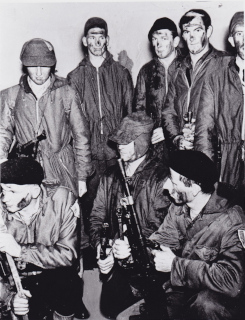
(Pictured: A group of IRA men before embarking on an operation in the 1950s | Photo credited to http://laochrauladh.blogspot.ie/)
The M62 coach bombing occurs on February 4, 1974, on the M62 motorway in Northern England, when a Provisional Irish Republican Army (IRA) bomb explodes in a coach carrying off-duty British Armed Forces personnel and their family members. Twelve people, nine soldiers and three civilians, are killed by the bomb, which consists of 25 pounds of high explosive hidden in a luggage locker on the coach.
The coach has been specially commissioned to carry British Army and Royal Air Force personnel on leave with their families from and to the bases at Catterick and Darlington during a period of railway strike action. The vehicle departs from Manchester and is making good progress along the motorway. Shortly after midnight, when the bus is between junction 26 and 27, near Oakwell Hall, there is a large explosion on board. Most of those aboard are sleeping at the time. The blast, which can be heard several miles away, reduces the coach to a “tangle of twisted metal” and throws body parts up to 250 yards.
The explosion kills eleven people outright and wounds over fifty others, one of whom dies four days later. Amongst the dead are nine soldiers – two from the Royal Artillery, three from the Royal Corps of Signals, and four from the 2nd battalion Royal Regiment of Fusiliers. One of the latter is Corporal Clifford Haughton, whose entire family, consisting of his wife Linda and his sons Lee (5) and Robert (2), also die. Numerous others suffer severe injuries, including a six-year-old boy, who is badly burned.
The driver of the coach, Roland Handley, is injured by flying glass, but is hailed as a hero for bringing the coach safely to a halt. Handley dies at the age of 76 after a short illness in January 2011.
Suspicions immediately fall upon the IRA, which is in the midst of an armed campaign in Britain involving numerous operations, later including the Guildford pub bombing and the Birmingham pub bombings.
Reactions in Britain are furious, with senior politicians from all parties calling for immediate action against the perpetrators and the IRA in general. The British media are equally condemnatory. According to The Guardian, it is “the worst IRA outrage on the British mainland” at that time, whilst the BBC describes it as “one of the IRA’s worst mainland terror attacks.” The Irish newspaper The Sunday Business Post later describes it as the “worst” of the “awful atrocities perpetrated by the IRA” during this period.
IRA Army Council member Dáithí Ó Conaill is challenged over the bombing and the death of civilians during an interview and replies that the coach had been bombed because IRA intelligence indicated that it was carrying military personnel only.
Following the explosion, the British public and politicians from all three major parties call for “swift justice.” The ensuing police investigation led by Detective Chief Superintendent George Oldfield is rushed, careless, and ultimately forged, resulting in the arrest of the mentally ill Judith Ward who claims to have conducted a string of bombings in Britain in 1973 and 1974 and to have married and had a baby with two separate IRA members. Despite her retraction of these claims, the lack of any corroborating evidence against her, and serious gaps in her testimony – which is frequently rambling, incoherent, and “improbable” – she is wrongfully convicted in November 1974.
The case against Ward is almost completely based on inaccurate scientific evidence using the Griess test and deliberate manipulation of her confession by some members of the investigating team. The case is similar to those of the Guildford Four, the Birmingham Six, and the Maguire Seven, which occur at the same time and involve similar forged confessions and inaccurate scientific analysis. Ward is finally released in 1992, when three Appeal Court judges hold unanimously that her conviction was “a grave miscarriage of justice,” and that it had been “secured by ambush.”
Republican Sinn Féin (Irish: Sinn Féin Poblachtach), an unregistered Irish Republican political organisation, is founded at the West County Hotel in Dublin on November 2, 1986.
Republican Sinn Féin (RSF) claim to be heirs of the Sinn Féin party founded in 1905 and take its present form in 1986 following a split with Provisional Sinn Féin. RSF members take seats when elected in local Irish councils but do not recognise the partition of Ireland and subsequently the legitimacy of the Northern Ireland or Republic of Ireland governments, so does not register itself under them.
The decision to form, or to reorganise or reconstitute as its supporters see it, the organisation was taken in response to Gerry Adams-led Sinn Féin’s decision at its 1986 ardfheis to end its policy of abstentionism and to allow elected Sinn Féin Teachtaí Dála take their seats in Leinster House‘s Dáil Éireann. The supporters of Ruairí Ó Brádaigh and Dáithí Ó Conaill who go on to form RSF oppose this move as it signals a departure from the traditional republican analysis which views the parliament of the Republic of Ireland as an illegal assembly, set up by an act of the British parliament. They argue that republicans owe their allegiance to the All-Ireland (32 County) Irish Republic, maintaining that this state exists de jure and that its authority rests with the IRA Army Council. Hence, if elected, its members refuse to take their seats in the Oireachtas.
The organisation views itself as representing “true” or “traditional” Irish republicanism, while in the mainstream media the organisation is portrayed as a political expression of “dissident republicanism.” Republican Sinn Féin rejects the Good Friday Agreement and indeed the Anglo-Irish Treaty. As part of this they refuse to discount Irish republicans using militant means to “defend the Irish Republic” and considers the Continuity Irish Republican Army (IRA) to be the legitimate army of the Irish Republic. The CIRA is designated as a terrorist organisation by the governments of the United Kingdom and Republic of Ireland.
On February 26, 1962, due to lack of support, the Irish Republican Army (IRA) ends what it calls “The Campaign of Resistance to British Occupation,” which is also known as the “Border Campaign.”
The Border Campaign is the first major military undertaking carried out by the IRA since the harsh security measures of the Republic of Ireland and Northern Ireland governments had severely weakened it in the 1940s.
The campaign is launched with simultaneous attacks by approximately 150 IRA members on targets on the Border in the early hours of December 12, 1956. A BBC relay transmitter is bombed in Derry, a courthouse is burned in Magherafelt, a B-Specials post near Newry is burned, and a half-built Army barracks at Enniskillen is blown up. A raid on Gough barracks in Armagh is beaten off after a brief exchange of fire.
On December 14, an IRA column under Seán Garland detonates four bombs outside LisnaskeaRoyal Ulster Constabulary (RUC) station before raking it with gunfire. Further attacks on Derrylin and Roslea RUC barracks on the same day are beaten off.
On the evening of December 30, 1956, the Teeling Column attacks the Derrylin RUC barracks again, killing RUC constable John Scally, the first fatality of the campaign. The new year of 1957 begins with Seán Garland and Dáithí Ó Conaill planning an attack on the Police station at Brookeborough but they assault the wrong building. Two IRA men, Seán South and Fergal O’Hanlon, are killed in the abortive attack. Garland is seriously wounded in the raid. He and the remainder of the group are pursued back over the border by British soldiers.
The year 1957 is the most active year of the IRA’s campaign, with 341 incidents recorded. In November, the IRA suffers its worst loss of life in the period when four of its members die preparing a bomb, which explodes prematurely, in a farmhouse at Edentubber, County Louth. The civilian owner of the house is also killed.
By 1958, the campaign’s initial impetus has largely dissipated with many within the IRA in favour of calling the campaign off. By mid-year, 500 republicans are in gaol or interned. The decline in IRA activity leads the Fianna Fáil government in the South to end internment in March 1959.
Following their release, some of the interned leaders met Seán Cronin in a farmhouse in County Laois and are persuaded to continue the campaign “to keep the flame alive.” The number of incidents falls to just 26 in 1960, with many of these actions consisting of minor acts of sabotage.
The final fatality of the conflict comes in November 1961, when an RUC officer, William Hunter, is killed in a gun battle with the IRA in south County Armagh.
By late 1961, the campaign is over and has cost the lives of eight IRA men, four republican supporters, and six RUC members. In addition, 32 RUC members are wounded. A total of 256 Republicans are interned in Northern Ireland during the campaign and another 150 or so in the Republic.
The Campaign is officially called off on February 26, 1962, with a press release drafted by Ruairí Ó Brádaigh and several other persons including members of the Army Council. The statement is released by the Irish Republican Publicity Bureau and signed “J. McGarrity, Secretary.”




 seamus dubhghaill