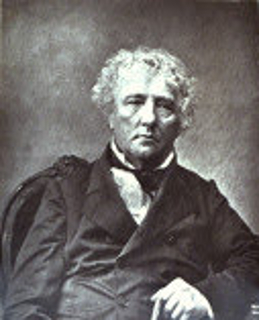
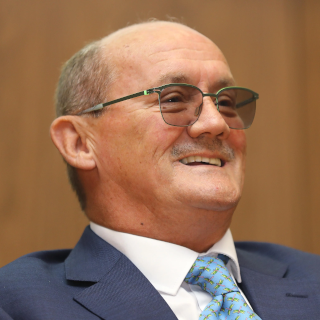
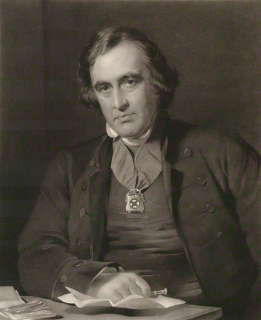
Thomas F. Kilroy, Irish playwright and novelist, is born on September 23, 1934, in Green Street, Callan, County Kilkenny. He is a difficult writer to categorize, having written plays ranging from the conventional The Death and Resurrection of Mr. Roche to more technically innovative and avant-garde works such as Talbot’s Box and The Secret Fall of Constance Wilde. Nevertheless, common thematic concerns run throughout many of his plays, including the issue of personal and cultural—specifically, Irish versus English—identity and the mythologizing of the past. Best known as a playwright, he is also the author of the Booker Prize-shortlisted novel The Big Chapel (1971).
Kilroy is the son of Thomas and Mary (née Devine) Kilroy. He attends St. Kieran’s College and plays hurling for the school team, captaining the senior team in 1952. He studies at University College Dublin, where his first play, The Death and Resurrection of Mr. Roche, is produced to great success at the Olympia Theatre. In his early career he is play editor at the Abbey Theatre in Dublin. In the 1980s, he sits on the board of Field Day Theatre Company, founded by Brian Friel and Stephen Rea in 1980, and is Director of its touring company.
In 1978, Kilroy is appointed Professor of English at University College Galway, a post from which he resigns in 1989 to concentrate on writing.
In 2008, Kilroy receives the Irish PEN Award, given to honour an Irish-born writer who has made an outstanding contribution to Irish literature.
While some of Kilroy’s plays hit a lighter note than others, the common thread in most of them is his attempt to address some of the social upheavals that have occurred in Ireland in the past and present. This has been a concern of his since he was in his twenties and wrote in the 1959 essay “Groundwork for an Irish Theatre” that his contemporaries were “inclined to shirk the painful, sometimes tragic problems of a modern Ireland which is undergoing considerable social and ideological stress.” Although he has not been one of Ireland’s most prolific playwrights, his plays may certainly be considered important contributions to the modern stage.
Charles Bianconi, Italo-Irish passenger car entrepreneur, dies on September 22, 1875, at Longfield House, Boherlahan, County Tipperary. Sometimes described as the “man who put Ireland on wheels,” he develops a network of horse-drawn coaches that become Ireland’s “first regular public transport” system.
Bianconi is born Carlo Bianconi in Tregolo, Costa Masnaga, Italy on September 24, 1786. He moves from an area poised to fall to Napoleon and travels to Ireland in 1802, by way of England, just four years after the Irish Rebellion of 1798. At the time, British fear of continental invasion results in an acute sense of insecurity and additional restrictions on the admission of foreigners. He is christened Carlo but anglicises his name to Charles when he arrives in Ireland.
Bianconi works as an engraver and printseller in Dublin, near Essex Street, under his sponsor, Andrea Faroni, when he is sixteen. In 1806 he sets up an engraving and print shop in Carrick-on-Suir, County Tipperary, moving to Clonmel in 1815.
Bianconi eventually becomes famous for his innovations in transport and is twice elected mayor of Clonmel.
Bianconi is the founder of public transportation in Ireland, at a time preceding railways. He establishes regular horse-drawn carriage services on various routes from about 1815 onward. These are known as “Bianconi coaches” and the first service, Clonmel to Cahir, takes five to eight hours by boat but only two hours by Bianconi’s carriage. Travel on one of his carriages cost one penny farthing a mile.
In 1832 Bianconi marries Eliza Hayes, the daughter of a wealthy Dublin stockbroker. They have three children – Charles Thomas Bianconi, Catherine Henrietta Bianconi and Mary Anne Bianconi, who marries Morgan John O’Connell and is the mother of his grandson John O’Connell Bianconi.
Bianconi’s transport services continue into the 1850s and later, by which time there are a number of railway services in the country. The Bianconi coaches continue to be well-patronised, by offering connections from various termini, one of the first and few examples of an integrated transport system in Ireland. By 1865 Bianconi’s annual income was about £35,000.
Charles Bianconi dies on September 22, 1875, at Longfield House, Boherlahan, County Tipperary. Having donated land to the parish of Boherlahan for the construction of a parish church, he wishes to be buried on the Church grounds. He, and his family, are buried in a side chapel, separate from the parish church in Boherlahan, approximately five miles from Cashel, County Tipperary.
Three British soldiers are killed, the first in the city since the Easter Rising of 1916, and two more wounded in a short exchange of gunfire with an Irish Republican Army (IRA) unit on the morning of September 20, 1920, at the corner North King Street and Church Street in Dublin.
Just before 11 o’clock, fifteen soldiers of the Duke of Wellington’s Regiment arrive in a motor lorry at Monks’ Bakery, North King Street, to acquire a supply of bread for Collinstownaerodrome. What happens next is disputed. Soldiers involved in the incident testify later that the volunteers began the shooting, after shouting “Hands Up!” and demanding they hand over their rifles.
Two key testimonies tally. The driver of the truck, Private C. Barnes, testifies at IRA volunteer Kevin Barry‘s court martial that he had been looking under the bonnet of the vehicle when he saw a civilian carrying a pistol walk up, shout “Hands Up!,” and fire a single round into the air. Decades later, the officer commanding the IRA unit that day, Seamus Kavanagh, tells the Bureau of Military History that it was indeed one of his men, but not Barry, that had fired the first shot, perhaps due to “overanxiety.”
Kavanagh sees the soldiers in the truck immediately rise to their feet, rifles in hand. The plan has fallen apart at the first hurdle, the element of surprise is lost, and there are no guns captured that day. He says he then gives the order to open fire, and retreat from the bakery. The exchange lasts four or five minutes.
In the last seconds of the ambush, Barry is in trouble. His gun has jammed twice, and has only fired two shots. Trying to clear the second jam, he fails to realise the rest of the unit has retreated, leaving him alone. He rolls under the lorry to hide, but a woman in the crowd of onlookers points him out to the soldiers, actually out of concern that he might be run over. He is taken prisoner and brought to the nearest base, at the North Dublin Union.
One reporter who attends the scene counts 22 bullet marks on walls, doors and windows in nearby homes and shops and adds that the military lorry is also riddled with bullet holes.
The three dead soldiers are identified as 18 year-old Private Harold Washington, who is found dead at the scene, Private Marshall Whitehead and Private Thomas Humphries who both die subsequently in King George V Hospital in Stoneybatter. The two wounded are Private William Smith and Private Frank Noble, neither of whom is armed.
It is rumoured that one or two of the attackers are killed, but this is not confirmed. Several volunteers are slightly wounded, but get away. Bob Flanagan’s wound is the most serious, a bullet literally parting his scalp. One onlooker expresses disbelief that the episode did not result in further fatalities given how close the soldiers and their assailants were to each other.
One person is understood to have been arrested in connection with the incident, however, according to eyewitnesses, the civilian in question has nothing to do with the attack and is taking shelter under a dray when arrested.
(Pictured: The funeral of the soldiers killed in the North King Street ambush, Irish Life, October 1, 1920)
Today, St. Patrick’s University Hospital, known for the innovative care of its patients, provides “Ireland’s largest, independent, not-for-profit mental health services.” When founded in 1745 it is the first psychiatric hospital to be built in Ireland mandated for the care of “Idiots and Lunaticks.”
Although new theories of madness and more therapeutic approaches to treatment are being proposed in the late 1700’s, during most of the eighteenth-century society views the lunatic as one who has literally lost his reason, “the essence of his humanity,” and therefore “his claim to be treated as a human being.” Treatments designed “to weaken the animal spirits that were believed to be producing madness,” still include restraints with chains, bloodletting, emetics, purging, and beating.
Confinement rather than cure is the focus of the earliest institutions in Great Britain. They resemble prisons with cells and keepers to control the inmates. Bethlem Hospital in London is the first to include lunatics in 1377. By the eighteenth century it has become infamous as “Bedlam” and has a reputation for cruelty, neglect, and poor living conditions, with an inadequate diet, rough clothing, and inactivity. Even worse, the mad in Bedlam are displayed as entertainment — a “freak show,” a “spectacle,” a “menagerie” from which “both provincial bumpkins and urban sophisticates could derive almost endless amusement” for a fee.
The earliest biographers of Jonathan Swift report that he had chosen to found St. Patrick’s Hospital because he had become insane himself at the end of his life. One writer even claims that he is the first patient to die there. Neither of these conclusions is accurate. It is his philosophical views and personal experiences that influence Swift’s decision to leave his estate for the establishment of St. Patrick’s.
Throughout the eighteenth century, medicine, politics, and literature all debate the relation between reason and madness, a subject that greatly interests Swift. In his most powerful satires, including Gulliver’s Travels (1726) and A Modest Proposal (1729), he sometimes explores the Lockean theory that “any person could fall into madness by the erroneous association of ideas.”
But the stronger motivation for Swift’s legacy grows from his involvement with the day-to-day problems of the Irish people, not only as an individual but also as Dean of St. Patrick’s Cathedral, a position he holds from 1713 until his death. At mid-century there are no provisions specifically for lunatics. If not being cared for by their families or found wandering the countryside, lunatics would sometimes be confined with criminals in prisons, with the poor in a workhouse, or with the sick in a hospital. Swift has firsthand knowledge of these conditions since he served as a governor of the workhouse and as a trustee of several hospitals. In 1710, after a visit to Bedlam, he gets himself elected a governor there in 1714. By 1731 he has decided on his legacy, intending his hospital to be charitable and more humane than Bedlam.
Another strong motivation may have been Swift’s ability to empathize with the sufferers of madness. Not mental illness but recurring attacks of Ménière’s disease (MD) afflict him for over fifty years, beginning at age twenty-three. The debilitating bouts of vertigo, nausea, tinnitus, and deafness worsen by the late 1730’s, and he complains of memory loss and difficulty in reading and writing. When he finalizes his will in 1740, he refers to himself as sound in mind but weak in body. In 1742, following a sudden decline in his health, his friends have him judged incompetent and appoint a guardian. Probable dementia increases his helplessness until his death on October 19, 1745.
Swift leaves an estate of about 12,000 pounds. In his will he lists details as to where St. Patrick’s should be built and how it should be run by his board of governors. Although they first meet in 1746, the asylum does not open until 1757. The governors need to acquire the site, oversee the plan and construction of the building, and ensure available money for operating expenses. Insufficient funds are the main obstacle, even after adding money from rents, donations, subscriptions and Parliament. Finally, St. Patrick’s has to accept paying patients to offset the costs of its charity cases.
Richard Leeper, who is appointed Resident Medical Superintendent in 1899, introduces a series of important initiatives including providing work and leisure activities for the patients. Norman Moore, who is appointed Resident Medical Superintendent in 1946, introduces occupational therapy, including crafts and farm work to the patients.
After the introduction of deinstitutionalisation in the late 1980s the hospital goes into a period of decline. In 2008 the hospital announces the expansion of its outpatient services to a series of regional centres across Ireland. A mental health facility for teenagers, known as the Willow Grove Adolescent Inpatient Unit, opens at the hospital in October 2010.
Brendan O’Carroll, Irish actor, comedian, director, producer and writer, is born in Finglas, Dublin, on September 17, 1955. He is best known for portraying foul-mouthed matriarch Agnes Brown on stage and in the BBC and RTÉ television sitcom Mrs. Brown’s Boys. In 2015, he is awarded the Irish Film and Television Academy Lifetime Achievement Award for his contribution to Irish television.
O’Carroll is the youngest of eleven children. His mother, Maureen, is a Labour PartyTD and his father, Gerard O’Carroll, is a carpenter. His father dies in 1962 when O’Carroll is six years old, and his mother raises the eleven children with little money. He attends Saint Gabriel’s National School and leaves at the age of twelve. He has a string of occupations, including being a waiter and a milkman.
Having become well known as a comedy guest on The Late Late Show, O’Carroll releases four stand-up videos, titled How’s your Raspberry Ripple, How’s your Jolly Roger, How’s your Snowballs and How’s your Wibbly Wobbly Wonder.
O’Carroll writes the screenplay to Sparrow’s Trap, a boxing movie. The film, which has Stephen Rea cast in the lead role, runs into financing difficulties midway through the shoot when the distributor withdraws, and it is abandoned. Incurring debts of over €1 million, he becomes bankrupt, and the film has never been produced.
O’Carroll presents a quiz show called Hot Milk and Pepper on RTÉ One, with long-term collaborator Gerry Browne.
In 1992, O’Carroll performs a short radio play titled Mrs. Brown’s Boys and shortly afterwards he writes four books titled The Mammy, The Granny, The Chisellers and The Scrapper. In 1999, a movie named Agnes Browne, starring Anjelica Huston, is released, based on his book The Mammy. He also co-writes the screenplay. He then decides to put together his own family theatre company, Mrs. Browne’s Boys, and dresses up as a woman to play his part, as the actress he had originally hired did not show up.
From 1999 to 2009, O’Carroll writes and performs in five plays. Since 2011, the stage shows have been re-toured across the UK. In 2011, his plays are adapted into a television sitcom, with the name “Browne” shortened to “Brown.” From its beginning in 2011 through January 2022, 28 episodes have aired, across three series, several Christmas-special episodes and a one-off live episode that aired in 2016 on RTÉ One and BBC One. Mrs. Brown’s Boys D’Movie is released on June 27, 2014, and is a significant success in the UK, staying at number one in the box office for two consecutive weeks. However, the film has negative reviews with one saying it is not just unfunny but “close to anti-funny.” O’Carroll’s wife, his sister Eilish, his son Danny, and his daughter Fiona all appear or have appeared on episodes of Mrs. Brown’s Boys.
It is announced in January 2015 that the BBC wants O’Carroll to do “other stuff,” due to the fact that Mrs. Brown’s Boys has become so successful. He reveals plans to adapt his first ever written play, patser grey, into a television sitcom.
O’Carroll is married to Doreen O’Carroll from 1977 to 1999. He marries Jennifer Gibney in 2005. They live in Davenport, Florida. He has three surviving children: Fiona, Danny, and Eric. Their first son Brendan dies of spina bifida at just a few days old. He has six grandchildren, four children from Fiona and two children from Danny.
O’Carroll’s paternal grandfather, Peter O’Carroll, a father of seven and a prominent republican, is shot dead on October 16, 1920, at his home in Manor Street, Dublin. Two of his sons are Irish Republican Army volunteers. The incident is investigated in the television series Who Do You Think You Are?
In March 2016 O’Carroll appears in the BBC Two documentary Brendan O’Carroll – My Family at War, which explores the involvement of three of his uncles — Liam, James and Peadar O’Carroll — in the Easter Rising.
McCormack is born on June 14, 1884, in Athlone, County Westmeath, the second son and fifth of the 11 children of Andrew McCormack and his wife Hannah Watson. His parents are both from Galashiels, Scotland, and work at the Athlone Woolen Mills, where his father is a foreman. He is baptised in St. Mary’s Church, Athlone, on June 23, 1884.
McCormack receives his early education from the Marist Brothers in Athlone and later attends Summerhill College, Sligo. He sings in the choir of the old St. Peter’s Church in Athlone under his choirmaster Michael Kilkelly. When the family moves to Dublin, he sings in the choir of St. Mary’s Pro-Cathedral where he is discovered by Vincent O’Brien. In 1903 he wins the coveted gold medal of the Dublin Feis Ceoil. He marries Lily Foley in 1906 and they have two children, Cyril and Gwen.
In March 1904, McCormack becomes associated with James Joyce, who at the time has singing ambitions himself. He persuades Joyce to enter the Feis Ceoil that year, where the not yet famous writer is awarded the Bronze Medal.
Fundraising activities on his behalf enable McCormack to travel to Italy in 1905 to receive voice training by Vincenzo Sabatini, father of the novelist Rafael Sabatini, in Milan. Sabatini finds McCormack’s voice naturally tuned and concentrates on perfecting his breath control, an element that becomes part of the basis of his renown as a vocalist.
In 1906, McCormack makes his operatic début at the Teatro Chiabrera, Savona. The next year, he begins his first important operatic performance at Covent Garden in Pietro Mascagni‘s Cavalleria rusticana, becoming the theatre’s youngest principal tenor. In 1909, he begins his career in the United States.
In February 1911, McCormack plays Lieutenant Paul Merrill in the world premiere of Victor Herbert‘s opera Natoma with Mary Garden in the title role. Later that year, he tours Australia after DameNellie Melba engages him, then at the height of his operatic career, aged 27, as a star tenor for the Melba Grand Opera Season. He returns for concert tours in subsequent years.
By 1912, McCormack is beginning to become involved increasingly with concert performances, where his voice quality and charisma ensures that he becomes the most celebrated lyric tenor of his time. He does not, however, retire from the operatic stage until after his performance of 1923 in Monte Carlo, although by then the top notes of his voice have contracted. Famous for his extraordinary breath control, he can sing 64 notes on one breath in Mozart‘s “Il mio tesoro” from Don Giovanni, and his Handelian singing is just as impressive in this regard.
McCormack makes hundreds of recordings, his best-known and most commercially successful series of records being those for the Victor Talking Machine Company during the 1910s and 1920s. He is Victor’s most popular Red Seal recording artist after tenor Enrico Caruso. In the 1920s, he sings regularly on radio and later appears in two sound films, Song o’ My Heart (1930), playing an Irish tenor, and as himself appearing in a party scene in Wings of the Morning (1937), the first British three-strip Technicolor feature.
McCormack is one of the first artists to record the popular ballad “I Hear You Calling Me” written in 1908 by Harold Harford and Charles Marshall. He records it twice for Odeon Records starting in 1908 and a further four times for Victor between 1910 and 1927, becoming his best seller. He is the first artist to record the famous World War I song “It’s a Long Way to Tipperary” in 1914. He also records a best-selling version of another popular World War I tune, “Keep the Home Fires Burning,” in 1917. He also sings songs expressive of Irish nationalism and endorses the Irish Nationalist estrangement from the United Kingdom. He is associated particularly with the songs of Thomas Moore, notably “The Harp That Once Through Tara’s Halls,” “The Minstrel Boy,” “Believe Me If All (Those Endearing Young Charms),” and “The Last Rose of Summer.” Between 1914 and 1922, he records almost two dozen songs with violin accompaniment provided by Fritz Kreisler, with whom he also tours. He records songs of Hugo Wolf for the Hugo Wolf Society in German. In 1918, he records the song “Calling Me Home to You.”
In 1917, McCormack becomes a naturalised citizen of the United States. In June 1918, he donates $11,458 toward the U.S. World War I effort. By then, his career is a huge financial success, earning millions in his lifetime from record sales and appearances.
By 1920, Edwin Schneider has become McCormack’s accompanist and the two are “inseparable.” When Schneider retires, Gerald Moore takes over as accompanist from 1939 to 1943.
In 1927, McCormack moves into Moore Abbey, Monasterevin, County Kildare, and adopts a very opulent lifestyle by Irish standards. He also owns apartments in London and New York. He hopes that one of his racehorses, such as Golden Lullaby, would win The Derby, but this never occurs.
McCormack also purchases Runyon Canyon in Hollywood in 1930 from Carman Runyon. He sees and likes the estate while there filming Song o’ My Heart (1930), an early all-talking, all-singing picture. He uses his salary for this movie to purchase the estate and builds a mansion he calls ‘San Patrizio,’ after Saint Patrick. He and his wife live in the mansion until they return to England in 1938.
McCormack tours often, and in his absence, the mansion is often let to celebrities such as Janet Gaynor and Charles Boyer. The McCormacks make many friends in Hollywood, among them Errol Flynn, Will Rogers, John Barrymore, Basil Rathbone, Ronald Colman, Charles E. Toberman and the Dohenys. After his farewell tour of America in 1937, the McCormacks deed the estate back to Carman Runyon expecting to return to the estate at a later date. World War II intervenes and he does not return.
McCormack originally ends his career at the Royal Albert Hall in London, during 1938. However, one year after that farewell concert, he is back singing for the Red Cross and in support of the war effort. He gives concerts, tours, broadcasts and records in this capacity until 1943 when poor health finally forces him to retire permanently.
Ill with emphysema, McCormack purchases a house near the sea, “Glena,” Booterstown, Dublin. After years of increasingly poor health, and a series of infectious illnesses, including influenza and pneumonia, he dies at his home in Booterstown on September 16, 1945. He is buried in Deans Grange Cemetery, St. Patrick’s section, plot reference E/120.
Sheppard is based in Dublin for almost all of his life, having traveled widely across Europe. His wife Rosie dies in 1931, with whom he has several children. They live at Howth and 30 Pembroke Road in central Dublin.
From 1902 to 1937 Sheppard teaches sculpture at the Dublin Metropolitan School of Art. His annual stipend is £250 but for this he only has to lecture three mornings a week, allowing him plenty of time for work on commissioned projects. One of his most famous students is the sculptor, Kathleen Cox.
The Dying Cuchulain is considered Sheppard’s masterpiece and an important work of Irish art. It is a bronze figure of the mythological warrior-hero Cuchulain, who continued to fight against his enemies while gravely wounded and tied to a tree. It is created in 1911 and later chosen by Éamon de Valera in 1935 as the national memorial to the 1916 Easter Rising. It can still be viewed today in the General Post Office (GPO), O’Connell Street, Dublin.
Sheppard is generally critical of the low standards of sculpture in Ireland: “For the last sixty years or so thousands of figures and groups have been executed in Dublin for ecclesiastical purposes, and, with one or two exceptions … was not up to a reasonable standard. The making of a work of art hardly entered into it at all. The sculptor, well trained and properly encouraged, should collaborate with the architect.”
Sheppard is in the minority of Irish Protestants who support independence, starting with support for the Irish Parliamentary Party in the 1880s, when he is an art student.
In 1890–1910 Sheppard is a part of the Celtic Revival movement, and, from his works such as Inis Fáil, is admired by his student William Pearse. Through him he meets his brother Patrick Pearse who later helps launch the Easter Rising in 1916. While most of the Revival’s artists are writers, playwrights and poets, Sheppard can claim to be the main sculptor working on themes similar to theirs.
After the Irish War of Independence (1919–21) Sheppard says, “They thought me too old to fight but I have tried to help in other ways. My politics are simple. I have always thought that this country should be a free country.” His opinions are not overly dogmatic, considering his work on the war memorials in 1920.
In the mid-1920s the first series of Irish Free State coinage is planned and is finally launched in 1928. Sheppard is one of the designers short-listed but his designs are not accepted.
After his retirement in 1937 from the National College of Art, the now renamed Dublin Metropolitan School of Art, he is appointed in 1938 by the Minister for Education to the College’s standing committee. He is also made a judge in the Royal Dublin Society art competition in 1939 and 1940.
By 1972, Ahern has met his future wife, Miriam Kelly, a bank official who lives near the Aherns’ family home. They marry in St. Columba’s Church, Iona Road in 1975. They have two daughters from the marriage, Georgina and Cecelia. Georgina is the wife of Westlife member Nicky Byrne. Cecelia is a best-selling author. The Aherns separate in 1992.
Ahern is elected to the Dáil, the lower house of the Oireachtas, in 1977 as a member of the Fianna Fáil party for the newly created Dublin Finglas constituency. He is elected to the Dublin City Council in 1979, later becoming Lord Mayor of Dublin (1986–87). An assistant whip (1980–81) in the first government of Taoiseach Charles Haughey, he becomes a junior minister in Haughey’s second government (1982) and Minister for Labour in his third (1987–89) and fourth (1989–91) governments.
Ahern’s success in establishing general economic agreements with employers, unions, and farmers in 1987 and 1990 and his role in constructing the first Fianna Fáil coalition government (with the Progressive Democrats) in 1989 confirms his reputation as a skillful negotiator. He is made Minister for Finance in 1991. In the contest to choose Haughey’s successor, Ahern withdraws in favour of Albert Reynolds, and he remains Minister for Finance in each of Reynolds’s two governments (February–November 1992 and 1993–94). In November 1994, following the fall of the Fianna Fáil–Labour Party government, Reynolds resigns, and Ahern is elected party leader. He is set to become Taoiseach in a new coalition with the Labour Party, but at the eleventh-hour Labour opts to join a government with Fine Gael and Democratic Left.
Ahern forms a Fianna Fáil–Progressive Democrats minority government following elections in 1997. Credited with overseeing a thriving economy, he is reelected Taoiseach in 2002. He plays a major role in securing peace in Northern Ireland, participating in the signing of the Good Friday Agreement in 1998 and helping negotiate the return of devolution to Northern Ireland in 2007. On May 15, 2007, he becomes the first Taoiseach to address a joint session of the Parliament of the United Kingdom.
Soon afterward Ahern wins a third term as Taoiseach. He is reelected despite implications of his involvement in an influence-peddling scandal. The Tribunal of Inquiry into Certain Planning Matters & Payments, ultimately better known as the Mahon Tribunal, which is investigating alleged illegal payments by developers to politicians to influence zoning decisions in and around Dublin during the early 1990s, subsequently questions Ahern about his personal finances during his tenure as Minister for Finance. In early April 2008, as the investigation of Ahern’s involvement mounts, he announces that he will step down as Taoiseach and Leader of Fianna Fáil in May. He is succeeded in both posts by Brian Cowen. In the Mahon Tribunal’s final report, issued on March 22, 2012, it indicates that it does not believe Ahern had told the truth when questioned by the commission about alleged financial improprieties, though it does not directly accuse him of corruption. Ahern, threatened with expulsion from Fianna Fáil in the wake of the report, resigns from the party later in March while still maintaining that he had testified truthfully to the tribunal.
Ahern says in April 2018 that he is considering running for President of Ireland in 2025 as an independent candidate. That same month he walks out of an interview with DW News after being questioned on the findings of the Mahon Tribunal.
In October 2018, Ahern is appointed to chair the Bougainville Referendum Commission, which is responsible for preparing an independence referendum in Bougainville, Papua New Guinea, which takes place in December 2019.
Frank Ryan, politician, journalist, intelligence agent and paramilitary activist, is born in the townland of Bottomstown, Elton, County Limerick, on September 11, 1902. A fascinating, somewhat mythical figure, he lives during turbulent times when Ireland finally disposes of tyrannical British rule in Ireland and becomes an icon for socialist republicans in Europe during the 1930s and 40s.
Ryan fights on the Anti-Treaty side in the Irish Civil War (1922-23) and is wounded and interned. In November 1923 he is released and returns to UCD. He secures his degree in Celtic Studies and further secures the editorship of An Phoblacht (The Republic), the newspaper of the anti-Treaty Irish Republican Army (IRA).
The split in the Irish independence party, Sinn Féin, results in regular fist fights between pro and anti-Treaty forces. Cumann na nGaedhael, the pro-Treaty political party in government, recruits the Army Comrades Association (Blueshirts) under former Garda CommissionerEoin O’Duffy to protect their members from anti-Treaty IRA protesters at annual Armistice Day and Wolfe Tone commemorations. Ryan is a forceful orator at these events and is frequently arrested and beaten up by the Gardai. The fractious politics results in Dáil members Sean Hales and Kevin O’Higgins being shot dead in public.
The outbreak of the Spanish Civil War (1936-39) inspires Ryan to lead the first contingent of Irish volunteers to support the Popular Front government of Republican Spain. A brave and inspiring leader, he serves with Italian and German Republican divisions. He is seriously wounded at the Battle of Jarama in February 1937. Following recuperation in Ireland, he is appointed adjutant to republican General José Miaja. During the Aragon Offensive he is captured with 150 of his men in April 1938 and sentenced to death. Irish President, Éamon de Valera, intervenes with General Francisco Franco and Ryan’s sentence is commuted to thirty years. His health suffers severely in Burgos Prison, Spain during his two-year incarceration.
Franco refuses to release Ryan because he is considered his most dangerous prisoner. In August 1940 he is transferred to Berlin, where he is re-united with IRA Chief of StaffSeán Russell. An attempt to return both men to Ireland by U-boat ends with Russell dying from a perforated ulcer. Ryan voluntarily returns to Germany where he serves as the unofficial IRA ambassador for German intelligence. Irishman Francis Stuart, son-in-law of Maud Gonne, who writes some of William Joyce’s propaganda, takes good care of Ryan until his untimely death at a hospital in Loschwitz in Dresden on June 10, 1944.
Ryan’s funeral in Dresden is attended by Elizabeth Clissmann, wife of Helmut Clissmann, and Francis Stuart. Clissmann eventually forwards details of Ryan’s fate to Leopold Kerney in Madrid. According to Stuart and Clissmann, the cause of death is pleurisy and pneumonia.
In 1963, historian Enno Stephan locates Ryan’s grave in Dresden. Three volunteers of the International Brigades, Frank Edwards, Peter O’Connor and Michael O’Riordan travel to East Germany as a guard of honour to repatriate Ryan’s remains in 1979. On June 21, 1979, his remains arrive in Whitefriar Street Carmelite Church, his local church when he lived in Dublin. The church is packed with all shades of Republican and left-wing opinion, as well as those from his past such as the Stuarts, the Clissmanns, Peadar O’Donnell, George Gilmore, and ex-comrades and sympathizers from all over the world. The cortège on its way to Glasnevin Cemetery halts at the GPO in memory of the dead of the 1916 Easter Rising. His coffin is borne to the grave in Glasnevin Cemetery by Irish veterans of the Spanish Civil War, Frank Edwards, Peter O’Connor, Michael O’Riordan and Terry Flanagan. Con Lehane delivers the funeral oration while a piper plays “Limerick’s Lamentation.” He is buried next to Éamonn Mac Thomáis.
Ryan leads a vicarious life in pursuit of human rights, socialism and republicanism. His life story remains more colourful than fiction.
Trench is the son of Richard Trench (1774–1860), barrister-at-law, and the Dublin writer Melesina Chenevix (1768–1827). His elder brother is Francis Chenevix Trench. He is educated at Harrow School, and graduates from Trinity College, Cambridge in 1829. In 1830 he visits Spain. While incumbent of Curdridge Chapel near Bishop’s Waltham in Hampshire, he publishes The Story of Justin Martyr and Other Poems (1835), which is favourably received, and is followed by Sabbation, Honor Neale, and other Poems (1838), and Poems from Eastern Sources (1842). These volumes reveal the author as the most gifted of the immediate disciples of William Wordsworth, with a warmer colouring and more pronounced ecclesiastical sympathies than the master, and strong affinities to Alfred, Lord Tennyson, John Keble and Richard Monckton Milnes.
In 1841 Trench resigns his living to become curate to Samuel Wilberforce, then rector of Alverstoke, and upon Wilberforce’s promotion to the deanery of Westminster Abbey in 1845 he is presented to the rectory of Itchen Stoke. In 1845 and 1846 he preaches the Hulsean Lectures, and in the former year is made examining chaplain to Wilberforce, now Bishop of Oxford. He is shortly afterwards appointed to a theological chair at King’s College London.
Trench joins the Canterbury Association on March 27, 1848, on the same day as Samuel Wilberforce and Wilberforce’s brother Robert.
In 1851 Trench establishes his fame as a philologist by The Study of Words, originally delivered as lectures to the pupils of the Diocesan Training School, Winchester. His stated purpose is to demonstrate that in words, even taken singly, “there are boundless stores of moral and historic truth, and no less of passion and imagination laid up” — an argument which he supports by a number of apposite illustrations. It is followed by two little volumes of similar character — English Past and Present (1855) and A Select Glossary of English Words (1859). All have gone through numerous editions and have contributed much to promote the historical study of the English tongue. Another great service to English philology is rendered by his paper, read before the Philological Society, On some Deficiencies in our English Dictionaries (1857), which gives the first impulse to the great Oxford English Dictionary. He envisages a totally new dictionary that is a “lexicon totius Anglicitatis.” As one of the three founders of the dictionary, he expresses his vision that it will be “an entirely new Dictionary; no patch upon old garments, but a new garment throughout.”
Trench’s advocacy of a revised translation of the New Testament (1858) helps promote another great national project. In 1856 he publishes a valuable essay on Pedro Calderón de la Barca, with a translation of a portion of Life is a Dream in the original metre. In 1841 he had published his Notes on the Parables of our Lord, and in 1846 his Notes on the Miracles, popular works which are treasuries of erudite and acute illustration.
In 1856 Trench becomes Dean of Westminster Abbey, a position which suits him. Here he introduces evening nave services. In January 1864 he is advanced to the post of Archbishop of Dublin. Arthur Penrhyn Stanley had been first choice, but is rejected by the Church of Ireland, and, according to Bishop Wilberforce’s correspondence, Trench’s appointment is favoured neither by the Prime Minister nor the Lord Lieutenant. It is, moreover, unpopular in Ireland, and a blow to English literature, yet it turns out to be fortunate. He cannot prevent the disestablishment of the Church of Ireland, though he resists with dignity. But, when the disestablished communion has to be reconstituted under the greatest difficulties, it is important that the occupant of his position should be a man of a liberal and genial spirit.
This is the work of the remainder of Trench’s life. It exposes him at times to considerable abuse, but he comes to be appreciated and, when he resigns his archbishopric because of poor health in November 1884, clergy and laity unanimously record their sense of his “wisdom, learning, diligence, and munificence.” He finds time for Lectures on Medieval Church History (1878), and his poetical works are rearranged and collected in two volumes (last edition, 1885). He dies at Eaton Square, London, on March 28, 1886, after a lingering illness. He is buried at Westminster Abbey.
George W. E. Russell describes Trench as “a man of singularly vague and dreamy habits” and recounts the following anecdote of his old age:
“He once went back to pay a visit to his successor, Lord Plunket. Finding himself back again in his old palace, sitting at his old dinner-table, and gazing across it at his wife, he lapsed in memory to the days when he was master of the house, and gently remarked to Mrs. Trench, ‘I am afraid, my love, that we must put this cook down among our failures.'”