Long comes from a carpentry and blacksmithing background. In 1959, he enters Queen’s University Belfast to study civil engineering. He graduates with first class honours and then takes a PhD at Queens. In 1967, he moves to Canada, working as a bridge designer for Fenco Engineering in Toronto.
Long, however, spends only a year in Canada, returning to Belfast in 1968 to become an associate professor of civil engineering at Queen’s University Belfast. In 1976, he is promoted to a full professorship. His work is largely in the field of concrete structures, particularly in chloride resistance, maintenance problems and arch bridge structures. He publishes twenty papers in journals managed by the Institution of Civil Engineers and wins eight of the institution’s medals for these, including the ICE Gold Medal.
From 1997 Long works on the FlexiArch, a precast concrete arch in which the individual voussoirs are joined by a flexible polymeric membrane. The arch arrives to site flat packed and when lifted into position by a crane, the gaps between the voussoirs close under gravity and form the correct arch profile. He patents the product, which is produced by Irish precast manufacturer Macrete, in 2004. The product can be constructed within a day and, containing no corrodible elements, has been stated to have a design lifespan of 300 years. More than fifty FlexiArch bridges have been constructed in the UK and Ireland and spans up to 30m are possible.
By 2002, Long is appointed dean of the faculty of engineering at QUB. In November of that year, he is appointed president of the ICE for the 2002–2003 session, the first Northern Irish person to hold that position. He is also a Fellow of the Royal Academy of Engineering and of the Institute for the Advancement of Engineering.
Long is appointed an officer of the Order of the British Empire in the 2006 New Year Honours for services to higher education and civil engineering. He resigns as professor at QUB in 2006 but remains there as an emeritus professor in the School of Natural and Built Environment. Since 2015, the ICE Northern Ireland awards the Adrian Long medal to the best paper in an ICE journal to be authored by a Northern Ireland member. The medal features a bust of Long.
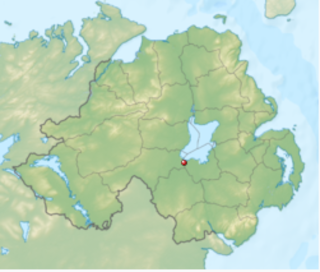
Coalisland is a town in County Tyrone that has a tradition of militant republicanism; five residents are killed by British security forces before the first IRA ceasefire in 1994. In February 1992, four IRA volunteers are killed in a gun battle with the SAS during their escape after a machine gun attack on the RUC/British Army barracks there. Three months later, an IRA bomb attack on a British Army patrol at Cappagh, in which a paratrooper loses his legs, triggers a series of clashes between local residents and British troops on May 12 and 17. A number of civilians and soldiers are injured, a soldier’s backpack radio destroyed, and two British weapons stolen. The melee is followed by a 500-strong protest in the town and bitter exchanges between Republic of Ireland and British officials. Further scuffles between civilians and soldiers are reported in the town on March 6, 1994.
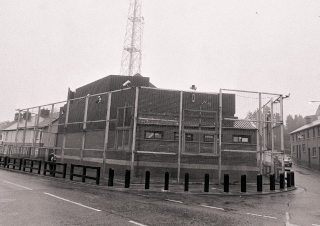
At 9:40 p.m. on Wednesday, March 26, 1997, a grenade is thrown at the joint British Army/RUC base at Coalisland, blowing a hole in the perimeter fence. The RUC reports that a 1 kg device hit the fence ten feet off the ground. Another source claims that the device is a coffee-jar bomb filled with Semtex. The grenade is thrown or fired by two unidentified men. At the time of the attack, there is an art exhibition at Coalisland Heritage Hall, also known as The Mill, from where the explosion and the gunshots that follow are clearly heard. The incident lasts less than two minutes.
Just one minute after the IRA attack, bypassers hear high-velocity rounds buzzing around them. A number of men, apparently SAS soldiers, get out of civilian vehicles wearing baseball caps with “Army” stamped on the front. A source initially describes them as members of the 14 Field Security and Intelligence Company. The men are firing Browning pistols and Heckler & Kochsubmachine guns. Witnesses say there are eight to ten gunshots, while a republican source claims that up to eighteen rounds are fired. Nineteen-year-old Gareth Doris is shot in the stomach and falls to the ground. He is allegedly returning from the local church and is in the company of a priest when he is shot. A local priest, Seamus Rice, is driving out of the church car park when his car is hit by bullets, smashing the windscreen.
Three minutes after the blast, hundreds of angry residents gather at the scene and confront the undercover soldiers. The soldiers fire live rounds at the ground and into the air to keep people back. The crowd keeps drawing back and moving forward again until 9:50 p.m., when the RUC arrives and begins firing plastic bullets at the protesters. Two women are wounded by plastic bullets and the undercover soldiers then flee in unmarked cars, setting off crackers or fireworks at the same time. Sinn FéincouncillorFrancie Molloy claims that the protesters forced the SAS to withdraw, saving Doris’s life in the process. Witnesses allegedly fear an undercover soldier brandishing a pistol would have killed the wounded Doris with a shot to his head.
Afterward, hundreds of residents are forced to leave their homes as security forces search the area near the base. This keeps tensions high, according to local republican activist Bernadette McAliskey. Two men are later questioned by the RUC about the attack.
The attack, along with two large bombings the same day in Wilmslow, England, raise concerns that the IRA is trying to influence the upcoming UK general election. Martin McGuinness describes the shooting as “murderous,” while independent councillor Jim Canning says that more than a dozen soldiers “were threatening to shoot anybody who moved […] while a young man lay shot on the ground.” Republican sources claim that this is another case of shoot-to-kill policy by the security forces. Ulster Unionist Party (UUP) MPKen Maginnis, however, praises the SAS for their actions.
Gareth Doris is admitted to South Tyrone Hospital in Dungannon, where he is arrested after undergoing surgery. He is later transferred to Musgrave Park Hospital in Belfast. He is later convicted for involvement in the bombing and sentenced to ten years in jail, before being released in 2000 under the terms of the Good Friday Agreement. Gareth is the cousin of Tony Doris, an IRA member killed in an SAS ambush in the nearby village of Coagh on June 3, 1991, and a cousin of Sinn Féin leader Michelle O’Neill. According to Sinn Féin councillor Brendan Doris, another cousin of Gareth, “He absolutely denies being involved in terrorist activity of any description.” Amnesty International raises its concerns over the shooting and the fact that no warning is given beforehand.
DNA evidence collected in the area of the shooting leads to the arrest of Coalisland native Paul Campbell by the Police Service of Northern Ireland (PSNI) in 2015, on the charges of being the other man with Doris during the attack. In February 2020, he is convicted by a Diplock court in Belfast. He denies the charges but receives a seven-and-a-half-year sentence. The prosecutor acknowledges that Campbell would have been released by this time under the provisions of the Good Friday Agreement but argues that that was a decision for the parole commission, not the court.
On July 5, 1997, on the eve of the 1997 nationalist riots in Northern Ireland, the British Army/RUC base is the scene of another attack, when an IRA volunteer engages an armoured RUC vehicle with gunfire beside the barracks. One female officer is wounded. The former RUC station at Coalisland is eventually shut down in 2006 and sold for private development in 2010.
(Pictured: Coalisland RUC/British Army base in Coalisland, County Tyrone, Northern Ireland)
Donnelly is born in Killybrackey, near Dungannon, County Tyrone, on July 10, 1914, into a family of cattle breeders. His father, Joseph Donnelly, sells his farm in 1917 and the family moves to Dundalk and opens a greengrocer‘s shop. Joseph Donnelly becomes quite prosperous, running his shop, dealing cattle and buying and selling property in the Dundalk area. In addition to Charles, the Donnellys have five other sons and two daughters. His mother, Rose, dies in 1927, when he is 13 years old.
Donnelly receives his early education in the Christian Brothers school in Dundalk. When he is fourteen in 1928, the family moves again, this time to Dublin, where his father purchases a house on Mountjoy Square in the north inner city. He enrolls in O’Connell School on North Frederick Street but is expelled after only a few weeks. He spends the next few months wandering the streets of Dublin during school time before his father discovers what had happened. Also at this time, he meets and is befriended by radical political activists from the Irish Republican Army (IRA), the Communist Party of Ireland and the left-Republican group Saor Éire.
Donnelly’s father and aunts get him an apprenticeship with a carpenter, but he gives this up after a year to enroll in University College Dublin (UCD) in 1931, where he studies Logic, English, History and the Irish language. In university he begins writing poetry and prose for student publications but fails his first-year examinations. At this time, he also becomes deeply involved in radical left-wing and republican politics. He drops out of university in 1934, having failed his first-year exams three times and joins the radical group, the Republican Congress. There he befriends veteran republicans Frank Ryan and George Gilmore. He also becomes involved in a romantic relationship with another republican activist, Cora Hughes, Éamon de Valera‘s goddaughter and later partner of George Gilmore. In July 1934, he is arrested and imprisoned for two weeks for his role in picketing a Dublin bakery with other Congress members. After this, his father expells him from the family home and he spends a period sleeping in parks around Dublin.
The Republican Congress splits at its first annual meeting in September 1934, but the 20-year-old Donnelly is elected to the National Executive of the truncated organisation. Thereafter, he writes for the Congress newspaper on political and social questions. In January 1935, he is again arrested for assaulting a Garda at a Congress demonstration and is imprisoned for a month. In February 1935, he leaves Ireland for London. In the British capital he forms the first Republican Congress branch in London and becomes its first chairman. He finds employment variously as a dishwasher in pubs and cafes and as a reporter with an international news agency. While in London he remains a regular contributor to the Republican Congress newspaper and various left-wing publications. Together with two other poets, Leslie Daiken and Ewart Milne, he is one of the founders of a duplicated publication called Irish Front, the London journal of the Republican Congress. Daiken admits that many of the Irish Front editions are written almost entirely by Donnelly.
Eoin McNamee recalls Donnelly as “a frail looking Dublin man with a Tyrone background…he was something of an intellectual and clearly the theorist of the Irish Republican Congress in London at that time. He was well versed in Marxism, wrote for the Congress and Communist press, and frequently appeared on left-wing public platforms.”
In July 1936, on the outbreak of the Spanish Civil War, Donnelly urges the Republican Congress to send fighters to the International Brigades. He himself returns to Dublin with the intention of organising such a force. By the end of 1936, he has gone again to London and joins the Brigades. He reaches Spain on January 7, 1937, and at Albacete, meets up with an Irish contingent, led by Frank Ryan, known as the Connolly Column, who had come to Spain to fight on the Republican side. He and his comrades are attached to the American Lincoln Battalion. On February 15, after receiving only rudimentary military training, the Lincoln Battalion is thrown into the Battle of Jarama, near Madrid. Donnelly reaches the front on February 23, where he is promoted to the rank of field commander. On February 27, his unit is sent on a frontal assault on the Nationalist positions on a hill named Pingarrón. The object of the attack is to take the enemy trenches and ultimately to drive them across the Jarama River. He and his unit are pinned down by machine gun fire all day. In the evening, the Nationalists launch a counterattack.
A Canadian veteran recalls, “We ran for cover, Charlie Donnelly, the commander of an Irish company is crouched behind an olive tree. He has picked up a bunch of olives from the ground and is squeezing them. I hear him say something quietly between a lull in machine gun fire: Even the olives are bleeding.” The line later becomes famous.
A few minutes later, as his unit retreats, Donnelly is caught in a burst of gunfire. He is struck three times, in the right arm, the right side and the head. He collapses and dies instantly. His body lay on the battlefield until it is recovered by fellow Irish Brigadier Peter O’Connor on March 10. He is buried at Jarama in an unmarked grave with several of his comrades.
Written by Donnelly’s brother Joseph, a collection of his work, Charlie Donnelly: the Life and Poems, is published in 1987 by Dedalus Press. On the eve of the 71st anniversary of his death, February 26, 2008, he is commemorated with the unveiling of a plaque at his alma mater, UCD, attended by 150 people. The commemoration, organised jointly by a group of UCD students and the Donnelly family, is hosted by the School of English and also includes a lecture by Gerald Dawe on Donnelly’s life and poetry. In April 2008, the UCD branch of the Labour Party is renamed the Charlie Donnelly Branch in his honour.
Donnelly’s friend Blanaid Salkeld commemorates him in her poem “Casualties,” writing “That Charlie Donnelly small and frail/ And flushed with youth was rendered pale/ But not with fear, in what queer squalor/ Was smashed up his so-ordered valour.” A 1976 documentary about the Civil War by Cathal O’Shannon is entitled Even the Olives are Bleeding.
Donnelly is survived by a brother, Joseph, who manages to get many of his poems published in 1987; only five or six are published during his lifetime. Discussing his work, Colm Tóibín says it “mixed an Audenesque exactitude with a youthful romanticism… his poem “The Tolerance of Crows” belongs in any anthology of modern poetry.” In 1992, Donnelly has work included in Dedalus Irish Poets: An Anthology from Dedalus Press.
After the death of Brendan Doris in 2006, Martin McGuinness pays tribute to the Doris family as “a well-known and respected republican family [who] have played a significant role in the republican struggle for many years.”
O’Neill becomes involved in republican politics in her teens, assisting her father with constituency work in his role as a Dungannon councillor. She joins Sinn Féin after the Good Friday Agreement in 1998, at the age of 21, and starts working as an advisor to Francie Molloy in the Northern Ireland Assembly, holding this role until 2005.
O’Neill automatically relinquishes her office following Paul Givan‘s resignation as first minister on February 3, 2022. Sinn Féin becomes the largest party after the 2022 Northern Ireland Assembly election, putting O’Neill in line to become the First Minister of Northern Ireland, and the Democratic Unionist Party (DUP) leader to become the deputy First Minister of Northern Ireland. However, she remains to be officially sworn in as First Minister because, as part of its opposition to the Northern Ireland Protocol, the DUP has refused to nominate a deputy First minister and there is therefore no functioning executive of Northern Ireland.
In August 2022, O’Neill is asked in a BBC interview whether it was right during the Troubles for the Provisional IRA “to engage in violent resistance to British rule.” She is criticised for her response, “I think at the time there was no alternative, but now thankfully we have an alternative to conflict, and that is the Good Friday Agreement – that is why it’s so precious to us all.”
In May 2023, O’Neill attends the coronation of King Charles, saying, “Well obviously I wanted to be here. We live in changing times, and it was the respectful thing to do, to show respect and to be here for all those people at home, who I had said I would be a first minister for all. Attendance here is about honouring that and fulfilling my promise.”
Arthurs is one of six children, and the fourth of Paddy and Amelia Arthurs. He works on the family farm learning how to drive diggers. He works as an agricultural contractor for the farm. He has one young daughter.
Arthurs joins the East Tyrone Brigade of the Provisional IRA in 1982 in the wake of Martin Hurson‘s death on the 1981 Irish Hunger Strike. Hurson is also from Galbally like Arthurs, and Arthurs and his friends look up to Hurson. At the time he joins so do other young men from the same area, like Tony Gormley, Eugene Kelly, Seamus Donnelly and Martin McCaughey.
Arthurs takes part in two of the IRA’s biggest attacks of the 1980s. At the attack on the Ballygawley barracks in December 1985 and the attack on the RUC Birches barracks in August 1986, Arthurs is a key member of the team who drives a digger past a security fence, stops it outside the barracks, lights a fuse, runs to safety and wrecks the barracks with a 200-pound bomb in the JCB Digger.
Arthurs is killed along with seven other IRA Volunteers who are ambushed by the Special Air Service (SAS) during the Loughgall Ambush on May 8, 1987. Before the SAS fires he lights the 40-second fuse on the bomb and it destroys most of the station, injuring a number of British decoys inside. The Loughgall ambush is supposed to be a carbon copy attack of the bombing of The Birches barracks, with the IRA expecting no resistance. One of the photos of the aftermath of the ambush shows that Arthurs died with the Zippo lighter he used to light the fuse still in his hand.
Amelia Arthurs, Declan’s mother, says of the ambush in an interview to journalist Peter Taylor, “He was mowed down. He could have been taken prisoner. They knew that the ‘boys’ were coming and they lay in wait. The SAS never gave them a chance. Declan died for his country and I’m very proud of him. He was caught up in a war and he died.”
Arthurs is buried in St. John’s Cemetery, Galbally, beside IRA Volunteer Seamus Donnelly who also died in the Loughgall ambush.
The Rebellion comes about because of the resentment felt by the Irish Catholics, both Gael and Old English, in regard to the loss of their lands to Protestant settlers from England and Scotland.
Irish Catholics are frightened by reports that the Covenanter army in Scotland is considering an invasion of Ireland in order to eradicate the Catholic religion. At the same time, there is also a threat of invasion by Oliver Cromwell’s Puritans who are at war against King Charles I. It is hoped that the King would redress the complaints of the Catholics and halt or even reverse the policy of plantation. It is not an act of rebellion against the Royal domain.
The uprising is led by Rory O’ Moore from Leix, with Sir Phelim Roe O’ Neill and his brother Turlough of Tyrone, the Maguires of Fermanagh, the Magennis, O’ Reilly and the MacMahons. They plan to begin the rebellion on October 23, 1641, with attacks on Dublin and various other British strongholds throughout the country. However, their plans are betrayed to the British by a native Irish convert to Protestantism, Owen O’ Connolly.
As a result of this betrayal, Dublin does not fall. However, the rebellion proceeds in the north with the towns of Dungannon, Newry, and Castleblayney, along with the fort at Charlemont falling to the rebels.
Most of the province of Ulster comes under the control of the rebel leaders. The rebel army, consisting of 30,000 men, has been instructed to take no life except in battle, to arrest the gentry and to spare the Scottish planters as they are considered kindred. For a week after the rebellion, these instructions are adhered to but many of the rebels have lost their lands to the Protestant planters, and they want revenge. They attack farms and settlements, killing and turning many people away, robbing and stripping them of all their goods.
Sir Phelim O’ Neill has been himself thought to have ordered the murder of Protestants in Tyrone and Armagh. It is believed that about 12,000 people are slaughtered although contemporary reports put the death toll as much higher. It is thought that up to 30% of the Ulster planters lost their lives while 10% is the figure for the whole of Ireland.
As the rebellion progresses in Ulster there are uprisings in Leinster by November and thereafter throughout the whole of Ireland. In Munster, where many English settlers are planted, the rebels do not shed much blood, but they do turn out these settlers, many of whom flee back to England.
In 1642 the Scottish Covenanters invade the North and they, in turn, take to killing Catholics in revenge for the deaths of Protestants. The Covenanter Clan Campbell of Argyll takes the opportunity to attack and slaughter the Catholic Rathlin Islanders who belong to ancient enemies, Clan Mac Donald. The Covenanters also slaughter the approximately 3,000 Catholics on Islandmagee. Catholic prisoners and traders in Newry are murdered.
This ruthless slaughtering of civilians, by both sides, is only brought under control when Owen Roe O’ Neill arrives back from exile in France to take control of the Confederate army and, with Major General Robert Monroe in charge of the Covenanter Army, continues the war under the code of conduct that they had both learned on the Continent. However, the effects of the rebellion last to the present day, especially in Ulster where sectarian divide remains strong during The Troubles.
(Pictured: Depiction of the massacre of Ulster Protestants during the 1641 rebellion, The LIFE Picture Collection via Getty Images)
In 1985 the IRA’s East Tyrone Brigade, commanded by Patrick J. Kelly, begins a campaign of destroying remote RUC stations and preventing anyone from rebuilding them, to create no-go zones. On December 7, 1985, it launches an attack on the RUC barracks in Ballygawley, County Tyrone, destroying the base and killing two RUC officers.
On January 22, 1986, the East Tyrone Brigade fires mortars at the Ulster Defence Regiment (UDR) base in Dungannon, County Tyrone, injuring two UDR soldiers and damaging the base. Just over a week later, on February 1, it carries out a large van bomb attack on the RUC base at Coalisland, County Tyrone, damaging the base and several houses and shops.
The Birches base attack is a complex attack that involves several units, including teams of lookouts, an armed team and bomb-makers as well as a team to carry out a diversionary attack. A diversionary bomb attack is staged at Pomeroy to draw security forces away from the real target at the Birches. Another team hijacks a JCB digger, getaway vehicles and scout cars at Washing Bay.
The digger is used to deliver the bomb to its target. The IRA does not expect any resistance as the RUC station is unmanned at the time of the attack. The IRA first rakes the base with automatic gunfire while the digger, with the bomb in its bucket, is driven through the high wire perimeter fence which had been constructed to protect the base from grenade or mortar attack. The digger is most likely driven by young IRA volunteer Declan Arthurs from Galbally, County Tyrone, who has experience driving diggers on his family’s farm. A volunteer then lights a fuse, and the bomb explodes after the IRA hads retreated to safety in a waiting van. The blast destroys most of the base and also damages nearby buildings, blowing the roof off a pub across the road. The IRA team then makes its getaway. According to journalist Mark Urban, the armed members of the unit evade British security force roadblocks by escaping in a boat across Lough Neagh.
About 35 people are reportedly involved in the Birches attack, from planning, executing the attack and creating an escape route. A partially disabled American tourist and six local civilians are slightly injured in the blast.
A member of the British security forces tells Mark Urban of the attack: “The Birches RUC station was destroyed by the bomb, creating problems for the authorities about how to re-build it. The Tyrone IRA was able to combine practical skills such as bomb-making and the welding needed to make mortars with considerable resources. Its members went on operations carrying the latest assault rifles and often wore body-armour similar to that used by the security forces, giving them protection against pistol or sub-machine-gun fire. By 1987 they had also succeeded in obtaining night-sights, allowing them to aim weapons or observe their enemy in darkness.”
The IRA unit’s next major target is the RUC station at Loughgall, which is attacked in the same manner. This operation is a disaster for the IRA as the IRA unit is ambushed by the Special Air Service (SAS). The entire IRA unit of eight, along with a Catholic civilian, are shot dead. Many of those IRA volunteers killed at Loughgall had taken part in the Birches attack, like Pádraig McKearney, Jim Lynagh and Patrick J. Kelly.
Coigly is born in August 1761 in Kilmore, County Armagh, second son of James Coigly, farmer, and Louisa Coigly (née Donnelly). In the absence of seminary education in penal Ireland, he serves an apprenticeship with a local parish priest. He is ordained to the priesthood at Dungannon, County Tyrone, in 1785 and goes on to study at the Irish College in Paris, where he takes the unprecedented step of initiating legal proceedings against his superior, John Baptist Walsh, which ends in a compromise after the intervention of the Archbishop of Paris. Coigly, who has been described as “no friend of the revolution,” leaves France in October 1789, after a narrow escape from a revolutionary mob.
Coigly returns to Ireland where he holds a curacy in Dundalk from 1793–96. He finds the inhabitants of County Armagh engaged in a civil war, and religion made the pretext – the Armagh disturbances. There is no suggestion that his religious views are not orthodox. He sees himself not as a politician, but as a priest attempting to reconcile parties. He quickly immerses himself in the politics of the region, riding through Ulster in an attempt to unite Catholic and dissenter. Yet, while he represents his efforts in 1791–93 as an isolated effort to restore peace, there is little doubt that his mission merges into the “uniting business” of Theobald Wolfe Tone, Samuel Neilson, and John Keogh. Almost certainly a Defender, he represents a key link between that organisation and the United Irishmen. He cooperates in their efforts to expose the tyranny of the Orange Order, and his profile is heightened, in late 1796, after the arrest of the Ulster leadership of the United Irishmen. He becomes particularly conspicuous in 1797 and, with a general election in the offing, possibly writes an influential anonymous pamphlet, A view of the present state of Ireland (London, 1797), attributed by Francis Plowden to Arthur O’Connor.
More significantly, Coigly makes several forays to England to forge alliances between the United Irishmen and British radicals. In 1796 he carries communications from the secret committee of England to the French directory, and makes at least two crossings to France in 1797, endeavouring to rekindle French interest in Ireland after the failure of the French expedition to Ireland in December 1796. His final mission in February 1798 ends in disaster when he is arrested at Margate, as he prepares to cross to France along with John Binns and Arthur O’Connor.
The arrests electrify government circles, since O’Connor is publicly associated with the Whig opposition. No effort is spared to secure his conviction, including the manipulation of the jury. Yet while O’Connor is acquitted, Coigly is found guilty of high treason and sentenced to die, on the slender evidence of seditious papers found in his coat pocket. The administration immediately attempts to reverse this embarrassment. Coigly is offered his life in return for the incrimination of O’Connor, and the vicar apostolic refuses him final absolution unless he obliges. His refusal seals his fate.
Awaiting execution, Coigly pens a propagandist narrative of his life for publication. It appears in three editions, which Benjamin Binns claims has a circulation of 40,000 copies. In it the priest condemns his judicial murder, Lord Camden, his ‘Irish Sanhedrim,’ and the Orange Order. He is executed on June 7, 1798, at Penenden Heath, Maidstone. His death is overtaken by the outbreak of the Irish Rebellion of 1798. Forgotten in the general narrative history of 1798, his social radicalism and diplomatic missions set him among the most significant Irish radicals of the 1790s.
On June 7, 1998, a memorial was unveiled to Coigly in the cemetery at St. Patrick’s Cathedral in Armagh. In the oration, Monsignor Réamonn Ó Muirí reads from a letter Coigly wrote from prison. While he assured Irish Catholics of his attachment to “the principles of our holy religion”, Coigly addressed himself to Irish Presbyterians.
(From: “Coigly (Coigley, Quigley, O’Coigley), James” by Dáire Keogh, Dictionary of Irish Biography, http://www.dib.ie)
Eleven people are injured when a car bomb rocks the centre of Moira, County Down, on the evening of February 20, 1998. The injured include seven Royal Ulster Constabulary (RUC) officers, one a policewoman, and four civilians. The RUC Chief Constable, Ronnie Flanagan, who visits the scene the following morning, says that a warning was issued by a man with a “southern” accent in calls to the Maze and Maghaberry prisons. He adds that a vehicle, possibly the getaway car, was discovered on the southern route of the M1 motorway, suggesting that the attack may have come from south of the Border.
The car bomb, estimated at 500 lbs., is planted outside the local RUC station and explodes at approximately 11:40 PM, about ten minutes after the warnings are issued. Houses and pubs in the vicinity of the RUC station are evacuated. Local people described the explosion as “huge” and “massive.”
The attack comes just hours after Sinn Féin is expelled from the talks about the future of the province by the British Government because of recent IRA killings. By the following morning, no organisation has admitted responsibility for the bombing.
There are reports of the explosion being heard 20 miles away from Moira, which is a picturesque village about 20 miles west of Belfast.
The injured are rushed to Craigavon Area Hospital. None of the injuries are believed to be critical. Flanagan says the damage caused to the local RUC station is significant. A number of nearby houses are also extensively damaged. “One house was virtually demolished in the explosion,” says a police source.
The Democratic Unionist Party (DUP) justice spokesman, Ian Paisley, Jr., who lives nearby, believes that the bomb is initially intended for a specific target in the nearby town of Lisburn, but because of heavy policing the bombers set off the device instead in Moira. “I lay the blame completely at the door of the Provisional IRA,” he says.
In December 2013, a 43-year-old man is arrested in Moy, County Tyrone, and questioned about the attack, but is later released unconditionally. A 47-year-old man is arrested in Dungannon, County Tyrone, on May 7, 2014. He is taken to Antrim police station for questioning but is also released unconditionally.
(From: “11 injured in bomb blast in Co Down,” by Gerry Moriarty, The Irish Times, http://www.irishtimes.com, February 21, 1998)
Holmes appears to be a stern judge, who does not suffer fools gladly and often imposes exceptionally severe sentences in criminal cases. Although the story is often thought to be apocryphal, Maurice Healy maintains that Holmes did once sentence a man of great age to 15 years in prison, and when the prisoner pleaded that he could not do 15 years, replied “Do as much of it as you can.” His judgments do however display some good humour and humanity, and the sentences he imposes often turned out to be less severe in practice than those he announces in Court.
The quality of his judgments is very high and Holmes, together with Christopher Palles and Gerald FitzGibbon, is credited with earning for the Irish Court of Appeal its reputation as perhaps the strongest tribunal in Irish legal history. His retirement, followed by that of Palles (FitzGibbon had died in 1909), causes a loss of expertise in the Court of Appeal from which its reputation never recovers. Among his more celebrated remarks is that the Irish “have too much of a sense of humour to dance around a maypole.” His judgment in The SS Gairloch remains the authoritative statement in Irish law on the circumstances in which an appellate court can overturn findings of fact made by the trial judge.