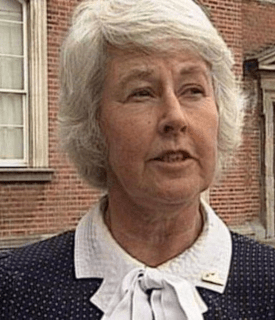
Mary Jennifer Guinness, English-born Irish socialite, member of the Guinness family and victim of a notorious 1986 kidnapping that lasts eight days, passes away peacefully at home on January 23, 2016, after a long battle with cancer. She is surrounded by her family, son Ian and daughters Gillian and Tania and long-term partner Alex Booth.
Guinness is born in England on August 22, 1937. On April 9, 1959, she marries merchant bankerJohn Henry Guinness, a member of the Guinness brewing dynasty and chairman of Guinness Mahon. She is predeceased by her husband, who dies two years after the kidnapping in 1988.
“She had been sick for a long time. We will remember her as a most loving mother,” her son Ian says.
Guinness had been an enthusiastic sailor and member of Howth Yacht Club. “It is with great sadness that the Commodore and Officers of Howth Yacht Club have to inform members of the passing of esteemed member Jennifer Guinness,” a posting on the club website says.
Guinness, at the age of 48, makes headlines around the world after she is abducted from her luxury home in Howth, Dublin on April 8, 1986, by three masked gunmen armed with an Uzisubmachine gun. They pistol-whip her husband and demand a £2.m ransom from him.
She is held for eight days in five various locations and is forced into the boot of a car and a cardboard box during her ordeal. She is also chained to a tree and a bed and at one point, even handcuffed to one of her captors. She is eventually rescued by Garda Síochána from a house on Waterloo Road in Ballsbridge following an all-night standoff with the kidnappers.
It does not take long for her kidnappers to be brought to justice. The following June, John “The Colonel” Cunningham is sentenced to seventeen years in prison, alongside his brother Michael Cunningham, who gets fourteen years. The notorious brothers, who have strong links with the gang led by Martin “The General” Cahill, are behind a string of armed robberies in the 1970s.
Michael Cunningham, who is released from prison in 1995, dies of a heart attack in January 2016. His brother escapes from the Shelton Abbey Prison in 1995 but is tracked down in Holland in 2000 where he serves four years in prison on drug charges before being extradited to Ireland in 2004 to serve out the rest of his sentence. He is released in 2007 and moves to Spain.
After her kidnap ordeal, Guinness says that she never gave in to despair during her eight-day ordeal. “I had no doubt at all, most of the time, that my life was in danger,” she says during a news conference, “but I couldn’t afford to allow myself to lose hope.”
When asked what kept her going during her captivity, Guinness says, “A certain amount of anger, a lot of determination and just a conviction that they weren’t going to get to me.” She draws laughter from reporters when she says, “I kept saying, ‘You’ve got the wrong branch of the family. John’s a banker, but two million is not our style of life.'”
Investigating Gardai praise her courage. Superintendent Frank Hanlon says she was “a considerable asset toward the ending of this incident through her advice to all parties.”
(From: “Jennifer Guinness – victim of a notorious 1986 kidnapping that lasted eight days – has died” by Jerome Reilly, Irish Independent, http://www.independent.ie, January 23, 2016)
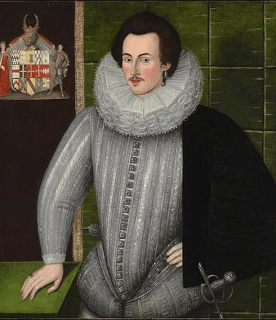
Blount is born in 1563, the second son of James, 6th Baron Mountjoy, and Catherine, only daughter of Sir Thomas Legh. He is among the most distinguished of the family, succeeding as 8th Baron Mountjoy on the death in 1594 of his unmarried elder brother William, 7th Baron Mountjoy. The good fortune of his youthful and handsome looks find favour with Queen Elizabeth I which arouses the jealousy of Robert Devereux, 2nd Earl of Essex, leading to a duel between the two courtiers, who later become close friends.
The downfall of Lord Essex does not damage Blount’s career. After the failure of his rebellion, Essex shocks many by denouncing his sister Penelope, who is Blount’s mistress, as a traitor, which inevitably raises the question of his own possible involvement. But the Crown, anxious to retain Blount’s services, and also to show as much leniency as possible to the defeated rebels, simply ignore the accusation.
On February 24, 1600, Blount lands in Ireland as Lord Deputy following Lord Essex and in the ensuing years brings the Nine Years’ War to an end. The leader of the rebellion, Hugh O’Neill, Earl of Tyrone, writes about Blount’s “refined manners” that he would lose a whole season of campaigning “while waiting until breakfast is prepared to his mind!” Despite this, Blount proves that he is quite qualified to pursue the war.
In early 1600, Blount dispatches Sir Henry Docwra with an army of 4,200 troops to land at Culmore to erect a fortress commanding the shores of Lough Foyle in the northwest of Ulster. To prevent Hugh O’Neill from sending a strong force to repulse Dowcra’s forces, Blount advances in force from Dublin to Newry causing O’Neill to fear a southern advance into Tyrone.
Blount aims to avoid the mistakes of previous Lords-Deputy. After the Battle of Moyry Pass, he has it cleared, and a garrison is established there. It had long been a problem for English forces advancing into Ulster from the south. He also establishes posts with garrisons at Mountnorris and Armagh.
On July 13, 1601, Blount and his army along with Turlough McHenry O’Neill of the Fews who had recently switched to the English side in the war, have a stand-off with Hugh O’Neill’s forces at the River Blackwater. After a few shots in vain from either side, O’Neill’s forces withdraw, and Blount sends his forces to occupy the ruined Blackwater fort destroyed by O’Neill in 1595. Later O’Neill’s forces attack Blount’s camp before withdrawing. In response, the Lord-Deputy sends his forces across the river where they find strong artificially fortified fords, which would have held out against the English.
By July 15, 1601, the Lord-Deputy has secured the surrender of O’Neill’s ally Hugh Magennis. That month, he has a new fort near the old Blackwater fort erected.
Blount reports to the council in England that O’Neill is determined to prevent his forces from advancing into Tyrone and toward Dungannon. As such, he initiates a policy of burning large quantities of corn to induce a famine to drive the rebels out of their strongholds.
Blount sets about trying to entice Hugh’s forces to come out and attack by fetching some materials for the new fort from the Tyrone side of the river as well as burning more corn. Further skirmishes between Blount and O’Neill’s forces ensue during the summer of 1601.
Spanish forces land in Munster in August 1601, forcing Blount to send his forces southward leaving O’Neill remaining in his unbroken heartland of Tyrone. The Spanish arrival culminates in the Siege of Kinsale that December, which sees a major defeat of the rebels and their allies.
O’Neill during this time has also moved south to assist some of his allies, however, after some serious defeats at the hands of the forces of Richard Burke, 4th Earl of Clanricarde of Connacht, he is in no place to offer any effective resistance once Blount marches once more to Tyrone in the summer of 1602.
Blount advances to the location he found the previous summer at the River Blackwater, which commands safe and secure passage into Tyrone, previously inaccessible, and sets about erecting a new fort. Having observed this, O’Neill burns his capital at Dungannon and flees to his last refuge in Glenconkeyne.
Advancing northward through Tyrone, Blount erects a fort in the townland of Magheralamfield, afterward known as Mountjoy Castle. He also christens the new fort at the Blackwater Charlemont Fort after himself.
Once in Tyrone, Blount carries out a campaign of devastation throughout it resulting in the mass hunting of rebels, spoiling of corn, the burning of houses and the killing of churls so as to force the submission of O’Neill and his remaining allies. Most symbolically, Blount has the inauguration site of the O’Neill’s at Tullyhogue Fort destroyed.
On March 30, 1603, six days after the death of Elizabeth and the accession of James I, O’Neill makes peace with Blount, signing the Treaty of Mellifont. Blount continues in office with the more distinguished title of Lord-Lieutenant. He declares amnesty for the rebels and grants them honourable terms, which causes some severe criticism from England. He shows similar moderation in putting down the abortive risings in Cork, Waterford and Wexford, where the aldermen, apparently with some vague idea of gaining greater toleration for Roman Catholics, refuse to proclaim the new King. In Cork, three insurgents are hanged after a summary trial, but the rest are acquitted or pardoned.
As part of the Plantation of Ulster, the majority of the barony of Loughinsholin is detached from County Tyrone and made part of the newly created County Londonderry. The rest of Loughinsholin along with the northern parts of Dungannon barony are merged to create the short-lived barony of Mountjoy. It is later amalgamated with the barony of Dungannon.
On his return to England, Blount serves as one of Sir Walter Raleigh’s judges in 1603, and in the same year King James I appoints him Master-General of the Ordnance as well as creating him Earl of Devonshire, granting him extensive estates. He is one of the founder members of the Spanish Company re-founded by royal charter in 1605.
Toward the end of Blount’s life, on December 26, 1605, at Wanstead House near London, in a ceremony conducted by his chaplain William Laud, afterward Archbishop of Canterbury, he marries his long-time mistress Lady Penelope, formerly wife of Robert Rich, 3rd Baron Rich (later 1st Earl of Warwick) and sister of Robert Devereux, 2nd Earl of Essex.
Blount leaves no legitimate children, and so his hereditary titles become extinct at his death on April 3, 1606, at Savoy House, London.
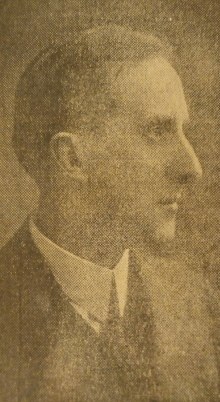
Blackham is born in London, England, on December 16, 1891. His father, William George Blackham, is an Ulster Protestant from Newry, while his mother is an Englishwoman named Evison Elizabeth Saunders. An uncle is Robert J. Blackham who is the Surgeon-General to the British Army in Ireland. The family are evangelical Protestants, against which he rebels. Having been brought up to take the Bible literally, he suffers a religious crisis upon the realisation his teachers at school do not. He finds the transition to adulthood difficult, particularly due to the early death of his father.
For a time, Blackham moves in socialist circles, under the influence of Ulster socialist Robert Wilson Lynd. However, upon the discovery that his father had been a Protestant who had been in favour of Irish home rule and also had some republican sympathies, he turns toward Irish nationalism.
Blackham becomes involved in the Gaelic League while in London. he Gaelicizes his name to Aodh Sandrach de Blácam or Hugh de Blácam, despite his non-Gaelic ethnic origin. He learns the Irish language from the essayist Robert Wilson Lynd. During this time, he seeks to synthesize his urge to reclaim his sense of Irish nationality with the works and thoughts of hardline Catholic author G. K. Chesterton. It is partially because of Chesterton’s influence that he converts to Catholicism, although the conversion of Protestant Irish Nationalists to Catholicism is common throughout the early 20th century. Another influence upon his decision to convert is his desire to marry Catholic Mary McCarville of County Monaghan.
In May 1914 de Blácam returns to Ireland and begins working as a freelance journalist. He joins the Enniscorthy Echo as a journalist in 1915.
During the Irish War of Independence de Blácam writes nationalist propaganda alongside Arthur Griffith and Herbert Moore Pim. He is interned by the British in 1919. During this time period he writes two political manifestoes: Towards the Republic; a study of new Ireland’s social and political aims (1918) and What Sinn Féin Stands For (1921). The two books argue that at their root, Catholic social teaching (CST) and Bolshevism are essentially identical and that Ireland, having only experienced feudalism and capitalism because of external forces, can skip many of the phrases normally described in the Marxist Trajectory of historical development and go straight to a soviet-type society, an idea not dissimilar to the two-stage theory. He imagines this soviet-type society to be an Irish-speaking decentralised rural cooperative commonwealth. Critics of Sinn Féin frequently cite his works as proof of the infeasibility of Sinn Féin’s aims.
De Blácam opposes the Anglo-Irish Treaty and subsequently aids the Anti-Treaty Irish Republican Army (IRA) during the Irish Civil War. For this he is interned by the newly created Irish Free State in 1922. Following his release, he continues to pin his flag to the mast of Éamon de Valera and his newly formed Fianna Fáil party. He believes De Valera fully embodies his own political ideas.
During the 1920s de Blácam joins The Irish Times, which he later leaves to become editor of The Catholic Standard. For seventeen years he writes a feature in the Fianna Fáil aligned The Irish Press called “Roddy the Rover.”
It was also during the 1920s that de Blácam moves to Dublin, where he begins to move in the same circles as George Bernard Shaw, George Russell, and W. B. Yeats. He hopes all three men might one day convert to Catholicism as he did and is sorely disappointed when each do not. Upon the death of Yeats, he goes so far as to refer to Yeats’ poem as “Demonic.” He has similar hopes for Peadar O’Donnell but is similarly disappointed in his lack of interest in conversion.
In 1938 de Blácam publishes The Black North, a book which carries an introduction by de Valera. In the book he argues that Ulster Protestants are in actuality both Irish and Catholic, but they simply do not realise it. Among his arguments to support this idea are the suggestions that the presbyterian emphasis on self-government is derived from the Gaelic clan tradition, that presbyterian “kailyard” writers of rural nostalgia such as Lydia Mary Foster exemplify the naturally Irish piety and purity of her co-religionists, and that the fact that some workers commute from the Armagh borderland to work in Dundalk factories prove that the south is better off economically than the north.
It is suggested de Blácam is an influence upon de Valera’s 1943 broadcast “The Ireland That We Dreamed Of.” Politically he is highly considered about rural depopulation and is involved in a number of organisations seeking to end it. He advocates more economic autarky and cultural protectionism to combat rural depopulation and lamented urbanisation and industrialisation. He also tries to convince the Fianna Fáil executive that they should ban women from emigration as well as ban women from factories in order to force women to remain in rural Ireland. His ideas fail to impress the executive, with Seán MacEntee in particular standing in strong disagreement.
De Blácam is a member of the Fianna Fáil executive until 1947, when he defects to the upstart Irish Republican party Clann na Poblachta. For this move he is immediately fired from The Irish Press. He stands for Clann na Poblachta in the Louth constituency at the 1948 Irish general election but is not elected.
During the brief period in which Clann na Poblachta is in government, de Blácam serves as an official spokesman for the Department of Health and as a speechwriter to Noël Browne, the embattled Minister for Health.
De Blácam dies while working in the Custom House on January 16, 1951. His funeral is attended by many dignitaries including TaoiseachJohn A. Costello and former Taoiseach Éamon de Valera. He is buried in New Mellifont Abbey, County Louth.
The youngest daughter of Captain Henry Butler, a grandson of the Edmund Butler, 11th Viscount Mountgarret, and Clara Butler (née Taylor) of the Newarke, Leicester, England. Her father is himself an enthusiastic painter, known for his publication South African sketches: illustrative of the wildlife of a hunter on the frontier of Cape Colony (1841). Her early artistic efforts are mainly copies of romantic subjects, but the influence of the London artist Paul Jacob Naftel, with whom she begins corresponding in the early 1880s, proves to be crucial to her artistic development. Studies with William Frank Calderon, an expert in animal painting, are also significant. She subsequently spends the summers of 1894 and 1895 in Newlyn, Cornwall, England, with the Irish artist Norman Garstin, who introduces her to contemporary French painting.
In 1885, Butler makes her first visit to the continent, traveling through France, Switzerland, and Italy. From 1905 to 1914 she travels regularly to Europe, most particularly Aix-les-Bains and Wiesbaden, during which time she produces genre views of French and German villages. After 1914 her life at the family home is interrupted only by visits to London exhibitions. She is best known for her paintings of Kilmurry and its environs, many of which display an interest in botany. Much of her work is dominated by detailed representations of animals and birds, often drawn from photographs and stuffed specimens.
Butler’s career as an exhibitor begins in 1882 with the Irish Fine Arts Society, later known as the Water Colour Society of Ireland (WCSI), with which she has a long association. She exhibits regularly with the society from 1892 onward and is a member of its committee for many years. She is also closely associated with the Dudley Museum and Art Gallery in London. Her work is first shown there in 1888, and on this evidence, she is elected to their society. The purchase by the Chantrey bequest for the Tate Gallery of The Morning Bath for £50 in 1896 is a high point in her career. The first painting by a woman to be selected by the council, its purchase is followed by almost consistently good press reviews for her work. The Athenaeum of May 5, 1897, writes: “The young lady knows how to look at her subjects with the eyes of a well-trained artist.”
Butler also comes to the attention of the American artistic press. She contributes to the portfolio of drawings given by the Society of Lady Artists to Princess May on her marriage to the Duke of York in 1893, while in 1922 her work is included in the portfolio presented to Princess Mary on her marriage. Her patrons include Queen Alexandra, and the grand duke of Hesse, who purchases two of her paintings after she is invited to exhibit in Hesse Darmstadt in 1911. In 1914 she is made a member of the Union Internationale des Beaux Arts, and in 1921 her paintings are shown in Japan. She regularly exhibits with the Belfast Ramblers, the Royal Ulster Academy, the Royal Academy of Arts (RA), the Royal Hibernian Academy (RHA), the Society of Lady Artists, and the Royal Watercolour Society, of which she is made an associate member in 1896, and a full member in 1937.
In her later years, severe rheumatism prevents Butler from painting. She has a keen interest in music. She survives all five of her siblings, and inherits Kilmurry, where she dies on October 11, 1941. She is buried at Thomastown, County Kilkenny. Her paintings are represented in the collections of the National Gallery of Ireland, Dublin City Gallery the Hugh Lane, the Ulster Museum, and the Tate, London.
(From: “Butler, Mildred Anne” by Frances Clarke, Dictionary of Irish Biography, http://www.dib.ie, October 2009)
Pery is the son of William Cecil Pery, 1st Baron Glentworth, and his first wife, Jane Walcott, daughter of John Minchin Walcott. He is educated at Trinity College Dublin (TCD). He marries Alice Mary Ormsby, the daughter of Henry Ormsby of County Mayo, by his wife Mary Hartstonge, in 1783, and they have at least eight children. Alice Mary is the heiress of her uncle, Sir Henry Hartstonge, 3rd Baronet, who leaves her substantial property in the south of Ireland.
Pery is elected to the Parliament of Ireland as the Member of Parliament for Limerick City in 1786 and holds the seat until 1794, when he inherits his father’s barony and takes his seat in the Irish House of Lords. As a politician, he is a vocal Unionist. He holds the office of Keeper of the Signet and Privy Seal of Ireland between 1795 and 1797. In 1797, he is invested as a Privy Counsellor. He subsequently holds the office of Clerk of the Crown and Hanaper of Ireland between 1797 and 1806. In 1800, he is created Viscount Limerick of the City of Limerick.
Pery’s eldest son and heir, Henry Hartstonge Pery, Viscount Glentworth, predeceases him on August 7, 1834, and thus Pery is succeeded in his titles by Henry’s eldest son, William Henry Tenison Pery. One of Pery’s daughters, Theodosia, marries the Whig politician and Chancellor of the Exchequer, Thomas Spring Rice, 1st Baron Monteagle of Brandon.
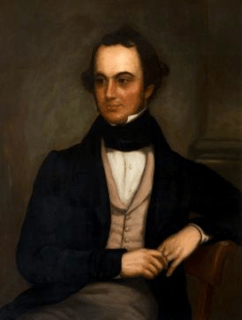
Following his local education, Lanyon becomes an apprentice civil engineer with Jacob Owen in Portsmouth. When Owen is made senior Engineer and Architect of the Irish Board of Works and moves to Dublin, Lanyon follows. In 1835 he marries Owen’s daughter, Elizabeth Helen. They have ten children, including Sir William Owen Lanyon, an army officer and future administrator of the Transvaal in southern Africa.
Lanyon is county surveyor in County Kildare briefly, a post he exchanges for its equivalent in County Antrim, based in Belfast, when the incumbent, Thomas Jackson Woodhouse, resigns in 1836. By 1842, he has built the Antrim coast road between Larne and Portrush, through spectacular natural surroundings. He designs the lofty three-arched Glendunviaduct on this route near Cushendun, an early example of his versatile talent for monumental display as well as the Ormeau Bridge over the River Lagan. He remains county surveyor of Antrim until 1861 when he resigns from the post to concentrate on private work and other interests.
Lanyon’s other business interests include being director of the Blackstaff Flax Spinning Company and chairman of several railway companies. He is made director of the Northern Counties Railway in 1870 but resigns in 1887 because of ill-health. Alongside his business activities he is an active Freemason and serves as Provincial Deputy Grand Master of Belfast and North Down between 1863 and 1868, Provincial Deputy Grand Master of Antrim between 1868 and 1883 and Provincial Grand Master of Antrim between 1883 and 1889.
Lanyon lives at The Abbey, a grand house in Whiteabbey, County Antrim, which eventually becomes a sanitorium during World War I and is now part of Whiteabbey Hospital. His wife dies in 1858, and his son William dies from cancer at the age of 44 in 1887. He dies at The Abbey on May 31, 1889, and is buried in Knockbreda Cemetery, Belfast, in a tomb also of his design.
Healy is one of twins, the third son born to Maurice, a Poor Law Union clerk, and Eliza (née Sullivan) Healy. His mother dies during the birth. It is said that the nurse places him in his brother Tim‘s arms and said, “This little boy has no mother now and you will have to be a mother to him.” As he grows up, he becomes very close to his elder brother. The orphaned children are effectively raised by their maternal grandmother, Jane Sullivan. The family moves to Lismore, County Waterford, where he is educated at the local Christian Brothers school. Both brothers marry Sullivans who are first cousins to their husbands and to each other.
Admitted as a solicitor in 1882, Healy practises as such and is returned to parliament four times, first as a member of the Irish Parliamentary Party for Cork City from 1885 to 1900, in which year standing as a Healyite nationalist he is defeated by William O’Brien in a bitter campaign. He is returned again for Cork City in May 1909 to January 1910.
Healy’s force in parliament is land law. He is a close confidant of his brother Tim and although more retiring and stolid than his better-known elder brother, he is considered the more intelligent and often acts as a counterbalance to his brother’s emotionality. On the outbreak of World War I in 1914 a son of each enlists in one of the Irish Divisions.
Maurice (junior) moves to England after the founding of the Irish Free State where he is both a successful lawyer and a broadcaster for the BBC during the early years of World War II. He writes the well-known legal memoir The Old Munster Circuit and the popular Stay Me with Flagons: A Book about Wine and Other Things.
Fay is born on August 30, 1870, at 10 Lower Dorset Street, Dublin, the eldest son of four children of William Patrick Fay, a government clerk, and his wife, Martha Fay (née Dowling). He is educated at Belvedere College, Dublin, where he learns shorthand and typing, before leaving to become a secretary for an accountancy firm in Dublin. From an early age he has a passion for the theatre and immerses himself in books on the subject, becoming a drama expert. His brother, William George Fay, shares his enthusiasm and they take part in many amateur productions, setting up the Ormonde Dramatic Company in 1891.
Fay is an ardent nationalist, and Arthur Griffith appoints him drama critic for his newspaper, the United Irishman (1899–1902), where he develops his ideas on how the theatre should be run. Initially in favour of plays in the Irish language, he soon abandons this as unworkable. In May 1901 he attacks W. B. Yeats for his faulty notions about theatre and even his work as a dramatist, ending with the fiercely nationalistic assertion that “there is a herd of Saxon and other swine fattening on us. They must be swept into the sea with the pestilent breed of West Britons with which we are troubled, or they will sweep us there.” Yeats’s and Lady Gregory‘s next play is Cathleen ni Houlihan.
In 1902, Fay writes a famous article advocating a national theatre company that will “be the nursery of an Irish dramatic literature which, while making a world-wide appeal, would see life through Irish eyes.” He is a member of his brother’s National Dramatic Society, which merges with the Irish Literary Theatre in 1902 to form the Irish National Theatre Society, the originating body of the Abbey Theatre. The following year Yeats declares that the national theatre owes its existence to the two Fay brothers. Fay soon abandons Griffith and begins to champion the cause of Yeats.
An excellent tragic actor, Fay can make audiences forget his less than five feet six-inch stature through the power of his voice. When the Abbey Theatre opens on December 27, 1904, he stars in Yeats’s On Baile’s Strand as Cú Chulainn, a role he makes his own. He spends much time training the other actors. As an elocution teacher he has no equal. One play has Yeats leaving with his “head on fire” because of the quality of the voices on stage. Yeats dedicates his play The King’s Threshold (1904) with the words: “In memory of Frank Fay and his beautiful speaking in the character of Seanchan.”
Fay has a close but turbulent relationship with his brother William, whom he defers to in all theatrical matters except acting. Their heated arguments sometimes lead to blows. His temper is always volatile, and he is prone to histrionics and fits of depression. After 1905, the Abbey Theatre becomes a limited company owing to the patronage of Annie Horniman, and the Fays lose most of their control, which results in much tension and bitterness. In 1907, Fay plays Shawn Keogh in the first production of The Playboy of the Western World by John Millington Synge.
Disagreements with Yeats over the approach to choosing and staging of plays comes to a head late in late 1907 and the Fays resign on January 13, 1908. On March 13 they are suspended from the Irish National Theatre Society. They tour the United States with Charles Frohman before separating. Fay then tours England in minor Shakespearean roles and melodrama. Between 1912 and 1914, Thomas MacDonagh and Joseph Mary Plunkett attempt to persuade him to become actor-manager of an Irish theatre. In 1918 he returns to the Abbey Theatre in two short-lived revivals of Yeats’s The Hour Glass and The King’s Threshold. He retires to Dublin permanently in 1921, teaching elocution and directing plays in local colleges.
Fay marries, in 1912, Freda, known as “Bird.” They live at Upper Mount Street, Dublin, and have one son, Gerard, who becomes a popular writer and memoirist. Fay dies on January 2, 1931, having never really recovered from the death of his wife, and is buried at Glasnevin Cemetery. He is credited with creating the Abbey Theatre style of acting, which becomes internationally known, and influences many other schools of acting. He wanted actors to behave as naturally as possible and to speak the lines as people would in real life, rather than with an exaggerated stage delivery. His training is a major influence on subsequent generations, as actors learned to “speak words with quiet force, like feathers borne on puffs of wind.”
(From: “Fay, Frank J. (Francis John)” by Patrick M. Geoghegan, Dictionary of Irish Biography, http://www.dib.ie, October 2009) | Pictured: Portrait of Frank Fay by John Butler Yeats, commissioned by Annie Horniman for the opening of the Abbey Theatre, December 27, 1904)
Moving to Dublin by September 1916, MacDonagh is headmaster for a time of Patrick Pearse‘s St. Enda’s School, the bilingual school where his brother Thomas had formerly served on the staff under Pearse, which had reopened after the rising in Cullenswood House, Oakley Road, Rathmines. By 1918 he is in private practice as an income tax recovery expert. He later quips that by recovering thousands of pounds annually for clients, he has done greater harm to the British government than any other Irishman. He is also partner by 1919 in an insurance brokerage with fellow Sinn FéinTDWilliam Cosgrave. Following Cosgrave’s departure, the firm trades from 1920 as MacDonagh & Boland, with offices first on Dame Street, and latterly on College Green.
MacDonagh’s prominence in the post-1916 reorganisation of Sinn Féin commences at the April 19, 1917, convention of advanced nationalists summoned by George Noble Plunkett after his parliamentary by-election victory. MacDonagh makes a resounding speech ratifying Plunkett’s determination not only to abstain from attendance at Westminster, but also to affirm the principles of the republican Easter Week proclamation rather than the dual-monarchy programme of Sinn Féin under Arthur Griffith. After campaigning vigorously on behalf of the successful by-election candidacy of Éamon de Valera in East Clare, he is arrested on August 30 and sentenced to six-months’ imprisonment for making a seditious speech. He joins in the hunger strike of republican prisoners seeking prisoner-of-war status in Mountjoy Gaol, on which Thomas Ashe dies on September 25 after enduring forcible feeding. Released with the other surviving strikers, he is a principal witness at the emotional inquest into the circumstances of Ashe’s death.
Elected to the Sinn Féin executive at the October 1917 ardfheis, at which the party adopts a republican constitution, MacDonagh is alternately rearrested and released on several occasions under the “cat-and-mouse act,” enduring further hunger strikes in both Belfast and Dundalk jails, before serving out in its entirety the original six-month sentence (1917–18). After deportation to England and while incarcerated in Reading Gaol, he is returned unopposed in the 1918 United Kingdom general election in Ireland as Sinn Féin candidate in North Tipperary and is released in time to attend the second session of the first Dáil Éireann on April 10, 1919. With the Dáil driven underground in September 1919 after its proscription, he protests against the infrequency of sessions, querying whether “private members [were] to abstain from Dublin as well as Westminster.”
Elected in January 1920 to both Dublin Corporation and Rathmines town council, MacDonagh concentrates his political energies on local government until appointment in January 1921 as acting Dáil Minister for Labour, and director of the Belfast boycott. Exercising effective authority over the labour department because of the imprisonment of the minister, Constance Markievicz, he seeks to define a comprehensive industrial and economic strategy and establishes a labour commission to formulate proposals. The resultant radical plan for supplanting capitalist ownership by developing cooperative and distributive industrial structures is ignored by his cabinet colleagues. His organisation and enforcement of the Belfast boycott – a response to the anti-Catholic rioting of July 1920, and expulsion of workers from jobs and families from homes – is relentless and efficient. He appoints a team of boycott organisers and local boycott committees empowered to impose fines and to seize goods, and blacklists firms that are facilitating circumvention of the boycott by trans-shipment of Belfast goods through non-boycotted northern towns or through British ports.
Throughout the Irish War of Independence MacDonagh is constantly on the run, usually under disguise as a priest, and is imprisoned for a time in Mountjoy Gaol in 1920. One of four Sinn Féin candidates returned unopposed to the Second Dáil for Tipperary Mid, North, and South, after a cabinet reorganisation in August 1921 following the truce, he remains as boycott director but is removed from the Labour Department. Bitterly opposed to the Anglo–Irish Treaty, in the Dáil debates he responds to Griffith’s assertion that the agreement is indeed a treaty concluded between two sovereign nations by asking why the pro-Treatyites are conducting the sovereign Irish nation into the British empire, and whether they are doing so “with their heads up or their hands up.”
Manager of the anti-Treaty bulletin Poblacht na hÉireann, in the 1922 Irish general election MacDonagh is returned on the first count to the third seat in his constituency. Arrested soon after the outbreak of the Irish Civil War, he escapes from Portobello military barracks. Rearrested on September 30 and imprisoned in Mountjoy Gaol, he falls seriously ill with acute appendicitis but refuses to sign the required form to secure release for medical treatment because it implicitly recognises the legitimacy of the Free State government. Transferred at length to the Mater Misericordiae private nursing home, he undergoes an operation, but two days later, having developed peritonitis, he dies on December 25, 1922. He is buried in Glasnevin Cemetery.
A small, supple man with alert blue eyes, MacDonagh wielded a swift and stinging tongue in debate. It is said that he indulged his caustic wit more for the delight in the bon mot than for the bitterness of the invective. Genial in company, with a store of amusing anecdote, he was celebrated for hearty humour even in the face of hardship and danger. On a prison sickbed days before his death, he referred to another inmate, bald-headed like himself, “who wears his hair like mine.” In 1913, he married Margaret O’Toole of Dublin. They had one daughter and two sons. They resided in Rathmines, first at 86 Moyne Road, before moving during 1922 to 9 Palmerston Road.
(From: “MacDonagh, Joseph” by Lawrence William White, Dictionary of Irish Biography, http://www.dib.ie, October 2009)
On a cold December day in 1919, a group of young IRA volunteers wait at a public house near the Ashtown gate of Dublin’s Phoenix Park. Some are from Dublin, members of Michael Collins’ recently created assassination unit, the Squad. Others are from farther afield, like Dan Breen and Seán Treacy from County Tipperary and Martin Savage from County Sligo.
They are waiting for Sir John French, Lord Lieutenant of Ireland, the most senior British official in the land. He is returning from a visit to the west of Ireland and has alighted at Ashtown train station before returning by car to his official residence, the Viceregal Lodge, in the Phoenix Park.
The IRA men have a signaler in a tree and when French’s car approaches, they attempt to block the road with a farm cart. However, they are too late to block the Lord Lieutenant’s car which sweeps through the impromptu barricade. Shots are fired and one policeman is wounded but French himself emerges unscathed.
A second car, which the IRA believes to contain French, bears the brunt of the volunteers’ revolver fire and grenades. Though the car is badly damaged, there are no casualties.
The third car in the convoy contains French’s military escort and the soldiers inside the vehicle return fire, killing one of the attackers, Martin Savage. Some of the volunteers attempt to recover his body but the Crown forces’ fire is too heavy. Savage’s body is left on the scene as the IRA party flees on bicycles back to the city.
The Irish Times, for one, expresses outrage at the attack, “the attempted assassination of the greatest of Irishmen” which it says will “shock Ireland” and force Sinn Féin, victorious in the election of the previous year, to reflect on whether it wants to be associated with “outrage and assassination.” “There will now be many throughout the world ready to attribute the character of a murder society to the whole new Irish movement.”
Many in Ireland are even less sympathetic to hear of the escape of the Lord Lieutenant. The Irish Catholicbishops issue a statement the next day condemning not the attack but British rule in Ireland, which they characterise as “rule of the sword, utterly unsuited to a civilised nation.”
The attack is, in hindsight, a turning point, moving the standoff over Irish independence toward all out guerrilla warfare, but also, in a way, symbolising the eclipse of French and of his vision for what the country should be.
Sir John French’s health declines in 1920 and though he holds the position of Lord Lieutenant until April 1921, his central role in Irish affairs is eclipsed by new Chief Secretary for Ireland Sir Hamar Greenwood. He wants to retire to his estates in Ireland in 1922 but is told it is simply too dangerous for him. During the Irish Civil War (1922-23), his country house at Drumdoe, County Roscommon, is raided by armed men who carry off much of the furniture.
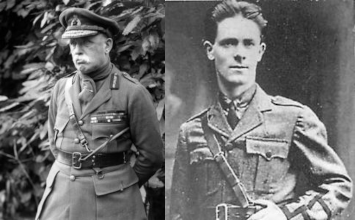
(From: “Today in Irish History: 19 December 1919, The Attempted Assassination of Sir John French” by John Dorney, The Irish Story, http://www.theirishstory.com, December 18,2019 | Pictured: L to R, Sir John French and Martin Savage)





 seamus dubhghaill