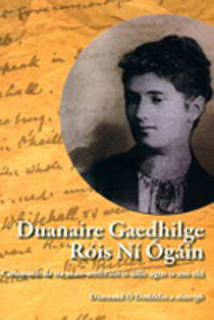
Young is born in Galgorm Castle, Ballymena, County Antrim, daughter and seventh of twelve children born to Grace Charlotte Savage, and John Young who is a prosperous unionist and high sheriff. Despite his position he is a believer in tenant rights. Her younger sister is the writer Ella Young and her brother Willie Young is secretary of the Ulster Unionist League.
Young is educated by governesses until 1884 before completing training as a teacher through Cambridge University. Young also attends Gaelic League classes in 1903 in London while visiting her sister who is living in the city at the time. After visiting the Bodleian Library she becomes committed to the study of the Irish language.
In the early 1900s Young returns to Ireland and continues her study of the Irish language in Belfast at Seán Ó Catháin‘s Irish College and in County Donegal at Coláiste Uladh in Gort an Choirce. Young also stays in Dublin and becomes friends with members of the Gaelic League and meets Margaret Dobbs. Young works with Dobbs on the Feis na nGleann (The Glens Festival), a gathering dedicated to the Irish language.
Young is not involved in nationalism though she is strongly supportive of creating and maintaining a sense of “Irishness” through language and culture. She is also a friend and patron of Roger Casement. She also works with Ellen O’Brien and contributes to O’Brien’s book, The Gaelic Church. She keeps meticulous diaries and becomes interested in Rathlin Island and the Gaelic spoken there.
Rose Young is buried in the Presbyterian churchyard at Ahoghill, County Antrim.
The Royal University of Ireland is founded by Royal Charter on April 27, 1880, in accordance with the University Education (Ireland) Act 1879 as an examining and degree-awarding university based on the model of the University of London. The first chancellor is the Irish chemist, Robert Kane.
The university becomes the first university in Ireland that can grant degrees to women on a par with those granted to men, granting its first degree to a woman on October 22, 1882. In 1888 Letitia Alice Walkington has the distinction of becoming the first woman in Great Britain or Ireland to receive a degree of Bachelor of Laws. Among the honorary degree recipients of the university is Douglas Hyde, founder of the Gaelic League and later President of Ireland, who is awarded a DLitt in 1906.
The Royal University of Ireland is the successor to the Queen’s University of Ireland, dissolved in 1882, and the graduates, professors, students and colleges of that predecessor are transferred to the new university. In addition to the Queen’s Colleges, Magee College, University College Dublin, Cecillia St. Medical School, St. Patrick’s College, Maynooth and Blackrock College present students for examinations as well, and no special status is accorded to the colleges of the former Queen’s University. After the 1880 reforms Catholic Colleges such as St. Patrick’s, Carlow College, Holy Cross College and Blackrock College come under the Catholic University, and with a number of other seminaries present students for examination by the RUI.
External students not of approved colleges can sit examinations of the Royal University although they are seen as being at a disadvantage to those of designated colleges whose professors are part of the university. In fact, many schools, including convent schools prepare students for the examinations of the Royal University.
Like the Queen’s University, the Royal University is entitled to grant any degree, similar to that of any other university in the United Kingdom of Great Britain and Ireland, except in theology. The colleges themselves award degrees in theology and divinity.
The professorships and Senate of the Royal University are shared equally between Roman Catholics and Protestants. However, colleges of the university maintain full independence except in the awarding of degrees, and the compilation and enforcement of academic regulations and standards.
O’Rahilly is educated in Clongowes Wood College. As an adult, he becomes a republican and a language enthusiast. He joins the Gaelic League and becomes a member of An Coiste Gnotha, its governing body. He is well travelled, spending at least a decade in the United States and in Europe before settling in Dublin.
O’Rahilly is a founding member of the Irish Volunteers in 1913, which is organized to work for Irish independence and resist the proposed Home Rule. He serves as the IV Director of Arms. He personally directs the first major arming of the Irish Volunteers, the landing of 900 Mausers at the Howth gun-running on July 26, 1914.
O’Rahilly is not party to the plans for the Easter Rising, nor is he a member of the Irish Republican Brotherhood (IRB), but he is one of the main people who train the Irish Volunteers for the coming fight. The planners of the Rising go to great lengths to prevent those leaders of the Volunteers who are opposed to unprovoked, unilateral action from learning that a rising is imminent, including its Chief-of-Staff Eoin MacNeill, Bulmer Hobson, and O’Rahilly. When Hobson discovers that an insurrection is planned, he is kidnapped by the Military Council leadership.
Learning this, O’Rahilly goes to Patrick Pearse‘s school, Scoil Éanna, on Good Friday. He barges into Pearse’s study, brandishing his revolver as he announces, “Whoever kidnaps me will have to be a quicker shot!” Pearse calms O’Rahilly, assuring him that Hobson is unharmed, and will be released after the rising begins.
O’Rahilly takes instructions from MacNeill and spends the night driving throughout the country, informing Volunteer leaders in Cork, Kerry, Tipperary, and Limerick that they are not to mobilise their forces for planned manoeuvres on Sunday.
O’Rahilly fights with the General Post Office (GPO) garrison during Easter Week. On Friday, April 28, with the GPO on fire, O’Rahilly volunteers to lead a party of men along a route to Williams and Woods, a factory on Great Britain Street, now Parnell Street. A British machine-gun at the intersection of Great Britain and Moore streets cuts him and several of the others down. Wounded and bleeding badly, O’Rahilly slumps into a doorway on Moore Street, but hearing the English marking his position, makes a dash across the road to find shelter in Sackville Lane, now O’Rahilly Parade. He is wounded diagonally from shoulder to hip by sustained fire from the machine-gunner.
The specific timing of O’Rahilly’s death is very difficult to pin down but understanding can be gained from his final thoughts. Despite his obvious pain, he takes the time to write a message to his wife on the back of a letter he received from his son in the GPO. It is this last message to Nancy that artist Shane Cullen etches into his limestone and bronze sculpture. The text reads:
Written after I was shot. Darling Nancy I was shot leading a rush up Moore Street and took refuge in a doorway. While I was there, I heard the men pointing out where I was and made a bolt for the laneway I am in now. I got more [than] one bullet, I think. Tons and tons of love dearie to you and the boys and to Nell and Anna. It was a good fight anyhow. Please deliver this to Nannie O’ Rahilly, 40 Herbert Park, Dublin. Goodbye Darling.
Mary MacSwiney, Irish politician and educationalist, is born in London on March 27, 1872, to an Irish father and English mother. In 1927, she becomes leader of Sinn Féin when Éamon de Valera resigns from the presidency of the party.
MacSwiney returns to Ireland with her family at the age of six and is educated at St. Angela’s School in Cork. At the age of twenty, she obtains a teaching post at a private school in England and studies for a Teaching Diploma at the University of Cambridge, which is normally reserved for men.
Influenced by her younger brother Terence MacSwiney‘s staunch Irish republicanism, MacSwiney joins the Gaelic League and Inghinidhe na hÉireann. She is a founder member of Cumann na mBan when it is formed in 1914 in Cork and becomes a National Vice-President of the organisation. She leads the denunciation of British rule at the Convention of November 1914. In 1916, she is arrested and imprisoned following the Easter Rising and is also dismissed from her teaching position due to her republican activities. Several months later, upon her release from prison, she and her sister Annie re-found Scoil Íte, a sister school to Patrick Pearse‘s St. Enda’s School, and she remains involved with the school for the rest of her life.
MacSwiney supports the Irish War of Independence in 1919–21. After the death of her brother Terence in October 1920 on hunger strike during the height of the war, she is elected for Sinn Féin to the Cork Borough constituency in 1921. She gives evidence in Washington, D.C., before the American Commission on Conditions in Ireland. For nine months she and Terence’s widow, Muriel, tour the United States lecturing and giving interviews.
MacSwiney is active in her friendship with Harry Boland and de Valera, whom she cultivates assiduously. In October 1921, a second delegation is to be sent to London which for the first time includes Michael Collins. MacSwiney, who remains implacably opposed, pleads with de Valera to be allowed to go. She is refused as de Valera thinks her to be “too extreme.” She strongly opposes the Anglo-Irish Treaty, debating during December 1921 to January 1922 to resume the war. On December 21 she speaks for three hours, criticising the agreement from all angles.
MacSwiney is arrested at Nell Ryan’s home, a safe house, at 40 Herbert Park, Ballsbridge, on November 4, 1922, when it is raided by Free State soldiers. She is interned at Mountjoy Gaol and immediately goes on hunger strike. Cumann na mBan organizes vigils outside the prison in protest of Mary’s and the others internment. The Women’s Prisoner’s Defence League is formed in August 1922 to protect their rights. During the hunger strike she refuses doctor’s visits and is resigned to her death. Her condition is critical, and she is given the Last Rites by a Catholic priest. The Government is not prepared to allow strikers die, so she is released.
En route to Liam Lynch‘s funeral, MacSwiney is again arrested when the car in which she is riding is stopped and she is recognised. She is taken with Kate O’Callaghan to Kilmainham Gaol. Fearless of death, she begins another protest. They continued to be interned without charge, but it is explained she is distributing anti-government propaganda. After nineteen days of hunger strike, she is due to be released on April 30, 1923. The Governor allows O’Callaghan to go but stays a decision on MacSwiney. Most of the women on hunger strike are sent to the North Dublin Union.
In March 1926 the party holds its Ardfheis. MacSwiney and Father Michael O’Flanagan lead the section from which Éamon de Valera and Fianna Fáil break away. De Valera has come to believe that abstentionism is not a workable tactic and now sees the need to become the elected government of the Dáil. The conference instructs a joint committee of representatives from the two sections to arrange a basis for co-operation. That day, it issues a statement declaring “the division within our ranks is a division of Republicans.” The next day, de Valera’s motion to accept the Free State Constitution, contingent upon the abolition of the Oath of Allegiance, narrowly fails by a vote of 223 to 218. However, de Valera takes the great majority of Sinn Féin support with him when he founds Fianna Fáil.
MacSwiney continues to maintain a republican position until her death. By then she is vice-president of Sinn Féin and Cumann na mBan but loses her seat at the June 1927 Irish general election. When lack of funds prevents Sinn Féin contesting the second election called that year, MacSwiney declares “no true Irish citizen can vote for any of the other parties.”
Mary MacSwiney dies at her home in Cork on March 8, 1942. Her stance, both before and after the Treaty, may be summed up by her statement, “A rebel is one who opposes lawfully constituted authority and that I have never done.”
Pádraic Ó Conaire, Irish writer and journalist whose production is primarily in the Irish language, is born in Galway on February 20, 1882. During his lifetime he writes 26 books, 473 stories, 237 essays, and 6 plays. His acclaimed novel Deoraíocht has been described by Angela Bourke as “the earliest example of modernist fiction in Irish.”
Ó Conaire’s father is a publican, who owns two premises in the town of Galway. His mother is Kate McDonagh. He is orphaned by the age of eleven. He spends a period living with his uncle in Garaffin, Ros Muc, Connemara. The area is in the Gaeltacht (Irish-speaking area) and Ó Conaire learns to speak Irish fluently.
He emigrates to London in 1899 where he gets a job with the Board of Education and becomes involved in the work of the Gaelic League. A pioneer in the Gaelic revival in the last century, Ó Conaire and Patrick Pearse are regarded as being the two most important Irish language short story writers during the first decades of the 20th century.
Ó Conaire is married to Molly Ní Mhanais, with whom he has four children: Eileen (born February 22, 1905), Patrick (born November 3, 1906), Kathleen (born February 24, 1909, and Mary Josephine (born July 28, 1911 but dies of diphtheria in 1922).
Ó Conaire returns to Ireland in 1914, leaving his family in London. Living mostly in Galway, he earns a meagre living through writing, teaching at Gaeltacht summer schools, and as an occasional organiser for the Gaelic League.
Ó Conaire dies at the age of 46 while on a visit to Dublin in 1928 after complaining of internal pains while at the head office of the Gaelic League. His fellow poet Frederick Robert Higgins writes a celebrated Lament for Pádraic Ó Conaire.
Pádraic Ó Conaire has family still living to this day in England as well as in Galway and Canada. The Ó Conaire surname is still strong in the Ros Muc area.
South is born in 1928 in Limerick where he is educated at Sexton Street Christian Brothers School, later working as a clerk in a local wood-importing company called McMahon’s. South is a member of a number of organisations including the Gaelic League, Legion of Mary, Clann na Poblachta, and Sinn Féin. In Limerick he founds the local branch of Maria Duce, a social Catholic organisation, where he also edits both An Gath and An Giolla. He receives military training as a lieutenant of the Irish army reserve, the LDF which later becomes the FCA (An Fórsa Cosanta Áitiúil or Local Defence Force), before he becomes a volunteer in the Irish Republican Army.
South is a devout Catholic, being a member of An Réalt, the Irish-speaking chapter of the Legion of Mary, and a conservative, even by the standards of the day. He is also a member of the Knights of Columbanus.
On New Year’s Day 1957, fourteen IRA volunteers cross the border into County Fermanagh to launch an attack on a joint RUC/B Specials barracks in Brookeborough. During the attack a number of volunteers are injured, two fatally. South and Fergal O’Hanlon die of their wounds as they are making their escape. They are carried into an old sandstone barn by their comrades which is later demolished by a British army jeep. Stone from the barn is used to build a memorial at the site.
The attack on the barracks inspires two popular rebel songs: “Seán South of Garryowen” and “The Patriot Game.” “Seán South of Garryowen,” is written by Sean Costelloe from County Limerick to the tune of another republican ballad “Roddy McCorley” and is made famous by The Wolfe Tones. The popularity of this song leads to the misconception that South is from Garryowen, a suburb in Limerick city. In fact, South is actually from 47 Henry Street in Limerick.
South is also mentioned in The Rubberbandits song “Up Da Ra”, which pokes fun at the concept of armchair republicanism using the literary device of the unreliable narrator.
There is a plaque dedicated to Seán South outside his birthplace on Henry Street, Limerick.
Joseph Mary Plunkett, Irish nationalist, poet, journalist, and a leader of the 1916 Easter Rising, is born at 26 Upper Fitzwilliam Street in Dublin on November 21, 1887.
Both his parents come from wealthy backgrounds, and his father, George Noble Plunkett, has been made a papal count. Despite being born into a life of privilege, young Joe Plunkett does not have an easy childhood.
Plunkett contracts tuberculosis at a young age. This is to be a lifelong burden. His mother is unwilling to believe his health is as bad as it is. He spends part of his youth in the warmer climates of the Mediterranean and North Africa. He spends time in Algiers where he studies Arabic literature and language and composes poetry in Arabic. He is educated at the Catholic University School and by the Jesuits at Belvedere College in Dublin and later at Stonyhurst College, in Lancashire, England, where he acquires some military knowledge from the Officers’ Training Corps. Throughout his life, Plunkett takes an active interest in Irish heritage and the Irish language and also studies Esperanto. He is one of the founders of the Irish Esperanto League. He joins the Gaelic League and begins studying with Thomas MacDonagh, with whom he forms a lifelong friendship. The two are both poets with an interest in theatre, and both are early members of the Irish Volunteers, joining their provisional committee. Plunkett’s interest in Irish nationalism spreads throughout his family, notably to his younger brothers George and John, as well as his father, who allows his property in Kimmage, south Dublin, to be used as a training camp for young men who wish to escape conscription in Britain during the First World War. Men there are instead trained to fight for Ireland.
Sometime in 1915 Plunkett joins the Irish Republican Brotherhood (IRB) and soon after is sent to Germany to meet with Roger Casement, who is negotiating with the German government on behalf of Ireland. Casement’s role as emissary is self-appointed, and, as he is not a member of the IRB, the organisation’s leadership wishes to have one of their own contact Germany to negotiate German aid for an uprising the following year. Plunkett is seeking, but not limiting himself to, a shipment of arms. Casement, on the other hand, spends most of his energies recruiting Irish prisoners of war in Germany to form a brigade to fight instead for Ireland. Some nationalists in Ireland see this as a fruitless endeavour, and prefer to seek weapons. Plunkett successfully gets a promise of a German arms shipment to coincide with the rising.
Plunkett is one of the original members of the IRB Military Committee that is responsible for planning the Easter Rising, and it is largely his plan that is followed. Shortly before the rising is to begin, Plunkett is hospitalised following a turn for the worse in his health. He has an operation on his neck glands days before Easter and has to struggle out of bed to take part in what is to follow. Still bandaged, he takes his place in the General Post Office with several other of the rising’s leaders, including Patrick Pearse and Tom Clarke, though his health prevents him from being terribly active. His energetic aide-de-camp is Michael Collins.
Following the surrender Plunkett is held in Kilmainham Gaol, and faces a court-martial. Seven hours before his execution by firing squad at the age of 28, he is married in the prison chapel to his sweetheart Grace Gifford, a Protestant convert to Catholicism, whose sister, Muriel, had years before also converted and married his best friend Thomas MacDonagh, who is also executed for his role in the Easter Rising. Plunkett is executed by firing squad on May 4, 1916, and is the fourth and youngest signatory of the Proclamation of the Irish Republic to be executed.
The main railway station in Waterford City is named after Plunkett as is Joseph Plunkett Tower in Ballymun. Plunkett barracks in the Curragh Camp, County Kildare is also named after him.
Dobbs’ father, Conway Edward Dobbs, is Justice of the Peace for County Antrim, High Sheriff for Carrickfergus in 1875, and High Sheriff for County Louth in 1882. The family spends time living in Dublin which is where Dobbs is born. She attempts to learn Irish. However, when her father dies in 1898 her mother, Sarah Mulholland, daughter of St. Clair Kelvin Mulholland Eglantine, moves the family back to Glenariff.
Dobbs’ interest in learning Irish continues and she finds it easier to learn in Donegal where the language is still spoken. Her first teacher is Hugh Flaitile. She attends the Irish College at Cloughaneely in the Donegal Gaeltacht. She brings the idea of promoting the language to the Glens of Antrim and her circle of friends. Dobbs is one of the small numbers of Protestant women interested in the Gaelic revival.
The “Great Feis” takes place in Antrim in 1904. Dobbs is a founding member of the Feis na nGleann committee and later a tireless literary secretary. In 1946, the Feis committee decides to honour her by presenting her with an illuminated address. It can be seen today at Portnagolan House with its stained-glass windows commemorating a great Irishwoman. During her speech she says, “Ireland is a closed book to those who do not know her language. No one can know Ireland properly until one knows the language. Her treasures are hidden as a book unopened. Open the book and learn to love your language.”
Dobbs writes seven plays, published by Dundalgan Press in 1920, though only three are ever performed. The Doctor and Mrs. McAuley wins the Warden trophy for one-act plays at the Belfast festival in 1913. However, her plays are generally not a success and after 1920 she never writes another. She continues to work on historical and archaeological studies and her articles are published in the Ulster Journal of Archaeology, in a German magazine for Celtic studies, in the French Revue Celtique, and in the Irish magazine Eriu.
Roger Casement is a good friend and, although Dobbs never makes her political opinions known, she contributes to his defence costs when he is accused of treason. She also is a member of the Gaelic League and in the executive of Cumann na mBan.
She dies in Portnagalon, County Antrim, on January 2, 1962.
Patrick Henry Pearse, teacher, barrister, poet, writer, nationalist, and political activist who is one of the leaders of the 1916 Easter Rising, is born in Dublin on November 10, 1879. Pearse’s father, James, is a stone worker who works on church buildings in Dublin and his mother, Margaret, comes from a family that has endured the Great Famine in 1846 and has left County Meath for Dublin. Here she brings up four children, Patrick being the second. Pearse has a comfortable childhood as his father is in constant work.
It is at school that Pearse first develops a love of Irish history. He is also taught the Irish language for the first time and while still a teenager, Patrick joins the Gaelic League, an organisation that wants to promote the Irish language and Irish literature. Pearse graduates with a law degree from the King’s Inns and, in 1901, he starts a BA course in modern languages but is called to the Bar in Dublin.
Regardless of his law training, Pearse is more interested in what he is learning about Ireland as a nation. All his knowledge about law has been based around the English language and he wants to know more about what he considers to be the rightful language of Ireland. This is not the Gaelic used in Dublin. Pearse has convinced himself that the real Irish language is based in Connaught, and he teaches himself the dialect of the area. Connaught is also a region that has been severely affected by the Great Famine. Therefore, the number of people who speak what Pearse considers to be proper Gaelic have been greatly reduced. From 1903 to 1909, Pearse develops his involvement in the Gaelic League’s An Claidheamh Soluis (The Sword of Light) which seeks to expand the use of Gaelic in Irish life, and, in particular, literature.
By 1909, Pearse has developed some political leanings. He cannot accept the impact England, and all things English have on Ireland and the Irish people, but his concern is more for Irish culture rather than Irish politics. Pearse wants Irish history and culture taught as compulsory subjects in both Irish schools and colleges. He breaks with the Roman Catholic Church when its national college, St. Patrick’s College, Maynooth, demotes courses in Irish history/culture to topics for trainee priests. He is keen for Maynooth to have compulsory Irish courses simply because priests then have a major influence in the areas where they work. However, all of Pearse’s protests fall on deaf ears. As a result, he founds his own school in Dublin, an “Irish-Ireland” school called St. Enda’s School.
Between 1909 and 1912, Pearse becomes more interested and involved in politics. Despite a limited income and the problems of keeping St. Edna’s on an even financial keel, Pearse launches his own newspaper called An Barr Buadh (The Trumpet of Victory). At this time the Home Rule issue has reared its head again. Sinn Féin and other republican movements have far more impact than Pearse, who seems to many to be no more than a political maverick. Many feel that Pearse is out of his depths in politics and that his input into Irish politics is no more than romanticism with an Irish slant.
By 1913, Pearse has become more depressed about the way Ireland is going under the rule of London. Those who know him, describe him as becoming more and more melancholy as the year progresses. Others believe that he is becoming more fanatical. He helps to organise the Irish Volunteers, the public face of the outlawed Irish Republican Brotherhood, before the outbreak of World War I. In 1914, he is sent on a fund-raising tour of America by Clan na Gael, an organisation that aids the Irish Republican Brotherhood. While the tour is a reasonable success financially, not many Americans are swayed by Pearse’s speeches.
By the time World War I starts, Pearse has taken an extreme political stance. He wants full Irish independence – not what the suspended Home Rule Bill of 1912 offers. He does not support the part Ireland plays in the war effort. He also splits the Irish Volunteers. He takes a small number of these men with him when John Redmond gives his agreement to suspend the Home Rule Bill until the war is over. By now, Pearse has become extreme. He publishes a pamphlet called The Murder Machine which is a severe condemnation of the Irish educational system. He also realises that with London totally focused on the war in Europe, the time is ripe to overthrow British rule in Ireland.
However, in this respect, Pearse is totally wrong. The young men who have volunteered to fight in the war have done so because they want to. Pearse has no mass support in Ireland whereas John Redmond has far more public support in the south. He also assumes incorrectly that all those in southern Ireland are completely against British rule. What Pearse fails to recognise, is that many people in Dublin itself rely on the British for work. They may not like this, but work brings in money regardless of where or who it comes from.
Those who participate in the Easter Uprising of 1916 are in the minority. Pearse decides to take command of the rebellion, and he reads aloud the declaration of independence at the General Post Office. Pearse also is one of the signatories of “Poblacht na hÉireann” (To the People of Ireland).
If Pearse expects the actions of the rebels in Dublin to spark off other uprisings in other Irish cities and towns, he is mistaken. In Dublin, the people of the city fail to offer the rebels any support. In fact, some Dubliners take the opportunity of the rebellion to loot the shops in Sackville Street. The Uprising is doomed from the start.
During the rebellion, Pearse says, “When we are all wiped out, people will blame us for everything, condemn us…. (but) in a few years they will see the meaning of what we tried to do.” Ironically, he is correct in this assessment.
On Friday, April 28, 1916, Pearse surrenders to the British army. By the following day all the rebels have surrendered. As they are paraded through the streets of Dublin before going to Kilmainham Gaol, they are jeered and verbally abused by Dubliners who have seen parts of their city destroyed. They blame Pearse and his followers rather than the British.
At Kilmainham Gaol, Pearse is charged with treason by a military court and sentenced to death. On May 16, Pearse is shot by firing squad. Eventually fourteen other rebel leaders are also executed by firing squad. Pearse’s body, and those of the other leaders, are thrown into a pit without a coffin or a burial service. Ironically, it is in death that Pearse finds real fame.
No one knows the fate of the rebel leaders until after the executions. Many in Ireland are horrified at the way they have been treated. If Pearse had not received national support during his life, his movement certainly received it after his death. Pearse had written that he wanted his fame and deeds to “live after me.” In death, Patrick Pearse is known as the “First President of Ireland” and Irish history and culture become part of the educational system after 1922.
The Irish language has largely retreated from Meath when O’Growney is born, and neither of his parents speak it. He becomes interested in the language when he chances upon the Irish lessons in the nationalist newspaper Young Ireland. He has help at first from a few old people who speak the language, and while at St. Patrick’s Pontifical University, Maynooth, where he continues his studies for the priesthood. He spends his holidays in Irish-speaking areas in the north, west, and south. He gets to know the Aran Islands and writes about them in the bilingual Gaelic Journal (Irisleabhar na Gaedhilge). He is ordained in 1888. His proficiency in the language leads him to be appointed in the re-established Chair of Irish at Maynooth in 1891. He serves as editor of the Gaelic Journal between 1894 and 1899 and during his tenure ensures that more material is published in Irish.
For O’Growney, language, nationality, and religion are closely linked. In 1890, writing in the Irish Ecclesiastical Review, he describes literature in Irish as “the most Catholic literature in the world.” He is aware, however, of its other aspects, adding that “even if Irish were to perish as a spoken language, it would remain valuable from the pure literature point of view.”
O’Growney’s Simple Lessons in Irish, first published in the newspaper the Weekly Freeman, prove so popular that they are published in booklet form. There are five books in the series and, by 1903, 320,000 copies have been sold.
O’Growney is a founding member of the Gaelic League, which is created in Dublin in 1893 “for the purpose of keeping the Irish language spoken in Ireland,” and later becomes its vice-president.
In 1894, failing health causes him to go to Arizona and California, where he dies in Los Angeles in 1899. Some years later, with the aid of Irish sympathisers in the United States, his body is brought back to Ireland.
His funeral, held on September 26, 1903 at the Catholic Pro-Cathedral, Dublin, is attended by 6,000 people, including members of the trade guilds, clerics, politicians, members of the nationalist Gaelic Athletic Association, and students. Eugene O’Growney is buried at Maynooth.



 seamus dubhghaill