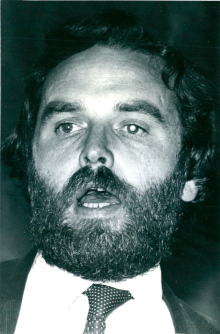
A notable aspect of McGahon’s political career is his stand against the Provisional IRA when that organisation’s campaign of violence is at its height. At great personal risk, he refuses to close his newsagents shop in Dundalk during the funerals of the hunger strikers in 1981. He takes another huge risk a few years later when he gives evidence in the High Court in support of The Sunday Times, which is being sued for libel by Thomas Murphy for accusing him of directing an IRA bombing campaign in Britain. Local Gardaí are ordered not to get involved in the case, but McGahon is not deterred from giving evidence that helps the newspaper to defend the claims being made against it by Murphy.
A maverick and outspoken TD, McGahon is known to speak his mind on many issues including divorce, crime, and single mothers. He once advocates that pedophiles should be castrated as part of their prison sentence and is the only TD to oppose the referendum to abolish the death penalty from the Constitution. He also argues that those under 21 years of age should not be able to drive or drink. He is a member of the World Anti-Communist League and opposes the decriminalisation of homosexuality. In 1993, he is the only TD to oppose the decriminalisation of homosexuality and says in the Dáil that:
“I regard homosexuals as being in a sad category, but I believe homosexuality to be an abnormality, some type of psycho-sexual problem that has defied explanation over the years. I do not believe that the Irish people desire this normalisation of what is clearly an abnormality. Homosexuality is a departure from normality and while homosexuals deserve our compassion, they do not deserve our tolerance. That is how the man in the street thinks. I know of no homosexual who has been discriminated against. Such people have a persecution complex because they know they are different from the masses or normal society. They endure inner torment, and it is not a question of the way others view them. The lord provided us with sexual organs for a specific purpose. Homosexuals are like left-hand drivers driving on the right-hand side of the road.”
On the other hand, McGahon speaks out strongly against the influence of the drink industry and defies his own party whip to vote with his left-wing friend Tony Gregory in favour of banning of hare coursing. He is also on good personal terms with members of the Oireachtas such as Michael D. Higgins and David Norris despite holding fundamentally opposed views to them.
McGahon does not contest the 2002 Irish general election and retires from politics.
McGahon lives in Ravensdale, County Louth. His son Conor is a Louth County Councillor from 1991 to 1999 and his brother Johnny is a Louth County Councillor from 1995 to 2004. Johnny’s nephew, John McGahon, is elected to Louth County Council at the 2014 Irish local elections and to Seanad Éireann in 2020.
McGahon dies at the age of 80 on February 8, 2017, following a short illness. Following a Mass at St. Patrick’s Cathedral on February 11, he is buried afterwards in St. Patrick’s Cemetery.
Logue grows up outside the village of Claudy in County Londonderry, the eldest of nine children born to Denis Logue, a bricklayer, and Kathleen (née Devine). He gains a scholarship to St. Columb’s College which he attends from 1961 to 1967. In 1967, he commences at St. Joseph’s Teacher Training college (Queen’s University) in Belfast from which he qualifies as a teacher of Mathematics in 1970. He first comes to prominence as a member of the executive of the Northern Ireland Civil Rights Association (NICRA), the only SDLP member of the executive. He stands as a candidate in elections to the new Northern Ireland Assembly in 1973 and is elected for Londonderry, at the age of 24, the youngest candidate elected that year. With John Hume and Ivan Cooper, he is arrested by the British Army during a peaceful demonstration in Londonderry in August 1971. Their conviction is ultimately overturned by the Law LordsR. (Hume) v Londonderry Justices (972, N.I.91) requiring the then British Government to introduce retrospective legislation to render legal previous British Army actions in Northern Ireland.
The Northern Ireland State Papers of 1980 show that together with John Hume and Austin Currie, Logue plays a key role in presenting the SDLP’S ‘Three Strands’ approach to the Thatcher Government’s Secretary of State for Northern IrelandHumphrey Atkins in April 1980. The “Three Strands” approach eventually becomes the basis for the Good Friday Agreement. The Irish State papers from 1980 reveal that he is a confidante of the Irish Government of that time, briefing it regularly on the SDLP’s outlook.
Logue is also known for his controversial comments at Trinity College Dublin at the time of the power sharingSunningdale Agreement, which many blame for helping to contribute to the Agreement’s defeat, to wit, that: [Sunningdale was] “the vehicle that would trundle Unionists into a united Ireland.” The next line of the controversial speech says, “the speed the vehicle moved at was dependent on the Unionist community.” In an article in The Irish Times in 1997 he claims that this implies that unity is always based on consent and acknowledged by Unionist Spokesman John Laird in the NI Assembly in 1973.
Logue unsuccessfully contests the Londonderry seat in the February 1974 and 1979 Westminster Elections. He is elected to the 1975 Northern Ireland Constitutional Convention and the 1982 Northern Ireland Assembly. He is a member of the New Ireland Forum in 1983. In the 1980s he is a member of the Irish Commission for Justice and Peace and plays a prominent part in its efforts to resolve the 1981 Irish hunger strike. His role is credited in Ten Men Dead: The Story of the 1981 Irish Hunger Strike by David Beresford, Biting the Grave by P. O’Malley and, more recently, in Blanketmen: An Untold Story of the H-block Hunger Strike (New Island Books, 2016) and Afterlives: The Hunger Strike and the Secret Offer that Changed Irish History (Lilliput Press, 2011) by former Provisional Irish Republican ArmyvolunteerRichard O’Rawe. Following the New Ireland Forum in 1984 and John Hume’s decision to represent the redrawn Londonderry constituency as Foyle and a safe seat, Logue leaves the Dublin-based, National Board for Science and Technology and joins the European Commission in 1984 in Brussels.
Following the 1994 Irish Republican Army (IRA) ceasefire, Logue, along with two EU colleagues, is asked by EU President Jacques Delors to consult widely throughout Northern Ireland and the Border regions and prepare recommendations for a Peace and Reconciliation Fund to underpin the peace process. Their community-based approach becomes the blueprint for the Peace Programme. In 1997, then EU President Jacques Santer asks the team, led by Logue, to return to review the programme and advise for a renewed Peace II programme. Papers published by National University Galway in 2016 from Logue’s archives indicate that he is the originator of the Peace Fund concept within the European Commission.
At the European Commission from 1984 to 1998, Logue creates Science and Technology for Regional Innovation and Development in Europe (STRIDE). In 1992, he is joint author with Giovanni de Gaetano, of RTD potential in the Mezzogiorno of Italy: the role of science parks in a European perspective and, with A. Zabaniotou and University of Thessaloniki, Structural Support For RTD.
Further publications by Logue follow: Research and Rural Regions (1996) and RTD potential in the Objective 1 regions (1997). With the fall of the Berlin Wall, his attention turns to Eastern Europe and in March 1998 publishes a set of studies Impact of the enlargement of the European Union towards central central and Eastern European countries on RTD- Innovation and Structural policies.
Logue convenes the first EU seminar on “Women in Science” in 1993 and jointly publishes with LM Telapessy Women in Scientific and Technological Research in the European Community, highlighting the barriers to women’s advancement in the Research world.
As the former vice-chairman of the North Derry Civil Rights Association, Logue gives evidence at the Saville Inquiry into Bloody Sunday. He is special adviser to the Office of First and Deputy First Minister from 1998 to 2002 and as an official of the European Commission. In 2002–03, he is a fellow of the Institute for British – Irish Studies at University College Dublin (UCD). In July 2006, he is appointed as a board member of the Irish Peace Institute, based at the University of Limerick and in 2009 is appointed Vice Chairman. He is a Life Member of the Institute of International and European Affairs.
On December 17, 2007, Logue is appointed as a director to InterTradeIreland (ITI), the North-South Body established under the Good Friday Agreement to promote economic development in Ireland. There he chairs the ITI’s Fusion programme, bringing north–south industrial development in Innovation and Research. Integrating Ireland economically is a theme of his writing throughout his career, most recently in The Irish Times and in earlier publications as economic spokesman for the SDLP. He is economist at the Dublin-based National Board for Science and Technology from 1981 to 1984.
Logue, after leaving the European Commission in 2005, becomes involved in Renewable Energy and is chairman of Priority Resources as well as a director of two companies, one in solar energy, the other in wind energy. In November 2011, he is elected to the main board of European Association of Energy (EAE).
In November 2023, Logue is awarded an honorary doctorate by the University of Galway in recognition of “a lifetime dedicated to civil rights, human rights, equality and peace in Northern Ireland, Ireland and Europe.” He donates an archive of material, more than 20 boxes of manuscripts, documents, photographs and political ephemera, on the development of the SDLP from the early 1970s to the University of Galway.
On January 21, 2002, Sinn Féin‘s four MPs take the historic step of signing up to use the facilities of the House of Commons, whose authority over Northern Irelandrepublicans have been fighting for almost a century. Party policy is also changed to allow MPs to sit in the Irish Parliament, the Dáil.
Amid concern among some republicans that the move comes close to recognising British rule, Sinn Féin president and Belfast West MP, Gerry Adams, insists that his party will never take its seats at Westminster. “There will never ever be Sinn Féin MPs sitting in the British houses of parliament,” he tells a Westminster press conference.
However, flanked by his three fellow Sinn Féin MPs, Martin McGuinness (Mid Ulster), Pat Doherty (West Tyrone) and Michelle Gildernew (Fermanagh and South Tyrone), Adams says taking up seats in the Dáil is a very different proposition from doing so the Commons. No Sinn Féin member would take the loyalty oath to the Queen, needed to take up a seat in Parliament, but that was a mere side issue to the key question of sovereignty, he says. Even if the oath were amended, the party would still refuse to take its seats because republicans do not recognise parliament’s jurisdiction over Northern Ireland.
“There are lots of things which there can be no certainty of and there are some things of which we can be certain,” Adams says. “There will never, ever be Sinn Féin MPs sitting in the British Houses of Parliament. The transfer of power by London and Dublin to the Assembly in the north … is all proof of where we see the political centre of gravity on the island of Ireland and that is in the island of Ireland.”
Adams insists his party’s presence in the Commons is a “temporary” measure until they can join the parliament of a united Ireland.
A ban on MPs using Commons facilities without taking the loyalty oath was lifted in December 2001 to Conservative fury. Tories end three decades of cross-party cooperation over the move, which also entitles Sinn Féin’s four MPs to allowances of £107,000 a year each.
Shadow Secretary of State for Northern IrelandQuentin Davies claims Adams plans to use the cash for party political campaigning – something forbidden by Westminster rules. He accuses British Prime MinisterTony Blair of “deliberately contributing to a great propaganda coup in which … the British Government are licking their boots.” The Prime Minister’s spokesman says Blair acknowledges “many victims do feel very strongly about what has happened, but the Prime Minister’s view is that this peace process has saved many lives.”
Sitting alongside a giant Irish tricolour inside his new office, Adams likens his presence there to that of MPs who had served in the British Army and intelligence services – suggesting some of them still do. He also dismisses concerns about the misuse of the money, accusing those “complaining loudest” of being from parties “indicted for corruption and sleaze.”
Sinn Féin’s move into their new offices coincides with a “routine” meeting with the Prime Minister in Downing Street to discuss the peace process. The Sinn Féin president uses publicity surrounding the controversial move to issue a new challenge to Blair to tackle the loyalist “killing campaign.” Adams is joined in Downing Street by his three fellow Sinn Féin MPs.
“There have been 300 bombs over the last nine or ten months,” Adams says. “The British Prime Minister has to face up to the reality that the threat to the peace process within Northern Ireland comes from within loyalism.”
Adams blames Betty Boothroyd‘s decision to bar Sinn Féin MPs from using Commons facilities for the current controversy. “We are here, elected, with our mandate renewed and increased,” he adds.
Adams is asked how he would react if he met former Cabinet minister Lord Tebbit and his wife, who was badly injured by the 1984 Provisional Irish Republican Army (IRA) bomb attack at the Tories conference at the Grand Brighton Hotel in Brighton, at the Commons. “I don’t ignore anyone. As someone who has been wounded and shot and someone whose house has been bombed, I understand precisely how others who have suffered more than me feel about all of this,” Adams replies. “I would like to think that as part of building a peace process that all of us agree there must be dialogue.”
(Pictured: from left, Sinn Fein MPs Michelle Gildernew, Martin McGuinness, Gerry Adams and Pat Doherty)
MacEntee is born as John McEntee at 47 King Street, Belfast, on August 23, 1889, the son of James McEntee, a publican, and his wife, Mary Owens, both of whom are from Monaghan. James McEntee is a prominent Nationalist member of Belfast Corporation and a close friend of Joseph DevlinMP.
MacEntee is educated at St. Mary’s Christian Brothers’ Grammar School, St. Malachy’s College and the Belfast Municipal College of Technology where he qualifies as an electrical engineer. His early political involvement is with the Irish Socialist Republican Party in Belfast. He quickly rises through the ranks of the trade union movement becoming junior representative in the city’s shipyards. Following his education, he works as an engineer in Dundalk, County Louth, and is involved in the establishment of a local corps of the Irish Volunteers in the town. He mobilises in Dundalk and fights in the General Post Office garrison in the Easter Rising in 1916. He is sentenced to death for his part in the rising. This sentence is later commuted to life imprisonment. He is released in the general amnesty in 1917 and is later elected a member of the National Executives of both Sinn Féin and the Irish Volunteers in October 1917. He is later elected Sinn Féin Member of Parliament (MP) for South Monaghan at the 1918 Irish general election.
An attempt to develop MacEntee’s career as a consulting engineer in Belfast is interrupted by the Irish War of Independence in 1919. He serves as Vice-Commandant of the Belfast Brigade of the Irish Republican Army (IRA). He is also a member of the Volunteer Executive, a sort of Cabinet and Directory for the Minister for Defence and the HQ Staff, however, he remains one of the few Sinn Féiners from the north. On August 6, 1920, he presents ‘a Memorial’ lecture to the Dáil from the Belfast Corporation. He tells the Dáil it is the only custodian of public order, that a Nationalist pogrom is taking place, and he advises them to fight Belfast. The Dáil government’s policy is dubbed Hibernia Irredenta or “Greening Ireland.” He is asked to resign his South Monaghan seat after voting against a bunting celebration in Lurgan to mark the signing of the Anglo-Irish Treaty.
In April 1921 MacEntee is transferred to Dublin to direct a special anti-partition campaign in connection with the May general election. It remains Michael Collins‘s policy, he declares, that the largely Protestant shipyard workers of Belfast are being directed by the British, urging all Irishmen to rejoin the Republic. Correspondingly the Ulster Unionist Council rejects the call for a review of the boundary commission decision made on Northern Ireland. But when Ulstermen choose James Craig as Premier, Collins denounces democracy in the north as a sham. It is on the partition of Ireland issue that MacEntee votes against the Anglo-Irish Treaty of 1921. During the subsequent Irish Civil War, he commands the IRA unit in Marlboro Street Post Office in Dublin. He later fights with Cathal Brugha in the Hamman Hotel and is subsequently interned in Kilmainham and Gormanstown until December 1923.
After his release from prison, MacEntee devotes himself more fully to his engineering practice, although he unsuccessfully contests the Dublin Countyby-election of 1924. He becomes a founder-member of Fianna Fáil in 1926 and is eventually elected a TD for Dublin County at the June 1927 Irish general election.
MacEntee founds the Association of Patent Agents in 1929, having gained his interest in Patents when he worked as an assistant engineer in Dundalk Urban District Council. He values his status as a Patent Agent as he maintains his name on the Register for over 30 years while he holds Ministerial rank in the Irish Government, although he is not believed to have taken any active part in the patent business, which is carried on by his business partners.
In 1932, Fianna Fáil comes to power for the very first time, with MacEntee becoming Minister for Finance. In keeping with the party’s protectionist economic policies his first budget in March of that year sees the introduction of new duties on 43 imports, many of them coming from Britain. This sees retaliation from the British government, which in turn provokes a response from the Irish government. This is the beginning of the Anglo-Irish Trade War between the two nations, however, a treaty in 1938, signed by MacEntee and other senior members brings an end to the issue.
In 1939, World War II breaks out and a cabinet reshuffle results in MacEntee being appointed as Minister for Industry and Commerce, taking over from his rival Seán Lemass. During his tenure at this department, he introduces the important Trade Union Act (1941). In 1941, another reshuffle of ministers takes place, with him becoming Minister for Local Government and Public Health. The Health portfolio is transferred to a new Department of Health in 1947. Following the 1948 Irish general election, Fianna Fáil returns to the opposition benches for the first time in sixteen years.
In 1951, Fianna Fáil are back in government, although in minority status, depending on independent deputies for survival. MacEntee once again returns to the position of Minister for Finance where he feels it is vital to deal with the balance of payments deficit. He brings in a harsh budget in 1951 which raises income tax and tariffs on imports. His chief aim is to cut spending and reduce imports, however, this comes at a cost as unemployment increases sharply. The increases are retained in his next two budgets in 1952 and 1953. It is often said that it is his performance during this period that costs Fianna Fáil the general election in 1954. The poor grasp on economics also does his political career tremendous damage as up to that point he is seen as a likely successor as Taoiseach. Seán Lemass, however, is now firmly seen as the “heir apparent.”
In 1957, Fianna Fáil returns to power with an overall majority with MacEntee being appointed Minister for Health. The financial and economic portfolios are dominated by Lemass and other like-minded ministers who want to move away from protection to free trade. He is credited during this period with the reorganisation of the health services, the establishment of separate departments of health and social welfare, and the fluoridation of water supplies in Ireland. In 1959, he becomes Tánaiste when Seán Lemass is elected Taoiseach.
Following the 1965 Irish general election, MacEntee is 76 years old and retires from the government. He re-emerges in 1966 to launch a verbal attack on Seán Lemass for deciding to step down as party leader and Taoiseach. The two men, however, patch up their differences shortly afterwards. MacEntee retires from Dáil Éireann in 1969 at the age of 80, making him the oldest TD in Irish history.
MacEntee dies in Dublin on January 9, 1984, at the age of 94. He is buried in Glasnevin Cemetery, Dublin.
In 1973, the Provisional Irish Republican Army (IRA) extends its campaign to mainland Britain, attacking military and symbolically important targets to both increase pressure on the British government, via popular British opinion, to withdraw from Northern Ireland and to maintain morale amongst their supporters. By 1974, mainland Britain sees an average of one attack — successful or otherwise — every three days.
In the early evening hours of November 21, at least three bombs connected to timing devices are planted inside two separate public houses and outside a bank located in and around central Birmingham. It is unknown precisely when these bombs were planted. If official IRA protocol of preceding attacks upon non-military installations with a 30-minute advance warning to security services is followed, and subsequent eyewitness accounts are accurate, the bombs would have been planted at these locations after 7:30 p.m. and before 7:47 p.m.
According to testimony delivered at the 1975 trial of the six men wrongly convicted of the bombings, the bomb planted inside the Mulberry Bush pub is concealed inside either a duffel bag or briefcase, whereas the bomb planted inside the Tavern in the Town is concealed inside a briefcase or duffel bag (possibly concealed within a large, sealed plastic bag) and Christmas cracker boxes. The remnants of two alarm clocks recovered from the site of each explosion leaves the possibility that two bombs had been planted at each public house. The explosion crater at each location indicates that if two bombs had been planted at each public house, they would each have been placed in the same location and likely the same container.
Reportedly, those who plant the bombs then walk to a preselected phone box to telephone the advance warning to security services. However, the phone box has been vandalised, forcing the caller to find an alternative phone box and thus shortening the amount of time police have to clear the locations.
At 8:11 p.m., an unknown man with a distinct Irish accent telephones the Birmingham Post newspaper. The call is answered by operator Ian Cropper. The caller says, “There is a bomb planted in the Rotunda and there is a bomb in New Street at the tax office. This is Double X,” before terminating the call. (“Double X” is an IRA code word given to authenticate any warning call.) A similar warning is also sent to the Birmingham Evening Mail newspaper, with the anonymous caller again giving the code word, but again failing to name the public houses in which the bombs had been planted.
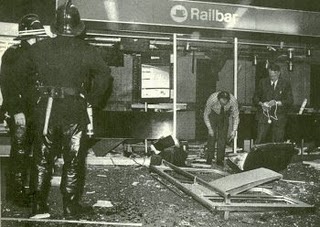
The Rotunda is a 25-story office block, built in the 1960s, that houses the Mulberry Bush pub on its lower two floors. Within minutes of the warning, police arrive and begin checking the upper floors of the Rotunda, but they do not have sufficient time to clear the crowded pub at street level. At 8:17 p.m., six minutes after the first telephone warning had been delivered to the Birmingham Post, the bomb, which had been concealed inside either a duffel bag or briefcase located ner the rear entrance to the premises, explodes, devastating the pub. The explosion blows a 40-inch crater in the concrete floor, collapsing part of the roof and trapping many casualties beneath girders and concrete blocks. Many buildings near the Rotunda are also damaged, and pedestrians in the street are struck by flying glass from shattered windows. Several of the victims die at the scene, including two youths who had been walking past the premises at the moment of the explosion.
Ten people are killed in this explosion and dozens are injured, including many who lose limbs. Several casualties are impaled by sections of wooden furniture while others have their clothes burned from their bodies. A paramedic called to the scene of this explosion later describes the carnage as being reminiscent of a slaughterhouse. One fireman says that, upon seeing a writhing, “screaming torso,” he begs police to allow a television crew inside the premises to film the dead and dying at the scene, in the hope the IRA would see the consequences of their actions. However, the police refuse this request, fearing the reprisals would be extreme.
The Tavern in the Town is a basement pub on New Street located a short distance from the Rotunda and directly beneath the New Street Tax Office. Patrons there hear the explosion at the Mulberry Bush, but do not believe that the sound, described by one survivor as a “muffled thump,” is an explosion.
Police have begun attempting to clear the Tavern in the Town when, at 8:27 p.m., a second bomb explodes there. The blast is so powerful that several victims are blown through a brick wall. Their remains are wedged between the rubble and live underground electric cables that supply the city centre. One of the first police officers on the scene, Brian Yates, later testifies that the scene which greeted his eyes was “absolutely dreadful,” with several of the dead stacked upon one another, others strewn about the ruined pub, and several screaming survivors staggering aimlessly amongst the debris, rubble, and severed limbs. A survivor says the sound of the explosion is replaced by a “deafening silence” and the smell of burned flesh.
Rescue efforts at the Tavern in the Town are initially hampered as the bomb had been placed at the base of a set of stairs descending from the street, the sole entrance to the premises, had been destroyed in the explosion. The victims whose bodies are blown through a brick wall and wedged between the rubble and underground electric cables take up to three hours to recover, as recovery operations are delayed until the power can be isolated. A passing West Midlands bus is also destroyed in the blast.
This bomb kills nine people outright, and injures everyone in the pub, many severely. Two later die of their injuries. After the second explosion, police evacuate all pubs and businesses in Birmingham city centre and commandeer all available rooms in the nearby City Centre Hotel as an impromptu first-aid post. All bus services into the city centre are halted, and taxi drivers are encouraged to transport those lightly injured in the explosions to hospital. Prior to the arrival of ambulances, rescue workers remove critically injured casualties from each scene upon makeshift stretchers constructed from devices such as tabletops and wooden planks. These severely injured casualties are placed on the pavement and given first aid prior to the arrival of ambulance services.
At 9:15 p.m., a third bomb, concealed inside two plastic bags, is found in the doorway of a Barclays Bank on Hagley Road, approximately two miles from the site of the first two explosions. This device consists of 13.5 pounds of Frangex connected to a timer and is set to detonate at 11:00 p.m. The detonator to the device activates when a policeman prods the bags with his truncheon, but the bomb does not explode. The device is destroyed in a controlled explosion early the following morning.
The bombings stoke considerable anti-Irish sentiment in Birmingham, which then has an Irish community of 100,000. Irish people are ostracised from public places and subjected to physical assaults, verbal abuse and death threats. Both in Birmingham and across England, Irish homes, pubs, businesses and community centres are attacked, in some cases with firebombs. Staff at thirty factories across the Midlands go on strike in protest of the bombings, while workers at airports across England refuse to handle flights bound for Ireland. Bridget Reilly, the mother of the two Irish brothers killed in the Tavern in the Town explosion, is herself refused service in local shops.
The bombings are immediately blamed on the IRA, despite the organisation not having claimed responsibility. Due to anger against Irish people in Birmingham after the bombings, the IRA Army Council places the city “strictly off-limits” to IRA active service units. In Northern Ireland, loyalist paramilitaries launch a wave of revenge attacks on Irish Catholics and within two days of the bombings, five Catholic civilians have been shot dead by loyalists. The Provisional IRA never officially admits responsibility for the Birmingham pub bombings.
Six Irishmen are arrested within hours of the blasts and in 1975 are sentenced to life imprisonment for the bombings. The men, who become known as the Birmingham Six, maintain their innocence and insist police had coerced them into signing false confessions through severe physical and psychological abuse. After 16 years in prison, and a lengthy campaign, their convictions are declared unsafe and unsatisfactory, and quashed by the Court of Appeal in 1991. The episode is seen as one of the worst miscarriages of justice in British legal history.
In 2001, each of the Birmingham Six is subsequently paid between £840,000 and £1.2 million in compensation.
(Pictured: The Mulberry Bush pub after the November 21, 1974, bombing)
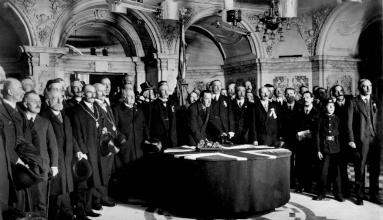
Ulster’s Solemn League and Covenant, commonly known as the Ulster Covenant, is signed by nearly 500,000 people on and before September 28, 1912, in protest against the Third Home Rule Bill introduced by the British Government in the same year.
The Covenant has two basic parts: the Covenant itself, which is signed by men, and the Declaration, which is signed by women. In total, the Covenant is signed by 237,368 men; the Declaration, by 234,046 women. Both the Covenant and Declaration are held by the Public Record Office of Northern Ireland (PRONI). An online searchable database is available on the PRONI website.
In January 1913, the Ulster Volunteers aim to recruit 100,000 men between the ages of 17 and 65 who had signed the Covenant as a unionist militia. A British Covenant, similar to the Ulster Covenant in opposition to the Home Rule Bill, receives two million signatures in 1914.
The majority of the signatories of the Covenant are from Ulster, although the signing is also attended by several thousand southern unionists. Acknowledging this, Carson pays tribute to “my own fellow citizens from Dublin, from Wicklow, from Clare [and], yes, from Cork, rebel Cork, who are now holding the hand of Ulster,” to cheers from the crowd.
The signature of Frederick Hugh Crawford is claimed by him to have been written in blood. However, this is disputed. Based on the results of a forensic test that he carries out in September 2012 at PRONI, Dr. Alastair Ruffell of Queen’s University Belfast asserts that he is 90% positive that the signature is not blood. Crawford’s signature is injected with a small amount of luminol. This substance reacts with iron in blood’s hemoglobin to produce a blue-white glow. The test is very sensitive and can detect tiny traces even in old samples. Crawford’s signature is still a rich red colour today which would be unlikely if it had been blood. Nevertheless, some unionists are not convinced by the evidence.
The Ulster Covenant is used as a template for the “Natal Covenant,” signed in 1955 by 33,000 British-descended Natalians against the nationalistSouth African government’s intention of declaring the Union a republic. It is signed in Durban‘s City Hall. Loosely based on Belfast’s Ulster Covenant, the Ulster scene is almost exactly reproduced.
September 28 is today known as “Ulster Day” to unionists.
(Pictured: Sir Edward Carson signing the Solemn League and Covenant)
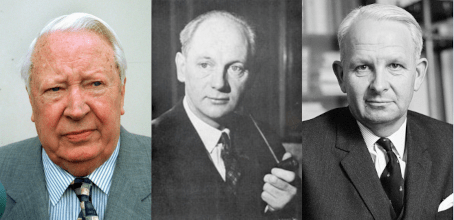
The meeting is held under conditions of tight secrecy. Each man has only one assistant with him and there is no briefing for the press afterward. No one expects a firm agreement on any issue of substance. The British appear to be satisfied with a promise to meet again and to keep the communication lines open.
The meeting, the first such tripartite conference since the partition of Ireland 50 years earlier, is itself a considerable accomplishment politically. Even six weeks earlier, it is considered an impossibility by most observers.
At that time, Faulkner is widely regarded as being under such heavy pressure from the right-wing of his Ulster Unionist Party (UUP) that he cannot talk with the Taoiseach. Lynch has been saying that he can meet with Faulkner only as the leader of the Unionist party, not as the Prime Minister of Northern Ireland. That is consistent with Dublin‘s view that the six counties of Ulster are part of the Republic of Ireland.
Heath also seems to have retreated from his previous position. In an angry exchange of telegrams in August, he suggests that the situation in Northern Ireland is a British affair and none of Lynch’s business. The exchange follows the decision to intern suspected members of the Irish Republican Army (IRA) in Ulster without trial. Faulkner, backed by the Heath government, begin arrests of suspects on August 9.
The interment policy arouses a bitter reaction among the Roman Catholics of Ulster, where they make up a third of the population. Lynch denounces the policy. The Catholic opposition members in the Ulster Parliament at Stormont say they will boycott all Government matters until the interned men are released.
What has softened the attitudes of the three leaders is the appalling extent of violence in Belfast and other towns in Northern Ireland since the internments began. In those seven weeks, 17 British soldiers, 36 civilians and one policeman are killed, most of them by IRA bullets and bombs.
The British Government and Faulkner offer broad changes in the constitutional setup of the Ulster regime. They talk about bringing Catholics — non‐Unionists — into the Government for the first time. But internment without trial remains an obstacle even to talking about those ideas with the main opposition group, the Social Democratic and Labor Party (SDLP). The SDLP refuses to join in a proposed conference on political reform while internment goes on.
Ideally, the British would like Lynch to use his influence with the opposition leaders. They want him to urge them to talk about political reform in return for some concession on internment, perhaps the release of some of those currently held. But any such concession might get Faulkner in trouble with his own party or arouse Protestant violence. That is always the trouble in Northern Ireland – any gesture toward one side antagonizes the other.
A new and serious problem for Heath is an apparent waning of the British public’s willingness to bear the military and social burden of Northern Ireland. A poll just before the meeting at Chequers shows that 59% want to bring all British troops home from Ulster at once.
Even Lynch, though he is pledged to the principle of a United Ireland, does not want the hasty withdrawal of British troops. That would almost certainly mean an enlargement of the present terror into civil war.
(From: 3 Prime Ministers Confer on Ulster, The New York Times, September 28, 1971)
Twomey is born on November 5, 1919, on Marchioness Street in Belfast, and lives at 6 Sevastopol Street in the Falls district. Known as “Thumper” owing to his short temper and habit of banging his fist on tables, he receives little education and is a bookmaker‘s “runner.” His father is a volunteer in the 1920s. In Belfast he lives comfortably with his wife, Rosie, whom he marries in 1946. Together they have sons and daughters.
Twomey begins his involvement with the Irish Republican Army in the 1930s and is interned in Northern Ireland during the 1940s on the prison ship HMS Al Rawdah and later in Crumlin Road Gaol in Belfast. Rosie, his wife, is also held prisoner at the women prison, Armagh Jail, in Northern Ireland. He opposes the left-wing shift of Cathal Goulding in the 1960s, and in 1968, helps set up the breakaway Andersonstown Republican Club, later the Roddy McCorley Society.
In 1969, Twomey is prominent in the establishment of the Provisional Irish Republican Army. By 1972, he is Officer Commanding (OC) of the Provisional IRA Belfast Brigade when it launches its bomb campaign of the city, including Bloody Friday when nine people are killed. During the 1970s, the leadership of the Belfast Brigade of the IRA is largely in the hands of Twomey and Ivor Bell.
In March 1973, Twomey is first appointed IRA Chief of Staff after the arrest of Joe Cahill. He remains in this position until his arrest in October 1973 by the Garda Síochána. Three weeks later, on October 31, 1973, the IRA organises the helicopter escape of Twomey and his fellow IRA members J. B. O’Hagan and Kevin Mallon, when an active service unit hijacks and forces the pilot at gunpoint to land the helicopter in the training yard of Mountjoy Prison. After his escape, he returns to his membership of IRA Army Council.
By June/July 1974, Twomey is IRA Chief of Staff for a second time. He takes part in the Feakle talks between the IRA and Protestant clergymen in December 1974. In the IRA truce which follows in 1975, he is largely unsupportive and wants to fight on in what he sees as “one big push to finish it once and for all.”
IRA informer Sean O’Callaghan claims that on January 5, 1976, Twomey and Brian Keenan give the go-ahead for the sectarian Kingsmill massacre, when ten unarmed Ulster Protestant workmen are executed by the Provisional IRA in retaliation for a rash of loyalist killings of Catholics in the area. It is Keenan’s view, O’Callaghan claims, that “The only way to knock the nonsense out of the Prods is to be ten times more savage.”
Twomey is dedicated to paramilitarism as a means of incorporating Northern Ireland into the Republic of Ireland. In an interview with French television on July 11, 1977, he declares that although the IRA had waged a campaign for seven years at that point, it can fight on for another 70 against the British state in Northern Ireland and in England. He supports the bombing of wealthy civilian targets, which he justifies on class lines. On October 29, 1977, for example, a no-warning bomb at an Italian restaurant in Mayfair kills one diner and wounds 17 others. Three more people are killed in similar blasts in Chelsea and Mayfair the following month. He says, “By hitting Mayfair restaurants, we were hitting the type of person that could bring pressure to bear on the British government.”
In December 1977, Twomey is captured in Sandycove, Dublin, by the Garda Síochána, who had been tipped off by Belgian police about a concealed arms shipment, to be delivered to a bogus company with an address in the area. They swoop on a house in Martello Terrace to discover Twomey outside in his car, wearing his trademark dark glasses. After a high-speed pursuit, he is recaptured in the centre of Dublin. The Gardaí later find documents in his possession outlining proposals for the structural reorganisation of the IRA according to the cell system. His arrest ends his tenure as IRA chief of staff. In the 1986 split over abstentionism, Twomey sides with the Gerry Adams leadership and remains with the Provisionals.
After a long illness from a heart condition, Twomey dies in Dublin on September 12, 1989. He is buried in the family plot in Milltown Cemetery, Belfast. His funeral is attended by about 2,000 people.
In 1971, during the Troubles, after two years engaged in violence based on a defensive strategy in Irish communal districts of Northern Ireland, the Provisional IRA launches an offensive against the United Kingdom. At a meeting of the IRA Army Council in June 1972 the organization’s Chief of Staff, Seán Mac Stíofáin, first proposes making bombing attacks in England. The Army Council does not at first agree to the suggestion, but in early 1973 after its negotiations with the British Government for a truce the previous year had failed to advance the political objective of the removal of Northern Ireland from the United Kingdom by the application of the threat of violence, it re-engages its paramilitary campaign and sanctions Mac Stíofáin’s proposal. Mac Stíofáin had put the strategy forward on the basis that extending the urban paramilitary violence of the Northern Ireland state into England would help to relieve pressure being exerted by the British Army on the IRA’s strongholds of Irish communal support in districts in the province, such as west Belfast and Derry, by diverting British security strength from them back into England, while at the same time increasing strategic pressure upon the British Government to resolve the conflict by political concessions to the IRA’s demands. He also believes that a successful bombing campaign in London, as the capital city of the United Kingdom, will offer substantial propaganda value for paramilitary Irish Republicanism, and provide a morale boost to its supporters.
The effects of the previous 1973 Old Bailey bombing appear to give some credence to the idea of the propaganda value of extending violence into London as, although it is considered almost routine in Northern Ireland by the mid-1970s and draws only brief media notice, being carried out instead in London, a global capital city, makes the event world news headlines. However, although the bombing of the Old Bailey is successfully carried out, and gains media attention, increasing political pressure upon the British Government to address the issue of the conflict in Northern Ireland with more urgency, it is costly to the IRA, as 10 out of the 11-man active service unit that carry it out are arrested by the British police while trying to leave England before the bombs they had planted detonate. Drawing the tactical lesson that large teams are a security liability, for the second wave of bombings in England later in 1973, instead of sending a large team to carry it out with orders to withdraw back to Ireland immediately afterwards, smaller detached “cell” units of 3-4 personnel are sent to carry out the operation, with instructions to remain in England afterward and wage a campaign of bombings around England upon a variety of targets.
There are bombings on September 8, 1973, including one at London Victoria station which injures four civilians.
On September 10, 1973, a bomb (with no warning issued beforehand) explodes at King’s Cross railway station in the booking hall at 12:24 p.m. when a youth of around 16 to 17 years of age walks up to the entrance of the station’s old booking hall and throws a bag into it which contains a 3 lb. (1.4 kg) device, which detonates, shattering glass throughout the hall and throwing a baggage trolley several feet into the air. The youth then flees into the station’s crowd and escapes the scene.
Approximately 45 minutes after the attack at King’s Cross, after a telephone call warning to the Press Association five minutes beforehand by a man with an Irish accent, a second bomb detonates in a snack bar at Euston railway station, injuring another eight civilians. One witness at Euston says, “I saw a flash and suddenly people were being thrown through the air – it was a terrible mess, they were bleeding and screaming.” A total of 13 civilians are injured in the two attacks. The Metropolitan Police issue a photofit picture of a 5 ft. 2 in. (157 cm) tall youth they are seeking in regard to the King’s Cross attack.
On September 12, 1973, two more bombs explode, one in Oxford Street and another in Sloane Square, targeting retail shopping centres. Police subsequently announce that they are looking for five people in connection with this second wave of bomb attacks in England.
Judith Ward is later wrongly convicted of having been involved in the late 1973 London bombings, along with the M62 coach bombing. She is later acquitted. No one else is brought to trial for this IRA bombing campaign.
MacEntee is the son of James McEntee, a publican, and his wife, Mary Owens, both of whom are from Monaghan. James McEntee is a prominent Nationalist member of Belfast Corporation and a close friend of Joseph DevlinMP.
MacEntee is educated at St. Mary’s Christian Brothers’ Grammar School, St. Malachy’s College and the Belfast Municipal College of Technology where he qualifies as an electrical engineer. His early political involvement is with the Irish Socialist Republican Party in Belfast. He quickly rises through the ranks of the trade union movement becoming junior representative in the city’s shipyards. Following his education, he works as an engineer in Dundalk, County Louth, and is involved in the establishment of a local corps of the Irish Volunteers in the town. He mobilises in Dundalk and fights in the General Post Office garrison in the Easter Rising in 1916. He is sentenced to death for his part in the rising. This sentence is later commuted to life imprisonment. He is released in the general amnesty in 1917 and is later elected a member of the National Executives of both Sinn Féin and the Irish Volunteers in October 1917. He is later elected Sinn Féin Member of Parliament (MP) for South Monaghan at the 1918 Irish general election.
An attempt to develop MacEntee’s career as a consulting engineer in Belfast is interrupted by the Irish War of Independence in 1919. He serves as Vice-Commandant of the Belfast Brigade of the Irish Republican Army (IRA). He is also a member of the Volunteer Executive, a sort of Cabinet and Directory for the Minister for Defence and the HQ Staff, however, he remains one of the few Sinn Féiners from the north. On August 6, 1920, he presents ‘a Memorial’ lecture to the Dáil from the Belfast Corporation. He tells the Dáil it is the only custodian of public order, that a Nationalist pogrom is taking place, and he advises them to fight Belfast. The Dáil government’s policy is dubbed Hibernia Irredenta or “Greening Ireland.” He is asked to resign his South Monaghan seat after voting against a bunting celebration in Lurgan to mark the signing of the Anglo-Irish Treaty.
In April 1921 MacEntee is transferred to Dublin to direct a special anti-partition campaign in connection with the May general election. It remains Michael Collins‘s policy, he declares, that the largely Protestant shipyard workers of Belfast are being directed by the British, urging all Irishmen to rejoin the Republic. Correspondingly the Ulster Unionist Council rejects the call for a review of the boundary commission decision made on Northern Ireland. But when Ulstermen choose James Craig as Premier, Collins denounces democracy in the north as a sham. It is on the partition of Ireland issue that MacEntee votes against the Anglo-Irish Treaty of 1921. During the subsequent Irish Civil War, he commands the IRA unit in Marlboro Street Post Office in Dublin. He later fights with Cathal Brugha in the Hamman Hotel and is subsequently interned in Kilmainham and Gormanstown until December 1923.
After his release from prison, MacEntee devotes himself more fully to his engineering practice, although he unsuccessfully contests the Dublin Countyby-election of 1924. He becomes a founder-member of Fianna Fáil in 1926 and is eventually elected a TD for Dublin County at the June 1927 Irish general election.
MacEntee founds the Association of Patent Agents in 1929, having gained his interest in Patents when he worked as an assistant engineer in Dundalk Urban District Council. He values his status as a Patent Agent as he maintains his name on the Register for over 30 years while he holds Ministerial rank in the Irish Government, although he is not believed to have taken any active part in the patent business, which is carried on by his business partners.
In 1932, Fianna Fáil comes to power for the very first time, with MacEntee becoming Minister for Finance. In keeping with the party’s protectionist economic policies his first budget in March of that year sees the introduction of new duties on 43 imports, many of them coming from Britain. This sees retaliation from the British government, which in turn provokes a response from the Irish government. This is the beginning of the Anglo-Irish Trade War between the two nations, however, a treaty in 1938, signed by MacEntee and other senior members brings an end to the issue.
In 1939, World War II breaks out and a cabinet reshuffle results in MacEntee being appointed as Minister for Industry and Commerce, taking over from his rival Seán Lemass. During his tenure at this department, he introduces the important Trade Union Act (1941). In 1941, another reshuffle of ministers takes place, with him becoming Minister for Local Government and Public Health. The Health portfolio is transferred to a new Department of Health in 1947. Following the 1948 Irish general election, Fianna Fáil returns to the opposition benches for the first time in sixteen years.
In 1951, Fianna Fáil are back in government, although in minority status, depending on independent deputies for survival. MacEntee once again returns to the position of Minister for Finance where he feels it is vital to deal with the balance of payments deficit. He brings in a harsh budget in 1951 which raises income tax and tariffs on imports. His chief aim is to cut spending and reduce imports, however, this comes at a cost as unemployment increases sharply. The increases are retained in his next two budgets in 1952 and 1953. It is often said that it is his performance during this period that costs Fianna Fáil the general election in 1954. The poor grasp on economics also does his political career tremendous damage as up to that point he is seen as a likely successor as Taoiseach. Seán Lemass, however, is now firmly seen as the “heir apparent.”
In 1957, Fianna Fáil returns to power with an overall majority with MacEntee being appointed Minister for Health. The financial and economic portfolios are dominated by Lemass and other like-minded ministers who want to move away from protection to free trade. He is credited during this period with the reorganisation of the health services, the establishment of separate departments of health and social welfare, and the fluoridation of water supplies in Ireland. In 1959, he becomes Tánaiste when Seán Lemass is elected Taoiseach.
Following the 1965 Irish general election, MacEntee is 76 years old and retires from the government. He re-emerges in 1966 to launch a verbal attack on Seán Lemass for deciding to step down as party leader and Taoiseach. The two men, however, patch up their differences shortly afterwards. MacEntee retires from Dáil Éireann in 1969 at the age of 80, making him the oldest TD in Irish history.
MacEntee dies in Dublin on January 9, 1984, at the age of 94. He is buried in Glasnevin Cemetery, Dublin. At the time of his death, he is the last surviving member of the First Dáil.





 seamus dubhghaill