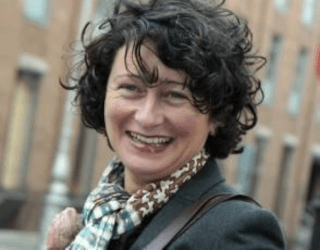
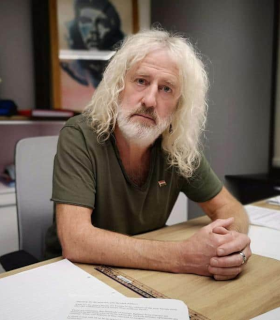
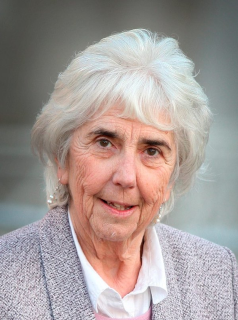
O’Malley comes from a political family. Her father, Desmond O’Malley, is a former Fianna Fáil cabinet minister and founder of the Progressive Democrats. Her granduncle, Donogh O’Malley, is a Fianna Fáil minister in the 1960s. She is also a cousin of another former Progressive Democrats TD, Tim O’Malley.
O’Malley is a member of the Oireachtas Committee on Arts, Sports and Tourism and the Oireachtas Committee on Health and Children. She is also a member of the Dáil All-Party group concerned with matters of sexual and reproductive health. She has traveled to South America and South Africa with the United Nations Population Fund and has spoken extensively of the need for a clear safe sex message both in Ireland and in the developing world.
O’Malley loses her Dáil seat at the 2007 Irish general election, but is nominated by the Taoiseach, Bertie Ahern, to the Seanad in August 2007. She is narrowly defeated in the race to become the leader of the Progressive Democrats by Ciarán Cannon.
O’Malley is an independent politician from the dissolution of the Progressive Democrats in 2009. She is an independent candidate at the 2011 Seanad election for the Dublin University constituency but is not elected.
Gregory becomes involved in republican politics, joining Sinn Féin and the Irish Republican Army (IRA) in 1964. In UCD he helps found the UCD Republican Club, despite pressure from college authorities, and becomes involved with the Dublin Housing Action Committee. Within the party he is a supporter of Wicklow Republican Seamus Costello. Costello, who is a member of Wicklow County Council, emphasises involvement in local politics and is an opponent of abstentionism. Gregory sides with the Officials in the 1970 split within Sinn Féin. Despite having a promising future within the party, he resigns in 1972 citing frustration with ideological infighting in the party. Later, Costello, who had been expelled by Official Sinn Féin, approaches him and asks him to join his new party, the Irish Republican Socialist Party. He leaves the party after Costello’s assassination in 1977. He is briefly associated with the Socialist Labour Party.
Gregory contests the 1979 local elections for Dublin City Council as a “Dublin Community Independent” candidate. At the February 1982 general election, he is elected to Dáil Éireann as an Independent TD. On his election he immediately achieves national prominence through the famous “Gregory Deal,” which he negotiates with Fianna Fáil leader Charles Haughey. In return for supporting Haughey as Taoiseach, he is guaranteed a massive cash injection for his inner-city Dublin constituency, an area beset by poverty and neglect.
Although Gregory is reviled in certain quarters for effectively holding a government to ransom, his uncompromising commitment to the poor is widely admired. Fianna Fáil loses power at the November 1982 general election, and many of the promises made in the Gregory Deal are not implemented by the incoming Fine Gael–Labour Party coalition.
Gregory is involved in the 1980s in tackling Dublin’s growing drug problem. Heroin had largely been introduced to Dublin by the Dunne criminal group, based in Crumlin, in the late 1970s. In 1982 a report reveals that 10% of 15- to 24-year-olds have used heroin at least once in the north inner city. The spread of heroin use also leads to a sharp increase in petty crime. He confronts the government’s handling of the problem as well as senior Gardaí, for what he sees as their inadequate response to the problem. He co-ordinates with the Concerned Parents Against Drugs group in 1986, who protest and highlight the activities of local drug dealers and defend the group against accusations by government Ministers Michael Noonan and Barry Desmond that it is a front for the Provisional IRA. He believes that the solution to the problem is multi-faceted and works on a number of policy level efforts across policing, service co-ordination and rehabilitation of addicts. In 1995 in an article in The Irish Times, he proposes what would later become the Criminal Assets Bureau, which is set up in 1996, catalysed by the death of journalistVeronica Guerin. His role in its development is later acknowledged by then Minister for JusticeNora Owen.
Gregory also advocates for Dublin’s street traders. After attending a sit-down protest with Sinn Féin Councillor Christy Burke, and future Labour Party TD Joe Costello on Dublin’s O’Connell Street in defence of a street trader, he, Burke and four others are arrested and charged with obstruction and threatening behaviour. He spends two weeks in Mountjoy Prison after refusing to sign a bond to keep the peace.
Gregory remains a TD from 1982 and, although he never holds a government position, remains one of the country’s most recognised Dáil deputies. He always refuses to wear a tie in the Dáil chamber stating that many of his constituents could not afford them.
Gregory dies on January 2, 2009, following a long battle with cancer. Following his death, tributes pour in from politicians from every party, recognising his contribution to Dublin’s north inner city. During his funeral, politicians from the Labour Party, Fianna Fáil and Fine Gael are told that although they speak highly of Gregory following his death, during his time in the Dáil he had been excluded by many of them and that they were not to use his funeral as a “photo opportunity.” He is buried on January 7, with the Socialist Party‘s Joe Higgins delivering the graveside oration.
On December 5, 2011, Pringle delivers a televised address to the nation, representing the technical group of TDs in Dáil Éireann. He does so in response to TaoiseachEnda Kenny‘s address to the nation of the previous evening. Later that month, he calls on people for support in a campaign not to pay a new household charge brought in as part of the latest austerity budget and announces that he will not register for the tax or pay it.
In February 2012, Pringle publishes his expenses online. He is elected leader of the technical group in Dáil Éireann in March 2012.
In May 2012, Pringle brings an unsuccessful High Court challenge over the 2012 European Fiscal Compact referendum and the European Stability Mechanism (ESM) Treaty which is appealed to the Supreme Court in July 2012. In July 2012, the Irish Supreme Court decides to refer three questions to the Court of Justice of the European Union (CJEU) arising out of his challenge of the European Stability Mechanism Treaty and doubts about the ESM’s legality under the Treaties of the European Union. The CJEU holds an oral hearing on the referral on October 23, 2012. It is the first time that the full court sits to hear a reference from a member state of the Union. The 27 judges hear oral arguments from the counsel for Pringle, Ireland, nine other member states, the Commission, the Council, and the European Parliament. On November 27, 2012, the EU Court of Justice dismisses Pringle’s arguments and rules that the ESM is in accordance with the Treaties.
In the 2016 Irish general election, after a re-drawing of constituency boundaries, Pringle campaigns in the new five-seater Donegal constituency. He is re-elected to the final seat by a margin of just 184 votes over Sinn Féin’s Pádraig Mac Lochlainn. During negotiations to form a government, Pringle says he is glad not to have signed up to the Independent Alliance, after that group enters talks with Taoiseach Enda Kenny. He says that unless Kenny or Fianna Fáil leader Micheál Martin sign up to Right2Change, he will not support either as Taoiseach.
As of April 2016, Pringle had become a member of the Independents 4 Change technical group in the Dáil.
In May 2016, Pringle introduces legislation designed to retain water in public ownership and avoid further privatisation.
Pringle puts forward a bill calling on the government to end public spending from fossil fuels, which passes, making Ireland the first country to fully divest public money from fossil fuels. In June 2022, he puts forward a bill proposing a referendum on lowering the voting age to sixteen.
The treaty had been intended to enter into force on January 1, 2009, but has to be delayed following the Irish rejection. However, the Lisbon treaty is approved by Irish voters when the Twenty-eighth Amendment of the Constitution of Ireland is approved in the second Lisbon referendum, held in October 2009.
The Treaty of Lisbon is signed by the member states of the European Union on December 13, 2007. It is in large part a revision of the text of the Treaty establishing a Constitution for Europe (TCE) after its rejection in referendums in France in May 2005 and in the Netherlands in June 2005. The Treaty of Lisbon preserves most of the content of the Constitution, especially the new rules on the functioning of the European Institutions but gives up any symbolic or terminologic reference to a constitution.
Because of the decision of the Supreme Court of Ireland in Crotty v. An Taoiseach (1987), an amendment to the Constitution is required before it can be ratified by Ireland. Ireland is the only one of the then fifteen EU member states to put the Treaty to the people in a referendum. Ratification of the Treaty in all other member states is decided upon by national parliaments alone.
The government parties of Fianna Fáil and the Progressive Democrats are in favour of the treaty, but the other government party, the Green Party, is divided on the issue. At a special convention on January 19, 2008, the leadership of the Green Party fails to secure a two-thirds majority required to make support for the referendum official party policy. As a result, the Green Party itself does not participate in the referendum debate, although individual members are free to be involved in whatever side they chose. All Green Party members of the Oireachtas support the Treaty. The main opposition parties of Fine Gael and the Labour Party are also in favour. Only one party represented in the Oireachtas, Sinn Féin, is opposed to the treaty, while minor parties opposed to it include the Socialist Party, the Workers’ Party and the Socialist Workers Party. Independent TD’s Tony Gregory and Finian McGrath, Independent MEPKathy Sinnott, and Independent members of the Seanad from the universities David Norris, Shane Ross and Rónán Mullen advocate a “No” vote as well.
The Government sends bilingual booklets written in English and Irish, explaining the Treaty, to all 2.5 million Irish households. However, compendiums of the two previous treaties, of which the Lisbon Treaty is intended to be a series of reforms and amendments, remain unavailable in Ireland. Some commentators argue that the treaty remains essentially incomprehensible in the absence of such a compendium.
On March 12, 2008, the Libertas Institute, a lobby group started by businessman Declan Ganley, launches a campaign called Facts, not politics which advocates a “No” vote in the referendum. A month later, the German Chancellor, Angela Merkel, appeals to Irish people to vote “Yes” in the referendum while on a visit to Ireland. The anti-Lisbon Treaty campaign group accuses the government and Fine Gael of a U-turn on their previous policy of discouraging foreign leaders from visiting Ireland during the referendum campaign. The European Commissioner for Internal MarketCharlie McCreevy admits he had not read the Treaty from cover to cover and says, “he would not expect any sane person to do so.”
At the start of May, the Irish Alliance for Europe launches its campaign for a “Yes” vote in the referendum this consists of trade unionists, business people, academics and politicians. Its members include Garret FitzGerald, Ruairi Quinn, Pat Cox and Michael O’Kennedy. The TaoiseachBrian Cowen states that should any member of the Fianna Fáil parliamentary party campaign against the treaty, they will likely be expelled from the party.
On May 21, 2008, the executive council of the Irish Congress of Trade Unions votes to support a “Yes” vote in the referendum. Rank and file members of the individual unions are not balloted, and the Technical, Engineering and Electrical Union (TEEU) advises its 45,000 members to vote “No.” The Irish bishops conference states the Catholic Church‘s declaration that the treaty will not weaken Ireland’s constitutional ban on abortion, however the conference does not advocate either a “Yes” or “No” vote. By the start of June, Fianna Fáil, Fine Gael and the Labour Party have united in their push for a “Yes” vote despite earlier divisions. The two largest farming organisations, the Irish Creamery Milk Suppliers Association (ICMSA) and the Irish Farmers’ Association call for a “Yes” vote, the latter giving its support after assurances from Taoiseach Brian Cowen that Ireland will use its veto in Europe if a deal on World Trade reform is unacceptable.
There were 3,051,278 voters on the electoral register. The vast majority of voting takes place on Thursday, June 12, between 7:00 a.m. and 10:00 p.m. Counting begins at 9:00 a.m. the following morning. Several groups vote before the standard polling day, with some casting postal votes before June 9. These include members of the Irish Defence Forces serving in United Nations peacekeeping missions, Irish diplomats and their spouses abroad, members of the Garda Síochána, those unable to vote in person due to physical illness or disability, those who are unable to vote in person due to their employment (including students) and prisoners.
Votes are counted separately in each Dáil constituency. The overall verdict is formally announced by the Referendum Returning officer in Dublin Castle by accumulating the constituency totals.
(Pictured: Campaign posters in St. Stephen’s Green, Dublin)
A notable aspect of McGahon’s political career is his stand against the Provisional IRA when that organisation’s campaign of violence is at its height. At great personal risk, he refuses to close his newsagents shop in Dundalk during the funerals of the hunger strikers in 1981. He takes another huge risk a few years later when he gives evidence in the High Court in support of The Sunday Times, which is being sued for libel by Thomas Murphy for accusing him of directing an IRA bombing campaign in Britain. Local Gardaí are ordered not to get involved in the case, but McGahon is not deterred from giving evidence that helps the newspaper to defend the claims being made against it by Murphy.
A maverick and outspoken TD, McGahon is known to speak his mind on many issues including divorce, crime, and single mothers. He once advocates that pedophiles should be castrated as part of their prison sentence and is the only TD to oppose the referendum to abolish the death penalty from the Constitution. He also argues that those under 21 years of age should not be able to drive or drink. He is a member of the World Anti-Communist League and opposes the decriminalisation of homosexuality. In 1993, he is the only TD to oppose the decriminalisation of homosexuality and says in the Dáil that:
“I regard homosexuals as being in a sad category, but I believe homosexuality to be an abnormality, some type of psycho-sexual problem that has defied explanation over the years. I do not believe that the Irish people desire this normalisation of what is clearly an abnormality. Homosexuality is a departure from normality and while homosexuals deserve our compassion, they do not deserve our tolerance. That is how the man in the street thinks. I know of no homosexual who has been discriminated against. Such people have a persecution complex because they know they are different from the masses or normal society. They endure inner torment, and it is not a question of the way others view them. The lord provided us with sexual organs for a specific purpose. Homosexuals are like left-hand drivers driving on the right-hand side of the road.”
On the other hand, McGahon speaks out strongly against the influence of the drink industry and defies his own party whip to vote with his left-wing friend Tony Gregory in favour of banning of hare coursing. He is also on good personal terms with members of the Oireachtas such as Michael D. Higgins and David Norris despite holding fundamentally opposed views to them.
McGahon does not contest the 2002 Irish general election and retires from politics.
McGahon lives in Ravensdale, County Louth. His son Conor is a Louth County Councillor from 1991 to 1999 and his brother Johnny is a Louth County Councillor from 1995 to 2004. Johnny’s nephew, John McGahon, is elected to Louth County Council at the 2014 Irish local elections and to Seanad Éireann in 2020.
McGahon dies at the age of 80 on February 8, 2017, following a short illness. Following a Mass at St. Patrick’s Cathedral on February 11, he is buried afterwards in St. Patrick’s Cemetery.
Wallace is born into a family of twelve children. He graduates from University College Dublin (UCD) with a teaching qualification. He marries Mary Murphy from Duncormick, County Wexford, in 1979. The couple has two sons, but the marriage ends when the children are young. He has two more children from another relationship in the 1990s.
Prior to entering politics, Wallace owns a property development and construction company completing developments such as the Italian Quarter in the Ormond Quay area of the Dublin quays. The company later collapses into liquidation, with him finally being declared bankrupt on December 19, 2016.
On December 15, 2011, Wallace helps to launch a nationwide campaign against the household charge which is introduced as part of the 2012 Budget.
Wallace is the listed officer of the Independents 4 Change, which is registered to stand for elections in March 2014 and, along with Clare Daly, is one of two MEPs which represent the party in the European parliament. During their time in the Dáil, Wallace and Daly, the Dublin North TD, become friends and political allies, and work together on many campaigns, including opposition to austerity and highlighting revelations of alleged Garda malpractices, including harassment, improper cancellation of penalty points and involvement of officers in the drug trade. They are partially active in protesting the Garda whistleblower scandal, which eventually leads to the resignation of Minister for JusticeFrances Fitzgerald, although she is later cleared of wrongdoing by the Charleton Tribunal.
In July 2014, Wallace and Daly are arrested at Shannon Airport while trying to board a U.S. military aircraft. He says the airport is being used as a U.S. military base and that the government should be searching the planes to ensure that they are not involved in military operations or that there are no weapons on board. He is fined €2,000 for being in an airside area without permission and chooses not to pay. He is sentenced to 30 days in prison in default, and in December 2015 is arrested for non-payment of the fine.
In December 2015, Wallace and independent TDs Clare Daly and Maureen O’Sullivan each put forward offers of a €5,000 surety for a man charged with membership of an unlawful organisation and with possession of a component part of an improvised explosive device.
At the 2016 Irish general election, Wallace stands as an Independents 4 Change candidate and is re-elected, finishing third on the first-preference count with 7,917 votes.
In 2017, Wallace calls on Ireland to join the Boycott, Divestment and Sanctions movement against Israel and “condemn the illegal expansion of Israeli settlements on Palestinian lands as well as the ongoing human rights abuses against Palestinians.”
Wallace is criticised for supporting Venezuela, Ecuador, China, Russia, Belarus and Syria during his period as an MEP. In November 2020, he refers to Belarusian opposition presidential candidate Svetlana Tikhanovskaya as a “pawn of western neoliberalism.” In February 2021, he is reprimanded for using a swear word during a session of the European Parliament. He has referred to Venezuelan opposition leader Juan Guaidó as being an “unelected gobshite.”
In April 2021, Wallace and Daly are called “embarrassments to Ireland” by Fianna Fáil‘s Malcolm Byrne after the two MEPs had travelled to Iraq and visited the headquarters of the Popular Mobilization Forces, an Iraqi militia supported by Iran.
Wallace questions the director general of the Organisation for the Prohibition of Chemical Weapons (OPCW), Fernando Arias, in the European Parliament in April 2021. He accuses the OPCW of falsely blaming the government of Bashar al-Assad for the 2018 Douma chemical attack. He says that, while he does not know what had happened in Douma, the White Helmets were “paid for by the U.S. and UK to carry out regime change in Syria.” Fianna Fáil’s Barry Andrews calls his accusation against the White Helmets a conspiracy theory and disinformation. French MEP Nathalie Loiseau describes his comments as “fake news” and apologises on his behalf to NGO groups in Syria.
In June 2021, Wallace and Daly are among the MEPs censured by the European Parliament’s Democracy Support and Election Coordination Group for acting as unofficial election-monitors in the December 2020 Venezuelan parliamentary election and April 2021 Ecuadorian general election without a mandate or permission from the EU. They are barred from making any election missions until the end of 2021. They are warned that any further such action may result in their ejection from the European parliament under the end of their terms in 2024.
Wallace has stated his opposition to vaccination certificates. He says, “I’m not anti-vax but we’re going down a dangerous path with COVID pass” and expresses concerns about civil liberties. Both Wallace and Daly have refused to present vaccination certs upon entering the European Parliament, resulting in them being reprimanded by the European Parliament.
In April 2022, Wallace and Daly initiate defamation proceedings against RTÉ.
In November 2022, Wallace criticises protests in Iran following the death of Mahsa Amini, accusing some protestors of violence and destruction and saying it “would not be tolerated anywhere.”
In February 2023, Wallace claims on social media that he has “three wine bars in Dublin.” This arouses alarm from his European parliamentary group, as no such assets were listed on his mandatory declaration of financial interests. After the chair of his parliamentary group calls any omission from the declaration “unacceptable” and not “worthy of our political group,” he amends his declaration to state that he is an “advisor” to the three wine bars and receives up to €500 a month in income for this role.
Byrne is born on March 17, 1882, the second of seven children born to Thomas Byrne, an engineer, and Fanny Dowman. His childhood home is at 36 Seville Place, a terraced house with five rooms just off the North Strand in Dublin. He drops out of school at the age of thirteen and is soon juggling jobs as a grocer’s assistant and a bicycle mechanic. Eventually he uses his savings to buy a pub on Talbot Street. He marries Elizabeth Heagney in 1910.
Byrne becomes an Alderman on Dublin Corporation in 1914. He is a member of the Dublin Port and Docks Board, a significant position for a politician from the Dublin Harbour constituency. In the records of the Oireachtas his occupation is given as company director. He is elected as MP for Dublin Harbour as a candidate of the Irish Parliamentary Party (IPP) in a by-election on October 1, 1915, following the death of William Abraham. The Easter Rising in 1916 is followed by the rapid decline of the Irish Parliamentary Party and the rise of Sinn Féin. At the 1918 Irish general election he is defeated by a Sinn Féin candidate, Philip Shanahan.
Byrne is elected as an Independent TD supporting the Anglo-Irish Treaty for the Dublin Mid constituency at the general election to the Third Dáil in 1922. From 1923 to 1928 he represents Dublin City North. In 1928 he is elected for a six-year term as a member of Seanad Éireann. He vacates his Dáil seat on December 4, 1928. He resigns from the Seanad on December 10, 1931, and returns to the Dáil in 1932. He remains a TD until his death in 1956, representing Dublin City North (1932–37) and Dublin North-East (1937–56). In several elections he secures more votes than any other politician in the country.
Byrne is elected as Lord Mayor of Dublin in 1930, serving in the post for nine consecutive years. When cycling or walking around the city he dispenses lollipops to children, who are often seen chasing him down the street. With a handshake and a few words for all, his eternal canvassing soon earns him the first of his nicknames: the Shaking Hand of Dublin. Married with eight children, he treats the people of Dublin as his second family. Every morning, he finds up to fifty people waiting for him in the Mansion House. None have appointments. All are met. He answers 15,000 letters in his first year as Lord Mayor. Many are from Dubliners looking for a job, a house, some advice or a reference. One morning in 1931 a journalist watches the Lord Mayor attend to his correspondence. Within an hour he accepts “seventeen invitations to public dinners, one invitation to a public entertainment and eight invitations to public functions.” Then he dictates forty-three sympathetic letters to men and women looking for employment.
In 1937, children between the ages of eight and eleven years old are being sentenced to spend up to five years in Industrial Schools. Their crime is stealing a few apples from an orchard. When Byrne says such sentences are “savage,” a judge responds with a defence of the Industrial School system, urging an end to “ridiculous Mansion House mummery.” He stands firm: “For the punishment of trifling offences the home of the children is better than any institution.” In 1938, he is favoured by the press for the presidency of Ireland, a ceremonial role created in the new Constitution, but he is outgunned by the political establishment.
When, in 1935, Byrne becomes the first Lord Mayor of Dublin to visit North America in 40 years, he is granted the freedom of Toronto, and The New York Times hails the arrival of a “champion showman.” He often extends a hand of friendship to Britain. He also improves relations between Dublin, until recently the centre of British authority, and the rest of the country. One night Dublin Fire Brigade gets an urgent call for assistance from Clones, County Monaghan. As Lord Mayor, he feels obliged to join the men on top of the fire engine as they set off on the 85-mile journey in the middle of the night.
In August 1936, Byrne addresses the inaugural meeting of the anti-communistIrish Christian Front, some of whose members later express anti-Semitic views. In 1938, as Lord Mayor, he presents a gift of a replica of the Ardagh Chalice to Italian naval cadets visiting Dublin on board two warships, who had been welcomed by the Irish government despite the protests of Dubliners. A photograph exists of Byrne giving a fascist salute along with Eoin O’Duffy, commander of the Blueshirts, around 1933.
In 1954, Byrne is elected as Lord Mayor for a record tenth time. This time he does not live in the Mansion House, but stays in Rathmines with his family, taking the bus to work each morning. He is just as devoted to the job. When flooding damages 20,000 houses in Fairview and North Strand, he rises from his sick bed to organise a relief fund. His final term as Lord Mayor comes to an end in 1955. Shortly afterwards, Trinity College Dublin awards him an honorary Doctor of Law, describing him as a “champion of the poor and needy, and a friend of all men.”
Byrne dies on March 13, 1956. His funeral is the largest seen in Dublin for many years. TheEvening Herald reports that “Traffic in O’Connell Street was held up for almost 20 minutes to allow the cortege of over 150 motor cars to pass, and at all the junctions along the route to Glasnevin people silently gathered to pay tribute to one of Dublin’s most famous sons.” The members of the Dáil stand and observe a short silence as a mark of respect. A telegram is sent to his widow from the Mayor of New York City, Robert F. Wagner Jr., expressing deepest sympathy, and stating “that Ald. Byrne had attained high office of Lord Mayor many times, but he never lost contact with the poor and the underprivileged, whose champion he was.”
The by-election caused by Byrne’s death, is won by his son, Patrick Byrne. Two other sons, A. P. Byrne and Thomas Byrne, are also TDs for various Dublin constituencies. Alfie Byrne Road in Clontarf is named after him. The Dublin Bay North branch of Young Fine Gael is renamed “Alfie Byrne YFG.”
Healy’s brother, Paddy Healy, serves as president of the Teachers’ Union of Ireland and runs unsuccessfully in the Seanad elections in 2007 and 2011 on the NUI panel, and in the 1980s runs in the Dublin North–East constituency as an Anti H-Block candidate.
Healy is re-elected to South Tipperary County Council at the 2009 Irish local elections. He wins back Tipperary South seat at the 2011 Irish general election with 21.3% of the first preference vote. On December 15, 2011, he helps launch a nationwide campaign against the household charge being brought in as part of the 2012 Irish budget.
Healy stands for re-election to the new Tipperary constituency as a non-party candidate in the 2016 Irish general election, and is elected on the seventh count. However, he is entered into the register of the 32nd Dáil as a Workers and Unemployed Action TD once again. He votes for both Gerry Adams and Richard Boyd Barrett for Taoiseach when the 32nd Dáil first convenes on March 10, 2016.
O’Sullivan is educated locally at Mount Carmel school. After completing a BA at University College Dublin (UCD), she then goes on to work as an English and History teacher and guidance counsellor in a secondary school in Baldoyle, a position she holds for thirty years.
O’Sullivan is a member of Tony Gregory‘s local political organisation in the 1970s, first canvassing for him and later serving as his election agent. She is co-opted onto Dublin City Council for the North Inner City local electoral area from September 2008 to June 2009, after the retirement of Mick Rafferty. After the death of Tony Gregory, she wins the resulting by-election which is held on the same day as the local elections where she also wins a seat on Dublin City Council, for the North Inner City local electoral area. Marie Metcalfe is co-opted to take the seat due to the dual mandate rule. Subsequently Anna Quigley replaces Metcalfe on Dublin City Council, who is in turn replaced by Mel MacGiobúin in March 2014. MacGiobúin fails to be elected at the local elections held in May.
O’Sullivan is re-elected to the Dáil at the 2011 Irish general election. She joins the Dáil technical group which gives independents and minor parties more speaking time in Dáil debates. She describes a proposal for political gender quota legislation as “tokenistic” and that women are able to get themselves nominated for election.
In December 2015, O’Sullivan and fellow independent TDs Clare Daly and Mick Wallace each put forward offers of a €5,000 surety for a 23-year-old man being prosecuted under terrorism legislation in the Special Criminal Court in Dublin charged with membership of an illegal dissident republican terrorist organisation.
After the 2016 Irish general election O’Sullivan unsuccessfully stands for election as Ceann Comhairle. She joins a technical group aligned with Independents 4 Change, while remaining outside the Independents 4 Change party. She is criticised by the brother of late TD Tony Gregory, over an allegedly false claim made in her election literature.
On January 16, 2020, O’Sullivan announces she will not be standing in the 2020 Irish general election in February.
Gregory becomes involved in republican politics, joining Sinn Féin and the Irish Republican Army (IRA) in 1964. In UCD he helps found the UCD Republican Club, despite pressure from college authorities, and becomes involved with the Dublin Housing Action Committee. Within the party he is a supporter of Wicklow Republican Seamus Costello. Costello, who is a member of Wicklow County Council, emphasises involvement in local politics and is an opponent of abstentionism. Gregory sides with the Officials in the 1970 split within Sinn Féin. Despite having a promising future within the party, he resigns in 1972 citing frustration with ideological infighting in the party. Later, Costello, who had been expelled by Official Sinn Féin, approaches him and asks him to join his new party, the Irish Republican Socialist Party. He leaves the party after Costello’s assassination in 1977. He is briefly associated with the Socialist Labour Party.
Gregory contests the 1979 local elections for Dublin City Council as a “Dublin Community Independent” candidate. At the February 1982 general election, he is elected to Dáil Éireann as an Independent TD. On his election he immediately achieves national prominence through the famous “Gregory Deal,” which he negotiates with Fianna Fáil leader Charles Haughey. In return for supporting Haughey as Taoiseach, he is guaranteed a massive cash injection for his inner-city Dublin constituency, an area beset by poverty and neglect.
Although Gregory is reviled in certain quarters for effectively holding a government to ransom, his uncompromising commitment to the poor is widely admired. Fianna Fáil loses power at the November 1982 general election, and many of the promises made in the Gregory Deal are not implemented by the incoming Fine Gael–Labour Party coalition.
Gregory is involved in the 1980s in tackling Dublin’s growing drug problem. Heroin had largely been introduced to Dublin by the Dunne criminal group, based in Crumlin, in the late 1970s. In 1982 a report reveals that 10% of 15- to 24-year-olds have used heroin at least once in the north inner city. The spread of heroin use also leads to a sharp increase in petty crime. He confronts the government’s handling of the problem as well as senior Gardaí, for what he sees as their inadequate response to the problem. He co-ordinates with the Concerned Parents Against Drugs group in 1986, who protest and highlight the activities of local drug dealers and defend the group against accusations by government Ministers Michael Noonan and Barry Desmond that it is a front for the Provisional IRA. He believes that the solution to the problem is multi-faceted and works on a number of policy level efforts across policing, service co-ordination and rehabilitation of addicts. In 1995 in an article in The Irish Times, he proposes what would later become the Criminal Assets Bureau, which is set up in 1996, catalysed by the death of journalistVeronica Guerin. His role in its development is later acknowledged by then Minister for JusticeNora Owen.
Gregory also advocates for Dublin’s street traders. After attending a sit-down protest with Sinn Féin Councillor Christy Burke, and future Labour Party TD Joe Costello on Dublin’s O’Connell Street in defence of a street trader, he, Burke and four others are arrested and charged with obstruction and threatening behaviour. He spends two weeks in Mountjoy Prison after refusing to sign a bond to keep the peace.
Gregory remains a TD from 1982 and, although he never holds a government position, remains one of the country’s most recognised Dáil deputies. He always refuses to wear a tie in the Dáil chamber stating that many of his constituents could not afford them.
Gregory dies on January 2, 2009, following a long battle with cancer. Following his death, tributes pour in from politicians from every party, recognising his contribution to Dublin’s north inner city. During his funeral, politicians from the Labour Party, Fianna Fáil and Fine Gael are told that although they speak highly of Gregory following his death, during his time in the Dáil he had been excluded by many of them and that they were not to use his funeral as a “photo opportunity.” He is buried on January 7, with the Socialist Party‘s Joe Higgins delivering the graveside oration.