seamus dubhghaill

Promoting Irish Culture and History from Little Rock, Arkansas, USA


Leave a comment

Death of Andrew O’Connor, American Irish Sculptor

Andrew O’Connor, American Irish sculptor whose work is represented in museums in the United States, Ireland, Britain and France, dies in Dublin on June 9, 1941.

O’Connor is born on June 7, 1874, at Worcester, Massachusetts, the eldest of three sons and two daughters of Andrew O’Connor, a stonecutter from Lanarkshire, Scotland, who becomes a professional sculptor, and Marie Anne O’Connor (née McFadden), of County Antrim. Educated in Worcester public schools, at the age of 14 he becomes apprenticed to his father, helping him to design monuments for cemeteries. He is employed in the early 1890s on sculptural work for the World’s Columbian Exposition (Chicago World’s Fair), being active in the studio of William Ordway Partridge, and assisting Daniel Chester French on his colossal Statue of the Republic, a landmark of the 1893 Columbian exposition.

Moving to London (1894–98), O’Connor works on bas-reliefs in the studio of the painter John Singer Sargent, who uses him as a model for his mural Frieze of Prophets for the Boston Public Library. His first independent work, Sea Dreams, a relief of a head, is exhibited at the Royal Academy of Arts in 1896. Returning to the United States (1898–1903), he becomes a studio assistant of French, through whom he receives his first public commission, for the Vanderbilt Memorial Doors for St. Bartholomew’s Episcopal Church, Manhattan, New York, a project completed in 1902 to wide critical acclaim. He also executes the tympanum and lateral friezes.

Around 1900, O’Connor marries an artist’s model named Nora, by whom he has a daughter. In 1902, he hires as studio model Jessie Phoebe Brown from New Jersey and of County Down parentage. The following year he elopes with her to Paris, where they marry and have four sons, the youngest of whom, Patrick O’Connor, becomes an artist and gallery curator. Jessie continues for many years as his primary model, sitting for the heads of both female and male figures, O’Connor coarsening the features for the latter.

During his years in Paris (1903–14), O’Connor is influenced by the work of Auguste Rodin, whom he befriends. Among his pupils in Paris is the American sculptor and heiress Gloria Vanderbilt Whitney. He continues to fulfil numerous commissions for funerary and public monuments in the United States, an example of the former being the Recuillement in Sleepy Hollow Cemetery, near Tarrytown, New York. From 1906 he exhibits annually at the Salon in Paris, where he is the first foreigner to win a second-class medal, for his bronze statue of Gen. Henry Lawton. Included in his only exhibition at the Royal Hibernian Academy (1907) is a bronze relief of the prophet Nehemiah adapted from a panel of the Vanderbilt doors. The relief is subsequently included in his one-man show at the Galerie Hébrard, Paris in 1909.

In 1909, O’Connor wins a competition open to sculptors of Irish descent to execute a monument to Commodore John Barry, the County Wexford-born “father of the American navy,” for Washington, D.C. His design includes a frieze depicting events in Irish history, flanked by a group of three nude Irish emigrants entitled Exile from Ireland, and another group representing the Genius of Ireland, which includes a female figure of the “Motherland.” Probably owing to opposition from the Barry family to the depiction of their ancestor as a rough-and-ready sailor, the commission is not completed. His marble statue of Gen. Lew Wallace (author of Ben-Hur: A Tale of the Christ), a plaster of which is exhibited at the Salon in Paris in 1909, is placed by the state of Indiana in the National Statuary Hall in the United States Capitol, Washington, D.C. Another marble, Peace by Justice, is commissioned as a gift from the United States to the Peace Palace in The Hague in 1913.

O’Connor returns with his family to the United States on the outbreak of World War I, and sets up a studio in Paxton, Massachusetts. In 1918, his standing statue of the youthful Abraham Lincoln is placed outside the Illinois State Capitol at Springfield, Illinois. He later presents a marble head of Lincoln to the American ambassador’s residence, Phoenix Park, Dublin. His memorial in Chicago to President Theodore Roosevelt (1919) is commissioned as a tribute to Roosevelt’s associations with the Boy Scouts of America. The design of four standing scouts, modelled on O’Connor’s sons, is exhibited at the Philadelphia Art Alliance in 1920. He becomes an associate of the National Academy of Design, New York in 1919. In the early 1920s he executes an equestrian statue of the Marquis de Lafayette for South Park, at Mount Vernon, Baltimore, Maryland.

Returning to Paris in the mid-1920s, O’Connor becomes the first foreigner to win a gold medal at the Salon des Artistes in 1928, for the marble sculpture Tristan and Iseult, now held in the Brooklyn Museum, New York. The French government makes him a Chevalier of the National Order of the Legion of Honour in 1929. In 1926 he had exhibited a plaster group, Monument aux morts de la Grande Guerre, at the Salon in Paris. The sculpture is requested in 1932 by the people of Dún Laoghaire, County Dublin, as a memorial to Christ the King, O’Connor obligingly altering the interpretation of his iconography. Imposed on a “Tree of life” are three figures of Christ, representing in turn “Desolation,” “Consolation” and “Triumph.” Cast in bronze, throughout World War II the statue remains hidden in Paris to avoid its being melted down for the valuable metal. Transported to Dún Laoghaire in 1949, due to clerical opposition to its unconventional iconography, it is not at first erected, but for years lay on its side in a garden in Rochestown Avenue until its eventual unveiling in 1978 as Triple Cross in Haigh Terrace, where it stands in Moran Park. His other chief work in Ireland is a bronze statue of Daniel O’Connell in the Bank of Ireland, College Green, Dublin. Inspired by Rodin’s famous Monument to Balzac, the work is executed at his studio in a converted stable at Leixlip Castle, County Kildare in 1931–32.

During the 1930s, O’Connor lives and works in London and Ireland, where he has residences at Glencullen House, County Wicklow, and 77 Merrion Square, Dublin. He dies at the latter address on June 9, 1941, and is buried in Glasnevin Cemetery. His own bronze relief, Le feu sacré, marks the grave. A portrait painting, executed by his son Patrick in 1940, is in Dublin City Gallery The Hugh Lane, which also holds twenty-six sculptures presented by O’Connor late in his life, and posthumously by his family. The collection includes a marble self-portrait bust of 1940, a bronze of the Lafayette cast by the gallery in 1984 from a reduced plaster model presented by the artist, and a bronze group entitled The Victim, on view in Merrion Square Park, from an uncommissioned and uncompleted war memorial conceived by O’Connor under the general title Le Débarquement. The National Gallery of Ireland has the Desolation maquette for the Triple Cross. A centenary exhibition of his work is held at Trinity College Dublin in 1974. His widow dies in Dublin in 1974.

(From: “O’Connor, Andrew” by Lawrence William White and Carmel Doyle, Dictionary of Irish Biography, http://www.dib.ie, October 2009)
Leave a comment

Birth of Seamus Deane, Poet, Novelist, Critic & Historian

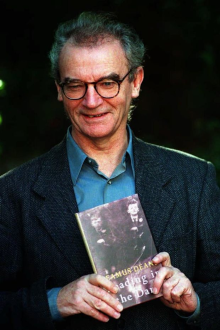
Seamus Francis Deane, Irish poet, novelist, critic, and intellectual historian, is born in Derry, County Londonderry, Northern Ireland on February 9, 1940. He is noted for his debut novel, Reading in the Dark, which wins several literary awards and is nominated for the Booker Prize in 1996.

Deane is the fourth child of Frank Deane and Winifred (Doherty) and is brought up as part of a Catholic nationalist family. He attends St. Columb’s College in his hometown, where he befriends fellow student Seamus Heaney. He then attends Queen’s University Belfast (BA and MA) and Pembroke College, Cambridge (PhD). Although he too becomes noted for his poetry, he chooses to go into academia instead. He workws as a teacher in Derry, with Martin McGuinness being one of his students. McGuinness later recalls how Deane was “gentle, kind and never raised his voice at all, an ideal teacher who was very highly thought of.”

After graduating from Cambridge, Deane teaches at the Reed College in Portland, Oregon during the 1960s and the University of California, Berkeley during the 1970s. Over the next two decades, he teaches American college juniors part-time at the School of Irish Studies in the Ballsbridge section of Dublin. He is a professor of Modern English and American Literature at University College Dublin (UCD) until 1992. He subsequently relocates to the University of Notre Dame in South Bend, Indiana, as the Donald and Marilyn Keough Chair of Irish Studies, from which he retires as professor emeritus.

Deane is a member of the Royal Irish Academy and a founding director of the Field Day Theatre Company, together with Heaney, Tom Paulin, and David Hammond.

Deane is the co-editor of Field Day Review, an annual journal of Irish studies. He also serves as general editor of the Penguin Classic James Joyce series and of Critical Conditions, a series in Irish Studies which is jointly published by the University of Notre Dame Press and Cork University Press. He co-founds the book series Field Day Files, which contains key works by David Lloyd, Joe Cleary, Marjorie Howes, and Kerby A. Miller.

The first collection of Deane’s poetry, Gradual Wars, is published in 1972 and receives the AE Memorial Award for Literature. His first novel, Reading in the Dark, is published in 1996 and is partly autobiographical. It wins the 1996 Guardian Fiction Prize and the 1996 South Bank Show Award for Literature, is a New York Times Notable Book, wins The Irish Times International Fiction Prize and the Irish Literature Prize in 1997, besides being shortlisted for the Booker Prize in 1996. The novel is translated into more than twenty languages. He is also the general editor of the monumental Field Day Anthology of Irish Writing, which is 4,000 pages long and whose first volumes are released in 1990. It is later criticised for excluding the voices and experiences of Irish women. He responds to this by stating, “To my astonishment and dismay, I have found that I myself have been subject to the same kind of critique to which I have subjected colonialism … I find that I exemplify some of the faults and erasures which I analyse and characterize in the earlier period.”

Deane’s first marriage is to Marion Treacy. Together, they have four children. He is in a civil partnership with Emer Nolan until his death. They have one child together.

Following a short illness, Deane dies at the age of 81 on May 12, 2021 at Beaumont Hospital in Dublin.


Leave a comment

Birth of Rev. William Corby, Chaplain & Notre Dame President

The Rev. William Corby, American priest of the Congregation of Holy Cross and Union Army chaplain in the American Civil War attached to the Irish Brigade, is born in Detroit, Michigan on October 2, 1833. He serves twice as president of the University of Notre Dame.

Corby is born to Daniel Corby, an Irish immigrant, and his wife Elizabeth, a Canadian. He attends public school until age 16, then joins his father’s real estate business. In 1853, he enrolls in the 10-year-old college of Notre Dame in South Bend, Indiana, and begins study for the priesthood three years later. Following ordination, he teaches at Notre Dame and serves as a local parish priest.

Corby leaves his position at Notre Dame and joins the predominately Catholic Irish Brigade in 1861. He spends the next three years as chaplain of the 88th New York Volunteer Infantry, which is one of the five original regiments in the Irish Brigade. He is perhaps best known for giving general absolution to the Irish Brigade on the second day of the Battle of Gettysburg. Of the Brigade’s original 3,000 men, only about 500 remain. Of the men Corby absolves that day, 27 are killed, 109 are wounded, and 62 are listed as missing. The scene of Corby blessing the troops is depicted in the 1891 painting Absolution under Fire by Paul Wood, and dramatized in the 1993 film Gettysburg. His memoir of the Irish Brigade becomes a best-seller.

Following his service in the Civil War, Corby returns to Notre Dame and serves as its vice-president (1865–1866) and twice as its president (1866–1872, 1877-1881). Under his first administration, enrollment at Notre Dame increases to more than 500 students. In 1869 he opens the law school, which offers a two-year course of study, and in 1871 he begins construction of Sacred Heart Church, today the Basilica of the Sacred Heart, Notre Dame. The institution is still small, and he teaches in the classroom and knows most students and faculty members. In 1869, the entire student body and the faculty present him with the gift of a black horse and, when he leaves the presidency three years later, they present him with a matching carriage.

Corby becomes president again following the short term of Fr. Patrick Colovin. When he returns to the presidency, Notre Dame has not yet become a significant academic institution. His presidency sees the April 1879 fire that destroys the old Main Building of the school. He sends all students home and promises that they will return to a “bigger and better Notre Dame.” He overcomes the $200,000 fire loss and rebuilds the Main Building, which now stands with its “Golden Dome.” During his administration, he also constructs Washington Hall, in which he takes much pride, and starts the construction of St. Edward’s Hall for the minims program.

In addition to his presidency, Corby is also serving as the Holy Cross Provincial, when Rev. Edward Sorin, who had become Superior General of the Congregation, writes to him to tell him that he will have to relinquish one of his positions. He wants to remain president but is overruled by Sorin. Famous throughout the U.S. Catholic world as chaplain for the Irish Brigade, known as the “Fighting Irish,” it may be that the nickname followed Corby back to Notre Dame, where it stuck.

Corby dies at the age of 64 on December 28, 1897 in South Bend, Indiana. He is buried in Holy Cross Cemetery, Notre Dame, Indiana.

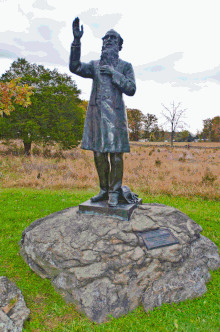
A statue by Samuel Murray, depicting Corby with right hand raised in the gesture of blessing, stands upon the same boulder at the Gettysburg Battlefield on which the priest stood while blessing the troops that second morning of the battle. It is the first statue of a non-general erected on the Gettysburg Battlefield, and is dedicated in 1910.

Corby is widely remembered among military chaplains and celebrated by Irish American fraternal organizations. Corby Hall at Notre Dame is named for him, and a copy of the Gettysburg statue stands outside the building. An organization of Notre Dame alumni is named The William Corby Society.

(Pictured: Statue of Father William Corby by Samuel Murray, Gettysburg Battlefield, Gettysburg, Pennsylvania)