In 1992, Flanagan returns to duty with the RUC as Assistant Chief Constable of Operations, later taking on the responsibilities of Operational Commander for Belfast. He is appointed as head of Special Branch in 1994 and is promoted to Acting Deputy Chief Constable the following year. He becomes the Deputy Chief Constable proper in 1996, and when Chief Constable Hugh Annesley retires later that year, he succeeds him. When the PSNI is established in 2001, he serves as Chief Constable until his retirement the following year. He is replaced by Hugh Orde.
Since then Flanagan has served in Her Majesty’s Inspectorate of Constabulary and is appointed as HM Chief Inspector of Constabulary in 2005. He is tasked to review the police arrangements in Iraq in December 2005 as part of the British involvement there. Following his retirement in December 2008, Denis O’Connor succeeds him as Her Majesty’s Acting Chief Inspector of Constabulary.
Flanagan denies any wrongdoing or acting with any knowledge of the events in question. He agrees that these events had taken place. In the aftermath of the ombudsman’s report, Irish nationalist politicians say he should be forced to resign from his job as Chief Inspector of Constabulary.
The Police Ombudsman criticises Flanagan’s role in the RUC inquiry into the Omagh Bombing of August 15, 1998, in a report published in 2001, to which his response is that he would “publicly commit suicide” if he believed her report was correct, though he later apologises for the form of words he used.
In July 2010, Flanagan appears before the Iraq Inquiry into the UK’s role in the Iraq War. In 2005, he had conducted a review into the UK’s contribution to policing reform in Iraq. As he gives evidence, he has to apologise for the amount of acronyms in his report on Iraq, which is presented to the government in January 2006:
“In my view, and I would like to almost apologise for the number of acronyms in this report – but it wasn’t written with a view to being read publicly. It was written for the people who invented the acronyms…”
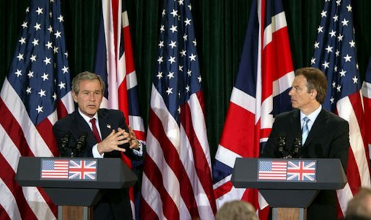
The two leaders meet at Hillsborough Castle and begin their sessions on April 7 with a half-hour walk through the gardens before dinner. The following day they hold a press conference and further talks, including a session on the Northern Ireland peace effort.
Bush and Blair, Bush’s closest ally in confronting Saddam Hussein, come together to discuss questions made increasingly urgent by the rapid military progress American and British forces have made and to plan for a postwar Iraq. They seek to bridge their differences over how much of a role to give the United Nations in rebuilding the country and putting together a new government.
Blair has been under pressure at home and from much of Europe to support giving the United Nations a strong role in stabilizing Iraq. The White House, however, has consistently signaled that it wants the United States and Britain to play the lead role in creating a new Iraqi government.
United States Secretary of StateColin L. Powell tells reporters traveling with the president that the United States is sending officials to the region to begin assembling a group of Iraqis who will constitute an interim governing authority and will be put in place alongside the American-led military and civilian authorities. In a sign of the speed with which the maneuvering for power in post-Hussein Iraq is unfolding, Ahmed Chalabi, the leader of the main Iraqi exile opposition group, the Iraqi National Congress (INC), is reported to be heading to Baghdad from southern Iraq.
“The hostilities phase is coming to a conclusion,” Powell says. “It’s time for all of us to think about the post-hostilities phase, how we create a representative government consisting of all elements of Iraqi society.”
Powell and British officials play down the magnitude of the differences between the United States and Britain over the United Nations role. The United Nations, Powell says, will have “an endorsing role to play to the interim authority to give it legitimacy,” a formulation that appears to reserve for the United States and Britain the right to select the leaders of the temporary postwar administration. A spokesman for Blair uses similar language, referring to the United Nations’ being involved “in a way that endorses that new Iraqi authority” as a step toward establishing a full-fledged Iraqi government.
Initially, primary responsibility for administering Iraq would rest with a team led by a retired United States Armylieutenant general, Jay Garner, and the interim Iraqi authority would be likely to begin assuming power after that, perhaps 90 days later, the British spokesman says.
Clearly wary of getting into another diplomatic squabble with other members of the United Nations Security Council, Powell and other administration officials have emphasized in recent days that the United States and Britain, having waged the war and paid for it with blood and money, will not be drawn into a negotiation with countries like France and Germany over the immediate postwar period.
Powell emphasizes, however, that part of his focus will now be on “healing” diplomatic wounds and granting the United Nations an important role once Iraq is stabilized.
At the United Nations, Secretary-GeneralKofi Annan says he will travel to Britain, France, Germany and Russia in the coming week to test whether the Security Council might be able to agree on a postwar plan. He announces that he has been working on post-conflict issues with a special adviser, Rafeeuddin Ahmed. He says he expects the United Nations to play an important role, whether as a political facilitator or dealing with issues like reconstruction or human rights. “Above all, the U.N. involvement does bring legitimacy, which is necessary, necessary for the country, for the region and for the peoples around the world,” Annan says.
Bush’s trip to see Blair here is the third British-American summit meeting in as many weeks. It coincides with news that American forces are attacking the presidential palaces and other symbols of the Iraqi government in the heart of Baghdad and that British soldiers have taken control of Iraq’s second-largest city, Basra.
The presence of the two leaders draws crowds of antiwar protesters and set off a local debate about whether this city, which has been trying to put behind it a history of sectarian violence, is an appropriate location for a war council.
The city authorities in Belfast have to divert traffic and clear public buildings in various locations following a series of bomb scares. The scenes are reminiscent of the conflicted time before the Northern Ireland peace agreement in 1998 put an end to organized sectarian violence that cost the lives of more than 3,600 people over three decades.
In the conversations about Iraq, Blair plays his customary role of trying to bridge trans-Atlantic differences. He hopes to placate criticism at home and ease relations with his European neighbors by pushing for a United Nations resolution authorizing an interim governing authority.
He had earlier envisaged a more prominent role for the United Nations, but he emerged from his last meeting with Bush, at Camp David on March 27, emphasizing the need for the United Nations to endorse the transition plans rather than play a central part in the plans, as he had advocated at the first summit meeting, in the Azores on March 16.
Europeans express alarm at what they see as the marginalization of the United Nations. At the same time, European critics of the war, like France, Germany and Russia, may object to Blair’s compromise proposal on grounds that it legitimizes a war they oppose. Even in Britain, the one European country where the war has majority support, there is great resistance to American domination of the postwar running of Iraq. An opinion poll in The Daily Telegraph shows that while Britons’ enthusiasm for the war has grown to a high of 60 percent and their approval of Blair’s conduct has also risen, there is only 2 percent approval of an American-controlled administration of Iraq.
Powell says the United States is only trying to lay out a plan under which military control of Iraq can give way to a mix of civilian and military control, including substantial involvement by Iraqis, and then to a full-fledged government. He says United Nations involvement might be necessary to convince banks and financial markets that they can safely and legally lend money to Iraq. Asked about peacekeeping duties, he says NATO is open to the possibility of helping to provide postwar security or assisting in the search for weapons of mass destruction.
Planning for the peace has exposed differences not only between the United States and Britain, but also within the Bush administration and between the administration and Congress.
Blair chose to hold his meeting with Bush in Northern Ireland in part so that the president can lend his support to the long-running efforts by Britain and Ireland to find a peaceful solution to the strife between Catholics and Protestants in the province. The White House, however, seems not to be paying much attention to Northern Ireland diplomacy. The schedules and credentials it distributes to reporters list the site as “Belfast, Ireland.”
(From: “Bush Meets With Blair to Discuss Postwar Iraq” by Richard W. Stevenson and Warren Hoge, The New York Times, http://www.nytimes.com, April 8, 2003)
Wallace is born into a family of twelve children. He graduates from University College Dublin (UCD) with a teaching qualification. He marries Mary Murphy from Duncormick, County Wexford, in 1979. The couple has two sons, but the marriage ends when the children are young. He has two more children from another relationship in the 1990s.
Prior to entering politics, Wallace owns a property development and construction company completing developments such as the Italian Quarter in the Ormond Quay area of the Dublin quays. The company later collapses into liquidation, with him finally being declared bankrupt on December 19, 2016.
On December 15, 2011, Wallace helps to launch a nationwide campaign against the household charge which is introduced as part of the 2012 Budget.
Wallace is the listed officer of the Independents 4 Change, which is registered to stand for elections in March 2014 and, along with Clare Daly, is one of two MEPs which represent the party in the European parliament. During their time in the Dáil, Wallace and Daly, the Dublin North TD, become friends and political allies, and work together on many campaigns, including opposition to austerity and highlighting revelations of alleged Garda malpractices, including harassment, improper cancellation of penalty points and involvement of officers in the drug trade. They are partially active in protesting the Garda whistleblower scandal, which eventually leads to the resignation of Minister for JusticeFrances Fitzgerald, although she is later cleared of wrongdoing by the Charleton Tribunal.
In July 2014, Wallace and Daly are arrested at Shannon Airport while trying to board a U.S. military aircraft. He says the airport is being used as a U.S. military base and that the government should be searching the planes to ensure that they are not involved in military operations or that there are no weapons on board. He is fined €2,000 for being in an airside area without permission and chooses not to pay. He is sentenced to 30 days in prison in default, and in December 2015 is arrested for non-payment of the fine.
In December 2015, Wallace and independent TDs Clare Daly and Maureen O’Sullivan each put forward offers of a €5,000 surety for a man charged with membership of an unlawful organisation and with possession of a component part of an improvised explosive device.
At the 2016 Irish general election, Wallace stands as an Independents 4 Change candidate and is re-elected, finishing third on the first-preference count with 7,917 votes.
In 2017, Wallace calls on Ireland to join the Boycott, Divestment and Sanctions movement against Israel and “condemn the illegal expansion of Israeli settlements on Palestinian lands as well as the ongoing human rights abuses against Palestinians.”
Wallace is criticised for supporting Venezuela, Ecuador, China, Russia, Belarus and Syria during his period as an MEP. In November 2020, he refers to Belarusian opposition presidential candidate Svetlana Tikhanovskaya as a “pawn of western neoliberalism.” In February 2021, he is reprimanded for using a swear word during a session of the European Parliament. He has referred to Venezuelan opposition leader Juan Guaidó as being an “unelected gobshite.”
In April 2021, Wallace and Daly are called “embarrassments to Ireland” by Fianna Fáil‘s Malcolm Byrne after the two MEPs had travelled to Iraq and visited the headquarters of the Popular Mobilization Forces, an Iraqi militia supported by Iran.
Wallace questions the director general of the Organisation for the Prohibition of Chemical Weapons (OPCW), Fernando Arias, in the European Parliament in April 2021. He accuses the OPCW of falsely blaming the government of Bashar al-Assad for the 2018 Douma chemical attack. He says that, while he does not know what had happened in Douma, the White Helmets were “paid for by the U.S. and UK to carry out regime change in Syria.” Fianna Fáil’s Barry Andrews calls his accusation against the White Helmets a conspiracy theory and disinformation. French MEP Nathalie Loiseau describes his comments as “fake news” and apologises on his behalf to NGO groups in Syria.
In June 2021, Wallace and Daly are among the MEPs censured by the European Parliament’s Democracy Support and Election Coordination Group for acting as unofficial election-monitors in the December 2020 Venezuelan parliamentary election and April 2021 Ecuadorian general election without a mandate or permission from the EU. They are barred from making any election missions until the end of 2021. They are warned that any further such action may result in their ejection from the European parliament under the end of their terms in 2024.
Wallace has stated his opposition to vaccination certificates. He says, “I’m not anti-vax but we’re going down a dangerous path with COVID pass” and expresses concerns about civil liberties. Both Wallace and Daly have refused to present vaccination certs upon entering the European Parliament, resulting in them being reprimanded by the European Parliament.
In April 2022, Wallace and Daly initiate defamation proceedings against RTÉ.
In November 2022, Wallace criticises protests in Iran following the death of Mahsa Amini, accusing some protestors of violence and destruction and saying it “would not be tolerated anywhere.”
In February 2023, Wallace claims on social media that he has “three wine bars in Dublin.” This arouses alarm from his European parliamentary group, as no such assets were listed on his mandatory declaration of financial interests. After the chair of his parliamentary group calls any omission from the declaration “unacceptable” and not “worthy of our political group,” he amends his declaration to state that he is an “advisor” to the three wine bars and receives up to €500 a month in income for this role.
McCourt is the son of Irish parents Angela (née Sheehan) and Malachy McCourt. He is the last survivor of their seven offspring, following the death of his younger brother Alphonsus in 2016. He is raised in Limerick, County Limerick, and returns to the United States in 1952. He has four children: Siobhán, Malachy III, Conor, and Cormac, the latter two by his second wife, Diana. He also has a stepdaughter, Nina. He is portrayed by Peter Halpin in the film version of his brother’s memoir Angela’s Ashes. He is also one of the four founding members of the Manhattan Rugby Football Club in 1960. He appears in Frank McCourt’s memoirs.
In 1970, McCourt releases an album, And the Children Toll the Passing of the Day. Also, in the 1970s he hosts a talk show on WMCA.
In recent years McCourt occasionally appears on various programs on New York City’s political radio station, WBAI. Among the shows on which he appears is Radio Free Éireann. He is also a regular guest artist at the Scranton Public Theatre in Pennsylvania, having performed in Inherit the Wind, Love Letters and A Couple of Blaguards, which he co-wrote with brother Frank McCourt. Currently, he has been hosting a call-in radio forum on WBAI, airing on Sunday mornings at 11:00 a.m. He also has a short-lived role as a Catholic priest on the HBO prison drama Oz. He is the owner of Malachy’s, a bar on Third Avenue in New York City. One of his frequent patrons was actor, and friend, the late Richard Harris, who although famous works for a short time behind the bar for McCourt. He plays Francis Preston Blair in Gods and Generals (2003).
McCourt has written two memoirs titled, respectively, A Monk Swimming and Singing My Him Song, detailing his life in Ireland and his later return to the United States. He has also authored a book on the history of the ballad Danny Boy, and put together a collection of Irish writings, called Voices of Ireland.
On April 18, 2006, McCourt announces that he will run as a Green Party candidate to become governor of New York in the November 2006 election. Running under the slogan “Don’t waste your vote, give it to me,” he promises to recall the New York National Guard from Iraq, to make public education free through college, and to institute a statewide comprehensive “sickness care” system. He polls at 5% in an October 10 Zogby poll, versus 25% for RepublicanJohn Faso and 63% for Democrat Eliot Spitzer. He is endorsed by Cindy Sheehan, mother of a fallen soldier in the Iraq War. The League of Women Voters exclude him from the gubernatorial debate. He comes in a distant third in the general election, receiving 40,729 votes (or just under 1%), 9,271 votes short of what is required to gain automatic access in the 2010 election.
To seek to achieve unity among the Irish people on the issue of restoring national sovereignty and to promote the revolutionary ideals of republicanism and to this end involve itself in resisting all forms of colonialism and imperialism.
To seek the immediate and unconditional release of all Irish republican prisoners throughout the world.
The 32CSM does not contest elections but acts as a pressure group, with branches, or cumainn, organised throughout the traditional counties of Ireland. It has been described as the “political wing” of the now defunct Real Irish Republican Army (Real IRA or RIRA), but this is denied by both organisations. The group originates in a split from Sinn Féin over the Mitchell Principles.
The organisation is founded on December 7, 1997, at a meeting of like-minded Irish republicans in the Dublin suburb of Finglas. Those present are opposed to the direction taken by Sinn Féin and other mainstream republican groups in the Northern Ireland peace process, which eventually leads to the Good Friday Agreement, also known as the Belfast Agreement, the following year. The same division in the republican movement leads to the paramilitary group now known as the Real IRA breaking away from the Provisional Irish Republican Army at around the same time.
Most of the 32CSM’s founders had been members of Sinn Féin, with some having been expelled from the party for challenging the leadership’s direction, while others felt they had not been properly able to air their concerns within Sinn Féin at the direction its leadership had taken. Bernadette Sands McKevitt, wife of Michael McKevitt and a sister of hunger strikerBobby Sands, is a prominent member of the group until a split in the organisation.
The name refers to the 32 counties of Ireland which were created during the Lordship of Ireland and Kingdom of Ireland. With the partition of Ireland in 1920–22, twenty-six of these counties form the Irish Free State which is abolished in 1937 and is now known as Ireland since 1949. The remaining six counties of Northern Ireland remain part of the United Kingdom. Founder Bernadette Sands McKevitt says in a 1998 interview with The Mirror that people did not fight for “peace” – “they fought for independence” – and that the organisation reaffirms to the republican position in the 1919 Irish Declaration of Independence.
Before the referendums on the 1998 Good Friday Agreement, the 32CSM lodges a legal submission with the United Nations challenging British sovereignty in Ireland. The referendums are opposed by the 32CSM but are supported by 71% of voters in Northern Ireland and by 94% in the Republic of Ireland. It is reported in February 2000 that the group had established a “branch” in Kilburn, London.
In November 2005, the 32CSM launches a political initiative titled Irish Democracy, A Framework for Unity.
On May 24, 2014, Gary Donnelly, a member of the 32CSM, is elected to the Derry and Strabane super council. In July 2014, a delegation from the 32CSM travels to Canada to take part in a six-day speaking tour. On arrival the delegation is detained and refused entry into Canada.
In 2015, the 32CSM organises a demonstration in Dundee, Scotland, in solidarity with the men convicted of shooting Constable Stephen Carroll, the first police officer to be killed in Northern Ireland since the formation of the PSNI. The organisation says the “Craigavon Two” are innocent and are victims of a miscarriage of justice.
The 32CSM also operates outside of the island of Ireland to some extent. The Gaughan/Stagg Cumann covers England, Scotland and Wales, and has an active relationship of mutual promotion with a minority of British left-wing groups and anti-fascist organisations. The James Larkin Republican Flute Band in Liverpool and the West of Scotland Band Alliance, the largest section of which is the Glasgow-based Parkhead Republican Flute Band, are also supporters of the 32CSM. As of 2014, the 32CSM’s alleged paramilitary wing, the Real IRA, is reported to still be involved in attempts to perpetrate bombings in Britain as part of the dissident Irish republican campaign, which has been ongoing since 1998.
The 32CSM is currently considered a foreign terrorist organization (FTO) in the United States, because it is considered to be inseparable from the Real IRA, which is designated as an FTO. At a briefing in 2001, a spokesman for the U.S. Department of State states that “evidence provided by both the British and Irish governments and open-source materials demonstrate clearly that the individuals who created the Real IRA also established these two entities to serve as the public face of the Real IRA. These alias organizations engage in propaganda and fundraising on behalf of and in collaboration with the Real IRA.” The U.S. Department of State’s designation makes it illegal for Americans to provide material support to the Real IRA, requires U.S. financial institutions to block the group’s assets and denies alleged Real IRA members travel visas into the United States.
On April 19, 2003, Bono, the lead singer of the Irish rock band U2, surpasses competition from British Prime MinisterTony Blair and French PresidentJacques Chirac to become Europe’s greatest hero. Already laden down with similar honours, he is picked by online voters from a list of 36 other Europeans compiled by the prestigious Time magazine.
Bono’s work for the starving starts with Band Aid in 1984 but develops over the years into a crusade lobbying world leaders and trying to reduce Third World debt.
“There are potentially another ten Afghanistans in Africa, and it is cheaper by a factor of 100 to prevent the fires from happening than to put them out. Look, I know how absurd it is to have a rock star talk about debt relief or HIV/AIDS in Africa. But if not me, who?” Bono says.
Caoimhe Butterly, a 24-year-old from Dublin, is also nominated by Time editors for her role as a peace activist, which resulted in her being shot at by Israeli troops. “I don’t really think the concept of heroes is helpful, but if my inclusion helps highlight the cause of people struggling against oppression, then it’s of some good,” Butterly says. She expects to go to Iraq in the near future “to further the struggle against oppression.”
The third Irish person on the list is 58-year-old Christina Noble whose torrid childhood leads her to work on behalf of impoverished street children in Asia. She survives tuberculosis, hunger, homelessness, beatings, molestation by relatives, institutionalisation and a gang rape. She starts her foundation‘s work in Vietnam in 1989 and Mongolia in 1997.
In Vietnam, where she is known fondly as Mama Tina, her foundation has 50 projects providing education, food and clean water for children. “We’re tools. We help a little. You don’t need brains or brawn to do that. You just need the heart of a survivor,” Noble says.
Margaret Hassan, Irish-born aid worker also known as “Madam Margaret,” is born Margaret Fitzsimons in Dalkey, County Dublin on April 18, 1945. She works in Iraq for many years until she is abducted and murdered by unidentified kidnappers in Iraq in 2004. Her remains have never been recovered.
Soon after the end of World War II Hassan’s family moves to London, where she spends most of her early life and where her younger siblings are born. At the age of 27, she marries Tahseen Ali Hassan, a 29-year-old Iraqi studying engineering in the United Kingdom. She moves to Iraq with him in 1972, where she begins work with the British Council of Baghdad, teaching English. Eventually she learns Arabic and becomes an Iraqi citizen.
During the early 1980s, Hassan becomes the assistant director of studies at the British Council, later becoming director. Meanwhile, her husband works as an economist. She remains in Baghdad during the 1991 Gulf War, although the British Council suspends operations in Iraq, and she is left jobless at the end of it.
Hassan joins humanitarian relief organisation CARE International in 1991. Sanitation, health, and nutrition become major concerns in the sanctioned Iraq. She is crucially involved in bringing leukemia medicine to child cancer victims in Iraq in 1998. She becomes a vocal critic of the United Nations restrictions. She is opposed to the United States invasion of Iraq in 2003, arguing that the Iraqis are already “living through a terrible emergency. They do not have the resources to withstand an additional crisis brought about by military action.”
By 2004, Hassan is head of Iraqi operations for CARE. Well known in many of Baghdad’s slums and other cities, she is especially interested in Iraq’s young people, whom she calls “the lost generation.” Her presence draws large crowds of locals.
Hassan is kidnapped in Baghdad on October 19, 2004, and is killed some weeks later on November 8. In a video released of her in captivity she pleads for help and begs British Prime MinisterTony Blair to remove British troops from Iraq. She adds that she does not “want to die like Mr. Bigley,” a reference to Kenneth Bigley, who had been executed in Iraq only weeks earlier.
Patients of an Iraqi hospital take to the streets in protest against the hostage takers’ actions. On October 25, between 100 and 200 Iraqis protest outside CARE’s offices in Baghdad, demanding her release. Prominent elements of the Iraqi insurgency and Iraqi political figures condemn the kidnapping and call for her release. On November 2, Al Jazeera reports that the kidnappers threatened to hand her over to the group led by Abu Musab al-Zarqawi and who is responsible for the execution of Bigley. On November 6, a statement purportedly from al-Zarqawi appears on an Islamist website calling for the release of Hassan unless the kidnappers have information she is aligned with the invading coalition. The statement cannot be authenticated and Hassan’s whereabouts in the video are unknown.
On 15 November, U.S. Marines in Fallujah uncover the body of an unidentified blonde- or grey-haired woman with her legs and arms cut off and throat slit. The body cannot be immediately identified, but is thought unlikely to be Hassan, who has brown hair. There is one other western woman known missing in Iraq at the time the body is discovered, Teresa Borcz Khalifa, a Polish-born long-time Iraqi resident. Khalifa is released by her hostage takers on November 20.
On November 16, CNN reports that CARE has issued a statement indicating that the organisation is aware of a videotape showing Hassan’s execution. Al-Jazeera reports that it has received a tape showing Hassan’s murder but is unable to confirm its authenticity. The video shows Hassan being shot with a handgun by a masked man. It is not known who is responsible for Hassan’s abduction and murder. The group holding her never identifies itself in the hostage videos.
CARE International suspends operations in Iraq because of Hassan’s kidnapping. At least eight other women kidnapped by insurgents during the conflict are released unharmed by their captors. It is unclear why Hassan, who was opposed to the war, lived in Iraq for many years, held Iraqi citizenship, was married to an Arab Muslim and spoke fluent Arabic was killed.
On May 1, 2005, three men are questioned by Iraqi police in connection with the murder. On June 5, 2006, news reports emerge that an Iraqi man by the name of Mustafa Salman al-Jubouri has been sentenced to life imprisonment for “aiding and abetting the kidnappers” but two other men are acquitted. Al-Jubouri appeals this sentence and is given a shorter imprisonment.
An Iraqi man named Ali Lutfi Jassar al-Rawi, also known as Abu Rasha, an architect from Baghdad, is arrested by Iraqi and U.S. forces in 2008 after contacting the British Embassy in Baghdad and attempting to extort 1 million dollars in return for disclosing the location of Hassan’s body. Though Jassar signs statements confessing to the charges, he pleads not guilty, stating he was forced to sign them after receiving beatings and electrical shocks during questioning.
On June 2, 2009, the Press Association reports that Jassar is given a life sentence by Baghdad’s Central Criminal Court for being involved in Hassan’s abduction and murder, and for attempting to blackmail the British Embassy. Hassan’s family welcomes the court’s decision but pleads with Jassar to tell them where her body is so they can return her to Britain for burial. On July 14, 2010, a day before Jassar is due to appear in court for retrial, it is reported that he could not be located in the prison facility where he was being held. He had been missing for a month.
The Games are hosted in Dublin, with participants staying in 177 towns, cities and villages and the Aran Islands in the lead up to the Games before moving to Dublin for the events. Events are held from June 21-29, 2003 at many venues including Morton Stadium, the Royal Dublin Society, the National Basketball Arena, all in Dublin. Croke Park serves as the central stadium for the opening and closing ceremonies, even though no competitions take place there. Belfast is the venue for roller skating events at the King’s Hall, as well as the Special Olympics Scientific Symposium held on June 19-20.
Approximately 7,000 athletes from 150 countries compete in the Games in 18 official disciplines and three exhibition sports. The participants from Kosovo are the region’s first team at an international sporting event. A 12-member team from Iraq receives special permission to attend the games, despite ongoing war in their home nation. This is the largest sporting event held in 2003.
The Games Flame is lit at the culmination of the Law Enforcement Torch Run, in which more than 2,000 members of the Garda Síochána and the Police Service of Northern Ireland participate. This is a series of relays carrying the Special Olympics Torch, the “Flame of Hope,” from Europe to the Games’ official opening.
The 2003 Games are the first to have their opening and closing schemes broadcast on live television, and Raidió Teilifís Éireann provides extensive coverage of the events through their ‘Voice of the Games’ radio station which replaces RTÉ Radio 1 on medium wave for the duration of the event. There is also a nightly television highlight programme. A daily newspaper, the Games Gazette, was published for each day of the Games.
Among the activities carried out during the Games are thorough medical checks on the athletes, some of whom have previously undiagnosed conditions uncovered, as some of the athletes come from countries with limited medical facilities or have difficulty communicating their symptoms.
The United States and the UK are forced to push back their plans for a second UN resolution on military action as more countries come out against the use of force in Iraq. Mary Robinson, the former United Nations High Commissioner for Human Rights, says she is fearful of the consequences of a war without UN backing.
In an interview with RTÉ News Ahern says the most important issue for this country is the primacy of the United Nations. He disagrees with the United States on whether or not they legally needed another UN Resolution before launching an attack on Iraq. He says other countries, including Ireland, have another point of view.
The Fianna Fáil parliamentary party unanimously passes a motion calling for a second resolution from the United Nations Security Council prior to the consideration of military action against Iraq. The motion also expresses “full confidence” in the efforts of the Taoiseach and the Minister for Foreign Affairs, Brian Cowen, to reach a peaceful outcome to the crisis.
The leading United States Congressman, Jim Walsh, welcomes the support that the Taoiseach has given to the United States in relation to Iraq. After a meeting with Sinn Féin in Belfast earlier in the day, he says that he recognises that it is a difficult time for the Irish people.
In the meantime, the UK has told its nationals in Iraq to leave the country immediately. In a statement the British Foreign & Commonwealth Office (FCO) says it has issued the alert because of increasing tension in the region and the risk of terrorist action. The office says anyone considering going to Iraq should remember that UK nationals were held hostage by the Baghdad government in the run-up to the 1991 Gulf War.
The British embassy in Kuwait City advises its citizens to leave Kuwait unless their presence in the emirate is essential. It also orders dependants of embassy staff to leave. “We advise you not to make any non-essential travel including holiday travel to Kuwait and, if already in Kuwait, to leave unless you consider your presence there is essential,” the embassy says in an advisory note.
An estimated 4,000 British nationals are resident in Kuwait. Britain has no diplomatic relations with President Saddam Hussein’s regime, and therefore cannot give consular assistance to British nationals inside Iraq. The current travel advisory for Israel warns against “any non-essential travel including holiday travel.”
(From: “More countries call for second UN Resolution” by RTÉ News, originally published Wednesday, February 19, 2003)
Donal Billings of St. Bridget’s Court in Drumlish, County Longford, a 66-year-old man who put a bomb on a bus during Britain’s Queen Elizabeth‘s visit to Ireland in May 2011, is convicted on December 15, 2016 at the Special Criminal Court of possessing explosives and is sentenced to eight-and-a-half years in prison.
Justice Tony Hunt describes it as an outrageous, dangerous and highly irresponsible act, which recklessly exposed the 31 people on the bus, as well as the emergency services, to the very significant risk of injury or death. He says it was no thanks to Billings that this did not occur.
The court hears that on May 16, 2011, following a phone call to LongfordGarda station, gardaí stopped a bus travelling from Ballina to Dublin at Maynooth. They find a well-made bomb in a bag in the luggage hold with gunpowder, petrol, a timing power unit, battery and a fuse, which if it had exploded could have caused seriously injured or killed the passengers and driver. Threats were also made that there were bombs on another bus and at the Sinn Féin headquarters in Dublin but none were found.
Billings is identified as the caller though phone records, notes, a SIM card and a mobile phone. Two days later he makes another call saying that two mortars have been left in Dublin Castle set for 8:00 PM, during the State banquet for the queen. “I am a member of the Republican Brotherhood Squad A”, he says. “This is for the Queen of Blood, War in Iraq.” Because of the first bomb, the threat is taken very seriously, but no more explosive devices are found.
Two days later a third call threatens there are two more bombs in the toilets in Cork Airport, but again nothing is found.
Billings is identified as a suspect that day and put under surveillance before being arrested at a supermarket car park in Longford. He tells gardaí he had found the SIM card in the car park.
Following the trial, during which interpreters are used to translate proceedings into Irish, Billings is convicted of making bomb threats and possessing explosives. He has previous convictions for possessing explosives in Northern Ireland in 1973 and is sentenced to eight years in prison. He also spent four years in Libya.
(From: “Man sentenced over bomb on bus during Queen Elizabeth’s visit,” RTÉ.ie, the website of Raidió Teilifís Éireann, Thursday, December 15, 2016)





 seamus dubhghaill