seamus dubhghaill

Promoting Irish Culture and History from Little Rock, Arkansas, USA


Leave a comment

Death of Charles O’Brien, 5th Viscount Clare

charles_o_brien

Charles O’Brien, 5th Viscount Clare, is mortally wounded in the Battle of Ramilles on May 23, 1706. He is the son of Daniel O’Brien, 3rd Viscount Clare and Philadelphia Lennard. He marries Charlotte Bulkeley, daughter of Henry Bulkeley and Sophia Stuart, on January 9, 1696, at Saint-Germain-en-Laye, France. Henry Bulkeley is the “Master of the Household” for Kings Charles II and James II. Charles O’Brien and Charlotte Bulkeley have two children, Charles O’Brien, 6th Viscount Clare (March 27, 1699 – September 9, 1761) and Henry O’Brien (born February 12, 1701).

The family fights as part of the Jacobite Irish Army during the War of the Two Kings, before going into exile in the Flight of the Wild Geese. Charles succeeds his brother, Daniel O’Brien, 4th Viscount Clare, to the title as 5th Viscount Clare in the Jacobite Peerage on his brother’s death from a mortal wound received in the Battle of Marsaglia in Italy on October 4, 1693. Charles is transferred from the Queen’s Dismounted Dragoons where he is a colonel, to the command of O’Brien’s Regiment on April 6, 1696. Later in the year he leads the regiment in the siege of Valenza in Lombardy, and the next year they are stationed with the army at Meuse.

By 1698 over one third of King James’ army is either dead or crippled, and when the Treaty of Ryswick ends the war between Louis and William, James’ soldiers are disbanded, unemployed, and homeless. Many become beggars but others join the Irish Brigade in the Spanish army, while others travel to Austria and enter the Catholic Corps.

Hostilities are renewed and Clare’s Regiment is assigned to the Army of Germany for two years in 1701-02. At the Battle of Cremona in 1702, the Irishmen defend the town against Prince Eugene and the imperial army. The attack is to be a surprise, but the Wild Geese foil the attempt. The following year Lord Clare is promoted to brevet Brigadier of Infantry on April 2, 1703. A few months later on September 20, 1703, the unit takes part in the successful Battle of Hochstedt, better known as the Battle of Blenheim. A year later the unit is involved with the unsuccessful battle on August 13, 1704, at the second Battle of Blenheim. Although Clare’s Regiment experiences ups and downs, they are always admired. Two months after Blenheim, Charles rises to the brevet rank of Marshal-de-Camp on October 26, 1704, and a year later he is assigned to the Army of the Moselle under the Marshel de Villars. Clare’s Regiment fights in the disastrous Battle of Ramillies on May 23, 1706, where they distinguish themselves with great glory, but Lord Clare is mortally wounded and dies at Brussels, Belgium.

Due to the great service the O’Brien family has given to France, and having risked all, King Louis XIV makes sure that the regiment is kept in the family and appoints Lt. Col. Murrough O’Brien (of the Carrigonnell O’Brien’s) as its commander until the minor Charles comes of age.


18 Comments

Execution of James Cotter the Younger

cotter-family-burial-spot

James Cotter the Younger, the son of Sir James Fitz Edmond Cotter who had commanded King James‘s Irish Army forces in the Counties of Cork, Limerick, and Kerry, and Eleanor/Ellen Plunkett, daughter of Matthew, 7th Baron Louth, is executed on May 7, 1720, for high treason in supporting the Jacobite cause. His death is seen by many, especially within the Catholic population of Ireland, as a form of political assassination.

At the time of his death Cotter is seen, like his father before him, as the natural leader of the Catholics of Cork. He is also a prominent patron of poetry and other literature in the Irish language. The Irish text Párliament na mBan or ‘The Parliament of Women’ is dedicated by its author, Domhnall Ó Colmáin,’ to a young James Cotter in 1697. As one of the few major landowners of the Catholic faith remaining in Ireland, and as a man of known Jacobite and Tory sympathies he is distrusted by the authorities. He is also held in suspicion by those of his landed neighbours who are part of the Protestant Ascendancy and of Whiggish political views. Amongst his overt political actions, he is believed to play a leading part in the instigation of the election riots of 1713 in Dublin. His trial, ostensibly for rape, is a cause célèbre at the time and widely seen as an example of judicial murder.

Though married, Cotter has a reputation as a ladies’ man. His wealth allows him to flaunt his independence of the Protestant ruling class and anti-Catholic laws of Ireland. These characteristics, allied to his political activities, lead to his downfall. He makes an enemy of a powerful neighbour, Alan Brodrick, 1st Viscount Midleton. Brodrick, it appears, arranges that Cotter be accused of abducting and raping a young Quaker woman named Elizabeth Squibb, reported by some to have been Cotter’s mistress. When news of this trumped-up or exaggerated charge reaches Cork City, the Quakers of the town live in fear of their lives for many weeks. Believing the charge cannot hold up in court, Cotter gives himself up to the Cork sheriff.

The judge presiding on the case is Sir St. John Brodrick who, as a close relative of James Cotter’s accuser, is hardly impartial. The jury has also been packed as all twelve of its members are justices of the peace. The trial takes place in a period of heightened rumour of Jacobite invasion. A large number of arms for cavalry are found in Cork which triggers a scare until it is discovered that they are government owned and intended for a local militia unit. James Cotter is held in jail, though bail has been granted, and is convicted of the crime.

A bizarre element in Cotter’s downfall are the pleas for mercy expressed by both the jury which has convicted him and Elizabeth Squibb, his alleged victim. Attempts to gain a pardon in Dublin are proceeding and a stay of execution is sent, however, the hanging is deliberately brought forward, and the stay does not arrive in time. Cotter has attempted to escape and spends the night before his execution in chains. The gallows erected for the execution are destroyed by some of the citizens of Cork and the hanging is extemporised using a rope attached to a metal staple in a vertical post. James Cotter is hanged in Cork City on May 7, 1720. News of his execution triggers widespread riots on a national scale. He is buried in his family’s vault at Carrigtwohill.

Some have seen the death of James Cotter as the working of a family feud. His father had been intimately involved in the assassination of the regicide John Lisle in Switzerland (1664). The wife of the Lord Lieutenant of Ireland at the time of James Cotter’s trial is a granddaughter of John Lisle.

Up to twenty poems in Gaelic survive which reflect the widespread dismay felt at James Cotter’s execution, including ones by Éadbhard de Nógla, son of his close friend, the lawyer Patrick Nagle.

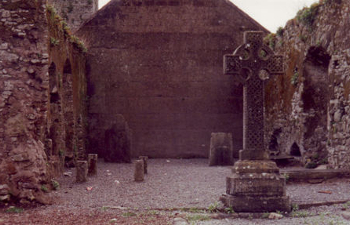
(Pictured: The Cotter Family burial vault in Carrigtwohill)


Leave a comment

Construction of Royal Hospital Kilmainham Begins

royal-hospital-kilmainham

The first stone of the Royal Hospital Kilmainham in Kilmainham, Dublin, is laid by James Butler, 1st Duke of Ormond, on April 29, 1680. Completed in 1684, it is one of the finest 17th-century buildings in Ireland.

The hospital is built by Sir William Robinson, official State Surveyor General of Ireland for James Butler, 1st Duke of Ormonde and Lord Lieutenant of Ireland to King Charles II, as a home for retired soldiers of the Irish Army and continues in that use for over 250 years. The style is based on Les Invalides in Paris with a formal facade and a large courtyard. The Royal Hospital Chelsea in Chelsea, London is completed two years later and also has similarities in style. A priory, founded in 1174 by Strongbow, exists on the site until the English close it down in the Dissolution of the Monasteries in the 1530s.

The Richmond Tower at the end of the formal avenue leading to the Royal Hospital is designed by Francis Johnston, one of the leading architects of the day. This gateway originally stands beside the River Liffey at Bloody Bridge (now Rory O’More Bridge) but has to be moved after the arrival of the railway in 1844 increases traffic congestion. Johnston places his personal coat of arms above the arch, concealed by a piece of wood painted to match the stone, his idea being that his arms would be revealed to future generations after the wood becomes rotten. However, his little trick is uncovered when the gateway is taken down for removal. The coat of arms currently on the gateway is that of the Royal Hospital.

The Royal Hospital Kilmainham graveyards, including Bully’s Acre, are 400 metres to the west. A cross-shaft in the former cemetery may be the remains of a boundary cross associated with a ninth-century monastery located at this site.

Following the creation of the Irish Free State the Royal Hospital is considered as a potential home for Oireachtas Éireann, the new Irish national parliament. Eventually it is decided to keep parliament in its temporary home in Leinster House. The Hospital remains the home of a dwindling number of soldiers, before being variously used by the Garda Síochána and as a storage location for property belonging to the National Museum of Ireland. The large statue Queen Victoria which used to stand in the forecourt of Leinster House, before its removal in 1947, is stored in the main courtyard of the Hospital, as are various state carriages, including the famously spectacular State Coach of the Lord Chancellor of Ireland. The Royal Hospital Kilmainham is finally restored by the Irish Government in 1984 and controversially opens as the Irish Museum of Modern Art (IMMA). Some people working in heritage organisations criticise the decision to demolish the eighteenth-century barrack rooms in one section of the quadrangle to create open spaces for the IMMA.

Every year on the National Day of Commemoration, the Sunday nearest July 11, the anniversary of the Truce that ends the Irish War of Independence, the President of Ireland, in the presence of members of the Government of Ireland, members of Dáil Éireann and of Seanad Éireann, the Council of State, the Defence Forces, the Judiciary and the Diplomatic Corps, lays a wreath in the courtyard in memory of all Irishmen and Irishwomen who have died in past wars and on service with the United Nations.

In recent years, Royal Kilmainham Hospital has become a popular location for concerts during the summer months. Acts such as Blur, Leonard Cohen, The Flaming Lips, Jack White and Public Enemy have played within the grounds in the past.


Leave a comment

The Bombing of Nelson’s Pillar

nelsons-pillar-bombing

A powerful explosion destroys the upper portion of Nelson’s Pillar in Dublin in the early morning hours of March 8, 1966, bringing Nelson’s statue crashing to the ground amid hundreds of tons of rubble. All that is left of the Pillar is a 70-foot-high jagged stump. The pillar is seen by many as an anachronistic monument to English occupation of Ireland, especially as 1966 is the 50th anniversary of the 1916 Easter Rising.

Nelson’s Pillar is a large granite column capped by a statue of Horatio Nelson, built in the centre of what is then Sackville Street (later renamed O’Connell Street) in Dublin. It is completed in 1809 when Ireland is part of the United Kingdom. Its remnants are later destroyed by the Irish Army.

The decision to build the monument is taken by Dublin Corporation in the euphoria following Nelson’s victory at the Battle of Trafalgar in 1805. The original design by William Wilkins is greatly modified by Francis Johnston, on grounds of cost. The statue is sculpted by Thomas Kirk. From its opening on October 29, 1809, the Pillar is a popular tourist attraction, but provokes aesthetic and political controversy from the outset. A prominent city centre monument honouring an Englishman rankles as Irish nationalist sentiment grows, and throughout the 19th century there are calls for it to be removed or replaced with a memorial to an Irish hero.

During the Easter Rising in 1916 an attempt is made to blow up the pillar, but the explosives fail to ignite due to dampness. It remains in the city as most of Ireland becomes the Irish Free State in 1922, and the Republic of Ireland in 1949. The chief legal barrier to its removal is the trust created at the Pillar’s inception, the terms of which gave the trustees a duty in perpetuity to preserve the monument. Successive Irish governments fail to deliver legislation overriding the trust. Although influential literary figures such as James Joyce, William Butler Yeats and Oliver St. John Gogarty defend the Pillar on historical and cultural grounds, pressure for its removal intensifies in the years preceding the 50th anniversary of the Rising, and its sudden demise is, on the whole, well received by the public. Although it is widely believed that the action is the work of the Irish Republican Army (IRA), the police are unable to identify any of those responsible.

After years of debate and numerous proposals, the site is occupied in 2003 by the Spire of Dublin, a slim needle-like structure rising almost three times the height of the Pillar. In 2000 a former republican activist gives a radio interview in which he admits planting the explosives in 1966, but after questioning him the Gardaí decides not to take action. Relics of the Pillar are found in Dublin museums and appear as decorative stonework elsewhere, and its memory is preserved in numerous works of Irish literature.


Leave a comment

Birth of Actress Fionnghuala Flanagan

fionnula-flanagan

Fionnghuala Manon “Fionnula” Flanagan, Irish actress and political activist, is born in Dublin on December 10, 1941.

Flanagan is the daughter of Rosanna (née McGuirk) and Terence Niall Flanagan, an Irish Army officer and Communist who had fought in the International Brigade in the Spanish Civil War against General Francisco Franco. Although her parents are not Irish speakers, they want Fionnula and her four siblings to learn the Irish language, thus she grows up speaking English and Irish fluently. She is educated in Switzerland and England. She trains extensively at the Abbey Theatre in Dublin and travels throughout Europe before settling in Los Angeles, California in early 1968.

Flanagan comes to prominence in Ireland in 1965 as a result of her role as Máire in the Telefís Éireann production of the Irish language play An Triail, for which she receives the Jacob’s Award in Dublin for her “outstanding performance.” With her portrayal of Gerty McDowell in the 1967 film version of Ulysses, she establishes herself as one of the foremost interpreters of James Joyce. She makes her Broadway debut in 1968 in Brian Friel‘s Lovers, then appears in The Incomparable Max (1971) and such Joycean theatrical projects as Ulysses in Nighttown and James Joyce’s Women (1977-1979), a one-woman show written by Flanagan and directed for the stage by Burgess Meredith. It is subsequently filmed in 1983, with Flanagan both producing and playing all six main female roles.

Flanagan is a familiar presence in American television, as she has appeared in several made-for-TV movies including The Legend of Lizzie Borden (1975) starring Elizabeth Montgomery, Mary White (1977), The Ewok Adventure (1984) and A Winner Never Quits (1986). She wins an Emmy Award for her performance as Clothilde in the 1976 network miniseries Rich Man, Poor Man. Her weekly-series stints include Aunt Molly Culhane in How the West Was Won (1977), which earns her a second Emmy Award nomination. She does multiple appearances on Murder, She Wrote. She plays Lt. Guyla Cook in Hard Copy (1987), and as Kathleen Meacham, wife of a police chief played by John Mahoney in H.E.L.P. (1990).

Flanagan makes guest appearances in three of the Star Trek spin-offsStar Trek: Deep Space Nine episode “Dax,” Star Trek: The Next Generation episode “Inheritance,” and Star Trek: Enterprise episode “Fallen Hero.”

Flanagan guest-stars in several episodes of Lost as Eloise Hawking, a recurring character. She appears in such films as The Others opposite Nicole KidmanDivine Secrets of the Ya-Ya Sisterhood as the eldest Teensy and Waking Ned. She appears in television series and stage productions including the Emmy-nominated miniseries Revelations, starring Bill Pullman and Natascha McElhone, and in Transamerica, starring Felicity Huffman. From 2006–08, she plays Rose Caffee, the matriarch of an Irish American Rhode Island family on the Showtime drama Brotherhood.


Leave a comment

Charles Haughey Acquitted of Conspiring in the Arms Crisis

Charles Haughey, former Minister for Finance, and three others including former Minister for Agriculture Neil Blaney, are acquitted on October 23, 1970, of charges that they had conspired to illegally import arms and ammunition into Ireland for the Irish Republican Army (IRA), an incident known as the Arms Crisis.

The Garda Special Branch informs the Minister for Justice Micheál Ó Móráin and Taoiseach Jack Lynch that a plot to import arms exists and includes government members, however Lynch takes no action until the Special Branch makes opposition leader Liam Cosgrave aware of the plot. Cosgrave tells Lynch he is aware of the plot and will announce it in the Dáil the next day if he does not act. Lynch subsequently requests that Haughey and Blaney resign from the Cabinet. Both men refuse, saying they had done nothing illegal. Lynch then asks President Éamon de Valera to terminate their appointments as members of the government, a request that de Valera is required to grant by convention. Haughey and Blaney are subsequently tried in court along with Captain James Kelly, a former intelligence captain in the Irish Army, and Albert Luykx, a former Flemish Nationalist and businessman, who allegedly used his contacts to buy the arms.

The verdict, reached by jury after two hours and 10 minutes of deliberation, leads to political repercussions for the Government of Taoiseach Jack Lynch. Lynch had dismissed the Haughey from his Cabinet post the previous May on the allegation of illegal gunrunning.

Witnesses declare during the 14‐day trial that the arms, imported from the Continental Europe, were ultimately destined for the Roman Catholic minority in Northern Ireland. However, the defense contends that the arms had been brought in with the knowledge and approval of the current Minister for Agriculture, Jim Gibbons, who was serving as Minister for Defence at the time.

The jury rules that the prosecution had failed to prove its case.  Haughey is carried from the High Court after the acquittal, as are the three other defendants.

Although cleared of wrongdoing, it appears as if Haughey’s political career is finished. Blaney eventually resigns from Fianna Fáil but Haughey remains. He spends his years on the backbenches building support within the grassroots of the party. During this time, he remains loyal to the party and serves the leader but after the debacle of the Arms Crisis neither man trusts the other.

(Pictured: Charles Haughey with Neil Blaney at the 1970 at the Arms Trial)


Leave a comment

Death of IRA Chief of Staff Cathal Goulding

cathal-goulding

Cathal Goulding, former Chief of Staff of the Irish Republican Army and the Official IRA, dies in Dublin on December 26, 1998.

Goulding is born on January 2, 1923, one of seven children born on East Arran Street, north Dublin to an Irish republican family. As a teenager Goulding joins Fianna Éireann, the youth wing of the Irish Republican Army (IRA). He joins the IRA in 1939. In December of that year, he takes part in a raid on Irish Army ammunition stores in Phoenix Park, Dublin. In November 1941 he is gaoled for a year in Mountjoy Prison for membership in an unlawful organisation and possession of IRA documents. Upon his release in 1942, he is immediately interned at the Curragh Camp, where he remains until 1944.

In 1945, he is involved in the attempts to re-establish the IRA which has been badly affected by the authorities in both the Irish Free State and Northern Ireland. He is among twenty-five to thirty men who meet at O’Neill’s Pub, Pearse Street, to try to re-establish the IRA in Dublin. He organises the first national meeting of IRA activists after the World War II in Dublin in 1946 and is arrested along with John Joe McGirl and ten others and sentenced to twelve months in prison when the gathering is raided by the Garda Síochána.

Upon his release in 1947, Goulding organises IRA training camps in the Wicklow Mountains and takes charge of the IRA’s Dublin Brigade in 1951. In 1953, Goulding, along with Seán Mac Stíofáin and Manus Canning, is involved in an arms raid on the Officers Training Corps armoury at Felsted School, Essex. The three are arrested and sentenced to eight years’ imprisonment, but are released in 1959 after serving only six years at Pentonville, Wakefield, and Stafford prisons. During his time in Wakefield prison, he befriends EOKA members and Klaus Fuchs, a German-born spy who has passed information about the U.S. nuclear programme to the Soviet Union, and becomes interested in the Russian Revolution.

In 1959, Goulding is appointed IRA Quartermaster General and in 1962 he succeeds Ruairí Ó Brádaigh as IRA Chief of Staff. In February 1966, together with Sean Garland, he is arrested for possession of a revolver and ammunition. In total, Goulding spends sixteen years of his life in British and Irish jails.

Goulding is instrumental in moving the IRA to the left in the 1960s. He argues against the policy of abstentionism and develops a Marxist analysis of Irish politics. He believes the British state deliberately divides the Irish working class on sectarian grounds to exploit them and keep them from uniting and overthrowing their bourgeois oppressors. This analysis is rejected by those who later go on to form the Provisional IRA after the 1969 IRA split.

Goulding remains chief of staff of what becomes known as the Official IRA until 1972. Although the Official IRA, like the Provisional IRA, carries out an armed campaign, Goulding argues that such action ultimately divides the Irish working class. After public revulsion regarding the shooting death of William Best, a Catholic from Derry who is also a British soldier, and the bombing of the Aldershot barracks, the Official IRA announces a ceasefire in 1972.

Goulding is prominent in the various stages of Official Sinn Féin‘s development into the Workers’ Party. He is also involved in the anti-amendment campaign in opposition to the introduction of a constitutional ban on abortion along with his partner, Dr. Moira Woods. However, in 1992, he objects to the political reforms proposed by party leader Proinsias De Rossa and remains in the Workers’ Party after the formation of Democratic Left. He regards the Democratic Left as having compromised socialism in the pursuit of political office.

In his later years, Goulding spends much of his time at his cottage in Raheenleigh near Myshall, County Carlow. He dies of cancer in his native Dublin and is survived by three sons and a daughter. He is cremated and his ashes scattered, at his directive, at the site known as “the Nine Stones” on the slopes of Mount Leinster.


Leave a comment

Last British Troops Leave the Irish Free State

british-troops-leave-ireland

The last British troops leave the Irish Free State on December 17, 1922. They are the remnants of a 5,000 strong garrison maintained up to that point in Dublin, commanded by Nevil Macready.

It appears to be a friendly farewell, even while Ireland is embroiled in its own Civil War. The Union Jack is lowered at the hospital and Macready goes to review the final contingent of troops as they leave the Royal barracks, later known as the Collins barracks. He then motors to Kingstown, now Dún Laoghaire, where he receives a 17-gun salute and joins Admiral Cecil Fox, the Sligo-born naval commander in the area, on board the cruiser HMS Dragon to sail home to England and retirement.

Meanwhile, the troops, 3,500 men mostly from the Leicester, Worchester, and Border regiments, march to the port. At Beresford Place they are greeted by 500 members of the Legion of Irish Ex-Servicemen, in civilian clothes but wearing their decorations. Thousands of other people line the quays and the armoured cars and the Dublin Metropolitan Police stand by, but there is no trouble. Embarkation onto six ships begins around 1:15 PM. At 3:10 PM, the last ship to leave, the steamer Arvonia chartered from the London and North Western Railway, weighs anchor while a band on deck plays “God Save the King” and a crowd breaks into the North Wall Extension to wave a final farewell as it enters Alexandra Basin.

The armoured cars them drive north to Ulster and the evacuation of the Irish Free State, apart from the Treaty ports, is over. General Richard Mulcahy, who takes over the Royal barracks that day, claims “the incubus of occupation that has lain as a heavy hand on the country for years has been removed.”

In his memoirs, Macready expresses annoyance that a photograph of Fox and himself published in The Irish Times on December 18 has the caption “two gallant Irishmen.” Although he has an Irish grandfather, he cordially loathes Ireland.

The British leave fully outfitted barracks to the Irish Army and artifacts including a large card in the Headquarters in Parkgate Street printed with the admonition “LOVE ONE ANOTHER.”


Leave a comment

Free State Government Purchases Copyright to “The Soldiers Song”

amhran-na-bhfiann

The Irish Free State government purchases the copyright of Peadar Kearney‘s The Soldiers Song on October 20, 1933, which becomes the Irish national anthem Amhrán na bhFiann. The song has three verses, but only the choral refrain is officially designated the national anthem.

A Soldiers’ Song is composed in 1907, with words by Peadar Kearney and music by Kearney and Patrick Heeney. The text is first published in Irish Freedom by Bulmer Hobson in 1912. It is used as a marching song by the Irish Volunteers and is sung by rebels in the General Post Office (GPO) during the Easter Rising of 1916. Its popularity increases among rebels held in Frongoch internment camp after the Rising, and the Irish Republican Army (IRA) in the Irish War of Independence (1919–21). After the establishment of the Irish Free State in 1922, a large proportion of the IRA’s men and apparatus become the National Army. The Soldiers’ Song remains popular as an Army tune and is played at many military functions.

The Free State does not initially adopt any official anthem. The delicate political state in the aftermath of the Irish Civil War provokes a desire to avoid controversy. Ex-Unionists continue to regard God Save the King as the national anthem, as it has been for the rest of the British Empire. W. T. Cosgrave, President of the Executive Council of the Irish Free State expresses opposition to replacing The Soldiers’ Song, which is provisionally used within the State.

There is concern that the lack of an official anthem is giving Unionists an opportunity to persist with God Save the King. The Soldiers’ Song is widely if unofficially sung by nationalists. On July 12, 1926, the Executive Council of the Irish Free State decides to adopt it as the National Anthem, with Cosgrave the driving force in the decision. However, this decision is not publicised.

In 1928, the Army band establishes the practice of playing only the chorus of the song as the Anthem, because the longer version is discouraging audiences from singing along.

The anthem is played by Radio Éireann at close down from its inception in 1926. Cinemas and theatres do so from 1932 until 1972. Peadar Kearney, who has received royalties from publishers of the text and music, issues legal proceedings for royalties from those now performing the anthem. He is joined by Michael Heeney, brother of Patrick Heeney, who had died in 1911. In 1934, the Department of Finance acquires the copyright of the song for the sum of £1,200. Copyright law changes in 1959, such that the government has to reacquire copyright in 1965, for £2,500. As per copyright law, the copyright expires in December 2012, following the 70th anniversary of Kearney’s death. In 2016, three Fianna Fáil senators introduce a private member’s bill intended to restore the state’s copyright in the anthem.


4 Comments

Founding of “The Squad” (“The Twelve Apostles”)

the-squad

The Squad, originally nicknamed the Twelve Apostles, an Irish Republican Army (IRA) unit founded by Michael Collins to counter British intelligence efforts during the Irish War of Independence, is officially established on September 19, 1919, at 46 Rutland Square although by this time it has already been in operation for two months and has already carried out two killings.

On April 10, 1919, the First Dáil announces a policy of ostracism of Royal Irish Constabulary men. At the time Sinn Féin official policy is against acts of violence. Boycotting, persuasion, and mild intimidation succeed against many officers. However, others escalate their activities against republicans and in March 1920 Collins asks Dick McKee to select a small group to form an assassination unit.

When the squad is formed, it comes directly under the control of the Director of Intelligence or his deputy and under no other authority. The Squad is commanded by Mick McDonnell.

The original ‘Twelve Apostles’ are Mick McDonnell, Tom Keogh, Jimmy Slattery, Paddy Daly, Joe Leonard, Ben Barrett, Vincent Byrne, Sean Doyle, Paddy Griffin, Eddie Byrne, Mick Reilly, and Jimmy Conroy. After some time, the Squad is strengthened with the addition of Ben Byrne, Frank Bolster, Mick Keogh, Mick Kennedy, Bill Stapleton, and Sam Robinson. They are employed full-time and receive a weekly wage.

Sometimes the squad is strengthened as occasion demands by members of the Intelligence staff, the Active Service Unit, munition workers, and members of the Dublin Brigade.

On July 30, 1919, the first assassination authorised by Michael Collins is carried out when Detective Sergeant “the Dog” Smith is shot near Drumcondra, Dublin. The Squad continues targeting plainclothes police, members of the G Division of the Dublin Metropolitan Police, and occasionally, problematic civil servants. Organisationally it operates as a subsection of Collins’ Intelligence Headquarters. Two of the executions by The Squad are the killing on January 21, 1920, of RIC Inspector William Redmond of the DMP “G” Division and on March 2, 1920, of British double agent John Charles Byrnes.

One of the Apostles’ particular targets is the Cairo Gang, a deep-cover British intelligence group, so called since it has either been largely assembled from intelligence officers serving in Cairo or from the Dublin restaurant called The Cairo, which the gang frequents. Sir Henry Wilson brings in the Cairo Gang in mid-1920, explicitly to deal with Michael Collins and his organization. Given carte blanche in its operations by Wilson, the Cairo Gang adopts the strategy of assassinating members of Sinn Féin unconnected with the military struggle, assuming that this would cause the IRA to respond and bring its leaders into the open.

The most well-known operation executed by the Apostles occurs on Bloody Sunday, November 21, 1920, when British MI5 officers, linked to the Cairo Gang and significantly involved in spying, are shot at various locations in Dublin. Fourteen are killed and six are wounded. In addition to the Twelve Apostles, a larger number of IRA personnel are involved in this operation. The only IRA man captured during the operation is Frank Teeling. In response to the killings, the Black and Tans retaliate by shooting up a Gaelic football match between Dublin and Tipperary at Croke Park, killing fourteen civilians including one of the players, Michael Hogan, and wounding sixty-eight. The Hogan stand at Croke Park is named after him.

In May 1921, after the IRA’s Dublin Brigade takes heavy casualties during the burning of the Custom House, the Squad and the Brigade’s Active Service Unit are combined into the Dublin Guard, under the direction of Paddy Daly. Under the influence of Daly and Michael Collins, most of the Guard takes the Free State side and joins the Irish Army in the Irish Civil War of 1922-23. During this conflict some of them are attached to the Criminal Investigation Department and are accused of multiple assassinations of Anti-Treaty fighters.

(Pictured: Squad Members Mick McDonnell, Liam Tobin, Vinny Byrne, Paddy Daly, and Jim Slattery)