seamus dubhghaill

Promoting Irish Culture and History from Little Rock, Arkansas, USA


Leave a comment

The Dublin and Monaghan Bombings

dublin-and-monaghan-bombings

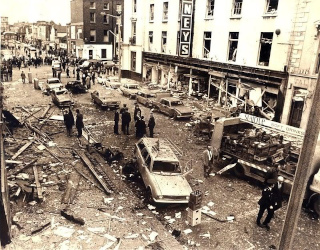
The Dublin and Monaghan bombings of May 17, 1974 are a series of co-ordinated bombings in Dublin and Monaghan, Ireland. Three car bombs explode in Dublin at Parnell Street, Talbot Street and South Leinster Street during the evening rush hour and a fourth car bomb explodes in Monaghan, just south of the border with Northern Ireland, almost ninety minutes later. The bombs kill 33 civilians and a full-term unborn child, and injure almost 300. The bombings are the deadliest attack of the conflict known as the Troubles, and the deadliest attack in the Republic of Ireland‘s history. Most of the victims are young women, although the ages of the dead range from pre-born up to 80 years.

The Ulster Volunteer Force (UVF), an Ulster loyalist paramilitary group from Northern Ireland, claims responsibility for the bombings in 1993. It has launched a number of attacks in the Republic since 1969. There are allegations taken seriously by inquiries that elements of the British state security forces help the UVF carry out the bombings, including members of the Glenanne gang. Some of these allegations have come from former members of the security forces. The Irish parliament‘s Joint Committee on Justices calls the attacks an act of international terrorism involving British state forces. The month before the bombings, the British government lifts the UVF’s status as a proscribed organisation.

The bombings happen during the Ulster Workers’ Council strike. This is a general strike called by hardline loyalists and unionists in Northern Ireland who oppose the Sunningdale Agreement. Specifically, they oppose the sharing of political power with Irish nationalists and the proposed role for the Republic in the governance of Northern Ireland. The Republic’s government had helped bring about the Agreement. The strike brings down the Agreement and the Northern Ireland Assembly on May 28.

No one has ever been charged with the bombings. A campaign by the victims’ families leads to an Irish government inquiry under Justice Henry Barron. His 2003 report criticises the Garda Síochána‘s investigation and says the investigators stopped their work prematurely. It also criticises the Fine Gael/Labour Party government of the time for its inaction and lack of interest in the bombings. The report says it is likely that British security force personnel or MI5 intelligence is involved but has insufficient evidence of higher-level involvement. However, the inquiry is hindered by the British government’s refusal to release key documents. The victims’ families and others are continuing to campaign to this day for the British government to release these documents.

(Pictured: Some of the damage caused by the second car bomb on Talbot Street, Dublin)


Leave a comment

Birth of Pádraig Flynn, Fianna Fáil Politician

CREATOR: gd-jpeg v1.0 (using IJG JPEG v62), quality = 90

Pádraig Flynn, former Fianna Fáil politician, is born in Castlebar, County Mayo on May 9, 1939. He serves as European Commissioner for Social Affairs from 1993 to 1999, Minister for Industry and Commerce and Minister for Justice from 1992 to 1993, Minister for the Environment from 1987 to 1991, Minister for Trade, Commerce and Tourism from October 1982 to December 1982, Minister for the Gaeltacht from March 1982 to October 1982 and Minister of State at the Department of Transport from 1980 to 1981. He serves as a Teachta Dála (TD) for the Mayo West constituency from 1977 to 1994.

Flynn is the son of Patrick and Anne Flynn. He is educated in St. Gerald’s College, Castlebar and qualifies as a teacher from St. Patrick’s College, Dublin. He first holds political office in 1967, when he becomes a member of Mayo County Council. Ten years later, at the 1977 general election, he is elected to Dáil Éireann as a Fianna Fáil TD for the Mayo West constituency.

Flynn is a supporter of Charles Haughey in the 1979 Fianna Fáil leadership election. His loyalty is rewarded when he becomes a Minister of State at the Department of Transport and Power. He joins the Cabinet for the first time following the February 1982 general election when he is appointed Minister for the Gaeltacht. In October 1982, in a minor reshuffle, he becomes Minister for Trade, Commerce and Tourism. However, his time in this office is brief, since Fianna Fáil loses the November 1982 general election.

Fianna Fáil is returned to power in the 1987 general election and Flynn becomes Minister for the Environment. Two years later he opposes the formation of the coalition government with the Progressive Democrats, describing it “as hitting at Fianna Fáil core values.” In 1990, he attacks the opposition presidential candidate Mary Robinson on a radio show, accusing her of “having a new-found interest in her family” for the purposes of her election campaign. This attack backfires drastically, causing many women who initially support Brian Lenihan to back Robinson. Lenihan’s campaign never recovers, and Robinson becomes Ireland’s first female President.

In 1991, Flynn is sacked from the Cabinet because of his support for a motion of no confidence in the Taoiseach, Charles Haughey. Then in 1992, Albert Reynolds becomes Taoiseach and Flynn is rewarded for supporting Reynolds by becoming Minister for Justice. In 1993, he retires from domestic politics when he is appointed Ireland’s European Commissioner. He is reappointed by the Fine GaelLabour Party government in 1995 and, on both of these occasions, serves in the social affairs portfolio.

On January 15, 1999, Flynn makes comments on The Late Late Show regarding Tom Gilmartin and a donation of IR£50,000 to the Fianna Fáil party. He also makes comments about his own lifestyle, boasting of having a salary of IR£140,000 together with three houses, cars and housekeepers and travels regularly, yet complains about the hassle involved. The performance was seen as eccentric and out of touch. In effect, he is interpreted as behaving in a manner more befitting the Irish stereotype known as the Dublin 4 mentality, complaining of the costs incurred in the pursuit of extravagance.

The show’s presenter, Gay Byrne, then asks Flynn if he knows of Gilmartin. He responds that he knows him well. He seems to be making an attack of Gilmartin’s emotional stability, based on the effect of sickness of Gilmartin’s wife. If it is to be interpreted as an attack of Gilmartin’s credibility, it backfires in a spectacular manner against Flynn. Also, unknown to Flynn, Gilmartin is actually watching the program at his home in Luton. This hurts Gilmartin a great deal, while also bringing the illness of his wife into the picture as the real driving force behind Gilmartin’s testimony against Flynn. Gilmartin responds by releasing details of meetings he held with Flynn to the McCracken Tribunal. The interview is widely described as the end of Flynn’s political career.

Flynn’s second term as European Commissioner ends early in September 1999, when the entire commission resigns due to allegations of malpractice by the European Parliament. He is not reappointed to the Commission and retires from politics completely. He is a member of the Comite d’Honneur of the Institute of International and European Affairs.

Flynn is cited in the Mahon Tribunal for having received money from Frank Dunlop intended for Fianna Fáil, but diverted to his personal use. On March 22, 2012, the final report of the Mahon Tribunal is published. It finds that Flynn “wrongly and corruptly” sought a substantial donation from Tom Gilmartin for the Fianna Fáil party. It also finds that having been paid IR£50,000 by Gilmartin, for that purpose, Flynn proceeded to use that money for his personal benefit, and that the donation funded at least a significant portion of the purchase of a farm in County Mayo.

On March 26, 2012, facing expulsion following the Mahon Tribunal, Flynn resigns in disgrace from Fianna Fáil before he can be ousted.


Leave a comment

Death of Eileen Desmond, Labour Party Politician

eileen-desmond

Eileen Christine Desmond (née Harrington), Irish Labour Party politician who serves as Minister for Health and Minister for Social Welfare from 1981 to 1982, dies suddenly in Cork, County Cork on January 6, 2005. She serves as a Teachta Dála (TD) from 1965 to 1969, 1973 to 1981 and 1981 to 1987. She serves as a Member of the European Parliament (MEP) for the Munster constituency from 1979 to 1984. She is a Senator for the Industrial and Commercial Panel from 1969 to 1973.

Desmond is born in Kinsale, County Cork on December 29, 1932. She is educated locally at the Convent of Mercy in Kinsale, where she is one of only two girls in her class to sit the Leaving Certificate examination. Before entering politics, she works as a civil servant with the Department of Posts and Telegraphs. She marries Dan Desmond in 1958.

Desmond is first elected to Dáil Éireann in a by-election on March 10, 1965, due to the death of her husband who had been a Teachta Dála (TD) since 1948. Her victory in the Cork Mid constituency leads Taoiseach Seán Lemass to dissolve the 17th Dáil and call a general election. She is elected for the second time in a year but loses her seat at the 1969 general election. However, she is then elected to the 12th Seanad on the Industrial and Commercial Panel, where she serves until her re-election to the 20th Dáil at the 1973 general election.

Desmond is elected to the European Parliament at the 1979 European Parliament election for the Munster constituency. However, her time in Europe is short-lived, as she returns to domestic politics when she is offered a position as Minister and the chance to impact upon national legislation. At the 1981 general election she switches her constituency to Cork South-Central. A Fine Gael–Labour Party coalition comes to power, and she is appointed Minister for Health and Social Welfare.

Desmond’s cabinet appointment is historic, as she is only the second woman to be a member of cabinet since the foundation of the state in 1922, and the first in any Fine Gael or Labour Party cabinet. Countess Markievicz had held the cabinet post of Minister for Labour in the revolutionary First Dáil in 1919, but only one woman had held cabinet office after the foundation of the state, Máire Geoghegan-Quinn of Fianna Fáil who was appointed as Minister for the Gaeltacht in 1979.

Desmond retires from full-time politics at the 1987 general election for health reasons. She dies suddenly in Cork, County Cork on January 6, 2005. Her funeral Mass takes place at Our Lady and St. John’s Church, Carrigaline with burial following in Crosshaven Cemetery.


Leave a comment

The Constitution of Ireland Comes Into Force

constitution-of-ireland-1937

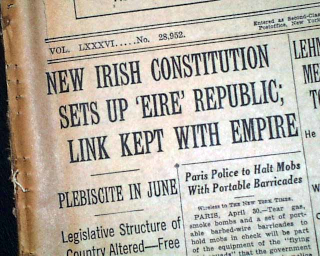
The Constitution of Ireland, the second constitution of the Irish state since independence, comes into force on December 29, 1937, following a statewide plebiscite held on July 1, 1937, replacing the 1922 Constitution of the Irish Free State. It asserts the national sovereignty of the Irish people. The constitution falls broadly within the tradition of liberal democracy, being based on a system of representative democracy. It guarantees certain fundamental rights, along with a popularly elected non-executive president, a bicameral parliament based on the Westminster system, a separation of powers and judicial review. The Constitution may be amended solely by a national referendum.

The Constitution of Ireland replaces the Constitution of the Irish Free State which had been in effect since the independence, as a dominion, of the Irish state from the United Kingdom on December 6, 1922. There are two main motivations for replacing the constitution in 1937. Firstly, the Statute of Westminster 1931 grants parliamentary autonomy to the six British Dominions (now known as Commonwealth realms) within a British Commonwealth of Nations. This has the effect of making the dominions sovereign nations in their own right. The Irish Free State constitution of 1922 is, in the eyes of many, associated with the controversial Anglo-Irish Treaty. The anti-treaty faction, who oppose the treaty initially by force of arms, is so opposed to the institutions of the new Irish Free State that it initially takes an abstentionist line toward them, boycotting them altogether. However, the largest element of this faction becomes convinced that abstentionism cannot be maintained forever. This element, led by Éamon de Valera, forms the Fianna Fáil party in 1926, which enters into government following the 1932 Irish general election.

After 1932, under the provisions of the Statute of Westminster, some of the articles of the original Constitution which were required by the Anglo-Irish Treaty are dismantled by acts of the Oireachtas of the Irish Free State. Such amendments remove references to the Oath of Allegiance, appeals to the United Kingdom’s Judicial Committee of the Privy Council, the British Crown and the Governor-General of the Irish Free State. The sudden abdication of Edward VIII in December 1936 is quickly used to redefine the Royal connection. Nevertheless, the Fianna Fáil government still desires to replace the constitutional document they see as having been imposed by the British government in 1922.

The second motive for replacing the original constitution is primarily symbolic. De Valera wants to put an Irish stamp on the institutions of government and chooses to do this in particular through the use of Irish Gaelic nomenclature.

The text of the draft constitution, with minor amendments, is approved on June 14, 1937, by Dáil Éireann, then the sole house of parliament as the Seanad had been abolished the previous year.

The draft constitution is then put to a plebiscite on July 1, 1937, the same day as the 1937 Irish general election, when it is passed by a plurality of 56% of the voters, comprising 38.6% of the whole electorate. The constitution formally comes into force on December 29, 1937.

Among the groups who oppose the constitution are supporters of Fine Gael and the Labour Party, Unionists, and some independents and feminists. The Seal of the President of Ireland is also adopted in the same year. Ireland does not become a republic until 1948.

(Pictured: Headline from The New York Times, May 1, 1937)


Leave a comment

Birth of Suffragist Winifred Carney

winifred-carney

Maria Winifred Carney, also known as Winnie Carney, suffragist, trade unionist and Irish independence activist, is born into a lower-middle class Catholic family in Bangor, County Down on December 4, 1887. Her father is a Protestant who leaves the family. Her mother and six siblings move to Falls Road in Belfast when she is a child.

Carney is educated at St. Patrick’s Christian Brothers School in Donegall Street in Belfast, later teaching at the school. She enrolls at Hughes Commercial Academy around 1910, where she qualifies as a secretary and shorthand typist, one of the first women in Belfast to do so. However, from the start she is looking towards doing more than just secretarial work.

In 1912 Carney is in charge of the women’s section of the Northern Ireland Textile Workers’ Union in Belfast, which she founds with Delia Larkin in 1912. During this period, she meets James Connolly and becomes his personal secretary. She becomes Connolly’s friend and confidant as they work together to improve the conditions for female labourers in Belfast. Carney then joins Cumann na mBan, the women’s auxiliary of the Irish Volunteers, and attends its first meeting in 1914.

Carney is present with Connolly in Dublin‘s General Post Office (GPO) during the Easter Rising in 1916. She is the only woman present during the initial occupation of the building. While not a combatant, she is given the rank of adjutant and is among the final group to leave the GPO. After Connolly is wounded, she refuses to leave his side despite direct orders from Patrick Pearse and Connolly. She leaves the GPO with the rest of the rebels when the building becomes engulfed in flames. They make their new headquarters in nearby Moore Street before Pearse surrenders.

After her capture, Carney is held in Kilmainham Gaol before being moved to Mountjoy Prison and finally to an English prison. By August 1916 she is imprisoned in HM Prison Aylesbury alongside Nell Ryan and Helena Molony. The three request that their internee status be revoked so that they could be held as normal prisoners with Countess Markievicz. Their request is denied, however Carney and Molony are released two days before Christmas 1916.

Carney is a delegate at the 1917 Belfast Cumann na mBan convention. She stands for Parliament as a Sinn Féin candidate for Belfast Victoria in the 1918 United Kingdom general election but loses to the Labour Unionists. Following her defeat, she decides to continue her work at the Irish Transport and General Workers’ Union until 1928. By 1924 she has become a member of the Labour Party. In the 1930s she joins the Socialist Party of Northern Ireland.

Following the Irish Civil War, Carney becomes much more disillusioned with politics. She is very critical and outspoken of Éamon de Valera and his governments.

In 1928 she marries George McBride, a Protestant Orangeman and former member of the Ulster Volunteers. Ironically, the formation of the Ulster Volunteers prompts the formation of the Irish Volunteers, of which Carney was a member. She alienates anyone in her life that does not support her marriage to McBride.

A number of serious health problems limit Carney’s political activities in the late 1930s. She dies in Belfast on November 21, 1943, and is buried in Milltown Cemetery. Her resting place is located years later, and a headstone is erected by the National Graves Association, Belfast. Because she married a Protestant and former Orangeman, she is not allowed to have his name on her gravestone due to the religious differences.

In 2013, the Seventieth Anniversary of Carney’s death is remembered by the Socialist Republican Party. Almost one hundred people attend as a short parade follows, marking and commemorating the work she did for the cause. She is placed in high esteem among the other hundreds of radical women, who stand up for what they believe in, regardless of the consequences they face.


Leave a comment

Máiría Cahill Elected to Seanad Éireann

mairia-cahillMáiría Cahill is elected to Seanad Éireann on November 13, 2015 after winning a by-election held to fill the seat left vacant after the resignation of the Labour Party‘s Jimmy Harte. She wins 122 of the 188 valid votes cast in an election in which only Teachta Dálas (TDs) and Senators can cast a vote.

Cahill is born in 1981 into a prominent republican extended family in West Belfast. Her great-uncle Joe Cahill is one of the founders and chief of staff of the Provisional Irish Republican Army (IRA) in the 1970s. She is a cousin of both Siobhán O’Hanlon, a prominent republican activist in the IRA and later in Sinn Féin until her death in 2006, and her sister Eilis O’Hanlon, a political commentator for the Irish Independent and critic of both the IRA and Sinn Féin. She also claims her grandfather recruited Gerry Adams into the IRA.

Cahill is elected National Secretary of Ógra Shinn Féin and works for Sinn Féin between 1998 and 2001. She quits Sinn Féin in 2001 when she moves to the United States. She later returns and works on two election campaigns for the party before growing disillusioned at her treatment and leaving for good.

In February 2015, Cahill receives a James Larkin Thirst for Justice award from the Irish Labour Party. In November 2015, she receives a Special Recognition Award in the Irish Tatler‘s Woman of the Year Awards.

In October 2015, Labour Party leader Joan Burton announces Cahill has joined the party and she, along with her deputy Alan Kelly, will put her forward as the party’s nominee in a by-election to Seanad Éireann’s Industrial and Commercial Panel. The by-election has been occasioned by the resignation of Senator Jimmy Harte due to illness. Cahill secures the party’s nomination unopposed and wins the election in November 13 on the first count, with 122 first preferences out of 188 valid votes from Oireachtas members.

Cahill is criticised by Senator David Norris for failing to satisfactorily answer questions on her links to dissident republican groups and for failing to take part in media debates with other candidates. Norris later states that she is “an interesting and vital voice in Seanad Éireann.”

In a March 2016 interview with Catherine Shanahan of the Irish Examiner, Kathleen Lynch, a former Labour party TD and Minister of state, states she has no idea as to why Cahill was chosen as the party’s by-election candidate. Cahill does not contest the 2016 Seanad elections.

Cahill is co-opted into a Social Democratic and Labour Party (SDLP) council seat in Lisburn and Castlereagh council in July 2018. She has to withdraw from the local election campaign in April 2019, due to a law requiring candidates to publish their home addresses. Cahill is unable to do so due to threats made against her. The British Government subsequently apologises.


Leave a comment

Inauguration of Mary McAleese as 8th President of Ireland

CREATOR: gd-jpeg v1.0 (using IJG JPEG v62), quality = 100

Mary Patricia McAleese (née Leneghan) is inaugurated as the eighth President of Ireland on November 11, 1997. She succeeds Mary Robinson, making her the second female president of Ireland and the first woman in the world to succeed another woman as president. She is the first president to come from Northern Ireland.

Leneghan is born into a Roman Catholic family on June 27, 1951, in Ardoyne, north Belfast. The eldest of nine children, she grows up in Northern Ireland through the violent times that have come to be known as “The Troubles.” She is educated at St. Dominic’s High School, Queen’s University Belfast, from which she graduates in 1973, and Trinity College Dublin. She is called to the Bar of Northern Ireland in 1974 and remains a member of the Bar Council of Ireland. In 1975, she is appointed Reid Professor of Criminal Law, Criminology and Penology at Trinity College Dublin.

Leneghan marries Martin McAleese, an accountant and dentist in 1976. They have three children, Emma, born 1982, and twins Justin and SaraMai, born in 1985.

In 1987, McAleese returns to her Alma Mater, Queen’s University Belfast, to become Director of the Institute of Professional Legal Studies. In 1994, she becomes the first female Pro-Vice-Chancellor of the university.

McAleese defeats former Taoiseach Albert Reynolds in an internal party election in 1997, held to determine the Fianna Fáil nomination for the Irish presidency. Her opponents in the 1997 presidential election are Mary Banotti of Fine Gael, Adi Roche of the Labour Party and two Independents, Dana Rosemary Scallon and Derek Nally.

McAleese wins the presidency with 45.2% of first preference votes. In the second and final count against Banotti, McAleese wins 55.6% of preferences. Within weeks of her November 1997 inauguration, she makes her first official overseas trip to Lebanon.

McAleese describes the theme of her presidency as “building bridges.” The first individual born in Northern Ireland to become President of Ireland, McAleese is a regular visitor to Northern Ireland throughout her presidency, where she is on the whole warmly welcomed by both communities, confounding critics who had believed she would be a divisive figure. While on an official visit to the United States in 1998, Archbishop of Boston Cardinal Bernard Francis Law tells her he is “sorry for Catholic Ireland to have you as President.” She tells the cardinal that she is the “President of Ireland and not just of Catholic Ireland.”

McAleese’s initial seven-year term of office ends in November 2004, but she stands for a second term in the 2004 presidential election. She is re-elected on October 1, 2004, being the only validly nominated candidate.

McAleese is an experienced broadcaster, having worked as a current affairs journalist and presenter in radio and television with Radio Telefís Éireann. She has a longstanding interest in many issues concerned with justice, equality, social inclusion, anti-sectarianism and reconciliation.


Leave a comment

Birth of Conor Cruise O’Brien, Politician, Writer & Historian

conor-cruise-o-brien

Conor Cruise O’Brien, politician, writer, historian and academic often nicknamed “The Cruiser,” is born in Rathmines, Dublin on November 3, 1917. He serves as Minister for Posts and Telegraphs from 1973 to 1977, a Senator for University of Dublin from 1977 to 1979, a Teachta Dála (TD) for the Dublin North-East constituency from 1969 to 1977 and a Member of the European Parliament (MEP) from January 1973 to March 1973.

Cruise O’Brien follows his cousin Owen into Sandford Park School, which has a predominantly Protestant ethos despite objections from Catholic clergy. He subsequently attends Trinity College Dublin before joining the Irish diplomatic corps.

Although he is a fierce advocate of his homeland, Cruise O’Brien is a strong critic of Irish Republican Army violence and of what he considers the romanticized desire for reunification with Northern Ireland. His collection of essays Maria Cross: Imaginative Patterns in a Group of Modern Catholic Writers (1952; written under the pseudonym Donat O’Donnell) impresses UN Secretary-General Dag Hammarskjöld, who in 1961 appoints him UN special representative in the Congo, later the Democratic Republic of the Congo. He orders UN peacekeeping forces into the breakaway Katanga province, and the resulting scandal forces him out of office. Despite UN objections, he writes To Katanga and Back (1963) to explain his actions.

After serving as vice-chancellor of the University of Ghana (1962–65) and Albert Schweitzer Professor of Humanities at New York University (1965–69), Cruise O’Brien enters Irish politics. He holds a Labour Party seat in Dáil Éireann from 1969 to 1977 and then in the Senate from 1977 to 1979, representing Trinity College, of which he is pro-chancellor (1973–2008).

In 1979 Cruise O’Brien is named editor in chief of the British Sunday newspaper The Observer, but he leaves after three tumultuous years. He remains an active newspaper columnist, especially for the Irish Independent until 2007. His books include States of Ireland (1972) and On the Eve of the Millennium (1995), as well as perceptive studies of Charles Stewart Parnell, Edmund Burke, and Thomas Jefferson.

Conor Cruise O’Brien dies at the age of 91 on December 18, 2008, in Howth, Dublin.


Leave a comment

Mo Mowlam Presented International Woman of the Year Award

mo-mowlan

Marjorie “Mo” Mowlam, English Labour Party politician, is presented with the International Woman of the Year Award at a ceremony in Dublin on October 23, 2001. United Nations High Commissioner for Human Rights Mary Robinson wins the Overall Award at the Irish Tatler Women of the Year Awards.

Mowlam is born on September 18, 1949 in Watford, Hertfordshire, England but grows up in Coventry. She starts her education at Chiswick Girls’ grammar school in West London, then moves to Coundon Court school in Coventry which, at the time, is one of the first comprehensive schools in the country. She then studies at Trevelyan College, Durham University, reading sociology and anthropology. She joins the Labour Party in her first year.

Mowlam becomes the Secretary of the Durham Union Society in 1969 and later goes on to become the Vice-President of the Durham Student’s Union. She works for then-MP Tony Benn in London and American writer Alvin Toffler in New York, moving to the United States with her then-boyfriend and studying for a PhD in political science at the University of Iowa.

Mowlam is a lecturer in the Political Science Department at the University of Wisconsin–Milwaukee in 1977 and at Florida State University in Tallahassee from 1977 to 1979. During her time in Tallahassee, someone breaks into her apartment. She suspects that it is Ted Bundy, the serial killer and rapist who is thought to have murdered at least 35 young women and attacked several others. She returns to England in 1979 to take up an appointment at the University of Newcastle upon Tyne.

Having failed to win selection for the 1983 general election, Mowlam is selected as Labour candidate for the safe seat of Redcar after James Tinn stands down. She takes the seat in the 1987 general election, becoming the Labour spokesperson on Northern Ireland later that year. Together with Shadow Chancellor John Smith, she is one of the architects of Labour’s “Prawn Cocktail Offensive” dedicated to reassuring the UK’s financial sector about Labour’s financial rectitude.

Mowlam joins the Shadow Cabinet when John Smith becomes leader of the Labour Party in 1992, holding the title of Shadow Secretary of State for National Heritage. During this time, she antagonises both monarchists and republicans by calling for Buckingham Palace to be demolished and replaced by a “modern” palace built at public expense. Later, her willingness to speak her mind, often without regard to the consequences, is seen as her greatest strength by her supporters.

Following Smith’s death in 1994, Mowlam, alongside Peter Kilfoyle, becomes a principal organiser of Tony Blair‘s campaign for the Labour leadership. After his victory, Blair makes her Shadow Secretary of State for Northern Ireland. She initially resists being appointed to the position, preferring an economic portfolio, but, after accepting it, she throws her weight into the job.

Mowlam oversees the negotiations which lead to the 1998 Good Friday Agreement. She is successful in helping to restore an Irish Republican Army (IRA) ceasefire and including Sinn Féin in multi-party talks about the future of Northern Ireland. In an attempt to persuade the Ulster loyalists to participate in the peace process, she pays an unprecedented and potentially dangerous visit to loyalist prisoners in HM Prison Maze, meeting convicted murderers face-to-face and unaccompanied.

Mowlam witnesses the Good Friday Agreement signing in 1998, which leads to the temporary establishment of a devolved power-sharing Northern Ireland Assembly. However, an increasingly difficult relationship with Unionist parties means her role in the talks is ultimately taken over by Tony Blair and his staff.

Mowlam’s deteriorating relationship with Unionists is the key reason she is replaced by Peter Mandelson as Northern Ireland Secretary in October 1999. Her move to the relatively lowly position of Minister for the Cabinet Office possibly involves other factors, notably her health and her popularity. On September 4, 2000, she announces her intention to retire from Parliament and relinquishes her seat at the 2001 general election.

Five months before the 1997 general election, Mowlam is diagnosed with a brain tumor, a fact that she tries to keep private. She appears to suffer from balance problems as a result of her radiotherapy. According to her husband, she falls on July 30, 2005, receiving head injuries and never regaining consciousness. Her living will, in which she asks not to be resuscitated, is honoured. On August 12, 2005, Mowlan is moved to Pilgrims Hospice in Canterbury, Kent, where she dies seven days later, on August 19, 2005, aged 55.

Mowlam is an atheist and is cremated in Sittingbourne on September 1, 2005 at a non-religious service conducted by Reverend Richard Coles, formerly of the 1980s band The Communards. Half of her ashes were scattered at Hillsborough Castle, the Secretary of State for Northern Ireland’s official residence, and the other half in her former parliamentary constituency of Redcar.