Quirke begins his club career at juvenile and underage levels with Clonoulty–Rossmore. He wins consecutive divisional championship titles with the club’s minor team in 2014 and 2015, before winning a Tipperary U21AHC title after a defeat of Thurles Sarsfields in the final. He scores two points from play when Clonoulty–Rossmore beats Nenagh Éire Óg in the 2018 Tipperary Senior Hurling Championship final.
After a year away from the inter-county scene, Quirke is called up to the Tipperary under-21 hurling team for the 2018 Munster Under-21 Hurling Championship. After lining out at left wing-back in Tipperary’s 2–23 to 1–13 defeat by Cork in the Munster final, he is in the same position when the result is reversed and Tipperary beats Cork in the subsequent 2018 All-Ireland Under-21 Hurling Championship final.
Quirke is one of twelve under-21 players called up to the senior team‘s pre-season training panel in November 2018, however, he is later released from the panel. He is later recalled to the senior panel and makes his first appearance in a 2–14 to 0–18 defeat by Limerick in the first round of the 2020 National Hurling League. Later that season, he makes his championship debut when he comes on as a 73rd-minute substitute for Jason Forde in an All-Ireland qualifier defeat of Cork. By 2022, he is a regular member of the starting fifteen and starts all four games in Tipperary’s unsuccessful Munster Championship campaign.
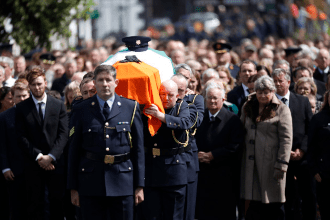
Quirke’s funeral is held on August 9 in Clonoulty. His inter-county and club teammates, as well as the opposition Kilruane MacDonagh’s team from the fateful match, provide a guard of honour as the cortege makes its way from the GAA Clubhouse through the village to St. John the Baptist Church for the Requiem Mass. The coffin is draped in the colours of his club side as well as his county and is brought into the church by his Clonoulty-Rossmore teammates.
Donnelly is born in Killybrackey, near Dungannon, County Tyrone, on July 10, 1914, into a family of cattle breeders. His father, Joseph Donnelly, sells his farm in 1917 and the family moves to Dundalk and opens a greengrocer‘s shop. Joseph Donnelly becomes quite prosperous, running his shop, dealing cattle and buying and selling property in the Dundalk area. In addition to Charles, the Donnellys have five other sons and two daughters. His mother, Rose, dies in 1927, when he is 13 years old.
Donnelly receives his early education in the Christian Brothers school in Dundalk. When he is fourteen in 1928, the family moves again, this time to Dublin, where his father purchases a house on Mountjoy Square in the north inner city. He enrolls in O’Connell School on North Frederick Street but is expelled after only a few weeks. He spends the next few months wandering the streets of Dublin during school time before his father discovers what had happened. Also at this time, he meets and is befriended by radical political activists from the Irish Republican Army (IRA), the Communist Party of Ireland and the left-Republican group Saor Éire.
Donnelly’s father and aunts get him an apprenticeship with a carpenter, but he gives this up after a year to enroll in University College Dublin (UCD) in 1931, where he studies Logic, English, History and the Irish language. In university he begins writing poetry and prose for student publications but fails his first-year examinations. At this time, he also becomes deeply involved in radical left-wing and republican politics. He drops out of university in 1934, having failed his first-year exams three times and joins the radical group, the Republican Congress. There he befriends veteran republicans Frank Ryan and George Gilmore. He also becomes involved in a romantic relationship with another republican activist, Cora Hughes, Éamon de Valera‘s goddaughter and later partner of George Gilmore. In July 1934, he is arrested and imprisoned for two weeks for his role in picketing a Dublin bakery with other Congress members. After this, his father expells him from the family home and he spends a period sleeping in parks around Dublin.
The Republican Congress splits at its first annual meeting in September 1934, but the 20-year-old Donnelly is elected to the National Executive of the truncated organisation. Thereafter, he writes for the Congress newspaper on political and social questions. In January 1935, he is again arrested for assaulting a Garda at a Congress demonstration and is imprisoned for a month. In February 1935, he leaves Ireland for London. In the British capital he forms the first Republican Congress branch in London and becomes its first chairman. He finds employment variously as a dishwasher in pubs and cafes and as a reporter with an international news agency. While in London he remains a regular contributor to the Republican Congress newspaper and various left-wing publications. Together with two other poets, Leslie Daiken and Ewart Milne, he is one of the founders of a duplicated publication called Irish Front, the London journal of the Republican Congress. Daiken admits that many of the Irish Front editions are written almost entirely by Donnelly.
Eoin McNamee recalls Donnelly as “a frail looking Dublin man with a Tyrone background…he was something of an intellectual and clearly the theorist of the Irish Republican Congress in London at that time. He was well versed in Marxism, wrote for the Congress and Communist press, and frequently appeared on left-wing public platforms.”
In July 1936, on the outbreak of the Spanish Civil War, Donnelly urges the Republican Congress to send fighters to the International Brigades. He himself returns to Dublin with the intention of organising such a force. By the end of 1936, he has gone again to London and joins the Brigades. He reaches Spain on January 7, 1937, and at Albacete, meets up with an Irish contingent, led by Frank Ryan, known as the Connolly Column, who had come to Spain to fight on the Republican side. He and his comrades are attached to the American Lincoln Battalion. On February 15, after receiving only rudimentary military training, the Lincoln Battalion is thrown into the Battle of Jarama, near Madrid. Donnelly reaches the front on February 23, where he is promoted to the rank of field commander. On February 27, his unit is sent on a frontal assault on the Nationalist positions on a hill named Pingarrón. The object of the attack is to take the enemy trenches and ultimately to drive them across the Jarama River. He and his unit are pinned down by machine gun fire all day. In the evening, the Nationalists launch a counterattack.
A Canadian veteran recalls, “We ran for cover, Charlie Donnelly, the commander of an Irish company is crouched behind an olive tree. He has picked up a bunch of olives from the ground and is squeezing them. I hear him say something quietly between a lull in machine gun fire: Even the olives are bleeding.” The line later becomes famous.
A few minutes later, as his unit retreats, Donnelly is caught in a burst of gunfire. He is struck three times, in the right arm, the right side and the head. He collapses and dies instantly. His body lay on the battlefield until it is recovered by fellow Irish Brigadier Peter O’Connor on March 10. He is buried at Jarama in an unmarked grave with several of his comrades.
Written by Donnelly’s brother Joseph, a collection of his work, Charlie Donnelly: the Life and Poems, is published in 1987 by Dedalus Press. On the eve of the 71st anniversary of his death, February 26, 2008, he is commemorated with the unveiling of a plaque at his alma mater, UCD, attended by 150 people. The commemoration, organised jointly by a group of UCD students and the Donnelly family, is hosted by the School of English and also includes a lecture by Gerald Dawe on Donnelly’s life and poetry. In April 2008, the UCD branch of the Labour Party is renamed the Charlie Donnelly Branch in his honour.
Donnelly’s friend Blanaid Salkeld commemorates him in her poem “Casualties,” writing “That Charlie Donnelly small and frail/ And flushed with youth was rendered pale/ But not with fear, in what queer squalor/ Was smashed up his so-ordered valour.” A 1976 documentary about the Civil War by Cathal O’Shannon is entitled Even the Olives are Bleeding.
Donnelly is survived by a brother, Joseph, who manages to get many of his poems published in 1987; only five or six are published during his lifetime. Discussing his work, Colm Tóibín says it “mixed an Audenesque exactitude with a youthful romanticism… his poem “The Tolerance of Crows” belongs in any anthology of modern poetry.” In 1992, Donnelly has work included in Dedalus Irish Poets: An Anthology from Dedalus Press.
Barnes is educated at the Louis Convent, Carrickmacross, County Monaghan. After the birth of her first child, she later says she suffers from postpartum depression, a condition largely unrecognised in Ireland at the time. She is told by her doctor to “pull yourself together,” and subsequently she sets up a support group for women suffering from the condition and begins to take an interest in equality and women’s rights. She is a co-founder of the Council for the Status of Women (now the National Women’s Council of Ireland) in 1973, a move which prompts her to fully commit herself to politics.
Barnes also unsuccessfully contests the European Parliament election for the Leinster constituency in 1979 and 1994.
Barnes dies at the age of 82 on May 2, 2018, at Glenageary, Dublin.
Following Barnes’s death, TaoiseachLeo Varadkar says in a statement, “Monica Barnes was an inspiration for so many people in the Fine Gael party and beyond. She was particularly inspirational for women and younger members of our party. Monica gave great service to Fine Gael and to the people of Dún Laoghaire, having been encouraged to enter the political arena by [former Taoiseach] Garret FitzGerald, as a result of her work in the women’s movement.”
PresidentMichael D. Higgins says, “I am very saddened to learn of the death of former TD and Senator, Monica Barnes, who provided exceptional public service to the people of Dún Laoghaire and Ireland over many years. Monica was a proud feminist and championed women’s rights throughout her parliamentary career and beyond. She was a pioneer in the struggle for a space for women’s rights to be discussed.”
Barnes is credited as a feminist and an advocate of women’s rights. She is seen as having made a critical intervention that led to the passing of the Health (Family Planning) (Amendment) Bill 1985, which gives Irish adults the right to purchase non-medical contraceptives without having to get a doctor’s prescription, which passed the Dáil by a narrow margin.
Reynolds is educated at Summerhill College in Sligo, County Sligo and works for a state transport company before succeeding at a variety of entrepreneurial ventures, including promoting dances and owning ballrooms, a pet-food factory, and newspapers. In 1974 he is elected to the Longford County Council as a member of Fianna Fáil. He enters Dáil Éireann, lower house of the Oireachtas, the Irish parliament, in 1977 as a member representing the Longford-Westmeath parliamentary constituency and becomes Minister for Posts and Telegraphs in Haughey’s Fianna Fáil government (1979–81). He is subsequently Minister of Industry and Commerce (1987–88) and Minister for Finance (1988–91) in Haughey’s third and fourth governments. He breaks with Haughey in December 1991. On January 30, 1992, Haughey retires as leader of Fianna Fáil at a parliamentary party meeting. Reynolds easily defeats his rivals Mary O’Rourke and Michael Woods in the party leadership election and succeeds Haughey as Taoiseach on February 11, 1992.
The Fianna Fáil–Progressive Democratscoalition that Reynolds inherits breaks up in November 1992 but, after the general election later that month, he surprises many observers by forming a new coalition government with the Labour Party in January 1993. He plays a significant part in bringing about a ceasefire between the Irish Republican Army (IRA) and unionist paramilitary groups in Northern Ireland in 1994, but he is less effective in maintaining his governing coalition. When this government founders in November 1994, he resigns as Taoiseach and as leader of Fianna Fáil, though he remains acting prime minister until a new government is formed the following month. He unsuccessfully seeks his party’s nomination as a candidate for the presidency of Ireland in 1997. He retires from public life in 2002.
A notable aspect of McGahon’s political career is his stand against the Provisional IRA when that organisation’s campaign of violence is at its height. At great personal risk, he refuses to close his newsagents shop in Dundalk during the funerals of the hunger strikers in 1981. He takes another huge risk a few years later when he gives evidence in the High Court in support of The Sunday Times, which is being sued for libel by Thomas Murphy for accusing him of directing an IRA bombing campaign in Britain. Local Gardaí are ordered not to get involved in the case, but McGahon is not deterred from giving evidence that helps the newspaper to defend the claims being made against it by Murphy.
A maverick and outspoken TD, McGahon is known to speak his mind on many issues including divorce, crime, and single mothers. He once advocates that pedophiles should be castrated as part of their prison sentence and is the only TD to oppose the referendum to abolish the death penalty from the Constitution. He also argues that those under 21 years of age should not be able to drive or drink. He is a member of the World Anti-Communist League and opposes the decriminalisation of homosexuality. In 1993, he is the only TD to oppose the decriminalisation of homosexuality and says in the Dáil that:
“I regard homosexuals as being in a sad category, but I believe homosexuality to be an abnormality, some type of psycho-sexual problem that has defied explanation over the years. I do not believe that the Irish people desire this normalisation of what is clearly an abnormality. Homosexuality is a departure from normality and while homosexuals deserve our compassion, they do not deserve our tolerance. That is how the man in the street thinks. I know of no homosexual who has been discriminated against. Such people have a persecution complex because they know they are different from the masses or normal society. They endure inner torment, and it is not a question of the way others view them. The lord provided us with sexual organs for a specific purpose. Homosexuals are like left-hand drivers driving on the right-hand side of the road.”
On the other hand, McGahon speaks out strongly against the influence of the drink industry and defies his own party whip to vote with his left-wing friend Tony Gregory in favour of banning of hare coursing. He is also on good personal terms with members of the Oireachtas such as Michael D. Higgins and David Norris despite holding fundamentally opposed views to them.
McGahon does not contest the 2002 Irish general election and retires from politics.
McGahon lives in Ravensdale, County Louth. His son Conor is a Louth County Councillor from 1991 to 1999 and his brother Johnny is a Louth County Councillor from 1995 to 2004. Johnny’s nephew, John McGahon, is elected to Louth County Council at the 2014 Irish local elections and to Seanad Éireann in 2020.
McGahon dies at the age of 80 on February 8, 2017, following a short illness. Following a Mass at St. Patrick’s Cathedral on February 11, he is buried afterwards in St. Patrick’s Cemetery.
Among the thousands paying their respects are 4,000 serving and retired gardaí, over 2,000 in uniform. Garda Golden is remembered as a happy man, proud to serve, a role model for the community – and by his brother Patrick as a “big gentle giant.”
In his homily, chief celebrant parish priest Father Pádraig Keenan tells the congregation that the killing of Garda Golden was “cold-blooded murder.” He reminds the mourners that Garda Golden is the 88th garda to die in the line of duty. He says, “It is 88 members too many. He like all the others is mourned by the entire nation.”
“His murder brings to mind once again all the families and communities that have been affected on our island.”
Fr. Keenan says, “Garda Tony’s death once again reflects how north Louth and the Cooley Peninsula have been affected by the tragic history of the Troubles on the island of Ireland, and especially the murder of Detective Garda Adrian Donohoe, three years ago at Lordship Credit Union in Bellurgan.”
He says that too many hearts have been broken, and too many lives shattered. There is no place for violence in our society, violence is wrong, always wrong. He refers to Garda Golden as one of life’s gentlemen.
Fr. Keenan begins the funeral mass by saying that Garda Golden quietly let “his light shine in so many ways through his life in a very humble way. Amidst our sadness may we be thankful for the charisma of his beautiful but too short life.”
The stillness of the water across from the churchyard in Dundalk Bay mirrors the silence and sadness that has unfolded on everyone since the weekend, he tells the congregation.
“Tony was so proud to serve the community of Omeath,” he says. “As one person from Omeath put it to me in recent days, he was ‘our garda’, and to a person amongst his family and colleagues, all are immensely proud of Garda Tony and his selfless nature. Proud of everything he lived for, worked for and stood for. Tony Golden was a much-loved role model in our community.”
Symbols including a family photograph are taken to the altar in memory of Garda Golden. A club jersey and hurley from the Stephenites GAA club in his native Ballina, County Mayo, represent his roots and love of sport. A television remote control, a soft drink, a bar of chocolate and packet of crisps were offered to recall his cherished “time out.”
Garda Golden’s final journey begins at the home in the village of Blackrock he shared with his wife Nicola and their three young children, Lucy, Alex and Andrew. The funeral cortège is led by the Garda Commissioner, while thousands of gardaí escort their colleague into his parish church, St. Oliver Plunkett’s, for the funeral mass at noon.
Fr. Keenan is joined on the altar by the vicar general of the Armagh diocese Dean Colum Curry, who represents the Primate of All Ireland, Bishop Eamon Martin. As well as the chaplains to the Garda and the Defence Forces, Bishop John Fleming and Father Gerard O Hora travel to the funeral from Golden’s home county of Mayo.
Screens are erected in the grounds and the village to relay the service to those outside.
Businesses shut down along the route as a mark of respect during the funeral. Roads around the village are sealed off for several hours. Garda Golden is laid to rest at St. Paul’s Cemetery Heynestown.
Golden is killed as he is bringing Siobhan Phillips to her home to retrieve her personal possessions. Phillips is also shot in the incident and is in a critical condition in hospital with her family at her bedside at the time of Garda Golden’s funeral.
President of the Garda Representative Association, Dermot O’Brien, says members of the gardaí from all corners of Ireland traveled to County Louth to pay their respects to their colleague. He says they are grief-stricken and numb.
O’Brien says everyone will reflect in their own way and that the realisation has struck that Garda Golden was murdered doing “a bread-and-butter type call.”
“They are going to ask themselves, those that attended the same type of call on Sunday that it could have been them. These are very similar calls that a lot of members did on Sunday, and they will sit back and reflect on what happened to Tony as they responded to a similar call.”
O’Brien says he had spoken to Garda Golden’s unit in the days leading to the funeral and, while they are coping, they are not well. “They are angry, grieving and disillusioned because today they have to bury a second friend, a murdered friend, a second murdered colleague.”
Father Michael Cusack also speaks of the pain and anger expressed by members of the garda force he met following Garda Golden’s death. Speaking on RTÉ‘s Today with Sean O’Rourke, Fr. Cusack says it is a very difficult day and week for gardaí. He says a lot of care needs to be offered to the members of the force and that there needs to be appropriate follow-up care given.
(From: “Garda Tony Golden ‘mourned by entire nation’,” RTÉ News, http://www.rte.ie, October 15, 2015)
Sir Michael Terence WoganKBEDL, Irish-British radio and television broadcaster who works for the BBC in the United Kingdom (UK) for most of his career, is born at Cleary’s Nursing Home, Elm Park, Limerick, County Limerick, on August 3, 1938. Between 1993 and his semi-retirement in December 2009, his BBC Radio 2 weekday breakfast programme Wake Up to Wogan regularly draws an estimated eight million listeners. He is believed at the time to be the most listened-to radio broadcaster in Europe.
Wogan is the elder of two children. He is the son of the manager of Leverett & Frye, a high-class grocery store in Limerick, and is educated at Crescent College, a Jesuit school, from the age of eight. He experiences a strongly religious upbringing, later commenting that he had been brainwashed into believing by the threat of going to hell. Despite this, he often expresses his fondness for the city of his birth, commenting on one occasion that “Limerick never left me, whatever it is, my identity is Limerick.”
At the age of 15, after his father is promoted to general manager, Wogan moves to Dublin with his family. While living there he attends Crescent College’s sister school, Belvedere College. He participates in amateur dramatics and discovers a love of rock and roll. After leaving Belvedere in 1956, he has a brief career in the banking profession, joining the Royal Bank of Ireland. Still in his twenties, he joins the national broadcaster of Ireland, Raidió Teilifís Éireann (RTÉ), as a newsreader and announcer, after seeing a newspaper advertisement inviting applicants.
Wogan conducts interviews and presents documentary features during his first two years at RTÉ, before moving to the light entertainment department as a disc jockey and host of TV quiz and variety shows such as Jackpot, a top-rated quiz show on RTÉ in the 1960s.
Wogan is a leading media personality in Ireland and Britain from the late 1960s, and is often referred to as a “national treasure.” In addition to his weekday radio show, he is known for his work on television, including the BBC One chat show Wogan, presenting Children in Need, the game show Blankety Blank and Come Dancing. He is the BBC’s commentator for the Eurovision Song Contest from 1971 to 2008 (radio in 1971, 1974–1977; television in 1973, 1978, 1980–2008) and the Contest’s host in 1998. From 2010 to 2015 he presents Weekend Wogan, a two-hour Sunday morning show on BBC Radio 2.
In 2005, Wogan acquires British citizenship in addition to his Irish nationality and is awarded a knighthood in the same year and is therefore entitled to use the title “Sir” in front of his name.
Wogan’s health declines after Christmas 2015. He does not present Children in Need in November 2015, citing back pain as the reason for his absence from the long-running annual show. One of his friends, Father Brian D’Arcy, visits him during January and notices he is seriously ill. He dies of cancer at the age of 77 on January 31, 2016 at his home.
After Wogan’s death and his private funeral a few weeks later, a public memorial service is held on September 27 the same year. This is held at Westminster Abbey and is opened by a recording of Wogan himself, and features a number of his celebrity friends making speeches, such as Chris Evans and Joanna Lumley. The service is broadcast live on BBC Radio 2.
On November 16, 2016, the BBC renames BBC Western House, home of BBC Radio 2, in his memory, to BBC Wogan House.
The couple are welcomed at NUI Galway by the Tánaiste (Deputy Prime Minister) Joan Burton, among the guests are Gerry Adams and Martin McGuinness.The highlight of Tuesday’s engagements is the historic handshake between the Prince and Gerry Adams. This is the first time a member of the British royal family and the Sinn Féin President have formerly engaged. They shake hands and speak briefly at a reception in NUI Galway, where the prince makes the first of two scheduled speeches.
Charles and Camilla then go on to visit the Burren in County Clare, fulfilling one of Charles’ life-long goals, by exploring the karst landscape for almost an hour.
They conclude their first day by dining with the President of Ireland, Michael D. Higgins, and his wife Sabina, at Lough Cutra Castle in south County Galway. They dine on blanched Highgrove asparagus to start, followed by pan-seared halibut, with panna cotta and poached Highgrove rhubarb for dessert.
Their packed itinerary for Wednesday begins with a trip to Lissadell House with a civic reception and a viewing of the Niland Collection at The Model contemporary arts centre in Sligo. Mayor of Sligo, Seán MacManus, formerly of Sinn Féin, attends the reception. MacManus’ son was killed in a gun battle with security forces in Northern Ireland in 1992.
The prince then visits the Institute of Technology, Sligo, and the couple has lunch at Lissadell. They then visit the grave of W. B. Yeats and attend a service at St. Columba’s Church, in Drumcliff. The royal couple takes part in a tree-planting and unveil a plaque. The theme of this service and the tree-planting is peace and reconciliation.
The prince then visits Mullaghmore Harbour on Wednesday afternoon. On August 27, 1979, his great-uncle, Lord Louis Mountbatten, is killed in a bomb attack executed by the Irish Republican Army (IRA). Mountbatten holidayed every summer at Classiebawn Castle near the harbor. He had, along with family and friends, embarked on a lobster-potting and angling expedition when a bomb on board was detonated just a few hundred yards from the harbor. He died of his injuries, along with his grandson Nicholas Knatchbull (14), Paul Maxwell (15), from County Fermanagh, and Lady Brabourne (83), his eldest daughter’s mother-in-law.
Charles and Camilla conclude their Wednesday itinerary with a trip to the Sligo races.
On Thursday and Friday, Charles and Camilla travel to Northern Ireland. Their engagements include a reception and a concert featuring a selection of local performers at Hillsborough Castle. They make a trip to Mount Stewart House and gardens to mark the completion of a three-year restoration programme. They also visit the Corrymeela Community, Northern Ireland’s oldest peace and reconciliation centre, which is celebrating its 50th anniversary in 2015.
(From: “History is made as Prince Charles fulfills life-long dream in Ireland” by Cathy Hayes, IrishCentral, http://www.irishcentral.com, May 20, 2015 | Pictured: The Prince of Wales and the Duchess of Cornwall at Mullaghmore pier on May 20, 2015)
Born on January 1, 1954 in Thurles, County Tipperary, O’Driscoll is the child of James O’Driscoll and Catherine Lahart, a salesman/horticulturist and a homemaker. He is educated by the Congregation of Christian Brothers. After completing his secondary education in 1970 at the age of sixteen, he is offered a job at Ireland’s Office of the Revenue Commissioners, the internal revenue and customs service. Specializing in “death duties, stamp duties, and customs,” he is employed for over thirty years full-time. He lives in Naas, County Kildare, until his sudden death.
In the 1970s and 80s, O’Driscoll holds many part-time jobs and positions in association with his writing. He takes a position as part-time editor of Tax Briefing, a technical journal produced in Ireland, as well as reviewing poetry for Hibernia, and The Crane Bag. He also serves on the council of the Irish United Nations Association from 1975–80. After this, he marries Julie O’Callaghan, a poet and writer, in September 1985. He stays in the revenue business for as long as he does due to the advice of a colleague, who teels him, “If you ever leave your job, you will stop writing.” Thus, revenue becomes a sort of fall back option for him; a career that pays regularly and provides a pension. Whereas poetry is his art. Even so, in his memoir entitled, Sing for the Taxman, he states, “I have always regarded myself as a civil servant rather than a ‘poet’ or ‘artist’ – words I would find embarrassing and presumptuous to ascribe to myself.”
After thirty-eight years in Revenue, in early 2008, O’Driscoll is asked to write a poem marking the opening of the Revenue Museum in Dublin Castle, marking the first time his job and his art intermingle. This poem, At The Revenue Museum, which is originally brought to life to be printed in a program for the opening ceremony, now hangs as an exhibit in the museum itself.
Prior to the publication of his own poems, O’Driscoll publishes widely in journals and other print publications as both an essayist and poetry reviewer, for which he is very widely known. He writes nine books of poetry, three chapbooks, and two collections of essays and reviews. The majority of his works are characterised by the use of economic language and the recurring motifs of mortality and the fragility of everyday life. In 1987, he temporarily becomes a writer-in-residence at the National University of Ireland. He also serves for a short time as editor of Poetry Ireland Review.
O’Driscoll dies suddenly at the age of 58 on December 24, 2012. He is rushed to hospital after becoming ill but quickly succumbs to his fate. The arts world is shocked by his sudden demise. His wife and siblings – brothers Proinsias, Seamus, Declan, and sisters, Marie and Eithne – survive him.
PresidentMichael D. Higgins notes that O’Driscoll is “held in the highest regard not only by all those associated with Irish and European poetry.” Joe Duffy, with whom O’Driscoll had appeared on air on the very week of his death, calls him a “generous, caring and witty man.” Fellow writer Belinda McKeon says he was “a scholar, a gentleman, a character, a friend.” English poet and critic David Morley describes him as a “fine poet and great critic.” Irish PEN mourns his death.
Browne grows up in the Bogside area of Derry. The Browne family also lives in Athlone and Ballinrobe for a period of time. His mother Mary Therese (née Cooney) is born in 1885 in Hollymount, County Mayo. His father Joseph Brown, a Royal Irish Constabulary (RIC) sergeant, later works as an inspector for the National Society for the Prevention of Cruelty to Children and, partly as a result of this work, all of the Browne family becomes infected with tuberculosis. Both parents die of the disease during the 1920s. His father is the first to die, leaving only £100 behind to support a wife and seven children. Fearing that if she and the children remain in Ireland they will be forced into a workhouse, Mary sells all their possessions and takes the family to London. Within two days of their arrival, Mary is dead, later buried in a pauper’s grave. Of her seven children, six contract tuberculosis. Noël is only one of two Browne children to survive into adulthood after those bouts with TB.
In 1929, Browne is admitted free of charge to St. Anthony’s, a preparatory school in Eastbourne, England. He then wins a scholarship to Beaumont College, the Jesuitpublic school near Old Windsor, Berkshire, where he befriends Neville Chance, a wealthy boy from Dublin. Neville’s father, the eminent surgeon Arthur Chance, subsequently pays Browne’s way through medical school at Trinity College Dublin.
In 1940, while still a student, Browne suffers a serious relapse of tuberculosis. His treatment at a sanatorium in Midhurst, Sussex is paid for by the Chance family. He recovers, passes his medical exams in 1942, and starts his career as a medical intern at Dr. Steevens’ Hospital in Dublin, where he works under Bethel Solomons. He subsequently works in numerous sanatoria throughout Ireland and England, witnessing the ravages of the disease. He soon concludes that politics is the only way in which he can make an attack on the scourge of tuberculosis.
The poverty and tragedy that had shaped Browne’s childhood deeply affects him. He considers both his survival and his level of education a complete fluke, a stroke of random chance that saved him when he was seemingly destined to die unknown and in poverty like the rest of his family. He finds this completely distasteful and is moved to enter politics as a means to ensure no one else would suffer the same fate that had befallen his family.
A ‘White Paper’ on proposed healthcare reforms had been prepared by the previous government, and results in the 1947 Health Act. In February 1948, Browne becomes Minister for Health and starts the reforms advocated by the Paper and introduced by the Act.
The health reforms coincide with the development of a new vaccine and of new drugs (e.g., BCG and penicillin) that help to treat a previously untreatable group of medical conditions. Browne introduces mass free screening for tuberculosis sufferers and launches a huge construction program to build new hospitals and sanitoria, financed by the income and accumulated investments from the Department of Health-controlled Hospital Sweeps funds. This, along with the introduction of Streptomycin, helps dramatically reduce the incidence of tuberculosis in Ireland.
As Minister for Health Browne comes into conflict with the bishops of the Catholic Church and the medical profession over the Mother and Child Scheme. This plan, also introduced by the 1947 Health Act, provides for free state-funded healthcare for all mothers and children aged under 16, with no means test, a move which is regarded as radical at the time in Ireland, but not in the rest of Europe. Virtually all doctors in private practice oppose the scheme, because it would undermine the “fee for service” model on which their income depended.
The Church hierarchy, which controls many hospitals, vigorously opposes the expansion of “socialised medicine” in the Irish republic. They claim that the Mother and Child Scheme interferes with parental rights, and fear that the provision of non-religious medical advice to mothers will lead to birth control contrary to Catholic teaching. They greatly dislike Browne, seeing him as a “Trinity Catholic,” one who has defied the Church’s ruling that the faithful should not attend Trinity College Dublin, which had been founded by Protestants and for many years did not allow Catholics to study there.
Under pressure from bishops, the coalition government backs away from the Mother and Child Scheme and forces Browne’s resignation as Minister for Health. Following his departure from government, he embarrasses his opponents by arranging for The Irish Times to publish TaoiseachJohn A. Costello‘s and MacBride’s correspondence with the Catholic hierarchy, which details their capitulation to the bishops.
The controversy over the Mother and Child Scheme leads to the fall of the coalition government in which Browne had served as a Minister. But Church opposition to socialised medicine continues under the subsequent Fianna Fáil-led government. The hierarchy does not accept a no-means-test mother-and-infant scheme even when Fianna Fáil reduces the age limit from sixteen years to six weeks, and the government again backs down.
After his resignation as Minister for Health, Browne leaves Clann na Poblachta, but is re-elected to the Dáil as an Independent TD from Dublin South-East in the subsequent election.
Browne joins Fianna Fáil in 1953 but loses his Dáil seat at the 1954 Irish general election. He fails to be selected as a candidate for the 1957 Irish general election and he resigns from the party. He is re-elected at that election for Dublin South-East as an Independent TD.
In 1977 Browne is the first Irish parliamentarian to call for law reforms in regard to homosexuality, which is illegal at the time, and in 1979 is one of the few Irish politicians to attend the opening of the Hirschfeld Centre, Dublin’s first full-time LGBT community space.
In 1990, a number of left-wing representatives within the Labour Party, led by Michael D. Higgins, approach Browne and suggest that he should be the party’s candidate in the presidential election due later that year. Though in failing health, Browne agrees. However, the offer horrifies party leader Dick Spring and his close associates for two reasons. Firstly, the leadership had secretly decided to run Mary Robinson, a barrister and former senator. Secondly, many around Spring are “appalled” at the idea of running Browne, believing he has “little or no respect for the party” and is “likely in any event to self-destruct as a candidate.” When Spring informs Browne by telephone that the party’s Administrative Council has chosen Robinson over him, Browne hangs up the telephone.
Browne spends the remaining seven years of his life constantly criticising Robinson who had gone on to win the election, thus becoming the seventh President of Ireland, and who is considered highly popular during her term. During the campaign he also indicates support for the rival Fine Gael candidate, Austin Currie.
After retiring from politics, Browne moves with his wife Phyllis to Baile na hAbhann, County Galway. He dies at the age of 81 in the Regional Hospital, Galway, on May 21, 1997. He is buried in a small graveyard near Baile na hAbhann.