seamus dubhghaill

Promoting Irish Culture and History from Little Rock, Arkansas, USA


Leave a comment

Birth of Karl Mullen, Rugby Union Player & Gynecologist

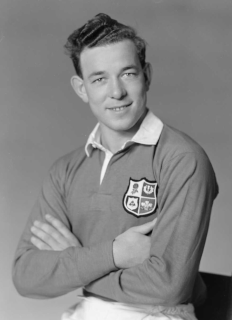
Dr. Karl Daniel Mullen, rugby union player and consultant gynecologist who captains the Irish rugby team and captains the British Lions on their 1950 tour to Australia and New Zealand, is born on November 26, 1926, in Courtown Harbour, County Wexford.

Mullen is one of three sons and seven daughters of Daniel Mullen, an officer of the customs and excise, and his wife Annie (née Hargrove). After his parents move to Home Farm Road, Drumcondra, Dublin, he is educated at the Dominican St. Thomas’s Academy, Eccles Street, the Jesuit Belvedere College, Great Denmark Street, and the Royal College of Surgeons in Ireland (RCSI). He plays rugby and cricket at school, association football with Home Farm F.C., and golf in the summer months. Initially a centre, he becomes a prop on the Belvedere junior cup team and, after injury to a teammate, hooker on the senior cup team, which loses the Leinster Schools Rugby Senior Cup final to Castleknock College in 1944.

On January 25, 1947, Mullen makes his formal Irish debut in a 12–8 loss to France. He plays as hooker, winning 25 caps for Ireland from 1947 to 1952. A year later, on January 31, 1948, he plays his first game for Barbarian F.C. in a 9–6 victory over Australia in Cardiff, Wales. After helping Ireland to victory over France on January 1, 1948, at the age of 21, he captains Ireland for the first time, on February 14, 1948, leading them to an 11–10 victory over England at Twickenham Stadium.

Mullen captains the Irish team to their first Grand Slam in the 1948 Five Nations Championship and is one of eight players from that team who live to see the country’s next Grand Slam in 2009.

Ireland retains the triple crown in 1949 by beating Wales 5–0 in Swansea, ending a run of defeats on Welsh soil lasting fourteen years. The following season Ireland suffers from injuries and loses to both England and Wales, the latter securing the triple crown.

Mullen is selected to captain the 1950 Lions Tour to Australia and New Zealand. After appearing in the first two tests against New Zealand, a 9–9 draw and an 8–0 loss, he sustains an ankle injury in the latter game and concedes his place to Dai Davies of Wales. Returning for the second test against Australia, a resounding 24–3 victory, he also plays in a semi-official “British Isles RFU” team against Ceylon during their return journey in September.

Under Mullen’s captaincy Ireland regains the international championship in 1951. His last cap comes in a 14–3 loss to Wales at Lansdowne Road on March 8, 1952. In twenty-five successive appearances (fifteen as captain), he secured three international championships and two triple crowns for Ireland in four seasons, their most successful haul of the twentieth century.

Mullen’s distinguished rugby career has to be fitted around his medical studies. In 1945, he enters the RCSI, graduating L and LM (RCSI and RCPI) in 1949. Awarded the diploma in obstetrics (1952) and membership of the Royal College of Obstetricians and Gynaecologists (1956), he trains at Sir Patrick Dun’s Hospital, Jervis Street Hospital and the Rotunda hospitals. After serving as senior obstetrics registrar at the Derby City General Hospital (1953–56), he returns to Dublin to become a consultant obstetrician, based at Mount Carmel Community Hospital, Churchtown, Dublin, and develops a considerable private practice. By his retirement in 2002, he is estimated to have delivered over 40,000 babies. A proponent of sex education in schools, he appears on RTÉ‘s 7 Days in December 1970, outlining various methods of birth control and calling for a more honest and realistic approach to artificial contraception.

Mullen marries Doreen Kilbride, an accomplished soprano, on April 30, 1952, in Donnybrook, Dublin, interrupting their honeymoon to play for Old Belvedere R.F.C. in the Leinster Senior Cup final. They have eight children, three boys and five girls. In 1975, they move from Altamount, Dundrum, Dublin, to Tulfarris House, Blessington, County Wicklow, adjacent to Poulaphouca Reservoir, where they farm and bred Irish draught horses. In 1985, he sells the property and much of his art collection and moves to Kilcullen, County Kildare.

Mullen is one of eight surviving members of the 1948 team to witness Ireland’s second grand slam on March 21, 2009. Only weeks later, having suffered from a long illness, he dies on April 27, 2009, at his home, Gilltown Lodge, in Kilcullen.

(Pictured: Karl Mullen, captain of the British Lions rugby union team, 1950)


Leave a comment

Birth of Bethel Solomons, Medical Doctor & Rugby Player

Bethel Albert Herbert Solomons, gynaecologist and international rugby player for the Ireland national rugby union team, is born into a prominent Jewish family, one of the oldest continuous Jewish families in Ireland, at 32 Waterloo Road, Dublin, on February 27, 1885. He is also a supporter of the 1916 Easter Rising.

The Solomons come to Ireland from England in 1824. Solomons is the son of Maurice Solomons (1832–1922), an optician whose practice is mentioned in James Joyce‘s Ulysses. His grandmother, Rosa Jacobs Solomons (1833–1926), is born in Hull in England. His elder brother Edwin (1879–1964) is a stockbroker and prominent member of the Dublin Jewish community. His sister Estella Solomons (1882–1968) is a leading artist, and a member of Cumann na mBan during the 1916 Easter Rising. She marries poet and publisher Seumas O’Sullivan. His younger sister Sophie is a trained opera singer.

Solomons attends St. Andrew’s College, Dublin, where he is very interested in rugby. He earns ten international rugby caps for Ireland between 1908 and 1910. He studies medicine at Trinity College, Dublin, becomes a medical doctor, and is Master of the Rotunda Hospital in Dublin from 1926 to 1933, surprising those who felt that a Jew would never hold the post. When his term ends in 1933, his name is intimately linked with that of the hospital when James Joyce writes in Finnegans Wake, “in my bethel of Solyman’s I accouched my rotundaties.” He serves as president of the Royal College of Physicians of Ireland (RCPI) in the late 1940s and practices from No. 30 Lower Baggot Street.

In a biography of Solomons he is described as “World famous obstetrician & gynaecologist, Rugby international, horseman, leader of Liberal Jewry & of Irish literary & artistic renaissance.”

Following a brief courtship, Solomons marries Gertrude Levy, who had studied with his sister Sophie at the Royal Academy of Music, London, in the liberal synagogue in London in 1916. His second son, Dr. Michael Solomons (1919–2007), is a distinguished gynaecologist, a pioneer of family planning in Ireland, and a veteran of the bitter and divisive 1983 constitutional amendment campaign.

Solomons is a friend of the founder of Sinn Féin and TD, Arthur Griffith. He contributes to the purchase of a house for Griffith. He is a founding member and the first president of the Liberal Synagogue in Dublin. He establishes a dispensary for Jewish women with Ada Shillman. In retirement he is inspector of qualifying examinations and visitor of medical schools in midwifery for the general medical council. A volume of memoirs is published in 1956. He is an art collector, including the works of Jean Cooke.

Solomons dies on September 11, 1965, at his home, Laughton Beg, Rochestown Avenue, Dún Laoghaire. The Bethel Solomons medal is awarded annually to an outstanding student in midwifery at the hospital.


2 Comments

Death of William Drennan, Physician, Poet & Political Radical

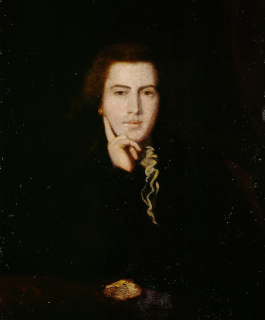
William Drennan, physician, poet and political radical, dies on February 5, 1820, in Belfast. He is one of the chief architects of the Society of United Irishmen and is known as the first to refer in print to Ireland as “the emerald isle” in his poem When Erin first rose.

Drennan is born on May 23, 1754, in Belfast, the son the son of Reverend Thomas Drennan (1696–1768), minister of Belfast’s First Presbyterian Church on Rosemary Street. Thomas Drennan is an educated man from the University of Glasgow and is ordained to the congregation of Holywood, County Down in 1731. Drennan is heavily influenced by his father, whose religious convictions serve as the foundation for his own radical political ideas. His sister, Martha, marries fellow future United Irishman Samuel McTier in 1773.

In 1769 Drennan follows in his father’s footsteps by enrolling in the University of Glasgow where he becomes interested in the study of philosophy. In 1772 he graduates in arts and then in 1773 he commences the study of medicine at Edinburgh. After graduating in 1778 he sets up practice in Belfast, specialising in obstetrics. He is credited with being one of the earliest advocates of inoculation against smallpox and of hand washing to prevent the spread of infection. He also writes much poetry, coining the phrase “Emerald Isle” and is the founder and editor of a literary periodical, Belfast Magazine. He moves to Newry in 1783 but eventually moves to Dublin in 1789 where he quickly becomes involved in nationalist circles.

Like many other Ulster Presbyterians, Drennan is an early supporter of the American Colonies in the American Revolution and joins the Volunteers who had been formed to defend Ireland for Britain in the event of French invasion. The Volunteer movement soon becomes a powerful political force and a forum for Protestant nationalists to press for political reform in Ireland eventually assisting Henry Grattan to achieve legislative independence for the Irish parliament in 1782. However, Drennan, like many other reformers, quickly becomes dismayed by the conservative and sectarian nature of the Irish parliament and in 1791 he co-founds the Society of United Irishmen with Wolfe Tone and Thomas Russell.

Drennan writes many political pamphlets for the United Irishmen and is arrested in 1794 for seditious libel, a political charge that is a major factor in driving the United Irishmen underground and into becoming a radical revolutionary party. Although he is eventually acquitted, he gradually withdraws from the United Irishmen but continues to campaign for Catholic Emancipation.

On February 8, 1800, Drennan marries Sarah Swanwick, “an English lady of some wealth” from Shropshire. They have one daughter and four sons.

Drennan settles in Belfast in 1807. In 1810 he co-founds the non-denominational Royal Belfast Academical Institution. As a poet, he is best remembered for his poem The Wake of William Orr, written in memory of a United Irishman executed by the British. Despite his links with revolutionary republicans, he gradually becomes alienated from the post-Union nationalism of the period. His abiding concern for Liberalism and post union realities make him contemplate his political ideas anew.

Drennan dies in Belfast on February 5, 1820. He directs that his coffin be carried by an equal number of Catholics and Protestants with clergy from different denominations in attendance.

Drennan’s son, John Swanwick Drennan, is a noted poet who, along with his brother William Drennan, write a biography of him for Richard Davis Webb‘s A Compendium of Irish Biography. Through his daughter Sarah, who marries John Andrews of a prominent family of flax merchants, he has several notable descendants, including William Drennan Andrews, judge of the High Court of Justice in Ireland, Sir James Andrews, 1st Baronet, Lord Chief Justice of Northern Ireland, John Miller Andrews, Prime Minister of Northern Ireland, Thomas Andrews who drew up the plans for the RMS Titanic and was aboard and drowned when she sank, and Thomas Drennan, performance artist known primarily for his seminal work ‘Journey to the Centre of Drennan.’


Leave a comment

Birth of William Drennan, Physician, Poet & Political Radical

william-drennan

William Drennan, physician, poet and political radical, is born on May 23, 1754, in Belfast. He is one of the chief architects of the Society of United Irishmen and is known as the first to refer in print to Ireland as “the emerald isle” in his poem When Erin first rose.

Drennan is son the son of Reverend Thomas Drennan (1696–1768), minister of Belfast’s First Presbyterian Church on Rosemary Street. Thomas Drennan is an educated man from the University of Glasgow and is ordained to the congregation of Holywood, County Down in 1731. Drennan is heavily influenced by his father, whose religious convictions serve as the foundation for his own radical political ideas. His sister, Martha, marries fellow future United Irishman Samuel McTier in 1773.

In 1769 Drennan follows in his father’s footsteps by enrolling in the University of Glasgow where he becomes interested in the study of philosophy. In 1772 he graduates in arts and then in 1773 he commences the study of medicine at Edinburgh. After graduating in 1778 he sets up practice in Belfast, specialising in obstetrics. He is credited with being one of the earliest advocates of inoculation against smallpox and of hand washing to prevent the spread of infection. He also writes much poetry, coining the phrase “Emerald Isle” and is the founder and editor of a literary periodical, Belfast Magazine. He moves to Newry in 1783 but eventually moves to Dublin in 1789 where he quickly becomes involved in nationalist circles.

Like many other Ulster Presbyterians, Drennan is an early supporter of the American Colonies in the American Revolution and joins the Volunteers who had been formed to defend Ireland for Britain in the event of French invasion. The Volunteer movement soon becomes a powerful political force and a forum for Protestant nationalists to press for political reform in Ireland eventually assisting Henry Grattan to achieve legislative independence for the Irish parliament in 1782. However, Drennan, like many other reformers, quickly becomes dismayed by the conservative and sectarian nature of the Irish parliament and in 1791 he co-founds the Society of United Irishmen with Wolfe Tone and Thomas Russell.

Drennan writes many political pamphlets for the United Irishmen and is arrested in 1794 for seditious libel, a political charge that is a major factor in driving the United Irishmen underground and into becoming a radical revolutionary party. Although he is eventually acquitted, he gradually withdraws from the United Irishmen but continues to campaign for Catholic Emancipation.

On February 8, 1800, Drennan marries Sarah Swanwick, “an English lady of some wealth” from Shropshire. They have one daughter and four sons.

Drennan settles in Belfast in 1807. In 1810 he co-founds the non-denominational Royal Belfast Academical Institution. As a poet, he is best remembered for his poem The Wake of William Orr, written in memory of a United Irishman executed by the British. Despite his links with revolutionary republicans, he gradually becomes alienated from the post-Union nationalism of the period. His abiding concern for Liberalism and post union realities make him contemplate his political ideas anew.

Drennan dies on February 5, 1820. He directs that his coffin be carried by an equal number of Catholics and Protestants with clergy from different denominations in attendance.

Drennan’s son, John Swanwick Drennan, is a noted poet who, along with his brother William Drennan, write a biography of him for Richard Davis Webb‘s A Compendium of Irish Biography. Through his daughter Sarah, who marries John Andrews of a prominent family of flax merchants, he has several notable descendants, including William Drennan Andrews, judge of the High Court of Justice in Ireland, Sir James Andrews, 1st Baronet, Lord Chief Justice of Northern Ireland, John Miller Andrews, Prime Minister of Northern Ireland, Thomas Andrews who drew up the plans for the RMS Titanic and was aboard and drowned when she sank, and Thomas Drennan, performance artist known primarily for his seminal work ‘Journey to the Centre of Drennan.’