seamus dubhghaill

Promoting Irish Culture and History from Little Rock, Arkansas, USA


Leave a comment

Birth of Composer Michael William Balfe

michael-william-balfe

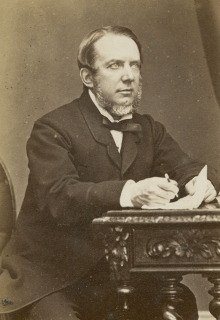
Michael William Balfe, Irish composer best remembered for his opera The Bohemian Girl, is born in Dublin on May 15, 1808.

Balfe’s musical gifts become apparent at an early age. He receives instruction from his father, a dancing master and violinist, and the composer William Rooke. His family moves to Wexford when he is a child.

In 1817, Balfe appears as a violinist in public, and in this year composes a ballad, first called “Young Fanny” and afterwards, when sung in Paul Pry by Lucia Elizabeth Vestris, “The Lovers’ Mistake”. In 1823, upon the death of his father, he moves to London and is engaged as a violinist in the orchestra of the Theatre Royal, Drury Lane. He eventually becomes the leader of that orchestra. While there, he studies violin with Charles Edward Horn and composition with Charles Frederick Horn.

While still playing the violin, Balfe pursues a career as an opera singer. He debuts unsuccessfully at Norwich in Carl Maria von Weber‘s Der Freischütz. In 1825, Count Mazzara takes him to Rome for vocal and musical studies and introduces him to Luigi Cherubini. In Italy, he also pursues composing, writing his first dramatic work, a ballet, La Perouse. He becomes a protégée of Gioachino Rossini‘s, and at the close of 1827, he appears as Figaro in The Barber of Seville at the Italian opera in Paris.

Balfe soon returns to Italy, where he is based for the next eight years, singing and composing several operas. In 1829 in Bologna, he composes his first cantata for the soprano Giulia Grisi, then 18 years old. He produces his first complete opera, I rivali di se stessi, at Palermo in the carnival season of 1829—1830.

Balfe returned to London in May 1835. His initial success takes place some months later with the premiere of The Siege of Rochelle on October 29, 1835, at Drury Lane. Encouraged by his success, he produces The Maid of Artois in 1836, which is followed by more operas in English. In July 1838, Balfe composes a new opera, Falstaff, for The Italian Opera House, based on The Merry Wives of Windsor, with an Italian libretto by S. Manfredo Maggione.

In 1841, Balfe founds the National Opera at the Lyceum Theatre, but the venture is a failure. The same year, he premieres his opera, Keolanthe. He then moves to Paris, presenting Le Puits d’amour in early 1843, followed by his opera based on Les quatre fils Aymon for the Opéra-Comique and L’étoile de Seville for the Paris Opera. Meanwhile, in 1843, he returns to London where he produces his most successful work, The Bohemian Girl, on November 27, 1843, at the Theatre Royal, Drury Lane. The piece runs for over 100 nights, and productions are soon mounted in New York, Dublin, Philadelphia, Vienna, Sydney, and throughout Europe and elsewhere.

From 1846 to 1852, Balfe is appointed musical director and principal conductor for the Italian Opera at Her Majesty’s Theatre. There he first produces several of Giuseppe Verdi‘s operas for London audiences. He conducts for Jenny Lind at her opera debut and on many occasions thereafter.

In 1851, in anticipation of The Great Exhibition in London, Balfe composes an innovative cantata, Inno Delle Nazioni, sung by nine female singers, each representing a country. He continues to compose new operas in English, including The Armourer of Nantes (1863), and writes hundreds of songs. His last opera, nearly completed when he dies, is The Knight of the Leopard and achieves considerable success in Italian as Il Talismano.

Balfe retires in 1864 to Hertfordshire, where he rents a country estate. He dies at his home in Rowney Abbey, Ware, Hertfordshire, on October 20, 1870, and is buried at Kensal Green Cemetery in London, next to fellow Irish composer William Vincent Wallace. In 1882, a medallion portrait of him is unveiled in Westminster Abbey.

In all, Balfe composes at least 29 operas. He also writes several cantatas and a symphony. His only large-scale piece that is still performed regularly today is The Bohemian Girl.


Leave a comment

Birth of Brigadier General Thomas Alfred Smyth

thomas-alfred-smyth

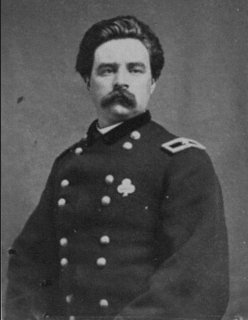
Thomas Alfred Smyth, brigadier general in the Union Army during the American Civil War, is born in Ballyhooly, County Cork on December 25, 1832. He is the last Union general killed in the war. In March 1867, he is nominated and confirmed a brevet major general of volunteers posthumously to rank from April 7, 1865.

Smyth works on his father’s farm in Ireland as a youth. He emigrates to the United States in 1854, settling in Philadelphia, Pennsylvania. He participates in William Walker‘s expedition to Nicaragua. He is employed as a wood carver and coach and carriage maker. In 1858, he moves to Wilmington, Delaware.

In 1861 Smyth enlists in the Union army in an Irish American three-months regiment, the 24th Pennsylvania, and is quickly made a captain. He is later commissioned as a major of the 1st Delaware Infantry, a three-years regiment. He serves at the battles of Chancellorsville and Fredericksburg, following which he is promoted to lieutenant colonel and then to colonel. During the Gettysburg campaign, he commands the 2nd Brigade, 3rd Division of the II Corps. During the Battle of Gettysburg, his men help defend Cemetery Ridge and advance to the area of the Bliss farm to oust enemy sharpshooters. He is wounded on the third day of the battle and relinquishes command briefly.

Smyth retains brigade command during the reorganization of II Corps before Ulysses S. Grant‘s Overland Campaign. He leads the second brigade of the first division from March 25 to May 17, 1864. When Colonel Samuel S. Carroll is wounded, Smyth is transferred to his command, the third brigade of second division, the Gibraltar Brigade. In October 1864, he is promoted to brigadier general during the Siege of Petersburg. He retains command of his brigade throughout the siege.

Between July 31, 1864, and August 22, 1864, and between December 23, 1864, and February 25, 1865, Smyth commands the 2nd division of the corps. In April 1865 near Farmville, Virginia, he is shot through the mouth by a sniper, with the bullet shattering his cervical vertebra and paralyzing him. He dies two days later at Burke’s Tavern, concurrent with the surrender of Robert E. Lee and his Confederate States Army at Appomattox Court House.

On March 18, 1867, President Andrew Johnson nominates Smyth for posthumous appointment to the grade of brevet major general of volunteers to rank from April 7, 1865, the date he was mortally wounded, and the United States Senate confirms the appointment on March 26, 1867. He is the last Union general killed or mortally wounded during the war and is buried in Wilmington and Brandywine Cemetery in Wilmington, Delaware.


Leave a comment

Adoption of the Articles of Confederation

articles-of-confederation

The Articles of Confederation and Perpetual Union, the first written constitution of the United States is adopted by the Second Continental Congress on November 15, 1777. A number of the members of the Congress hail from Ireland including Secretary of the Congress Charles Thomson who is born in Maghera, County Derry in 1729. Thomson is the permanent Secretary of the Continental Congress for more than fifteen years. At least three signatories to the Declaration of Independence are Irish – James Smith, George Taylor, and Matthew Thornton.

The Articles of Confederation is approved, after much debate between July 1776 and November 1777, by the Second Continental Congress and sent to the states for ratification. The Articles come into force on March 1, 1781, after being ratified by all thirteen states. A guiding principle of the Articles is to preserve the independence and sovereignty of the states. The weak central government established by the Articles receives only those powers which the former colonies had recognized as belonging to king and parliament.

The document provides clearly written rules for how the states’ “league of friendship” is to be organized. During the ratification process, the Congress looks to the Articles for guidance as it conducts business, directs the war effort, conducts diplomacy with foreign nations, addresses territorial issues and deals with Native American relations. Little changes politically once the Articles of Confederation go into effect, as ratification does little more than legalize what the Continental Congress had already been doing. That body is renamed the Congress of the Confederation however most Americans continue to call it the Continental Congress, since its organization remains the same.

As the Confederation Congress attempts to govern the continually growing American states, delegates discover that the limitations placed upon the central government render it ineffective at doing so. As the government’s weaknesses become apparent, especially after Shays’ Rebellion, some prominent political thinkers in the fledgling nation begin asking for changes to the Articles. Their hope is to create a stronger national government.

Initially, some states meet to deal with their trade and economic problems. However, as more states become interested in meeting to change the Articles, a meeting is set in Philadelphia on May 25, 1787. This becomes the Constitutional Convention. It is quickly agreed that changes will not work, and instead the entire Articles needs to be replaced. On March 4, 1789, the government under the Articles is replaced with the federal government under the Constitution of the United States. The new Constitution provides for a much stronger federal government by establishing a chief executive (the President), courts, and taxing powers.


Leave a comment

Death of Colonel James Hagan

james-hagan

James Hagan, Irish American captain in the United States Army during the Mexican–American War and a Confederate States Army colonel during the American Civil War, dies in Mobile, Alabama on November 6, 1901.

Hagan is born in County Tyrone on June 17, 1822. His family moves to a farm near Philadelphia, Pennsylvania when he is still at an early age, and he is educated at Clermont Academy. He moves to Alabama in 1837. His prosperous uncle, John Hagen of New Orleans, Louisiana, takes him into the family business and sets him up in Mobile to manage the Hagan business there.

Hagan serves in John Coffee Hays‘s Texas Rangers, a cavalry unit in Major General Zachary Taylor‘s army during the Mexican–American War. He is recognized for his gallantry at the Battle of Monterrey. He is commissioned a captain in the 3rd U.S. Dragoons in 1848 and is discharged on July 31, 1848. After the war, he returns to Mobile where he purchases and subsequently manages a plantation rather than remaining in the family mercantile business. In 1854, he marries Bettie Oliver, daughter of Alabama’s attorney general.

At the beginning of the American Civil War, Hagan organizes and is elected captain of a cavalry company for the Alabama Militia, the “Mobile Dragoons,” which serves on guard duty along the Gulf Coast. At the rank of major he transfers to the 1st Mississippi Cavalry Regiment on October 26, 1861. The regiment fights at the Battle of Shiloh on April 6–7, 1862. He leads his men in a mounted charge at the Battle of Perryville, which is highly commended by his brigade commander, Brigadier General Joseph Wheeler.

Hagan is promoted to colonel of a new regiment, the 3rd Alabama Cavalry Regiment, on July 1, 1862. The regiment fights in all of the campaigns of the Army of Tennessee. In July 1863, He is assigned to command Brigade 1 of Brigadier General William T. Martin‘s Division of the Cavalry Corps of the Army of Tennessee, which is Major General Joseph Wheeler’s old brigade. During the spring and summer of 1863, the brigade screens the left front of General Braxton Bragg‘s army. Wheeler recommends that Hagan be promoted to brigadier general, but Bragg blocks the promotion because he says Hagan is in a state of “dissipation”, a reference to drunkenness or alcoholism. Hagan is wounded near Franklin, Tennessee in the winter of 1862 and again near Kingston, Tennessee in November 1863. In November 1863, he resigns and returns to Mobile to recover from his wounds and his disappointment from not being promoted.

After he recuperates, Hagan asks that his resignation be revoked. The resignation is revoked, and he returns to his regiment for the Atlanta campaign, where the regiment fights as infantry in the trenches. When Brigadier General William Wirt Adams is promoted to command of the Division, Hagan is assigned to permanent command of the brigade, consisting of five regiments and one battalion of Alabama cavalry. His brigade is part of Wheeler’s force which opposes Major General William Tecumseh Sherman‘s March to the Sea and Campaign of the Carolinas. He is wounded again at the Battle of Monroe’s Crossroads, near Kinston, North Carolina on March 10, 1865, and again at Fayetteville, North Carolina the next day.

Although Hagan is assigned as acting brigadier general in early 1865, he never receives an official appointment from Jefferson Davis or confirmation by the Confederate States Senate of an appointment as a general officer. Major General Wheeler later writes that he had been told unofficially by Confederate States War Department officials that brigadier general commissions had been issued for Hagan, Henry Marshall Ashby and Moses Wright Hannon near the end of the war, but no such commissions ever were delivered.

Hagan returns to Mobile after the war but is penniless since his fortune had been converted to Confederate money. He works as manager of a plantation on the Alabama River in the 1870s and early 1880s. President Grover Cleveland appoints him crier of the United States District Court in Alabama in 1885.

James Hagan dies on November 6, 1901, at Mobile, Alabama. He is buried in Magnolia Cemetery in Mobile.


Leave a comment

Birth of Peter Boyle, Irish American Actor

peter-boyle

Peter Lawrence Boyle Jr., Irish American character actor and comedian, is born on October 18, 1935, in Norristown, Pennsylvania. He is most noted for his role as Frank Barone on the sitcom Everybody Loves Raymond and the comical monster in Mel Brooks‘s film spoof Young Frankenstein (1974).

Boyle is born to Alice (Lewis) and Francis Xavier Boyle. His paternal grandparents are Irish immigrants, and his mother is of mostly French and British Isles descent. He eventually moves to Philadelphia, where his father is a sought-after local TV personality and children’s show host. Following a solid Catholic upbringing, he is a sensitive youth and joins the Christian Brothers religious order at one point while attending La Salle University in Philadelphia. He leaves the monastery after only a few years when he “lost” his calling.

Bent on an acting career, Boyle initially studies with guru Uta Hagen in New York. The tall, hulking, prematurely bald actor wannabe struggles through a variety of odd jobs as a postal worker, waiter and bouncer while simultaneously building up his credits on stage and waiting for that first big break. Things start progressing for him after appearing in the national company of The Odd Couple in 1965 and landing TV commercials on the sly. In the late 1960s Boyle joins Chicago‘s The Second City improv group and makes his Broadway debut as a replacement for Peter Bonerz in Paul Sills’ Story Theatre (1971).

Boyle gains acclaim for his first starring role, playing the title character, a bigoted New York City factory worker, in the 1970 movie Joe, directed by John G. Avildsen. The film’s release is surrounded by controversy over its violence and language. The role leads to major notoriety, however, and some daunting supporting parts in T.R. Baskin (1971), Slither (1973) and as Robert Redford‘s calculating campaign manager in The Candidate (1972). During this time his political radicalism finds a visible platform after joining Jane Fonda and Donald Sutherland on anti-war crusades, which also includes the anti-establishment picture Steelyard Blues (1973). This period also sees the forging of a strong friendship with former Beatle John Lennon.

Destined to be cast as monstrous undesirables throughout much of his career, Boyle plays a monster of another sort in his early film days, and thus avoids a complete stereotype as a film abhorrent. His hilarious, sexually potent Frankenstein’s Monster in the cult Mel Brooks spoof Young Frankenstein (1974) sees him in a sympathetic and certainly more humorous vein. His creature’s first public viewing, in which Boyle shares an adroit tap-dancing scene with “creator” Gene Wilder in full Fred Astaire regalia, is a show-stopping audience pleaser. Late 1970s filmgoers continue to witness him in seamy, urban settings with brutish roles in Taxi Driver (1976) and Hardcore (1979). At the same time, he addresses several TV mini-movie roles with the same brilliant darkness such as his Senator Joe McCarthy in Tail Gunner Joe (1977), for which he receives an Emmy nomination, and his murderous, knife-wielding Fatso in the miniseries remake of From Here to Eternity (1979).

While the following decade finds Boyle in predominantly less noteworthy filming and a short-lived TV series lead as remote cop Joe Bash (1986), the 1990s bring him Emmy glory for a guest role in an episode of The X-Files (1993). Despite a blood clot-induced stroke in 1990 that impairs his speech for six months, he ventures on and caps his enviable career on TV wielding funny but crass one-liners in the “Archie Bunker” mold on the long-running sitcom Everybody Loves Raymond (1996). A major Emmy blunder has him earning seven nominations for his Frank Barone character without a win, the only prime player on the show unhonored. He survives a heart attack while on the set of Everybody Loves Raymond in 1999 but manages to return full time for the remainder of the series’ run through 2005.

Following a superb turn as Billy Bob Thornton‘s unrepentantly racist father in the sobering Oscar-winner Monster’s Ball (2001), the remainder of Boyle’s films are primarily situated in frivolous comedy fare such as The Adventures of Pluto Nash (2002), The Santa Clause 2 (2002), Scooby-Doo 2: Monsters Unleashed (2004), and The Santa Clause 3: The Escape Clause (2006), typically playing cranky curmudgeons.

Boyle dies of multiple myeloma and heart disease at NewYork-Presbyterian Hospital on December 12, 2006. He is interred at Green River Cemetery in Springs, New York. At the time of his death, he has completed his role in the film All Roads Lead Home and is scheduled to appear in The Golden Boys. The end credits of All Roads Lead Home include a dedication to his memory.


Leave a comment

Birth of Irish American Painter William Harnett

william-michael-harnett

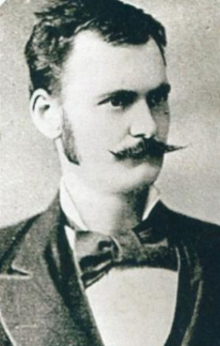
William Michael Harnett, Irish American painter known for his trompe-l’œil still lifes of ordinary objects, is born in Clonakilty, County Cork on August 10, 1848, during the time of the Great Famine.

Shortly after his birth Harnett’s family emigrates to the United States, settling in Philadelphia. Becoming a United States citizen in 1868, he makes a living as a young man by engraving designs on table silver, while also taking night classes at the Pennsylvania Academy of the Fine Arts and later, in New York City, at Cooper Union and at the National Academy of Design. His first known oil painting, a still life, dates from 1874.

The style of trompe-l’œil painting that Harnett develops is distinctive and inspired many imitators, but it is not without precedent. A number of Dutch Golden Age painters, Pieter Claesz for instance, had specialized in tabletop still life of astonishing verisimilitude. Raphaelle Peale, working in Philadelphia in the early 19th century, pioneers the form in America. What sets Harnett’s work apart, besides his enormous skill, is his interest in depicting objects not usually made the subject of a painting.

Harnett paints musical instruments, hanging game, and tankards, but also paints the unconventional Golden Horseshoe (1886), a single rusted horseshoe shown nailed to a board. He paints a casual jumble of second-hand books set on top of a crate, Job Lot, Cheap (1878), as well as firearms and even paper currency. His works sell well, but they are more likely to be found hanging in a tavern or a business office than in a museum, as they did not conform to contemporary notions of high art.

still-life-violin-and-music

Harnett spent the years 1880–1886 in Europe, staying in Munich from 1881 until early 1885. His best-known paintings, the four versions of After the Hunt, are painted between 1883 and 1885. Each is an imposing composition of hunting equipment and dead game, hanging on a door with ornate hinges at the right and keyhole plate at the left. These paintings, like the horseshoe or currency depictions mentioned earlier, are especially effective as trompe-l’œil because the objects occupy a shallow space, meaning that the illusion is not spoiled by parallax shift if the viewer moves.

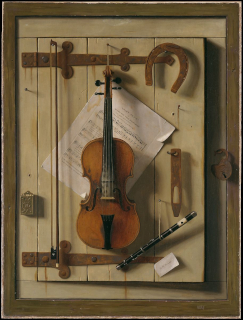
Overall, Harnett’s work is most comparable to that of the slightly younger John F. Peto. The two artists know each other, and a comparison can be made between two paintings featuring violins. Harnett’s Music and Good Luck from 1888 shows the violin hanging upright on a door with ornate hinges and with a slightly torn piece of sheet music behind it. The elements are arranged in a stable, deliberate manner. Peto’s 1890 painting shows the violin hanging askew, as well as chipped and worn, with one broken string. The sheet music is dog-eared and torn around the edges and placed haphazardly behind the instrument. The hinges are less ornate, and one is broken. Harnett’s objects show signs of use but are well preserved, while Peto’s more humble objects are nearly used up.

Crippling rheumatism plagues Harnett in his last years, reducing the number but not the quality of his paintings. He dies in New York City on October 29, 1892. Other artists who paint similar compositions in Harnett’s wake include his contemporary John Haberle and successors such as Otis Kaye and Jefferson David Chalfant.

Harnett’s work is in collections in the Albright-Knox Art Gallery (Buffalo, New York), the Amon Carter Museum of American Art (Fort Worth, Texas), the Dallas Museum of Art, the Art Institute of Chicago, the Brooklyn Museum, the Carnegie Museum of Art (Pittsburgh, Pennsylvania), the Cincinnati Art Museum, the Cleveland Museum of Art, the Detroit Institute of Arts, the Fine Arts Museums of San Francisco, Harvard Art Museums, the High Museum of Art (Atlanta, Georgia), the Honolulu Museum of Art, the Joslyn Art Museum (Omaha, Nebraska), the Los Angeles County Museum of Art, the Metropolitan Museum of Art (New York, New York), the National Gallery of Art (Washington D.C.), the National Gallery of Canada (Ottawa, Ontario), the Philadelphia Museum of Art, the San Diego Museum of Art, Thyssen-Bornemisza Museum (Madrid, Spain), the Toledo Museum of Art (Toledo, Ohio), the Wadsworth Atheneum (Hartford, Connecticut), and the Wichita Art Museum (Wichita, Kansas) among others.

(Pictured: Music and Good Luck, oil on canvas by William Michael Harnett, 1888, Metropolitan Museum of Art)


6 Comments

Death of Colonel Dennis O’Kane

dennis-o-kane

Colonel Dennis O’Kane, officer in the Union Army during the American Civil War, dies on July 4, 1863, of wounds sustained the previous day when fighting with the 69th Pennsylvania Irish Brigade at the Battle of Gettysburg.

Born in Coleraine, County Londonderry, O’Kane is a tavern owner in Philadelphia, Pennsylvania and a member of the 2nd Pennsylvania Militia regiment prior to the Civil War. When the conflict starts, he helps recruit the 24th Pennsylvania Volunteer Infantry, a unit that has the 2nd Pennsylvania Militia as its nucleus. Commissioned Major, Field and Staff, on May 1, 1861, he is with his regiment as it serves first in Maryland and then Virginia before their enlistment expires in July 1861.

In August 1861 O’Kane joins with many of the men from the 24th Pennsylvania in re-enlisting to continue the war effort, and they form the basis of what becomes the 69th Pennsylvania Infantry Regiment. Commissioned Lieutenant Colonel, Field and Staff on August 19, 1861, his new regiment is composed largely of Irish immigrants like himself, and they emblazon the Irish harp on their flag. The unit eventually is joined with the 71st, 72nd and 106th Pennsylvania Infantry Regiments to form the famous Philadelphia Brigade.

O’ Kane serves as second-in-command through 1862, participating in the Peninsular Campaign of May and June, the Second Battle of Bull Run in August, and the September 1862 Battle of Antietam, where his brigade is caught in the West Woods area and takes heavy losses. In November 1862, the 69th Pennsylvania’s commander, Colonel Joshua T. Owen, is promoted to Brigadier General, US Volunteers. O’Kane is advanced to Colonel on December 1, 1862, to fill the vacancy.

At the Battle of Fredericksburg on December 14, 1862, O’Kane leads his men in the third of four waves of futile Union charges on strong Confederate positions at Marye’s Heights south of the town, and sees his regiment sustain fifty-one casualties. In May 1863 during the Battle of Chancellorsville, his brigade is held in reserve and sees limited action.

During the Battle of Gettysburg in July 1863, O’Kane finds the 69th Pennsylvania positioned along a rock fencing in the middle of the Union lines that becomes famous as “The Angle.” That position becomes the epicenter of Pickett’s Charge on July 3, the third day of the battle, as the remnants of the Confederate forces, having been much devastated from Union artillery fire, crash over the rock walls and engage the Philadelphia Brigade in brutal hand-to-hand fighting.

O’Kane is shot in the head at the wall and dies the following day. His regiment again takes high casualties but succeeds in helping to repulse the rebels and defeat the charge. The monument for the 69th Pennsylvania Infantry in Gettysburg National Military Park stands on the spot where O’Kane was mortally wounded.


Leave a comment

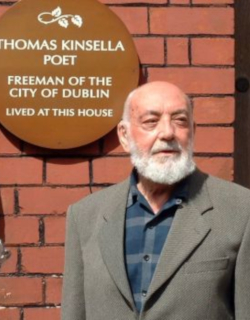
Birth of Poet Thomas Kinsella

thomas-kinsella

Thomas Kinsella, poet whose sensitive lyrics deal with primal aspects of the human experience, often in a specifically Irish context, is born in Inchicore, Dublin on May 4, 1928.

Kinsella spends most of his childhood in the Kilmainham/Inchicore area of Dublin. He is educated at the Model School, Inchicore, where classes are taught in Irish Gaelic, and at the O’Connell School in North Richmond Street, Dublin. He acquires a series of grants and scholarships that allow him to attend University College Dublin, where he studies physics and chemistry before receiving a degree in public administration.

Kinsella begins serving in the Irish civil service in 1946, and in the early 1950s he meets Liam Miller, the founder of Dolman Press, which publishes much of Kinsella’s poetry beginning in 1952. Among these publications are Poems (1956), his first volume of collected work, Another September (1958), which contains poems that explore the imposition of existential order through various forms, be they natural or products of the poet’s imagination and Downstream (1962), a collection focusing on war and political and social disruption in modern Ireland.

In 1965 Kinsella leaves the Irish civil service and takes a position as a writer in residence at Southern Illinois University in Carbondale (1965–70). During this time, he publishes Nightwalker, and Other Poems (1967), a sombre collection ruminating on Ireland’s past and turbulent present. His translation of the ancient Gaelic saga The Cattle Raid of Cooley (Táin bó Cuailnge) is published in 1969, and the following year he begins teaching at Temple University in Philadelphia. New Poems 1956–73 (1973) and One, and Other Poems (1979) skillfully extend the themes of love, death, and rejuvenation.

Kinsella founds his own publishing company, the Peppercanister Press, in Dublin in 1972, which allows him to publish pamphlets and individual poems in limited editions without relying on submissions to journals or magazines. His first poem to be published through his press is Butcher’s Dozen (1972), about Bloody Sunday, in which 13 demonstrators are killed by British troops in Derry, Northern Ireland, and the ensuing tribunal. Blood & Family (1988) combines four short collections of prose and verse originally published individually through Peppercanister, and Godhead (1999) explores the Trinity in the light of contemporary society. Later works published through Peppercanister include Marginal Economy (2006), Man of War (2007), and Belief and Unbelief (2007). Numerous collections of his poems have been released, including Collected Poems, 1956–2001 (2001) and Selected Poems (2007).

In December 2018, Kinsella is awarded Doctor in Littoris, Honoris Causa, by Trinity College Dublin.


Leave a comment

Capture of Gustavus Conyngham, the Dunkirk Pirate

gustavus-conyngham

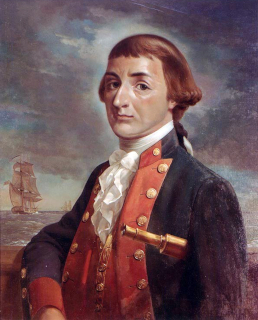
Irish-born United States Navy Captain Gustavus Conyngham, “The Dunkirk Pirate,” is captured by the British Royal Navy in the waters off New York on April 27, 1779.

Conyngham is born in County Donegal in 1747 and emigrated to British America in 1763 in search of a better life. He settles in Philadelphia in order to work for his cousin Redmond Conyngham in the shipping industry. When the American Revolutionary War begins in 1775, he immediately sailed to France to try to procure supplies needed for the war effort.

The British become aware of Conyngham’s plans and manage to maneuver him out of his ship with the help of the Dutch. After the loss of his ship, he heads back to France, hoping to connect with an ally to the United States. It is there he meets Benjamin Franklin, who helps him in his adventures many times in the future. They form a lasting relationship, and Conyngham eventually awards Franklin the nickname “the Philosopher” for his intellectual fortitude and resourcefulness. Franklin is entrusted with several commissions of the Continental Navy, and on March 1, 1777, Conyngham is appointed Captain of the lugger Surprise.

Conyngham scores a first victory that would warm the heart of any Irishmen, capturing the British merchant ship Prince of Orange on May 3, 1777. Later that year he is commissioned a captain in the Continental Navy and given command of the USS Revenge. He begins a series of highly successful raids into British waters from the port of Dunkirk, thus earning his sobriquet “The Dunkirk Pirate.”

In 1778 Conyngham sets sail for the West Indies and terrorizes British vessels there before finally returning to Philadelphia on February 21, 1779. He and his men had claimed 60 prize vessels in just 18 months. When he sets sail again his luck runs out and his ship is captured by the British vessel HMS Galatea on April 27, 1779. Conyngham was taken to prison in England and treated harshly by his British captors.

After two failed escape attempts, Conyngham tunnels his way out of Mill Prison in Plymouth and manages to make his way to the continent. He joins John Paul Jones on a cruise on the Alliance before returning to the United States. He is captured by the British again in March 1780 and spends another year in Mill Prison.

After the war Conyngham fails in his efforts to continue his naval career or to gain recognition from the United States Congress for his service during the war. He had lost the commission papers given to him by colonial representatives in Paris in 1777. It is said that he assists in the defense of Philadelphia against his old British foes during the War of 1812.

Gustavus Conyngham dies in Philadelphia seven years later on November 27, 1819. Nearly a century later, John Sanford Barnes, a retired navy captain and naval historian, acquires a cache of autographs and documents from a sale by Charavay of Paris. In the collection is Conyngham’s commission from Benjamin Franklin. Barnes publishes his discovery in September 1902, proving that the “Dunkirk Pirate” had never been a pirate at all, but one of the first heroes of the United States Navy.

(Pictured: Captain Gustavus Conyngham, Continental Navy. Painting by V. Zveg, 1976, based on a miniature by Louis Marie Sicardi. Courtesy of the U.S. Navy Art Collection, Washington, D.C. U.S. Naval Historical Center Photograph.)


Leave a comment

Birth of St. Clair Mulholland, Union Army Colonel

File source: http://commons.wikimedia.org/wiki/File:St_Clair_Mulholland.jpg

St. Clair Augustine Mulholland, colonel in the Union Army in the American Civil War and Medal of Honor winner, is born in Lisburn, County Antrim on April 1, 1839.

Mulholland emigrates to Philadelphia with his parents while a boy. His youthful tastes incline him to military affairs, and he becomes active in the ranks of the militia. At the outbreak of the Civil War, he is commissioned lieutenant colonel of the 116th Pennsylvania Infantry Regiment, which is attached to Thomas Francis Meagher‘s Irish Brigade. When the regiment‘s size is reduced to a battalion, he accepts a reduction in rank to major.

Mulholland is wounded during the famous charge of the Irish Brigade up Marye’s Heights at the Battle of Fredericksburg on December 13, 1862. At the Battle of Chancellorsville on May 3 and 4, 1863, he leads his regiment and distinguishes himself by saving the guns of the 5th Maine Battery that had been abandoned to the enemy. For this he is complimented in general orders and later receives the Medal of Honor from the United States Congress. In this campaign he is given the command of the picket line by Major General Winfield Scott Hancock and covers the retreat of the Army of the Potomac across the Rappahannock River.

Although Mulholland later claims that at the Battle of Gettysburg on July 2, 1863, he personally took command of the 140th Pennsylvania Infantry and led it into action, this fact is mentioned in neither his own official report of the battle, nor that of the lieutenant colonel commanding the 140th. When the 116th is returned to full strength in early 1864, he is promoted to colonel. He is wounded a second time at the Battle of the Wilderness on May 5, 1864. At the Battle of Spotsylvania Court House, he is wounded a third time but remains in the hospital only ten days. Resuming his command, he is dangerously wounded again at the Battle of Totopotomoy Creek. He recovers rapidly and commands his brigade in all the actions around the Siege of Petersburg, particularly distinguishing himself by storming a fort on the Boydton Plank Road. He is mustered out of the volunteer service on June 3, 1865.

On May 4, 1866, President Andrew Johnson nominates Mulholland for the brevet grade of brigadier general of volunteers to rank from March 13, 1865, for his conduct at the Battle of the Wilderness and the U.S. Senate confirms the appointment on May 18, 1866. On January 13, 1869, President Johnson nominates Mulholland for appointment to the brevet grade of major general of volunteers, to rank from March 13, 1865, for his actions on the Boydton Plank Road and the Senate confirms the appointment on February 16, 1869. The brevet is issued February 20, 1869. It is the last brevet of major general issued for service during the Civil War.

Returning to civilian life after the war, Mulholland is appointed Chief of Police in Philadelphia in 1868 and signalizes his administration by the good order in which he keeps both the force and the city. President Grover Cleveland appoints him United States Pension Agent, in which office he is continued by Presidents William McKinley and Theodore Roosevelt. He is considered an authority on the science of penology and also devotes much of his leisure time to art studies, and as a lecturer and writer on the Civil War and its records. He compiles a history of the 116th Regiment, and another of those to whom Congress voted the Medal of Honor. In the Catholic affairs of Philadelphia, he is always active and a leader among the best-known laymen.

St. Clair Augustin Mulholland dies on February 17, 1910, in Philadelphia, Pennsylvania. He is buried at Old Cathedral Cemetery, Philadelphia.