seamus dubhghaill

Promoting Irish Culture and History from Little Rock, Arkansas, USA


Leave a comment

The Bloody Sunday Inquiry

CREATOR: gd-jpeg v1.0 (using IJG JPEG v62), quality = 75

The Bloody Sunday Inquiry, also known as the Saville Inquiry or the Saville Report after its chairman, Mark Saville, Baron Saville of Newdigate, is launched on April 3, 1998, by British Prime Minister Tony Blair. The inquiry follows campaigns for a second inquiry by families of those killed and injured in Derry on Bloody Sunday during the peak of ethno-political violence known as The Troubles. The inquiry is set up to establish a definitive version of the events of Sunday, January 30, 1972, superseding the tribunal set up under John Widgery, Baron Widgery that had reported on April 19, 1972, eleven weeks after the events, and to resolve the accusations of a whitewash that had surrounded it.

The inquiry takes the form of a tribunal established under the Tribunals of Inquiry (Evidence) Act 1921, and consists of Lord Saville, the former Chief Justice of New Brunswick William L. Hoyt and John L. Toohey, a former Justice of the High Court of Australia.

The judges finish hearing evidence on November 23, 2004, and reconvene once again on December 16 to listen to testimony from another witness, known as Witness X, who had been unavailable earlier.

The report is published on June 15, 2010. That morning thousands of people walk the path that the civil rights marchers had taken on Bloody Sunday before fourteen were killed, holding photos of those who had been shot. The families of the victims receive advance copies of the report inside the Guildhall.

Then British prime minister David Cameron addresses the House of Commons that afternoon where he describes what British soldiers had done as “both unjustified and unjustifiable, it was wrong.” He acknowledges, among other things, that the paratroopers had fired the first shot, had fired on fleeing unarmed civilians, and shot and killed one man who was already wounded. He then apologises on behalf of the British Government by saying he is “deeply sorry.”

(Pictured: Lord Saville and his colleagues visit the Bogside during their first day in the city on April 3, 1998. Credit: Derry Journal)


Leave a comment

Killing of PSNI Officer Stephen Carroll

stephen-carroll

Stephen Carroll, a Police Service of Northern Ireland (PSNI) officer, is killed by the Continuity Irish Republican Army on March 9, 2009 in Craigavon, County Armagh, Northern Ireland. Carroll’s killing marks the first time a serving police officer has been killed since the Good Friday Agreement in 1998.

Two days prior to the attack the Real Irish Republican Army shoots dead two British soldiers outside the Massereene Barracks in Antrim, County Antrim. This period marks a significant escalation in the campaign by dissident republicans.

The Continuity IRA smashes a window with a brick knowing the PSNI would respond. At about 9:45 PM two police vehicles arrive at the scene. The officers are fired upon as they attempt to exit their vehicles. A gunman shoots Carroll from 50 metres away with an AK-47 while in his patrol car. Carroll is shot in the head.

The Continuity IRA claims responsibility saying their North Armagh Battalion is responsible for the attack and that “As long as there is British involvement in Ireland, these attacks will continue.”

On March 10 there is a one-minute silence in the Northern Ireland Assembly. Prime Minister Gordon Brown states that “These are murderers who are trying to distort, disrupt and destroy a political process that is working for the people of Northern Ireland.” Chief Constable Sir Hugh Orde calls it a “sad day” and says the gunmen are “criminal psychopaths.”

Richard Walsh, the spokesman for Republican Sinn Féin, a party linked to the Continuity IRA, says the killings are “an act of war” rather than murder. “We have always upheld the right of the Irish people to use any level of controlled and disciplined force to drive the British out of Ireland. We make no apology for that.” He also describes the PSNI as “an armed adjunct of the British Army.”

Deputy First Minister of Northern Ireland Martin McGuinness says those responsible are “traitors to the island of Ireland” and that “they have betrayed the political desires, hopes and aspirations of all of the people who live on this island.”


Leave a comment

Ahern & Blair Push for Implementation of the Good Friday Agreement

ahern-and-blair-1998

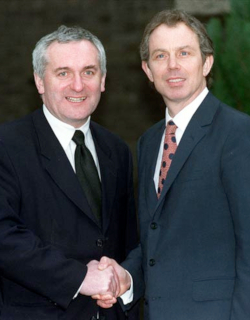
At an informal European Union summit near Bonn on February 26, 1999, Taoiseach Bertie Ahern and British Prime Minister Tony Blair agree to push for implementation of the Good Friday Agreement by the March 10 deadline.

As EU delegates discuss the Union’s budget and Europe‘s farming subsidies, the two prime ministers vow to battle on with the peace deal’s outstanding problems.

“We’re very clear on what we have to do in the Good Friday agreement … we have just got to keep pushing the thing forward as well as we possibly can,” says Blair.

Both Ahern and Blair say the way forward on the outstanding deadlocked issue of paramilitary disarmament is through the official decommissioning commission. Chaired by former Canadian General John de Chastelain, the international commission is working to take arms out of the province’s political arena.

The republican party Sinn Féin insists it is fully cooperating with the commission, which is implementing the final deadline for the handover of arms in May 2000. But some Ulster Unionists oppose further peace moves because of the Irish Republican Army‘s (IRA) failure to begin disarming.

According to Ahern and Blair, the following few weeks will be a key time to try and finalise disarmament issues.

“During the month of March … we can conclude the central aspects,” says Blair.

However, in a separate development on February 26, the chairman of the IRA’s political wing, Sinn Féin’s Mitchel McLaughlin, warns that pressure on disarmament could cause irreparable damage to the fragile peace process. He adds that disarmament should not become a litmus test for progress.

“Those who are now demanding prior decommissioning before we move to setting up the executive are reneging on the Good Friday Agreement,” says McLaughlin in an interview with BBC Radio.

(From BBC News Online Network, Friday, February 26, 1999 | Pictured: Bertie Ahern with Tony Blair at the signing of the Good Friday Agreement in April 1998)


Leave a comment

Paddington & Victoria Stations Bombings

london-victoria-station

The Provisional Irish Republican Army (PIRA) explodes two bombs at London mainline stations on February 18, 1991, one at Victoria station and the other at Paddington station, killing one person and injuring 38 others all at Victoria station. It is the IRA’s second major attack in London in February 1991 after the Downing Street mortar attack eleven days earlier which is an attempt to wipe out the British war cabinet and British prime minister John Major. It is also the first IRA attack on civilians since the 1983 Harrods bombing, marking a strategic change in their bombing campaign.

The Paddington bomb, which goes off at 4:20 AM, is much smaller than the second bomb at Victoria and is designed to make sure the security services will take the Victoria bomb seriously and not as a hoax. There are no deaths or injuries at Paddington station, but the roof is badly damaged.

Sometime before 7:00 AM, a caller with an Irish accent says, “We are the Irish Republican Army. Bombs to go off in all mainline stations in 45 minutes.” The Victoria station bomb, which is hidden in a rubbish bin inside the station, goes off at 7:40 AM. Despite a 45-minute warning and the Paddington bomb three hours earlier, the security services are slow to act. The bomb kills one person instantly and injures 38 others from flying glass and other debris. This is the worst attack suffered by civilians in England by the IRA since the 1983 Harrods bombing which killed three policemen, three civilians and injured 50 people. All London’s rail terminals are closed, disrupting the journeys of almost half a million commuters and bringing chaos to London, which is the IRA’s intended goal. There is also a hoax call made to Heathrow Airport, causing the airport’s closure.

That night the Provisional IRA claims responsibility for the bombings but blames the British police for the casualties. A statement from the Provisional IRA GHQ says, “The cynical decision of senior security personnel not to evacuate railway stations named in secondary warnings, even three hours after the warning device had exploded at Paddington in the early hours of this morning was directly responsible for the casualties at Victoria.” The statement goes on, “All future warnings should be acted upon.” The main purpose of the bombings in the overall IRA strategy is to keep pressure up on John Major, his Government and to make sure he acts on the Irish Troubles.

Police defend the decision not to close all stations after receiving warning that bombs had been planted. Commander George Churchill-Coleman, head of Scotland Yard‘s anti-terrorist squad, says that dozens of hoax calls are received every day. “It is very easy with hindsight to be critical.” Churchill-Coleman also says that the bomb was “quite deliberately intended to maim and kill.”

A year later, a French TV crew interviews an IRA Commander who says he speaks on behalf of the IRA’s GHQ Staff. The commander of the unit says of the Victoria station bombing that warnings were given by telephone naming nine railroad stations in London and that a 50-minute warning was given. He goes on to say that the attack was not aimed at hurting anybody but to disrupt the British transport system.

This bombing marks the IRA’s shift to targeting civilian areas following the July 1990 London Stock Exchange bombing. It is also the first IRA attack on the London transport system since 1976. The IRA keeps bombing targets in England for the remainder of the year.

(Pictured: London Victoria Station – The main station building for this terminus, with trains servicing the south and south-eastern destinations, as well as Gatwick. In front is the bus station.)


Leave a comment

Murder of Patrick Finucane, Human Rights Lawyer

patrick-finucane

Patrick Finucane, Irish human rights lawyer, is killed on February 12, 1989, by loyalist paramilitaries acting in collusion with the British government intelligence service MI5. His killing is one of the most controversial during the Troubles in Northern Ireland.

Finucane is born into a Roman Catholic family on the Falls Road, Belfast on March 21, 1949. At the start of the Troubles, his family is forced out of their home. He graduates from Trinity College, Dublin in 1973. He comes to prominence due to successfully challenging the British government in several important human rights cases during the 1980s.

Finucane is shot fourteen times and killed at his home in Fortwilliam Drive, north Belfast, by Ken Barrett and another masked man using a Browning Hi-Power 9mm pistol and a .38 revolver respectively. The two gunmen knock down the front door with a sledgehammer and enter the kitchen where Finucane has been having a Sunday meal with his family. They immediately open fire and shoot him twice, knocking him to the floor. Then while standing over him, the leading gunman fires twelve bullets into his face at close range. Finucane’s wife Geraldine is slightly wounded in the shooting attack which their three children witness as they hide underneath the table.

The Royal Ulster Constabulary (RUC) immediately launches an investigation into the killing. The investigation, led by Detective Superintendent Alan Simpson, runs for six weeks and he later states that from the beginning, there had been a noticeable lack of intelligence coming from the other agencies regarding the killing. Finucane’s killing is widely suspected by human rights groups to have been perpetrated in collusion with officers of the RUC and, in 2003, the British Government Stevens Report states that the killing is indeed carried out with the collusion of police in Northern Ireland.

In September 2004, an Ulster Defence Association (UDA) member, and at the time of the murder a paid informant for the Royal Ulster Constabulary, Ken Barrett, pleads guilty to Finucane’s murder.

The Ulster Defence Association/Ulster Freedom Fighters (UDA/UFF) claim they killed Finucane because he was a high-ranking officer in the Irish Republican Army (IRA). Police at his inquest say they have no evidence to support this claim. Finucane had represented republicans in many high-profile cases, but he had also represented loyalists. Several members of his family have republican links, but the family strongly denies Finucane is a member of the IRA. Informer Sean O’Callaghan claims that he attended an IRA finance meeting alongside Finucane and Gerry Adams in Letterkenny in 1980. However, both Finucane and Adams have consistently denied being IRA members.

In Finucane’s case, both the RUC and the Stevens Report find that he is not a member of the IRA. Republicans strongly criticise the claims made by O’Callaghan in his book The Informer and subsequent newspaper articles. One Republican source says O’Callaghan “…has been forced to overstate his former importance in the IRA and to make increasingly outlandish accusations against individual republicans.”

In 2011 British Prime Minister David Cameron meets with Finucane’s family and admits the collusion, although no member of the British security services has yet been prosecuted.


Leave a comment

Harrods Bombing

harrods-bombing

A Provisional Irish Republican Army (PIRA) car bomb kills six and injures ninety outside London‘s Harrods department store, a large, upmarket department store in the affluent Knightsbridge district near Buckingham Palace on December 17, 1983. The IRA Army Council claims that it has not authorised the attack and expresses regret for the civilian casualties. After the bombing, the IRA changes its tactic to focus on military targets on the mainland.

Harrods had been the target of an earlier IRA bomb on December 21, 1974, which was placed in the northeast corner of the first floor. There was a very short warning, and the store was in the process of being cleared when it exploded. It was also the target of a much smaller IRA bomb almost ten years later, in January 1993, which injured four people.

From 1973 the Provisional IRA has carried out waves of bombing attacks on commercial targets in London and elsewhere in England as part of its “economic war.” The goal is to damage the economy and cause disruption, which would put pressure on the British government to withdraw from Northern Ireland. On December 10, 1983, the IRA carries out its first attack in London in some time when a bomb explodes at the Royal Artillery Barracks, injuring three British soldiers.

One week later, on the afternoon of December 17, IRA members park a car bomb near the side entrance of Harrods, on Hans Crescent. The bomb contains 25 to 30 lbs. of explosives and is set to be detonated by a timer. It is left in a 1972 blue Austin 1300 GT four-door sedan. At 12:44 PM a man using an IRA codeword phones the central London branch of the Samaritans charity. The caller says there is a car bomb outside Harrods and another bomb inside Harrods and gives the car’s registration plate. According to police, he does not give any other description of the car.

The bomb explodes at about 1:21 PM, as four police officers in a car, an officer on foot and a police dog-handler near the suspect vehicle. Three officers and three bystanders are killed, and 90 others are injured, including 14 police officers. The blast damages 24 cars and all five floors on the side of Harrods, sending a shower of glass down onto the street. The police car absorbs much of the blast and this likely prevents further casualties.

Five people die at the scene of the bombing and a sixth later dies in the hospital. The bystanders who die are Philip Geddes (24), a journalist who had heard about the alert and went to the scene, Jasmine Cochrane-Patrick (25) and Kenneth Salvesen (28), a United States citizen. The Metropolitan Police Service officers killed are Sergeant Noel Lane (28) and Constable Jane Arbuthnot (22). A third officer, Inspector Stephen Dodd (34), dies in the hospital from his injuries on December 24. Constable Jon Gordon survives but loses both legs and part of a hand in the blast.

At the time of the explosion, a second warning call is made by the IRA. The caller says that a bomb has been left in the C&A department store at the east end of Oxford Street. Police clear the area and cordon it off, but this claim is found to be false. In the aftermath of the attack, hundreds of extra police and mobile bomb squads are drafted into London. Aleck Craddock, chairman of Harrods, reports that £1 million in turnover has been lost as a result of the bombing. Despite the damage, Harrods re-opens three days later, proclaiming it will not be “defeated by acts of terrorism.” Denis Thatcher, the husband of British Prime Minister Margaret Thatcher, visits the store and tells reporters “no damned Irishman is going to stop me going there.”


Leave a comment

Ratification of the Anglo-Irish Treaty

anglo-irish-treaty-negotiatorsThe Anglo-Irish Treaty is ratified by the Parliament of the United Kingdom on December 16, 1921. It is ratified by the British House of Commons by a vote of 401 to 58. On the same day the House of Lords votes in favour by 166 to 47.

The Anglo-Irish Treaty, commonly known as “The Treaty” and officially the “Articles of Agreement for a Treaty Between Great Britain and Ireland,” is an agreement between the government of the United Kingdom of Great Britain and Ireland and representatives of the Irish Republic that concludes the Irish War of Independence. It provides for the establishment of the Irish Free State within a year as a self-governing dominion within the “community of nations known as the British Empire,” a status “the same as that of the Dominion of Canada.” It also provides Northern Ireland, which had been created by the Government of Ireland Act 1920, an option to opt out of the Irish Free State, which it exercises.

The agreement is signed in London on December 6, 1921, by representatives of the Government of the United Kingdom, which includes Prime Minister David Lloyd George, who is head of the British delegates, and by representatives of the Irish Republic including Michael Collins and Arthur Griffith. The Irish representatives have plenipotentiary status (negotiators empowered to sign a treaty without reference back to their superiors) acting on behalf of the Irish Republic, though the British government declines to recognise that status. As required by its terms, the agreement is ratified by “a meeting” of the members elected to sit in the House of Commons of Southern Ireland and separately by the British Parliament.

Éamon de Valera calls a cabinet meeting to discuss the treaty on December 8, where he comes out against the treaty as signed. The cabinet decides by four votes to three to recommend the treaty to Dáil Éireann on December 14. Though the treaty is narrowly ratified, the split leads to the Irish Civil War, which is won by the pro-treaty side.

The Irish Free State as contemplated by the treaty comes into existence when its constitution becomes law on December 6, 1922 by a royal proclamation giving the force of law to the Irish Free State Constitution Act 1922.

(Pictured: Members of the Irish negotiation committee returning to Ireland in December 1921)


Leave a comment

The Kilmichael Ambush

SAMSUNG DIGITAL CAMERA

The Kilmichael Ambush is carried out near the village of Kilmichael in County Cork on November 28, 1920, by the Irish Republican Army (IRA) during the Irish War of Independence. Thirty-six local IRA volunteers commanded by Tom Barry kill seventeen members of the Royal Irish Constabulary‘s Auxiliary Division. The Kilmichael ambush is politically as well as militarily significant. It occurs one week after Bloody Sunday, marking an escalation in the IRA’s campaign.

As dusk falls the ambush takes place on a road at Dus a’ Bharraigh in the townland of Shanacashel, Kilmichael Parish, near Macroom.

Just before the Auxiliaries in two lorries come into view, two armed IRA volunteers, responding late to Barry’s mobilisation order, drive unwittingly into the ambush position in a horse and sidecar, almost shielding the British forces behind them. Barry manages to avert disaster by directing the car up a side road and out of the way. The Auxiliaries’ first lorry is persuaded to slow down by the sight of Barry placing himself on the road in front of a concealed Command Post, wearing an IRA officer’s tunic given to him by Paddy O’Brien. Concealed on the south side of the road are six riflemen, whose instructions are to prevent the enemy taking up positions on that side. Another six riflemen are positioned some way off as an insurance group, should a third Auxiliary lorry appear.

The first lorry, containing nine Auxiliaries, slows almost to a halt close to their intended ambush position, at which point Barry gives the order to fire. He throws a Mills bomb that explodes in the open cab of the first lorry. A savage close-quarter fight ensues. According to Barry’s account, some of the British are killed using rifle butts and bayonets in a brutal and bloody encounter. This part of the engagement is over relatively quickly with all nine Auxiliaries dead or dying.

While this part of the fight is going on, a second lorry also containing nine Auxiliaries has driven into the ambush position. This lorry’s occupants, at a more advantageous position than Auxiliaries in the first lorry because of their distance from the ambushing group, dismount to the road and exchange fire with the IRA, killing Michael McCarthy. Barry then brings the Command Post soldiers who had completed the attack on the first lorry to bear on this group. Barry claimed these Auxiliaries called out a surrender and that some dropped their rifles but opened fire again with revolvers when three IRA men emerged from cover, killing volunteer Jim O’Sullivan instantly and mortally wounding Pat Deasy. Barry then orders his men to open fire and not stop until told to do so. Barry ignores a subsequent attempt by remaining Auxiliaries to surrender and keeps his men firing until he believes all the Auxiliaries are dead.

At the conclusion of the fight, it is observed that two IRA volunteers, Michael McCarthy and Jim O’Sullivan, are dead and that Pat Deasy, brother of Liam Deasy, is mortally wounded. Although the IRA fighters think they had killed all of the Auxiliaries, two actually survive, one very badly injured and another who escapes and is later captured and shot dead. Among the 16 British dead on the road at Kilmichael is Francis Crake, commander of the Auxiliaries in Macroom, probably killed at the start of the action by Barry’s Mills bomb.

Many IRA volunteers are deeply shaken by the severity of the action, referred to by Barry as “the bloodiest in Ireland,” and some are physically sick. Barry attempts to restore discipline by making them form-up and perform drill, before marching away. Barry himself collapses with severe chest pains on December 3 and is secretly hospitalized in Cork. It is possible that the ongoing stress of being on the run and commander of the flying column, along with a poor diet as well as the intense combat at Kilmichael contribute to his illness, diagnosed as heart displacement.

The political fallout from the Kilmichael ambush outweighs its military significance. While the British forces in Ireland can easily absorb 18 casualties, the fact that the IRA had been able to wipe out a whole patrol of elite Auxiliaries is for them deeply shocking. The British forces in the West Cork area take their revenge on the local population by burning several houses, shops and barns in Kilmichael, Johnstown and Inchigeelagh, including all of the houses around the ambush site. On December 3, three IRA volunteers are arrested by the British Essex Regiment in Bandon, beaten and killed, and their bodies dumped on the roadside.

For the British government, the action at Kilmichael is an indication that the violence in Ireland is escalating. Shortly after the ambush, barriers are placed on either end of Downing Street to protect the Prime Minister‘s office from IRA attacks. On December 10, as a result of Kilmichael, martial law is declared for the counties of Cork, Kerry, Limerick and Tipperary.

The British military now has the power to execute anyone found carrying arms and ammunition, to search houses, impose curfews, try suspects in military rather than civilian courts and to intern suspects without trial. On December 11, in reprisal for Kilmichael and other IRA actions, the centre of Cork city is burned by Auxiliaries, British soldiers and Black and Tans, and two IRA men are assassinated in their beds. In separate proclamations shortly afterwards, the authorities sanction “official reprisals” against suspected Sinn Féin sympathisers and the use of hostages in military convoys to deter ambushes.

(Pictured: The Kilmichael Ambush Monument at the ambush site)


Leave a comment

IRA Refuses to Disband in Response to Ultimatums

gerry-adams-2002

On October 27, 2002, after comments by the British prime minister Tony Blair that the continued existence of the Irish Republican Army (IRA) is an obstacle to rescuing the Northern Ireland peace process, Sinn Féin leader Gerry Adams says the IRA is never going to disband in response to ultimatums from the British government and from unionists.

Nationalists throughout Ireland wish to see the end of the IRA. In a response to a major speech by Adams, Mark Durkan, leader of the Social Democratic and Labour Party (SDLP), says IRA activity is playing into the hands of anti-Agreement unionists and calls on the IRA to cease all activity.

Adams tells elected Sinn Féin representatives from both sides of the Irish border in Monaghan that he can envision a future without the IRA. He also admits that “alleged” IRA activities are boosting the cause of those opposing the Northern Ireland peace process. However, he also tells Tony Blair that the IRA will never disband in response to ultimatums.

“He needs to recognise, however, that the Agreement requires an end to paramilitarism and that nationalists throughout this island fervently want one. It is time that republicans took heed of their call.”

The former Deputy First Minister in the devolved administration at Stormont says he welcomes Adams’ recognition that IRA activity is exacerbating the difficulties within unionism. “The reality is that IRA activity is playing right into the hands of anti-Agreement unionists. And letting the nationalist community badly down,” he said.

“It is also welcome that Gerry Adams has begun to recognise Sinn Féin’s credibility crisis. Too often republican denials have proved to be false in the past – be it over Colombia or Florida. This too has served only to create distrust and destabilise the Good Friday Agreement,” he adds.

In a major speech billed by his party as a considered response to the Prime Minister’s demand for an end to Republican-linked violence, Adams declares “Our view is that the IRA cessations effectively moved the army out of the picture – and allowed the rest of us to begin an entirely new process.” His speech is understood to have been handed in advance to both the British and Irish governments.

Adams says the continued IRA ceasefire and decommissioning initiatives demonstrated the organisation’s commitment to the peace process. “I do not pretend to speak for the army (IRA) on these matters, but I do believe that they are serious about their support for a genuine peace process. They have said so. I believe them,” he said. He adds, “The IRA is never going to respond to ultimatums from the British government or David Trimble.”

Fianna Fáil leader Bertie Ahern later says he welcomes and is encouraged by many aspects of Adams’ speech. He says the Sinn Féin leader’s strong statement of determination to keep the peace process intact and the recognition of the need to bring closure to all the key issues is a positive contribution at this difficult time in the Northern Ireland peace process.

(From the Irish Examiner, October 27, 2002)


Leave a comment

Birth of Januarius MacGahan, Journalist & Correspondent

januarius-macgahan

Januarius Aloysius MacGahan, American journalist and war correspondent for the New York Herald and The Daily News, is born near New Lexington, Ohio on June 12, 1844. His articles describing the massacre of Bulgarian civilians by Turkish soldiers and irregular volunteers in 1876 creates public outrage in Europe and are a major factor in preventing Britain from supporting Turkey in the Russo–Turkish War of 1877–78, which leads to Bulgaria gaining independence from the Ottoman Empire.

MacGahan’s father is an immigrant from Ireland who had served on the Northumberland, the ship which took Napoleon into exile on Saint Helena. He moves to St. Louis, where he briefly works as a teacher and as a journalist. There he meets his cousin, General Philip Sheridan, an American Civil War hero also of Irish parentage, who convinces him to study law in Europe. He sails to Brussels in December 1868.

MacGahan does not get a law degree, but he discovers that he has a gift for languages, learning French and German. He runs short of money and is about to return to America in 1870 when the Franco-Prussian War breaks out. Sheridan happens to be an observer with the German Army, and he uses his influence to persuade the European editor of the New York Herald to hire MacGahan as a war correspondent with the French Army.

MacGahan’s vivid articles from the front lines describing the stunning defeat of the French Army win him a large following, and many of his dispatches to the Herald are reprinted by European newspapers. When the war ends, he interviews French leader Léon Gambetta and Victor Hugo and, in March 1871, he hurries to Paris and is one of the first foreign correspondents to report on the uprising of the Paris Commune. He is arrested by the French military and nearly executed and is only rescued through the intervention of the U.S. Minister to France Elihu B. Washburne.

In 1871 MacGahan is assigned as the Herald‘s correspondent to Saint Petersburg. He learns Russian, mingles with the Russian military and nobility, covers the Russian tour of General William Tecumseh Sherman and meets his future wife, Varvara Elagina, whom he marries in 1873. In 1874 he spends ten months in Spain, covering the Third Carlist War.

In 1876 MacGahan quarrels with James Gordon Bennett Jr., the publisher of the New York Herald, and leaves the newspaper. He is invited by his friend, Eugene Schuyler, the American Consul-General in Constantinople, to investigate reports of large-scale atrocities committed by the Turkish Army following the failure of an attempted uprising by Bulgarian nationalists in April 1876. He obtains a commission from The Daily News, then the leading liberal newspaper in England, and leaves for Bulgaria on July 23, 1876.

MacGahan reports that the Turkish soldiers have forced some of the villagers into the church, then the church is burned, and survivors tortured to learn where they have hidden their treasures. He says that of a population of seven thousand, only two thousand survive. According to his account, fifty-eight villages in Bulgaria are destroyed, five monasteries demolished, and fifteen thousand people in all massacred. These reports, published first in The Daily News, and then in other papers, cause widespread popular outrage against Turkey in Britain. The government of British Prime Minister Benjamin Disraeli, a supporter of Turkey, tries to minimize the massacres and says that the Bulgarians are equally to blame, but his arguments are refuted by the newspaper accounts of MacGahan.

In the wake of the massacres and atrocities committed by the Ottoman forces during the suppression of the April Uprising, as well as centuries-long conflicts between Russia and Turkey in Crimea, the Russian Government, stirred by anti-Turkish and Pan-Slavism sentiment, prepare to invade the Ottoman Empire, and declare war on it on April 24, 1877. The Turkish Government of Sultan Abdul Hamid II appeals for help to Britain, its traditional ally against Russia, but the British government responds that it cannot intervene “because of the state of public feeling.”

MacGahan is assigned as a war correspondent for The Daily News and, thanks to his friendship with General Skobelev, the Russian commander, rides with the first units of the Russian Army as it crosses the Danube into Bulgaria. He covers all the major battles of the Russo–Turkish War, including the Siege of Plevna and the Battle of Shipka Pass. He reports on the final defeat of the Turkish armies and is present at the signing of the Treaty of San Stefano, which ends the war.

MacGahan is in Constantinople, preparing to travel to Berlin for the conference that determines the final borders of Bulgaria, when he catches typhoid fever. He dies on June 9, 1878, and is buried in the Greek cemetery, in the presence of diplomats, war correspondents, and General Skobelev. Five years later his body is returned to the United States and reburied in New Lexington and a statue is erected in his honor by a society of Bulgarian Americans.