Northern Ireland is plunged into a new crisis after Benedict Hughes, a Catholic, is shot dead on January 21, 1998, as he is getting into his car after finishing his work in a loyalist area of south Belfast. It is the latest murder aimed at wrecking the peace process and the eighth sectarian killing since Christmas.
Hughes, age 55, dies in a hail of bullets in Sandy Row shortly after 5:00 PM, as he is preparing to travel back to his Suffolk Crescent home in west Belfast. The father of three is shot at least five times in the neck and chest as he tries to get into his car which is parked in Utility Street off the Donegall Road. He is taken to the Royal Victoria Hospital where he later dies. The lone gunman makes off on foot in the direction of Felt Street.
The attack comes after the funeral of Fergal McCusker, a Catholic shot dead by the Loyalist Volunteer Force (LVF) just days earlier and ahead of the funerals of Catholic taxi driver Larry Brennan and prominent loyalist Jim Guiney held on January 22.
When forensic people arrive on the scene soon after the shooting, the area is packed with onlookers who believe the shot man is a Protestant.
As a recovery truck comes to remove Hughes’s car later that night, small groups of people are still watching the scene. The Rev. Richard Darmody, the rector of nearby St. Aidan’s Church in Sandy Row, who went to the scene thinking the victim was one of his parishioners, condemns the murder. “I’m shocked and horrified that the life of an innocent person has been taken and that another family has been plunged into grief and pain. I feel very concerned about where this is going to lead, and the possibility of more lives being taken, and more families being bereaved.”
There is no immediate admission of responsibility. However, the blame is placed firmly on loyalists, either the LVF, which has admitted being behind a series of recent killings, or the Ulster Freedom Fighters, which has remained silent, but which is suspected by the security forces of having joined the killings.
SDLP councillor Alastair McDonnell says the peace process is not in crisis. Hughes was “an innocent Catholic who was just trying to earn a living, who has no connections with any political or paramilitary grouping. If he had he wouldn’t have worked here.” He adds that there is a “small handful of evil people” who do not want to see peace.
Alliance spokesman Dr. Philip McGarry says there is “no excuse, no justification for causing pain to yet another family.”
(From: “Catholic shot dead leaving work in loyalist Sandy Row” by Louise McCall, The Irish Times, January 22, 1998)
The UDA is formed in September 1971 during one of the most violent phases of The Troubles right after internment without trial is introduced when a number of Loyalist Defense groups combine together. They form a paramilitary wing, the UFF, in 1972 so the organisation can use the UFF name to carry out violent acts and kill people while keeping the UDA name legal by not involving the UDA name with attacks.
The UDA/UFF claim to be combating the Provisional Irish Republican Army (IRA) but approximately 85% of its victims are innocent Catholic civilians. The UDA carries out its first killing on April 20, 1972, when they shoot dead taxi driver Gerard Donnelly in Ardoyne, Belfast. In October, the group is responsible for the deaths of two small girls when they detonate a car bomb outside an Irish nationalist pub in Sailortown, Belfast. The girls killed are Clare Hughes, age 4, and Paula Strong, age 6.
On December 20, 1972, along the Strabane Old Road, Annie’s Bar is packed with customers watching a football match. At about 10:30 PM two men from the UDA burst into the bar, one of them carrying a Sterling submachine gun and the other holding a pistol. Both are wearing hoods to disguise their identities. The men instantly and indiscriminately spray the main room in the bar with bullets. The attack is reported to have lasted less than a minute, but it still manages to leave five people dead, and four others wounded. Those killed in the attack are all males and include, Charlie McCafferty (31), Frank McCarron (58), Charles Moore (31), Barney Kelly (26) and Michael McGinley (37). At the time this is the largest and most deadly attack carried out by the UDA. They do not carry out another attack of this size until February 1992, when they shoot dead five civilians and injure nine in the Sean Graham bookmakers’ shooting on the Ormeau Road in Belfast.
The year 1972 in Derry begins with the Bloody Sunday shooting which occurs in the Bogside area and ends with the Annie’s Bar shooting. Nobody is ever charged in connection with the Annie’s Bar murders, although in recent years relatives of those murdered have been calling for a fresh investigation to take place.
The attack is carried out by members from the UDA’s “North Antrim & Londonderry Brigade.” Although this is one of the UDA’s smaller brigades it also carries out the October 1993 Greysteel massacre which is the UDA’s worst ever attack, in which eight people are killed and 19 others are injured. The Greysteel shooting happens about 9-10 miles away from Annie’s Bar.
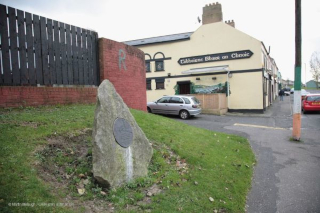
(Pictured: Annie’s Bar Memorial stone located at Strabane Old Road, Top of the Hill, Waterside, Derry, County Derry, Northern Ireland. Annie’s Bar is in the background. Photo taken by Martin Melaugh, November 20, 2008.)
Childers is educated at Gresham’s School, Holt, and the University of Cambridge, hence his striking British upper-class accent. On November 24, 1922, when he is sixteen, his father, Robert Erskine Childers, is executed by the new Irish Free State on politically inspired charges of gun-possession. The pistol he had been found with had been given to him by Michael Collins. Before his execution, in a spirit of reconciliation, the elder Childers obtains a promise from his son to seek out and shake the hand of every man who had signed his death warrant.
Following his father’s funeral, he returns to Gresham’s, then two years later he goes on to Trinity College, Cambridge. He returns to Ireland in 1932 and becomes advertising manager of The Irish Press, the newly founded newspaper owned by the family of Éamon de Valera.
Childers is nominated as the presidential candidate of Fianna Fáil at the behest of de Valera, who pressures Jack Lynch in the selection of the presidential candidate. He is a controversial nominee, owing not only to his British birth and upbringing but to his Protestantism. However, on the campaign trail his personal popularity proved enormous, and in a political upset at the 1973 Irish presidential election, he is elected the fourth President of Ireland on May 30, 1973, defeating Tom O’Higgins by 635,867 (52%) votes to 578,771 (48%). He becomes the second Protestant to hold the office, the first being Douglas Hyde (1938–1945).
Prevented from transforming the presidency as he desires, Childers instead throws his energy into a busy schedule of official visits and speeches, which is physically taxing.
The British monarch and the Republic of Ireland‘s head of state chat and pose together at Hillsborough Castle, outside Belfast, for an occasion that would have provoked hostility within Northern Ireland’s Protestant majority just a few years earlier. But their trouble-free meeting becomes inevitable once Ireland dropped its territorial claim to Northern Ireland as part of the landmark Good Friday Agreement peace accord of 1998. The visit also fuels speculation the queen could soon make her first official visit to the neighboring Republic of Ireland, where the Irish Republican Army assassinated Lord Louis Mountbatten, the uncle of her husband, Prince Philip, Duke of Edinburgh.
No British monarch has visited the territory of the modern-day Republic of Ireland since George V visited Dublin in 1911, a decade before the island’s partition into a mostly Protestant north that remains within the United Kingdom, and a predominantly Catholic rest of Ireland that gradually gains full independence from Britain.
Camera crews are allowed to film the moment, but not record the sound, when McAleese shakes the queen’s hand at the start of a 20-minute meeting, their fourth since 1998. Previous meetings occurred at Buckingham Palace and on a World War I battlefield site. McAleese later calls it “a very special day for Anglo-Irish relationships” that brings forward the day when the queen will visit the Irish Republic.
McAleese, a Belfast-born Catholic, had made scores of visits to Northern Ireland since being elected to the Irish Republic’s largely symbolic presidency in 1997. As part of her presidential theme of “building bridges,” she regularly invites Protestant groups to her official Dublin mansion and has built impressive diplomatic contacts with northern Protestants.
Before McAleese’s arrival, visits north by an Irish president were rare events that drew public protests from Protestants, who demanded that Ireland remove its territorial claim from its 1937 constitution. The republic’s voters overwhelmingly supported this in a May 1998 referendum, an action completed in December 1999.
The queen has avoided traveling to the Irish Republic, in part, because of security fears following the IRA assassination of Mountbatten in August 1979. He, his daughter-in-law and two teenage boys are killed when the IRA blows up his private boat near his castle in County Sligo. However, Prince Philip and their son, Prince Charles, make several visits to the Irish Republic in the decade following the IRA’s 1994 cease-fire.
Carney is educated at St. Patrick’s Christian Brothers School in Donegall Street in Belfast, later teaching at the school. She enrolls at Hughes Commercial Academy around 1910, where she qualifies as a secretary and shorthand typist, one of the first women in Belfast to do so. However, from the start she is looking towards doing more than just secretarial work.
In 1912 Carney is in charge of the women’s section of the Northern Ireland Textile Workers’ Union in Belfast, which she founds with Delia Larkin in 1912. During this period, she meets James Connolly and becomes his personal secretary. She becomes Connolly’s friend and confidant as they work together to improve the conditions for female labourers in Belfast. Carney then joins Cumann na mBan, the women’s auxiliary of the Irish Volunteers, and attends its first meeting in 1914.
Carney is present with Connolly in Dublin‘s General Post Office (GPO) during the Easter Rising in 1916. She is the only woman present during the initial occupation of the building. While not a combatant, she is given the rank of adjutant and is among the final group to leave the GPO. After Connolly is wounded, she refuses to leave his side despite direct orders from Patrick Pearse and Connolly. She leaves the GPO with the rest of the rebels when the building becomes engulfed in flames. They make their new headquarters in nearby Moore Street before Pearse surrenders.
After her capture, Carney is held in Kilmainham Gaol before being moved to Mountjoy Prison and finally to an English prison. By August 1916 she is imprisoned in HM Prison Aylesbury alongside Nell Ryan and Helena Molony. The three request that their internee status be revoked so that they could be held as normal prisoners with Countess Markievicz. Their request is denied, however Carney and Molony are released two days before Christmas 1916.
Following the Irish Civil War, Carney becomes much more disillusioned with politics. She is very critical and outspoken of Éamon de Valera and his governments.
In 1928 she marries George McBride, a Protestant Orangeman and former member of the Ulster Volunteers. Ironically, the formation of the Ulster Volunteers prompts the formation of the Irish Volunteers, of which Carney was a member. She alienates anyone in her life that does not support her marriage to McBride.
A number of serious health problems limit Carney’s political activities in the late 1930s. She dies in Belfast on November 21, 1943, and is buried in Milltown Cemetery. Her resting place is located years later, and a headstone is erected by the National Graves Association, Belfast. Because she married a Protestant and former Orangeman, she is not allowed to have his name on her gravestone due to the religious differences.
In 2013, the Seventieth Anniversary of Carney’s death is remembered by the Socialist Republican Party. Almost one hundred people attend as a short parade follows, marking and commemorating the work she did for the cause. She is placed in high esteem among the other hundreds of radical women, who stand up for what they believe in, regardless of the consequences they face.
Henry Flood, Anglo-Irishstatesman and founder of the Patriot movement that in 1782 wins legislative independence for Ireland, dies on December 2, 1791.
Flood enters the Irish Parliament in 1759 as member for Kilkenny County. Irish Protestants are becoming impatient with the British Parliament’s right to legislate for Ireland over the wishes of the Irish Parliament. Moreover, the British government controls a majority in Ireland’s House of Commons through the distribution of crown patronage by the owners of parliamentary boroughs.
Flood’s outstanding oratorical powers soon enable him to create a small but effective opposition inside the Irish Parliament that agitates for political reforms. They demand provisions for new Irish parliamentary elections every eight years, instead of merely at the start of a new British king’s reign. Their long-range goal is legislative independence. In 1768 his Patriots engineer passage of a bill limiting the duration of Parliament to eight years, and in 1769 and 1771 they defeat measures to grant funds for the British administration in Ireland.
Although Flood had become the first independent Irish statesman, he sacrifices this position in 1775 by accepting the office of vice treasurer under the British viceroy, Lord Simon Harcourt, 1st Earl Harcourt. Henry Grattan, an even greater orator than Flood and who describes Flood as a man “with a metaphor in his mouth and a bribe in his pocket,” replaces him as leader of the Patriots.
Flood, however, leaves the Patriot cause at the wrong time. The movement grows rapidly as more and more Irish people are influenced by the North American colonists who are rebelling against the British in the American Revolution. In 1779 he rejoins his old party, and two years later he is officially dismissed from his government post. Although he has lost his following, he helps Grattan force the British government to renounce its restrictions on Irish trade (1779) and grant legislative independence to Ireland (1782).
Flood then decides to challenge Grattan’s leadership. Charging that Grattan has not gone far enough in his reforms, he obtains passage of a measure requiring the British Parliament to renounce all claims to control of Irish legislation. Nevertheless, his newly acquired popularity is destroyed upon the defeat of his attempt to reform the Irish Parliament in 1784.
Flood is a member of both the British and Irish parliaments from 1783 until he loses his seat in both parliaments in 1790, although in England he fails to achieve the kind of political successes that characterize his Irish parliamentary career.
Following the loss of his seats in parliament, Flood retires to Farmley, his residence in County Kilkenny, where he remains until his death on December 2, 1791. He and his wife Lady Frances Beresford, daughter of Marcus Beresford, 1st Earl of Tyrone, who survives until 1815, have no children, and his property passes to a cousin, John Flood. A large bequest to Trinity College Dublin is declared invalid.
(Pictured: Portrait of Henry Flood (1732 – 1791) by Bartholomew Stoker (1763-1788). John Comerford later makes a sketch of the portrait, from which James Heath makes an engraving.)
Although he is a fierce advocate of his homeland, Cruise O’Brien is a strong critic of Irish Republican Army violence and of what he considers the romanticized desire for reunification with Northern Ireland. His collection of essays Maria Cross: Imaginative Patterns in a Group of Modern Catholic Writers (1952; written under the pseudonym Donat O’Donnell) impresses UN Secretary-GeneralDag Hammarskjöld, who in 1961 appoints him UN special representative in the Congo, later the Democratic Republic of the Congo. He orders UN peacekeeping forces into the breakaway Katanga province, and the resulting scandal forces him out of office. Despite UN objections, he writes To Katanga and Back (1963) to explain his actions.
After serving as vice-chancellor of the University of Ghana (1962–65) and Albert Schweitzer Professor of Humanities at New York University (1965–69), Cruise O’Brien enters Irish politics. He holds a Labour Party seat in Dáil Éireann from 1969 to 1977 and then in the Senate from 1977 to 1979, representing Trinity College, of which he is pro-chancellor (1973–2008).
In 1979 Cruise O’Brien is named editor in chief of the British Sunday newspaper The Observer, but he leaves after three tumultuous years. He remains an active newspaper columnist, especially for the Irish Independent until 2007. His books include States of Ireland (1972) and On the Eve of the Millennium (1995), as well as perceptive studies of Charles Stewart Parnell, Edmund Burke, and Thomas Jefferson.
Conor Cruise O’Brien dies at the age of 91 on December 18, 2008, in Howth, Dublin.
As Alfred Willmore, he is one of the leading child actors on the English stage, in the company of Noël Coward. He appears for several seasons in Peter Pan. He studies painting at London’s Slade School of Fine Art, continuing to paint throughout his lifetime. In the 1920s he travels all over Europe. He is captivated by Irish culture and learns the Irish language which he speaks and writes fluently. He changes his name to an Irish version, presenting himself in Ireland as a descendant of Irish Catholics from Cork. Later in his life, he writes three autobiographies in Irish and translates them into English.
While acting in Ireland with the touring company of his brother-in-law Anew MacMaster, Mac Liammóir meets the man who becomes his partner and lover, Hilton Edwards. Their first meeting takes place in the Athenaeum, Enniscorthy, County Wexford. Deciding to remain in Dublin, where they live at Harcourt Terrace, the pair assists with the inaugural production of Galway‘s Irish language theatre, An Taibhdhearc. The play is Mac Liammóir’s version of the mythical story Diarmuid agus Gráinne, in which Mac Liammóir plays the lead role as Diarmuid.
Mac Liammóir and Edwards then throw themselves into their own venture, co-founding the Gate Theatre in Dublin in 1928. The Gate becomes a showcase for modern plays and design. Mac Liammóir’s set and costume designs are key elements of the Gate’s success. His many notable acting roles include Robert Emmet/The Speaker in Denis Johnston‘s The Old Lady Says “No!” and the title role in Hamlet.
In 1948, Mac Liammóir appears in the NBC television production of Great Catherine with Gertrude Lawrence. In 1951, during a break in the making of Othello, he produces Orson Welles‘s ghost-story Return to Glennascaul which is directed by Hilton Edwards. He plays Iago in Welles’s film version of Othello (1951). The following year, he goes on to play ‘Poor Tom’ in another Welles project, the TV film of King Lear (1953) for CBS.
Mac Liammóir claims when talking to Irish playwright Mary Manning, to have had a homosexual relationship with General Eoin O’Duffy, former Garda Síochána Commissioner and head of the paramilitary Blueshirts in Ireland, during the 1930s. The claim is revealed publicly by RTÉ in a documentary, The Odd Couple, broadcast in 1999. However, Mac Liammóir’s claims have not been substantiated.
Mac Liammóir’s life and artistic development are the subject of a major study by Tom Madden, The Making of an Artist. Edwards and Mac Liammóir are the subject of a biography, titled The Boys by Christopher Fitz-Simon.
Micheál Mac Liammóir dies at the age of 78 on March 6, 1978. Edwards and Mac Liammóir are buried alongside each other at St. Fintan’s Cemetery, Sutton, Dublin.
Hume, 61, the Catholic head of the Social Democratic and Labor Party, is cited by the Nobel Committee in Oslo for having been the “clearest and most consistent of Northern Ireland’s political leaders in his work for a peaceful solution.”
Trimble, 54, the Protestant leader of the Ulster Unionist Party, is honored for having demonstrated “great political courage when, at a critical stage in the process, he advocated solutions which led to the peace agreement.”
The accord, signed on April 10 and known as the Good Friday Agreement, gives the 1.7 million residents of Northern Ireland a respite from the sectarian violence that has claimed more than 3,200 lives in the previous 30 years. It also opens the possibility of lasting stability for the first time since the establishment of Northern Ireland with partition from Ireland in 1921.
Forging concessions from fiercely antagonistic populations, the accord seeks to balance the Protestant majority’s wish to remain part of Britain with Catholic desires to strengthen ties to the Republic of Ireland to the south. The committee, seeing in Northern Ireland’s two warring groups a dispute with notable similarities to violent tribal confrontations elsewhere, expresses the hope that the accord will serve “to inspire peaceful solutions to other religious, ethnic and national conflicts around the world.”
Adams, in New York on a fund-raising trip for Sinn Féin, welcomes the Oslo announcement and particularly praises Hume, who is widely seen as having helped persuade the IRA to adopt a cease-fire and having eased Sinn Féin’s entry into the talks. “Indeed, there would be no peace process but for his courage and vision,” Adams says, adding, “No one deserves this accolade more.” He also wishes Trimble well and says the prize imposes on everyone the responsibility to “push ahead through the speedy implementation of the agreement.”
In the unforgiving politics of Northern Ireland, the Unionist dissidents and members of other Protestant parties who do not join in the peace talks attack both Trimble and Hume. Ian Paisley Jr., son of the head of the Democratic Unionist Party, calls the Nobel Committee’s decision a “farce” and says of the winners, “These people have not delivered peace, and they are not peacemakers.”
Trimble says he is “slightly uncomfortable” with the award because so many other people have been involved beside him in reaching the settlement and much remains to be done to put it in place. “We know that while we have the makings of peace, it is not wholly secure yet,” he tells the BBC from Denver, where he is on an 11-city North American tour to spur foreign investment in Ulster. “I hope it does not turn out to be premature.”
Hume receives word of the prize at his home in Londonderry and terms it “an expression of the total endorsement of the work of very many people.” He adds, “This isn’t just an award to David Trimble and myself. It is an award to all the people in Northern Ireland.”
In Washington, D.C., President Clinton says “how very pleased” he is, “personally and as President, that the Nobel Prize Committee has rewarded the courage and the people of Northern Ireland by giving the Nobel Peace Prize to John Hume and to David Trimble.” He adds “a special word of thanks” to George Mitchell, who issues a statement praising Hume and Trimble as “fully deserving of this honor.”
The peace talks began in the summer of 1996. They eventually draw the participation of 8 of the 10 Northern Irish parties, with many of the men around the table convicted murderers and bombers who had emerged from prison with a commitment to peaceful resolution to what for nearly a century have been referred to wearily as “the Troubles.” The paramilitary groups had also made the tactical decision that violence would not secure their goals; a shared conviction that gives these talks a chance for success that past fitful attempts at settlement lacked.
The peace talks move in a desultory manner until Blair takes office in May 1997 and highlights the cause of peace in Northern Ireland as an early commitment. At his and Ahern’s urging, the IRA declares a cease-fire in July, and by September Sinn Féin is permitted to join the talks.
Blair also gives Trimble and Adams unprecedented access to 10 Downing Street, and the Ulster Protestants report that they obtained from Clinton the most sympathetic hearing they ever had from an American President, allaying their longtime suspicions of Washington’s bias in favor of the Catholic minority.
(From: “2 Ulster Peacemakers Win the Nobel Prize,” The New York Times, Warren Hoge, October 17, 1998)
Louis MacNeice, British poet and playwright, is born in Belfast on September 12, 1907. He is a member, along with Wystan Hugh Auden, Cecil Day-Lewis, and Stephen Spender, of a group whose low-keyed, unpoetic, socially committed, and topical verse is the “new poetry” of the 1930s. His body of work is widely appreciated by the public during his lifetime, due in part to his relaxed but socially and emotionally aware style.
MacNeice’s first book of poetry, Blind Fireworks, appears in 1929, followed by more than a dozen other volumes, such as Poems (1935), Autumn Journal (1939), Collected Poems, 1925–1948 (1949), and, posthumously, The Burning Perch (1963). An intellectual honesty, Celtic exuberance, and sardonic humour characterize his poetry, which combines a charming natural lyricism with the mundane patterns of colloquial speech. His most characteristic mood is that of the slightly detached, wryly observant, ironic and witty commentator. Among MacNeice’s prose works are Letters from Iceland (with W.H. Auden, 1937) and The Poetry of W.B. Yeats (1941). He is also a skilled translator, particularly of Horace and Aeschylus (The Agamemnon of Aeschylus, 1936).
By the early 1960s, MacNeice is “living on alcohol,” and eating very little, but still writing. In August 1963 he goes caving in Yorkshire to gather sound effects for his final radio play, Persons from Porlock. Caught in a storm on the moors, he does not change out of his wet clothes until he is home in Hertfordshire. Bronchitis evolves into viral pneumonia and he is admitted to hospital in London on August, 27. He dies there on September 3, 1963 at the age of 55. He is buried in Carrowdore churchyard in County Down, alongside his mother.
MacNeice’s final book of poems, The Burning Perch, is published a few days after his funeral. His life-long friend from Oxford, W.H. Auden, who gives a reading at MacNeice’s memorial service, describes the poems of his last two years as “among his very best.”