seamus dubhghaill

Promoting Irish Culture and History from Little Rock, Arkansas, USA


Leave a comment

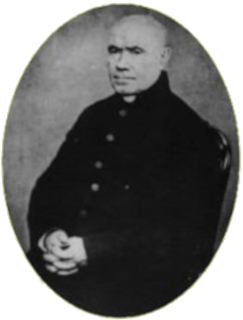
Birth of Nicholas Joseph Callan, Priest & Scientist

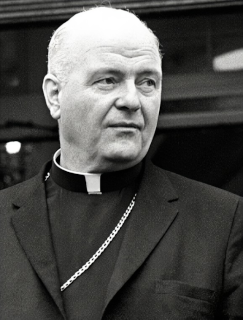
Father Nicholas Joseph Callan, Irish priest and scientist, is born on December 22, 1799, in Darver, County Louth. He is Professor of Natural Philosophy in Maynooth College in Maynooth, County Kildare from 1834, and is best known for his work on the induction coil.

Callan attends school at an academy in Dundalk. His local parish priest, Father Andrew Levins, then takes him in hand as an altar boy and Mass server and sees him start the priesthood at Navan seminary. He enters Maynooth College in 1816. In his third year at Maynooth, he studies natural and experimental philosophy under Dr. Cornelius Denvir. He introduces the experimental method into his teaching and has an interest in electricity and magnetism.

Callan is ordained a priest in 1823 and goes to Rome to study at Sapienza University, obtaining a doctorate in divinity in 1826. While in Rome he becomes acquainted with the work of the pioneers in electricity such as Luigi Galvani (1737–1798), who is a pioneer in bioelectricity, and Alessandro Volta (1745–1827), who is known especially for the development of the electric battery. In 1826, he returns to Maynooth as the new Professor of Natural Philosophy (now called physics), where he also begins working with electricity in his basement laboratory at the college.

Influenced by William Sturgeon and Michael Faraday, Callan begins work on the idea of the induction coil in 1834. He invents the first induction coil in 1836. An induction coil produces an intermittent high voltage alternating current from a low voltage direct current supply. It has a primary coil consisting of a few turns of thick wire wound around an iron core and subjected to a low voltage (usually from a battery). Wound on top of this is a secondary coil made up of many turns of thin wire. An iron armature and make-and-break mechanism repeatedly interrupts the current to the primary coil, producing a high voltage, rapidly alternating current in the secondary circuit.

Callan invents the induction coil because he needs to generate a higher level of electricity than currently available. He takes a bar of soft iron, about 2 feet long, and wraps it around with two lengths of copper wire, each about 200 feet long. He connects the beginning of the first coil to the beginning of the second. Finally, he connects a battery, much smaller than the enormous contrivance just described, to the beginning and end of winding one. He finds that when the battery contact is broken, a shock can be felt between the first terminal of the first coil and the second terminal of the second coil.

Further experimentation shows how the coil device can bring the shock from a small battery up the strength level of a big battery. So Callan tries making a bigger coil. With a battery of only 14 seven-inch plates, the device produces power enough for an electric shock “so strong that a person who took it felt the effects of it for several days.” He thinks of his creation as a kind of electromagnet, but what he actually makes is a primitive induction transformer.

Callan’s induction coil also uses an interrupter that consists of a rocking wire that repeatedly dips into a small cup of mercury (similar to the interrupters used by Charles Grafton Page). Because of the action of the interrupter, which can make and break the current going into the coil, he calls his device the “repeater.” Actually, this device is the world’s first transformer. He induces a high voltage in the second wire, starting with a low voltage in the adjacent first wire. The faster he interrupts the current, the bigger the spark. In 1837 he produces his giant induction machine using a mechanism from a clock to interrupt the current 20 times a second. It generates 15-inch sparks, an estimated 60,000 volts and the largest artificial bolt of electricity then seen.

Callan experiments with designing batteries after he finds the models available to him at the time to be insufficient for research in electromagnetism. Some previous batteries had used rare metals such as platinum or unresponsive materials like carbon and zinc. He finds that he can use inexpensive cast iron instead of platinum or carbon. For his Maynooth battery he uses iron casting for the outer casing and places a zinc plate in a porous pot (a pot that had an inside and outside chamber for holding two different types of acid) in the centre. Using a single fluid cell, he disposes of the porous pot and two different fluids. He is able to build a battery with just a single solution.

While experimenting with batteries, Callan also builds the world’s largest battery at that time. To construct this battery, he joins together 577 individual batteries (“cells“), which use over 30 gallons of acid. Since instruments for measuring current or voltages have not yet been invented, he measures the strength of a battery by measuring how much weight his electromagnet can lift when powered by the battery. Using his giant battery, his electromagnet lifts 2 tons. The Maynooth battery goes into commercial production in London. He also discovers an early form of galvanisation to protect iron from rusting when he is experimenting on battery design, and he patents the idea.

Callan dies at the age of 64 in Maynooth, County Kildare, on January 10, 1864. He is buried in the cemetery in St. Patrick’s College, Maynooth.

The Callan Building on the north campus of NUI Maynooth, a university which is part of St. Patrick’s College until 1997, is named in his honour. In addition, Callan Hall in the south campus, is used through the 1990s for first year science lectures including experimental & mathematical physics, chemistry and biology. The Nicholas Callan Memorial Prize is an annual prize awarded to the best final year student in Experimental Physics.


Leave a comment

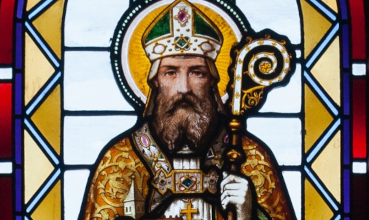
Canonisation of Laurence O’Toole by Pope Honorius III

Lorcán Ua Tuathail, also known as Saint Laurence O’Toole, is canonised by Pope Honorius III on December 11, 1225. It will be 750 years before another Irish person is canonised.

O’Toole is born in Castledermot in what is now County Kildare in 1128. His father is Maurice O’Toole, King of Hy Murray. It is common practice in the day for princes of one clan to be given as hostages to another clan, as a guarantee of peace. When he is ten years old O’Toole is given as hostage to Diarmaid Mac Murchada, King of Leinster, who treats him very badly. He is sent in chains to a remote place, where he gets very little to eat and does not have enough clothes to keep him warm in the winter. For two years, even though he is a king’s son, he learns what it is like to be poor and to be oppressed.

After two years, it is agreed that O’Toole is to be released. He is sent to a monastery at Glendalough, and the monks make him welcome. It is agreed that his father is to come and collect him there. But he soon comes to love Glendalough and likes joining the monks in prayer. After his two years as a hostage, he realises that wealth and power are not important. He feels very close to God in Glendalough. He asks his father’s permission to stay there and become a monk, to which his father agrees. At the age of only 26 years old, he is elected Abbot of Glendalough. As the leader of the community, he encourages the monks in their learning. There is always a welcome in the monastery for the poor. When there is a famine in the area, he sells some of the treasures of Glendalough to provide food for those who are hungry.

In 1162 O’Toole becomes the first Irish-born Archbishop of Dublin, then a city ruled by Danes and Norwegians. In those days, many of the people of Dublin do not take their Christian religion very seriously. He encourages them to become real Christians. He brings monks to Dublin from France, and they live at Christ Church Cathedral. They help many people to come back to Mass and the Sacraments. O’Toole himself never forgets his own days of poverty. He continues to care for the poor, especially homeless children. He makes room for them in his own house, and they share the food at his table.

The Normans land in Ireland in 1169. The following year they besiege Dublin under their leader, Richard de Clare, 2nd Earl of Pembroke, also known by the nickname of “Strongbow.” O’Toole meets Strongbow to arrange peace but the Normans attack while the talks are going on. They seize the city and begin killing the citizens and looting their houses. O’Toole saves the lives of many people.

As Archbishop of Dublin, O’Toole participates in the Third Council of the Lateran in Rome in 1179, with some of the other Irish bishops. Pope Alexander III knows that Ireland has been going through a bad time. He knows that many people, including priests, are no longer taking their religion seriously. He entrusts to O’Toole the task of reforming the Church in Ireland.

A new dispute breaks out between Henry II of England and the Irish Kings. In the spring of 1180, O’Toole leaves Ireland to see if he can help settle the dispute. King Henry II does not have much time for bishops. He has already arranged to have the Archbishop of Canterbury, Thomas Becket, murdered. He does not welcome O’Toole. He sees a chance to get rid of O’Toole as Archbishop of Dublin and does not let him return to Ireland. Henry has control of Normandy as well as England. O’Toole follows him there. As long as there is a chance of peace, he would not give up trying.

In 1180, O’Toole becomes seriously ill. The monks at Eu in Normandy look after him in their monastery but on November 14, 1180, at the age of 52, he dies. His tomb is in the crypt under the Collegial Church at Eu. Many people still go there to pray.

Laurence O’Toole is canonized by Pope Honorius III on December 11, 1225.

(From “St. Laurence O’Toole: a spiritual leader for difficult times,” CatholicIreland.net, November 30, 1999)


Leave a comment

The Arrest of Oliver Plunkett, Archbishop of Armagh

Oliver Plunkett, Catholic Archbishop of Armagh and Primate of All Ireland, is accused of instigating the Popish Plot and arrested on December 6, 1679. He is the last victim of the Popish Plot.

Plunkett is born on November 1, 1625, in Loughcrew, County Meath, to parents of Hiberno-Norman ancestors. Until his sixteenth year, his education is entrusted to his cousin Patrick Plunkett, Abbot of St. Mary’s, Dublin, and brother of Luke Plunkett, 1st Earl of Fingall, who later becomes successively Bishop of Ardagh and of Meath. As an aspirant to the priesthood, he sets out for Rome in 1647.

Plunkett is admitted to the Pontifical Irish College in Rome and proves to be an able pupil. He is ordained a priest in 1654 and deputed by the Irish bishops to act as their representative in Rome. Meanwhile, the Cromwellian conquest of Ireland (1649–1653) has defeated the Roman Catholic cause in Ireland. As a result, it is impossible for Plunkett to return to Ireland for many years, so he petitions to remain in Rome. At the Congregation of Propaganda Fide on July 9, 1669, he is appointed Archbishop of Armagh and is consecrated on November 30 at Ghent. He returns to Ireland on March 7, 1670, as the English Restoration of 1660 has begun on a basis of toleration.

Plunkett sets about reorganising the ravaged Roman Church and builds schools both for the young and for clergy. The Penal Laws have been relaxed in line with the Declaration of Breda in 1660 and he is able to establish a Jesuit College in Drogheda in 1670, which becomes the first Catholic-Protestant integrated school in Ireland.

On the enactment of the Test Act in 1673, to which Plunkett does not agree for doctrinal reasons, the college is closed and demolished. Plunkett goes into hiding, traveling only in disguise, and refuses a government edict to register at a seaport to await passage into exile.

In 1678 the so-called Popish Plot, concocted in England by clergyman Titus Oates, leads to further anti-Roman Catholic action. Archbishop Peter Talbot of Dublin is arrested, and Plunkett again goes into hiding. Despite being on the run and with a price on his head, he refuses to leave his flock.

Plunkett is arrested in Dublin on December 6, 1679, and imprisoned in Dublin Castle. He is tried at Dundalk for conspiring against the state by allegedly plotting to bring 20,000 French soldiers into the country, and for levying a tax on his clergy to support 70,000 men for rebellion. The trial soon collapses as the prosecution witnesses are themselves wanted men and afraid to appear in court. Plunkett is moved to Newgate Prison in London in order to face trial at Westminster Hall. The first grand jury finds no true bill, but he is not released. The second trial is generally regarded as a serious miscarriage of justice as Plunkett is denied defending counsel.

Archbishop Plunkett is found guilty of high treason in June 1681 “for promoting the Roman faith,” and is condemned to death. Plunkett is hanged, drawn, and quartered at Tyburn on July 1, 1681, the last Roman Catholic martyr to die in England. His body is initially buried in two tin boxes in the courtyard of St. Giles in the Fields church. The remains are exhumed in 1683 and moved to the Benedictine monastery at Lamspringe, near Hildesheim in Germany. His head is brought to Rome, and from there to Armagh, and eventually to Drogheda where it has rested in St. Peter’s Church since June 29, 1921. Most of the body is brought to Downside Abbey, England, where the major part is located today, with some parts remaining at Lamspringe.

Sir Oliver Plunkett is canonised in Rome by Pope Paul VI on October 12, 1975, the first new Irish saint in almost seven hundred years, and the first of the Irish martyrs to be beatified. For the canonisation, the customary second miracle is waived.


Leave a comment

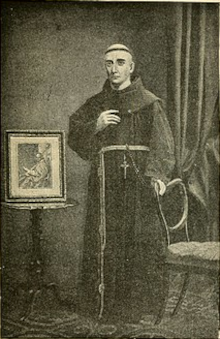
Death of Flaithrí Ó Maolchonaire, Archbishop of Tuam

Flaithrí Ó Maolchonaire, Irish Franciscan and theologian, founder of St. Anthony’s College, Leuven, and Archbishop of Tuam, dies in Madrid, Spain on November 18, 1629.

Ó Maolchonaire is born in the townland of Figh, civil parish of Tibohine, barony of Frenchpark, County Roscommon. His father and mother are Fíthil and Onóra Ó Maolchonaire. Two other sons survive to adulthood, Maoilechlainn and Firbisigh. They belong to a well-known family of historians and poets. He is brought up in the family profession.

Ó Maolchonaire studies for the priesthood at Salamanca, entering the Irish college founded in 1592. He first studies the liberal arts and philosophy. In 1593 he translates into Irish a short Castilian catechism by Jerónimo de Ripalda SJ. The original is a simple catechetical work written in Aristotelian master-pupil dialogue. According to Mícheál Mac Craith, Ó Maolchonaire’s translation pointedly refers to the Irish as Eirinnach rather than Gaedheal.

After five years at the Salamanca Irish college, Ó Maolchonaire leaves to join the Franciscan province of Santiago. Aodh Mac Cathmhaoil is among his classmates in the Salamanca Franciscan friary. They and nine of their peers in the Santiago province are later raised to the episcopacy, an unprecedented development in the history of the order.

At the height of the Nine Years’ War, Ó Maolchonaire sails to Ireland where he serves as a confessor and preacher to troops under the command of Hugh O’Neill and Hugh Roe O’Donnell. In 1601, they request a bishopric for Ó Maolchonaire “in recognition of his diligence, commending his sound judgment on Irish affairs.” After the disaster of Kinsale in 1601, he accompanies O’Donnell to Spain as his confessor and adviser, hoping to see a renewal of Spanish military intervention in Ireland.

In 1602, Ó Maolchonaire attempts to get approval for O’Donnell to meet Philip III in person, but they are kept at arm’s length by the Spanish court. During this time, they also drafted an official complaint against the Jesuit superiors of the Irish college at Salamanca over presumed discrimination in favour of Old English students at the expense of students from Connacht and Ulster.

While waiting for a response to his repeated calls for military support in Ireland, O’Donnell becomes seriously ill and dies at Simancas, being assisted on his deathbed by Ó Maolconaire. In keeping with his patronage of the order of friars minor in Donegal, O’Donnell is buried in the Franciscan habit. Ó Maolchonaire accompanies the remains to their last resting place in the Franciscan church at Valladolid. He continues to press for military support after O’Donnell’s death. He participates in an abandoned maritime expedition which reaches Achill Sound in 1603 but never lands in Ireland. He subsequently assists the Spanish councils of state and war to stem the flow of Irish military migrants and their dependents in Spain.

As adviser to Puñonrostro, the king’s appointee as protector of Irish exiles in Spain, Ó Maolchonaire helps to secure funds for widows, orphans and clerics. Trained as a chronicler and genealogist, he sponsors the entry of Irish soldiers into Spanish military orders and successfully calls for the promotion of Henry O’Neill, second eldest son of the earl of Tyrone, as colonel of Irish infantry units in Flanders, the O’Neill tercio in 1604.

In 1606, the Franciscan general chapter is held in Toledo where Ó Maolchonaire is selected as minister-provincial of the Irish friars minor. The most notable act of his tenure as provincial is the founding of a new Irish Franciscan college at Leuven in the Habsburg Netherlands. A year before his appointment, he begins his efforts in earnest with an appeal to the Spanish king. The loss of five Franciscan houses during the Nine Years’ War makes a new foundation essential. In response, Philip III instructs Albert VII, Archduke of Austria, to provide a perpetual grant for a new college in the university town of Leuven. Ó Maolchonaire’s part in founding the college clearly influences the Catholic pastoral mission to Ireland during the seventeenth century. The first and most active Irish printing press on the continent is long in operation at Leuven.

After Hugh O’Neill and Rory O’Donnell leave Ireland in 1607, Ó Maolconaire accompanies them from Douai to Rome as interpreter and advisor. Christopher St. Laurence, baron of Howth, implicates him in a plot to seize Dublin Castle and raises a new rebellion just before the Flight of the Earls. In recognition of his losses, Philip III and Paul V offer O’Neill the concession of Ó Maolchonaire’s promotion to the archbishopric of Tuam. On Sunday, May 3, 1609, he is consecrated archbishop by Cardinal Maffeo Barberini in the centre of Rome at the Chiesa Santo Spirito in Sassia. He remains in Rome until his appointment as archbishop of Tuam before returning to Madrid on behalf of Hugh O’Neill.

In response to the 1613–15 Parliament of Ireland, Ó Maolchonaire writes from Valladolid a remonstrance to the Catholic members of the parliament, rebuking them for assenting to the bill of attainder that confiscated the estates of O’Neill, O’Donnell and their adherents. As Archbishop of Tuam, he never takes possession of his episcopal see, governing through vicars general. He continues to live in Madrid and Leuven, as is the case with many Irish clergy at the time. Like his fellow-Franciscan, Luke Wadding, and Peter Lombard, Archbishop of Armagh, he serves as a key intermediary and his influence in Irish matters is considerable. In 1626, a year after Charles I declared war on Spain, he makes the case for an invasion of Ireland under the joint leadership of the earls of Tyrone and Tyrconnell.

Ó Maolconaire dies at the Franciscan friary of San Francisco el Grande in Madrid on November 18, 1629. In 1654, two Irish friars bring his remains back to St. Anthony’s College in Leuven where he is buried near the high altar in the collegiate chapel.


Leave a comment

Death of Sculptor Alexandra Wejchert

Alexandra Wejchert, Polish-Irish sculptor known for her use of perspex (plexiglass), stainless steel, bronze and neon colours, dies in Dún Laoghaire, County Dublin, on October 24, 1995.

Wejchert was born in Kraków, Poland on October 16, 1921. Her father is Tedeusz Wejchert, who ran a shipping business out of Gdańsk. She enters University of Warsaw to study architecture in 1939, and while there witnesses the German invasion of Poland during World War II. Having graduated in 1949, she works as a town planner and architect in Warsaw, where she graduates from the Academy of Fine Arts in 1956 with a degree before moving to Italy.

Wejchert holds her first solo show in 1959 in the Galeria dell’ Obelisco, Rome. She then returns to Warsaw where she is featured in the National Museum “Fifteen years of Polish art” exhibition in 1961. At this time she is still working as an architect, but does not support the social realism of Soviet architecture, which leads her to decide to concentrate solely on art from 1963. She leaves communist Poland in 1964, when she accompanies her younger brother, the architect Andrej Wejchert, when he and his wife Danuta moved to Dublin.

She holds her first solo show in Dublin in November 1966 with an exhibition of 30 paintings at The Molesworth Gallery. In 1967 she shows Blue relief at the Irish Exhibition of Living Art, which is a wall relief of “sculpted paintings” which are precursors to her later free-standing sculpture. She wins the Carroll Open award of £300 at the 1968 Irish Exhibition of Living Art for Frequency No. 5. Also in 1968 she holds a solo exhibition in the Galerie Lamert, Paris, becoming a regular exhibitor there. During this period her work is used as a setting for an electronic music concert with the critic Dorothy Walker noting her designs have a rhythmic quality.

From the 1970s, Wejchert wins commissions for public art, starting with the 1971 wood and acrylic wall relief in the arts building at University College Dublin. In the same year, the Bank of Ireland purchases Blue form 1971 and then Flowing relief in 1972. Her 1971 triptych, Life, is commissioned for the Irish Life headquarters in Abbey Street. The Lombard and Ulster Bank in Dublin commissions untitled in 1980, and Allied Irish Banks (AIB) purchases Freedom in 1985 for their branch in Ballsbridge. Her entry wins a competition in 1975 for a stamp marking International Women’s Year, and features an image of hands reaching for a dove with an olive branch.

Wejchert becomes an Irish citizen in 1979, a member of Aosdána in 1981, and a member of the Royal Hibernian Academy (RHA) in 1995. She is recognised internationally when she is the only Irish sculptor included in Louis Redstone’s new directions (1981). She is shown at the Solomon gallery from 1989 numerous times, including a solo show in 1992. A number of her most important pieces are for Irish universities, such as Geometric form at the University of Limerick and Flame at the University College Cork in 1995, her last work.

Wejchert dies suddenly at her home on Tivoli Road, Dún Laoghaire on October 24, 1995. She has one son, Jacob. The RHA holds a posthumous exhibition of her work in 1995. She is said to have influenced the younger generation of Irish sculptors, including Vivienne Roche, Eilis O’Connell, and Michael Warren. Flame is selected to be a part of the Irish Artists’ Century exhibition at the RHA in 2000.

(Pictured: “Flame,” 1995, brass and granite, University College Cork. This sculpture commemorates the people who bequested their bodies to the UCC Anatomical Gift Programme for the purpose of science and learning. It represents the flame of knowledge which leads to the light of understanding.)


Leave a comment

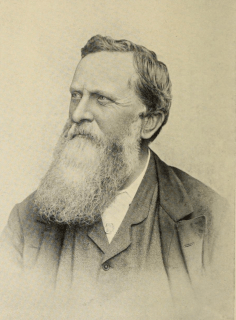
Birth of Michael George Mulhall, Author & Newspaper Editor

Michael George Mulhall, Irish author, statistician, economist and newspaper editor, is born in Dublin on September 29, 1836. He co-founds the Buenos Aires Standard, which in 1862 becomes the first English-language newspaper to be published daily in South America. He co-authors the first English-language book published in that continent, The Handbook of the River Plate, a work that goes to six editions, is widely consulted by immigrants and is now a historical sourcebook. His Dictionary of Statistics (1883 and later editions) becomes a standard work of reference.

Mulhall is the third son of Thomas Mulhall. He is educated for the priesthood at the Pontifical Irish College, Rome, but not having the vocation emigrates to Argentina to work with his brother Edward Thomas Mulhall, then a large sheep farmer in that country. In 1861 the Mulhall brothers found the Buenos Aires Standard, which in the next year becomes a daily. It is the preferred newspaper of the Anglo-Argentine community and claims to be the only English-language daily newspaper to be published south of the equator. A third brother, Francis Healey Mulhall, also emigrates to Argentina and founds the Southern Cross, a newspaper of the Irish-Argentine community.

By 1864 Mulhall, despite his relative youth, is regarded as a spokesman for the entire British community in the region.

In 1878 (1868 by another source) Mulhall marries Marion McMurrough Murphy, herself an author whose works include Between the Amazon and the Andes (1881) and Explorers in the New World (1909). She cooperates with him closely on his statistical work.

Mulhall dies in Dublin on December 13, 1900.


Leave a comment

Birth of Christopher Augustine Reynolds, Archbishop of Adelaide

Christopher Augustine Reynolds, the first Catholic Archbishop of Adelaide, South Australia, is born in Dublin on August 11, 1834.

Reynolds is the son of Patrick Reynolds and his wife Elizabeth, née Bourke. Educated by the Carmelites at Clondalkin, Dublin, he later comes under the influence of the Benedictines when he volunteers for the Northern Territory mission of Bishop Rosendo Salvado Rotea, and is sent to Subiaco near Rome to train for the priesthood. He leaves after three years and goes to the Swan River Colony with Bishop Joseph Serra to continue his training at New Norcia, arriving at Fremantle in May 1855. Probably because of poor health, he leaves the Benedictines and in January 1857 goes to South Australia. He completes his training under the Jesuits at Sevenhill and is ordained in April 1860 by Bishop Patrick Geoghegan. He is parish priest at Wallaroo (where he builds the church at Kadina), Morphett Vale and Gawler. When Bishop Laurence Sheil dies in March 1872, he is appointed administrator of the diocese of Adelaide. On November 2, 1873, in Adelaide he is consecrated bishop by Archbishop John Bede Polding.

Reynolds has a large diocese and in 1872-80 travels over 52,000 miles in South Australia. The opening up of new agricultural districts, an increase in Irish migrants and diocesan debts had produced a grave shortage of clergy. But his most urgent problem is conflicts between and within the clergy and laity over education, especially the role to be played by the Sisters of St. Joseph of the Sacred Heart. He supports the Sisters, reopens schools closed by Archbishop Sheil and, though opposed by the Bishop of the Diocese of Bathurst Matthew Quinn, helps the Superior, Mother Mary MacKillop, secure Rome’s approval for autonomy for her Sisterhood.

Reynolds is not a good administrator and his strenuous efforts to extend Catholic education after the Education Act of 1875 incurs alarming debts. In 1880-81 he visits Rome. On his return, increasingly concerned with finances, disturbed at the prospect of losing St. Joseph nuns and, to some extent misled by jealousy and intrigue, he dramatically reverses his policy towards the Sisterhood and on November 14, 1883, relieves Mother Mary of her duties as Mother Superior. Though the Plenary Council of the Bishops of Australasia, held in Sydney in 1885, support him, in 1888 Pope Leo XIII decrees a central government for the Sisterhood, to be located in Sydney. The council requests that Adelaide be raised to an archiepiscopal and metropolitan see and on September 11, 1887, Reynolds is invested archbishop by Cardinal Francis Moran.

Reynolds’s health is never robust and after a two-year illness he dies on June 12, 1893, in Adelaide, where he is buried. Although he is austere and hard-working, he leaves his successor church debts of over £56,000. A particularly fine preacher, he is widely respected for his missionary zeal and for an ecumenical spirit unusual for his time.

(From: Australian Dictionary of Biography, http://www.adb.anu.edu.au, Ian J. Bickerton)


Leave a comment

Death of Edward Daly, Catholic Bishop of Derry

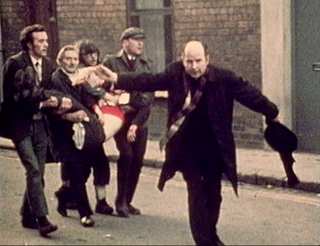
The retired Catholic Bishop of Derry, Dr. Edward Daly, whose photograph becomes the iconic image of Bloody Sunday in 1972, dies at the age of 82 on August 8, 2016.

Daly is born in Ballyshannon, County Donegal, but raised in Belleek, County Fermanagh in Northern Ireland. He attends and boards at St. Columb’s College in Derry on a scholarship, after which he spends six years studying towards ordination to the priesthood at the Pontifical Irish College in Rome. He is ordained a priest of the Diocese of Derry in Belleek on March 16, 1957. His first appointment is as a Curate in Castlederg, County Tyrone. In 1962, he is appointed a Curate in St. Eugene’s Cathedral in Derry, with responsibility for the Bogside area of the city. He leaves briefly in the 1970s to serve as a religious advisor to RTÉ in Dublin in the Republic of Ireland but spends the majority of his career in Derry.

During his time in Derry, Daly takes part in the civil rights marches. He has first-hand experience of the Battle of the Bogside in 1969, the early years of the Troubles, internment, and the events of Bloody Sunday, in which British soldiers fire on unarmed protesters on January 30, 1972, killing 14 people. He becomes a public figure after he is witnessed using a blood-stained handkerchief as a white flag in an attempt to escort 17-year-old Jackie Duddy, a wounded protester, to safety. Duddy dies of his injuries soon after and Daly administers the last rites. He later describes the events as “a young fella who was posing no threat to anybody being shot dead unjustifiably.”

Daly gives an interview to the BBC in which he insists, contrary to official reports, that the protesters were unarmed. He testifies as such to the Widgery Tribunal, though he also testifies that he had seen a man with a gun on the day, to the anger of some of those involved. The Widgery Report largely exonerates the British Army, perpetuating the controversy. Years later, he says that the events of Bloody Sunday were a significant catalyst to the violence in Northern Ireland, and that the shootings served to greatly increase recruitment to the Irish Republican Army (IRA).

Prior to Bloody Sunday, Daly is sympathetic to the “old” IRA, of which his father was a member, but the events of Bloody Sunday leave him of the opinion that “violence is completely unacceptable as a means to a political end,” which leads to tension with the Provisional Irish Republican Army throughout his career.

Daly is appointed Bishop of Derry in 1974, a position he holds until he is forced to retire in October 1993 after suffering a stroke. He continues in the role of chaplain to Derry’s Foyle Hospice until February 2016.

Daly makes headlines in 2011 when he says there needs to be a place in the modern Catholic Church for married priests. He addresses the controversial issue in his book about his life in the Church, A Troubled See. Allowing clergymen to marry would ease the church’s problems, he says.

Daly is awarded the Freedom of the City by Derry City Council in 2015 in a joint ceremony with Bishop James Mehaffey, with whom he had worked closely while the two were in office. He is “hugely pleased to accept [the award], particularly when it is being shared with my friend and brother, Bishop James.” The city’s mayor, Brenda Stevenson, announces that the joint award is in recognition of the two bishops’ efforts towards peace and community cohesion.

Daly dies on August 8, 2016, at Altnagelvin Area Hospital in Derry, having been admitted after a fall several weeks previously. He had also been diagnosed with cancer. He is surrounded by family and local priests.

Daly’s remains are taken to St. Eugene’s Cathedral, where he lay in state with mourners able to file past. His coffin is sealed at midday on August 11, 2016, and buried after Requiem Mass in the grounds of St. Eugene’s Cathedral alongside his predecessor as Bishop of Derry, Neil Farren. The bells of the cathedral toll for one hour on the morning of Daly’s death while many local people arrived to pay tribute. The mayor of Derry, Hilary McClintock, opens a book of condolence in the city’s guildhall for members of the public to sign. The funeral, conducted by the incumbent Bishop of Derry Donal McKeown, is attended by multiple religious and political leaders from across Ireland and retired leaders from throughout his career. A message from Pope Francis is read aloud at the beginning of the service. Hundreds of members of the public also attend the funeral, some lining the route from the cathedral to the gravesite. His coffin is greeted with applause as it is carried out of the cathedral for burial.

(Pictured: Father Edward Daly, waving a blood-stained white handkerchief as he escorts a mortally-wounded protester to safety during the events of Bloody Sunday (1972) in Derry, Northern Ireland, an image which becomes one of the most recognisable moments of the Troubles)


1 Comment

Death of Myles Walter Keogh, Last Man Killed at the Battle of Little Big Horn

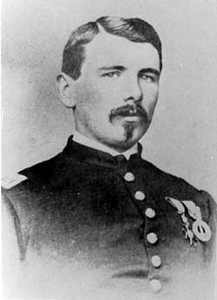
Myles Walter Keogh, soldier in the United States Army, is the last man killed at the Battle of Little Big Horn on June 25, 1876, according to the Sioux. His horse is the only U.S. survivor.

Keogh is born in Orchard House in Leighlinbridge, County Carlow, on March 25, 1840. He attends the National School in Leighlinbridge and is long thought to have attended St. Patrick’s College in Carlow but that college has no record of his attendance. It is possible that he attends St. Mary’s Knockbeg College.

By 1860, a twenty-year-old Keogh volunteers, along with over one thousand of his countrymen, to rally to the defence of Pope Pius IX following a call to arms by the Catholic clergy in Ireland. By August 1860, Keogh is appointed second lieutenant of his unit in the Battalion of St. Patrick, Papal Army under the command of General Christophe Léon Louis Juchault de Lamoricière. Once the fighting is over and duties of the Pontifical Swiss Guard become more mundane, Keogh sees little purpose in remaining in Rome. In March 1862, with civil war raging in America, he resigns his commission in the Company of St. Patrick and sets out for New York City, arriving on April 2.

Keogh actively participates in several prominent American Civil War battles including the Shenandoah Valley, the Battle of Antietam, the Battle of Fredericksburg, and the Battle of Gettysburg.

Perhaps the strongest testimony to Keogh’s bravery and leadership ability comes at the Battle of the Little Bighorn, also known as Custer’s Last Stand, on June 25, 1876. The senior captain among the five companies wiped out with General George Armstrong Custer that day, and commanding one of two squadrons within the Custer detachment, Keogh dies in a “last stand” of his own, surrounded by the men of Company I. When the sun-blackened and dismembered dead are buried three days later, Keogh’s body is found at the center of a group of troopers. The slain officer is stripped but not mutilated, perhaps because of the “medicine” the Indians see in the Agnus Dei (“Lamb of God”) he wears on a chain about his neck or because many of Sitting Bull‘s warriors are believed to be Catholic. Keogh’s left knee has been shattered by a bullet that corresponds to a wound through the chest and flank of his horse, indicating that horse and rider may have fallen together prior to the last rally.

The badly injured animal is found on the fatal battlefield and nursed back to health as the 7th Cavalry’s regimental mascot, which he remains until his death in 1890. This horse, Comanche, is considered the only U.S. military survivor of the battle, though several other badly wounded horses are found and destroyed at the scene. Keogh’s bloody gauntlet and the guidon of his Company I are recovered by the army three months after Little Bighorn at the Battle of Slim Buttes.

Originally buried on the battlefield, Keogh’s remains are disinterred and taken to Auburn, New York as he had requested in his will. He is buried at Fort Hill Cemetery on October 26, 1877, an occasion marked by citywide official mourning and an impressive military procession to the cemetery.

Tongue River Cantonment in southeastern Montana is renamed after him to be Fort Keogh. The fort is first commanded by Nelson A. Miles. The 55,000-acre fort is today an agricultural experiment station. Miles City, Montana is located two miles from the old fort.


4 Comments

Republic of Ireland’s First World Cup Finals Match

The Republic of Ireland plays their first ever match in the finals of the World Cup, drawing 1-1 with England in Cagliari, Sardinia on June 11, 1990.

At Italia ’90 the Irish team is drawn in a very tough Group F that includes European champions the Netherlands, African footballing power Egypt, and England. This is something of a coincidence as the English and the Dutch were also in Ireland’s UEFA Euro 1988 group. The tournament organisers are fearful that this grouping might lead to crowd disorder particularly between the English and Dutch fans. The group is based on the Italian islands of Sicily and Sardinia and security is very tight with alcohol bans in place on match days.

Ireland’s first match at a World Cup finals competition is against their longtime foe England. The English are seeking revenge for their surprise defeat by the Irish in the opening group match at Euro ’88. Once again Bobby Robson‘s English team is expected to beat Ireland and his players underline that by taking an early lead through an eight-minute goal from Gary Lineker. Despite Ireland getting a greater foothold in the second half an equaliser is elusive until an error by Steve McMahon allows Kevin Sheedy to score in the 73rd minute.

Ireland’s next matches are against Egypt and the Netherlands, both played in Palermo and both ending in a draw. The Irish team finishes group play with 0 wins, 0 losses and 3 draws. England registers the only win in the group, beating Egypt. The three European teams progress into the next round.

In the knock-out round Ireland avoids drawing West Germany, the ultimate winner of the 1990 World Cup. They draw Romania as their first opponent and end regulation in yet another draw in Genoa. A penalty shoot-out follows and after the first eight penalties the teams are still tied at 4-4. Irish goalkeeper Packie Bonner blocks Romania’s fifth penalty kick. David O’Leary steps up confidently and sends his kick past the goalkeeper and into the net. Ireland has advanced to the quarterfinals at the first attempt.

Ireland bows out at the quarterfinals stage losing by a single goal to the hosts, Italy, at the Stadio Olimpico in Rome. It is a very strange campaign in that Ireland does not win any of their matches, scores only two goals, and plays in some really poor matches in terms of quality of play. Notwithstanding this the Irish over-achieves which is fully appreciated by the Irish supporters. The green army stays on in the Stadio Olimpico long after the final whistle to laud manager Jack Charlton and his gallant squad.

(From: “Ireland at 1990 World Cup Finals in Italy,” Soccer-Ireland.com, http://www.soccer-ireland.com | Photograph by Ray McManus / SPORTSFILE)