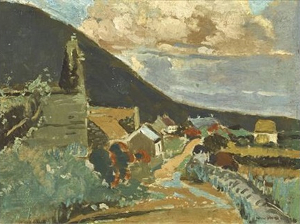
Nano Reid, Irish landscape artist, figure painter and portraitist, is born in Drogheda, County Louth on March 1, 1900. An individual, expressionistic artist, Reid is acknowledged to be one of the finest Irish woman painters of twentieth-century visual art in Ireland. Her works are represented in many public collections throughout Ireland.
In 1920, Reid wins a scholarship to study fine art painting and drawing at the Dublin Metropolitan School of Art, now the National College of Art and Design, under Harry Clarke. At the time, she is, in the words of fellow student Hilda van Stockum, “a fierce redhead…uncompromising and looking for truth.” In 1925 she starts showing at the Royal Hibernian Academy (RHA), submitting a total of 42 canvases until the late 1960s.
In 1950, with Norah McGuinness, Reid represents Ireland at the Venice Biennale. This is followed by the Exhibition of Contemporary Irish Art in Aberystwyth, Wales (1953), and the Mostra Internazionale di Bianco e Nero in Lugano, Switzerland (1956), the Guggenheim International Award Exhibition in New York City (1960) and the Twelve Irish Painters show in New York City (1963). In 1974, the Arts Council and the Arts Council of Northern Ireland stage a major retrospective of Reid’s artworks.
Nano Reid dies in Drogheda in 1981. Retrospectives are held at Taylor Galleries in Dublin (1984), Droichead Arts Centre in Drogheda (1991), and at Linenhall Arts Centre in Castlebar, County Mayo (1999).
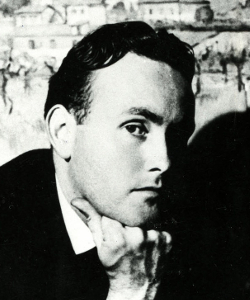
Hill is born at Southampton, Hampshire, on December 6, 1916, the son of a wealthy sugar trader. He first works as a theatre designer in Leningrad in the 1930s and later as an historian. In World War II he registers as a conscientious objector and works on a farm.
Hill’s long association with Ireland begins when he visits Glenveagh Castle in County Donegal to paint the portrait of the Irish American art collector Henry McIlhenny, whose grandfather had emigrated to the United States from the nearby village of Milford, and who subsequently made a fortune from his patent gas meter.
Hill begins to enjoy increased success as a portrait painter from the 1960s. His subjects include many notable composers, musicians, politicians and statesmen, such as broadcaster Gay Byrne, Jerusalem mayor Teddy Kollek and The Prince of Wales. He is also an enthusiastic art collector and traveller, with a wide range of friends such as Bryan Guinness and Isaiah Berlin. Greta Garbo visits Hill in the 1970s, a visit which forms inspiration for Frank McGuinness‘ 2010 play Greta Garbo Came to Donegal.
An exhibition of his work and personal art collection can be seen at the House and associated Glebe Gallery at Churchill, near Letterkenny. Another collection of his work is held at Mottisfont Abbey. Many of his landscapes portray scenes from Tory Island, where he has a painting hut for years, and starts and then mentors the artists’ community there, teaching the local fishermen how to paint. This leads to the informal but busy “Tory School” of artists such as James Dixon and Anton Meenan, who find that they have the time to paint and use their wild surroundings as a dramatic subject.
Hill is made a CBE in 1997. A Retrospective exhibition is arranged for and by him at the Royal Hibernian Academy in 1998. On January 13, 1999, he is made an honorary Irish citizen by the President of Ireland Mary McAleese.
Arthur Derek Hill dies at the age of 83 at a London hospital on July 30, 2000. He is buried in Hampshire in the South of England with his parents. Memorial services are held for him in Dublin at St. Patrick’s Cathedral, as well as St. James’s Church, Piccadilly, London, and his local Church in Trentagh, County Donegal.
Rothwell is born to James and Elizabeth and is the oldest of their seven children. He trains to become a painter at the Dublin Society‘s school from 1814 until 1820 and wins a silver medal for his work. At the age of 24, he is made a member of the newly established Royal Hibernian Academy and exhibits portraits there from 1826 to 1829. He subsequently moves to London and works as a studio assistant to Thomas Lawrence. When Lawrence dies in 1830, Rothwell completes many of his unfinished works and is poised to become the next foremost portrait painter in Britain and Ireland.
According to Leoneé Ormond’s biographical article in the Grove Dictionary of Art, Rothwell “was at the height of his powers from 1829 to 1831” and he “was much influenced by Lawrence, but he lacked the incisiveness and flair of his master.” According to Fintan Cullen‘s biographical entry in the Oxford Dictionary of National Biography, Rothwell’s “portraits are highly accomplished” and “fine examples” including those of novelist Gerald Griffin and Mary Shelley.
From 1831 to 1834, Rothwell tours Italy to study Italian art so that he can paint history paintings. In the 1830s, he starts painting genre pictures, such as The Poor Mendicants (1837). He usually paints Italian-inspired pieces, such as his semi-nude study Calisto, a work he considers to be his masterpiece. He is furious when the painting is poorly hung at the 1862 International Exhibition in London and publishes a pamphlet on the topic.
When Rothwell returns to London, his popularity has evaporated. He lives and exhibits works in Ireland, the United States, London, and Italy, but he never again achieves the same level of popularity he had reached in the late 1820s.
In 1842 Rothwell marries Rosa Marshall. The couple has several children. Rothwell contracts a fever while working in Rome and dies on September 13, 1868. Joseph Severn, who painted a portrait of the Romantic poetJohn Keats, arranges for Rothwell’s funeral and tomb in the Protestant Cemetery, Rome.
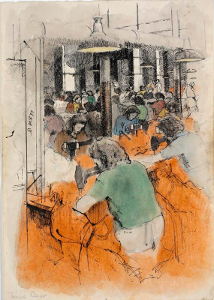
Thomas James Carr, British artist who is associated with the Euston Road School in the 1930s and has a long career as a painter of domestic scenes and landscapes, is born in Belfast to a well-to-do family on September 21, 1909.
Although essentially a realist painter, Carr is included in the 1934 Objective Abstractionists exhibition at Zwemmer’s Gallery. In 1937, he shares an exhibition with Victor Pasmore and Claude Rogers at the Storran Gallery and subsequently becomes associated with the representational style of the Euston Road School. Starting in 1940, at Georges Wildenstein‘s gallery, he holds a series of one-man exhibitions at various galleries including at the Leicester Galleries, The Redfern Gallery and also at Thomas Agnew & Sons.
After the war, Carr teaches at the Belfast College of Art and moves to Belfast in 1955. After the death of his wife in 1995, he moves to Norfolk, England to be nearer one of his three daughters and her family. He continues to paint into old age and tends to concentrate on landscape painting.
Painter Michael Angelo Hayes is born in Waterford on July 25, 1820. Probably the best 19th century painter of animals in Ireland, Hayes is most accomplished as a watercolourist, although he occasionally uses oils.
Hayes is the son and pupil of Tipperary watercolour miniaturist Edward Hayes RHA. It is clear from his christening that he is expected to become an artist. Fortunately, the younger Hayes is a talented draughtsman, and by his late teens has acquired something of a reputation as a painter of horses and military subjects.
Hayes begins showing at the Royal Hibernian Academy (RHA) in 1837, then for three years 1840-1842. In 1842, he is appointed Military Painter-in-ordinary to the Lord Lieutenant. He passes the next few years in London, where he exhibits watercolours at the New Society of Painters in Water Colours, of which he is elected an Associate Member in 1848, the same year he makes his one and only contribution to the Royal Academy of Arts.
Returning to Dublin, Hayes resumes exhibiting at the RHA, at the same time becoming involved in its administration. He is elected an Associate member in 1853, a full Academician the following year, and Secretary in 1856. The affairs of the Academy are totally disorganized at the time, inducing Hayes and others to resolve the situation. His efforts to reform the institution and secure its finances meets with entrenched opposition from older members, which results in Hayes being removed from his post, although he is successfully reinstated in 1861.
Not long afterwards he is appointed secretary to the Lord Mayor of Dublin, Peter McSwiney, who happens to be his brother-in-law, and later becomes City Marshal in 1867. He continues as Secretary of the RHA until he resigns in 1870, and continues showing until 1874.
Hayes makes a special study of horses in motion, and in 1876 publishes his conclusions in an illustrated pamphlet, The Delineation of Animals in Rapid Motion. One of his Dublin paintings, Sackville Street, Dublin, depicts a view of Dublin’s premier street in the 1850s. The painting is a documentary of social life in Dublin. It achieves widespread popularity when reprinted as a lithograph.
Michael Angelo Hayes dies prematurely in 1877 in a tragic drowning accident at his home.
Murphy is the son of James Murphy, a railway employee, and Margaret Sheehan of Little Island, County Cork. He attends Saint Patrick’s School on Gardiner’s Hill. In 1921 he enrolls as a part-time student at the Crawford School of Art, Emmet Place, Cork. In 1922 he finds work as an apprentice stone-carver at John Aloysius O’Connell’s Art Marble Works, Watercourse Road, Blackpool. There he specialises in architectural and foliage carving while continuing his studies at Crawford by night.
He is elected associate of the Royal Hibernian Academy in 1944, elected a full member in 1954, and appointed Royal Hibernian Academy Professor of Sculpture in 1964.
Also in 1944, he married Maighread Higgins, daughter of the Cork sculptor Joseph Higgins, and they go on to have three children – the knitwear designer Bebhinn Marten, the novelist Orla Murphy and the painter and De Dannan member Colm Murphy.
Murphy designs the Church of the Annunciation on Great William O’Brien Street in Blackpool, Cork, for William Dwyer in 1945. The stonework in the church is mostly by Murphy himself. It is officially dedicated on October 7, 1945.
Seamus Murphy dies in Cork on October 2, 1975. He is buried in Rathcooney, County Cork.
Examples of Murphy’s unique carvings of statues, gravestones, monuments and plaques can be seen around Cork and Ireland, including a signed panel of the four evangelists outside the entrance of the church of Our Lady and Saint John in Carrigaline, County Cork.
Samuel Lover, Irish songwriter, composer, novelist, and a painter of portraits, chiefly miniatures, dies on July 6, 1868. He was the grandfather of composer, cellist, and conductor Victor Herbert.
Lover is born at number 60 Grafton Street, Dublin and goes to school at Samuel Whyte’s at 79 Grafton Street, now home to Bewley’s, an Irish hot beverage company. By 1830 he is secretary of the Royal Hibernian Academy and lives at number 9 D’Olier Street. In 1835 he moves to London and begins composing music for a series of comic stage works. To some of them, like the operetta Il Paddy Whack in Italia (1841), he contributes both words and music, for others he merely contributes a few songs.
Lover produces a number of Irish songs, of which several – including The Angel’s Whisper, Molly Bawn, and The Four-leaved Shamrock – attain great popularity. He also writes novels, of which Rory O’Moore and Handy Andy are the best known, and short Irish sketches which, with his songs, he combines into a popular entertainment called Irish Nights or Irish Evenings. With the latter, he tours North America between 1846 and 1848. He joins with Charles Dickens in founding Bentley’s Magazine.
Lover’s grandson is composer Victor Herbert whose mother is Lover’s daughter Fanny. Irish-born and German-raised, Herbert is best known for his many successful musicals and operettas that premiere on Broadway. As a child he stays with the Lovers in a musical environment following the death of his father.
Poet, painter, novelist and composer, who, in the exercise of a genius as distinguished in its versatility as in its power, by his pen and pencil illustrated so happily the characteristics of the peasantry of his country that his name will ever be honourably identified with Ireland.
Most of Osborne’s paintings are figurative and focus on women, children, the elderly, the poor, and the day-to-day life of ordinary people on Dublin streets, as well as series of rural scenes. He also produces city-scapes, which he paints from both sketches and photographs. A prolific artist, he produces oils, watercolours, and numerous pencil sketches. He is best known for his documentary depictions of late 19th century working class life.
Osborne is the second of three sons of William Osborne, a successful animal painter who specialises in portraying horses and dogs for the then prosperous Irish landlords. He is educated at Rathmines School and at the Royal Hibernian Academy school. He learns from his father that there is money to be earned from painting animals. He produces quite a few, including of children with their pets, notably his 1885 A New Arrival, and a series of impressionistic works on cows.
In 1883, Osborne moves from Antwerp to Brittany where he paints his famous Apple Gathering, Quimperlé, now in the National Gallery of Ireland. Soon after, he moves to England where he works alongside Nathaniel Hill and Augustus Burke at Walberswick. During his period, he often returns to Dublin to make preparatory sketches for what becomes his most renowned series, of the everyday lives of the city’s poor. Although highly regarded today, these documentary street paintings are not commercially successful, and Osborne supplements his income through portrait paintings of the middle class, which are not as artistically satisfying.
In 1886, he is elected to the Royal Hibernian Academy and receives many commissions for portraits. This is an important source of income, as he has no private means of his own. After his sister dies, he is involved in looking after her daughter, and his own parents become increasingly financially dependent on him.
In 1892, he returns to Ireland to live in the family residence, and he also keeps a studio at No. 7 St. Stephen’s Green. He spends a considerable amount of time painting outdoors, in Dublin around St. Patrick’s Cathedral or in the country. He is well liked in social circles and counts the surgeon Sir Thornely Stoker, brother of Bram Stoker, among his best friends.
Osborne’s mother becomes ill in the early 1900s, and Walter spends significant periods caring for her. In 1903, while gardening, he overheats himself and catches a chill, which he neglects, and which develops into pneumonia. He dies prematurely from the illness at the age of 43 on April 24, 1903. He is buried in Mount Jerome Cemetery in Dublin.
Some critics have suggested that at the time of his death he is on the brink of his artistic maturity. His final work Tea in the Garden, a fusion of naturalism and impressionism, remains unfinished at his death and is now in the collection of the Hugh Lane Gallery in Dublin. Today his work is highly sought after by collectors.
Artist William Conor is born on May 6, 1881, in the Old Lodge Road area of north Belfast, the son of a wrought-iron worker.
Celebrated for his warm and sympathetic portrayals of working-class life in Ulster, Conor studies at the Government School of Design in Belfast in the 1890s. His artistic talents are recognized at the early age of ten when a teacher of music, Louis Mantell, notices the merit of his chalk drawings and arranges for him to attend the College of Art.
Conor is one of the first Academicians when the Belfast Art Society becomes the Ulster Academy of Arts in 1930. He becomes an Associate RHA in 1938 and a full member in 1946. Exhibitions at the Victor Waddington Galleries are held in 1944 and 1948. In 1952 he is awarded the Order of the British Empire (OBE) and in 1957 he is elected President of the Royal Ulster Academy, an office he holds until 1964.
More than 50 works of his in crayon and watercolour are in the permanent collections of the Ulster Museum.
(Pictured: Bronze statue of William Conor at Conor’s Corner, Shankill Road, Belfast)
Purser works mostly as a portraitist. She is also associated with the stained-glass movement, founding a stained-glass workshop, An Túr Gloine, in 1903. Some of her stained-glass work is commissioned from as far as New York City, including a window at Christ Church, Pelham dedicated to the memory of Katharine Temple Emmet and Richard Stockton Emmet, grandson of the Irish patriot, Thomas Addis Emmet. Through her talent and energy and owing to her friendship with the Gore-Booths, she is very successful in obtaining commissions, famously commenting, “I went through the British aristocracy like the measles.”
In 1977 Bruce Arnold noted, “some of her finest and most sensitive work was not strictly portraiture, for example, An Irish Idyll in the Ulster Museum, and Le Petit Déjeuner (in the National Gallery of Ireland).”
Sarah Purser becomes wealthy through astute investments, particularly in Guinness. She is very active in the art world in Dublin and is involved in the setting up of the Hugh Lane Municipal Gallery, persuading the Irish government to provide Charlemont House to house the gallery. In 1923 she becomes the first female member of the Royal Hibernian Academy.
Until her death she lives for years in Mespil House, a Georgian mansion with beautiful plaster ceilings on Mespil Road, on the banks of the Grand Canal. After her death in Dublin on August 7, 1943, it is demolished and is developed into apartments. She is buried in Mount Jerome Cemetery in Dublin.




 seamus dubhghaill