Denis Devlin, one of the major figures and influences of modern and modernist Irish poetry, dies in Dublin on August 21, 1959. Along with Samuel Beckett and Brian Coffey, he is one of the generation of Irish modernist poets to emerge at the end of the 1920s. He is also a career diplomat.
Devlin is born in Greenock, Scotland of Irish parents on April 15, 1908. His family returns to live in Dublin in 1918. He studies at Belvedere College and, from 1926, as a seminarian for the Roman Catholicpriesthood at Clonliffe College. As part of his studies, he attends a degree course in modern languages at University College Dublin (UCD), where he meets and befriends Brian Coffey. Together they publish a joint collection, Poems, in 1930.
Devlin joins the Irish Diplomatic Service in 1935 and spends a number of years in Rome, New York and Washington, D.C. During this time, he meets the French poet Saint-John Perse, and the Americans Allen Tate and Robert Penn Warren. He goes on to publish a translation of Exile and Other Poems by Saint-John Perse, and Tate and Warren edit his posthumous Selected Poems.
Denis Devlin dies suddenly at the age of 51 in Dublin on August 21, 1959. Since his death, there have been two Collected Poems published; the first in 1964 is edited by Coffey and the second in 1989 by J.C.C. Mays.
In 1972, Linehan wins a Jacob’s Award for her RTÉ Radio comedy series Get an Earful of This. She is the recipient of the Lifetime Achievement Award at the Irish Theatre Awards in 2008.
Linehan and her husband live in Dublin and have four children and eight grandchildren. Her father Daniel McMenamin was a Teachta Dála for Donegal from 1927 to 1961.
Recognised for early works such as Philadelphia, Here I Come! and Faith Healer, Friel has 24 plays published in a career of more than a half-century. He is elected to the honorary position of Saoi of Aosdána. His plays are commonly produced on Broadway in New York City throughout this time, as well as in Ireland and the United Kingdom. In 1980 Friel co-founds Field Day Theatre Company, and his play Translations is the company’s first production. With Field Day, Friel collaborates with Seamus Heaney, 1995 recipient of the Nobel Prize in Literature. Heaney and Friel first become friends after Friel sends the young poet a letter following publication of his book Death of a Naturalist. Friel’s play Dancing at Lughnasa wins three Tony Awards in 1992.
After a long illness Friel dies at the age of 86 in the early morning of Friday, October 2, 2015, in Greencastle, County Donegal. He is survived by his wife Anne and children Mary, Judy, Sally and David. A daughter, Patricia, predeceases him in 2012.
Robert “Bobby” Ballagh, artist, painter and designer, is born in Dublin on September 22, 1943. His painting style is strongly influenced by pop art. He is particularly well known for his hyperealistic renderings of well-known Irish literary, historical or establishment figures.
In 1991, he co-ordinates the 75th anniversary commemoration of the 1916 Easter Rising, during which he claims he is harassed by the Special Branch of the Garda Síochána.
He is the president of the Ireland Institute for Historical and Cultural Studies, which promotes international republicanism. It is based at the new Pearse centre at 27 Pearse Street, Dublin, which is the birthplace of Pádraig Pearse in 1879.
In July 2011 it is reported that he might consider running for the 2011 Irish Presidential election with the backing of Sinn Féin and the United Left Alliance. A Sinn Féin source confirms there has been “very informal discussions” and that Ballagh’s nomination is “a possibility” but “very loose at this stage.” However, on July 25 Ballagh rules out running in the election, saying that he has never considered being a candidate. His discussions with the parties had been about the election “in general” and he has no ambitions to run for political office.
That same month, Ballagh breaks ranks with his colleagues in the travelling production of Riverdance in their decision to perform in Israel. He is an active member of the Ireland Palestine Solidarity Campaign, which insists that artists and academics participate in boycotts of Israeli businesses and cultural institutions.
In July 2012, Ballagh says he is “ashamed and profoundly depressed” at the en masse closure of Irish galleries and museums. He cites an example of some Americans and Canadians on holiday in Ireland. “They described most of the National Gallery as being closed along with several rooms in the Hugh Lane Gallery. I’m glad they didn’t bother going out to the Museum of Modern Art in Kilmainham because that’s closed too. At the point I met them, they were returning from Galway where they had found the Nora Barnacle Museum closed too.” He condemns the hypocrisy of political leaders, saying, “I know arts funding is not a big issue for people struggling to put food on the table, but we are talking about the soul of the nation.”
Due to asphyxiation at birth, Nolan is born with permanent impairment of his nerve-signaling system, a condition now labelled dystonia. Because of these complications, Nolan is born with cerebral palsy and can only move his head and eyes. Due to the severity of the cerebral palsy, he uses a wheelchair. In an interview, his father, Joseph, explains how, at the age of 10, he is placed on medication that “relaxed him so he could use a pointer attached to his head to type.” To write, Nolan uses a special computer and keyboard. In order to help him type, his mother holds his head in her cupped hands while Christopher painstakingly picks out each word, letter by letter, with a pointer attached to his forehead.
He communicates with others by moving his eyes, using a signal system. When he is young, his father tells him stories and reads passages from James Joyce, Samuel Beckett and D.H. Lawrence to keep his mind stimulated. His mother strings up letters of the alphabet in the kitchen, where she keeps up a stream of conversation. His sister, Yvonne, sings songs and acts out skits. His mother stated that “he wrote extensively since the age of 11 and went on to write many poems, short stories and two plays, many of which were published.” Many of the writings are compiled for his first publication, the chapbook Dam-Burst of Dreams.
Nolan spends more than a decade writing The Banyan Tree. According to The New York Times, the book is a multigenerational story of a dairy-farming family in Nolan’s native county of Westmeath. The story is seen through the eyes of the aging mother. It is inspired, he tells Publishers Weekly, by the image of “an old woman holding up her skirts as she made ready to jump a rut in a field.” A review of the book is done in The New York Times by Meghan O’Rourke. She reviews the book and relates it to James Joyce’s A Portrait of the Artist as a Young Man; in the story the protagonist leaves his mother in Ireland while he moves on to travel the world. Nolan, however, gives the reader a version of the mother’s story. “And so, in the end, one suspects that he wants Minnie’s good-natured, commonplace ways to stand as their own achievement, reminding us that life continues in the places left behind.”
At the age of 43, while working on a new novel, Christopher Nolan dies in Beaumont Hospital in Dublin at 2:30 AM on February 20, 2009. His death is the result of a piece of salmon becoming trapped in his airway. However, nothing from the novel he was working on has been released since his death.
Upon hearing the news of Nolan’s death, President of IrelandMary McAleese says, “Christopher Nolan was a gifted writer who attained deserved success and acclaim throughout the world for his work, his achievements all the more remarkable given his daily battle with cerebral palsy.”
David Kelly, Irish actor who has regular roles in several film and television works from the 1950s onwards, is born in Dublin on July 11, 1929. One of the most recognisable voices and faces of Irish stage and screen, Kelly is known to Irish audiences for his role as Rashers Tierney in Strumpet City, to British audiences for his roles as Cousin Enda in Me Mammy and as the builder Mr. O’Reilly in Fawlty Towers, and to American audiences for his role as Grandpa Joe in the film Charlie and the Chocolate Factory. Another notable role is as Michael O’Sullivan in Waking Ned.
He becomes a familiar face on British television beginning in the 1960s with the BBC comedy Me Mammy, opposite Milo O’Shea and Anna Manahan. He goes on to often-memorable guest roles on such series as Oh Father!, Never Mind the Quality, Feel the Width, and On the Buses, and particularly during the 1970s with a long-running role as the one-armed dishwasher Albert Riddle in the Man About the House spin-off Robin’s Nest. He also has a regular long running role alongside Bruce Forsyth in both series of the comedy Slingers Day from 1986 to 1987.
He gains some of his greatest recognition in 1975, playing inept builder Mr. O’Reilly on the second episode of Fawlty Towers. He is in the voice cast of The Light Princess, a partly animated, hour-long family fantasy that airs on the BBC in 1978.
In Ireland, he may be most famous for his portrayal of the character “Rashers” Tierney in the 1980 RTÉ miniseries Strumpet City, which stars Peter O’Toole, Cyril Cusack and Peter Ustinov. He goes on to have starring roles in television shows such as Emmerdale Farm in the 1980s and Glenroe in the 1990s, as well as playing the grandfather in Mike Newell‘s film Into the West (1992).
Following his appearance as Michael O’Sullivan in the 1998 film Waking Ned, Kelly plays roles in such films as Tim Burton‘s Charlie and the Chocolate Factory, in which he plays Grandpa Joe and Agent Cody Banks 2: Destination London. He plays title character Frank Kovak in the mystery film The Kovak Box, in a rare villainous role. Stardust, released in 2007, is his final film. He also does extensive radio work, including a guest appearance on the BBC Radio 4 series Baldi.
David Kelly dies after a short illness on February 12, 2012 at age of 82. The Irish Times refers to him as the “grand old man of Irish acting.” A Catholic funeral mass takes place on February 16, 2012 at the Church of the Miraculous Medal, in his hometown of Dublin. He is cremated at Mount Jerome Cemetery and Crematorium.
Friel receives his B.A. from St. Patrick’s College, Maynooth (1945–48), and qualifies as a teacher at St. Joseph’s Training College in Belfast. He marries Anne Morrison in 1954, with whom he has four daughters and one son. Between 1950 and 1960, he works as a math teacher in the Derry primary and intermediate school system, taking leave in 1960 to pursue a career as a writer, living off his savings. In the late 1960s, the Friels move from 13 Malborough Street, Derry to Muff, County Donegal, eventually settling outside Greencastle, County Donegal.
Recognised for early works such as Philadelphia, Here I Come! and Faith Healer, Friel has 24 plays published in a more than half-century spanning career that culminates in his election to the position of Saoi of Aosdána. His plays are commonly featured on Broadway throughout this time. In 1980, Friel co-founds Field Day Theatre Company, and his play Translations is the company’s first production. With Field Day, Friel collaborates with Seamus Heaney, 1995 recipient of the Nobel Prize in Literature. Heaney and Friel first become friends after Friel sends the young poet a letter following the publication of Death of a Naturalist.
Heaney’s poetry is often down-to-earth. For him, poetry is like the earth – something that must be plowed and turned. Often he paints the gray and damp landscape from the British Isles. Peat moss has a special place in his poetry. The poems often are connected with daily experiences, but they also derive motifs from history, all the way back to prehistoric times. Heany’s profound interest in the Celtic and the pre-Christian as well as in Catholic literary tradition has found expression in a number of essays and translations.
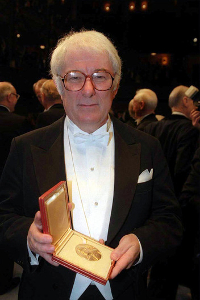
Heaney is awarded the Nobel Prize in Literature in 1995 for what the Nobel committee describes as “works of lyrical beauty and ethical depth, which exalt everyday miracles and the living past.” He is on holiday in Greece with his wife, Marie, when the news breaks. No one, not even journalists or his own children, can locate him until he appears at Dublin Airport two days later, though an Irish television camera traces him to Kalamata. Asked how it feels having his name added to the Irish Nobel pantheon featuring William Butler Yeats, George Bernard Shaw, and Samuel Beckett, Heaney responds, “It’s like being a little foothill at the bottom of a mountain range. You hope you just live up to it. It’s extraordinary.” He and Marie are immediately whisked straight from the airport to Áras an Uachtaráin for champagne with President Mary Robinson.




 seamus dubhghaill