seamus dubhghaill

Promoting Irish Culture and History from Little Rock, Arkansas, USA


Leave a comment

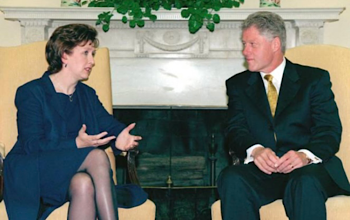
Mary McAleese Meets Bill Clinton in the Oval Office

On June 23, 1998, Irish president Mary McAleese pays a courtesy call on President Bill Clinton at the White House before he leaves for China. This is one of the highlights of her six-day visit to Washington, D.C. and New York.

As this is not a state visit, there is no formal welcome for President McAleese or official functions at the White House as there was for President Mary Robinson‘s state visit two years earlier. McAleese arrives the previous day by government jet, accompanied by her husband, Dr. Martin McAleese, and the Minister for Foreign Affairs, David Andrews, and his wife. The McAleese’s son, thirteen-year-old Justin McAleese, travels to the United States separately and joined his parents in Washington, D.C..

Within hours of her arrival, McAleese attends a reception in the Four Seasons Hotel mainly for the Irish American community and hosted by the Irish ambassador, Sean O Huiginn, and his wife. In her remarks to the several hundred guests, President McAleese praises the role of President Clinton in the Northern Ireland peace process and of former Senator George Mitchell. She says Clinton’s contribution has been “remarkable.” She says, “He was prepared to take risks for peace: without his courage and leadership we could not have made the progress we have.”

McAleese says many of those present “have descended from some of the first settlers of the early colonies – some of whom, like myself, come from the northern part of the island of Ireland. I am deeply honoured that all of you have retained such a close bond and pride in your Irish heritage and that you demonstrated your affection by the strength of the many vibrant organisations in this area.”

McAleese says when our forebears crossed the Atlantic Ocean they retained a yearning that someday the Ireland they left would be a better place. “Regrettably, they did not live to see a new Ireland but it is now a reality in the economic, cultural and social progress of the last number of years.” Arranging the meeting at the White House is a problem for U.S. and Irish officials because of Clinton’s extremely busy schedule, as he prepares for his China visit. But the fact that he makes time for it is an indication of the importance he attaches to U.S.-Irish relations.

Later in the day, McAleese has lunch at the U.S. Supreme Court with Chief Justice William Rehnquist. This is followed by a speech at Georgetown University, mainly dealing with Northern Ireland.

In the evening, McAleese attends a dinner in her honour at the Irish Embassy residence, to which leading political and administration figures are invited. On June 24, following a press conference at the National Press Club and a lunch on Capitol Hill with members of Congress, she flies to New York. There she pays a courtesy visit on the UN Secretary-General, Kofi Annan, and later attends a trade show organised by the Irish Business Organisation. In the evening she attends the “Dreamer of Dreams” awards ceremony organised by the Irish Voice newspaper.

On Thursday, June 25, McAleese has more engagements and prior to her return to Ireland on Friday, June 26.

(From: “McAleese for courtesy call on Clinton today” by Joe Carroll, The IrishTimes, http://www.irishtimes.com, July 23, 1998)

Leave a comment

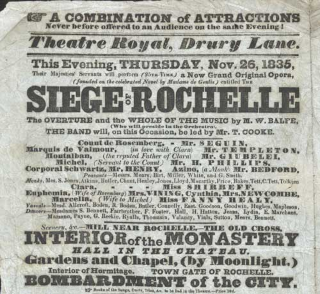
“The Siege of Rochelle” First Performed at Drury Lane Theatre

Irish composer Michael William Balfe‘s opera The Siege of Rochelle is first performed at the Drury Lane Theatre in London on October 29, 1835.

The opera is originally prepared for the English Opera House but for some reason the theatrical manager, Samuel James Arnold, does not want it. Instead, Alfred Bunn, the manager of Drury Lane Theatre, seizes the opportunity and begins what is a very fruitful collaboration with Balfe that lasts a decade. Balfe is to become the mainstay of English Opera for almost the next 30 years with a succession of popular operas.

The opera runs for 70 nights on its initial run and is revived in the following three seasons with Balfe singing the role of Michel. Queen Victoria sees the opera on November 15, 1837, her first state visit to a theatre during her reign. In 1836, the opera is reported as staged in Leeds, York, Sheffield, Manchester, Liverpool, Bath and Dublin with Abigail Betts as Clara. John Wilson, who sings in the initial run of the opera, also sings in, at least, some of these. Madame Balfe chooses the opera for her benefit in 1841, and Bunn opens his 1843 season with it on September 30. Emma Romer uses it to open her 1853 season at the Surrey Theatre, although it is being described by then as “somewhat hacknied.”

October 1875 sees a revival of the opera by the Carl Rosa Opera Company at the Princess’s Theatre, and it is then included in the company’s repertoire that tours to Manchester in 1875, Liverpool in 1876, Birmingham in 1877 and Dublin in 1879. The Turner Company tours it in 1893. This is possibly the opera’s last performance until the Wexford Festival Opera performances in 1963. The overture and songs from the opera, such as “When I beheld the anchor weigh’d” continue to retain a place in the concert hall and the home into the 20th century.

In 1838, the opera is performed by the Caradori-Allan troupe at the Park Theatre in New York but fails although it appears to be retained in the repertory. In 1839, it is performed again in Dublin with Balfe as Michel and in Sydney in 1848.

The opera’s production sparks an acrimonious argument between a correspondent in The Examiner accusing Balfe of plagiarism from Luigi Ricci‘s 1832 opera, Chiara di Rosemberg, and, in defence, Frederick Beale, from Balfe’s publishers, and Balfe. The matter seems to be settled in Balfe’s favour when the score of Chiara di Rosemberg is displayed at music publisher Cramer, Beale and Co. so that people can compare the two for themselves. While Edward Fitzball probably uses Ricci’s libretto as the basis for his, it does not seem to have been a straight translation, as some allege, but similarities would help to feed the accusations of plagiarism, bolstered by the Italian training and approach of both composers and the fact that Balfe had sung in Chiara di Rosemberg in Italy in 1834.

Balfe is said to have been paid £5 a night by Bunn and 400 guineas for the score by the publishers Cramer, Beale and Co. In 1871, the Bury and Norwich Post (April 11, 1871) report that the copyright has sold for £156 and just over ten years later the Aberdeen Evening Express (May 8, 1883) notes that the copyright has been sold again for approximately £20, adding “So much for Balfe’s ‘popularity.”


Leave a comment

Queen Elizabeth II Visits Cork

Queen Elizabeth II spends the last of her four days in Ireland visiting Cork on May 20, 2011, where she once again is greeted warmly. Despite initial concerns about security, the visit proves to be a huge success for both countries. The Queen’s apology at Dublin Castle for the treatment her government meted out to Ireland over many years is received with enormous positive, emotional response.

Large crowds line the streets in Cork city centre and the Queen is given a tour of the city’s English Market by the Lord Mayor of Cork, Terry Shannon. She meets some stall owners and speaks to members of the public after she leaves the market. There is a carnival atmosphere on the streets of Cork and the visit is more relaxed than many engagements in Dublin.

The Queen and Prince Philip also visit the Tyndall Institute, which is run by University College Cork. While at the institute, they meet twins Hassan and Hussein Benhaffaf and their mother Angie. Earlier, they visit the Rock of Cashel in County Tipperary and pay a private visit to Coolmore Stud.

The Queen indicates she would like to return to Ireland for another visit. Taoiseach Enda Kenny says he invited her to return as she boarded her flight at Cork Airport. Kenny says the Queen told him she and the royal party enjoyed the visit. He pays tribute to everyone involved in the State visit. He says Ireland responded magnificently to the visit, from the President right down to ordinary people, who showed restraint and understanding.

Kenny says the Queen had received a real Irish welcome, which he says demonstrates the importance of a new beginning for both islands. He says that Ireland has measured up to the highest global standards and the county can be proud.

Tánaiste and Minister for Foreign Affairs Eamon Gilmore says the visit has enhanced Ireland’s reputation abroad at a time when there are only negative headlines. He says that, because of the visit, the world is finally getting a picture of a country that does things well and that is working through its difficulties.

Sinn Féin President Gerry Adams says that, while expressing concerns about Queen Elizabeth’s visit, he also hopes some good will come from it.

At Cork Airport she walks to her plane passing an army guard of honour and Taoiseach Enda Kenny is there to bid her farewell. The plane departs bringing an end to her four-day State visit.

(From: “Queen Elizabeth II concludes Irish visit,” RTÉ.ie, the website of Raidió Teilifís Éireann, May 20, 2011)


Leave a comment

Irish Government Announces New Zealand Embassy

The Irish Government confirms on October 24, 2017, that it plans to open an embassy in New Zealand. The announcement comes as President Michael D. Higgins meets Governor-General Patsy Reddy on the first day of his State visit to New Zealand.

The new Embassy in New Zealand brings to six the number of new Embassies or Consulates announced by the Government in the recent weeks. The new Missions announced on Budget Day are an Embassy in Santiago, Chile; an Embassy in Bogotá, Colombia; an Embassy in Amman, Jordan; a Consulate General in Vancouver, Canada; and a Consulate General in Mumbai, India.

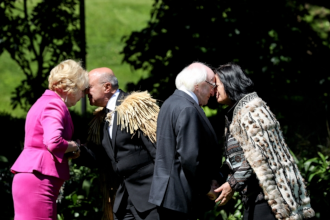
The President along with his wife Sabina Higgins meet with Governor-General Reddy and Sir David Gascoigne on the first day of their State visit to New Zealand.

According to a statement released by the President’s office, “the decision to establish an embassy reflects an exceptionally close partnership between Ireland and New Zealand in international affairs, including at the United Nations.” New Zealand also announces plans to open an embassy in Ireland.

Diplomatic relations between Ireland and New Zealand are established in 1965. Ireland’s Ambassador to Australia is also accredited to New Zealand. Niamh McMahon serves as Ireland’s Honorary Consul in Auckland, New Zealand.

The President visits Wellington, Christchurch, Auckland and Waitangi while in New Zealand, a country in which there are almost 14,000 Irish born people and one in six people claim Irish heritage.

President Higgins also meets with the prime minister-elect of New Zealand, Jacinda Ardern, who becomes the third woman to lead a government in her country.

(Pictured: President Michael D. Higgins and Sabina Higgins receive a traditional Maori welcome from Governor-General of New Zealand Dame Patsy Reddy and Sir David Gascoigne, Government House, Wellington)


Leave a comment

President Mary Robinson Meets Queen Elizabeth II

robinson-elizabeth-visit-1993

Mary Robinson, the first female president of Ireland, becomes the first Irish head of state to meet with a British monarch when she visits Queen Elizabeth II on May 27, 1993.

For much of the 20th century, relations between Ireland and its nearest neighbour are cool. Temperatures drop significantly over the economic war in the 1930s and Ireland’s neutrality in World War II. The sense of unfinished business permeates diplomacy during the Troubles, but by 1990 there is significant warmth in trade, tourism, business and even politics.

The newly elected Robinson makes a big play of reaching out to Irish emigrants and sees the opportunity to help Anglo-Irish relations. And so, on her 49th birthday, she pops in for tea with the British head of state.

None of Robinson’s predecessors had set foot in Britain, other than to change planes. Even when President Patrick Hillery is invited to the wedding of Prince Charles and Lady Diana Spencer in 1981, he is advised by the Government of Ireland to decline the invitation.

But Robinson decides she will not be pushed around, and successfully insists she be allowed to join other heads of state at the opening of a European bank in London. Next, she asks the government if she might be able to travel to the University of Cambridge to deliver a speech and receive an honorary degree. It is only after he reluctantly agrees that Taoiseach Charlie Haughey realises that the Chancellor of the University is the Queen’s husband, Prince Philip.

Robinson meets the royal, the world remains on its axis, and a precedent is set. “Partly because I’ve never been fazed by royalty of any kind, least of all the British royal family, I felt entirely relaxed,” she recalls in her authorised biography.

Robinson next meets the prince at a memorial service for the victims of an Irish Republican Army (IRA) bombing in Warrington, where she is applauded as she leaves the church. Soon, she is meeting royals all over the place, at rugby matches and memorial ceremonies, and in a television interview says that she would like to meet the Queen.

By February 1993, Haughey has been replaced by Albert Reynolds and he grants permission for Robinson to travel for a strictly personal visit. The visit does not happen in a vacuum – Reynolds is in secret discussions with Republicans that would end in the IRA ceasefire – and the Taoiseach is keen not to give any suggestion that this is a State visit, which would require a reciprocal visit.

Robinson’s party arrives at Buckingham Palace at 4:55 PM on May 27 where they are greeted by the Queen’s private secretary, Sir Robert Fellowes. Robinson’s staff pushes the Palace to allow press photographers, reckoning that a historic moment should be captured.

Robinson, in an Ib Jorgensen fuchsia suit, later donated to Madame Tussauds waxworks, and her husband Nick are brought up to the first floor to meet the Queen for a friendly and informal tea party that lasts 30 minutes. They sip a blend of Chinese and India tea in Minton cups, exchange signed photographs of themselves, and discuss the prospects for peace. The President also hands over an extra present of a hand-turned wooden cup from Spiddal.

Afterwards, the ground-breaking photographs are taken and published all over the world, including the front page of the Irish Independent. “Palace Talks Prepare Way for State Visit” runs the lead headline over a piece by Bernard Purcell and Gene McKenna. They go on, reporting the President as saying the visit is “symbolic of the maturing relationship between Ireland and Britain.”

In 1996 President Robinson’s 15th visit to Britain is upgraded to an Official Visit, and she leaves office the following year.

Robinson’s successor, Mary McAleese, takes things further, and meets Queen Elizabeth II several times in London and at World War I commemorations on the continent. In May 2011 McAleese welcomes Queen Elizabeth II on her four-day State Visit to Ireland and in April 2014 President Michael D. Higgins makes the first State Visit to the UK.

(Pictured: President Mary Robinson with the Queen outside Buckingham Palace in 1993. Photo: Eamonn Farrell/Photocall Ireland | “Flashback 1993: The first Irish head of state meeting with a British monarch” by Ger Siggins, Independent.ie, May 22, 2016)


Leave a comment

State Visit of U.S. President John F. Kennedy

jfk-state-visit

John F. Kennedy, an Irish American and the first Catholic to become president of the United States, arrives in Ireland on a state visit on June 26, 1963. After Air Force One touches down at Dublin airport, Kennedy’s motorcade weaves through the streets of Dublin city, the thrilled crowd, lacking ticker tape, improvises by throwing rolls of bus tickets.

Kennedy is proud of his Irish roots and makes a special visit to his ancestral home in Dunganstown, County Wexford, while in the country. There, he is greeted by a crowd waving both American and Irish flags and is serenaded by a boys’ choir that sings The Boys of Wexford. Kennedy breaks away from his bodyguards and joins the choir for the second chorus, prompting misty-eyed reactions from both observers and the press.

Kennedy meets with 15 members of his extended Irish family at the Kennedy homestead in Dunganstown. There he enjoys a cup of tea and some cake and makes a toast to “all those Kennedys who went and all those Kennedys who stayed.” His great-grandfather, Thomas Fitzgerald, had left Ireland for the United States in the middle of the Great Famine of 1848 and settled in Boston, becoming a cooper. Generations of his descendants go on to make their mark on American politics.

At the time of JFK’s visit to Ireland, the predominantly Catholic Irish Republic has been an independent nation for 41 years. The northern counties of the island, however, remain part of the largely Protestant British Empire and still suffer from long-standing sectarian violence. On the day after his arrival in Dublin, Kennedy speaks before the Irish parliament, where he openly condemns Britain’s history of persecuting Irish Catholics. Two days later, he travels to England, America’s oldest ally, to meet with British Prime Minister Harold Macmillan and his cabinet to discuss setting up a pro-democratic regime in British Guiana.

Kennedy later tells his aides that his favourite part of the trip was the wreath laying and silent funeral drill done by the Irish Army cadets at Arbour Hill military cemetery in Dublin.

Five months later, his widow, Jacqueline Kennedy, makes a special request to the Irish government. She asks that those same Irish army cadets, who so impressed the President on his visit, perform the drill again at his state funeral. Within days, those awe-stuck, trembling young men stand just inches away from foreign dignitaries from over 90 countries and perform their silent funeral drill in memory of a president that had inspired their country just a few short months earlier.