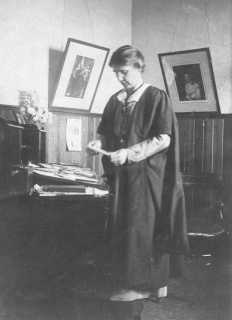
Gwynn is appointed first lady registrar of Trinity College Dublin in February 1905. Women had only been admitted to the university the previous year. Despite coming from a family of academics, she had been unable to get a university education herself. She is 39 years old when appointed to her position in the university.
Students describe Gwynn as a pioneer. Her role as women’s registrar is described by one of her charges as “to control our movements to some extent and to protect the college and the students from criticism.”
In 1907, Gwynn is summoned before the Fry Commission on Dublin University to defend the position of women at Trinity. She is supported by the parents of the students. The result is that the commission endorses the principle of women’s admission to the university.
In 1922, the Dublin University Women Graduates’ Association is founded, under Gwynn’s presidency.
Gwynn never marries. As an eldest daughter she is required to assist in the management of her parents’ household and attend to them in their old age. From her mother’s brother, architect Robert Donough O’Brien, she inherits the house he had designed and built at Parteen-a-Lax in County Clare, close to Limerick. It is there that she retires at the end of her working life. Her hobby is tending its beautiful garden which lay next to the River Shannon.
Gwynn dies in County Clare in 1947.
Founded, by subscription, in 1948 in memory of Lucy Gwynn, the Lucy Gwynn Memorial Prize is awarded annually in the Michaelmas term to a Junior Sophister woman student for distinction in her course. The award is made by two women on the university staff nominated by the Board, and one of the female tutors. The value of the prize is €1,207.
Henry is born Emily Grace Mitchell at Kirktown St. Fergus, near Peterhead, Aberdeenshire, Scotland, on February 10, 1868. She is the ninth of ten children of the Rev. John Mitchell and Jane Mitchell (née Gardner). Lord Byron is a cousin of her maternal grandmother. She is educated at home, spending time at the family’s home in Piccadilly, where she experiences London society. After the death of her father, and the reduced circumstances she finds herself in, she leaves home in 1895 to pursue a career as an artist. The first record of her work being exhibited is with the Aberdeen Artists Society in 1896 and 1898. These paintings have not been traced since. In 1899, she leaves Scotland for the continent, visiting Holland and Belgium, studying at the Blanc‐Guerrins Academy in Brussels. She goes on to attend the Delacluze Academy in Paris. While in Paris, she meets Paul Henry, an Irish artist. The couple marries in September 1903 in London.
The Henrys live at a few different residences outside London until 1910. A small number of her works are known from this time, such as The Girl in White, which is in the collections of the Hugh Lane Gallery. This piece shows the influence of fellow artist James Abbott McNeill Whistler, whom she meets in Paris through her husband. The couple travels to Achill Island for the first time in 1910, intending to stay two-weeks, but going on to live there until 1919. During this time, she paints numerous night scenes, including Achill Cottages (Hugh Lane Gallery). One of her well-known works is Top of the Hill, on display in the Limerick City Gallery of Art, which shows a group of island women. The period spent on the island places a strain on the Henrys marriage, as she is not as happy living there.
The couple returns to Dublin in 1919 and are founding members of the Society of Dublin Painters in 1920 alongside Letitia Marion Hamilton, Mary Swanzy, and Jack Butler Yeats. The Society offers an outlet for younger Irish artists to exhibit. Five of Henry’s works are featured at the Irish Exhibition in Paris in 1922, and at a similar exhibition in Brussels in 1930.
Around 1920, Henry has a romantic association with Stephen Gwynn who is an important political, cultural and literary figure from the lost world of late-nineteenth and early-twentieth century Ireland. During this period, she travels with Gwynn in France and Italy and later paints a number of portraits of him. Invariably, during this time, the Henrys’ marriage continues to have problems, with the couple breaking up in 1924. Her affair with Gwynn, who she depicts in two known oil paintings including The Orange Man (Limerick City Gallery of Art) and Portrait of a Man, which depicts a much more distinguished Gwynn in later life, contribute to the breakup. The couple legally separates in 1930.
Henry develops her own style through the 1920s and 1930s, spending time in France and Italy. From 1924 to 1925, she studies with André Lhote, a cubist painter who also works with Mainie Jellett, Evie Hone, and Mary Swanzy. She goes on to display little of his influence in her work. She paints in Venice and in the environs of the Italian lakes, painting with the fauvist style, with free brushwork and vibrant colours. She also experiments with expressionism, which can be seen in Spring in Winter. Upon the outbreak of World War II, she returns to Ireland. She does not have a permanent residence during this period, instead stayed with friends or living in hotels. She also experiences periods of melancholy during these later years, though she continues to exhibit. Her work is regularly displayed at the Royal Hibernian Academy (RHA), and she has solo shows at the Waddington and Dawson galleries. She is made an honorary member of the RHA in 1949.
Henry dies in Dublin on August 11, 1953, and is buried at Mount Jerome Cemetery. During her career, and for a number of years after her death, she is largely overshadowed by her husband, sometimes being referred to as “Mrs. Paul Henry.” She is even omitted from Paul Henry’s two-volume autobiography. Her body of work is re-examined in the 1970s, which leads to wider public recognition and her inclusion in a number of exhibitions such as The Paintings of Paul and Grace Henry at the Hugh Lane Gallery in 1991. She is deemed to be a much bolder painter than her husband, incorporating more elements of the modernist movement, as evident in The Long Grey Road of Disting (1915). Her popularity has been growing since her rediscovery.
(Pictured: “Road to Destiny,” oil on board by Grace Henry)
Gwynn spends his early childhood in rural County Donegal, which is to shape his later view of Ireland. He attends Brasenose College, Oxford, where, as scholar, in 1884 he is awarded first-class honours in classical moderations and in 1886 literae humaniores. During term holidays he returns to Dublin, where he meets several of the political and literary figures of the day.
After graduating, Gwynn spends ten years from 1886 tutoring as a schoolmaster, for a time in France, which creates a lifelong interest in French culture, as expressed in his Praise of France (1927). By 1896 he has developed an interest in writing, becoming a writer and journalist in London focused on English themes, until he comes into contact with the emerging Irish literary revival, when he serves as secretary of the Irish Literary Society.
This is the beginning of a long and prolific career as a writer covering a wide range of literary genres, from poetry and biographical subjects to general historical works. The eighteenth century is Gwynn’s particular specialism. He writes numerous books on travel and on the topography of his own homeland, as well as on his other interests: wine, eighteenth-century painting and fishing.
Gwynn returns to Ireland in 1904 when he enters politics. In the 1906 Galway Borough by-election he wins a seat for Galway Borough, which he represents as a member of the Irish Parliamentary Party until 1918. During this period, he is active in the Gaelic League and is one of the few Irish MPs to have close links to the Irish literary revival. Along with Joseph Maunsel Hone and George Roberts he founds the Dublin publishing house of Maunsel and Company. He is opposed to the demand for the Irish language to be a compulsory subject for matriculation. He supports the campaign which wins the establishment of a Catholic university when he serves on the Irish University Royal Commission in 1908. During the debate on the third Home Rule Bill, and at the request of his party leader John Redmond, he writes The case for Home Rule (1911) and is in charge of much of the party’s official publicity and its replies to criticism from Sinn Féin.
On the outbreak of World War I in August 1914, Gwynn strongly supports Redmond’s encouragement of Irish nationalists and the Irish National Volunteers to support the Allied and British war effort by enlisting in Irish regiments of the Irish Divisions, especially as a means to ensure the implementation of the suspended Home Rule Act at the end of an expectedly short war. Now over fifty, he enlists in January 1915 with the 7th Leinster Regiment in the 16th (Irish) Division. In July he is commissioned as a captain in the 6th (Service) Battalion, Connaught Rangers and serves with them on the Western Front at Messines, the Somme and elsewhere.
Gwynn is one of five Irish Nationalist MPs who enlist and serve in the army, the others being John L. Esmonde, Willie Redmond, William Redmond and D. D. Sheehan, as well as former MP Tom Kettle. Together with Kettle and William Redmond, he undertakes a recruitment drive for the Irish divisions, co-operating with Kettle on a collection of ballads called Battle Songs for the Irish Brigade (1915). He is made a chevalier of the Legion of Honour in July 1915. In 1916, he is appointed to the Dardanelles Commission.
Recalled to Ireland in late 1917 to participate in the Irish Convention chaired by Sir Horace Plunkett, Gwynn sides with the Redmondite faction of the Irish Party in supporting a compromise with the southern unionists in an attempt to reach consensus on a Home Rule settlement which would avoid partition. On the death of Redmond in March 1918, he takes over as leader of the moderate nationalists in the Convention. He opposes the threat of compulsory military service during the Conscription Crisis of 1918, though as a member of the Irish Recruiting Council he continues to support voluntary recruitment, encountering intense opposition led by Sinn Féin.
Gwynn forms the Irish Centre Party in 1919 and stands unsuccessfully as an Independent Nationalist for Dublin University in the 1918 Irish general election. The party merges with Plunkett’s Irish Dominion League to press for a settlement by consent on the basis of dominion status, but Gwynn subsequently breaks with Plunkett due to his willingness to accept partition as a temporary compromise. The polarities which divide Ireland during the Irish War of Independence and Irish Civil War increasingly sideline his brand of moderate cultural nationalism. Although he supports the newly emergent nation, he equally condemns some of the excesses, such as the burning of houses belonging to Free State senators.
Gwynn’s personal life also becomes complicated at this stage and around 1920. He has a romantic association with married artist Grace Henry who is perhaps the best-known female artist in Ireland at the time. During this period, he and Grace travel in France and Italy and at various stages in his life she painted portraits of him including a very distinguished looking one of him in his late 60s or early 70s. Their relationship contributes significantly to the separation of Henry from her artist husband Paul Henry in 1930.
During the 1920s, Gwynn also devotes himself to writing, covering political events as Irish correspondent to The Observer and The Times. Later in his career, he writes some substantial works, and together with his son Denis Gwynn (The Life of John Redmond, 1932) does much to shape the retrospective image and self-justification of John Redmond. In the mid-1930s he authors three books with a connecting theme of fishing with the artist Roy Beddington serving as illustrator: The Happy Fisherman (1936), From River to River (1937), and Two in a Valley (1938).
Gwynn is awarded an honorary D.Litt. by the National University of Ireland in 1940, and a Litt.D. by the University of Dublin in 1945. The Irish Academy of Letters awards him the Gregory Medal in April 1950. In his literary writings he stands for a humanism and tolerance, which qualities, due to political upheavals, were relatively rare in the Ireland of his day.
Gwynn dies on June 11, 1950, at his home in Terenure, Dublin, and is buried at Tallaght Cemetery, south County Dublin.
Gwynn marries his cousin Mary Louisa (d. 1941), daughter of Rev. James Gwynn. She later converts to Catholicism. They have three sons and two daughters who are brought up in her religion, of whom Aubrey (1892–1983) becomes a Jesuit priest and professor of medieval history at University College Dublin (UCD). Their second son, Denis Rolleston (1893–1971), is professor of modern Irish history at University College Cork (UCC).
Gwynn’s brother Edward John (1868–1941) becomes provost of Trinity College and another brother Robert Malcolm becomes its senior dean. His sister Lucy Gwynn is the first woman registrar of Trinity. A third brother, Charles, has a successful career in the British Army and retires as a Major General. Younger brothers Lucius and Jack are noted cricketers.
In his early years, Devlin is active in various local debating societies, where his associates include Cathal O’Byrne, who he retains a personal friendship despite later political differences. A committee member of the Belfast branch of the Irish National League (INL) in 1890, he joins the anti-Parnellite faction during the O’Shea divorce scandal (1891), becoming local secretary of the Irish National Federation (INF). His political model at this time is Thomas Sexton, MP for Belfast West, whose campaign he organises at the 1892 United Kingdom general election.
Although Healyism is strong in CatholicUlster, Devlin aligns himself with the faction led by John Dillon and, from 1899, with the United Irish League (UIL), founded by William O’Brien. From the late 1890s this brings Devlin into conflict with the Belfast Catholic Association of Dr. Henry Henry, bishop of Down and Connor (1895–1908). This organisation, though sometimes regarded as Healyite, is essentially based on the view that mass nationalist political mobilisation in Belfast can only bring trouble and ostracism, and that Catholic interests are best represented by allowing a small group of lay and clerical notables to broker concessions from the unionist majority. After a series of local election contests in Catholic wards and controversies between the pro-Devlin weekly Northern Star and the clerically controlled The Irish News, Devlin succeeds in marginalising the politically maladroit Henry by 1905. In the process, however, he takes on some of the qualities of his “Catholic establishment” opponents. At the same time, he moves onto the national political stage.
Returned unopposed for North Kilkenny (1902–06), Devlin is appointed secretary of the United Irish League of Great Britain in 1903, and of the parent body in Dublin in 1904. A speaking tour of the United States in 1902–03 convinces him of the organisational potential of Catholic fraternal organisations, and in 1905 he takes over the presidency of the Board of Erin faction of the Ancient Order of Hibernians (AOH), a specifically Catholic body which he proceeds to develop as an organisational arm of the Nationalist Party. Under his tutelage the AOH expands from 10,000 members in 1905 to 60,000 in 1909, despite opposition from some Catholic bishops who distrust it because of its close affiliation to Dillonism, its secrecy, and its habit of staging dances and other entertainments without paying what they regard as due deference to local priests. His AOH also faces opposition from a rival separatist body, the Irish-American Alliance AOH. Though far less numerous, this group is able to draw on the support of separatists within the American AOH and hinder Devlin’s attempts to mobilise the American organisation in his support. The AOH expands further after 1910 and is strengthened by becoming an approved society under the National Insurance Act 1911.
Belfast is where Devlin’s political career begins and where it ends. Organisational skill contributes substantially to his hold on the largely working-class seat of Belfast West, which he wins in 1906 on a platform that seeks to transcend religious boundaries by combining labour issues with the home rule demand. A lifelong bachelor, though short in stature, he is apparently highly attractive to women, and takes a special interest in their problems, no doubt mindful of the influence they might have on the political behaviour of their spouses. He founds a holiday home for working-class women. When the scholar Betty Messenger interviews former Belfast linen workers in the late 1960s and early 1970s, she is startled to discover the extent to which Devlin is remembered as a champion of the workers decades after his death. This image persists among Protestant workers as well as Catholics, and he is generally credited with various ameliorations of workplace conditions even when he had not been responsible for them.
Possessed of great oratorical skills and even greater organisational ability, Devlin effectively becomes the key organiser of the Nationalist Party from the early years of the twentieth century, relieving the party leader, John Redmond, of a great deal of the administrative burden of party affairs, and becoming well known abroad through fund-raising trips, especially in North America. His personal geniality makes him a great favourite at Westminster, and Irish socialists are dismayed at the willingness of British Labour Party MPs to accept him as an authentic Labour representative. Several MPs elected after 1906 can be identified as his protégés, and groups of Hibernian strong-arm men uphold the party leadership in such contests as the 1907 North Leitrimby-election and the 1909 “baton convention” which witnesses the final departure of William O’Brien and his supporters from the UIL. He is the only post-Parnellite MP to be admitted to the tight leadership group around Redmond. In 1913 he is a leading organiser of the National Volunteers.
When William O’Brien embarks on his personal initiative to deal with the Ulster problem through conciliation in the early Edwardian period, he finds a stern critic in Devlin and in turn demonises the “Molly Maguires” as sectarian corruptionists. Personally non-sectarian, Devlin, like other party leaders, endorses the shibboleth that home rule will prove a panacea for Ireland’s problems, including Ulster, and uses his credentials as a labour representative to dismiss popular unionism as a mere product of elite manipulation. In a period when the Vatican‘s Ne Temere decree on religiously mixed marriages is heightening Protestant fears about the “tyranny” of Rome, he seems to be oblivious to how his integration of Hibernianism and nationalism is exacerbating that problem. As the third home rule bill passes through Parliament and the Ulster Volunteer Force (UVF) mobilises, he encourages the Irish party leaders in the view that the Ulster unionist campaign is a gigantic bluff, dismissing contrary opinions even when held by other nationalist MPs. During these years the AOH clashes with the Irish Transport and General Workers’ Union (ITGWU) during the Dublin lock-out, and from late 1913 the AOH spearheads the Redmondite attempt to take over and dominate the Irish Volunteers.
Devlin endorses Redmond’s support for the British war effort and engages in extensive recruiting activity. He seems to be motivated, at least in part, by the belief that after the war nationalist ex-soldiers can be used to overawe the Ulster unionists by the threat of force. According to Stephen Gwynn, Devlin wishes to apply for an officer’s commission but is asked not to do so by Redmond on the grounds that the party needs his organisational skills.
Devlin’s career is decisively shaped by his decision to use his influence to persuade northern nationalists to accept temporary partition, in fulfilment of the flawed agreement arrived at between David Lloyd George, Sir Edward Carson, and Redmond in the aftermath of the 1916 Easter Rising. He later claims he has been decisively influenced by the prospect that under this agreement the excluded area would be governed directly from Westminster, rather than by a local, Orange-dominated parliament. He forces the agreement through a Belfast-based convention despite protests from west Ulster nationalists, but the proposal collapses after it transpires that Lloyd George has made incompatible commitments to nationalists and unionists. Northern nationalism immediately splits between west and south Ulster dissidents and Devlin’s loyalists predominant in Belfast and east Ulster, and the next year sees massive secessions of AOH members outside Ulster to Sinn Féin. Although he retains a core of loyal supporters, he is reduced from a national to a sectional leader. As a member of the Irish convention (1917–18) he sides with Bishop Patrick O’Donnell against Redmond on the issue of seeking a compromise settlement with southern unionists on the basis of home rule without fiscal autonomy. He is offered the leadership of the Nationalist Party on Redmond’s death in 1918, but concedes the honour to his long-standing mentor, John Dillon.
Devlin holds Belfast West until 1918 and easily sweeps aside an attempt by Éamon de Valera to displace him from the Falls division of Belfast at the general election of that year, though the electoral decimation of the Nationalist Party elsewhere leaves him leading a rump of only seven MPs. In the ensuing parliament he is an outspoken critic of government policy towards Ireland and highlights sectarian violence against northern nationalists. Clearly discouraged and with boundary changes militating against retention of the Falls seat, he unsuccessfully contests the Liverpool Exchange constituency as an Independent Labour candidate in 1922. Elected for Antrim and Belfast West to the Parliament of Northern Ireland in 1921, he eventually takes his seat in 1925, holding it until 1929, when he combines representation for Belfast Central with that for Fermanagh and South Tyrone at Westminster.
Only after the boundary commission ends the border nationalists’ hopes of speedy incorporation in the Irish Free State is Devlin able to assert leadership of northern nationalism as a whole on the basis of attendance at the northern parliament. Even then he is considerably handicapped by recriminations over the events of 1916–25. He embarks on his last significant political campaign in 1928, when he seeks to unite minority politics through the agency of the National League of the North (NLN). The initiative, emphasising social reform, is unsuccessful. His own political baggage is a hindrance to the unity of the factions that minority politics had thrown up over the previous ten years, while the minority community itself is politically demoralised by the fate that has overtaken it, and the unionist government shows itself unwilling to make concession to him. The project, moreover, coincides with the onset of the gastric illness, exacerbated by heavy smoking, that takes his life on January 18, 1934. For some time before his death he ceases to attend the Northern Ireland parliament.
Devlin’s political career is one of great promise only partially fulfilled, its ultimate realisation undermined firstly by the fallout from the Easter Rising that destroyed the vehicle of his political ambitions, and secondly by the sequence of events that led to the creation of a constitutional entity so constructed that all nationalist politicians, regardless of talent, were effectively denied a route to power. Only at his death does the unionist regime adequately acknowledge his political stature. His funeral is attended by at least three Northern Ireland cabinet ministers, together with representatives of the government of the Irish Free State. Northern nationalism never again produces a leader of his ability in the Stormont era. His ability to use Westminster to promote the interests of Ulster nationalists is comparable to John Hume‘s use of Europe for the same purpose from the mid 1970s. After his death the nationalist party in Belfast grows increasingly reliant on middle-class leadership and is eventually displaced by nationalist labour splinter groups, some of whose prominent activists, such as Harry Diamond, had begun their careers as election workers for Devlin.



 seamus dubhghaill