seamus dubhghaill

Promoting Irish Culture and History from Little Rock, Arkansas, USA


Leave a comment

Blair & Ahern Meet in Aftermath of the Omagh Bombing

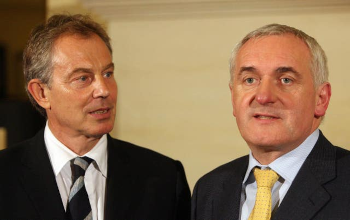
British Prime Minister Tony Blair meets with Taoiseach Bertie Ahern in Ashford Castle, County Mayo on August 26, 1998. They join forces to fight terrorism and discuss laws which will be introduced in the aftermath of the Omagh bombing, which took place eleven day earlier on August 15 in Omagh, County Tyrone, 110 kilometres west of Belfast, and resulted in 28 deaths.

Leading the way in a return to the past is Ahern’s Dublin government, which has introduced the toughest anti-terrorist legislation in the history of the Irish Republic. He concedes that the measures are draconian but says that his government is determined to do everything in its power, “working closely with the British government to defeat and suppress this murderous conspiracy against the people of Ireland.”

Prime Minister Blair promises that he too plans to introduce extreme measures. “We will bring in similar measures to those proposed by the Irish government, so we will then have the toughest anti-terrorist measures for the whole of Ireland, the Republic and Northern Ireland, that we have ever seen.”

With no plans to recall the British parliament, it is thought that existing legislation will be applied, since it already includes measures similar to those announced by the Irish government.

Oppressive British legislation has sustained British rule in Ireland for decades. This includes internment without trial, non-jury courts, entry and search of homes without a warrant, seven-day detention with unrecorded and unsupervised interrogation, denial of access to lawyers, exclusion orders and more. Most of these are still in use in 1998.

The Ahern package includes withdrawal of a suspect’s right to silence — refusal to answer questions can be used as evidence that a suspect is a member of an illegal organisation, the seizure of property that has been used for storing weapons or making bombs, and the creation of a new offence of directing an unlawful organisation. This is expected to carry the penalty of life imprisonment.

Omagh is 75% nationalist, with good cross-community relations, and has largely escaped the worst of the conflict. Although Republican dissidents have carried out a spate of similar bombings in the previous year, the towns targeted are mainly Unionist and further east.

In the wake of the Good Friday Agreement, Republican splinter groups remain on a military footing. These groups — the Irish National Liberation Army (INLA), the Continuity IRA and the Real IRA — have announced their determination to fight on.

The group that claims responsibility for the Omagh bombing is the Real IRA, which was formed in protest at the IRA’s 1997 cease-fire. Irish police have insisted that the Real IRA is the military wing of the recently formed 32 County Sovereignty Movement (32CSM), although this is denied by that organisation.

Although both the INLA and the Real IRA have declared a unilateral cease-fire since the Omagh bombing, media focus has settled on Bernadette Sands McKevitt, sister of the 1980s IRA hunger striker Bobby Sands, who is a leading figure in the 32 County Sovereignty Movement. Sands-McKevitt has condemned the Omagh bombing, but her home in Blackrock, County Louth, has since been targeted by local townspeople who have staged protests against her and her family. She has also been denied a visa to enter the United States on a speaking tour.

The Omagh bombing could not have come at a better time for Britain. With the war formally over and Sinn Féin penned, the bombing delivers an opportunity to smash the Republican left once and for all and wrench it from any semblance of ongoing support in Ireland.

All nationalist opponents of the Good Friday Agreement must now cope with being stained by the blood of Omagh. With the massive referendum vote in favour of peace to back them up, the British and Irish governments can be satisfied that the Good Friday Agreement now looks more in place than at any other time. As one nationalist describes the situation, “If the Good Friday Agreement was a defeat for the cause of Irish nationalism, the Omagh bombing has turned it into a rout.”

(From: “Blair, Ahern make the most of Omagh bomb” by Dave Riley, Green Left (www.greenleft.org), August 26, 1998)


Leave a comment

Death of Kieran Doherty, Irish Republican Hunger Striker

Kieran Doherty, Irish republican hunger striker and politician who serves as a Teachta Dála (TD) for the Cavan–Monaghan constituency from June 1981 to August 1981, dies on August 2, 1981, in HM Prison Maze (known to republicans as Long Kesh) on the 73rd day of his hunger strike. He is a volunteer in the Belfast Brigade of the Provisional Irish Republican Army (IRA).

Doherty is the third son in a family of six. He is born on October 16, 1955, in the Andersonstown area of Belfast and is educated at St. Theresa’s Primary School and Glen Road Christian Brothers School (CBS). The Doherty brothers are known cyclists and sportsmen in the Andersontown area. He wins an Antrim Gaelic football medal at minor level in 1971.

Doherty joins Fianna Éireann in 1971 and is interned by the British Government between February 1973 and November 1975. His brothers Michael and Terence are interned between 1972 and 1974.

Doherty works as an apprentice heating engineer. His girlfriend is Geraldine Scheiss and, although they never become formally engaged, they become very close toward the end of his life. Before his arrest, she had not known that he is in the IRA.

In August 1976, while he is out to set a bomb, the van in which he is riding is chased by the Royal Ulster Constabulary (RUC). During the chase Doherty manages to leave the van and hijack a car. He later ditches the car and is found one mile away from the car. He is convicted and sentenced to 18 years for possession of firearms and explosives, with another four years for the hijack.

Doherty starts his hunger strike on May 22, 1981. While on hunger strike, he is elected as an Anti H-Block TD for the Cavan–Monaghan constituency at the 1981 Irish general election, which is held on June 11. He receives 9,121 (15.1%) first preference votes and is elected on the fourth count. The two seats gained by Anti H-Block candidates denies Taoiseach Charles Haughey the chance to form a government, and the 22nd Dáil Éireann sees a Fine GaelLabour Party coalition government come to office, with Garret FitzGerald as Taoiseach.

Doherty dies at the age of 25 on August 2, 1981. He lasts 73 days on hunger strike, the longest of the 1981 hunger strikers, and only one day short of Terence MacSwiney. He is the shortest-serving Dáil deputy ever, serving as a TD for only two months.

Doherty is commemorated on the Irish Martyrs Memorial at Waverley Cemetery in Sydney, Australia. In October 2016, a painting of him is unveiled in Leinster House by Sinn Féin.


Leave a comment

Death of Valerie Hamilton, Hon. Lady Goulding

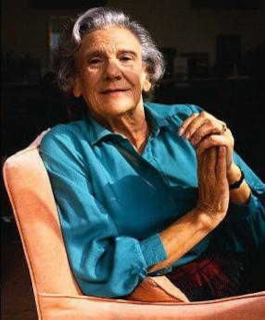
Valerie Hamilton, Hon. Lady Goulding, Irish senator and campaigner for disabled people, dies in a Dublin nursing home on July 28, 2003. She, alongside Kathleen O’Rourke, sets up the Central Remedial Clinic (CRC) in 1951 which is now the largest organisation in Ireland looking after people with physical disabilities. She served as a member of Seanad Éireann from 1977 to 1981.

Born Valerie Hamilton Monckton at Ightham Mote in Ightham, Kent, England on September 12, 1918, she is the only daughter of Mary Adelaide Somes Colyer-Ferguson and Sir Walter Monckton (later 1st Viscount Monckton of Brenchley). Ightham Mote is owned by her maternal grandfather, Sir Thomas Colyer-Fergusson, until his death in 1951. Her only brother, Gilbert (1915–2006), becomes a major general in the British Army. She is educated at Downe House School, near Newbury. Both she and her brother eventually convert to Roman Catholicism.

Hamilton’s father is a British lawyer and politician, and becomes chief legal adviser to Edward VIII during the Abdication Crisis in 1936. She acts as her father’s secretary and courier during the crisis, carrying letters between the King and Prime Minister Stanley Baldwin.

In World War II, Hamilton joins the First Aid Nursing Yeomanry before switching to the Auxiliary Territorial Service. In Dublin for a race meeting in 1939, she meets and soon marries Irish fertiliser manufacturer and art collector Sir Basil Goulding and moves to Ireland. However, her husband moves to England to join the Royal Air Force, ending the war as a wing commander. Meanwhile, she serves as a second lieutenant in the British Army. After the war, the couple returns to Ireland, where Sir Basil and his family manage Goulding Chemicals.

In 1951, Lady Goulding co-founds, with Kathleen O’Rourke, the Central Remedial Clinic located in a couple of rooms in central Dublin to provide non-residential care for disabled people. The Clinic later moves to a purpose building in Clontarf in 1968, where it is located today. The Clinic’s foundation initiates a revolution in the treatment of physical disability and rapidly grows to by far the largest centre dealing with the needs of disabled people. She remains chairman and managing director of the CRC until 1984.

On account of her widespread popularity, Lady Goulding is nominated by Taoiseach Jack Lynch to Seanad Éireann, where she works to raise awareness of disability issues in 1977. She seeks election to Dáil Éireann as a Fianna Fáil candidate at the November 1982 Irish general election for the Dún Laoghaire constituency but is unsuccessful. She is mentioned as a possible President of Ireland in 1983, should the president, Patrick Hillery, decline to seek a second term. Hillery ultimately is re-elected.

Lady Goulding dies at the age of 84 in a nursing home in Dublin on July 28, 2003. She is predeceased by her husband in 1982, but is survived by her sons, the eldest of whom, Sir William Goulding, known as Lingard Goulding, serves as Headmaster of Headfort School in County Meath. The other sons are Hamilton and Timothy, who is a founding member of the experimental Irish folk group Dr. Strangely Strange.


Leave a comment

1990 Armagh City Roadside Bomb Attack

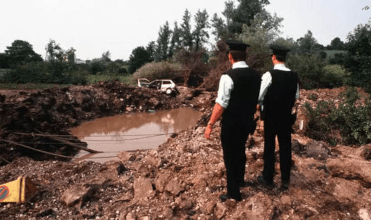
The Provisional Irish Republican Army (IRA) carries out an IED roadside bomb attack at the Killylea Road on the outskirts of Armagh, County Armagh, Northern Ireland, on July 24, 1990. An IRA active service unit detonates a large bomb as an unmarked Royal Ulster Constabulary (RUC) vehicle and a civilian car pass, killing three RUC officers and a Catholic nun.

Leading up to the attack, on April 9, 1990 four Ulster Defence Regiment (UDR) soldiers (Michael Adams, John Birch, John Bradley, Steven Smart) are killed in a similar attack when the IRA detonates a land mine under their patrol vehicle on Ballydugan Road, Downpatrick, County Down. The land mine contains over 1,000 lbs. of explosives.

On the afternoon of July 24, 1990, 37-year-old nun Catherine Dunne is driving an Austin Metro car with a passenger, Cathy McCann, a 25-year-old social worker. Some hours previously, members of the IRA take over a house close to Killylea Road, two miles outside Armagh, County Armagh, holding its occupants, a married couple and their children, at gunpoint.

A detonating wire is placed from the house to a 1,000 lb. bomb, placed in a culvert under Killylea Road. At approximately 2:00 PM, as Dunne’s car is driving to Armagh, a Royal Ulster Constabulary patrol car is traveling in the opposite direction. Dunne’s car passes by the patrol car just as the police drive over the culvert, at which point the IRA detonate the bomb. Constable William James Hanson (37), and reserve officers Joshua Cyril Willis (35) and David Sterritt (34), are all killed instantly. Their car is blown into the air and lands upside down. Dunne and McCann are both severely injured with Dunne later dying of her injuries.

Witness Paul Corr, owner of a petrol filling station nearby, says, “The ground shook beneath us and it was accompanied by a very large explosion. At first we did not see the police car. The whole place was a terrible mess. Then we saw two young girls in the [Austin Metro]. They were unconscious and looked in a pretty bad way. There was nothing we could do for the policemen. Nobody could have come out of that car alive. It was dreadful.”

The bomb leaves a 20-foot-diameter crater in the two-lane road.

Taoiseach Charles Haughey is quoted as saying, “I know all the people of Ireland join me in my condemnation of this atrocity.”

The IRA releases a message claiming responsibility for the attack, and calls Dunne a victim of “unforeseen and fluke circumstances.” The statement is rejected in advance by political and Catholic and Protestant leaders alike and politicians in Ireland and Great Britain.

Sinn Féin‘s Martin McGuinness says, “Our sorrow at these deaths is genuine and profound, but will be abused by our political opponents who will cynically exploit yesterday’s events for their own political purpose.”

Pope John Paul II sends a message to be read at Dunne’s funeral in which he condemns the “grievous injustice and futility” of the murders that leave him “deeply shocked and saddened.” He implores “the men and women who espouse violence to recognise the grievous injustice and futility of terrorism.”

Two men, Henry McCartney (26) and Tarlac Connolly (29), are charged with the killings. They are later given life sentences but are released in 2000 under the terms of the Good Friday Agreement.


Leave a comment

Bloomsday, Commemoration & Celebration of Writer James Joyce

Bloomsday is a commemoration and celebration of the life of Irish writer James Joyce, observed annually in Dublin and elsewhere on June 16, the day his novel Ulysses (1922) takes place in 1904, the date of his first outing with his wife-to-be, Nora Barnacle, and named after its protagonist Leopold Bloom.

The first mention of such a celebration is found in a letter by Joyce to Miss Weaver of June 27, 1924, which refers to “a group of people who observe what they call Bloom’s Day – 16 June.”

The day involves a range of cultural activities, including Ulysses readings and dramatisations, pub crawls and other events, some of it hosted by the James Joyce Centre in North Great George’s Street. Enthusiasts often dress in Edwardian costume to celebrate Bloomsday, and retrace Bloom’s route around Dublin via landmarks such as Davy Byrne’s pub. Hard-core devotees have even been known to hold marathon readings of the entire novel, some lasting up to 36 hours.

The James Joyce Tower and Museum at Sandycove, site of the opening chapter of Ulysses, hosts many free activities around Bloomsday including theatrical performances, musical events, tours of the iconic tower and readings from Joyce’s masterpiece.

In 1954, on the 50th anniversary of the events in the novel, artist, critic, publican and founder of Envoy magazine, John Ryan, and the novelist Brian O’Nolan organise what is to be a daylong pilgrimage along the Ulysses route. They are joined by Patrick Kavanagh, Anthony Cronin, Tom Joyce (Joyce’s cousin, representing the family interest) and A. J. Leventhal, a lecturer in French at Trinity College, Dublin. Ryan engages two horse-drawn cabs, of the old-fashioned sort, in which in Ulysses Mr. Bloom and his friends drive to Paddy Dignam’s funeral. The party are assigned roles from the novel. They plan to travel around the city through the day, starting at the Martello tower at Sandycove where the novel begins, visiting in turn the scenes of the novel, ending at night in what had once been the brothel quarter of the city, the area which Joyce called Nighttown. The pilgrimage is abandoned halfway through when the weary pilgrims succumb to inebriation and rancour at the Bailey pub in the city centre, which Ryan owns at the time, and at which in 1967 he installs the door to No. 7 Eccles Street (Leopold Bloom’s front door), having rescued it from demolition. A Bloomsday record of 1954, informally filmed by John Ryan, follows this pilgrimage.

On Bloomsday 1982, the centenary year of Joyce’s birth, Irish state broadcaster RTÉ transmits a continuous 30-hour dramatic performance of the entire text of Ulysses on radio.

A five-month-long festival, ReJoyce Dublin 2004, takes place in Dublin between April 1 and August 31, 2004. On the Sunday before the 100th “anniversary” of the fictional events described in the book, 10,000 people in Dublin are treated to a free, open-air, full Irish breakfast on O’Connell Street consisting of sausages, rashers, toast, beans, and black and white puddings.

The 2006 Bloomsday festivities are cancelled, the day coinciding with the funeral of former Taoiseach Charles Haughey.

(Pictured: Firstbloom (L to R) John Ryan, Anthony Cronin, Brian O’Nolan, Patrick Kavanagh and Tom Joyce (James Joyce’s cousin); Sandymount, 1954)


Leave a comment

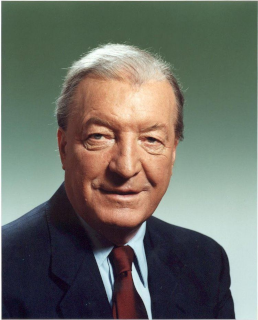
Death of Former Taoiseach Charles Haughey

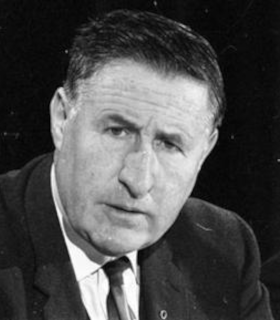
Charles James Haughey, Fianna Fáil leader and Taoiseach of Ireland, dies at his home in the Kinsealy area of Dublin on June 13, 2006, following a lengthy battle with prostate cancer and a heart condition.

Haughey is born in Castlebar, County Mayo on September 16, 1925, the third of seven children of Seán Haughey, an officer in the original Irish Republican Army (IRA), and Sarah McWilliams, both natives of Swatragh, County Londonderry. He attends University College Dublin, studying law and accounting. While making a fortune, apparently in real estate, he marries Maureen Lemass, the daughter of future Taoiseach Seán Lemass on September 18, 1951. After several attempts he enters Dáil Éireann (the lower house of the Oireachtas, the Irish parliament) in 1957 as a member of the Fianna Fáil party for the Dublin North-East constituency. He becomes Minister for Justice in 1961 and later Minister for Agriculture and Minister for Finance.

In 1970 Haughey is twice tried for conspiracy to use government funds to procure arms for the outlawed IRA. The first trial is aborted, and he wins acquittal in the second. Dismissed from the government, he remains in the Dáil and gains strong support among his party’s grass roots. When Fianna Fáil is returned to office in 1977, he is made Minister for Health and Minister for Social Welfare. On the resignation of party leader Jack Lynch in 1979, he is elected party leader and becomes Taoiseach. In June 1981 his government falls, but he returns to power briefly in 1982. He becomes Taoiseach again after the 1987 Irish general election in February 1987, though his government lacks a majority in the Dáil. When Fianna Fáil forms a government with the Progressive Democrats in July 1989, thereby eschewing the party’s traditional rejection of coalition rule, he is made Taoiseach for a fourth time.

Haughey’s first two terms in office are marked by deteriorating relations with Great Britain, a declining economy, and deep divisions within Fianna Fáil. Despite the controversies that plague his government, the charismatic Haughey remains party leader after losing office for a second time in late 1982. During his later terms, he successfully mounts a fiscal austerity program to address Ireland’s financial crisis. In 1992 he resigns and retires after being implicated in a phone tapping scandal of two journalists. He denies the allegations. He remains out of public life until 1997, when an official tribunal of inquiry determines that he had received large sums of money from a prominent businessman while Taoiseach. The Dáil then establishes another tribunal to investigate his financial affairs, and many other irregularities are uncovered. He eventually agrees to pay €6.5 million in back taxes and penalties.

Haughey dies at the age of 80 from prostate cancer, from which he had suffered for a decade, on June 13, 2006, at his home in Kinsealy, County Dublin. He receives a state funeral on June 16. He is buried in St. Fintan’s Cemetery, Sutton, Dublin, following mass at Donnycarney. The then Taoiseach Bertie Ahern delivers the graveside oration. The funeral rites are screened live on RTÉ One and watched by a quarter of a million people. The funeral is attended by President Mary McAleese, the Taoiseach, Bertie Ahern, members of the Oireachtas, many from the world of politics, industry and business. The chief celebrant is Haughey’s brother, Father Eoghan Haughey.


Leave a comment

Queen Elizabeth II Visits Cork

Queen Elizabeth II spends the last of her four days in Ireland visiting Cork on May 20, 2011, where she once again is greeted warmly. Despite initial concerns about security, the visit proves to be a huge success for both countries. The Queen’s apology at Dublin Castle for the treatment her government meted out to Ireland over many years is received with enormous positive, emotional response.

Large crowds line the streets in Cork city centre and the Queen is given a tour of the city’s English Market by the Lord Mayor of Cork, Terry Shannon. She meets some stall owners and speaks to members of the public after she leaves the market. There is a carnival atmosphere on the streets of Cork and the visit is more relaxed than many engagements in Dublin.

The Queen and Prince Philip also visit the Tyndall Institute, which is run by University College Cork. While at the institute, they meet twins Hassan and Hussein Benhaffaf and their mother Angie. Earlier, they visit the Rock of Cashel in County Tipperary and pay a private visit to Coolmore Stud.

The Queen indicates she would like to return to Ireland for another visit. Taoiseach Enda Kenny says he invited her to return as she boarded her flight at Cork Airport. Kenny says the Queen told him she and the royal party enjoyed the visit. He pays tribute to everyone involved in the State visit. He says Ireland responded magnificently to the visit, from the President right down to ordinary people, who showed restraint and understanding.

Kenny says the Queen had received a real Irish welcome, which he says demonstrates the importance of a new beginning for both islands. He says that Ireland has measured up to the highest global standards and the county can be proud.

Tánaiste and Minister for Foreign Affairs Eamon Gilmore says the visit has enhanced Ireland’s reputation abroad at a time when there are only negative headlines. He says that, because of the visit, the world is finally getting a picture of a country that does things well and that is working through its difficulties.

Sinn Féin President Gerry Adams says that, while expressing concerns about Queen Elizabeth’s visit, he also hopes some good will come from it.

At Cork Airport she walks to her plane passing an army guard of honour and Taoiseach Enda Kenny is there to bid her farewell. The plane departs bringing an end to her four-day State visit.

(From: “Queen Elizabeth II concludes Irish visit,” RTÉ.ie, the website of Raidió Teilifís Éireann, May 20, 2011)


Leave a comment

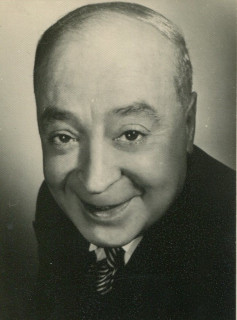
Birth of Jimmy O’Dea, Actor & Comedian

Jimmy O’Dea, Irish actor and comedian, is born at 11 Lower Bridge Street, Dublin, on April 26, 1899.

O’Dea, born James Augustine O’Dea, is one of eleven children of James O’Dea, an ironmonger, and Martha O’Gorman, who keeps a small toy shop. His father has a shop in Capel Street. He is educated at the Irish Christian Brothers O’Connell School in North Richmond Street, Dublin, where a classmate is future Taoiseach Seán Lemass, by the Holy Ghost Fathers at Blackrock College, and by the Jesuits at Belvedere College. From a young age he is interested in taking to the stage. He co-founds an amateur acting group, the Kilronan Players, in 1917, but his father will not hear of it. He is apprenticed to an optician in Edinburgh, Scotland, where he qualifies as an optician.

O’Dea returns to Dublin where, at age 21, he sets up his own business which he eventually gives to his sister, Rita. In his spare time he takes part in amateur productions of Henrik Ibsen and Anton Chekhov. From 1920 he is in the Irish theatre in Hardwicke Street working with actor-producer John MacDonagh. In 1922 he makes a series of comedy films for Norman Whitten. After working in plays by George Bernard Shaw for a few years he rejoins MacDonagh in revues, the first of which, Dublin To-Night, is produced at the Queen’s Theatre, Dublin in 1924. In 1927 he takes to the stage full-time. In 1928, the company’s first production Here We Are wins international acclaim, and in December of the same year it produces its first Christmas Pantomime, Sinbad the Sailor.

O’Dea forms a partnership with Harry O’Donovan whom he first meets in a production of You Never Can Tell in 1924. Their first show is Look Who’s Here at Queen’s Theatre. For more than two decades beginning in 1929 the duo produces two shows a year in Dublin, first in the Olympia Theatre, then in the Gaiety Theatre. They create O’Dea’s most famous character, Mrs. Biddy Mulligan. The role draws on O’Dea’s previous manifestations as “Dames” in Variety performances and pantomimes. Biddy Mulligan is the representation (caricature, parody and stereotype) of a Dublin street-seller, with all the working-class repartee, wisdom and failings implicit. He makes a number of recordings of sketches starring Mrs. Mulligan. Biddy Mulligan is referenced in many Dublin music hall songs such as “Biddy Mulligan the Pride of the Coombe,” “Daffy the Belle of the Coombe” and “The Charladies’ Ball.”

O’Dea makes some film appearances, such as Darby O’Gill and the Little People (1959) in which he plays King Brian of the little people and Johnny Nobody (1961). He also has a successful career in pantomime and tours Ireland and England many times, and is much associated with actress Maureen Potter, with whom he often partners.

O’Dea is also a prolific songwriter in his day. Many of his songs are still well known to this day, some of them having been sung and recorded by Dublin singer Frank Harte.

O’Dea marries Ursula Doyle, a theatrical impresario, in September 1959 with Seán Lemass standing in as best man and Maureen Potter as the bridesmaid. O’Dea had been best man at Lemass’s wedding in 1924.

Jimmy O’Dea dies at Dr. Steevens’ Hospital, Dublin, at age 65, on January 7, 1965. Seán Lemass, at the time Taoiseach, gives the valedictory oration at his funeral. He is buried in Glasnevin Cemetery, Dublin.


Leave a comment

Death of Feargal Quinn, Businessman & Politician

Feargal Quinn, Irish businessman, politician and television personality, dies in Dublin on April 24, 2019. He is the founder of the Superquinn supermarket chain and serves as a Senator in Seanad Éireann representing the National University of Ireland constituency from 1993 to 2016.

Quinn is born in Dublin on November 27, 1936. His father, Eamonn, founds a grocery brand and later the Red Island resort in Skerries, Dublin. He is a first cousin of Labour Party politician Ruairi Quinn and of Lochlann Quinn, former chairman of Allied Irish Banks (AIB). He is educated at Newbridge College and is a commerce graduate of University College Dublin (UCD). He builds a career in business and later takes on a range of public service roles.

Quinn founds the national supermarket chain Superquinn (originally Quinn’s Supermarkets), of which he remains non-executive president for some years after his family sells out their interest in August 2005 for over €400 million. Superquinn is known for its focus on customer service and pioneers a number of innovations, including Ireland’s first supermarket loyalty card in 1993, SuperClub. It also introduces self-scanning of goods by customers in a number of its outlets. Superquinn becomes the first supermarket in the world to guarantee the absolute traceability of all its beef from pasture to plate, using DNA TraceBack, a system developed at Trinity College, Dublin by IdentiGEN.

Quinn becomes the chairman of the Interim Board for Posts and serves as chairman of its successor An Post (the Irish postal administration) until 1989. He also serves on several other public authorities and boards. From 1993 to 1998, he chairs the steering committee which oversees the development of the Leaving Certificate Applied. In 2006, he is appointed an Adjunct Professor in Marketing at National University of Ireland Galway. He is also chairman of Springboard Ireland.

Quinn is a former President of EuroCommerce, the Brussels-based organisation which represents the retail, wholesale and international trade sectors in Europe. He also serves on the board of directors of CIES, the Food Business Forum based in Paris, as well as the American-based Food Marketing Institute.

In 2009, Quinn works with independent shops and helps them to revamp, modernise and stave off stiff competition from multi-national retailers. It airs as RTÉ‘s six-part television series, Feargal Quinn’s Retail Therapy. A second series airs in 2011, and a third series airs in 2012. In 2011, he fronts RTÉ’s Local Heroes campaign in Drogheda, County Louth, which is an assembled team of experts to kick-start the local economy. It airs as RTÉ One‘s six-part television series, Local Heroes – A Town Fights Back.

Quinn is first elected as a senator in 1993 from the National University of Ireland constituency and is re-elected in 1997, 2002, 2007 and 2011. He is a member of the Joint Oireachtas Committee on European Affairs, the Joint Committee on Finance and Public Service and is an Oireachtas member of the National Economic and Social Forum, along with the Joint Committee on Jobs and Innovation.

Quinn is one of the co-founders and is a driving force behind Democracy Matters – a civil society group that is formed to oppose the Government’s plans to abolish Seanad Éireann. In May 2013, with Senators Katherine Zappone and Mary Ann O’Brien, he introduces the Seanad Bill 2013 to reform the system of electing the elected members of Seanad Éireann (as provided for in Article 18.10 of the Constitution of Ireland) through a one-person, one vote franchise. The Seanad Bill 2013 succeeds in being passed at Second Stage in the Seanad. During the Seanad abolition referendum campaign, the Bill demonstrates to the electorate, in a very palpable way, that reform of the Seanad is achievable if they vote for its retention. In a referendum held in October 2013 on the Abolition of Seanad Éireann, the people vote to retain the Seanad by 51.7%.

In 2014, Quinn reveals that since being first elected to Seanad Éireann, he has donated his entire salary to charity and in more recent years he has refused to accept any salary. In March 2015, he opposes the Marriage Equality bill in the Seanad, and votes ‘No’ in the referendum. He serves as Chairman of the Independent Alliance. He does not contest the 2016 Seanad election.

Quinn is the recipient of five honorary doctorates from education institutions, including NUI Galway in 2006, a papal knighthood along with a fellowship and the French Ordre National du Mérite. He shares with Oprah Winfrey the 2006 “Listener of the Year” award of the International Listening Association.

Quinn dies peacefully at his home in Howth, County Dublin, on April 24, 2019, following a short illness. His funeral Mass takes place at St. Fintan’s Church in Sutton, Dublin. In attendance is President Michael D. Higgins, a representative for Taoiseach Leo Varadkar, Minister for Children Katherine Zappone, Senator Michael McDowell, and a host of other current and former politicians, business figures, and past colleagues of the “Superquinn family.” Fittingly, the coffin is carried from the church to the tune of Frank Sinatra’s “My Way.”


Leave a comment

The Inaugural Meeting of Aosdána

The inaugural meeting of Aosdána, an Irish association of artists, takes place in the Old Parliament House in Dublin on April 14, 1983. It is created in 1981 on the initiative of a group of writers with support from the Arts Council of Ireland. Membership, which is by invitation from current members, is limited to 250 individuals, up from 200 prior to 2005. Its governing body is called the Toscaireacht.

At the suggestion of writer Anthony Cronin, who becomes a founding member, Aosdána is originally established in 1981 by Taoiseach Charles Haughey, well known for his support for the Arts, although columnist Fintan O’Toole has argued that this also serves to deflect criticism of Haughey’s political actions. Haughey’s successor, Garret FitzGerald, formally addresses the inaugural assembly of Aosdána in Dublin.

The process of induction into Aosdána relies entirely on members proposing new members. Applications by artists themselves are not allowed. Some members receive a stipend, called the Cnuas, from the Arts Council of Ireland. This stipend is intended to allow recipients to work full-time at their art. The value of the Cnuas in 2015 is €17,180.

The title of Saoi is the highest honour that members of Aosdána can bestow upon a fellow member. No more than seven living members can be so honoured at one time. The honour is conferred by the President of Ireland in a ceremony during which a gold torc is placed around the neck of the recipient by the President. The current living Saoithe are Seóirse Bodley (composer), Camille Souter (painter), Imogen Stuart (sculptor), George Morrison (film-maker), Edna O’Brien (writer), and Roger Doyle (composer). Among the deceased holders of the title of Saoi are the Nobel Laureates Samuel Beckett and Seamus Heaney, dramatists Brian Friel and Tom Murphy, and the artists Patrick Scott and Louis le Brocquy.

The poet Pearse Hutchinson, a member of Aosdána, describes the organisation as “a miracle and a godsend” that allows him to continue writing at a time when he might have had to give up. Composer Roger Doyle has also spoken about the difference it makes, “I was elected to Aosdána in 1986. This gave me a small stipend from the Government each year, which enabled me to devote all my time to composing. This changed my life for the better and I have composed non-stop since then.”

The Toscaireacht is a committee of ten members, called Toscairí, of the Aosdána. It meets several times a year to deal with the administration and external relations of Aosdána, reports to every General Assembly, which meets once a year, and sets its Agenda. When new members of Aosdána are proposed, the Toscairí have the task of verifying that the nomination process has been complied with, and also that the candidate is willing to accept membership, before the next stage of election is begun.

Toscairí are elected to the Toscaireacht by the members of Aosdána for two year terms. All members of Aosdána are eligible for election, and nominations must be made in writing by three members. The electoral process is in two stages. First, within each of Aosdána’s three disciplines (Music, Literature, and Visual Arts), the two nominees with the highest number of votes are elected. This guarantees a minimum of two Toscairí from each of the disciplines. Next, the remaining four places are filled by the remaining nominees from any discipline who have the highest number of votes.

The current Toscairí are Anne Haverty (literature), Deirdre Kinahan (literature); Eamon Colman (visual art), Enda Wyley (literature), Geraldine O’Reilly (visual art), Gerard Smyth (literature), Gráinne Mulvey (music), Mary O’Donnell (literature), Michael Holohan (music), and Theo Dorgan (literature).

The procedure at meetings is laid down in the Toscaireacht’s Standing Orders. Minutes of its meetings appear on Aosdána’s web site (aosdana.artscouncil.ie).