McAleese marries Mary Leneghan in 1976. The couple resides in Scholarstown, Dublin, for a short period, and then for almost twelve years near Ratoath, County Meath. In 1980, he returns to full-time education at Trinity College Dublin (TCD), to study as a dentist, subsequently moving back, with his family, to Northern Ireland, where he practises as a dentist in Crossmaglen and Bessbrook, County Armagh.
While his wife serves as President of Ireland, McAleese initiates a series of meetings with senior Ulster loyalistparamilitary leaders to pursue peace negotiations. These actions do not take place without controversy, but are widely viewed as instrumental in bringing loyalist paramilitary groups to peace talks.
In May 2011, McAleese is appointed as a Senator by the Taoiseach Enda Kenny. In August 2011, he is appointed the Chancellor of Dublin City University, taking over from David Byrne.
On February 1, 2013, McAleese announces his intention to resign as a member of Seanad Éireann.
McAleese accepts an appointment as Chairman of the Inter-Departmental Committee which is set up by the Government of Ireland to investigate the Magdalene laundries. His findings have been criticised by some survivors and researchers from the Magdalene Names project.
On October 18-19, 2014, McAleese attends the One Young World Summit in Dublin as a keynote speaker. Here, he hosts a special session for the One Young World Peace and Conflict Resolution Project alongside former Ulster Defence Association (UDA) prisoner Jackie McDonald and former Irish Republican Army (IRA) prisoner Sean Murray. They address young people from 191 countries to share and develop ideas to strengthen efforts at conflict resolution in their own countries.
McAleese and his wife Mary have three children. The family moves to Rostrevor, County Down, in 1987, when he sets up practice in County Armagh.
Charles Harding Smith, a Northern Irish loyalist and the first effective leader of the Ulster Defence Association (UDA), is born in Belfast, Northern Ireland, on January 24, 1931. An important figure in the Belfast-based “defence associations” that form the basis of the UDA on its formation in 1971, he later becomes embroiled in feuds with other UDA leaders and is eventually driven out of Northern Ireland by his opponents.
A former soldier in the British Army, Smith, at the time residing in Rosebank Street on the Shankill Road, calls a meeting of other locals at the Leopold Street Pigeon Fanciers Club to develop a response to attacks by republicans from the neighboring Ardoyne area. The location is chosen because Smith is himself a pigeon fancier and a member of the club. At the meeting, it is agreed to establish a vigilante group, the Woodvale Defence Association (WDA), with Smith in command and assisted by Davy Fogel, who organises military drilling for the forty or so recruits, and Ernie Elliott.
The WDA gains widespread notoriety and is blamed for a series of bomb attacks and shootings, most of which have been carried out by the Ulster Volunteer Force (UVF). Nevertheless, Smith’s reputation as a hardline loyalist is boosted as a result and when his group merges with other similar vigilante movements to form the Ulster Defence Association (UDA) in late 1971, he is chosen as chairman of the new group’s thirteen-member Security Council ahead of the other leading candidates, Tommy Herron and Jim Anderson. According to journalist Martin Dillon, Smith is heavily influenced by William Craig and William McGrath, both of whom see a need for a group to replace the Ulster Special Constabulary (USC) and feel that they can easily influence Smith to their way of thinking.
Smith soon takes charge of procuring arms for the UDA. In early 1972, working in tandem with Belfast businessman John Campbell who agrees to bankroll the purchases, he is put in contact with a Scottish arms dealer from whom he is to purchase £50,000 worth of weapons. He sends three WDA associates, John White, Bobby Dalzell, and Robert Lusty (who is also a serving officer in the Royal Ulster Constabulary (RUC)), to meet the arms dealer in a London hotel, following them without attending the actual meeting. The “arms dealer” is actually an RUC Special Branch agent and, after recording the conversation with the WDA men, arrests all three. Smith goes to Scotland Yard the same day to inquire about his friends only to be arrested himself.
Smith remains in custody in England until December 1972 when his case comes to trial. Campbell claims that the deal had been organised for the RUC to entrap the arms dealer, whom they believe to be a Provisional Irish Republican Army member and a series of mistakes by the prosecution helps to ensure that the case collapses with Smith acquitted. The trial is used as part of early arguments regarding collusion between the RUC and loyalists as a list of RUC Special Branch suspects is uncovered in Smith’s house while he attempts to call Chief ConstableGraham Shillington as a character witness.
By the time Smith returns to Belfast in December 1972 there has been changes in the UDA with Tommy Herron in effective control of the organisation and Davy Fogel the dominant figure amongst the WDA. He immediately takes back control of his west Belfast stronghold, threatening Fogel with death if he does not fall into line. Fogel, a close ally of Ernie Elliott, who was killed in circumstances that Smith had been rumoured to be involved in, although it is later determined that Elliott was shot dead after a drunken brawl on Sandy Row had descended into a gunfight, decides it is best not to go up against Smith and stands down.
However, Smith is not satisfied and, after putting out intelligence that Fogel has been taking UDA funds for himself, arrests Fogel and holds him captive for three hours in a Shankill social club where he is told to leave the area. Fogel briefly leaves for east Belfast but when the UDA there makes it clear he is not welcome either he leaves to live in England, from where he controversially gives an interview about his time in the UDA to The Sunday Times. Among claims made by Fogel in this interview is one that Smith was attempting to take control of the UDA with the help of the UVF. Smith is a strong admirer of the UVF’s military structure and hopes to replicate it in the UDA but he has a deep dislike of UVF leader Gusty Spence. As part of his remit to instill military discipline, Smith moves against a culture of racketeering that has become endemic in the west Belfast UDA during his absence. It is this initiative that leads to the rumours concerning his involvement in the death of Elliott, who had been named by some of his rivals in the UDA as a gangster.
Despite Smith’s show of strength following his return to Belfast his public persona remains low-key, with Herron fast emerging as the public face of the UDA. Much of this is down to the fact that Smith is inarticulate and unable to project a good image, unlike Herron who is a good talker and fairly charismatic. The emergence of these two leaders at the same time however is to bring the fledgling movement into near civil war.
Following a period of marginalisation Jim Anderson, who is serving as caretaker leader of the UDA, resigns as chairman of the UDA and as a result a meeting is called of the group’s leaders in March 1973 to determine who will succeed him. By this time Smith and Herron are recognised as the undisputed leaders of the Belfast UDA. There is a fear that whichever of the two is chosen as chairman, the other one will automatically feel obliged to challenge his leadership. As a result, it is determined that someone else should be appointed chairman as a compromise candidate and as Highfield-based activist Andy Tyrie, a man noted for his skill as an organiser, is chairing the conference it is decided that he will be acceptable to both men as chairman of the UDA. Tyrie soon proves to be a powerful rival to the two leaders. In September 1973, Herron is kidnapped and shot dead. His murder remains unsolved.
Tyrie had not proven to be the puppet Smith had hoped and had consolidated his power through his close involvement with Glenn Barr and the Ulster Workers’ Council during the strike of May 1974, an event that had helped to give real credence to Tyrie’s leadership abilities. Fearing the growing power of Tyrie, Smith criticises the UDA leader for sending a delegation to Libya to meet Muammar Gaddafi, who is a hated figure for many loyalists due to his providing arms to the Provisional Irish Republican Army. Smith, who had known about the trip in advance but had raised no objections, verbally attacks Tyrie over the Libya debacle in a meeting of the Inner Council in December 1974 before declaring the following January that he intends to split his West Belfast Brigade from the rest of the UDA.
Two weeks after announcing the schism, Smith is attending a meeting at the West Belfast UDA’s headquarters with Tommy Lyttle when he notices a sniper on a nearby roof. Smith, who is wearing a bulletproof vest, opens his coat as if to challenge the sniper to fire but is seriously wounded when the sniper shoots twice, hitting him both times with armour-piercing bullets. With Smith in hospital, Tyrie calls a meeting of the leading figures in the Shankill UDA and manages to convince Lyttle and other leading figures that Smith is too divisive a figure to remain in charge.
Smith is out of the hospital after only two weeks and declares himself back in charge, but before long he has fallen foul of a number of important people. Two Shankill UDA members are interned on the basis of evidence that rumours suggest had come from Smith, while he also clashed with the local UVF after suggesting that they merge but only on the basis that he will be in control. He begins to make threats against Barr and Chicken, two popular members who are leading figures on the UDA’s political side. Smith calls a meeting of his commanders, but, on February 6, 1975, in an attack arranged in advance by his opponents within the UDA, a gunman bursts in and shoots him twice in the chest. The gunman walks up to the injured Smith and prepares to shoot him in the head but the gun jams and he again survives an attempt on his life.
Smith spends another week in hospital after which he again returns to his Belfast home. Loyalist Davy Payne is sent to his house with another hitman and the two order Smith to leave Northern Ireland. He is taken to the airport the following day and leaves for England, leaving Tyrie as sole leader of the UDA. He settles in Southowram, West Yorkshire, where he works as a lorry driver before his death in 1997. During Dáil Éireann debates in 2005 he is named as a “self-confessed British intelligence agent.”
Craig, known as Jim, grows up in an Ulster Protestant family on the Shankill Road. In the early 1970s, he, a former boxer, is sent to the HM Prison Maze for a criminal offence unrelated to paramilitary activities. While serving his sentence at the Maze he joins the Ulster Defence Association (UDA), and is asked by the organisation’s commander at the time, Charles Harding Smith, to take control of the UDA prisoners inside, on account of his reputation as a “hard man.”
After his release in 1976, Craig sets up a large protection racket and becomes the UDA’s chief fundraiser. By 1985, he has managed to blackmail and extort money from a number of construction firms, building sites, as well as pubs, clubs, and shops in Belfast and elsewhere in Northern Ireland, whose intimidated owners pay protection money out of fear of Craig and his associates. It is alleged that the UDA receives hundreds of thousands of pounds, some of which also find their way inside Craig’s pockets as part of his “commission.” He is acquitted on a firearm charge and Ulster Freedom Fighters (a cover name for the UDA) membership on March 18, 1982. In 1985, he is brought to court after a number of businessmen decide to testify against him, with the condition that their identities remained hidden. The case falls apart when Craig’s defence argues that his client’s rights were violated by the concealment of the witnesses’ identities.
Craig allegedly is involved in the double killing of a Catholic man and a Protestant man on the Shankill Road in 1977. The men, both colleagues, had entered a loyalist club and were later stabbed, shot and put into a car which was set on fire. By this time the UDA West Belfast Brigade no longer wants him in their ranks, as they claim they can no longer “afford him.” Craig, who is ordered to leave the Shankill Road, goes on to join forces with John McMichael’sSouth Belfast Brigade. In addition to being the principal fundraiser, he also sits on the UDA’s Inner Council. He usually travels in the company of his bodyguard, Artie Fee, a UDA member from the Shankill Road.
The rival Ulster Volunteer Force (UVF) carries out an investigation after it is rumoured Craig has been involved in the death of UVF major William Marchant, who is gunned down by Provisional Irish Republican Army gunmen from a passing car on the Shankill Road on April 28, 1987. Marchant is the third high-ranking UVF man to be killed by the IRA during the 1980s. Although their inquiries reveal that Craig had quarrelled with Marchant as well as Lenny Murphy and John Bingham prior to their killings, the UVF feel that there is not enough evidence to warrant an attack on such a powerful UDA figure as Craig.
In December 1987, when UDA South Belfast brigadier John McMichael is blown up by an IRA booby-trap car bomb outside his home in Lisburn‘s Hilden estate, it is believed that Craig had organised his death with the IRA. Allegedly Craig fears McMichael is about to expose his racketeering business, thus putting an end to his lucrative operation. McMichael reportedly sets up an inquiry and discovers that Craig is spending money on a lavish scale, going on holidays at least twice a year and indulging in a “champagne lifestyle.” At the same time, it is suggested that Craig has made certain deals with Irish republican paramilitary groups, dividing up the rackets in west Belfast, and he would be doing the IRA a favour by helping them to eliminate a high-profile loyalist such as McMichael. Craig has established links with republicans during his time in prison, and the profitable deals and exchanges of information between them ensures he will most likely not be a target for IRA assassination.
Craig is named as an extortionist in Central Television’s 1987 programme The Cook Report. He plans to sue the programme’s producers for libel. In January 1988, Jack Kielty (father of future television presenter Patrick Kielty), a building contractor from County Down who had promised to testify as a key witness against Craig, is murdered by the UDA. This killing is attributed to Craig, although it is never proven.
Craig is shot dead by two gunmen from the UDA in “The Castle Inn” (later called “The Bunch of Grapes”), a pub in Beersbridge Road, east Belfast on October 15, 1988, where he has been lured in the belief that there is to be a UDA meeting. He is playing pool in the pub at the time of his fatal shooting by the two men, both of whom are wearing boilersuits and ski masks and carrying automatic weapons. Upon spotting Craig they open fire, spraying the room with gunfire. Craig dies instantly. A bystander pensioner is also murdered in the attack, and four other bystanders are wounded by stray bullets. The UDA claims the killing is carried out due to Craig’s “treason” and involvement in John McMichael’s murder as they know he had provided the IRA with information to successfully carry out the assassination. They apologise for the unintentional death of the pensioner. Craig is not given a paramilitary funeral, and none of the UDA’s command attend it.
Johnny Adair, leader of “C Company” of the Ulster Loyalistparamilitary organisation Ulster Freedom Fighters (UFF), a cover name of the Ulster Defence Association, is born in Belfast, Northern Ireland, on October 27, 1963. He is known as Mad Dog. He is expelled from the organisation in 2002 following a violent power struggle. Since 2003, he, his family and a number of supporters have been forced to leave Northern Ireland by other loyalists.
Adair is born into a working class loyalist background and raised in Belfast. He grows up in the Lower Oldpark area, a site of many sectarian clashes during “The Troubles.” By all accounts, he has little parental supervision, and does not attend school regularly. He takes to the streets, forming a skinheadstreet gang with a group of young loyalist friends, who “got involved initially in petty, then increasingly violent crime.” Eventually, he starts a rock band called Offensive Weapon, which during performances espouses support for the British National Front.
While still in his teens, Adair joins the Ulster Young Militants (UYM), and later the Ulster Defence Association, a loyalist paramilitary organisation which also calls itself the Ulster Freedom Fighters.
By the early 1990s, Adair has established himself as head of the UDA/UFF’s “C Company” based on the Shankill Road. When he is charged with terrorist offences in 1995, he admits that he had been a UDA commander for three years up to 1994. During this time, he and his colleagues are involved in multiple and random murders of Catholic civilians. At his trial in 1995, the prosecuting lawyer says he is dedicated to his cause against those whom he “regarded as militant republicans – among whom he had lumped almost the entire Roman Catholic population.” Royal Ulster Constabulary (RUC) detectives believe his unit killed up to 40 people during this period.
Adair once remarks to a Catholic journalist from the Republic of Ireland upon the discovery of her being Catholic, that normally Catholics travel in the boot of his car. According to a press report in 2003, he is handed details of republican suspects by British Army intelligence, and is even invited for dinner in the early 1990s. In his autobiography, he claims he was frequently passed information by sympathetic British Army members, while his own whereabouts were passed to republican paramilitaries by the RUC Special Branch, who, he claims, hated him.
The Provisional Irish Republican Army (IRA) bombing of a fish shop on the Shankill Road in October 1993 is an attempt to assassinate Adair and the rest of the UDA’s Belfast leadership in reprisal for attacks on Catholics. The IRA claims that the office above the shop is regularly used by the UDA for meetings and one is due to take place shortly after the bomb is set to explode. The bomb goes off early, killing one IRA man, Thomas Begley, and nine Protestant civilians. The UFF retaliates with a random attack on the Rising Sun bar in Greysteel, County Londonderry, which kills eight civilians, two of whom are Protestants. Adair survives 13 assassination attempts, most of which are carried out by the IRA and Irish National Liberation Army (INLA).
During this time, undercover officers from the Royal Ulster Constabulary record months of discussions with Adair, in which he boasts of his activities, producing enough evidence to charge him with directing terrorism. He is convicted and sentenced to 16 years in HM Prison Maze. In prison, according to some reports, he sells drugs such as cannabis, ecstasy tablets and amphetamines to other loyalist prisoners, earning him an income of £5000 a week.
In January 1998, Adair is one of five loyalist prisoners visited in the prison by British Secretary of State for Northern Ireland, Mo Mowlam. She persuades them to drop their objection to their political representatives continuing the talks that leads to the Good Friday Agreement in April. In 1999, he is released early as part of a general amnesty for political prisoners after the Agreement.
Following his release, much of Adair’s activities are bound up with violent internecine feuds within the UDA and between the UDA and other loyalist paramilitary groupings. The motivation for such violence is sometimes difficult to piece together. It involves a combination of political differences over the loyalist ceasefires, rivalry between loyalists over control of territory and competition over the proceeds of organised crime.
In 1999, shortly after his release from prison, Adair is shot at and grazed in the head by a bullet at a UB40 concert in Belfast. He blames the shooting on republicans, but it is thought that rival loyalists are to blame.
In August 2000, Adair is again mildly injured by a pipe bomb he is transporting in a car. He again attempts to blame the incident on an attack by republicans, but this claim is widely discounted. A feud breaks out at the time between the UDA and the Ulster Volunteer Force (UVF) leaving several loyalists dead. As a result of Adair’s involvement in the violence, the then Secretary of State for Northern Ireland, Peter Mandelson, revokes his early release and returns him to prison.
In May 2002, Adair is released from prison again. Once free, he is a key part of an effort to forge stronger ties between the UDA/UFF and the Loyalist Volunteer Force (LVF), a small breakaway faction of the UVF loyalist paramilitary organization in Northern Ireland. The most open declaration of this is a joint mural depicting Adair’s UDA “C company” and the LVF. Other elements in the UDA/UFF strongly resist these movements, which they see as an attempt by Adair to win external support in a bid to take over the leadership of the UDA. Some UDA members dislike his overt association with the drugs trade, with which the LVF are even more heavily involved. A loyalist feud begins, and ends with several men dead and scores evicted from their homes.
On September 25, 2002, Adair is expelled from the UDA/UFF along with close associate John White, and the organisation almost splits as Adair tries to woo influential leaders such as Andre Shoukri, who are initially sympathetic to him. There are attempts on Adair’s and White’s lives.
Adair returns to prison in January 2003, when his early release licence is revoked by Secretary of State for Northern Ireland, Paul Murphy, on grounds of engaging in unlawful activity. On February 1, 2003, UDA divisional leader John Gregg is shot dead along with another UDA member, Rab Carson, on returning from a Rangers F.C. match in Glasgow. The killing is widely blamed on Adair’s C Company as Gregg is one of those who organised his expulsion from the UDA. Five days later, on February 6, about twenty Adair supporters, including White, flee their homes for Scotland, widely seen as a response to severe intimidation.
Adair is released from prison again on January 10, 2005. He immediately leaves Northern Ireland and joins his family in Bolton, Lancashire, where it is claimed he stays with supporters of Combat 18 and the Racial Volunteer Force.
The police in Bolton question Adair’s wife, Gina, about her involvement in the drugs trade, and his son, nicknamed both “Mad Pup” and “Daft Dog,” is charged with selling crack cocaine and heroin. Adair is arrested and fined for assault and threatening behaviour in September 2005. He had married Gina Crossan, his partner for many years and the mother of his four children, at HM Prison Maze on February 21, 1997. She is three years Adair’s junior and grew up in the same Lower Oldpark neighbourhood.
After being released, Adair is almost immediately arrested again for violently assaulting Gina, who suffers from ovarian cancer. Since this episode he reportedly moves to Scotland, living in Troon in Ayrshire.
In May 2006, Adair reportedly receives £100,000 from John Blake publishers for a ghost-written autobiography.
In November 2006, the UK’s Five television channel transmits an observational documentary on Adair made by Dare Films.
Adair appears in a documentary made by Donal MacIntyre and screened in 2007. The focus of the film centers around Adair and another supposedly reformed character, a Neo-Nazi from Germany called Nick Greger, and their trip to Uganda to build an orphanage. Adair is seen to fire rifles, stating it is the first time he has done so without wearing gloves. He also admits to being “worried sick” and “pure sick with worry” after Greger disappears in Uganda for days on end. It turns out that he had gone off and married a Ugandan lady. Adair confesses via telephone that he “thought something might have happened to Nick.”
On July 20, 2015, three Irish republicans, Antoin Duffy, Martin Hughes and Paul Sands, are found guilty of planning to murder Adair and Sam McCrory. Charges against one of the accused in the trial are dropped on July 1.
On September 10, 2016, Adair’s son, Jonathan Jr., is found dead in Troon, aged 32. He dies from an accidental overdose while celebrating the day after his release from prison for motoring offences. He had been in and out of prison since the family fled Northern Ireland. He served a five-year sentence for dealing heroin and crack cocaine. The year before, he had been cleared of a gun raid at a party and in 2012 is the target of a failed bomb plot. He was also facing trial later that year on drugs charges.
In December 2023, while recording a podcast with far-right activist Tommy Robinson, Adair surprisingly expresses a grudging respect for the IRA hunger strikers, describing the manner of their deaths as “dedication at the highest level” for a political cause and admitting that he would not have volunteered to do the same if asked.
McGeown joins the IRA’s youth wing, Fianna Éireann, in 1970. He is first arrested at the age of 14, and in 1973 he is again arrested and interned in Long Kesh Detention Centre until 1974. In November 1975, he is arrested and charged with possession of explosives, bombing the Europa Hotel, and IRA membership. At his trial in 1976 he is convicted and receives a five-year sentence for IRA membership and two concurrent fifteen-year sentences for the bombing and possession of explosives, and is imprisoned at Long Kesh with Special Category Status.
In March 1978, McGeown attempts to escape along with Brendan McFarlane and Larry Marley. The three have wire cutters and dress as prison officers, complete with wooden guns. The escape is unsuccessful, and results in McGeown receiving an additional six-month sentence and the loss of his Special Category Status.
McGeown is transferred into the Long Kesh Detention Centre’s H-Blocks where he joins the blanket protest and dirty protest, attempting to secure the return of Special Category Status for convicted paramilitary prisoners.He describes the conditions inside the prison during the dirty protest in a 1985 interview:
“There were times when you would vomit. There were times when you were so run down that you would lie for days and not do anything with the maggots crawling all over you. The rain would be coming in the window and you would be lying there with the maggots all over the place.“
In late 1980, the protest escalates and seven prisoners take part in a fifty-three-day hunger strike, aimed at restoring political status by securing what are known as the “Five Demands:”
The right not to wear a prison uniform.
The right not to do prison work.
The right of free association with other prisoners, and to organise educational and recreational pursuits.
The right to one visit, one letter and one parcel per week.
Full restoration of remission lost through the protest.
The strike ends before any prisoners die and without political status being secured. A second hunger strike begins on March 1, 1981, led by Bobby Sands, the IRA’s former Officer Commanding (OC) in the prison. McGeown joins the strike on July 9, after Sands and four other prisoners have starved themselves to death. Following the deaths of five other prisoners, his family authorises medical intervention to save his life after he lapses into a coma on August 20, the 42nd day of his hunger strike.
McGeown is released from prison in 1985, resuming his active role in the IRA’s campaign and also working for Sinn Féin, the republican movement’s political wing. In 1988, he is charged with organising the Corporals killings, an incident where two plain-clothes British Army soldiers are killed by the IRA. At an early stage of the trial his solicitor, Pat Finucane, argues there is insufficient evidence against McGeown, and the charges are dropped in November 1988. McGeown and Finucane are photographed together outside Crumlin Road Courthouse, a contributing factor to Finucane being killed by the Ulster Defence Association (UDA) in February 1989. Despite suffering from heart disease as a result of his participation in the hunger strike, McGeown is a member of Sinn Féin’s Ard Chomhairle and is active in its Prisoner of War Department. In 1993, he is elected to Belfast City Council.
McGeown is found dead in his home on October 1, 1996, after suffering a heart attack. Sinn Féin chairman Mitchel McLaughlin says his death is “a great loss to Sinn Féin and the republican struggle.” McGeown is buried in the republican plot at Belfast’s Milltown Cemetery. His death is often referred to as the “11th hunger striker.” In 1998, the Pat McGeown Community Endeavour Award is launched by Sinn Féin president Gerry Adams, with Adams describing McGeown as “a modest man with a quiet, but total dedication to equality and raising the standard of life for all the people of the city.” A plaque in memory of McGeown is unveiled outside the Sinn Féin headquarters on the Falls Road on November 24, 2001, and a memorial plot on Beechmount Avenue is dedicated to the memory of McGeown, Kieran Nugent and Alec Comerford on March 3, 2002.
Bates is born into an Ulster Protestant family and grows up in the Shankill Road area of Belfast. He has a criminal record dating back to 1966, and later becomes a member of the Ulster loyalistparamilitary organisation, the Ulster Volunteer Force (UVF). Bates, employed as a barman at the Long Bar, is recruited into the Shankill Butchers gang in 1975 by its notorious ringleader, Lenny Murphy.
The gang uses The Brown Bear pub, a Shankill Road drinking haunt frequented by the UVF, as its headquarters. Bates, a “sergeant” in the gang’s hierarchy, is an avid participant in the brutal torture and savage killings perpetrated against innocent Catholics after they are abducted from nationalist streets and driven away in a black taxi owned by fellow Shankill Butcher, William Moore.
The killings typically involve grisly-throat slashings preceded by lengthy beatings and torture. Bates is said to have been personally responsible for beating James Moorhead, a member of the Ulster Defence Association (UDA), to death on January 30, 1977, and to have played a central role in the kidnapping and murder of Catholic Joseph Morrisey three days later. He also kills Thomas Quinn, a derelict, on February 8, 1976, and the following day is involved in shooting dead Archibald Hanna and Raymond Carlisle, two Protestant workmen that Bates and Murphy mistake for Catholics.
Martin Dillon reveals that Bates is also one of the four UVF gunmen who carries out a mass shooting in the Chlorane Bar attack in Belfast city centre on June 5, 1976. Five people (three Catholics and two Protestants) are shot dead. The UVF unit bursts into the pub in Gresham Street and orders the Catholics and Protestants to line up on opposite ends of the bar before they open fire. He later recounts his role in the attack to police; however, he claims that he never fired any shots due to his revolver having malfunctioned. Forensics evidence contradicts him as it proves that his revolver had been fired inside the Chlorane Bar that night. Lenny Murphy is in police custody at the time the shooting attack against the Chlorane Bar takes place.
Bates is arrested in 1977, along with Moore and other “Shankill Butcher” accomplices. His arrest follows a sustained attack by Moore and Sam McAllister on Catholic Gerard McLaverty, after which they dump his body, presuming him dead. However, McLaverty survives and identifies Moore and McAllister to the Royal Ulster Constabulary who drive him up and down the Shankill Road during a loyalist parade until he sees his attackers. During questioning both men implicate Bates, and other gang members, leading to their arrests. Following a long period spent on remand, he is convicted in February 1979 of murder related to the Shankill Butcher killings and given ten life sentences, with a recommendation by the trial judge, Justice Turlough O’Donnell, that he should never be released.
At the start of his sentence, Bates is involved in a series of violent incidents involving other inmates. He later claims that he had perpetrated these acts in order to live up to his “Basher” nickname. He serves as company commander of the UVF inmates and becomes noted as a stern disciplinarian.
However, while in the Maze Prison, Bates is said to have “found God,” and as a result becomes a born again Christian. He produces a prison testimony, which is later reprinted in The Burning Bush, and, after publicly advocating an end to violence, is transferred to HM Prison Maghaberry.
In prison, Bates forms a friendship with Provisional IRA member and fellow detainee Brendan Hughes. Bates foil a UVF assassination plot on Hughes.
In October 1996, eighteen months prior to the signing of the Good Friday Agreement, Bates is cleared for early release by the Life Sentence Review Board. He is given the opportunity of participating in a rehabilitation scheme, spending the day on a work placement and returning to prison at night. As he arrives for work in his native Shankill area of Belfast early on the morning of June 11, 1997, he is shot dead by the son of a UDA man named James Curtis Moorehead, who Bates had killed in 1977. The killer identifies himself to Bates as the son of his victim before opening fire. The Sutton Index of Deaths attributes his assassination to a feud between the UVF and the UDA. Bates had been working at the Ex-Prisoners Interpretative Centre (EPIC), a drop-in centre for former loyalist prisoners.
Bates’s killing had not been sanctioned by the UDA leadership but nevertheless they refuse to agree to UVF demands that the killer should be handed over to them, instead exiling him from the Shankill. He is rehoused in the Taughmonagh area where he quickly becomes an important figure in the local UDA as a part of Jackie McDonald‘s South Belfast Brigade.
Bates’s name is subsequently included on the banner of a prominent Orange Lodge on the Shankill Road, called Old Boyne Island Heroes. Relatives of Shankill Butchers victim Cornelius Neeson condemn the banner, stating that “it hurts the memory of those the butchers killed.” A fellow Lodge member and former friend of Bates defends the inclusion of his name to journalist Peter Taylor: “I knew him very well and he’d been a personal friend for twenty or thirty years and to me he was a gentleman.” He goes on to describe him as having been “an easy-going, decent fellow, and as far as the Lodge is concerned, a man of good-standing.”
Bates is buried in a Free Presbyterian Church of Ulster ceremony by Reverend Alan Smylie. His funeral is attended by a large representation from local Orange Lodges. Peace activist Mairead Maguire is also among the mourners, arguing that Bates had “repented, asked for forgiveness and showed great remorse for what he had done,” while a memorial service held at the spot of his killing two days after the funeral is attended by Father Gerry Reynolds of Clonard Monastery.[8]
Fulton is born in Portadown, County Armagh in 1961, one of the children of Jim Fulton, a former British soldier who works as a window cleaner. His mother, Sylvia (née Prentice), comes from a family of wealthy car dealers. He grows up in the working classProtestant Killycomain area.
Fulton leaves school early and promptly joins the Mid-Ulster UVF, being sworn in at the age of 15. His early activity includes being part of the UVF gang that opens fire on a Craigavon mobile sweetshop on March 28, 1991, killing two teenaged girls and one man, all Catholics. The attack is allegedly planned by Robin Jackson.
In the early 1990s, Billy Wright, also from Portadown, takes over command of the UVF Mid-Ulster Brigade from Jackson. The Mid-Ulster Brigade, founded in 1972 by its first commander, Billy Hanna, operates mainly in the Lurgan and Portadown areas. Fulton soon becomes Wright’s closest associate and right-hand man and has an “extreme fixation and obsession over Wright.” He even has an image of Wright tattooed over his heart.
Fulton is alleged to have perpetrated twelve sectarian killings in the 1990s, and reportedly is implicated in many other attacks. His victims are often questioned about their religion prior to their killings, and sometimes they are killed in front of their families. He is very violent and has a quick temper. Wright is the only person who is able to control him. A Royal Ulster Constabulary (RUC) detective who knows both of them says that whenever they are stopped by the police in the 1990s, Wright is “coolness personified,” while Fulton rage’s, shouts and makes threats.
The Mid-Ulster Brigade calls themselves the “Brat Pack,” which journalist Martin O’Hagan of the Sunday World altered to “Rat Pack.” After the nickname of “King Rat” is given to Wright by local Ulster Defence Association commander Robert John Kerr as a form of pub bantering, O’Hagan takes to describing Wright by that term. This soubriquet is thereafter used by the media, much to Wright’s fury. This leads him to issue threats against O’Hagan and all journalists who work for the newspaper. The unit initially welcomes the Combined Loyalist Military Command ceasefire in October 1994; however, things change drastically over the next few years.
Following the order given in August 1996 by the UVF’s Brigade Staff (Belfast leadership) for Wright and the Portadown unit of the Mid-Ulster Brigade to stand down, Fulton remains loyal to Wright and defies the order. This comes after the Mid-Ulster UVF’s killing of a Catholic taxi driver, Michael McGoldrick, while the UVF are on ceasefire. After Wright defies a UVF order to leave Northern Ireland, he forms the breakaway Loyalist Volunteer Force, taking the members of the officially-disbanded Portadown unit with him, including Fulton.
Fulton, as Wright’s deputy, assumes effective control of the LVF when Wright is sent to the Maze Prison in March 1997. When Wright is shot dead by the Irish National Liberation Army (INLA) in December 1997, in a prison van while being taken to the Maze’s visitor block, Fulton assumes control of the LVF. He is deeply affected by Wright’s death, and reportedly spends many nights alone by his grave. In May 1998, the LVF calls a ceasefire. It is accepted by the Northern Ireland Office six months later.
Fulton is arrested in 1998 after shooting at an off-duty soldier in Portadown. He is heavily intoxicated at the time and sentenced to four years imprisonment. While he is out on compassionate leave in early 1999, he allegedly organises the killing of Catholic lawyer Rosemary Nelson. During the Drumcree standoff, Nelson had represented the Catholic Portadown residents who opposed the Orange Order‘s march through the predominantly nationalist Garvaghy area. She is blown up by a car bomb on March 15, 1999, outside her home in Lurgan. The bomb is allegedly made by a man from the Belfast UDA but planted by Fulton’s associates acting on his orders.
Colin Port, the Deputy Chief Constable of Norfolk Constabulary who heads the investigation into Nelson’s death, says “without question” Fulton is the person who had masterminded her killing. Although he is back in prison at the time, he is excited when he hears the news of her death on the radio. He is linked to the killing by police informers but not forensics. It is also revealed that prior to his own death, Wright had threatened to kill Nelson in the belief she had defended Irish Republican Army (IRA) volunteers. Fulton is released from prison in April 2001.
On June 10, 2002, Fulton, who has been held on remand in HM Prison Maghaberry since December 2001, is found dead in his prison cell with a leather belt around his neck. He is found on his bed rather than hanging from the ceiling, leading to speculation that his death had been accidentally caused by autoerotic asphyxiation. Friends claim he had expressed suicidal thoughts due to both his failure to recover from his close friend Wright’s death, as well as his fears that he was suffering from stomach cancer. Some reports suggest his unstable mental state had seen him stand down as leader several weeks before his death, with the LVF’s power base transferred to Belfast. He was also afraid that rival loyalist inmates wished to kill him inside the prison.
At the time of his death, Fulton is awaiting trial, having been charged with conspiracy to murder Rodney Jennett, a member of a rival loyalist paramilitary organisation, in connection with an ongoing feud. He leaves behind his wife, Louise and two children, Lee and Alana. His funeral is attended by 500 mourners, including a number of senior loyalist paramilitaries, including Johnny Adair and John White, who act as pallbearers alongside Fulton’s brother Jim and son, Lee. After a service at St. Columba’s Parish Church, he is interred in Kernan Cemetery in Portadown.
The 1973 Northern Ireland border poll is a referendum held in Northern Ireland on March 8, 1973, on whether Northern Ireland should remain part of the United Kingdom or join with the Republic of Ireland to form a united Ireland. It is the first time that a major referendum has been held in any region of the United Kingdom. The referendum is boycotted by nationalists and results in a conclusive victory for remaining in the UK. On a voter turnout of 58.7 percent, 98.9 percent vote to remain in the United Kingdom, meaning the outcome among registered voters is not affected by the boycott.
The Unionist parties support the “UK” option, as do the Northern Ireland Labour Party (NILP) and the Alliance Party of Northern Ireland (APNI). However, the Alliance Party is also critical of the poll. While it supports the holding of periodic plebiscites on the constitutional link with Great Britain, the party feels that to avoid the border poll becoming a “sectarian head count,” it should ask other relevant questions such as whether the people support the UK’s white paper on Northern Ireland. Nevertheless, on February 5, 1973, the party’s chairman, Jim Hendron, states that “Support for the position of Northern Ireland as an integral part of the United Kingdom is a fundamental principle of the Alliance Party, not only for economic reasons but also because we firmly believe that a peaceful solution to our present tragic problems is only possible within a United Kingdom context. Either a Sinn Féin all-Ireland republic or a Vanguard-style Ulster republic would lead to disaster for all our people.”
The Social Democratic and Labour Party (SDLP), however, calls for a boycott of the referendum, urging its members on January 23, 1973 “to ignore completely the referendum and reject this extremely irresponsible decision by the British Government.” Gerry Fitt, leader of the SDLP, says he has organised a boycott to stop an escalation in violence.
The civil authorities are prepared for violence on polling day. They put in place mobile polling stations which can be rushed into use if there is bomb damage to scheduled poll buildings. Two days before the referendum a British soldier, Guardsman Anton Brown of the 2nd Battalion, Coldstream Guards, is shot dead in Belfast as the army searches for weapons and explosives which can be used to disrupt the upcoming referendum.
As a political response to the referendum, the Provisional Irish Republican Army also plants four car bombs in London that day, two of which detonate, causing one death and injuring over two hundred.
The vote results in an overwhelming majority of those who voted stating they wish to remain in the UK. The nationalist boycott contributes to a turnout of only 58.7% of the electorate. In addition to taking a majority of votes cast, the UK option receives the support of 57.5% of the total electorate. According to the BBC, less than 1% of the Catholic population turn out to vote.
The referendum electorate consists of 1,030,084 adults registered to vote out of a total population of approximately 1,529,993.
The Government of the United Kingdom takes no action on receipt of the referendum result, as the result is in favour of the status quo (Northern Ireland remaining part of the UK). It is followed by an Assembly election on June 28, 1973.
Brian Faulkner, who had been the sixth and last Prime Minister of Northern Ireland, claims the result leaves “no doubt in any one’s mind what the wishes of Ulster’s people are. Despite an attempted boycott by some, almost 600,000 electors voted for the maintenance of the union with Great Britain.” He also claims that the poll showed that a “quarter of the [N.I.] Catholic population who voted … voted for the maintenance of the union” and that the result is a “blow … against IRA mythology.”
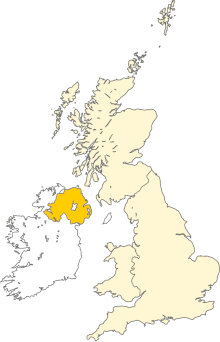
(Pictured: Map of Northern Ireland (yellow) within the United Kingdom.)
Jameson is born in Portadown to a ProtestantChurch of Ireland family in about 1953, one of five sons. He has a twin brother, Stuart. A former reservist in the Royal Ulster Constabulary (RUC) (1973-81), he works as a manager in the Jameson Group, a building firm which is a family-owned business. The building firm is regularly awarded government contracts to carry out work for the security forces and it is for this reason that his brother David loses a leg in a 1991 Provisional Irish Republican Army bombing attack. He is a member of the Orange Order‘s Drumherriff Star of Erin LOL 8 Portadown district.
It is not known exactly when Jameson becomes a member of the Ulster Volunteer Force (UVF) nor the leader of its Mid-Ulster Brigade. The Portadown unit of the Mid-Ulster Brigade had been officially stood down by the Brigade Staff in Belfast in August 1996 when it carried out an unauthorised sectarian killing while the UVF were on ceasefire. The Mid-Ulster Brigade’s commander at the time, Billy Wright, was expelled from the UVF. Wright brazenly defies a Combined Loyalist Military Command (CLMC) order to leave Northern Ireland or face execution by establishing the breakaway Loyalist Volunteer Force (LVF), taking most of the Portadown Mid-Ulster UVF with him. The units of the Mid-Ulster Brigade that remain loyal to the Brigade Staff continue to operate and Jameson becomes commander. He is said by The Guardian to be a “staunch supporter of the Good Friday Agreement.”
In the weeks prior to his killing, Jameson is in a violent street altercation with LVF member Muriel Gibson, whom he accuses of involvement in drugs and slaps forcefully in the face. This is followed by a fracas at the Portadown F.C. Social Club on December 27, 1999, where LVF members are commemorating the death of their comrade Billy Wright, shot and killed inside the Maze Prison by the Irish National Liberation Army (INLA) exactly two years previously. When he enters the club, several LVF men begin to push and jostle him and challenge him to a fight, telling him to hit them instead of women. Deeply offended, he leaves and soon returns with a UVF gang armed with pickaxe handles and baseball bats. In the violent brawl that ensues, twelve people, including three LVF prisoners out on Christmas parole, receive severe injuries. The LVF leaders subsequently make the decision that Jameson is to pay for the attack with his life.
One of the LVF members, who lives near Dungannon, gets in touch with a family of north Belfast loyalists who had been members of the UVF but who had left after Wright’s expulsion. From these former UVF members the LVF obtains the gun with which to shoot Jameson. On the evening of January 10, 2000, Jameson returns from work and drives his Isuzu Trooper jeep into the driveway outside his home on the Derrylettiff Road near Portadown. Waiting in ambush, a single gunman suddenly approaches from the passenger side of the parked jeep. Before Jameson can emerge from the vehicle and with the engine still running, the gunman opens fire through the window with a 9mm semi-automatic pistol, shooting Jameson five times in the head and chest. His assassin escapes to a nearby getaway car. He is rushed to Craigavon Area Hospital but dies of his wounds minutes after his arrival. The RUC immediately begins a murder inquiry. Within hours of the killing, the UVF Brigade Staff convene an emergency meeting at “the Eagle,” their headquarters on the Shankill Road, where they compile a list of all those they believe to be involved in Jameson’s death and plan their retaliation against the LVF.
Among those who condemn the killing is Northern Ireland’s First MinisterDavid Trimble who releases the following statement: “This is exactly the sort of thing we thought we had finally put behind us. I’m shocked by the news.”
Jameson’s funeral is held on January 13 at the Tartaraghan Parish Church and attended by several thousand mourners including Progressive Unionist Party (PUP) leaders David Ervine and Billy Hutchinson. Drumcree Orangeman Harold Gracey and Gary McMichael, the son of slain Ulster Defence Association (UDA) brigadier John McMichael, also attend as does local politicians representing the Ulster Unionist Party (UUP) and Democratic Unionist Party (DUP). The service is officiated by Reverend David Hilliard who speaks out against vengeance and describes Jameson as a “man admired and loved by many” and who “had been so cruelly murdered.” He is buried in the adjacent churchyard.
Despite Reverend Hilliard’s pleas and LVF leader Mark “Swinger” Fulton‘s claim that his organisation had nothing to do with Jameson’s shooting, the UVF/LVF feud intensifies. In the immediate aftermath members of Jameson’s family are filmed angrily defacing LVF murals in Portadown. A month after his killing, two Protestant teenagers, Andrew Robb (19) and David McIlwaine (18), are savagely beaten and repeatedly stabbed to death in a country lane outside Tandragee, County Armagh by a local UVF gang. The young men, believed to have been LVF members, are targeted by their UVF killers after they leave a nightclub together in search of a party. However, neither teenager is part of any paramilitary organisation and only Robb had tenuous links to the LVF. It is reported in the Belfast Telegraph that according to court hearings Robb had made disparaging remarks about Jameson’s death. Two of the UVF men, Stephen Leslie Brown and Noel Dillon, are infuriated by the comments and afterward Brown drives the victims to Druminure Road where he, Dillon and another man carry out the double killing. One of Jameson’s brothers, Bobby, is among the mourners at David McIlwaine’s funeral. The West Belfast Brigade of the Ulster Defence Association, whose brigadier Johnny Adair is close to the LVF, briefly becomes involved in the feud after Adair attends Andrew Robb’s funeral and joins LVF members at the Drumcree conflict. After the UVF track down Jameson’s killer to the Oldpark area of Belfast and attempt to shoot him, he is taken away under the protection of the West Belfast Brigade. The tit-for-tat killings continue intermittently until 2005 when the UVF makes a final assault against the LVF, leaving four members dead and the LVF leadership with no alternative but to order its military units to permanently disband.
Jameson’s family has persistently denied that he was a UVF member. They maintain that he was a vigilante who was murdered in retaliation for the firm stand he had taken against drug dealing in the Portadown area. The late PUP leader David Ervine expressed the same opinion the day after the killing by stating, “Mr. Jameson had been murdered by drug dealers masquerading as loyalists because he had been a bulwark in his community against dealers.” Ervine also described him as having been a “fine and honourable man, widely respected in the community.” Northern Ireland security sources, however, have repeatedly named Jameson as the Mid-Ulster UVF commander. He is listed as a UVF member in the CAIN: Sutton Index of Deaths, an online University of Ulster-sponsored project which chronicles the Northern Ireland conflict. It also emerges that for several days prior to his killing, he had been working at the BallykinlerBritish Army base. Immediately after his murder by the LVF, his family begins an anti-drug campaign in Portadown by putting up posters and handing out leaflets to passing motorists.
On the evening of December 3, 2012, hundreds of protesters gather outside Belfast City Hall as the Belfast City Council votes to limit the days that the Union Jack, the flag of the United Kingdom, flies from City Hall. Since 1906, the flag has been flown every day of the year. This is reduced to eighteen specific days a year, the minimum requirement for UK government buildings. The move to limit the number of days is backed by the council’s Irish nationalists while the Alliance Party abstains from the vote. It is opposed by the unionist councillors.
Minutes after the vote, protesters break into the back courtyard and try to force open the doors of the building. Two security staff and a press photographer are injured, and windows of cars in the courtyard are smashed. Protesters then clash with the police, injuring fifteen officers.
Ulster loyalists and British nationalists hold street protests throughout Northern Ireland. They see the council’s decision as part of a wider “cultural war” against “Britishness” in Northern Ireland. Throughout December and January, protests are held almost daily and most involve the protesters blocking roads while carrying Union Flags and banners. Some of these protests lead to clashes between loyalists and the police, sparking riots. Rioters attack police with petrol bombs, bricks, stones and fireworks. Police respond with plastic bullets and water cannon. Alliance Party offices and the homes of Alliance Party members are attacked, while Belfast City Councillors are sent death threats. According to police, some of the violence is orchestrated by high-ranking members of the Ulster Volunteer Force (UVF) and Ulster Defence Association (UDA). Loyalists also put up thousands of Union flags in public places, which further heightened tension.
After February 2013, the protests become smaller and less frequent, and lead to greater loyalist protests about related issues, such as restrictions on traditional loyalist marches.
Prime Minister of the United KingdomDavid Cameron condemns the protests, saying “violence is absolutely unjustified in those and in other circumstances.” MPNaomi Long says that Northern Ireland is facing “an incredibly volatile and extremely serious situation.” She also calls on Cameron to intervene after a police car outside her office is firebombed with a policewoman escaping injury in early December.
The Police Service of Northern Ireland‘s (PSNI) Chief ConstableMatt Baggott blames the violence on the UVF for “orchestrating violence for their own selfish motives. Everyone involved needs to step back. The lack of control is very worrying. The only answer is a political solution. Otherwise, this will eat into our ability to deal with drugs, into our ability to deal with alcohol issues, and deal with what is a very severe dissident threat.”
In September 2013, business representatives in Belfast reveal that the flag protests had resulted in losses totaling £50 million in the year to July 2013.
(Pictured: The Union Flag flying atop Belfast City Hall in 2006. The statue of Queen Victoria is in the foreground.)






 seamus dubhghaill