seamus dubhghaill

Promoting Irish Culture and History from Little Rock, Arkansas, USA


Leave a comment

Death of Author & Journalist Standish James O’Grady

Standish James O’Grady, author, journalist, and historian, dies on May 18, 1928, at ShanklinIsle of WightHampshireEngland.

O’Grady is born on March 22, 1846, at Castletown, County Cork, the son of Reverend Thomas O’Grady, the scholarly Church of Ireland minister of Castletown Berehaven, County Cork, and Susanna Doe. After a rather severe education at Tipperary Grammar School, O’Grady follows his father to Trinity College, Dublin, where he wins several prize medals and distinguishes himself in several sports.

O’Grady proves too unconventional of mind to settle into a career in the church and earns much of his living by writing for the Irish newspapers. Reading Sylvester O’Halloran‘s General history of Ireland sparks an interest in early Irish history. After an initial lukewarm response to his writing on the legendary past in History of Ireland: Heroic Period (1878–81) and Early Bardic Literature of Ireland (1879), he realizes that the public wants romance, and so follows the example of James Macpherson in recasting Irish legends in literary form, producing historical novels including Finn and his Companions (1891), The Coming of Cuculain (1894), The Chain of Gold (1895), Ulrick the Ready (1896) and The Flight of the Eagle (1897), and The Departure of Dermot (1913).

O’Grady also studies Irish history of the Elizabethan period, presenting in his edition of Sir Thomas Stafford‘s Pacata Hibernia (1896) the view that the Irish people have made the Tudors into kings of Ireland in order to overthrow their unpopular landlords, the Irish chieftains. His The Story of Ireland (1894) is not well received, as it sheds too positive a light on the rule of Oliver Cromwell for the taste of many Irish readers. He is also active in social and political campaigns in connection with such issues as unemployment and taxation.

Until 1898, he works as a journalist for the Daily Express of Dublin, but in that year, finding Dublin journalism in decline, he moves to Kilkenny to become editor of the Kilkenny Moderator. It is here he becomes involved with Ellen Cuffe, Countess of Desart and Captain Otway Cuffe. He engages in the revival of the local woolen and woodworking industries. In 1900 he founds the All-Ireland Review and returns to Dublin to manage it until it ceases publication in 1908. O’Grady contributes to James Larkin‘s The Irish Worker paper.

O’Grady’s works are an influence on William Butler Yeats and George Russell and this leads to him being known as the “Father of the Celtic Revival.” Being as much proud of his family’s Unionism and Protestantism as of his Gaelic Irish ancestry, identities that are increasingly seen as antithetical in the late 1800s, he is described by Augusta, Lady Gregory as a “fenian unionist.”

Advised to move away from Ireland for the sake of his health, O’Grady passes his later years living with his eldest son, a clergyman in England, and dies on the Isle of Wight on May 18, 1928.

O’Grady’s eldest son, Hugh Art O’Grady, is for a time editor of the Cork Free Press before he enlists in World War I early in 1915. He becomes better known as Dr. Hugh O’Grady, later Professor of the Transvaal University College, Pretoria, who writes the biography of his father in 1929.


Leave a comment

Birth of John Millington Synge, Poetic Dramatist

John Millington Synge, a leading figure in the Irish Literary Revival, is born at Rathfarnham, near Dublin, on April 16, 1871. He is a poetic dramatist of great power who portrays the harsh rural conditions of the Aran Islands and the western Irish seaboard with sophisticated craftsmanship.

After studying at Trinity College and at the Royal Irish Academy of Music in Dublin, Synge pursues further studies from 1893 to 1897 in GermanyItaly, and France. In 1894 he abandons his plan to become a musician and instead concentrates on languages and literature. He meets William Butler Yeats while studying at the Sorbonne in Paris in 1896. Yeats inspires him with enthusiasm for the Irish renaissance and advises him to stop writing critical essays and instead to go to the Aran Islands and draw material from life. Already struggling against the progression of Hodgkin’s lymphoma which is untreatable at the time and eventually causes his death, Synge lives in the islands during part of each year between 1898 and 1902, observing the people and learning their language, recording his impressions in The Aran Islands (1907) and basing his one-act plays In the Shadow of the Glen and Riders to the Sea (1904) on islanders’ stories. In 1905 his first three-act play, The Well of the Saints, is produced.

Synge’s travels on the Irish west coast inspire his most famous play, The Playboy of the Western World (1907). This morbid comedy deals with the moment of glory of a peasant boy who becomes a hero in a strange village when he boasts of having just killed his father but who loses the villagers’ respect when his father turns up alive. In protest against the play’s unsentimental treatment of the Irishmen’s love for boasting and their tendency to glamorize ruffians, the audience riots at its opening at Dublin’s Abbey Theatre. Riots of Irish Americans accompany its opening in New York City in 1911, and there are further riots in Boston and Philadelphia. Synge remains associated with the Abbey Theatre, where his plays gradually win acceptance, until his death. His unfinished Deirdre of the Sorrows, a vigorous poetic dramatization of one of the great love stories of Celtic mythology, is performed there in 1910.

John Millington Synge dies at the Elpis Nursing Home in Dublin on March 24, 1909, at the age of 37, and is buried in Mount Jerome Cemetery and CrematoriumHarold’s Cross, Dublin.

In the seven plays he writes during his comparatively short career as a dramatist, Synge records the colourful and outrageous sayings, flights of fancy, eloquent invective, bawdy witticisms, and earthy phrases of the peasantry from Kerry to Donegal. In the process he creates a new, musical dramatic idiom, spoken in English but vitalized by Irish syntax, ways of thought, and imagery.


Leave a comment

Birth of Theatrical Producer Hilton Edwards

hilton-edwards

Hilton Edwards, an English-born Irish actor, lighting designer, and theatrical producer, is born in London on February 2, 1903.

Edwards begins his career acting with the Charles Doran Shakespeare Company in 1920 in Windsor and then joins The Old Vic in London, playing in all but two of Shakespeare‘s plays before leaving the company a few years later. Trained in music, he also sings baritone roles with the Old Vic Opera company.

After touring with various companies in Britain and South Africa, Edwards goes to Ireland in 1927 for a season with Anew McMaster’s company and meets McMaster’s brother-in-law, Micheál Mac Liammóir. As he tells an interviewer once, both men want a theater of their own. Mac Liammóir wants it to be in Ireland and Edwards does not care. “I don’t care about nationalism, I care about the theater,” he says.

Edwards and Mac Liammóir co-found the Gate Theatre in Dublin in 1928. The two men’s talents are complementary. Mac Liammóir is an actor, designer, and writer. Edwards is a director, actor, producer, and lighting designer. Edwards produces and directs more than 300 plays at the Gate, ranging from the works of Aeschylus and Sophocles, Johann Wolfgang von Goethe and Henrik Ibsen to the comedies of George Bernard Shaw and Richard Brinsley Sheridan and new Irish plays, by such authors as W.B. Yeats, Brian Friel, and Mac Liammóir.

In New York City in 1948 Edwards plays in and directs John Bull’s Other Island and directs The Old Lady Says No and Where Stars Walk. In 1961 Edwards takes a two-year leave from the Gate to become the first Head of Drama at Telefís Éireann. A year later, he wins a Jacob’s Award for his television series Self Portrait.

Edwards appears in 15 films, including Captain Lightfoot (1955), David and Goliath (1960), Victim (1961), and Half a Sixpence (1967). He also writes and directs Orson Welles‘s Return to Glennascaul (1951). However, he is primarily known for his theatre work. He is nominated for a Tony Award in 1966 for Best Director of a Drama for Philadelphia, Here I Come!

Hilton Edwards dies in a Dublin hospital on November 18, 1982. Edwards and Mac Liammóir are the subject of a biography, titled The Boys by Christophor Fitz-Simon.


Leave a comment

Death of William Butler Yeats

william-butler-yeats

William Butler Yeats, Irish poet and one of the foremost figures of 20th century literature, dies on January 28, 1939, at the Hôtel Idéal Séjour, in Menton, France.

Yeats is born in Sandymount, County Dublin, on June 13, 1865, the oldest child of John Butler Yeats and Susan Mary Pollexfen. Although John trains as a lawyer, he abandons the law for art soon after his first son is born. Yeats spends much of his early years in London, where his father is studying art, but frequently returns to Ireland as well.

In the mid-1880s, Yeats pursues his own interest in art as a student at the Metropolitan School of Art in Dublin. Following the publication of his poems in the Dublin University Review in 1885, he soon abandoned art school for other pursuits.

After returning to London in the late 1880s, Yeats meets writers Oscar Wilde, Lionel Johnson, and George Bernard Shaw. He also becomes acquainted with Maud Gonne, a supporter of Irish independence. This revolutionary woman serves as a muse for Yeats for years. He even proposes marriage to her several times, but she turns him down. He dedicates his 1892 drama The Countess Kathleen to her.

Around this time, Yeats founds the Rhymers’ Club poetry group with Ernest Rhys. He also joins the Order of the Golden Dawn, an organization that explores topics related to the occult and mysticism. While he is fascinated with otherworldly elements, Yeats’s interest in Ireland, especially its folktales, fuels much of his output. The title work of The Wanderings of Oisin and Other Poems (1889) draws from the story of a mythic Irish hero.

In addition to his poetry, Yeats devotes significant energy to writing plays. He teams with Lady Gregory to develop works for the Irish stage, the two collaborating for the 1902 production of Cathleen Ni Houlihan. Around that time, Yeats helps found the Irish National Theatre Society with Lady Gregory and John Millington Synge, serving as its president and co-director. More works soon follow, including On Baile’s Strand, Deirdre, and At the Hawk’s Well.

Following his marriage to Georgie Hyde-Lees in 1917, Yeats begins a new creative period through experiments with automatic writing. The newlyweds sit together for writing sessions they believe to be guided by forces from the spirit world, through which Yeats formulates intricate theories of human nature and history. They soon have two children, daughter Anne and son Michael.

Yeats then becomes a political figure in the new Irish Free State, serving as a senator for six years beginning in 1922. The following year, he receives an important accolade for his writing as the recipient of the Nobel Prize in Literature. According to the official Nobel Prize website, Yeats is selected “for his always inspired poetry, which in a highly artistic form gives expression to the spirit of a whole nation.”

Yeats continues to write until his death. Some of his important later works include The Wild Swans at Coole (1917), A Vision (1925), The Tower (1928) and Words for Music Perhaps and Other Poems (1932). Yeats passes away on January 28, 1939, at the Hôtel Idéal Beauséjour near Menton, France. He is buried after a discreet and private funeral at Roquebrune-Cap-Martin. The publication of Last Poems and Plays and Two Plays shortly after his death further cements his legacy as a leading poet and playwright.

In September 1948, Yeats’ body is moved to the churchyard of St. Columba’s Church, Drumcliff, County Sligo, on the Irish Naval Service corvette Macha.


Leave a comment

Opening Night of “The Playboy of the Western World”

playboy-of-the-western-world

The Playboy of the Western World, a three-act play written by Irish playwright John Millington Synge, is first performed at the Abbey Theatre, Dublin, on January 26, 1907. The play is set in Michael James Flaherty’s public house in County Mayo during the early 1900s. It tells the story of Christy Mahon, a young man running away from his farm, claiming he killed his father. The locals are more interested in vicariously enjoying his story than in condemning the immorality of his murderous deed, and in fact, Christy’s tale captures the romantic attention of the barmaid Pegeen Mike, the daughter of Flaherty. The play is best known for its use of the poetic, evocative language of Hiberno-English, heavily influenced by the Irish language, as Synge celebrates the lyrical speech of the Irish.

The Playboy Riots occur during and following the opening performance of the play. The riots are stirred up by Irish nationalists who view the contents of the play as an offence to public morals and an insult against Ireland. The riots take place in Dublin, spreading out from the Abbey Theatre, and are finally quelled by the actions of the Dublin Metropolitan Police.

The fact that the play is based on a story of apparent patricide also attracts a hostile public reaction. Egged on by nationalists, including Sinn Féin leader Arthur Griffith, who believe that the theatre is not sufficiently political and describes the play as “a vile and inhuman story told in the foulest language we have ever listened to from a public platform,” and with the pretext of a perceived slight on the virtue of Irish womanhood in the line “a drift of females standing in their shifts” (a shift being a female undergarment), a significant portion of the crowd riots, causing the remainder of the play to be acted out in dumbshow. Nevertheless, press opinion soon turns against the rioters and the protests peter out.

Years later, William Butler Yeats declares to rioters against Seán O’Casey‘s pacifist drama The Plough and the Stars, in reference to the Playboy Riots, “You have disgraced yourself again. Is this to be the recurring celebration of the arrival of Irish genius?”

In the 1965 film Young Cassidy, a riot occurs during a play by the fictitious playwright Cassidy, following which the character W.B. Yeats refers to Synge and speaks similar words, starting with “You have disgraced yourselves again.”

The production of Synge’s play meets with more disturbances in the United States in 1911. On opening night in New York City, hecklers boo, hiss and throw vegetables and stink bombs while men scuffle in the aisles. The company is later arrested in Philadelphia and charged with putting on an immoral performance. The charges are later dismissed.


Leave a comment

Birth of Katharine Tynan, Novelist & Poet

katharine-tynan

Katharine Tynan, Irish writer, known mainly for her novels and poetry, is born into a large farming family in Clondalkin, County Dublin, on January 23, 1859.

Tynan is educated at St. Catherine’s, a convent school in Drogheda. Her poetry is first published in 1878. She meets and becomes friendly with the poet Gerard Manley Hopkins in 1886. She goes on to play a major part in Dublin literary circles. In 1898 she marries English writer and barrister Henry Albert Hinkson, and they move to England. After her marriage she usually writes under the name Katharine Tynan Hinkson, or variations thereof. Later she lives at Claremorris, County Mayo, when her husband is a magistrate from 1914 until 1919. Of their three children, Pamela Hinkson (1900–1982) was also known as a writer.

For a while, Tynan is a close associate of William Butler Yeats (who may have proposed marriage and been rejected, around 1885), and later a correspondent of Francis Ledwidge. Involved in the Irish Literary Revival, Tynan expresses concern for feminist causes, the poor, and the effects of World War I in her work. She also meditates on her Catholic faith. A prolific writer, she wrote more than one hundred novels, twelve collections of short stories, reminiscences, plays, and more than a dozen books of poetry.

Katharine Tynan Hinkson dies on April 2, 1931, in Wimbledon, London, at the age of 72.


Leave a comment

Birth of George Sigerson, Physician & Writer

george-sigerson

George Sigerson, Irish physician, scientist, writer, politician, and poet, is born at Holy Hill, near Strabane in County Tyrone on January 11, 1836. He is a leading light in the Irish Literary Revival of the late 19th century in Ireland.

Sigerson is the son of William and Nancy (née Neilson) Sigerson and has three brothers, James, John and William, and three sisters, Ellen, Jane, and Mary Ann. He attends Letterkenny Academy but is sent by his father, who developed the spade mill and who played an active role in the development of Artigarvan, to complete his education in France.

He studies medicine at the Queen’s College, Galway, and Queen’s College, Cork, and takes his degree in 1859. He then goes to Paris where he spends some time studying under Jean-Martin Charcot and Duchenne de Boulogne. Sigmund Freud is one of his fellow students.

Sigerson returns to Ireland and opens a practice in Dublin, specializing in neurology. He continues to visit France annually to study under Charcot. His patients included Maud Gonne, Austin Clarke, and Nora Barnacle. He lectures on medicine at the Catholic University of Ireland and is professor of zoology and later botany at the University College Dublin.

His first book, The Poets and Poetry of Munster, appears in 1860. He is actively involved in political journalism for many years, writing for The Nation. Sigerson and his wife Hester are by now among the dominant figures of the Gaelic Revival. They frequently hold Sunday evening salons at their Dublin home to which artists, intellectuals, and rebels alike attend, including John O’Leary, W.B. Yeats, Patrick Pearse, Roger Casement, and 1916 signatory Thomas MacDonagh. Sigerson is a co-founder of the Feis Ceoil and President of the National Literary Society from 1893 until his death. His daughter, Dora, is a poet who is also involved in the Irish literary revival.

Nominated to the first Seanad Éireann of the Irish Free State, Sigerson briefly serves as the first chairman on December 11-12, 1922, before the election of James Campbell, 1st Baron Glenavy. Sigerson dies at his home at 3 Clare Street, Dublin, on February 17, 1925, at the age of 89, after a short illness. On February 18, 1925, the day after his death, the Seanad Éireann pays tribute to him.

The Sigerson Cup, the top division of third level Gaelic football competition in Ireland is named in his honour. Sigerson donates the salary from his post at UCD so that a trophy can be purchased for the competition. In 2009, he is named in the Sunday Tribune‘s list of the “125 Most Influential People In GAA History.” The cup is first presented in 1911, with the inaugural winners being UCD GAA.


Leave a comment

Birth of Irish Revolutionary Maud Gonne

maud-gonne

Maud Gonne, Irish revolutionary, romantic muse for William Butler Yeats, and mother to Nobel Peace Prize-winner Seán MacBride, is born at Tongham, England on December 21, 1866.

Gonne is born into a distinguished and wealthy family, and her father serves as an army captain. Her mother dies of tuberculosis when she is a child, and she and her sister are raised and educated by a French nanny. This cosmopolitan upbringing is furthered by travels throughout Europe with her father, then a military attaché.

In 1884, Gonne’s father dies of typhoid fever, and she receives a considerable inheritance. After moving to France to be with her aunt, she meets and falls in love with right wing politician Lucien Millevoye. Though he is already married, he instills Gonne with his political passions. She begins a nearly lifelong fight for Irish freedom from England and the release of political prisoners. She and Millevoye have two children, one of whom survives, before their relationship ends.

Moved by the plight of those evicted in the Land Wars, Gonne continues to campaign for the Irish nationalist cause. While living in Paris, she is introduced to Fenianism by John O’Leary, a veteran of the Young Ireland Rebellion of 1848. In 1889, O’Leary introduces her to a man whose infatuation with her would last most of his life, poet William Butler Yeats. She begins a relationship with Yeats, though she refuses his many marriage proposals. She is the inspiration for many of Yeats’s poems. In 1900, she founds the Daughters of Ireland, which provides a home for Irish nationalist women.

In 1918, Gonne is arrested for being a political agitator. She becomes severely ill in prison and after her release, she begins a crusade for improved conditions for Ireland’s political prisoners. In 1903, she marries Major John MacBride, who had led the Irish Transvaal Brigade against the British in the Second Boer War, in Paris in 1903. After the birth of their son, Seán, Gonne and her husband agree to end their marriage. She demands sole custody of their son but MacBride refuses, and a divorce case begins in Paris on February 28, 1905. The only charge against MacBride substantiated in court is that he was drunk on one occasion during the marriage. A divorce is not granted, and MacBride is given the right to visit his son twice weekly.

The couple’s son, Seán MacBride, is active in politics in Ireland and in the United Nations. He is a founding member and Chairman of Amnesty International and is awarded the Nobel Peace Prize in 1974.

Gonne dies in Clonskeagh on April 27, 1953, at the age of 86 and is buried in Glasnevin Cemetery, Dublin. Maud Gonne’s autobiography, A Servant of the Queen, is published in 1938.


Leave a comment

Seamus Heaney Awarded Nobel Prize in Literature

seamus-heaney

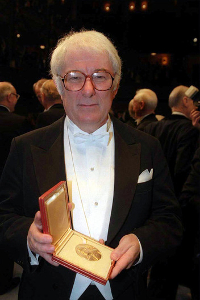
Seamus Heaney, poet, playwright, translator, and lecturer, is awarded the Nobel Prize in Literature on October 15, 1995.

Heaney is born in April 1939 near Castledawson, County Derry, Northern Ireland, where his family engages in farming and selling cattle. His education includes studies at Queen’s University Belfast, where he also serves as a lecturer in the late 1960s. He makes his debut as a poet then, but continues to divide his time between his own writing and academia. He works at Carysforth College in Dublin, at Harvard University in Cambridge, Massachusetts, and at Oxford University.

Heaney’s poetry is often down-to-earth. For him, poetry is like the earth – something that must be plowed and turned. Often he paints the gray and damp landscape from the British Isles. Peat moss has a special place in his poetry. The poems often are connected with daily experiences, but they also derive motifs from history, all the way back to prehistoric times. Heany’s profound interest in the Celtic and the pre-Christian as well as in Catholic literary tradition has found expression in a number of essays and translations.

Heaney is awarded the Nobel Prize in Literature in 1995 for what the Nobel committee describes as “works of lyrical beauty and ethical depth, which exalt everyday miracles and the living past.” He is on holiday in Greece with his wife, Marie, when the news breaks. No one, not even journalists or his own children, can locate him until he appears at Dublin Airport two days later, though an Irish television camera traces him to Kalamata. Asked how it feels having his name added to the Irish Nobel pantheon featuring William Butler Yeats, George Bernard Shaw, and Samuel Beckett, Heaney responds, “It’s like being a little foothill at the bottom of a mountain range. You hope you just live up to it. It’s extraordinary.” He and Marie are immediately whisked straight from the airport to Áras an Uachtaráin for champagne with President Mary Robinson.


Leave a comment

Birth of Playwright & Poet Lennox Robinson

lennox-robinson

Esmé Stuart Lennox Robinson, playwright, poet, theatre producer, and director who is involved with the Abbey Theatre, is born in Westgrove, Douglas, County Cork, on October 4, 1886.

Robinson is raised in a Protestant and Unionist family in which he is the youngest of seven children. His father, Andrew Robinson, is a middle-class stockbroker who in 1892 decides to become a clergyman in the Church of Ireland in the small Ballymoney parish, near Ballineen in West Cork. A sickly child, Robinson is educated by private tutor and at Bandon Grammar School. In August 1907, his interest in the theatre begins after he goes to see an Abbey production of plays by W.B. Yeats and Lady Gregory at the Cork Opera House. He publishes his first poem that same year. His first play, The Cross Roads, is performed in the Abbey in 1909 and he becomes manager of the theatre towards the end of that year. He resigns in 1914 as a result of a disastrous tour of the United States but returns in 1919. He is appointed to the board of the theatre in 1923 and continues to serve in that capacity until his death. His Abbey career and production involvement can be found in the Abbey archives.

As a playwright, Robinson shows himself as a nationalist with plays like Patriots (1912) and Dreamers (1915). On the other hand, he belongs to a part of Irish society which is not seen as fully Irish. This division between the majority native Irish (Roman Catholics) on one side and the Anglo-Irish (Protestants) on the other can be seen in a play such as The Big House (1926), which depicts the burning of a Protestant manor home by the Irish Republican Army (IRA). Robinson’s most popular play is The Whiteheaded Boy (1916).

Other plays include Crabbed Youth and Age (1924), The Far Off Hills (1928), Drama at Inish (1933), and Church Street (1935). Drama at Inish, which is presented in London and on Broadway as Is Life Worth Living?, is revived as part of the 2011 season at the Shaw Festival at Niagara-on-the-Lake, Ontario, Canada, with Mary Haney in the role of Lizzie Twohig. Robinson’s fiction includes Eight Short Stories (1919). In 1931 he publishes a biography of Bryan Cooper, who had recently died. In 1951, he publishes Ireland’s Abbey Theatre, the first full-length history of the company.

He publishes an edited edition of Lady Gregory’s diaries in 1947. In 1958 he co-edits with Donagh MacDonagh The Oxford Book of Irish Verse. He is also a director and producer, in 1930 producing a play by Irish playwright Teresa Deevy called The Reapers. In 1931 he is co-director of A Disciple along with W.B. Yeats and Walter Starkie.

Melancholic and alcoholic in later years, Lennox Robinson dies in Monkstown, County Dublin, on October 15, 1958. He is buried St. Patrick’s Cathedral.