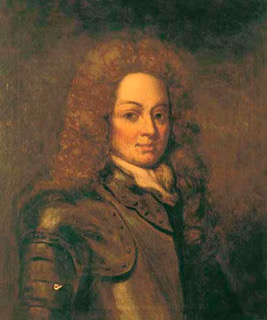
Sir Arthur Rawdon, 2nd Baronet, soldier, and horticulturalist, is born on October 17, 1662. He builds a large part of Moira, County Down in the seventeenth century. Known as the “Father of Irish Gardening” and “The Cock of the North,” he is a keen botanist, and brings over 400 different species of plants to Moira from Jamaica.
Rawdon marries Ellen Graham, daughter of Sir James Graham of Congleton in Cheshire. They have at least two children, John and Isabella.
Rawdon inherits the lands at Moira after his father dies. He rebuilds a mansion, surrounded by trees, sheep and huge gardens. On this estate, he builds the first hothouse in Europe.
Rawdon is a botanist and imports 400 plant species from Jamaica, earning the name “Father of Irish Gardening.” His garden has a labyrinth, ponds, and canals. The trees include the “Locust of Virginia” which is 30 feet high and has a trunk of at least a foot and a half in diameter. For two generations the garden is maintained.
Rawdon dies on October 17, 1695, his thirty-third birthday, and John succeeds to the baronetcy and estate as a minor. The plant collections, perhaps inevitably, decline after his death, though his wife and sisters share his interest in natural history. Some of his plant specimens are still preserved in Hans Sloane‘s herbarium in the Natural History Museum, London.
Today in Moira many places are named after Sir Arthur Rawdon, including Rawdon Court, off Main Street. Off Meeting Street there is Rawdon Place which is a housing street. Parts of the remains of his mansion are still visible.
After the Battle of the Boyne, William occupies Dublin and the Jacobites retreat to the west of Ireland. William assaults and besieges Limerick in August 1690 but is repulsed. To secure the Jacobite-held ports of Cork and Kinsale on the southern coast, he dispatches a force under John Churchill, then 1st Earl of Marlborough.
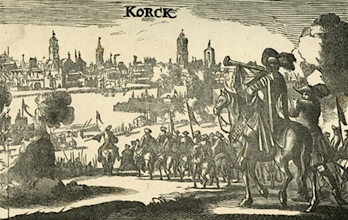
Marlborough reaches Cork by sea on September 21, 1690. His English forces are 5,000 strong and he also has at his disposal a fleet which blockades the port of Cork. He captures several of the harbour’s defences, including Fort Camden, and lands troops at Passage West on September 24, before setting up his base at Red Abbey, to the south of the walled city. Approaching from the northern, landward side are 4,000 Danish troops under the Ferdinand Willem, Duke of Württemberg-Neuenstadt.
The Williamites take the forts, such as Elizabeth Fort, which command the hills around Cork and commences a bombardment of the city from the heights. When a breach is opened in the city walls, the city’s garrison opens surrender negotiations, asking to be allowed to leave Cork and join the main Jacobite army at Limerick. Marlborough refuses the request, although Württemberg is in favour of granting the terms.
A few days later, the Williamites mount a joint English-Danish assault of the breach from the south. Henry FitzRoy, 1st Duke of Grafton, is reputedly mortally wounded while leading this assault. After the Williamites reach the walls, the Governor of Cork, Roger McElligott, opens new surrender talks and agrees that the garrison will become prisoners and will surrender their arms and stores. Marlborough accepts and the city surrenders.
In spite of this, the Williamite troops sack the city, do a great deal of damage, looting much property and abusing the Catholic inhabitants. Many civilians are killed before Württemberg and Marlborough restore order.
It remains for the Williamites to take nearby Kinsale, which is strongly defended by two forts, the Old Fort, also known as James’s Fort, and the New Fort or Charles Fort. Marlborough assaults these fortifications but is unable to take them by storm. The Old Fort, defended by the Governor Colonel Cornelius O’Driscoll, falls after an assault is made possible by an accidental explosion in its gunpowder magazine, which kills forty. After some 200 are slain in the following assault, including Colonel O’Driscoll, the rest surrender, receiving quarter. Charles Fort, however, holds out for ten days and surrenders only after receiving guarantees that its 1,200-strong garrison can march away to Limerick. It is defended by the elderly and experienced Governor Sir Edward Scott, and his Deputy Governor Colonel Donal IV O’Donovan.
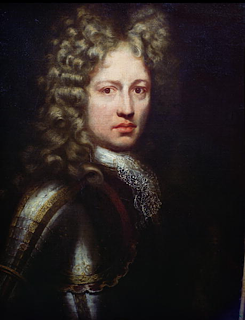
There are few surviving records of Sarsfield’s early life, although it is generally agreed he is brought up on the family estates at Tully. While some biographies claim he is educated at a French military college, there is no evidence for this.
Sarsfield fights at Entzheim, Turckheim and Altenheim. He and Hamilton are standing next to Turenne when he is killed by a chance shot at Salzbach in July 1675. He remains in France until the war ends in 1678, then returns to London to join a new regiment being recruited by Thomas Dongan, 2nd Earl of Limerick. However, the Popish Plot then results in Sarsfield and other Catholics being barred from serving in the military.
This leaves Sarsfield short of money, and he becomes involved in an expensive legal campaign to regain Lucan Manor from the heirs of his brother William, who dies in 1675. This ultimately proves unsuccessful amid allegations of forged documents, and in 1681 he returns to London, where he makes two separate attempts to abduct an heiress and is lucky to escape prosecution. When Charles’s Catholic brother James becomes king in 1685, Sarsfield rejoins the army and fights in the decisive Battle of Sedgemoor, which ends the Monmouth Rebellion. James is keen to promote Catholics, whom he views as more loyal, and by 1688 Sarsfield is colonel of a cavalry unit.
After Richard Talbot, 1st Earl of Tyrconnell, is appointed Lord Deputy of Ireland in 1687, he begins creating a Catholic-dominated Irish army and political establishment. Aware of preparations for invasion by his nephew and son-in-law William of Orange, James sends Sarsfield to Dublin in September to persuade Tyrconnell to provide him with Irish troops. This proves unsuccessful, and in November James is deposed by the Glorious Revolution. Sarsfield takes part in the Wincanton Skirmish, one of the few military actions during the invasion. He remains in England until January when he is allowed to join James in France.
Accompanied by French troops and English exiles, James lands in Ireland in March 1689, beginning the Williamite War in Ireland. Sarsfield is promoted brigadier, elected to the 1689 Irish Parliament for County Dublin, and commands cavalry units in the campaign in Ulster and Connacht. When an Irish brigade is sent to France in October, French ambassador Jean-Antoine de Mesmes proposes Sarsfield as its commander. He notes that while “not…of noble birth […], (he) has distinguished himself by his ability, and (his) reputation in this kingdom is greater than that of any man I know […] He is brave, but above all has a sense of honour and integrity in all that he does”.
James rejects this, stating that although unquestionably brave, Sarsfield is “very scantily supplied with brains.” His role at the Battle of the Boyne is peripheral, although the battle is less decisive than often assumed, Jacobite losses being around 2,000 from a force of 25,000. James returns to France, leaving Tyrconnell in control. He is the leader of the “Peace Party,” who want to negotiate a settlement preserving Catholic rights to land and public office. Sarsfield heads the “War Party,” who feel they can gain more by fighting on. It includes the Luttrell brothers, Nicholas Purcell and English Catholic William Dorrington, a former colleague from Monmouth’s Regiment.
The position of the War Party is strengthened by the Declaration of Finglas, which offers the rank and file amnesty but excludes senior officers. French victories in the Low Countries briefly increases hopes of a Stuart restoration, and the Jacobites establish a defensive line along the River Shannon. Sarsfield cements his reputation with an attack on the Williamite artillery train at Ballyneety, widely credited with forcing them to abandon the first siege of Limerick. The Jacobites also retain Athlone, offset by the loss of Kinsale and Cork, which make resupply from France extremely difficult.
With Tyrconnell absent in France, Sarsfield takes control and in December 1690, arrests several leaders of the peace faction. He then bypasses James by asking Louis XIV directly for French support, and requesting the removal of Tyrconnell and the army commander James FitzJames, 1st Duke of Berwick, James’ illegitimate son. The latter, who later describes Sarsfield as “a man […] without sense”, albeit “very good-natured,” leaves Limerick for France in February.
Tyrconnell returns in January 1691, carrying letters from James making Sarsfield Earl of Lucan, an attempt to placate an “increasingly influential and troublesome figure.” A large French convoy arrives at Limerick in May, along with Charles Chalmot de Saint-Ruhe, appointed military commander in an attempt to end the conflict between the factions. Saint-Ruhr and 7,000 others die at Aughrim in July 1691, reputedly the bloodiest battle ever on Irish soil. Sarsfield’s role is unclear: one account claims he quarrels with Saint-Ruhe and is sent to the rear with the cavalry reserves.
The remnants of the Jacobite army regroup at Limerick. Tyrconnell dies of a stroke in August, and in October, Sarsfield negotiates terms of surrender. He is criticised for this, having constantly attacked Tyrconnell for advocating the same thing, while it is suggested the Williamite army is weaker than he judged. However, the collapse of the Shannon line and surrender of Galway and Sligo leaves him little option. Without French supplies, the military position is hopeless, and defections mean his army is dissolving.
The military articles of the Treaty of Limerick preserve the Jacobite army by allowing its remaining troops to enter French service. About 19,000 officers and men, including Sarsfield, choose to leave in what is known as the Flight of the Wild Geese. Sarsfield’s handling of the civil articles is less successful. Most of its protections are ignored by the new regime, although Sarsfield possibly views it as temporary, hoping to resume the war.
On arrival in France, Sarsfield becomes Major-General in the army of exiles, an appointment James makes with great reluctance. In addition to other acts of perceived insubordination, Sarsfield allegedly tells William’s negotiators at Limerick “change but kings with us, and we will fight it over again.” After the planned invasion of England is abandoned in 1692, the exiles become part of the French army, and Sarsfield a French maréchal de camp.
Sarsfield fights at Steenkerque in August 1692, and is fatally wounded at the Battle of Landen in 1693, dying at Huy on August 21, 1693. Despite several searches, no grave or burial record has been found, although a plaque at St. Martin’s Church, Huy, has been set up in commemoration and an announcement in 2023 states that, pending exhumation and identification, his remains have been located. Like much else, his reputed last words, “Oh that this had been shed for Ireland!” are apocryphal.
In Enniskillen, armed Williamite civilians drawn from the local Protestant population organise a formidable irregular military force. The armed civilians of Enniskillen ignore an order from Robert Lundy that they should fall back to Derry and instead launch guerrilla attacks against the Jacobites. Operating with Enniskillen as a base, they carry out raids against the Jacobite forces in Connacht and Ulster, plundering Trillick, burning Augher Castle, and raiding Clones.
A Jacobite army of about 3,000 men, led by Justin McCarthy, Viscount Mountcashel (in the Jacobite peerage), advance on them from Dublin. Lord Mountcashel’s men consist of three regiments of infantry and two of dragoons. The regiments include his own regiment, Mountcashel (approx. 650 men in 13 companies), The O’Brien regiment (also 13 companies of 650 men), and the Lord Bophin (Burke) regiment. He also has the dragoon regiments of Cotter and Clare, each with seven companies of about 350 dragoons. On July 28, 1689, Mountcashel’s force encamps near Enniskillen and bombards the Williamite outpost of Crom Castle to the southeast of Enniskillen. Crom Castle is almost 20 miles (32 km) from Enniskillen by road and about 5 miles (8.0 km) from Newtownbutler.
Two days later, they are confronted by about 2,000 Williamite ‘Inniskilliniers’ under Colonel Berry, Colonel William Wolseley and Gustave Hamilton. The Jacobite dragoons under Antoine Hamilton stumble into an ambush laid by Berry’s men near Lisnaskea and are routed, taking 230 casualties. Mountcashel manages to drive off Berry’s cavalry with his main force but is then faced with the bulk of the Williamite strength under Wolseley. There is some debate in the sources over troop numbers, though it is believed that Mountcashel has a large number of poorly armed conscripts. Unwisely, Mountcashel halts and draws up his men for battle about a mile south of Newtownbutler.
Williamite histories claim that many of the Jacobite troops flee as the first shots are fired. Up to 1,500 of them are hacked down or drowned in Upper Lough Erne when pursued by the Williamite cavalry. Of the 500 men who try to swim across the Lough, only one survives. Approximately 400 Jacobite officers, along with Lord Mountcashel, the Jacobite commander, are captured and later exchanged for Williamite prisoners, with the other Jacobites being killed. These claims seem unlikely, for several reasons. Each Irish regiment includes approximately 40 officers. The entire force, therefore, would include only about 200 officers. Many of these officers are accounted for in an October 1689 roll call, which shows approximately a 15–20% change in the officer roll call since July for the infantry regiments and 5% for the dragoons. This totals some 20–30 officers in all. Also, the Mountcashel regiment’s roll call for October shows that companies which would normally have 50–60 men, have around 25, which results in a loss of approximately 300–400 men for this regiment. The Cotter and Clare dragoons who ride away from the battle do not have significant losses, based on the October 1689 roll call. Assuming the other two infantry regiments suffer similar losses, gives a total loss of 1,200–1,300. Given their officers are recorded in the October roll and show fewer losses than the Mountcashel regiment among officers, there may be fewer losses in the ranks as well. The Williamite histories acknowledge that they captured approximately 400, including men who are later sent to Derry, which would indicate a total loss of killed, wounded, and missing of 800–900, and likely less. This number is necessarily an estimate based on the available data but should be contrasted with Williamite claims that they killed and drowned 2,000. It appears likely that a couple of hundred men from Mountcashel’s regiment may have fled into the bogs toward Lough Erne, and some of them who made it to the river tried to swim and were drowned, leading to the story of the hundreds drowned.
The battle is still commemorated by the Orange Order in Ulster and is mentioned in the traditional unionist song, “The Sash.”
The battle is significant in another way: the regiments on both sides go on to have long and famous histories. On the Williamite side, the Innsikilling Regiment (27th Foot), and on the Jacobite side, the Clare and Mountcashel/Lee/Bulkeley regiments of the Irish Brigade. The two Irish regiments face off again at the Battle of Fontenoy in 1745, where the Irish Brigade famously drives the British army from the battlefield with a charge in the final stage of the battle.
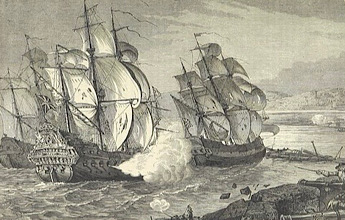
On July 28, 1689, two armed merchant ships, Mountjoy and Phoenix, sail toward the heavily defended defensive boom (floating barrier) across the River Foyle at Culmore, protected by the frigate HMS Dartmouth under Captain John Leake. Mountjoy rams and breaches the boom at Culmore fort and the ships move in, unloading many tons of food to relieve the Siege of Derry.
The Siege of Derry in 1689 is the first major event in the Williamite War in Ireland. The siege is preceded by an attempt against the town by Jacobite forces on December 7, 1688, that is foiled when thirteen apprentices shut the gates. This is an act of rebellion against James II.
The second attempt begins on April 18, 1689, when James himself appears before the Derry city walls with an Irish army led by Jacobite and French officers. The town is summoned to surrender but refuses. The siege begins. The besiegers try to storm the walls, but fail. They then resort to starving Derry. They raise the siege and do not leave until supply ships break through to the town.
Frederick Schomberg, having been appointed commander-in-chief by William III, orders Major-GeneralPercy Kirke to attack the boom. Thereupon, on July 28, Kirke sends four ships to the mouth of the River Foyle to try to bring food into Derry. These are HMS Dartmouth and three merchant ships: Mountjoy from Derry, Phoenix from Coleraine, and Jerusalem. Dartmouth, under Captain John Leake, engages the shore batteries, while Mountjoy, commanded by her Master Michael Browning, rams and breaches the boom, whereupon Mountjoy and Phoenix sail up to Derry, unloading many tons of food. Seeing that he can no longer starve out Derry and not having enough troops to storm the town, Conrad von Rosen, the commander of the Jacobite troops, decides to raise the siege. On August 1, the besieged discover that the enemy is gone. On August 3, Kirke reports the raising of the siege to London. On July 31, another Jacobite army is defeated at Newtownbutler by the armed citizens of Enniskillen.
The city endures 105 days of siege, from April 18 to August 1, 1689. Some 4,000 of its garrison of 8,000 are said to have died during this siege. The siege is commemorated annually by the Protestant community.
(Pictured: HMS Dartmouth fires at shore batteries while Mountjoy rams through the boom, from the 1873 book British Battles on Land and Sea, Volume 1)
Godert de Ginkel, the commanding general of William III‘s army, begins a ten-day siege of Athlone on June 20, 1691. Athlone is besieged twice during the Williamite War in Ireland (1689–91). The town is situated in the centre of Ireland on the River Shannon and commands the bridge crossing the river into the Jacobite-held province of Connacht. For this reason, it is of key strategic importance.
The army of William III first besieges Athlone in 1690, shortly after their defeat of the main Jacobite army at the Battle of the Boyne. James Douglas and about 7,500 troops attempt to take the town, but the Jacobite garrison’s commander, Colonel Richard Grace, refuses to surrender. Lacking siege artillery, Douglas is forced to withdraw after a week.
In the summer of the following year, the Williamite army, having regrouped at Mullingar under the command of Dutch general Godert de Ginkel, marches via Ballymore to make a second attempt on Athlone.
The Jacobite commander, Charles Chalmot de Saint-Ruhe, marches his main field army from its winter quarters in Limerick to meet the threat. He draws up his force to the west of the town. Other Jacobite troops man fortifications in the ruins of the “English Town,” the eastern half of Athlone, along with a garrison in the “Irish Town” on the western bank. This arrangement is intended to allow the Jacobites to fight a staggered, drawn-out defence, though the advantage is reduced by high ground on the Leinster bank of the Shannon and the fact that the river is running exceptionally low at the time.
Jacobite defences are also hampered by disagreements between James’s Viceroy, Richard Talbot, 1st Earl of Tyrconnell, Saint-Ruhe, and Jacobite general Patrick Sarsfield. When Talbot asserts his seniority and offers advice on the defences to Saint-Ruhe, the latter refuses to recognise Talbot’s command, while Sarsfield sends him a message that his pavilion ropes will be cut if he does not leave immediately. Though Talbot surmises that a large number of the best Jacobite troops will side with him, he chooses to depart for Limerick rather than split the army.
Ginkel opens an assault on the eastern part of Athlone on June 20, which causes the Jacobites to retreat to the west bank of the river, dismantling the bridge in the process. Colonel Grace, who had been superseded as garrison commander by the French officer d’Usson, is killed in a bombardment at the western end of the bridge on the same day.
The Jacobite forces in the western half of Athlone, led by Major-General Thomas Maxwell, a Scottish Catholic, initially hold off the Williamite assault. There is fierce fighting centred on the bridge over the Shannon. The Williamites try to lay planks over the partially wrecked structure, which the Irish Jacobite troops manage to destroy despite coming under intense fire. One such Jacobite sortie, by a small group of volunteers from Maxwell’s dragoon regiment led by a Sergeant Custume or Costy, all of whom are killed, later passes into Irish folklore as an example of bravery. Several attempts by the Williamites to storm the bridge are repulsed with heavy losses.
The Williamite bombardment of the western, Connacht, side of the town is intense, with over 12,000 cannonballs and 600 bombs or mortars fired into the town. John Stevens, serving in the Grand Prior’s Regiment, records that “with the balls and bombs flying so thick, that spot was hell on earth.” During the ten-day bombardment, 32 heavy cannon and mortars fire one shot every minute. Athlone suffers the heaviest bombardment of any city in Britain and Ireland up to this point.
While developing a plan to storm the bridge, Ginkel identifies another potential crossing point at a ford to the south. To test the crossing, on the morning of June 29 he orders a Danish quartermaster and two privates, under sentence of death for cowardice, to ford the river while troops fire over their heads to give the impression they are deserting. All three ford to the western bank and return safely, whereupon Ginkel sends a force of grenadiers, 2,000 strong, to cross there and attack the Jacobite positions from the rear.
Following an argument between Saint-Ruhe and the garrison commander d’Usson, the fortifications on the western side of the city have not been levelled, as Talbot had suggested some days earlier. Saint-Ruhe does not issue an order to demolish them until June 29, apparently believing it impossible that a city could be taken with a relieving army so close by. They remain standing a day later, and a party of Ginkel’s grenadiers hurry to occupy them and raise the drawbridge there, holding off counterattacks from Saint-Ruhe’s army until the main Williamite force can be brought up. Saint-Ruhe detaches two brigades under Major-General John Hamilton to dislodge the Williamites, but after approximately an hour and a half of intense fighting, the Jacobites retreat.
The breakthrough of the Williamites forces the remains of the Jacobite garrison, who have been awaiting reinforcement from the main Jacobite force under Saint-Ruhe, to hastily abandon their positions in Athlone. Maxwell is captured. Accusations of treachery are later levelled at him, partly as he had been a supporter of Talbot’s faction. Saint-Ruhe withdraws into County Galway, passing through Ballinasloe. The Jacobites lose around 1,000 men at Athlone, though the highest estimates suggest losses of over 2,000, including colonels McGuinness, McMahon and O’Gara, in addition to Grace.
Ginkel continues to march toward Limerick, unaware of the position of Saint-Ruhe. On the morning of July 12, the Williamites are confronted by the main Jacobite army drawn up in a strong defensive position at Aughrim. In the ensuing Battle of Aughrim, Ginkel inflicts a crushing defeat on them, effectively ending Jacobite resistance in Ireland.
(Pictured: The powerful Williamites army attack, illustration by Victor Ambrus)
Esther Vanhomrigh, Irish woman of Dutch descent and a longtime lover and correspondent of Jonathan Swift, dies in Celbridge, County Kildare, on June 2, 1723. Swift’s letters to her are published after her death. Her fictional name “Vanessa” is created by Swift by taking Van from her surname, Vanhomrigh, and adding Esse, a pet form of her first name, Esther.
Vanhomrigh is born in Dublin on February 14, 1688, the eldest of four children of Bartholomew Van Homrigh, a merchant of Amsterdam and afterwards of Dublin, who is appointed commissary of the stores by King William III upon his expedition into Ireland. He serves as Lord Mayor of Dublin from 1697–98. Her mother, also named Esther, is the daughter of John Stone, an Irish commissioner of revenue. She grows up at Celbridge Abbey in County Kildare.
Vanhomrigh’s father dies in 1703, and his widow moves her family to London in 1707. She becomes acquainted with Swift in December of that year while the family is en route for London, at Dunstable, and it is here that their intense 17-year relationship begins. She is 22 years younger than Swift, and it is obvious from the beginning that he admires her for her rugged qualities, as he does not admire very delicate women. She is said “not to be a beauty,” although it is difficult to be sure about this since no contemporary portrait of her exists (the famous 1868 Millais portrait is a work of artistic imagination). Swift later serves as her tutor. After her mother dies in 1714, she follows Swift to Ireland, and returns to Celbridge Abbey, but she is desperately miserable there.
Their relationship is fraught. It is broken up after 17 years by Swift’s relationship with another woman, Esther Johnson, whom he calls “Stella,” in 1723. Swift has known Stella since about 1690, when she is a little girl in the household of his employer Sir William Temple; their relationship is intense and it is possible that they secretly married in 1716. Vanhomrigh is thought to have asked Swift not to see Stella again, and he apparently refuses, thus putting an end to their relationship.
Vanhomrigh never recovers from his rejection and dies on June 2, 1723, likely from tuberculosis contracted from nursing her sister Mary, who had died of the same disease in 1720, as had their mother before her. Some accuse Swift of inadvertently causing her death.
Vanhomrigh’s father had left her well provided for, but she is burdened by debts accumulated by her mother and her spendthrift brother Bartholomew. In her will, she names the barristerRobert Marshall and George Berkeley, the celebrated philosopher and future Bishop of Cloyne, executors and joint residuary legatees of her estate, although she knew neither man well. Due to the debts, a protracted lawsuit ensues and a large part of the estate is lost in legal costs. It is widely reported that she had made it a condition of the inheritance that her executors publish all her correspondence with Swift, but in fact, no such stipulation seems to have been made.
Swift, whose letters to her are published after her death, is not mentioned in her will, perhaps a final retaliation against a man whose neglect made her “live a life like a languishing death.”
In January and February 1689, Butler votes against the motion to put William of Orange and Mary on the throne and against the motion to declare that James II has abdicated it. Nevertheless, he subsequently joins the forces of William of Orange, by whom he is made colonel of the 2nd Troop of Horse Guards on April 20, 1689. He accompanies William in his Irish campaign, debarking with him in Carrickfergus on June 14, 1690, and commands this troop at the Battle of the Boyne in July 1690. In February 1691 he becomes Lord Lieutenant of Somerset.
Butler serves on the continent under William of Orange during the Nine Years’ War and, having been promoted to major general, he fights at the Battle of Steenkerque in August 1692 and the Battle of Landen in July 1693, where he is taken prisoner by the French and then exchanged for the Duke of Berwick, James II’s illegitimate son. He is promoted to lieutenant general in 1694.
Butler plays a dramatic role at the notorious meeting of the Privy Council on March 8, 1711, when Antoine de Guiscard, a French double agent who is being questioned about his treasonable activities, attempts to assassinate Robert Harley, 1st Earl of Oxford, against whom he has a personal grudge for drastically cutting his allowance, by stabbing him with a penknife. Harley is wounded, but not seriously, due largely to the fact that he is wearing a heavy gold brocade waistcoat in which the knife gets stuck. Several Councillors, including Butler, stab Guiscard in return. Guiscard implores Butler to finish the deed, but he replies that it is not for him to play the hangman. In any case, he has the sense to see that Guiscard must be kept alive at least long enough to be questioned, although as it turns out Guiscard’s wounds are fatal, and he dies a week later.
On April 23, 1712, Butler leaves Harwich for Rotterdam to lead the British troops taking part in the war. Once there he allows himself to be made the tool of the Tory ministry, whose policy is to carry on the war in the Netherlands while giving secret orders to him to take no active part in supporting their allies under Prince Eugene. In July 1712, he advises Prince Eugene that he can no longer support the siege of Le Quesnoy and that he is withdrawing the British troops from the action and instead intends to take possession of Dunkirk. The Dutch are so exasperated at the withdrawal of the British troops that they close the towns of Bouchain on Douai to British access, despite the fact that they have plenty of stores and medical facilities available. Butler takes possession of Ghent and Bruges as well as Dunkirk, in order to ensure his troops are adequately provided for. On April 15, 1713, he becomes Lord Lieutenant of Norfolk.
Ormonde’s position as Captain-General makes him a personage of much importance in the crisis brought about by the death of Queen Anne and, during the last years of Queen Anne, he almost certainly has Jacobite leanings and corresponds with the Jacobite Court including his cousin, Piers Butler, 3rd Viscount Galmoye, who keeps barrels of gunpowder at Kilkenny Castle. King George I, on his accession to the throne in August 1714, institutes extensive changes and excludes the Tories from royal favour. Butler is stripped of his posts as Captain-General, as colonel of the 1st Regiment of Foot Guards and as Commander in Chief of the Forces with the first two posts going to the Duke of Marlborough and the role of Commander-in-Chief going to John Dalrymple, 2nd Earl of Stair. On November 19, 1714, Butler is instead made a member of the reconstituted Privy Council of Ireland.
Accused of supporting the Jacobite rising of 1715, Butler is impeached for high treason by Lord Stanhope on June 21, 1715. He might avoid the impending storm of Parliamentary prosecution, if he remains in England and stands trial but instead, he chooses to flee to France in August 1715 and initially stays in Paris with Lord Bolingbroke. On August 20, 1715, he is attainted, his estate forfeited, and honours extinguished. The Earl Marshal is instructed to remove the names and armorial bearings of Butler and Bolingbroke from the list of peers and his banner as Knight of the Garter is taken down in St. George’s Chapel.
On June 20, 1716, the Parliament of Ireland passes an act extinguishing the regalities and liberties of the county palatine of Tipperary; for vesting Butler’s estate in the crown and for giving a reward of £10,000 for his apprehension, should he attempt to land in Ireland. But the same parliament passes an act on June 24, 1721, to enable his brother, Charles Butler, 1st Earl of Arran, to purchase his estate, which he does accordingly.
Butler subsequently moves to Spain where he holds discussions with Cardinal Giulio Alberoni. He later takes part in a Spanish and Jacobite plan to invade England and puts James Francis Edward Stuart on the British throne in 1719, but his fleet is disbanded by a storm in the Bay of Biscay. In 1732, he moves to Avignon, where he is seen in 1733 by the writer Lady Mary Wortley Montagu. He dies at Avignon in exile on November 16, 1745, but his body is returned to London and buried in Westminster Abbey on May 22, 1746.
On July 20, 1682, Butler, then called Lord Ossory, marries Lady Anne Hyde, daughter of Laurence Hyde, who is then Viscount Hyde of Kenilworth but becomes Earl of Rochester in November. The couple has a daughter, Mary, who dies young in 1688.
Following the death of his first wife in 1685, Butler plans to marry again in order to secure a male heir. He gains permission from the House of Lords for the arranging of a jointure for another marriage in May 1685, and in August of that year, he marries Lady Mary Somerset, daughter of the Duke of Beaufort and Mary Capel. The couple has a son, Thomas (1686–1689), and two daughters, Elizabeth (1689–1750) and Mary (1690–1713). His second wife is a Lady of the Bedchamber to Queen Anne. Their younger daughter, Mary, marries John Ashburnham, 1st Earl of Ashburnham.
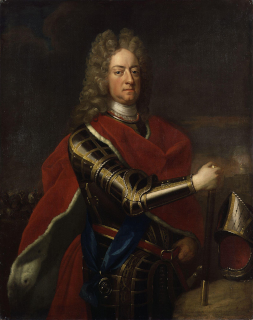
(Pictured: Portrait of James Butler, 2nd Duke of Ormonde, by Michael Dahl, National Portrait Gallery)
Butler succeeds to the title at the age of fifteen and was educated at the University of Oxford, taking the degree of LL.D. in 1677. In 1678, he is commissioned as a captain in Colonel Thomas Dongan‘s regiment, which is disbanded before he takes up his post.
In 1692, Butler is created Earl of Newcastle in County Limerick in the Jacobite peerage of Ireland. In France he is named Colonel of the 2nd Queen’s Regiment of Irish Horse in the service of that country and serves with distinction in various battles of the War of the Spanish Succession, also becoming a Lieutenant-General in the Spanish army. He is at the Siege of Roses in 1693, and in 1694 is a Brigadier attached to the army of Germany. He serves in Italy and other parts of Continental Europe from 1701 to 1703, sharing all the fortunes of the Irish Brigade. He later serves in the French army as a Lieutenant-General. He is created Brigadier of Cavalry in 1694.
Butler dies at the age of eighty-eight in Paris on June 18, 1740, and is buried at St. Paul’s there. John C. O’Callaghan writes in Irish Brigades in the Service of France (Glasgow, 1870): “The successive claimants of the title of Galmoy were officers in France down to the Revolution; in whose armies, as well as in others, various gentlemen have honourably represented a name, of which the illustrious General Lafayette is related to have said, in the war for the independence of the United States of America, that ‘whenever he wanted anything well done, he got a Butler to do it.'”
Notwithstanding the attainder, the viscountcy is assumed by his nephew, James Butler of the Irish Brigade in France, the son of the Viscount’s brother, Richard Butler of Galmoye.
The Protestant forces are taken by surprise and there is little fighting, reflected in the term “Break,” a Scottish word for rout. Victory secures eastern Ulster for the Jacobites but they fail to fully exploit their success.
While much of the Protestant population of east Ulster supports the claim of William III to thrones of Ireland, England and Scotland, the rest of Ireland, including the Lord Deputy of Ireland, Richard Talbot, 1st Earl of Tyrconnell, and the army, support James II. As a result, war breaks out in Ireland after James is deposed in the Glorious Revolution. At the start of the conflict, the Jacobites are left in control of two fortified positions at Carrickfergus and Charlemont in territory which is predominantly Williamite in sympathy. The local Williamites raise a militia and meet in a council at Hillsborough. They make an ineffective assault on Carrickfergus. However, this is easily beaten off and a local Catholic cleric named O’Hegarty reports that the Williamite are badly armed and trained.
The Jacobite commander in the north is Richard Hamilton, an experienced soldier who serves with the French military from 1671 to 1685, when he is appointed a colonel in the Irish Army. In September 1688, he and his regiment are transferred to England. When James flees into exile, he is held in the Tower of London. Released on parole by William in February, he is sent to negotiate with Talbot but drops this mission once back in Ireland. Alexander Osbourne, a Presbyterian clergyman, is sent to offer the Hillsborough council a pardon in return for surrender but they refuse, reportedly encouraged by Osbourne. On March 8, Hamilton marches north from Drogheda with 2,500 men to subdue the Williamites by force.
On March 14 Hamilton crosses the River Lagan and attacks a 3,000 strong Williamite force under Lord Mount Alexander at Dromore. Alexander’s cavalry falls back in disorder following a charge by the Jacobite dragoons. Seeing this, Hamilton orders a general advance of his infantry and the Williamite foot flee toward Dromore itself. They are overtaken in the village by the Jacobite cavalry and slaughtered, roughly 400 being killed and the rest fleeing for their lives.
Lord Mount Alexander rides to Donaghadee and takes a ship to England, while many other Protestants leave for Northern England or Scotland. Hamilton’s men capture Hillsborough, along with £1,000 and large stocks of food but fail to pursue their opponents. This allows the bulk of the militia under Rawdon and Henry Baker to reach Coleraine, then make their way to Derry, where they take part in the successful defence of the city.