seamus dubhghaill

Promoting Irish Culture and History from Little Rock, Arkansas, USA


Leave a comment

Execution of John MacBride, Irish Republican

john-macbride

Major John McBride, Irish republican, is executed by firing squad in the Stonebreakers Yard at Kilmainham Gaol in Dublin on May 5, 1916, for his participation in the 1916 Easter Rising.

MacBride is born at The Quay, Westport, County Mayo, to Patrick MacBride, a shopkeeper and trader, and the former Honoria Gill. He is educated at the Christian Brothers School in Westport and at St. Malachy’s College in Belfast. He studies medicine but gives it up and begins working with a chemist’s firm in Dublin.

He joins the Irish Republican Brotherhood (IRB) and is associated with Michael Cusack in the early days of the Gaelic Athletic Association. He also joins the Celtic Literary Society through which he comes to know Arthur Griffith, who is to remain a friend and influence throughout his life. Beginning in 1893, MacBride is termed a “dangerous nationalist” by the British government. In 1896, he travels to the United States on behalf of the IRB. Upon his return he emigrates to South Africa.

In the Second Boer War MacBride is instrumental in the raising of the Irish Transvaal Brigade and leads it into action against the British. When organised resistance collapses, he and the surviving members cross the border into Mozambique. After the war he marries Maud Gonne and they have a son, Seán MacBride, who is also to make a name for himself in Irish Politics. The marriage, however, is not a success and they go their separate ways. MacBride keeps up his associations with Republican activists but does not become personally involved other than making the odd speech in support of Ireland’s Cause.

After returning permanently from Paris to Dublin in 1905, MacBride joins other Irish nationalists in preparing for an Insurrection. Because he is so well known to the British, the leaders think it wise to keep him outside their secret military group planning a Rising. As a result, he happens to find himself in the midst of the Rising without notice.

MacBride is in Dublin early on Easter Monday morning, April 24, to meet his brother, Dr. Anthony MacBride, who is arriving from Westport to be married two days later. As MacBride walks up Grafton Street, he sees Thomas MacDonagh in uniform and leading his troops. He offers his services and is appointed second-in-command at the Jacob’s Biscuit Factory, which is occupied and held through Easter Week until the order to surrender is received. As he is dressed in civilian clothes rather than a military uniform, he could likely have escaped without too much difficulty but rather he decides to go with his comrades into captivity.

Tried by court martial under the Defence of the Realm Act, MacBride is found guilty and sentenced to death. He is executed on May 5, 1916, two days before his forty-eighth birthday. Facing the British firing squad, MacBride refuses to be blindfolded saying, “I have looked down the muzzles of too many guns in the South African war to fear death and now please carry out your sentence.”

John MacBride is buried in the cemetery at Arbour Hill Prison in Dublin.

Leave a comment

Executions of Edward Daly, Michael O’Hanrahan, Joseph Mary Plunkett, & William Pearse

plunkett-daly-ohanrahan-pearse

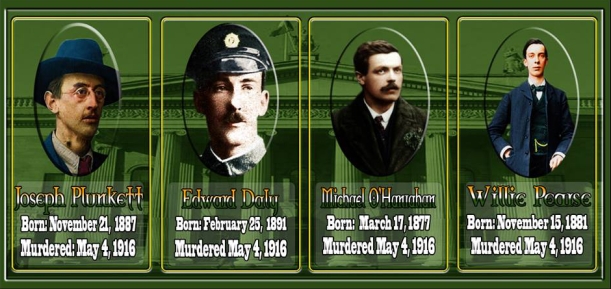
The executions of leaders and participants of the 1916 Easter Rising by the British continue as Edward Daly, Michael O’Hanrahan, Joseph Mary Plunkett, and William Pearse are executed by firing squad in the Stonebreakers Yard at Kilmainham Gaol in Dublin on May 4, 1916.

Edward Daly is born in Limerick in 1891 to a family that has a history of republican activity. His uncle, John Daly, had taken part in the rebellion of 1867. Edward Daly leads the First Battalion during the 1916 Easter Rising, which raids the Bridewell and Linenhall Barracks, eventually seizing control of the Four Courts. A close friend of Tom Clarke, their ties are made even stronger by the marriage of Clarke to Daly’s sister.

Michael O’Hanrahan is born in Wexford in 1877. As a young man, O’Hanrahan shows great promise as a writer, becoming heavily involved in the promotion of the Irish language. He founds the first Carlow branch of the Gaelic League, and publishes two novels, A Swordsman of the Brigade and When the Norman Came. Like many of the other executed leaders, he joins the Irish Volunteers from their inception and is second in command to Thomas MacDonagh at Jacob’s Biscuit Factory during the Rising, although this position is largely usurped by the arrival of John MacBride.

Joseph Mary Plunkett is born in Dublin in 1887, the son of a papal count. Plunkett is initially educated in England, though he returns to Ireland and graduates from University College Dublin in 1909. After his graduation, Plunkett spends two years traveling due to ill health, returning to Dublin in 1911. Plunkett shares Thomas MacDonagh’s enthusiasm for literature and is an editor of the Irish Review. Along with MacDonagh and Edward Martyn, he helps to establish an Irish national theatre. He joins the Irish Volunteers in 1913, subsequently gaining membership of the Irish Republican Brotherhood in 1914. Plunkett travels to Germany to meet Roger Casement in 1915. During the planning of the Rising, Plunkett is appointed Director of Military Operations, with overall responsibility for military strategy. Plunkett is stationed in the General Post Office during the Rising. Seven hours prior to his execution, Plunkett marries his sweetheart, Grace Gifford, in the prison chapel.

William “Willie” Pearse, the younger brother of Patrick, is born in Dublin in 1881. Willie shares his brother’s passion for an independent Ireland. He assists Patrick in running St. Enda’s School. The two brothers are extremely close and fight alongside each other in the General Post Office. He is not one of the planners of the revolt, nor is he one of its commanders. Willie is merely one of the soldiers involved with the Dublin actions. No other participant in Dublin whose actions or responsibilities are similar to Willie’s is executed in the days following the Rising, save perhaps John MacBride, whose earlier service with the Boers probably marks him for death. It seems likely that the sole reason Willie is executed by the British government is for the crime of being Patrick’s brother. It is repugnant British excesses such as this that soon reverse the Irish people’s initially negative opinion of the 1916 Easter Rising.


Leave a comment

Executions of Patrick Pearse, Thomas Clarke, & Thomas MacDonagh

pearse-clarke-mac-donagh

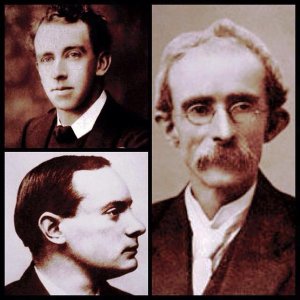
Patrick Pearse, Thomas Clarke, and Thomas MacDonagh are executed by firing squad in the Stonebreakers’ Yard at Kilmainham Gaol in Dublin on May 3, 1916. Pearse, Clarke, and MacDonagh are three of the seven signatories of the Proclamation of the Irish Republic.

Just three days after the end of the 1916 Easter Rising, the first military courts martial sits on May 2, 1916. Pearse, Clarke, and MacDonagh are immediately sentence to death. The three are taken that evening to the disused Kilmainham Gaol and are shot at dawn the following morning.

Patrick Pearse is born in Dublin in 1879, becoming interested in Irish cultural matters in his teenage years. In 1898, Pearse becomes a member of the Executive Commmittee of the Gaelic League. He graduates from the Royal University of Ireland in 1901 with a degree in Arts and Law. Pearse’s literary output is constant, and he publishes extensively in both Irish and English, becoming the editor of An Claidheamh Soluis, the newspaper of the Gaelic League. He is a keen believer in the value of education, and establishes two schools, Coláiste Éanna and Coláiste Íde, devoted to the education of Irish children through the Irish language.  Pearse is one of the founding members of the Irish Volunteers and the author of the Proclamation of the Irish Republic. He is Commander in Chief of the Irish forces and headquartered in the General Post Office (GPO) during the 1916 Easter Rising.

Thomas Clarke is born on the Isle of Wight in 1857, the son of a soldier in the British army. During his time in America as a young man, he joins Clan na Gael, later enduring fifteen years (1883-1898) of penal servitude for his role in a bombing campaign in London. In 1907, having returned from a second sojourn in America, his links with Clan na Gael in America copper-fastens his importance to the revolutionary movement in Ireland. He holds the post of Treasurer to the Irish Republican Brotherhood (IRB) and is a member of the Supreme Council from 1915. Clarke is the first signatory of the Proclamation of the Irish Republic through deference to his seniority. Clarke is also stationed at the GPO during Easter Week. Clarke tells his wife during his final night that he is relieved he is going to be executed because his greatest dread is that he would be sent back to prison.

Thomas MacDonagh is a native of Tipperary, born in 1878. He spends the early part of his career as a teacher. He moves to Dublin to study and is the first teacher on the staff at St. Enda’s School, the school he helps to found with Patrick Pearse. MacDonagh is well versed in literature, his enthusiasm and erudition earning him a position in the English department at University College Dublin. His play When the Dawn is Come is produced at the Abbey Theatre. He is appointed director of training for the Irish Volunteers in 1914, later joining the Irish Republican Brotherhood (IRB). MacDonagh is appointed to the IRB military committee in 1916. He is commander of the Second Battalion of Volunteers that occupies Jacob’s Biscuit Factory and surrounding houses during the Rising.

Immediately after the executions, Irish Parliamentary Party leader John Redmond warns British Prime Minister Herbert Asquith that “if any more executions take place in Ireland the position will become impossible for any constitutional party or leader.”

Asquith himself warns Sir John Maxwell that “anything like a large number of executions would…sow the seeds of lasting trouble in Ireland.”

These warnings fall upon deaf ears as thirteen additional executions take place in the following days.


Leave a comment

Birth of Sculptor John Edward Jones

john-edward-jones-busts

John Edward Jones, noted Irish civil engineer and sculptor in Dublin and London, is born in Dublin on May 2, 1806.

Jones is the son of miniature painter Edward Jones. Under the identity of “J. Jones,” architect, 7 Amiens Street, North Strand, Dublin, he exhibits several watercolors at the Royal Hibernian Academy in 1828 and 1829, including his View of the Town of Youghall, showing the proposed Chain Bridge (1828) and Design for a Viaduct (1829). He studies engineering under Alexander Nimmo and works for him on major engineering projects in Ireland including the building of the bridge at Waterford from 1829-1832, which he directs. He is listed as a civil engineer in Wilson’s Dublin Directory for the years 1833-35 with an office address at the Commercial Buildings, Dame Street. In 1839, he is awarded a Telford Medal in silver and 20 guineas for his paper and drawings on the sewage in Westminster.

In 1840, Jones ceases his engineering practice to become a sculptor in London, with considerable success, particularly in portrait busts of notables. Among his sitters are Queen Victoria, Albert, Prince Consort, Louis-Philippe, Napoleon III, the Duke of Cambridge, the Duke of Wellington, Lord Brougham, the Earl of Clarendon, Lord Palmerston, Daniel O’Connell, and Lord Gough. Among his few full-length statues is one of Sir R. Ferguson at Londonderry. He exhibits at the Royal Academy of Arts from 1854-1862.

Jones dies on July 25, 1862, while visiting Finglas, near Dublin, and is buried in Mount Jerome Cemetery.


Leave a comment

Death of Diarmait Mac Murchada, Irish King of Leinster

diarmait-mac-murchada

Diarmait Mac Murchada, Irish King of Leinster whose appeal to the English for help in settling an internal dispute leads to the Anglo-Norman invasion and conquest of Ireland by England, dies on May 1, 1171, of “an insufferable and unknown disease.”

Mac Murchada is born around 1110, the son of Donnchad mac Murchada, King of Leinster and Dublin. His father is killed in battle in 1115 by his cousin Sigtrygg Silkbeard, king of the Dublin Vikings, and is buried by them in Dublin along with the body of a dog which is considered to be a huge insult.

After the death of Énna Mac Murchada, his older brother, Mac Murchada unexpectedly becomes King of Leinster. This is opposed by the High King of Ireland, Toirdelbach Ua Conchobair, who fears that Mac Murchada will become a rival. Toirdelbach sends one of his allied Kings, the belligerent Tigernán Ua Ruairc, to conquer Leinster and oust the young Mac Murchada. Ua Ruairc goes on a brutal campaign slaughtering the livestock of Leinster and thereby trying to starve the province’s residents. Mac Murchada is ousted from his throne but is able to regain it with the help of Leinster clans in 1132. Two decades of an uneasy peace followed between Ua Conchobair and Mac Murchada. In 1152 he even assists the High King in a raid of the land of Ua Ruairc who has become a renegade.

As King of Leinster, between 1140–70, Mac Murchada commissions Irish Romanesque churches and abbeys at Baltinglass, Glendalough, Ferns, and Killeshin. He sponsors convents at Dublin, two at Aghade, County Carlow, and at Kilculliheen near Waterford city. He also sponsors the successful career of churchman St. Lorcán Ua Tuathail and presides at the synod of Clane in 1161 when Ua Tuathail is installed as archbishop of Dublin.

In 1166, Ireland’s new High King and Mac Murchada’s only ally, Muirchertach Ua Lochlainn, has fallen and a large coalition led by Mac Murchada’s arch enemy, Tigernán Ua Ruairc, marches on Leinster. The High King deposes Mac Murchada from the throne of Leinster, and he flees to Wales and from there to England and France seeking the support of Henry II of England in the recruitment of soldiers to reclaim his kingship. Henry authorises Mac Murchada to seek help from the soldiers and mercenaries in his kingdom. Those who agreed to help include Richard de Clare (Strongbow) and half-brothers Robert FitzStephen and Maurice FitzGerald.

In Mac Murchada’s absence, Ruaidrí Ua Conchobair, son of Mac Murchada’s former enemy, the High King Toirdelbach Ua Conchobair, has become the new High King of Ireland.

Mac Murchada brings an advance party of adventurers back to Ireland in 1167, recaptures Wexford, and waits for Strongbow to arrive. From his base in Wales, Strongbow launches an offensive in 1170, capturing Waterford and Dublin, taking control of the East coast, much to the dismay of the Gaelic Chieftains and Ua Conchobair. To cement the alliance, Mac Murchada marries his daughter, Aoife, to Strongbow, in Christ Church Cathedral in Dublin 1170.

The Irish Chieftains do not allow the invaders to settle, however, and they are continually attacked and harassed. It begins to appear likely that they will be driven from Ireland. However, they receive support from Henry II, who has become concerned about the amount of power and influence that Strongbow is amassing in Ireland. The subsequent domination of South Wales by the Normans is a result of the need to keep supply lines into Eastern Ireland open.

Mac Murchada dies on May 1, 1171, leaving Strongbow to declare himself King of Leinster. Mac Murchada is buried in the Cathedral graveyard of Ferns village.


Leave a comment

“Riverdance” Performed for the First Time

riverdance-1994

Riverdance, a theatrical show consisting of traditional Irish music and dance and featuring Irish dancing champions Jean Butler and Michael Flatley and a score composed by Limerick native Bill Whelan, is performed for the first time on April 30, 1994, as an interval performance act during the 1994 Eurovision Song Contest at the Point Theatre in Dublin.

Riverdance is rooted in a three-part suite of baroque-influenced traditional music called Timedance composed, recorded, and performed for the 1981 Eurovision Song Contest, which is hosted by Ireland. At the time, Bill Whelan and Dónal Lunny compose the music, augmenting the Irish folk band Planxty with a rock rhythm section of electric bass and drums and a four-piece horn section. The piece is performed, with accompanying ballet dancers, during the interval of the contest, and later released as a Planxty single. Whelan has previously produced EastWind, an album by Planxty member Andy Irvine with Davy Spillane who’s cross between Irish and Southeastern European folk music proves an influence on Riverdance. Thirteen years later, Bill Whelan is invited to do the intermission piece for another Eurovision Song Contest in Dublin and composes Riverdance. In the book The Humours of Planxty by Leagues O’Toole, Whelan says, “It was no mistake of mine to call it Riverdance because it connected absolutely to Timedance.”

The 1994 performance earns a standing ovation from the packed theatre of 3,000 people. As a result of this success, Riverdance is invited to perform at the prestigious Royal Variety Performance at Dominion Theatre, London, in the presence of Prince Charles on November 28, 1994.

At Congratulations: 50 Years of the Eurovision Song Contest and Eurovision Song Contest’s Greatest Hits events, the seven-minute performance is named as one of the most popular interval acts in the history of the contest.

An audio recording of Riverdance enters the Irish Singles Chart at number one on May 5, 1994, and remains there throughout the summer, eventually totalling a record eighteen weeks at #1. In response to the Rwandan genocide of May/June 1994, a video of the Eurovision interval performance is released by the Irish broadcaster Raidió Teilifís Éireann under the title Riverdance for Rwanda with all proceeds going to the Rwanda Appeal Disasters Joint Appeal Committee.

The success of the Eurovision performance leads husband and wife production team John McColgan and Moya Doherty to consider how to develop the piece. They decide to produce and direct a stage show, expanding the Eurovision piece and Bill Whelan’s composition. In November 1994, tickets are sold in Dublin for the first full-length performance of Riverdance, which opens at the Point Theatre on February 9, 1995. The show runs for five weeks and is a sell out with over 120,000 tickets sold. It stars the original lead dancers from the Eurovision performance as well as many from the dance troupe featured in the Eurovision performance.

Riverdance continues to be performed all over the world, in a diminished format and in smaller venues. Current productions are geared towards smaller theatres, whereas past productions have been performed in large theatres and arenas. Sets have been simplified, and some numbers contain fewer performers than in past productions.


Leave a comment

Rebels Surrender Ends the 1916 Easter Rising

pearse-surrenders-to-lowe

The Irish Volunteers and Irish Citizen Army rebels headquartered at the General Post Office (GPO) on Sackville Street, after days of shelling, are forced to abandon their headquarters when fire caused by the shells spreads to the GPO. James Connolly, Commandant of the Dublin Brigade, has been incapacitated by a bullet wound to the ankle and has passed command on to Patrick Pearse. Michael Joseph O’Rahilly, a founding member of the Irish Volunteers, is killed in a sortie from the GPO. The rebels tunnel through the walls of the neighbouring buildings in order to evacuate the Post Office without coming under fire and take up a new position at 16 Moore Street.

On Saturday, April 29, 1916, from the new headquarters on Moore Street, after realising that they will not break out of this position without further loss of civilian life, Pearse issues an order for all companies to surrender. Pearse surrenders unconditionally to Brigadier-General William Henry Muir Lowe (photo). The surrender document reads:

“In order to prevent the further slaughter of Dublin citizens, and in the hope of saving the lives of our followers now surrounded and hopelessly outnumbered, the members of the Provisional Government present at headquarters have agreed to an unconditional surrender, and the commandants of the various districts in the City and County will order their commands to lay down arms.”

The other posts surrender only after Pearse’s surrender order, carried by nurse Elizabeth O’Farrell, reaches them. Sporadic fighting, therefore, continues into Sunday, April 30, when word of the surrender is received by the other rebel garrisons. Command of British forces has passed from Lowe to General John Maxwell, who arrives in Dublin just in time to accept the surrender. Maxwell is made temporary military governor of Ireland.

The surrender signals the end of the 1916 Easter Rising, the most significant campaign in the struggle for Irish independence since the Irish Rebellion of 1798. The Rising leaves large parts of the city decimated and results in thousands of casualties. It is also, unambiguously, a spectacular military failure. And yet it is the spark that lights the fuse on the Irish War of Independence which, within five years, forces the British government to the negotiating table to discuss the terms of Irish independence.

Martial law, which was declared in Dublin by British authorities, remains in effect in Ireland through the fall of 1916.

The 1916 Easter Rising results in at least 485 deaths, according to the Glasnevin Trust. More than 2,600 are wounded, including at least 2,200 civilians and rebels, at least 370 British soldiers, and 29 policemen. The vast majority of the Irish casualties are buried in Glasnevin Cemetery in the aftermath of the fighting. British families come to Dublin Castle in May 1916 to reclaim the bodies of British soldiers and funerals are arranged. Soldiers whose bodies are not claimed are given military funerals in Grangegorman Military Cemetery.


Leave a comment

The Battle of Ashbourne

fingal-brigade-ira

As the end of the 1916 Easter Rising becomes increasingly apparent and the rebels in Dublin are being squeezed harder and harder by the British forces, the rebels outside the city achieve a small victory on Friday, April 28, 1916, in what comes to be known as the Battle of Ashbourne.

The Battle of Ashbourne is a direct confrontation and gun battle between up to 70 members of the Royal Irish Constabulary (RIC) and about 37 Irish Volunteers, led by Thomas Ashe and Richard Mulcahy. It is one of the few engagements outside of Dublin city centre and is, in contrast to the main Rising in Dublin, a successful one.  It is also an example of the guerilla warfare that becomes a normal method of operation during the Irish War of Independence.

After the Volunteers battalion is mobilized on Easter Sunday, they are split into smaller groups, known as flying columns, and are sent north of Dublin city towards Ashbourne. Their mission is to destroy the railway line near Batterstown and disrupt the movement of British troops into the city. They set out by bicycles, mostly armed with shotguns. After raiding a number of barracks in the area, cutting communications, and collecting rifles, they reach the Cross of the Rath at Ashbourne.

There they are met with a barricade that has been hastily erected by the RIC members stationed in the barracks nearby. The RIC constables quickly surrender and are sent to the barracks to order a full surrender, but they do not return. The Volunteers take up positions across the road while James O’Connor and Ashe try to break in the door. The constables begin firing from the upper windows of the building and a gun battle breaks out.

The fighting intensifies as RIC reinforcements arrive from Navan, Dunboyne, and Slane. Two Volunteers, John Crennigan and Thomas Rafferty, are fatally wounded. When District Inspector Gray is killed, the constables surrender and are taken prisoner. The Volunteers gather their arms and ammunition while Ashe warns the constables that they will be shot if they take up arms against the Irish people again.

In total, fourteen people are killed in the battle – two Volunteers, eight RIC members, two civilians driving the RIC cars, and two innocent civilians caught in the crossfire. Many more are injured.

The Volunteers’ victory is short lived, however, as in the early afternoon of the next day Ashe receives word of the surrender in Dublin. He demobilises the battalion and sends the men home. Many, including O’Connor, are arrested within days and interned in Wakefield Prison and Frongoch Internment Camp.

Ashe eventually spends time in jail for his role in the uprising and is jailed again in 1917. He begins a hunger strike on September 20, demanding POW status. Ashe dies after just five days on hunger strike from injuries received while being force-fed. The manner of his death outrages the Irish population.

As a side note, Thomas Ashe is a cousin of actor Gregory Peck.


Leave a comment

Birth of Cecil Day-Lewis, Poet & Poet Laureate of the U.K.

Cecil Day-Lewis, poet, novelist, critic, and the Poet Laureate of the United Kingdom from 1968 to 1972, is born in Ballintubbert, County Laois, on April 27, 1904. He also writes mystery stories under the pseudonym of Nicholas Blake and is the father of actor Daniel Day-Lewis and documentary filmmaker and television chef Tamasin Day-Lewis.

Day-Lewis is the son of Frank Day-Lewis, Church of Ireland Rector of the parish, and Kathleen Blake. His father takes the surname “Day-Lewis” as a combination of the surnames of his own birth father (Day) and his adoptive father (Lewis). After the death of his mother in 1906, Day-Lewis is brought up in London by his father, with assistance of an aunt, spending summer holidays with relatives in County Wexford. He is educated at Sherborne School and at Wadham College, Oxford. In Oxford, Day-Lewis becomes part of the circle gathered around W. H. Auden and helps him to edit Oxford Poetry 1927. His first collection of poems, Beechen Vigil, appears in 1925.

In 1928, Day-Lewis marries Constance Mary King, the daughter of a Sherborne teacher, and works as a schoolmaster in three schools, including Larchfield School in Helensburgh, Scotland. During the 1940s he has a long and troubled love affair with the novelist Rosamond Lehmann. His first marriage is dissolved in 1951, and he marries actress Jill Balcon, daughter of Michael Balcon.

During World War II he works as a publications editor in the Ministry of Information, an institution satirised by George Orwell in his dystopian Nineteen Eighty-Four. During this time his work is now no longer as heavily influenced by Auden, and he develops a more traditional style of lyricism. Some critics believe that he reaches his full stature as a poet in Word Over All (1943), when he finally distances himself from Auden. After the war he joins the publisher Chatto & Windus as a director and senior editor.

In 1946, Day-Lewis is a lecturer at Cambridge University, publishing his lectures in The Poetic Image (1947). He later teaches poetry at the University of Oxford, where he is Professor of Poetry from 1951 until 1956. He is the Norton Professor at Harvard University from 1962 to 1963, and is appointed Poet Laureate in 1968, in succession to John Masefield.

Day-Lewis is chairman of the Arts Council Literature Panel, vice-president of the Royal Society of Literature, an Honorary Member of the American Academy of Arts and Letters, a Member of the Irish Academy of Letters, and a Professor of Rhetoric at Gresham College, London.

Cecil Day-Lewis dies of pancreatic cancer on May 22, 1972, at Lemmons, the Hertfordshire home of Kingsley Amis and Elizabeth Jane Howard, where he and his family are staying. Being a great admirer of Thomas Hardy, he arranges to be buried as close as possible to the author’s grave at St. Michael’s Church in Stinsford, Dorset.


Leave a comment

The Battle of Mount Street Bridge

mount-street-bridge

Some of the bloodiest fighting of the 1916 Easter Rising occurs one hundred years ago today during the Battle of Mount Street Bridge on Wednesday, April 26, 1916.

Some of the rebel positions in Dublin are isolated and are bombarded from a distance. They barely see a British soldier during the six days of the Rising. The fighting is much bloodier when the British assault Volunteer positions dominating the routes into the city. In such instances, street fighting, snipers, and sudden close-range crossfires are prevalent. This happens mainly at three locations, Mount Street Bridge, South Dublin Union/Marrowbone Lane, and North King Street.

At Mount Street, on the approach to the city centre from the port at Kingstown, now known as Dún Laoghaire, a volunteer outpost manned by only 17 men under the command of Lieutenant Michael Malone and armed with rifles and hand guns, faces the frontal assault of a reinforcement column of British troops.

The reinforcement column meets its first resistance when it pauses at Carisbrook House. They respond to sniper fire by riddling the house, though it does not contain any Volunteers. The column, however, is thus alerted that Volunteers are in the area. They go no more than 500 yards further when they come under sustained fire from two Volunteers in 25 Northumberland Road. It takes five hours of sustained firing to dislodge the defenders. Ten British soldiers fall at the first volley. Volunteers in the other outposts nearby also begin picking off the attackers who are exposed to their fire.

Finally, the house is rushed, and Volunteer Lieutenant Malone is shot dead. The other Volunteer in the house, Section Commander James Grace, succeeds in hiding himself behind a cooker and escapes the area several hours later. He is arrested a few days later.

While the British soldiers attack 25 Northumberland Road, they also move against the Schoolhouse and the Parochial Hall, which is located between 25 Northumberland Road and Clanwilliam House. The Parochial Hall is held by four men, P.J. Doyle in command, Joe Clarke, William Christian, and J. McGrath. The Volunteers continue a fierce firefight until flames drive them from their stations.

The fight at Clanwillaim House continues as British soldiers try in vain to cross Mount Street Bridge. When the house is eventually engulfed in flames and their ammunition spent, the surviving four Volunteers escape over the back wall. When the final charge comes, one officer throws a grenade at one of the remaining intact windows, but it bounces back and explodes, killing him.

Up to 250 British soldiers are killed or wounded and their morale shattered by the gallant band of Volunteers around Mount Street and the British advance is delayed by a day. The fighting at Mount Street results in almost two thirds of British casualties in Easter week. Four Volunteers, Michael Malone, Dick Murphy, George Reynolds, and Patrick Doyle, lose their lives in the battle. Five others escape arrest, while four are captured, including Joe Clarke.

Clarke and his comrades from the other outposts are first brought to Ladd Lane Barracks, before joining the other captured Volunteers and those who surrender at the end of the week. Eventually, they are transported to British jails to serve their sentence or to be interned.