seamus dubhghaill

Promoting Irish Culture and History from Little Rock, Arkansas, USA


Leave a comment

The Kilmainham Treaty Signed by Parnell and Gladstone

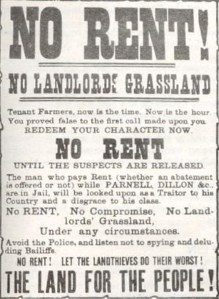
land-league-posterThe Kilmainham Treaty, an informal agreement between Liberal British Prime Minister William Ewart Gladstone and the Irish nationalist leader Charles Stewart Parnell, is signed on April 25, 1882.

The agreement extends the terms of the Second Land Act of 1881, with which Gladstone intends to make broad concessions to Irish tenant farmers. But the Act has many weaknesses and fails to satisfy Parnell and the Irish Land League because it does not provide a regulation for rent-arrears or rent-adjustments in the case of poor harvests or deteriorated economic conditions.

After the Second Land Act becomes law on August 22, 1881, Parnell, in a series of speeches in September and October, launches violent attacks on Chief Secretary for Ireland William Forster and even on Gladstone. Gladstone warns him not to frustrate the Act, but Parnell repeats his contempt for the Prime Minister. On October 12, the Cabinet, fully convinced that Parnell is bent on ruining the Act, takes action to have him arrested in Dublin the next day.

Parnell is conveyed to Kilmainham Gaol, where he joins several other prominent members of the Land League who have also protested against the Act and been jailed. There, together with William O’Brien, he enacts the No Rent Manifesto campaign. He is well aware that some in the Liberal Cabinet, in particular Joseph Chamberlain, are opposed to the mass internment of suspects then taking place across Ireland under the Protection of Person and Property Act 1881. The repressions do not have the desired effect, with the result that Forster becomes isolated within the Cabinet, and coercion becomes increasingly unpopular with the Liberal Party.

In gaol Parnell begins to turn over in his mind the possibility of coming to an arrangement with the Government. He has been corresponding with Katharine O’Shea who engages her husband, Captain William O’Shea, in April 1882 to act as a go-between for negotiations on behalf of Parnell. O’Shea contacts Gladstone on May 5 having been informed by Parnell that should the Government settle the rent-arrears problem on the terms he proposes, he is confident that he can curtail outrages. He further urges for the quick release of the League’s organizers in the West who will then work for pacification. This shocks Forster but impresses Gladstone.

Accordingly on May 2, Gladstone informs the House of Commons of the release of Parnell and the resignation of Forster. Gladstone always denies there has been a “Kilmainham Treaty,” merely accepting that he “had received informations.” He keeps his side of the arrangement by subsequently having the Arrears of Rent Act 1882 enacted. The government pays the landlords £800,000 in back rent owed by 130,000 tenant farmers.

Calling the agreement a “treaty” shows how Parnell manages to place a spin on the agreement in a way that strengthens Irish nationalism, since he manages to force concessions from the British while in gaol. Since real treaties are usually signed between two states, it leads to the idea that Ireland could become independent from Britain. After the “treaty” is agreed, those imprisoned with Parnell are released from gaol. This transforms Parnell from a respected leader to a national hero.

The Phoenix Park Murders, in which two top British officials in Ireland are assassinated, take place four days later and undo much of the goodwill generated by it in Britain. Though strongly condemned by Parnell, the murders show that he cannot control nationalist “outrages” as he has undertaken to do.
Leave a comment

The Beginning of the 1916 Easter Rising

proclamation-of-independence

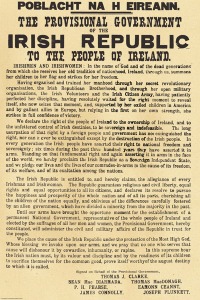
The Easter Rising, also known as the Easter Rebellion, begins in Dublin on April 24, 1916, and lasts for six days. The Rising, organised by seven members of the Military Council of the Irish Republican Brotherhood, is launched to end British rule in Ireland and establish an independent Irish Republic while the United Kingdom is heavily engaged in World War I. It is the most significant uprising in Ireland since the Irish Rebellion of 1798, and the first armed action of the Irish revolutionary period.

Shortly before midday, members of the Irish Volunteers, led by schoolmaster and Irish language activist Patrick Pearse and joined by the smaller Irish Citizen Army of James Connolly and 200 women of Cumann na mBan, seize key locations in Dublin and proclaim an Irish Republic. The rebels’ plan is to hold Dublin city centre, a large, oval-shaped area bounded by the Grand Canal to the south and the Royal Canal to the north, with the River Liffey running through the middle.

The rebels march to the General Post Office (GPO) on O’Connell Street, Dublin’s main thoroughfare, and occupy the building and hoist two republican flags. Pearse stands outside and reads the Proclamation of the Irish Republic.

Elsewhere in Dublin, some of the headquarters battalion under Michael Mallin occupy St. Stephen’s Green, where they dig trenches and barricade the surrounding roads. The 1st battalion, under Edward “Ned” Daly, occupy the Four Courts and surrounding buildings, while a company under Seán Heuston occupies the Mendicity Institution across the River Liffey from the Four Courts. The 2nd battalion, under Thomas MacDonagh, occupies Jacob’s Biscuit Factory. The 3rd battalion, under Éamon de Valera, occupy Boland’s Mill and surrounding buildings. The 4th battalion, under Éamonn Ceannt, occupy the South Dublin Union and the distillery on Marrowbone Lane. From each of these garrisons, small units of rebels establish outposts in the surrounding area.

There are isolated actions in other parts of Ireland, with attacks on the Royal Irish Constabulary barracks at Ashbourne, County Meath and in County Galway, and the seizure of the town of Enniscorthy, County Wexford. Due to a last-minute countermand issued on Saturday, April 22, by Volunteer leader Eoin MacNeill, the number of rebels who mobilise is much lower than expected.

The British Army brings in thousands of reinforcements as well as artillery and a gunboat. There is fierce street fighting on the routes into the city centre, where the rebels put up stiff resistance, slowing the British advance and inflicting heavy casualties. Elsewhere in Dublin, the fighting mainly consists of sniping and long-range gun battles. The main rebel positions are gradually surrounded and bombarded with artillery.

With much greater numbers and heavier weapons, the British Army suppresses the Rising, and Pearse agrees to an unconditional surrender on Saturday, April 29. Almost 500 people are killed during Easter Week. About 54% are civilians, 30% are British military and police, and 16% are Irish rebels. More than 2,600 are wounded. Many of the civilians are killed as a result of the British using artillery and heavy machine guns, or mistaking civilians for rebels. Others are caught in the crossfire in a crowded city. The shelling and the fires leave parts of inner-city Dublin in ruins.

After the surrender the country remains under martial law. About 3,500 people are taken prisoner by the British, many of whom have played no part in the Rising, with 1,800 of them being sent to internment camps or prisons in Britain. Most of the leaders of the Rising are executed following courts-martial. The Rising brings physical force republicanism back to the forefront of Irish politics, which for nearly 50 years has been dominated by constitutional nationalism. It, and the British reaction to it, leads to increased popular support for Irish independence. In December 1918, republicans, represented by the reconstituted Sinn Féin party, win a landslide victory in the general election to the British Parliament. They do not take their seats but instead convene the First Dáil and declare the independence of the Irish Republic, which ultimately leads to the Irish War of Independence.


Leave a comment

The Battle of Clontarf

battle-of-clontarf

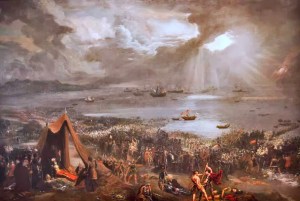
The Battle of Clontarf takes place on Good Friday, April 23, 1014, at Clontarf, near Dublin, on the east coast of Ireland. The battle is the culmination of two centuries of strife, treachery, failed alliances and treaties that pits the forces of Brian Boru, high king of Ireland, against a Norse-Irish alliance comprised of the forces of Sigtrygg Silkbeard, king of Dublin, Máel Mórda mac Murchada, king of Leinster, and a Viking contingent led by Sigurd of Orkney and Brodir of Mann.

The first Norsemen, also known as Vikings, arrive in Ireland some two centuries earlier, initially plundering the gold, chalices, crosses, and manuscripts of the monasteries and the corn harvests of the settled communities. Gradually they establish Viking settlements around Ireland and engage in trade and commerce.

There is, however, significant opposition to their presence in Ireland, not least in Munster where King Brian Boru has defeated their armies on several occasions. Brian’s aim is to unite all the warring Celtic kingdoms under one rule and one High King.

In 1013, Máel Mórda, the king of Leinster goes into revolt after inter-marriage alliances with Brian have broken down and joins forces with the Vikings. Together, they initially attack the kingdom of Mael Sechlainn of Meath who summons the help of King Brian. Brian sets off toward Dublin with 4,900 troops. Opposing them are Máel Mórda’s army of 4,000 Leinster men allied to 3,000 Viking warriors.

Although but a small segment of the battle is fought close to the seafront at Clontarf, the historic encounter of Good Friday 1014 enters the annals as the Battle of Clontarf. This is largely because some 2,000 Vikings had landed in longboats at Clontarf by sunrise on the morning of April 23.

As the two opposing armies face one another, the Vikings and the Leinster men are lined across the sloping plains bounded by the sea and the River Tolka, while King Brian’s army occupies the rising ground near Tomar’s Wood in Phibsborough.

The most ferocious part of the battle is fought at the “Battle of the Fishing Weir,” which approximates to the site of the former D.W.D. Whiskey Distillery on Richmond Road. Historic accounts of the battle also refer to the “savage encounters” fought on the “Bloody Fields of Marino” and what is today Phibsboro and Cross Guns.

The result of the bloodiest day in ancient Ireland is a rout for King Brian, although some 4,000 of his troops are killed on the battlefield. In contrast some 6,000 Leinster men and Vikings are slaughtered including every single Viking leader. King Brian’s army drives the fleeing Vikings back towards the sea at Clontarf.

Although Brian has won the greatest victory of his long career, he does not live long to enjoy it. As he kneels praying in his tent near Cross Guns, the Isle of Man Viking Leader, Brodir, who is hiding in the adjacent woods, runs into his tent and kills the 84-year-old Brian with his axe. Brodir is later captured and slaughtered by Ulf the Quarrelsome, the younger brother of King Brian.

The Battle of Clontarf is the watershed of all the hatred, division, and rivalries that have consumed Ireland for centuries. A period of relative peace follows where the Celtic chieftains and the Vikings live together in a spirit of harmony with the emphasis on greater integration, cooperation, and commerce.


Leave a comment

Postponement of the Easter Rising

general-post-office

On Saturday, April 22, 1916, the Easter Rising, originally planned for the following day, Easter Sunday, is postponed for one day.

At dawn a messenger from the Kerry Volunteers arrives in Dublin and informs James Connolly, Commandant of the Dublin Brigade, that Roger Casement had been arrested in County Kerry the previous day during a failed attempt to smuggle arms into Ireland on board the German ship Aud. A meeting of the Military Council is hastily organised, and the decision is made not to inform Chief-of-Staff of the Irish Volunteers, Eoin MacNeill, about Casement’s arrest.

Later in the morning, after attempting to escape the area, Karl Spindler, captain of the Aud, makes the decision to scuttle his ship after it is intercepted by the Royal Navy. Although Spindler and the crew are rescued, the armaments on board the Aud are lost. By early afternoon the Military Council is made aware of the loss of their arms shipment.

At 6:00 PM, Sean Fitzgibbon, Colm O’Loughlin, and Michael Joseph O’Rahilly arrive at Woodtown Park and inform MacNeill of the arrests and the loss of the Aud. After confronting Patrick Pearse at St. Enda’s School, a bilingual school for boys founded by Pearse, MacNeill and others, including O’Rahilly and Bulmer Hobson, gather at the house of Seumas O’Kelly on Rathgar Road and a decision is made to issue countermanding orders cancelling the Rising planned for Easter Sunday. To make sure that the countermanding order is received and understood, James Ryan is sent overnight to Cork, Colm O’Loughlin to Dundalk and Coalisland, Sean Fitzgibbon to Waterford, and Min Ryan to Wexford. O’Rahilly travels to Limerick, Kerry, Cork, and Tipperary. This succeeds in delaying the rising for only one day, although it greatly reduces the number of Volunteers who turn out.

During the evening, Major-General Sir Lovick Friend, General Officer Commanding of British forces in Ireland, travels to London on leave in wake of the capture of the Aud believing that any potential insurgency has been stopped. Chief Secretary Augustine Birrell is also in London having attended a Cabinet meeting. Both men remain in London through Easter, leaving Under Secretary Matthew Nathan as the most senior British official remaining in Dublin. Lord Lieutenant of Ireland, Ivor Churchill Guest, 1st Viscount Wimborne, urges Nathan to order the arrest of a large number of rebel leaders however he is unwilling to do so without the authorisation of Chief Secretary Birrell.


Leave a comment

Birth of Maurice Walsh, Author of “The Quiet Man”

maurice-walsh

Maurice Walsh, Irish novelist best known for the short story The Quiet Man which is later made into an Oscar-winning movie, is born on April 21, 1879, in Ballydonoghue near Listowel, County Kerry.

Walsh is the third child of ten and the first son born to John Walsh, a local farmer, and his wife Elizabeth Buckley who live in a three-room thatched farmhouse. John Walsh’s main interests are books and horses and he himself does little work about the farm, preferring to have a hired man. The most famous of these hired men is Paddy Bawn Enright, whose name is immortalised by Walsh in his story The Quiet Man, although the name is not used in the later motion picture. John Walsh passes on to his son not only a love of books but also legends and folk tales that are later featured of many of Walsh’s books.

Walsh goes to school in Lisselton, a mile or so up the road from Ballydonoghue, and later goes to St. Michael’s College in Listowel to prepare for the Civil Service examination. He enters the service on July 2, 1901, as an Assistant Revenue Officer in the Customs and Excise Service. He is posted to Scotland before the year is out and, although he subsequently has a number of postings outside Scotland, he spends most of his time there while in the British service.

Walsh has a life-long interest in writing and, during his early years in Scotland, this interest starts to bear fruit. He submits some of his stories and has two published in the Irish Emerald in 1908. Later that year, on August 8, 1908, Walsh marries Caroline Begg in Dufftown, Banffshire, Scotland.

When the Irish Free State is formed in 1922, Walsh transfers to its excise service and moves to Dublin. Fighting is still going on there at the time, and he leaves his family in Scotland until it is safe for them to join him in 1923. The story The Key Above the Door is written during the months of separation although it is not published until some years later, appearing first in Chambers Journal as a serial between December 1925 and May 1926 and then in book form, published by W & R Chambers Ltd., in July 1926.

Sales of Walsh’s books grow steadily, especially in the wake of an unsolicited and generous letter from J. M. Barrie, the creator of Peter Pan, praising The Key Above the Door, which Chambers is subsequently able to use on dust covers of Walsh’s books.

Walsh retires from government service in 1933 but his success as a writer continues. In that same year he sells a story to The Saturday Evening Post, then a well-known weekly magazine published in the United States. That story, later to be incorporated in the collection of stories published under the title Green Rushes, is The Quiet Man.

Director John Ford reads the story in 1933 and soon purchases the rights to it for $10. Walsh is paid another $2,500 when Republic Pictures buys the idea and receives a final payment of $3,750 when the film is actually made. Filming commences on June 7, 1951, with John Wayne and Maureen O’Hara in the leading roles. All of the outdoor scenes are shot on location in County Mayo and County Galway. The inside scenes are filmed in late July at the Republic Studios in Hollywood. The Quiet Man wins the Academy Award for Best Director for John Ford, his fourth, and for Best Cinematography.

Walsh becomes President of the Irish branch of PEN International in 1938 and visits the United States for an international meeting that year as the Irish delegate. His wife Caroline is able to accompany him although she has been in failing health for some years and ultimately dies in January 1941. Walsh himself dies on February 18, 1964, in Blackrock, a suburb of Dublin, and is buried in the Esker cemetery at Lucan, County Dublin. President Éamon de Valera attended Walsh’s funeral Mass.

In 2013, The Quiet Man is selected for preservation in the United States National Film Registry by the Library of Congress as being “culturally, historically, or aesthetically significant.”


Leave a comment

Death of Richard de Clare, 2nd Earl of Pembroke

strongbow-effigy-christ-church-dublin

Richard de Clare, 2nd Earl of Pembroke, Lord of Leinster, Justiciar of Ireland, and Cambro-Norman lord notable for his leading role in the Norman invasion of Ireland, dies in Dublin on April 20, 1176. Like his father, he is also commonly known by his nickname “Strongbow.”

As the son of Gilbert de Clare, 1st Earl of Pembroke, Richard succeeds to his father’s estates after his death in 1148 but is deprived of the title by King Henry II of England in 1154 for siding with King Stephen of England against Henry’s mother, the Empress Matilda. He sees an opportunity to reverse his bad fortune in 1168 when he meets Diarmait Mac Murchada, the deposed King of Leinster.

In 1167, Diarmait Mac Murchada is deprived of the Kingdom of Leinster by the High King of Ireland, Ruaidrí Ua Conchobair. To recover his kingdom, Mac Murchada solicits help from King Henry II of England. Henry provides a letter of comfort for willing supporters of Mac Murchada’s cause in his kingdom. However, after his return to Wales, he fails to rally any forces to his standard. He eventually meets Richard de Clare and other barons of the Welsh Marches. Mac Murchada comes to an agreement with de Clare where, for the Earl’s assistance with an army the following spring, he can have Mac Murchada’s eldest daughter, Aoife, in marriage and the succession to Leinster.

Mac Murchada and Richard de Clare raise a large army, which includes Welsh archers and arranges for Raymond FitzGerald to lead it. The force takes the Ostman towns of Wexford, Waterford, and Dublin in rapid succession between 1169 and 1170. Richard de Clare, however, is not with the first invading party and arrives later, in August 1170.

In May 1171, Diarmait Mac Murchada dies and his son, Donal MacMurrough-Kavanagh claims the kingdom of Leinster in accordance with his rights under the Brehon Laws. Richard de Clare also claims the kingship in the right of his wife. At this time, Strongbow sends his uncle, Hervey de Montmorency, on an embassy to Henry II, which is necessary to appease the King who is growing restive at the count’s increasing power. Upon his return, de Montmorency conveys the King’s terms – the return of Richard de Clare’s lands in France, England, and Wales as well as leaving him in possession of his Irish lands. In return, Richard de Clare surrenders Dublin, Waterford, and other fortresses to the English king. Henry’s intervention is successful and both the Gaelic and Norman lords in the south and east of Ireland accept his rule. Richard de Clare also agrees to assist Henry II in his upcoming war in France.

Richard de Clare dies on April 20, 1176, of an infection in his leg or foot. He is buried in Holy Trinity Church in Dublin with his uncle-in-law, Lorcán Ua Tuathail, Archbishop of Dublin, presiding. King Henry II takes all of Strongbow’s lands and castles for himself and places a royal official in charge of them.


Leave a comment

Passage of the Statutes of Kilkenny

Kilkenny Castle

The Statutes of Kilkenny, a series of thirty-five acts aiming to curb the decline of the Hiberno-Norman Lordship of Ireland, are passed on April 19, 1366.

By the middle decades of the 13th century, the Hiberno-Norman presence in Ireland is perceived to be under threat, mostly due to the dissolution of English laws and customs among English settlers. These English settlers are described as “more Irish than the Irish themselves,” referring to their taking up Irish law, custom, costume, and language.

The statutes attempt to prevent this “middle nation,” which is neither true English nor Irish, by reasserting English culture among the English settlers.

There are also military threats to the Norman presence, such as the failed invasion by Robert the Bruce‘s brother Edward Bruce in 1315. Further, there is the de Burgh or Burke Civil War of 1333–1338, which leads to the disintegration of the estate of the Earldom of Ulster into three separate lordships, two of which are in outright rebellion against the crown.

The prime author of the statutes is Lionel of Antwerp, better known as the Duke of Clarence, and who is also the Earl of Ulster. In 1361, he is sent as viceroy to Ireland by Edward III to recover his own lands in Ulster if possible and to turn back the advancing tide of the Irish. The statutes are enacted by a parliament that he summons in 1366. The following year, he leaves Ireland.

The statutes begin by recognizing that the English settlers have been influenced by Irish culture and customs. They forbid the intermarriage between the native Irish and the native English, the English fostering of Irish children, the English adoption of Irish children, and use of Irish names and dress. Those English colonists who do not know how to speak English are required to learn the language, along with many other English customs. The Irish pastimes of “hockie” and “coiting” are to be dropped and pursuits such as archery and lancing are to be taken up, so that the English colonists will be more able to defend against Irish aggression, using English military tactics.

Other statutes require that the English in Ireland are to be governed by English common law rather than the Irish March law or Brehon law. They also ensure the separation of the Irish and English churches.

The mistrust the English have of the Irish is demonstrated by Statute XV, which forbids Irish minstrels or storytellers to come to English areas, guarding against “the Irish agents who come amongst the English, spy out the secrets, plans, and policies of the English, whereby great evils have often resulted.”

While the Statutes are sweeping in scope and aim, the English never have the resources to fully implement them. Clarence is forced to leave Ireland the following year, and Hiberno-Norman Ireland continues to gain a primarily Irish cultural identity. The Statutes of Kilkenny ultimately help to create the complete estrangement of the two “races” in Ireland for almost three centuries. The Statutes of Kilkenny are repealed in 1983 by the Statute Law Revision Act.


Leave a comment

Ireland Declares Independence from British Commonwealth

Ireland declares its total independence and withdraws from the British Commonwealth on April 18, 1949, officially becoming the Republic of Ireland rather than the Irish Free State within the British Commonwealth.

Since December 1922 Ireland, apart from the six counties in the north, has been the Irish Free State, a British Dominion established by the Anglo-Irish Treaty of 1922. The partition leads to the civil war in Ireland that carries on into 1923, with Éamon de Valera leading the Irish Republican Army who are vehemently against the division of their country.

By 1927, however, de Valera has been brought into government and becomes Prime Minister in 1932, changing the name of the country to Éire in 1937, a symbol of its identity as separate from Britain.

In accordance with the terms of a 1938 treaty between the two states, British naval forces close their bases in southern Ireland and the Irish make a settlement of loans provided previously by the British. The two countries continue to drift apart. This separation is underlined further by Eire’s decision to remain neutral during World War II.

In February 1948, John Costello, the head of a six party coalition, ousts Fianna Fail and de Valera from power. By November of that year The Republic of Ireland Act is passed in the Dail, formally ending all Irish allegiance to Britain and its Commonwealth. The Oireachtas gathers to sign The Republic of Ireland Act on December 21, 1948, and it comes into force four months later on Easter Monday, April 18, 1949. The Act ends Ireland’s membership in the British Commonwealth of Nations and the existing basis upon which Ireland and its citizens are treated in the United Kingdom and other Commonwealth countries as “British subjects” rather than foreigners.

The Act, which has five concise sections, grants executive authority of Ireland, and its external relations, to the President of Ireland. The President will act under the advice of Government of Ireland, which will act alone without British influence. The Act is still largely in force but has been amended.

Britain accepts the Republic’s independence, but they enact the Ireland Act of 1949 which holds that citizens of the Republic will not be treated as aliens under British nationality law. They also guarantee to support Northern Ireland until the Northern Irish parliament decides they want a split.


Leave a comment

Bernadette Devlin Elected MP for Mid Ulster Constituency

Bernadette Devlin, Irish socialist and republican political activist, is elected Member of Parliament (MP) for the Mid Ulster constituency on April 17, 1969, standing as the Independent Unity candidate.

Devlin is born in Cookstown, County Tyrone to a Roman Catholic family and attends St. Patrick’s Girls Academy in Dungannon. She is studying Psychology at Queen’s University Belfast in 1968 when she takes a prominent role in a student-led civil rights organisation, People’s Democracy. Devlin is subsequently excluded from the university.

She stands unsuccessfully against James Chichester-Clark in the Northern Ireland general election of 1969. When George Forrest, the MP for Mid Ulster, dies, she fights the subsequent by-election on the “Unity” ticket, defeating Forrest’s widow Anna, the Ulster Unionist Party candidate, and is elected to the Parliament of the United Kingdom. At age 21, she is the youngest MP at the time, and remains the youngest woman ever elected to Westminster until the May 2015 general election when 20-year-old Mhairi Black succeeds to the title.

After engaging on the side of the residents in the Battle of the Bogside, she is convicted of incitement to riot in December 1969, for which she serves a short jail term.

Having witnessed the events of Bloody Sunday, Devlin is infuriated that she is consistently denied the floor in the House of Commons by the Speaker Selwyn Lloyd, despite the fact that parliamentary convention decrees that any MP witnessing an incident under discussion would be granted an opportunity to speak about it. Devlin slaps Reginald Maudling, the Home Secretary in the Conservative government, across the face when he states in the House of Commons that the paratroopers had fired in self-defence on Bloody Sunday.

Devlin helps to form the Irish Republican Socialist Party, a revolutionary socialist breakaway from Official Sinn Féin, with Seamus Costello in 1974. She serves on the party’s national executive in 1975 but resigns when a proposal that the Irish National Liberation Army become subordinate to the party executive is defeated. In 1977, she joins the Independent Socialist Party, but it disbands the following year.

Devlin stands as an independent candidate in support of the prisoners at Long Kesh prison in the 1979 European Parliament elections in Northern Ireland and wins 5.9% of the vote. She is a leading spokesperson for the Smash H-Block Campaign, which supports the hunger strikes of 1980 and 1981.

On January 16, 1981, Devlin and her husband, Michael McAliskey, are shot by members of the Ulster Defence Association (UDA), who break into their home near Coalisland, County Tyrone. Devlin is shot fourteen times in front of her children. British soldiers are watching the McAliskey home at the time but fail to prevent the assassination attempt. The couple are taken by helicopter to a hospital in nearby Dungannon for emergency treatment and then transported to the Musgrave Park Hospital, Military Wing, in Belfast, under intensive care. The attackers, all three members of the South Belfast UDA, are captured by the army patrol and subsequently jailed.

In 1982, she twice fails in an attempt to be elected to the Dublin North–Central constituency of Dáil Éireann. In 2003, she is barred from entering the United States and is deported on the grounds that the United States Department of State has declared that she “poses a serious threat to the security of the United States,” apparently referring to her conviction for incitement to riot in 1969.

On May 12, 2007, she is the guest speaker at éirígí‘s first Annual James Connolly commemoration in Arbour Hill, Dublin. She currently co-ordinates a not-for-profit community development organisation based in Dungannon, the South Tyrone Empowerment Programme, and works with migrant workers to improve their treatment in Northern Ireland.


Leave a comment

Birth of Pop Singer Dusty Springfield

dusty-springfield

Mary Isobel Catherine Bernadette O’Brien, English pop singer and record producer known professionally as Dusty Springfield, is born on April 16, 1939, to Irish parents in West Hampstead, North London.

With her distinctive sensual mezzo soprano sound, she is an important blue-eyed soul singer and, at her peak, is one of the most successful British female performers, with six top 20 singles on the United States Billboard Hot 100 and sixteen on the United Kingdom Singles Chart from 1963 to 1989. She is a member of both the U.S. Rock and Roll Hall of Fame and U.K. Music Hall of Fame. International polls name Springfield among the best female rock artists of all time. Her image, supported by a peroxide blonde bouffant hairstyle, evening gowns, and heavy make-up, as well as her flamboyant performances on the black and white television of the 1960s, make her an icon of the Swinging Sixties.

Born in West Hampstead, London to a family that enjoys music, Springfield learns to sing at home. In 1958, she joins her first professional group, The Lana Sisters, and two years later forms a pop-folk vocal trio, The Springfields, with her brother Tom Springfield. Her solo career begins in 1963 with the upbeat pop hit I Only Want to Be with You. Among the hits that follow are Wishin’ and Hopin’ (1964), I Just Don’t Know What to Do with Myself (1964), You Don’t Have to Say You Love Me (1966), and Son of a Preacher Man (1968).

As a fan of U.S. pop music, she brings many little-known soul singers to the attention of a wider U.K. record-buying audience by hosting the first national TV performance of many top-selling Motown artists beginning in 1965. Although she is never considered a Northern Soul artist in her own right, her efforts contribute a great deal to the formation of the genre.

Partly owing to these efforts, a year later she eventually becomes the best-selling female singer in the world and tops a number of popularity polls, including Melody Maker‘s Best International Vocalist. She is the first U.K. singer to top the New Musical Express readers’ poll for Female Singer.

To boost her credibility as a soul artist, Springfield goes to Memphis, Tennessee to record Dusty in Memphis, an album of pop and soul music with the Atlantic Records main production team. Released in 1969, it has been ranked among the greatest albums of all time by the U.S. magazine Rolling Stone and in polls by VH1 artists, New Musical Express readers, and Channel 4 viewers. The album is also awarded a spot in the Grammy Hall of Fame. Despite its current recognition, the album does not sell well and after its release and Springfield experiences a career slump for several years. However, in collaboration with Pet Shop Boys, she returns to the Top 10 of the U.K. and U.S. charts in 1987 with What Have I Done to Deserve This? Two years later, she has two other U.K. hits on her own with Nothing Has Been Proved and In Private. Subsequently in the mid-1990s, owing to the inclusion of Son of a Preacher Man on the Pulp Fiction soundtrack, interest in her early output is revived.

In January 1994, while recording her penultimate album, A Very Fine Love, in Nashville, Dusty Springfield falls ill. When she returns to the United Kingdom a few months later, her physicians diagnose breast cancer. She receives months of chemotherapy and radiation treatment, and the cancer goes into remission. In 1995, in apparent good health, Springfield sets about promoting the album, which is released that year. By mid-1996, the cancer has returned, and, in spite of vigorous treatments, she dies in Henley-on-Thames on March 2, 1999. Her induction into the Rock and Roll Hall of Fame in Cleveland, Ohio, has been scheduled two weeks after her death. Her friend Elton John helps induct her into the Hall of Fame, declaring, “I’m biased but I just think she was the greatest white singer there ever has been … Every song she sang, she claimed as her own.”

Springfield is cremated and some of her ashes are buried at Henley-on-Thames, while the rest are scattered by her brother, Tom Springfield, at the Cliffs of Moher, County Clare, Ireland.