Originally from Cork, Buckley joins Inghinidhe na hÉireann, which was founded in 1900, taking an active role in the women’s movement. She is involved in anti-British royal visit protests in 1903 and 1907 and is among the group that founds An Dún in Cork in 1910. In 1906, she marries Patrick Buckley, described as “a typical rugby-playing British civil servant.” After his death she moves into a house in Marguerite Road, Glasnevin, Dublin. Later, she returns to Cork to care for her elderly father.
Arrested in the aftermath of 1916 Easter Rising, she is released in the amnesty of June 1917 and plays a prominent role in the reorganisation of Sinn Féin. She is involved in the Irish War of Independence in Cork.
At the October 1934 Sinn Féin ardfheis, Buckley is elected one of the party’s vice-presidents. Three years later, in 1937, she succeeds Cathal Ó Murchadha, who is a former Teachta Dála (TD) of the second Dáil Éireann, as President of Sinn Féin at an ardfheis attended by only forty delegates.
When she assumes the leadership of Sinn Féin, the party is not supported by the IRA, which had severed its links with the party in the 1920s. When she leaves the office in 1950, relations with the IRA have been resolved. As President she begins the lawsuit Buckley v. Attorney-General, the Sinn Féin Funds case, in which the party seeks unsuccessfully to be recognised as owners of money raised by Sinn Féin before 1922 and held in trust in the High Court since 1924.
In 1938, her book, The Jangle of the Keys, about the experiences of Irish Republican women prisoners interned by the Irish Free State forces is published. In 1956, her Short History of Sinn Féin is published.
Buckley serves as honorary vice-president of Sinn Féin from 1950 until her death in 1962. She is the only member of the Ard Chomhairle of the party not to be arrested during a police raid in July 1957.
Margaret Buckley dies on July 24, 1962, and is buried in St. Finbarr’s Cemetery in Cork.
Chandler spends his early years in Plattsmouth, Nebraska, living with his mother and father near his cousins and his aunt and uncle. His father, an alcoholic civil engineer who works for the railway, abandons the family. To obtain the best possible education for Ray, his mother, originally from Ireland, moves them to the area of Upper Norwood in the London Borough of Croydon, England in 1900. In 1912, he borrows money from his Waterford uncle, who expects it to be repaid with interest, and returns to America, visiting his aunt and uncle before settling in San Francisco. The following year he moves to Los Angeles.
In 1932, at the age of forty-four, Chandler becomes a detective fiction writer after losing his job as an oil company executive during the Great Depression. His first short story, “Blackmailers Don’t Shoot,” is published in 1933 in Black Mask, a popular pulp magazine. His first novel, The Big Sleep, is published in 1939. In addition to his short stories, Chandler publishes seven novels during his lifetime. An eighth novel is in progress at the time of his death and is completed by Robert B. Parker. All but Playback have been made into motion pictures, some more than once.
Chandler has an immense stylistic influence on American popular literature. He is considered to be a founder of the hardboiled school of detective fiction, along with Dashiell Hammett, James M. Cain and other Black Mask writers. The protagonist of his novels, Philip Marlowe, like Hammett’s Sam Spade, is considered by some to be synonymous with “private detective.” Both are played in films by Humphrey Bogart, whom many consider to be the quintessential Marlowe.
Some of Chandler’s novels are important literary works, and three have been regarded as masterpieces: Farewell, My Lovely (1940), The Little Sister (1949), and The Long Goodbye (1953). The Long Goodbye is praised in an anthology of American crime stories as “arguably the first book since Hammett’s The Glass Key, published more than twenty years earlier, to qualify as a serious and significant mainstream novel that just happened to possess elements of mystery.”
Croke gains the good opinion of the Irish ecclesiastical authorities and is rewarded in 1870 by his promotion to Bishop of Auckland in New Zealand. His former professor, Paul Cullen, by then Cardinal Archbishop of Dublin, is largely responsible for filling the Australasian Catholic church with fellow Irishmen. His strong recommendations lead to Croke’s appointment. Croke arrives at Auckland on December 17, 1870, on the City of Melbourne. During his three years as bishop, he restores firm leadership to a diocese left in disarray by his predecessor, Bishop Jean Baptiste Pompallier. He devotes some of his considerable personal wealth to rebuilding diocesan finances and also takes advantage of Auckland’s economic growth following the development of the Thames goldfields to further his aims, ensuring that all surplus income from parishes at Thames and Coromandel is passed on to him, and he institutes a more rigorous system for the Sunday collection at St. Patrick’s Cathedral. He imports Irish clergy to serve the growing Catholic community, and with Patrick Moran, the first Catholic Bishop of the Diocese of Dunedin, he tries unsuccessfully to secure an Irish monopoly on future episcopal appointments in New Zealand. Croke supports separate Catholic schools and their right to state aid and voices his opposition to secular education as Auckland’s Catholic schools are threatened by the provincial council’s Education Act 1872, which helps to create a free, secular and compulsory education system. However, generally, Croke’s image is uncontroversial. On January 28, 1874, after barely three years in office, Croke departs for Europe, on what is ostensibly a 12-month holiday, and he does not return to New Zealand.
Croke becomes a member of the Irish hierarchy when he is translated to be Archbishop of Cashel, one of the four Catholic Irish archbishoprics in 1875. Archbishop Croke is a strong supporter of Irish nationalism, aligning himself with the Irish National Land League during the Land War, and with the chairman of the Irish Parliamentary Party, Charles Stewart Parnell. In an 1887 interview he explains that he had opposed the League’s “No rent manifesto” in 1881, preferring to stop payment of all taxes.
Croke also associates himself with the Temperance Movement of Fr. Theobald Mathew and Gaelic League from its foundation in 1893. Within Catholicism he is a supporter of Gallicanism, as opposed to the Ultramontanism favoured by the Archbishop of Dublin, Cardinal Cullen. His support of nationalism causes successive British governments and Lord Lieutenant of Ireland‘s governments in Dublin to be deeply suspicious of him, as are some less politically aligned Irish bishops.
Following the scandal that erupts over Parnell’s relationship with Katharine O’Shea, the separated wife of fellow MP Captain William O’Shea, Archbishop Croke withdraws from active participation in nationalist politics.
Bodkin is the eldest son of Matthias McDonnell Bodkin, a nationalist journalist, judge and Member of Parliament. Graduating from the Royal University of Ireland in 1908 he practises law from 1911 until 1916 while collecting art privately, influenced by his uncle Sir Hugh Lane. With the death of Lane in the sinking of the RMS Lusitania in 1915, Bodkin is charged with ensuring that Lane’s collection of art is displayed in Dublin, a dispute that would only finally be settled in 1957 and about which Bodkin is to write Hugh Lane and his Pictures in 1932.
Bodkin leaves the legal profession in 1916 to become a Governor of the National Gallery of Ireland, being appointed Director in 1927. He also serves in 1926 on the committee that commissions the design of the new coinage of the Republic of Ireland from Percy Metcalfe.
In 1935 Bodkin leaves Ireland upon being appointed Director of the newly established Barber Institute of Fine Arts and Barber Professor of Fine Art at the University of Birmingham. The funds available to the Barber Institute for the purchase of new works compare favourably even to some national museums and Bodkin is able to make a string of exceptional purchases in the depressed art market around the time of World War II. The collection that in 1935 numbers just seven works, by 1939 holds major pieces such as Tintoretto‘s Portrait of a Youth (1554), Simone Martini‘s St. John the Evangelist (1320), Nicolas Poussin‘s Tancred and Erminia (1634) and James Abbott McNeill Whistler‘s Symphony in White No. III (1867). Bodkin retires in 1952 but retains control over acquisitions until 1959. His successor as Director and Professor, Ellis Waterhouse, wistfully refers to Bodkin’s wayward later purchases as “Acts of Bod.”
Bodkin is also an active broadcaster and author, publishing personal reminiscences and translations of modern French poetry as well as works of art history and criticism. In particular, his The Approach to Painting (1927), an introduction for a popular audience, runs through many editions over the succeeding thirty years.
Bodkin is awarded the Civil Division of the Order of St. Gregory the Great for services to his church. A bust of Bodkin, previously exhibited at the Royal Academy in 1958, is donated to the Barber Institute of Fine Arts by its sculptor, Sir Charles Wheeler, President of the Royal Academy and a personal friend of Bodkin’s, on the latter’s death.
Bodkin is the subject of This Is Your Life in March 1960 when he was surprised by Eamonn Andrews at the BBC’s Costa Green Studios in Birmingham.
Thomas Bodkin dies in Birmingham, England on April 24, 1961. His remains are interred in Glasnevin Cemetery, Dublin.
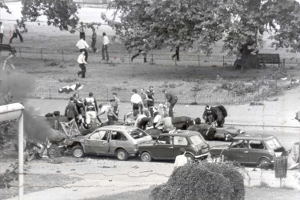
At 10:40 AM, a nail bomb explodes in the boot of a blue Morris Marina parked on South Carriage Drive in Hyde Park. The bomb comprises 25 lbs. of gelignite and 30 lbs. of nails. It explodes as soldiers of the Household Cavalry, Queen Elizabeth II‘s official bodyguard regiment, are passing. They are taking part in their daily Changing of the Guard procession from their barracks in Knightsbridge to Horse Guards Parade. Three soldiers of the Blues & Royals are killed outright, and another, their standard-bearer, dies from his wounds three days later. The other soldiers in the procession are badly wounded, and a number of civilians were injured. Seven of the regiment’s horses are also killed or had to be euthanised because of their injuries. Explosives experts believe that the Hyde Park bomb is triggered by remote by an IRA member inside the park.
The second attack happens at about 12:55 PM, when a bomb explodes underneath a bandstand in Regent’s Park. Thirty Military bandsmen of the Royal Green Jackets are on the stand performing music from Oliver! to a crowd of 120 people. It is the first in a series of advertised lunchtime concerts there. Six of the bandsmen are killed outright and the rest are wounded. A seventh dies of his wounds on August 1. At least eight civilians are also injured. The bomb had been hidden under the stand some time before and triggered by a timer. Unlike the Hyde Park bomb, it contains no nails and seems to be designed to cause minimal harm to bystanders.
A total of 22 people are detained in hospital as a result of the blasts. The IRA claims responsibility for the attacks by deliberately mirroring Prime MinisterMargaret Thatcher‘s words a few months before when Britain entered the Falklands War. They proclaimed that “The Irish people have sovereign and national rights which no task or occupational force can put down.” Reacting to the bombing, Thatcher states, “These callous and cowardly crimes have been committed by evil, brutal men who know nothing of democracy. We shall not rest until they are brought to justice.” The bombings have a negative impact on public support in the United States for the Irish republican cause.
On May 19, 2013, 61-year-old John Anthony Downey, from County Donegal, is charged with murder in relation to the Hyde Park bomb and intending to cause an explosion likely to endanger life. He appears at the Old Bailey on January 24, 2014, for the beginning of his trial and enters a not guilty plea. On February 25, 2014, it is revealed that Downey’s trial has collapsed after the presiding judge has ruled upon a letter sent by the Police Service of Northern Ireland to Downey in 2007, assuring him that he would not face criminal charges over the attack. Although the assurance is made in error and the police realise the mistake, it is never withdrawn, and the judge rules that therefore the defendant has been misled and prosecuting him would be an abuse of executive power. Downey is one of 187 IRA suspects who receive secret on-the-run letters guaranteeing them unofficial immunity from prosecution.
A memorial marks the spot of the Hyde Park bombing and the troop honours it daily with an eyes-left and salute with drawn swords. A plaque commemorating the victims of the second attack also stands in Regent’s Park.
Eilís Dillon, Irish author of 50 books, dies on July 19, 1994. Her work has been translated into fourteen languages.
Dillon is the third of five children of Professor Thomas Dillon and his wife Geraldine née Plunkett, who is the sister of Joseph Mary Plunkett. She is raised at Dangan House outside of Galway before moving to the small fishing village of Barna. She attends the local primary school where she becomes proficient in Irish and gains an intimate knowledge of tradition in the Connemara. Dillon’s family is involved in Irish revolutionary politics. Her uncle, Joseph Mary Plunkett, is a signatory of the 1916 Proclamation of the Irish Republic and is executed after the Easter Rising.
Educated by the Ursuline nuns in Sligo, she works briefly in the hotel and catering trade. In 1940 she marries Cormac Ó Cuilleanáin, an academic from University College Cork and seventeen years her senior. They have at least three children, including the Irish poet and Trinity College, Dublin professor Eiléan Ní Chuilleanáin and her brother, Cormac Ó Cuilleanáin, also a Trinity professor, who writes novels as Cormac Millar.
Dillon’s first books are written in Irish including An Choill Bheo, published in 1948, Oscar agus an Cóiste sé nEasóg in 1952 and Ceol na coille in 1955. After the success of The Lost Island, published in 1952, she writes almost exclusively in English. Most of her books are aimed at teen readers with themes of self-discovery and problem solving evident.
In 1964 she moves to Rome due to her husband’s poor health. While there she acts as adviser to International Commission on English in the Liturgy. She returns to Cork with her husband in 1969 where he dies the following year. She continues to visit Italy over the next several years, setting some of her stories there including Living in Imperial Rome (1974) and The Five Hundred (1972), though these are not as popular as her Irish books. In 1974 she marries the American-based critic and professor Vivian Mercier, dividing her time between California, Italy and Dublin.
Dillon’s adult fiction career begins in 1953 with the publication of the detective novel Death at Crane’s Court. This is followed by Sent to His Account in 1954 and Death in the Quadrangle in 1956. These novels are known for their depiction of contemporary Ireland. Over the following decade Dillon publishes many novels including The Bitter Glass (1959), Across the Bitter Sea (1973) and The Wild Geese (1981).
In her later years Dillon plays a prominent role in Irish culture. She is a Fellow of the Royal Society for Literature and a member of Aosdána, serves on the Irish Arts Council from 1974 until 1979, chairs the Irish Writers’ Union and the Irish Writers’ Centre, and founds the Irish Children’s Book Trust.
In 1987 Dillon and her husband move permanently to Dublin where she supports up and coming Irish authors. Her last story is Children of Bach published in 1993. Eilís Dillon dies on July 19, 1994, and is buried beside her second husband in Clara, County Offaly. A prize in her memory is given annually as part of the Bisto Book of the Year Awards.
Born Charles William St. John Burgess, Brugha is the tenth of fourteen children and is educated at the JesuitBelvedere College but is forced to leave at the age of sixteen because of the failure of his father’s business.
In 1899 Brugha join the Gaelic League, and he subsequently changes his name from Charles Burgess to Cathal Brugha. He meets his future wife, Kathleen Kingston, at an Irish class in Birr, County Offaly and they marry in 1912. They have six children, five girls and one boy. Brugha becomes actively involved in the Irish Republican Brotherhood (IRB) and in 1913 he becomes a lieutenant in the Irish Volunteers. He leads a group of twenty Volunteers to receive the arms smuggled into Ireland in the Howth gun-running of 1914.
He is second-in-command at the South Dublin Union under Commandant Éamonn Ceannt in the Easter Rising of 1916. On the Thursday of Easter Week, being badly wounded, he is unable to leave when the retreat is ordered. Brugha, weak from loss of blood, continues to fire upon the enemy and is found by Eamonn Ceannt singing “God Save Ireland” with his pistol still in his hands. He is initially not considered likely to survive. He recovers over the next year but is left with a permanent limp.
Brugha is elected speaker of Dáil Éireann at its first meeting on January 21, 1919, and he reads out the Declaration of Independence in Irish, which ratifies “the establishment of the Irish Republic.” On the following day, he is appointed president of the ministry pro tempore. He retains this position until April 1, 1919, when Éamon de Valera takes his place.
Brugha has differences with Michael Collins, who, although nominally only the IRA’s Director of Intelligence, has far more influence in the organisation as a result of his position as a high-ranking member of the Irish Republican Brotherhood, an organisation that Brugha sees as undermining the power of the Dáil and especially the Ministry for Defence. Brugha opposes the oath of allegiance required for membership of the IRB and, in 1919, his proposition that all Volunteers should swear allegiance to the Irish Republic and the Dáil is adopted.
At a top-level IRA meeting in August 1920, Brugha argues against ambushes of Crown forces unless there is first a call to surrender, but it is dismissed as unrealistic by the brigade commanders present. Brugha also has the idea of moving the front line of the war to England but is opposed by Collins.
In the months between the Treaty debates and the outbreak of Civil War, Brugha attempts to dissuade his fellow anti-treaty army leaders including Rory O’Connor, Liam Mellows and Joe McKelvey from taking up arms against the Free State. When the IRA occupies the Four Courts, he and Oscar Traynor call on them to abandon their position. When they refuse, Traynor orders the occupation of the area around O’Connell Street in the hope of easing the pressure on the Four Courts and of forcing the Free State to negotiate.
On June 28, 1922, Brugha is appointed commandant of the forces in O’Connell Street. The outbreak of the Irish Civil War ensues in the first week of July when Free State forces commence shelling of the anti-treaty positions.
Most of the anti-Treaty fighters under Oscar Traynor escape from O’Connell Street when the buildings they are holding catch fire, leaving Brugha in command of a small rearguard. On July 5, he orders his men to surrender but refuses to do so himself. He then approaches the Free State troops, brandishing a revolver. He sustains a bullet wound to the leg which severs a major artery.
Cathal Brugha dies on July 7, 1922, eleven days before his 48th birthday. He has been re-elected as an anti-Treaty Teachta Dála (TD) at the 1922 Irish general election but dies before the Dáil assembles. He is buried in Glasnevin Cemetery.
Douglas Corrigan, an American aviator born in Galveston, Texas, earns the nickname “Wrong Way” Corrigan on July 17, 1938. After a transcontinental flight from Long Beach, California, to New York City, he flies from Floyd Bennett Field in Brooklyn, New York, to Ireland, though his flight plan is filed to return to Long Beach. He claims his unauthorized flight is due to a navigational error, caused by heavy cloud cover that obscures landmarks and low-light conditions, causing him to misread his compass. However, he is a skilled aircraft mechanic and has made several modifications to his own plane, preparing it for his transatlantic flight. He had been denied permission to make a nonstop flight from New York to Ireland, and his “navigational error” is seen as deliberate. Nevertheless, he never publicly admits to having flown to Ireland intentionally.
On July 9, 1938, Corrigan departs California in his 1929 Curtiss Robin OX-5monoplane bound for Floyd Bennett Field, Brooklyn, New York. With the Robin cruising at 85 miles per hour (137 km/h) for maximum fuel efficiency, the outward journey takes him 27 hours. Fuel efficiency becomes critical towards the end of the flight as a gasoline leak develops, filling the cockpit with fumes.
Upon his unannounced arrival at Floyd Bennett Field, in the midst of Howard Hughes‘s preparations for takeoff on a world tour, Corrigan decides repairing the leak will take too long if he is to meet his schedule. His logged flight plan has him returning to California on July 17. Before takeoff, Corrigan asks the manager of Floyd Bennett Field, Kenneth P. Behr, which runway to use, and Behr tells him to use any runway as long as he does not take off to the west, in the direction of the administration building where Behr has his office. As recorded in Corrigan’s autobiography, Behr wishes him “Bon Voyage” prior to take-off, perhaps in a nod to Corrigan’s intentions to fly the Atlantic. Upon take off at 5:15 on the morning of July 17 with 320 US gallons of gasoline and 16 US gallons of oil, Corrigan heads east from the 4,200-foot runway of Floyd Bennett Field and keeps going. Behr later swears publicly that he has no foreknowledge of Corrigan’s intentions.
Corrigan claims to have noticed his “error” after flying for about 26 hours. This is not entirely consistent with his claim that after 10 hours, he feels his feet go cold. The cockpit floor is awash with gasoline leaking from the unrepaired tank. He uses a screwdriver to punch a hole through the cockpit floor so that the fuel will drain away on the side opposite the hot exhaust pipe, reducing the risk of a midair explosion. Had he been truly unaware he was over ocean, it seems likely he would descend at this point. Instead, he claims to increase the engine speed by almost 20% in the hope of decreasing his flight time.
Corrigan lands at Baldonnel Aerodrome, County Dublin, on July 18, after a 28-hour, 13-minute flight. His provisions for the flight consisted of just two chocolate bars, two boxes of fig bars, and 25 US gallons of water. Corrigan’s plane has fuel tanks mounted on the front, allowing him to see only out of the sides. He has no radio, and his compass is 20 years old.
Aviation officials require 600 words to list the regulations broken by his flight in a telegram, a medium that encourages brevity by charging at a rate per word. Despite the extent of Corrigan’s illegality, he receives only a mild punishment and his pilot’s certificate is suspended for 14 days. He and his plane return to New York on the steamship Manhattan and arrive on August 4, the last day of his suspension. His return is marked with great celebration. More people attend his Broadwayticker tape parade than had honored Charles Lindbergh after his triumph. He is also given a ticker tape parade in Chicago.
The Censorship of Publications Act is passed on July 16, 1929. The laws enacted by the Censorship of Publications Act, 1929 are introduced in an era of political isolationism and cultural and economic protectionism. Ireland’s culture is very moral and religious. Catholicism, the religion of 93% of the population, is the fundamental philosophy behind the censorship laws.
A main aim of the new legislation is to prevent the introduction of unwholesome foreign influences like materialism, consumerism and immorality from abroad. Specifically, this means works that are considered to be indecent or obscene, newspapers whose content relies too much on crime, and works that promote the “unnatural” prevention of conception or that advocate abortion. Irish writers who are found offensive are officially regarded as agents of decadence and social disintegration who are striking at the roots of family life and moral decency. For example, Father P.J. Gannon thinks that the Act is “but a simple measure of moral hygiene, forced upon the Irish public by a veritable spate of filth never surpassed.” He thinks that all literature must provide “noble ground for noble emotion.” PresidentÉamon de Valera feels that the arts in Ireland are to be encouraged when they observe the “holiest traditions,” but should be censored when they fail to live up to this ideal.
Although the new laws are typical of censorship laws in many other countries in the 1920s and 1930s, they are implemented with an eagerness which gradually alienates and embitters many Irish writers. It causes some writers to leave the country. The author Mervyn Wall explains that during the 1930s there is “a general intolerant attitude to writing, painting and sculpture. These were thought dangerous, likely to corrupt faith and morals…One encountered frequently among ordinary people bitter hostility to writers…Obscurantism had settled on the country like a fog, so of course anyone who had eyes to see and the heart to feel, was rebellious.”
The Academy of Letters established by William Butler Yeats attempts to fight censorship with solidarity among writers, but it achieves little in this field. The fight against literary censorship is fought mainly by isolated figures. Seán Ó Faoláin, perhaps the most vociferous critic of the censorship laws, writes, “Our Censorship…tries to keep the mind in a state of perpetual adolescence in the midst of all the influences that must, in spite of it, pour in from the adult world.”
Murphy is the son of James Murphy, a railway employee, and Margaret Sheehan of Little Island, County Cork. He attends Saint Patrick’s School on Gardiner’s Hill. In 1921 he enrolls as a part-time student at the Crawford School of Art, Emmet Place, Cork. In 1922 he finds work as an apprentice stone-carver at John Aloysius O’Connell’s Art Marble Works, Watercourse Road, Blackpool. There he specialises in architectural and foliage carving while continuing his studies at Crawford by night.
He is elected associate of the Royal Hibernian Academy in 1944, elected a full member in 1954, and appointed Royal Hibernian Academy Professor of Sculpture in 1964.
Also in 1944, he married Maighread Higgins, daughter of the Cork sculptor Joseph Higgins, and they go on to have three children – the knitwear designer Bebhinn Marten, the novelist Orla Murphy and the painter and De Dannan member Colm Murphy.
Murphy designs the Church of the Annunciation on Great William O’Brien Street in Blackpool, Cork, for William Dwyer in 1945. The stonework in the church is mostly by Murphy himself. It is officially dedicated on October 7, 1945.
Seamus Murphy dies in Cork on October 2, 1975. He is buried in Rathcooney, County Cork.
Examples of Murphy’s unique carvings of statues, gravestones, monuments and plaques can be seen around Cork and Ireland, including a signed panel of the four evangelists outside the entrance of the church of Our Lady and Saint John in Carrigaline, County Cork.






 seamus dubhghaill