seamus dubhghaill

Promoting Irish Culture and History from Little Rock, Arkansas, USA


2 Comments

Founding of Clan na Gael in New York City

CREATOR: gd-jpeg v1.0 (using IJG JPEG v62), quality = 90

The Clan na Gael, an Irish republican organization in the United States in the late 19th and 20th centuries, is founded by John Devoy, Daniel Cohalan, and Joseph McGarrity in New York City on June 20, 1867. It is the successor to the Fenian Brotherhood and a sister organization to the Irish Republican Brotherhood (IRB). It has shrunk to a small fraction of its former size in the 21st century.

As Irish immigration to the United States begins to increase in the 18th century many Irish organizations are formed. In the later part of the 1780s, a strong Irish patriot character begins to grow in these organizations and amongst recently arrived Irish immigrants.

In 1858, the IRB is founded in Dublin by James Stephens. In response to the establishment of the IRB in Dublin, a sister organization is founded in New York City, the Fenian Brotherhood, led by John O’Mahony. This arm of Fenian activity in America produces a surge in radicalism among groups of Irish immigrants, many of whom had recently emigrated from Ireland during and after the Great Famine.

In October 1865, the Fenian Philadelphia Congress meets and appoints the Irish Republican Government in the United States. Meanwhile in Ireland, the IRB newspaper The Irish People is raided by the police and the IRB leadership is imprisoned. Another abortive uprising occurs in 1867, but the British remain in control.

After the 1865 crackdown in Ireland, the American organization begins to fracture over what to do next. Made up of veterans of the American Civil War, a Fenian army is formed. While O’Mahony and his supporters want to remain focused on supporting rebellions in Ireland, a competing faction, called the Roberts, or senate wing, wants this Fenian Army to attack British bases in Canada. The resulting Fenian raids strain U.S.–British relations. The level of American support for the Fenian cause begins to diminish as the Fenians are seen as a threat to stability in the region.

After 1867, the Irish Republican Brotherhood headquarters in Manchester chooses to support neither of the existing feuding factions, but instead promotes a renewed Irish republican organization in America, to be named Clan na Gael.

According to John Devoy in 1924, Jerome James Collins founds what is then called the Napper Tandy Club in New York on June 20, 1867, Wolfe Tone‘s birthday. This club expands into others and at one point at a picnic in 1870 is named the Clan na Gael by Sam Cavanagh. This is the same Cavanagh who killed the informer George Clark, who had exposed a Fenian pike-making operation in Dublin to the police.

Collins, who dies in 1881 on the disastrous Jeannette Expedition to the North Pole, is a science editor on the New York Herald, who had left England in 1866 when a plot he was involved in to free the Fenian prisoners at Pentonville Prison was uncovered by the police. Collins believes at the time of the founding in 1867 that the two feuding Fenians branches should patch things up.

The objective of Clan na Gael is to secure an independent Ireland and to assist the Irish Republican Brotherhood in achieving this aim. It becomes the largest single financier of both the Easter Rising and the Irish War of Independence.

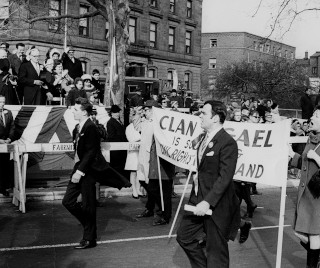
Clan na Gael continues to provide support and aid to the Irish Republican Army (IRA) after it is outlawed in Ireland by Éamon de Valera in 1936 but becomes less active in the 1940s and 1950s. However, the organization grows in the 1970s. The organization plays a key part in the Irish Northern Aid Committee (NORAID) and is a prominent source of finance and weapons for the Provisional Irish Republican Army during the Troubles in Northern Ireland in 1969–1998.

The Clan na Gael still exists today, much changed from the days of the Catalpa rescue. In 1987 the policy of abstentionism is abandoned. As recently as 1997 another internal split occurs as a result of the IRA shift away from the use of physical force as a result of the 1998 Good Friday Agreement. The two factions are known to insiders as Provisional Clan na Gael (allied to Provisional Sinn Féin/IRA) and Republican Clan na Gael (associated with both Republican Sinn Féin/Continuity IRA and 32 County Sovereignty Movement/Real IRA, though primarily the former). These have been listed as terrorist organizations at various times by the UK Government.

(Pictured: Clan na Gael marching in the 1970 St. Patrick’s Day Parade in Philadelphia, photograph by John Hamilton)

Leave a comment

Birth of Irish Journalist Mary Holland

mary-holland

Mary Holland, Irish journalist who specialises in writing about Ireland and in particular Northern Ireland, is born in Dover, Kent, South East England on June 19, 1935. She is raised in Ireland and married a British diplomat, Ronald Higgins. They lived in Indonesia but the marriage is annulled.

Holland originally works in fashion for Vogue magazine and then The Observer. She comes to prominence as one of the first Irish journalists to report on the rise of the Northern Ireland Civil Rights Association and becomes an increasingly prominent commentator on the affairs of the region.

In 1977 Conor Cruise O’Brien is appointed editor-in-chief of The Observer. He is a writer and politician who serves as a government minister in the Irish Parliament, Oireachtas. He is often criticized for his uncompromising opposition to “physical force Irish republicanism,” and his actions to that end during Liam Cosgrave‘s tenure as Taoiseach are labelled as censorship by some. Shortly after starting as editor, he sends a memo to Holland:

“It is a very serious weakness of your coverage of Irish affairs that you are a very poor judge of Irish Catholics. That gifted and talkative community includes some of the most expert conmen and conwomen in the world and I believe you have been conned.”

Holland subsequently leaves The Observer and joins The Irish Times as their Northern Ireland correspondent. In 1988, she witnesses the Provisional Irish Republican Army (IRA) Corporals killings.

Holland’s awards include the Prix Italia award for her television documentary on the Creggan in Derry (Creggan, 1980) and, in 1989, the Christopher Ewart-Biggs Memorial Prize for the promotion of peace and understanding in Ireland. She writes and campaigns for abortion rights in Ireland and admits, in an article on the topic of abortion, that she had had one.

Holland dies from scleroderma on June 7, 2004, just twelve days before her 69th birthday. She is survived by her children with fellow journalist Eamonn McCann. Daughter Kitty is now a journalist for The Irish Times, and son Luke works for the United States-based human rights think tank, the Center for Economic and Social Rights.


Leave a comment

The Loughinisland Massacre

CREATOR: gd-jpeg v1.0 (using IJG JPEG v80), quality = 90

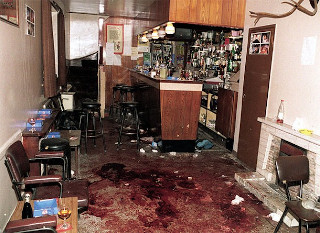
The Loughinisland massacre takes place on June 18, 1994, in the small village of Loughinisland, County Down, Northern Ireland. Members of the Ulster Volunteer Force (UVF), a loyalist paramilitary group, burst into a pub with assault rifles and fire on the customers, killing six civilians and wounding five. The pub is targeted because it is frequented mainly by Catholics. The UVF claims the attack is retaliation for the killing of three UVF members by the Irish National Liberation Army (INLA) two days earlier.

About 24 people are gathered in The Heights Bar, also known as O’Toole’s Pub, watching the Republic of Ireland vs. Italy in the 1994 FIFA World Cup. It is thus sometimes referred to as the “World Cup massacre.”

At 10:10 PM, two UVF members wearing boilersuits and balaclavas walk into the bar. One shouts “Fenian bastards!” and opens fire on the crowd with a vz. 58 assault rifle, spraying the small room with more than sixty bullets. Six men are killed outright, and five other people are wounded. Witnesses say the gunmen then run to a getaway car, “laughing.” One witness describes “bodies … lying piled on top of each other on the floor.” The dead were Adrian Rogan (34), Malcolm Jenkinson (52), Barney Green (87), Daniel McCreanor (59), Patrick O’Hare (35) and Eamon Byrne (39), all Catholic civilians. O’Hare is the brother-in-law of Eamon Byrne and Green is one of the oldest people to be killed during the Troubles.

The UVF claims responsibility within hours of the attack. It claims that an Irish republican meeting was being held in the pub and that the shooting was retaliation for the INLA attack. Police say there is no evidence the pub had links to republican paramilitary activity and say the attack is purely sectarian. Journalist Peter Taylor writes in his book Loyalists that the attack may not have been sanctioned by the UVF leadership. Police intelligence indicates that the order to retaliate came from the UVF leadership and that its ‘Military Commander’ had supplied the rifle used. Police believe the attack was carried out by a local UVF unit under the command of a senior member who reported to the leadership in Belfast.

The attack receives international media coverage and is widely condemned. Among those who send messages of sympathy are Pope John Paul II, Queen Elizabeth II and United States President Bill Clinton. Local Protestant families visit their wounded neighbours in the hospital, expressing their shock and disgust.

There have been allegations that police (Royal Ulster Constabulary) double agents or informants in the UVF were linked to the massacre and that police protected those informers by destroying evidence and failing to carry out a proper investigation. At the request of the victims’ families, the Police Ombudsman for Northern Ireland investigate the police. In 2011 the Ombudsman concludes that there were major failings in the police investigation, but no evidence that police colluded with the UVF. The Ombudsman does not investigate the role of informers and the report is branded a whitewash. The Ombudsman’s own investigators demand to be disassociated from it. The report is quashed, the Ombudsman replaced, and a new inquiry ordered.

In 2016, a new Ombudsman report concludes that there had been collusion between the police and the UVF, and that the investigation was undermined by the wish to protect informers but found no evidence police had foreknowledge of the attack. A documentary film about the massacre, No Stone Unturned, is released in 2017. It names the main suspects, one of whom is a member of the British Army and claims that one of the killers was an informer.


Leave a comment

Éamon de Valera Elected 3rd President of Ireland

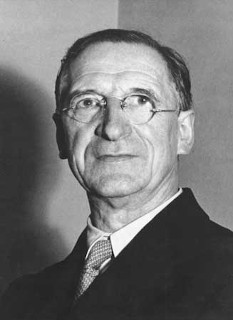
president-eamon-de-valeraThe 1959 Irish presidential election is held on June 17, 1959. Éamon de Valera, then Taoiseach, is elected as President of Ireland. A referendum proposed by de Valera to replace the electoral system of proportional representation by means of the single transferable vote with first-past-the-post voting which is held on the same day is defeated by 48.2% to 52.8%.

Under Article 12 of the Constitution of Ireland, a candidate for president may be nominated by:

  • at least twenty of the then 207 serving members of the Houses of the Oireachtas, or
  • at least four of 31 councils of the administrative counties, including county boroughs, or
  • themselves, in the case of a former or retiring president.

Outgoing president Seán T. O’Kelly had served two terms, and is ineligible to serve again. On April 27, the Minister for Local Government, Neal Blaney, signs the ministerial order opening nominations, with noon on May 19 as the deadline for nominations, and June 17 set as the date for a contest. All Irish citizens on the Dáil electoral register are eligible to vote.

De Valera who had served as President of Dáil Éireann and President of the Irish Republic from 1919 to 1922 during the Irish revolutionary period, as President of the Executive Council of the Irish Free State from 1932 to 1937, and as Taoiseach from 1937 to 1948, from 1951 to 1954, and again from 1957 until his election as president, is nominated by Fianna Fáil on May 12. He had served as Fianna Fáil’s leader since its foundation in 1926.

Seán Mac Eoin, a Fine Gael TD who had been the party’s candidate in the 1945 Irish presidential election, is nominated again by the party on May 15.

Patrick McCartan, who had also been a candidate in the 1945 election and had served as a senator for Clann na Poblachta from 1948 to 1951, is nominated by two county councils only, short of the four required for nomination. Eoin O’Mahony also seeks and fails to secure a nomination by county councils.

De Valera wins the popular vote with 538,003 votes (56.3%) to Mac Eoin’s 417,536 votes (43.7%).

Éamon de Valera is inaugurated as the third President of Ireland on June 25, 1959.


Leave a comment

Death of U.S. Union Army Colonel Patrick Kelly

colonel-patrick-kelly

Colonel Patrick Kelly of the Union Army‘s Irish Brigade (The Fighting Irish) dies on June 16, 1864, at the Siege of Petersburg during the American Civil War while leading the Irish Brigade forward against a Confederate position.

Kelly is born in Castlehacket, Tuam, County Galway and emigrates to the United States, landing in New York City. His wife Elizabeth is also from Tuam.

At the outset of the American Civil War, Kelly enlists in the Union Army and sees action as captain of Company E of the 69th New York Infantry at the First Battle of Bull Run. He briefly is a captain in the 16th U.S. Infantry. On September 14, 1861, he is named lieutenant colonel of the 88th New York Volunteer Infantry Regiment and fights in the Irish Brigade’s major battles in 1862. He commands the regiment at the Battle of Antietam. While stationed at Harpers Ferry, West Virginia following the Maryland campaign, he is promoted to colonel on October 20, 1862. He leads the regiment in the ill-fated attacks in front of Marye’s Heights in the Battle of Fredericksburg. He is acting commander of the Irish Brigade at the end of 1862.

After the 1863 Battle of Chancellorsville, Kelly is promoted to command the Irish Brigade following the resignation of Brigadier General Thomas Francis Meagher. He leads the heavily depleted brigade of fewer than 600 men in an attack at the Wheatfield during the Battle of Gettysburg. The brigade loses 198 of 532 troops engaged, approximately 37%.

Kelly resumes his role as colonel of his regiment as more senior officers return to the brigade. However, with the death of Colonel Richard Byrnes at the Battle of Cold Harbor in 1864, he again commands the brigade. At the age of 42, he dies during the Siege of Petersburg on June 16, 1864, when he is shot through the head while leading the Irish Brigade forward against Confederate earthworks. His body is recovered and sent back to New York for his funeral. He is buried in Calvary Cemetery in Woodside, Queens, New York.


Leave a comment

David Cameron Issues Formal State Apology for Bloody Sunday

cameron-bloody-sunday-apology

On June 15, 2010, David Cameron, Prime Minister of the United Kingdom, issues a formal state apology for the “unjustified and unjustifiable” killing of fourteen civil rights marchers in Derry, County Londonderry, Northern Ireland by British soldiers on Bloody Sunday, January 30, 1972. Cameron says Lord Saville inquiry’s long-awaited report shows soldiers lied about their involvement in the killings and that all of those who died were innocent.

Bloody Sunday, as the events on January 30, 1972, come to be known, is one of the most controversial moments of the Troubles. Paramilitary open fire while trying to police a banned civil rights march. They kill 13 marchers outright, and, according to Saville, wound another 15, one of whom subsequently dies later in the hospital.

In the House of Commons of the United Kingdom, Cameron begins his statement by saying he is “deeply patriotic” and does not want to believe anything bad about his country. Cameron says the inquiry, a 5,000-page, 10-volume report, which takes twelve years to compile at a cost of almost £191m, is “absolutely clear” and there are “no ambiguities” about the conclusions. He adds, “What happened on Bloody Sunday was both unjustified and unjustifiable. It was wrong.”

The report concludes there is no justification for shooting at any of those killed or wounded on the march. “None of the firing by the Support Company [Paratroopers] was aimed at people posing a threat or causing death or serious injury.” The report adds that the shootings “were not the result of any plan to shoot selected ringleaders” and that none of those killed by British soldiers was armed with firearms and no warning was given by the soldiers.

“The government is ultimately responsible for the conduct of the armed forces, and for that, on behalf of the government and on behalf of the country, I am deeply sorry,” says Cameron. The inquiry finds that the order sending British soldiers into the Bogside “should not have been given.” Cameron adds the casualties were caused by the soldiers “losing their self-control.”

The eagerly awaited report does not hold the British government at the time directly responsible for the atrocity. It finds that there is “no evidence” that either the British government or the unionist-dominated Northern Ireland administration encouraged the use of lethal force against the demonstrators. It also exonerates the army’s then commander of land forces, Major General Robert Ford, of any blame.

Most of the damning criticism against the military is directed at the soldiers on the ground who fired on the civilians. Saville says that on Bloody Sunday there had been “a serious and widespread loss of fire discipline among the soldiers.” He concludes that many of the soldiers lied to his inquiry. “Many of these soldiers have knowingly put forward false accounts in order to seek to justify their firing.” Under the rules of the inquiry this conclusion means that soldiers could be prosecuted for perjury.

The report also focuses on the actions of two Republican gunmen on the day and says that the Official Irish Republican Army (IRA) men had gone to a prearranged sniping position. But Saville finds that their actions did not provoke in any way the shootings by the paramilitary regiment.

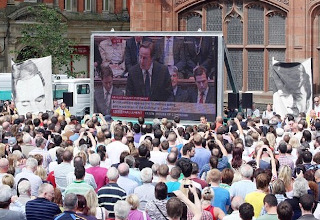
Relatives cheer as they watch the statement, relayed to screens outside the Guildhall in Derry. A minute of silence is held as thousands of supporters fill the square outside, waiting to be told about the report’s contents. A representative of each of the families speaks in turn and a copy of the hated report by Lord Widgery, which in 1972 accuses the victims of firing weapons or handling bombs, is torn apart by one of the families’ representatives.

Denis Bradley, who played a key part in secret talks that brought about the IRA ceasefire of 1994 and who was on the Bloody Sunday march in 1972, welcomes the report’s findings. The former Derry priest, who narrowly escaped being shot on the day, says he is “amazed” at how damning the findings are against the soldiers. He adds, “This city has been vindicated, this city has been telling the truth all along.”

(Pictured: Family and supporters watch David Cameron’s formal state apology in Guildhall Square in Derry, County Londonderry, Northern Ireland)


Leave a comment

Pro-Abortion Dutch Ship “Aurora” Sails into Dublin Docks

aurora-the-abortion-shipPro-choice activists sail into Dublin docks aboard the controversial pro-abortion Dutch ship Aurora on June 14, 2001. Although the trawler is equipped to carry out abortions, the purpose of its visit to Ireland is to fuel debate on the need for Irish legislation to provide women with choice.

Abortion is perhaps the last taboo in Irish society. The question of abortion still has the power to unleash emotive arguments among both pro-life and pro-choice camps. The arrival of the Aurora thrusts the issue back into the frontline of public debate.

The 1990s are a time of spectacular change in the Republic of Ireland, where the will of the Roman Catholic church traditionally has had a direct influence on family life. Contraception became widely available and a referendum overturned the constitutional bar on divorce. But abortion on Irish soil remains outlawed in all but the most extreme circumstances. As it stands, a woman is only entitled to have her pregnancy terminated if otherwise she is likely to commit suicide. Pro-choice campaigners call the law hypocritical and point to the fact that every year an estimated 6,300 women travel across the Irish Sea to Great Britain, where they pay up to £1,000 to have the procedure done privately.

The 35-metre ship, a cannibalised Dutch deep-sea fishing boat, is chartered by the feminist action group Women on Waves, with the aim of carrying out abortions on board. A shipping container which has been converted into an abortion clinic, complete with gynaecological chair, has been welded to the deck of the Aurora. The mobile clinic is capable of carrying out 20 operations a day.

Originally, the ship had planned to sail 12 miles out into international waters, where it would carry out the terminations. Once there, doctors on board would also be able to distribute the RU486 abortion pill. But a question mark hangs over the mission after it is revealed that Dutch authorities did not issue the floating clinic with the appropriate paperwork that would allow it to carry out abortions.

While the Aurora‘s voyage makes news beyond Irish shores, reaction among pro-life campaigners in Ireland is mostly muted. Many feel that by keeping quiet they will starve the mission of publicity. But some organisations, such as Human Life International Ireland (HLII), do speak out. HLII has plans to launch what it calls a “Life” boat to shadow the Aurora. Spokesman for the group, David Walshe, says the aim is not to protest but to act as “a non-confrontational witness to the sanctity of human life.”

Until 1983, abortion is outlawed in Ireland under a 19th Century act instituted during British rule. In 1983 a constitutional amendment is enacted that outlaws abortion in all circumstances. But in 1992 the Supreme Court of Ireland pronounces that if a woman were suicidal she would be entitled to a termination. The law has remained largely unchanged since then and the Irish government shows no appetite for tackling the issue head-on.

(From: “Abortion ship in stormy waters,” BBC News Online, June 14, 2001)


Leave a comment

Original “Ulysses” Manuscript Goes on Display in Dublin

CREATOR: gd-jpeg v1.0 (using IJG JPEG v80), quality = 82

The original manuscript of James Joyce‘s Ulysses arrives in its “spiritual home” for the first time on June 13, 2000 when it goes on display at the Chester Beatty Library on the grounds of Dublin Castle in Dublin, the city that inspired the novel.

Spidery sentences penned on yellowing paper and littered with scribbled alterations make up the first draft of what many scholars consider to be the most influential work of fiction of the 20th century. It is the centerpiece of a Joyce exhibition at the Chester Beatty library which runs through the end of September 2000.

Derick Dreher, director of the Rosenbach Museum and Library in Philadelphia, Pennsylvania, where the manuscript has been kept since 1924, says it marks the homecoming of a work which is “quintessentially Irish.” He adds, “People are amazed that it has never been here before. The novel captures the essence of Dublin and yet was composed entirely on foreign soil and then sold in America.”

Dreher says that Joyce’s handwriting is so bad it is hard to make out what is written on many of the pages. Joyce left Dublin with servant girl, Nora Barnacle, in 1904 and writes Ulysses in Trieste, Zürich and Paris between 1914 and 1921. Ultimately, he marries Barnacle in 1931.

The novel traces the wanderings of a young writer, Stephen Dedalus, and advertisement canvasser, Leopold Bloom, on June 16, 1904, the day on which Joyce first goes out with Barnacle. He sells the manuscript to New York City lawyer and art patron, John Quinn, for $12,000 before its publication in 1921.


4 Comments

The Gough Barracks Raid

gough-barracks

The Irish Republican Army (IRA) makes an audacious raid on Gough Barracks in Armagh, County Armagh, Northern Ireland on June 12, 1954. It marks the re-awakening of IRA activity in Northern Ireland and a re-arming that leads eventually to the 1956-1962 border campaign.

In January 1954, Leo McCormick, the Training Officer for the Dublin Brigade of the IRA, is on a visit to Armagh. As he passes Gough Barracks, the home of the Royal Irish Fusiliers, he notices that the guard on duty outside the barracks is armed with a Sten gun without a magazine. He concludes rightly that Gough Barracks is in effect being guarded by an unarmed guard.

On his return to Dublin, McCormick informs the Dublin Brigade of his chance observation. Alas, he does not see the end result of his information, as he is arrested soon after and receives four years for possession of a document.

By April, the General Head Quarters decides that they will raid Gough Barracks for arms. But first, they need more information. Eamonn Boyce, the Intelligence Officer of the Dublin Brigade, is asked to travel to Armagh and check out the barracks. He makes several trips to Armagh and soon has a detailed account of life outside the barracks. But GHQ wants more inside details. Charlie Murphy gets over this problem by asking Seán Garland to go to Armagh and enlist in the British Army. Not long after Garland’s enlistment, a stream of maps, documents, time schedules and photographs flow into GHQ for processing.

Finally, a last intelligence coup is arranged. Using Garland’s information, the IRA gets inside the barracks to have a look around. On a Saturday night in May, Boyce and Murphy slip into the barracks as “guests” at a weekly dance. With them they bring a girl, Mae Smith, who is later to become chairperson of Sinn Féin. After a few dances, Garland takes Mae outside for what his fellow soldiers assume is an hour of light passion but is in fact a detailed tour of the entire barracks.

The operation is launched on June 12, 1954, from a farm just outside Dundalk. A large red cattle truck is commandeered at the last moment and nineteen IRA men, about half of the Dublin Brigade, climb in and are informed as to what their target is. It is almost 3:00 on a busy Saturday afternoon when the cattle truck and a car drive into Armagh.

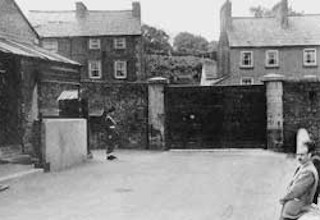
Paddy Ford gets out of the car and walks over to the sentry and asks him about enlisting in the British Army. While the sentry is dissuading Ford of what he considers a foolish course of action, he looks down into the barrel of a .45 caliber Colt revolver in the perspective recruit’s hand. As the sentry is held at gunpoint, three IRA men pass him into the guardhouse. The sentry is then brought in after them. While the sentry is being tied up, a new IRA sentry, complete with British uniform, white webbing belt, regimental cap and sten gun with magazine steps out to stand guard over Gough Barracks.

As soon as the IRA sentry appears, the cattle truck drives through the gate and comes to a halt outside the arsenal door. After fumbling through 200 keys, Eamonn Boyce finds the right one and opens the armoury. Murphy races up the stairs and in the first room two British soldiers demand to know what a civilian wants inside the barracks. Murphy has some trouble getting his revolver out of his pocket and is further embarrassed when the two soldiers refuse to put up their hands. However, another IRA man arrives carrying a Thompson submachine gun, which quickly convinces them to do as they are told. Posting a Bren gun at the armoury window to command the barracks square, the IRA begins stripping the armoury.

During the course of the raid a woman, noticing something is wrong, stops a British officer in the street and urges him into the barracks to investigate. Once inside the gate the officer is taken under control and, protesting that he is an officer and a gentleman, refuses to be tied until a gun is put to his head.

An NCO then notices what is happening, gets into a lorry and drives for the gate, intending to block the exit. An IRA man stands at the gate brandishing a revolver and shouts “Back.” He forces the NCO to reverse the lorry. The NCO is placed under arrest in the guard room. By the end of the raid, the IRA has tied up 19 British soldiers and one civilian.

In less than 20 minutes the job is done. The truck carrying 340 rifles, 50 Sten guns, 12 Bren guns, and a number of small arms drives out of the barrack gates and rumbles through Armagh in the direction of the border. Eamonn Boyce and the group in the car follow after locking every gate and door for which they can find keys. At 3:25 PM the first alarm in the barracks is given but it is not until 5:00 that the general alarm is given and by that time the big red truck is long gone.

The raid for arms in Gough Barracks gains international attention. The IRA, which has been described by some as moribund since the ’40s campaign, has once more risen from its slumber to strike a blow against the forces of occupation. The raid awakes a calling in many to join the IRA and take part in the Border Campaign, which keeps alive the flame of republicanism through to the present time.

(From: “The Gough Barracks raid – Remembering the Past” by Shane Mac Thomáis, anphoblacht.com, June 9, 2005)


Leave a comment

Keith Ridgway Awarded Rooney Prize for Irish Literature

keith-ridgway

Irish novelist Keith Ridgway is awarded the Rooney Prize for Irish Literature on June 11, 2001. Created in 1976, there is no shortlist, no entry form, and no categorisation for the award. The only requirement is for the writer to be Irish, under the age of 40, and published in Irish or English.

Ridgway is born in Dublin on October 2, 1965. An award-winning author, he has been described as “a worthy inheritor” of “the modernist tradition in Irish fiction.”

Horses, Ridgway’s first published work of fiction, appears in Faber First Fictions Volume 13 in 1997. In 1998 The Long Falling is published by Faber and Faber Limited, London. It is adapted into a film, Où va la nuit, by French director Martin Provost in 2011. A collection of short fiction, Standard Time, appears in 2000, followed by his third novel, The Parts, in 2003. Both are published by Faber and Faber. In 2006 Animals is published by 4th Estate, London. A short story, “Goo Book,” is published in the April 11, 2011, issue of The New Yorker magazine. The author’s most recent work, Hawthorn & Child, is published by New Directions Publishing on September 27, 2013. His novels have been translated into several languages and have been published in France, Italy and Germany.

In 2001, the same year that Ridgway is awarded the Rooney Prize for Irish Literature, The Long Falling receives the Prix Femina Étranger (translated as “Mauvaise Pente”). His short story “Rothko Eggs” wins the O. Henry Award in 2012 and is anthologized in the PEN/O. Henry Prize Stories that year.