seamus dubhghaill

Promoting Irish Culture and History from Little Rock, Arkansas, USA


Leave a comment

Pro-Abortion Dutch Ship “Aurora” Sails into Dublin Docks

aurora-the-abortion-shipPro-choice activists sail into Dublin docks aboard the controversial pro-abortion Dutch ship Aurora on June 14, 2001. Although the trawler is equipped to carry out abortions, the purpose of its visit to Ireland is to fuel debate on the need for Irish legislation to provide women with choice.

Abortion is perhaps the last taboo in Irish society. The question of abortion still has the power to unleash emotive arguments among both pro-life and pro-choice camps. The arrival of the Aurora thrusts the issue back into the frontline of public debate.

The 1990s are a time of spectacular change in the Republic of Ireland, where the will of the Roman Catholic church traditionally has had a direct influence on family life. Contraception became widely available and a referendum overturned the constitutional bar on divorce. But abortion on Irish soil remains outlawed in all but the most extreme circumstances. As it stands, a woman is only entitled to have her pregnancy terminated if otherwise she is likely to commit suicide. Pro-choice campaigners call the law hypocritical and point to the fact that every year an estimated 6,300 women travel across the Irish Sea to Great Britain, where they pay up to £1,000 to have the procedure done privately.

The 35-metre ship, a cannibalised Dutch deep-sea fishing boat, is chartered by the feminist action group Women on Waves, with the aim of carrying out abortions on board. A shipping container which has been converted into an abortion clinic, complete with gynaecological chair, has been welded to the deck of the Aurora. The mobile clinic is capable of carrying out 20 operations a day.

Originally, the ship had planned to sail 12 miles out into international waters, where it would carry out the terminations. Once there, doctors on board would also be able to distribute the RU486 abortion pill. But a question mark hangs over the mission after it is revealed that Dutch authorities did not issue the floating clinic with the appropriate paperwork that would allow it to carry out abortions.

While the Aurora‘s voyage makes news beyond Irish shores, reaction among pro-life campaigners in Ireland is mostly muted. Many feel that by keeping quiet they will starve the mission of publicity. But some organisations, such as Human Life International Ireland (HLII), do speak out. HLII has plans to launch what it calls a “Life” boat to shadow the Aurora. Spokesman for the group, David Walshe, says the aim is not to protest but to act as “a non-confrontational witness to the sanctity of human life.”

Until 1983, abortion is outlawed in Ireland under a 19th Century act instituted during British rule. In 1983 a constitutional amendment is enacted that outlaws abortion in all circumstances. But in 1992 the Supreme Court of Ireland pronounces that if a woman were suicidal she would be entitled to a termination. The law has remained largely unchanged since then and the Irish government shows no appetite for tackling the issue head-on.

(From: “Abortion ship in stormy waters,” BBC News Online, June 14, 2001)


Leave a comment

Original “Ulysses” Manuscript Goes on Display in Dublin

CREATOR: gd-jpeg v1.0 (using IJG JPEG v80), quality = 82

The original manuscript of James Joyce‘s Ulysses arrives in its “spiritual home” for the first time on June 13, 2000 when it goes on display at the Chester Beatty Library on the grounds of Dublin Castle in Dublin, the city that inspired the novel.

Spidery sentences penned on yellowing paper and littered with scribbled alterations make up the first draft of what many scholars consider to be the most influential work of fiction of the 20th century. It is the centerpiece of a Joyce exhibition at the Chester Beatty library which runs through the end of September 2000.

Derick Dreher, director of the Rosenbach Museum and Library in Philadelphia, Pennsylvania, where the manuscript has been kept since 1924, says it marks the homecoming of a work which is “quintessentially Irish.” He adds, “People are amazed that it has never been here before. The novel captures the essence of Dublin and yet was composed entirely on foreign soil and then sold in America.”

Dreher says that Joyce’s handwriting is so bad it is hard to make out what is written on many of the pages. Joyce left Dublin with servant girl, Nora Barnacle, in 1904 and writes Ulysses in Trieste, Zürich and Paris between 1914 and 1921. Ultimately, he marries Barnacle in 1931.

The novel traces the wanderings of a young writer, Stephen Dedalus, and advertisement canvasser, Leopold Bloom, on June 16, 1904, the day on which Joyce first goes out with Barnacle. He sells the manuscript to New York City lawyer and art patron, John Quinn, for $12,000 before its publication in 1921.


4 Comments

The Gough Barracks Raid

gough-barracks

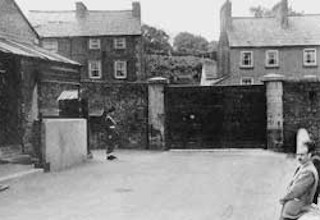
The Irish Republican Army (IRA) makes an audacious raid on Gough Barracks in Armagh, County Armagh, Northern Ireland on June 12, 1954. It marks the re-awakening of IRA activity in Northern Ireland and a re-arming that leads eventually to the 1956-1962 border campaign.

In January 1954, Leo McCormick, the Training Officer for the Dublin Brigade of the IRA, is on a visit to Armagh. As he passes Gough Barracks, the home of the Royal Irish Fusiliers, he notices that the guard on duty outside the barracks is armed with a Sten gun without a magazine. He concludes rightly that Gough Barracks is in effect being guarded by an unarmed guard.

On his return to Dublin, McCormick informs the Dublin Brigade of his chance observation. Alas, he does not see the end result of his information, as he is arrested soon after and receives four years for possession of a document.

By April, the General Head Quarters decides that they will raid Gough Barracks for arms. But first, they need more information. Eamonn Boyce, the Intelligence Officer of the Dublin Brigade, is asked to travel to Armagh and check out the barracks. He makes several trips to Armagh and soon has a detailed account of life outside the barracks. But GHQ wants more inside details. Charlie Murphy gets over this problem by asking Seán Garland to go to Armagh and enlist in the British Army. Not long after Garland’s enlistment, a stream of maps, documents, time schedules and photographs flow into GHQ for processing.

Finally, a last intelligence coup is arranged. Using Garland’s information, the IRA gets inside the barracks to have a look around. On a Saturday night in May, Boyce and Murphy slip into the barracks as “guests” at a weekly dance. With them they bring a girl, Mae Smith, who is later to become chairperson of Sinn Féin. After a few dances, Garland takes Mae outside for what his fellow soldiers assume is an hour of light passion but is in fact a detailed tour of the entire barracks.

The operation is launched on June 12, 1954, from a farm just outside Dundalk. A large red cattle truck is commandeered at the last moment and nineteen IRA men, about half of the Dublin Brigade, climb in and are informed as to what their target is. It is almost 3:00 on a busy Saturday afternoon when the cattle truck and a car drive into Armagh.

Paddy Ford gets out of the car and walks over to the sentry and asks him about enlisting in the British Army. While the sentry is dissuading Ford of what he considers a foolish course of action, he looks down into the barrel of a .45 caliber Colt revolver in the perspective recruit’s hand. As the sentry is held at gunpoint, three IRA men pass him into the guardhouse. The sentry is then brought in after them. While the sentry is being tied up, a new IRA sentry, complete with British uniform, white webbing belt, regimental cap and sten gun with magazine steps out to stand guard over Gough Barracks.

As soon as the IRA sentry appears, the cattle truck drives through the gate and comes to a halt outside the arsenal door. After fumbling through 200 keys, Eamonn Boyce finds the right one and opens the armoury. Murphy races up the stairs and in the first room two British soldiers demand to know what a civilian wants inside the barracks. Murphy has some trouble getting his revolver out of his pocket and is further embarrassed when the two soldiers refuse to put up their hands. However, another IRA man arrives carrying a Thompson submachine gun, which quickly convinces them to do as they are told. Posting a Bren gun at the armoury window to command the barracks square, the IRA begins stripping the armoury.

During the course of the raid a woman, noticing something is wrong, stops a British officer in the street and urges him into the barracks to investigate. Once inside the gate the officer is taken under control and, protesting that he is an officer and a gentleman, refuses to be tied until a gun is put to his head.

An NCO then notices what is happening, gets into a lorry and drives for the gate, intending to block the exit. An IRA man stands at the gate brandishing a revolver and shouts “Back.” He forces the NCO to reverse the lorry. The NCO is placed under arrest in the guard room. By the end of the raid, the IRA has tied up 19 British soldiers and one civilian.

In less than 20 minutes the job is done. The truck carrying 340 rifles, 50 Sten guns, 12 Bren guns, and a number of small arms drives out of the barrack gates and rumbles through Armagh in the direction of the border. Eamonn Boyce and the group in the car follow after locking every gate and door for which they can find keys. At 3:25 PM the first alarm in the barracks is given but it is not until 5:00 that the general alarm is given and by that time the big red truck is long gone.

The raid for arms in Gough Barracks gains international attention. The IRA, which has been described by some as moribund since the ’40s campaign, has once more risen from its slumber to strike a blow against the forces of occupation. The raid awakes a calling in many to join the IRA and take part in the Border Campaign, which keeps alive the flame of republicanism through to the present time.

(From: “The Gough Barracks raid – Remembering the Past” by Shane Mac Thomáis, anphoblacht.com, June 9, 2005)


Leave a comment

Keith Ridgway Awarded Rooney Prize for Irish Literature

keith-ridgway

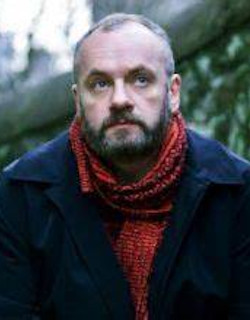
Irish novelist Keith Ridgway is awarded the Rooney Prize for Irish Literature on June 11, 2001. Created in 1976, there is no shortlist, no entry form, and no categorisation for the award. The only requirement is for the writer to be Irish, under the age of 40, and published in Irish or English.

Ridgway is born in Dublin on October 2, 1965. An award-winning author, he has been described as “a worthy inheritor” of “the modernist tradition in Irish fiction.”

Horses, Ridgway’s first published work of fiction, appears in Faber First Fictions Volume 13 in 1997. In 1998 The Long Falling is published by Faber and Faber Limited, London. It is adapted into a film, Où va la nuit, by French director Martin Provost in 2011. A collection of short fiction, Standard Time, appears in 2000, followed by his third novel, The Parts, in 2003. Both are published by Faber and Faber. In 2006 Animals is published by 4th Estate, London. A short story, “Goo Book,” is published in the April 11, 2011, issue of The New Yorker magazine. The author’s most recent work, Hawthorn & Child, is published by New Directions Publishing on September 27, 2013. His novels have been translated into several languages and have been published in France, Italy and Germany.

In 2001, the same year that Ridgway is awarded the Rooney Prize for Irish Literature, The Long Falling receives the Prix Femina Étranger (translated as “Mauvaise Pente”). His short story “Rothko Eggs” wins the O. Henry Award in 2012 and is anthologized in the PEN/O. Henry Prize Stories that year.


Leave a comment

George Mitchell begins Northern Ireland Talks with Sinn Féin

george-mitchell-in-belfast

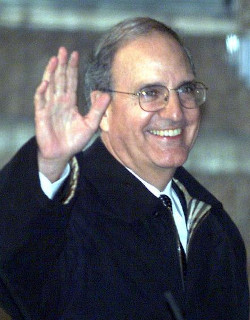
On June 10, 1996, former U.S. Senator George Mitchell begins Northern Ireland talks with Sinn Féin, who are blocked by the lack of an Irish Republican Army (IRA) ceasefire from what are supposed to be all-party talks on Northern Ireland’s future.

Pressure is coming from all sides on the Irish Republican Army to give peace a chance in Northern Ireland. Governments in London, Dublin, and Washington, D.C., as well as the vast majority of Northern Ireland’s citizens, are calling on the paramilitary group to call a new ceasefire. Even Gerry Adams, president of Sinn Féin, the IRA’s political wing, appeals to the IRA to reconsider its refusal to renew the ceasefire it broke in February with a bomb blast in London.

An opinion poll in the Dublin-based Sunday Tribune shows 97 percent of people, including 84 percent of Sinn Féin voters, want the IRA to renew its ceasefire.

The talks aim to reconcile two main political traditions in Northern Ireland, Protestant-backed unionism, which wants the province to stay part of the United Kingdom, and Catholic-backed Irish nationalism, which seeks to unite Northern Ireland with the Republic of Ireland.

Earlier in the year Senator Mitchell reported to the British government on the prospects for peace in Northern Ireland and drew up six principles which, if fulfilled by all the parties, would produce a lasting political settlement.

As internal and international pressure on the IRA mounts, politicians from the Ulster Unionist Party (UUP), a moderate party representing the province’s Protestants, shows signs of drifting apart on whether Sinn Féin should be allowed to participate. Even if the IRA announces “a ceasefire of convenience,” Sinn Féin should be barred from attending, says Peter Robinson, deputy leader of the radical Democratic Unionist Party (DUP).

Furthermore, the choice of Mitchell to head the talks makes some Protestants uneasy. Earlier, DUP leader Ian Paisley says Mitchell could not be trusted as chairman. “He is carrying too much American Irish baggage.”

Yet David Trimble, leader of the larger UUP, says a new IRA ceasefire might “get Sinn Féin to the door.” To be fully admitted to the all-party talks, however, its leadership will have to “commit itself to peace and democracy.” Trimble adds that he has doubts about Mitchell’s objectivity and had sought “certain assurances” before finally agreeing to lead a UUP delegation to the opening round. Mitchell, at an impromptu news conference in Belfast, says he plans to show “fairness and impartiality.”

The attitudes of the two unionist parties appear to reflect concern that the IRA would declare a ceasefire before the talks open, or during the early stages, technically clearing the way for Sinn Féin participation. David Wilshire, a senior Conservative member of Britain’s Parliament, who supports the unionist cause, says that a ceasefire by the IRA now would be a “cynical ploy.” He adds that “the government should not fall for it.”

Sinn Féin leaders, meanwhile, meet on Saturday, June 8, and announced that regardless of the IRA’s intentions, Adams and other Sinn Féin leaders will turn up at the opening session and demand to be admitted. They cite the party’s strong showing at special elections in May to the peace forum at which they obtain 15 percent of the vote and win a strong mandate from Catholic voters in West Belfast.

It is “the British government’s responsibility” to urge the IRA to renew its truce, says Martin McGuinness, Adams’s deputy. Yet Adams himself makes a direct approach to the IRA. This is confirmed by Albert Reynolds, the former Irish Taoiseach. He says that Adams has advised him that he is about to make a new ceasefire appeal to the IRA leadership. “I am now satisfied Gerry Adams and Sinn Féin will seek an early reinstatement of the ceasefire which, of course, has not broken down in Northern Ireland. I see a set of similar elements to those in 1994, which brought about the ceasefire, now coming together. Everyone must now compromise,” Reynolds says.

On June 8, the IRA tells the British Broadcasting Corporation that its military council has called a meeting to examine the agenda for the Northern Ireland talks.

(From:”Hopes for N. Ireland Talks Rely on Squeezing the IRA” by Alexander MacLeod, The Christian Science Monitor, June 10, 1996)


Leave a comment

The Battle of Port Republic

battle-of-port-republic

As part of Confederate States Army Maj. Gen. Thomas J. “Stonewall” Jackson‘s campaign through the Shenandoah Valley, the Irish 6th Louisiana fight in the Battle of Port Republic in Rockingham County, Virginia on June 9, 1862, during the American Civil War. The battle is a fierce contest between two equally determined foes and is the costliest battle fought by Jackson’s Army of the Valley during its campaign.

During the night of June 8–9, 1862, Brig. Gen. Charles S. Winder‘s Stonewall Brigade is withdrawn from its forward position near Bogota, a large house owned by Gabriel Jones, and rejoins Jackson’s division at Port Republic. Winder’s brigade is assigned the task of spearheading the assault against Union Army forces east of the river. Brig. Gen. Isaac R. Trimble‘s brigade and elements of Col. John M. Patton, Jr.’s, are left to delay Maj. Gen. John C. Frémont‘s Union forces at Cross Keys, while the rest of Maj. Gen. Richard S. Ewell‘s division march to Port Republic to be in position to support Winder’s attack.

Brig. Gen. Erastus B. Tyler‘s brigade joins Col. Samuel S. Carroll‘s brigade north of Lewiston on the Luray Road. The rest of Brig. Gen. James Shields‘s (a native of County Tyrone) division is strung out along the muddy roads back to Luray. General Tyler, in command on the field, advances at dawn on June 9 to the vicinity of Lewiston. He anchors the left of his line on a battery positioned on the Lewiston Coaling, extending his infantry west along Lewiston Lane to the South Fork near the site of Lewis’s Mill. The right and center are supported by artillery, 16 guns in all.

Winder’s brigade crosses the river by 5:00 AM and deploys to attack east across the bottomland. He sends two regiments, the 2nd Virginia Infantry and 4th Virginia Infantry, into the woods to flank the Union line and assault the Coaling. When the main Confederate battle line advances, it comes under heavy fire from the Union artillery and is soon pinned down. Confederate batteries are brought forward onto the plain but are outgunned and forced to seek safer positions. Ewell’s brigades are hurried forward to cross the river. Seeing the strength of the Union artillery at the Coaling, Jackson sends Richard Taylor‘s brigade, including the famed Louisiana Tigers, to the right into the woods to support the flanking column that is attempting to advance through the thick underbrush.

Winder’s brigade renews its assault on the Union right and center, taking heavy casualties. General Tyler moves two regiments from the Coaling to his right and launches a counterattack, driving Confederate forces back nearly half a mile. While this is occurring, the first Confederate regiments probe the defenses of the Coaling but are repulsed.

Finding resistance fiercer than anticipated, Jackson orders the last of Ewell’s forces still north of Port Republic to cross the rivers and burn the North Fork bridge. These reinforcements begin to reach Winder, strengthening his line and stopping the Union counterattack. Taylor’s brigade reaches a position in the woods across from the Coaling and launches a fierce attack, which carries the hill, capturing five guns. Tyler immediately responds with a counterattack, using his reserves. These regiments, in hand-to-hand fighting, retake the position. Taylor shifts a regiment to the far right to outflank the Union battle line. The Confederate attack again surges forward to capture the Coaling. Five captured guns are turned against the rest of the Union line. With the loss of the Coaling, the Union position along Lewiston Lane becomes untenable, and Tyler orders a withdrawal about 10:30 AM. Jackson orders a general advance.

William B. Taliaferro‘s fresh Confederate brigade arrives from Port Republic and presses the retreating Federals for several miles north along the Luray Road, taking several hundred prisoners. The Confederate army is left in possession of the field. Shortly after noon, Frémont’s army begins to deploy on the west bank of the South Fork, too late to aid Tyler’s defeated command, and watches helplessly from across the rain-swollen river. Frémont deploys artillery on the high bluffs to harass the Confederate forces. Jackson gradually withdraws along a narrow road through the woods and concentrates his army in the vicinity of Mt. Vernon Furnace. Jackson expects Frémont to cross the river and attack him on the following day, but during the night Frémont withdraws toward Harrisonburg.

Together, the Battles of Cross Keys and Port Republic are the decisive victories in Jackson’s Valley campaign, forcing the Union armies to retreat and leaving Jackson in control of the upper and middle Shenandoah Valley and free to reinforce Gen. Robert E. Lee for the Seven Days Battles outside Richmond, Virginia.

The Civil War Trust, a division of the American Battlefield Trust, and its partners have acquired and preserved 947 acres of the Port Republic battlefield in seven transactions since 1988. The battlefield is located about three miles east of Port Republic at U.S. Route 340 and Ore Bank Road. It retains its wartime agrarian appearance. The Port Republic Battle Monument is on Ore Bank Road beside the site of The Coaling, a key battlefield feature. The Coaling is the first land acquisition of the modern Civil War battlefield preservation movement. The 8.55-acre site is donated to the Trust’s forerunner, the Association for the Preservation of Civil War Sites by the Lee-Jackson Foundation in 1988.


Leave a comment

Death of John Bourke, U.S. Army Captain

File source: http://en.wikipedia.org/wiki/File:John_Bourke.jpg

John Gregory Bourke, a captain in the United States Army and a prolific diarist and postbellum author, dies in Philadelphia, Pennsylvania on June 8, 1896. He writes several books about the American Old West, including ethnologies of its indigenous peoples.

Bourke is born in Philadelphia on June 23, 1846, to Irish immigrant parents, Edward Joseph and Anna (Morton) Bourke. His early education is extensive and includes Latin, Greek, and Gaelic. When the American Civil War begins, Bourke is fourteen. At sixteen he runs away from home. Claiming to be nineteen, he enlists in the 15th Regiment Pennsylvania Volunteer Cavalry, in which he serves until July 1865. He receives a Medal of Honor for “gallantry in action” at the Battle of Stones River, Tennessee, in December 1862. He later sees action at the Battle of Chickamauga.

Based on his service during the war, Bourke’s commander, Major General George Henry Thomas, nominates him for the United States Military Academy at West Point, New York. He is appointed cadet in the Academy on October 17, 1865. He graduates on June 15, 1869, and is assigned as a second lieutenant in the 3rd Cavalry Regiment. He serves with his regiment at Fort Craig, New Mexico Territory, from September 29, 1869, to February 19, 1870.

Bourke serves as an aide to General George Crook in the Apache Wars from 1872 to 1883. As Crook’s aide, he has the opportunity to witness every facet of life in the Old West — the battles, wildlife, the internal squabbling among the military, the Indian Agency, settlers, and Native Americans.

During his time as aide to General Crook during the Apache Wars, Bourke keeps journals of his observations that are later published as On the Border with Crook. This book is considered one of the best firsthand accounts of frontier army life, as Bourke gives equal time to both the soldier and the Native American. Within it, he describes the landscape, Army life on long campaigns, and his observations of the Native Americans. His passages recount General Crook’s meetings with Sitting Bull, Crazy Horse, and Geronimo as the General attempts to sign peace treaties and relocate tribes to reservations. He provides considerable detail of towns and their citizens in the Southwest, specifically the Arizona Territory.

In 1881 Bourke is a guest of the Zuni tribe, where he is allowed to attend the ceremony of a Newekwe priest. His report of this experience is published in 1888 as The use of human odure and human urine in rites of a religious or semi religious character among various nations.

Bourke marries Mary F. Horbach of Omaha, Nebraska, on July 25, 1883. They have three daughters together.

John Bourke dies in the Polyclinic Hospital in Philadelphia on June 8, 1896, and is buried at Arlington National Cemetery. His wife is buried beside him after her death.


Leave a comment

Birth of Kevin Christopher O’Higgins, Politician

iohiggs001p1

Kevin Christopher O’Higgins, Irish politician who serves as Minister for Economic Affairs from January 1922 to September 1922, Minister for External Affairs from June 1927 to July 1927, Minister for Justice from August 1922 to July 1927 and Vice-President of the Executive Council of the Irish Free State from 1922 to 1927, is born in Stradbally, Queen’s County (County Laois since 1922) on June 7, 1892. He serves as a Teachta Dála (TD) from 1921 to 1927 and is a Member of Parliament (MP) for Queen’s County from 1918 to 1921.

A man of intellectual power, O’Higgins is described by William Butler Yeats as “a great man in his pride confronting murderous men.” He is in fact murdered by maverick republicans while on his way to church.

Educated at University College Dublin, O’Higgins is apprenticed to his uncle, a lawyer. Following the Easter Rising in 1916, he joins the Sinn Féin nationalist movement and is imprisoned. In 1918, while still in jail, he is elected to Parliament from Queen’s County, and in the next year he becomes assistant to the minister of local government, William Thomas Cosgrave. He goes on to become a prominent member of Cumann na nGaedheal.

O’Higgins supports the Anglo-Irish Treaty with Great Britain that creates the Irish Free State. In 1922 he is appointed Minister for Economic Affairs and Vice-President of the Executive Council. He helps to draft the Irish Free State constitution and secures its passage through Dáil Éireann, lower house of the Oireachtas, the Irish parliament. Working for a united Ireland within the British Commonwealth, he plays an important part in the 1926 Imperial Conference. He also prominently represents the Free State in the League of Nations.

As Minister for Justice, O’Higgins establishes the Garda Síochána police force and takes summary measures to restore order following the civil war between the Free State forces and the Irish Republican Army (IRA). His role in the execution of 77 republicans in 1922–23 makes him many enemies, as does his sardonic wit, his inflammatory speeches during the civil war, and his curtailment of the liquor trade.

On Sunday, July 10, 1927, O’Higgins is assassinated at the age of 35 on the Booterstown Avenue side of Cross Avenue in Dublin, while on his way to Mass at the Church of the Assumption. The assassination is carried out by three anti-Treaty members of the IRA, Timothy Coughlan, Bill Gannon and Archie Doyle, in revenge for O’Higgins’ part in the executions of the 77 IRA prisoners during the Irish Civil War.

None of the three assassins is ever apprehended or charged, but Coughlan, a member of Fianna Fáil as well as the IRA, is killed in 1928 in Dublin by a police undercover agent whom he is attempting to murder. The other two benefit from the amnesty to IRA members issued by Éamon de Valera, upon his assumption of power in 1932. Gannon, who dies in 1965, joins the Communist Party of Ireland and plays a central role in organising Irish volunteers for the Spanish Civil War. Doyle remains a prominent IRA militant and takes part in various acts in the early 1940s. He lives to an old age, dying in 1980, and continues to take pride in having killed O’Higgins.


Leave a comment

Birth of Joseph Shanahan, Bishop for Southern Nigeria

joseph-shanahan

Joseph Ignatius Shanahan B.Sc., C.S.Sp., priest of the Congregation of the Holy Spirit (Spiritans), is born on June 6, 1871 in Glankeen, Borrisoleigh, County Tipperary. He serves as a bishop in Nigeria, first as prefect apostolic of Lower Niger and then as vicar apostolic of Southern Nigeria.

Shanahan joins the Holy Ghost Order in France in 1886, where his uncle Pat Walsh (Brother Adelm) had also joined the Holy Ghost Fathers. In 1889, he is transferred to the French Juniorate of the Congregation in Cellule in the Auvergne. He makes his profession on Easter Sunday 1898 and his ordination takes place on April 22, 1900 in the Blackrock College chapel.

By mid-July 1902, Shanahan has received his appointment for Nigeria to help Fr. Léon Lejeune make bricks to build the first proper mission house in Onitsha.

Shanahan is instrumental in the setting up of the Saint Patrick’s Society for the Foreign Missions, sometimes known as the Kiltegan Fathers, when in 1920, following his ordination in Maynooth as Bishop for Southern Nigeria (then a British protectorate), he appeals to students in Maynooth College for missionaries to Nigeria and Africa.

In 1924 Bishop Shanahan founds a missionary society for women, the Missionary Sisters of the Holy Rosary, in Killeshandra, County Cavan.

Bishop Shanahan dies at Nairobi, Kenya, on Christmas Day 1943 aged 72 years, and is initially buried in the community cemetery in St. Mary’s School in Nairobi. However, in January 1956 his remains are brought back to Nigeria for the “second burial” in the Cathedral Basilica of the Most Holy Trinity, Onitsha.

Always revered as a saint by those in close contact with him, Shanahan’s cause for Beatification is introduced officially on November 15, 1997 in Onitsha cathedral.


Leave a comment

Birth of Cornelius Ryan, Journalist & Author

cornelius-ryan

Cornelius Ryan, Irish journalist and author mainly known for his writings on popular military history, is born in Dublin in June 5, 1920. He is especially known for his World War II books The Longest Day: 6 June 1944 D-Day (1959), The Last Battle (1966), and A Bridge Too Far (1974).

Ryan is educated at Synge Street CBS, Portobello, Dublin. He is an altar boy at St. Kevin’s Church, Harrington Street and studies the violin at the Irish Academy of Music in Dublin. He is a boy scout in the 52nd Troop of the Catholic Boy Scouts of Ireland and travels on their pilgrimage to Rome on the liner RMS Lancastria in 1934. He moves to London in 1940 and becomes a war correspondent for The Daily Telegraph in 1941.

Ryan initially covers the air war in Europe, flying along on fourteen bombing missions with the Eighth and Ninth United States Army Air Forces (USAAF). He then joins General George S. Patton‘s Third Army and covers its actions until the end of the European war. He transfers to the Pacific theater in 1945 and then to Jerusalem in 1946.

Ryan emigrates to the United States in 1947 to work for Time, where he reports on the postwar tests of atomic weapons carried out by the United States in the Pacific. He then reports for Time on the Arab-Israeli war in 1948. This is followed by work for other magazines, including Collier’s Weekly and Reader’s Digest.

Ryan marries Kathryn Morgan, a novelist, and becomes a naturalized citizen of the United States in 1951.

On a trip to Normandy in 1949 Ryan becomes interested in telling a more complete story of Operation Overlord than has been produced to date. He begins compiling information and conducting over 1,000 interviews as he gathers stories from both the Allies and the Germans, as well as the French civilians.

In 1956 Ryan begins to write down his World War II notes for The Longest Day: 6 June 1944 D-Day, which tells the story of the D-Day Invasion of Normandy, published three years later in 1959. It is an instant success, and he assists in the writing of the screenplay for the 1962 film of the same name. Darryl F. Zanuck pays the author U.S.$175,000 for the screen rights to the book.

Ryan’s 1957 book One Minute to Ditch! is about the successful ocean ditching of a Pan American Boeing 377 Stratocruiser. He had written an article about the ditching for Collier’s in their December 21, 1956, issue and then expanded it into the book.

Ryan’s next work is The Last Battle (1966), about the Battle of Berlin. The book contains detailed accounts from all perspectives: civilian, American, British, Russian and German. It deals with the fraught military and political situation in the spring of 1945, when the forces of the western allies and the Soviet Union contend for the chance to liberate Berlin and to carve up the remains of Germany.

This work was followed by A Bridge Too Far (1974), which tells the story of Operation Market Garden, the ill-fated assault by allied airborne forces on the Netherlands culminating in the Battle of Arnhem. It is made into a major 1977 film of the same name.

Ryan is awarded the French Legion of Honour and an honorary Doctor of Literature degree from Ohio University, where the Cornelius Ryan Collection is housed in the Alden Library. He is diagnosed with prostate cancer in 1970 and struggles to finish A Bridge Too Far during his illness. He dies in Manhattan on November 23, 1974, while on tour promoting the book, only two months after publication. He is buried in the Ridgebury Cemetery in northern Ridgefield, Connecticut.

Four years after his death, Ryan’s struggle with prostate cancer is detailed in A Private Battle, written by his widow, from notes he had secretly left behind for that purpose.