Leading up to the attack, on April 9, 1990 four Ulster Defence Regiment (UDR) soldiers (Michael Adams, John Birch, John Bradley, Steven Smart) are killed in a similar attack when the IRA detonates a land mine under their patrol vehicle on Ballydugan Road, Downpatrick, County Down. The land mine contains over 1,000 lbs. of explosives.
On the afternoon of July 24, 1990, 37-year-old nun Catherine Dunne is driving an Austin Metro car with a passenger, Cathy McCann, a 25-year-old social worker. Some hours previously, members of the IRA take over a house close to Killylea Road, two miles outside Armagh, County Armagh, holding its occupants, a married couple and their children, at gunpoint.
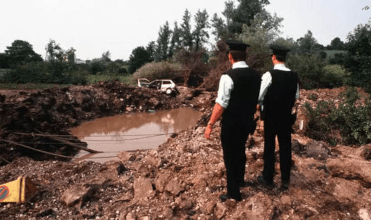
A detonating wire is placed from the house to a 1,000 lb. bomb, placed in a culvert under Killylea Road. At approximately 2:00 PM, as Dunne’s car is driving to Armagh, a Royal Ulster Constabulary patrol car is traveling in the opposite direction. Dunne’s car passes by the patrol car just as the police drive over the culvert, at which point the IRA detonate the bomb. Constable William James Hanson (37), and reserve officers Joshua Cyril Willis (35) and David Sterritt (34), are all killed instantly. Their car is blown into the air and lands upside down. Dunne and McCann are both severely injured with Dunne later dying of her injuries.
Witness Paul Corr, owner of a petrol filling station nearby, says, “The ground shook beneath us and it was accompanied by a very large explosion. At first we did not see the police car. The whole place was a terrible mess. Then we saw two young girls in the [Austin Metro]. They were unconscious and looked in a pretty bad way. There was nothing we could do for the policemen. Nobody could have come out of that car alive. It was dreadful.”
The bomb leaves a 20-foot-diameter crater in the two-lane road.
TaoiseachCharles Haughey is quoted as saying, “I know all the people of Ireland join me in my condemnation of this atrocity.”
The IRA releases a message claiming responsibility for the attack, and calls Dunne a victim of “unforeseen and fluke circumstances.” The statement is rejected in advance by political and Catholic and Protestant leaders alike and politicians in Ireland and Great Britain.
Sinn Féin‘s Martin McGuinness says, “Our sorrow at these deaths is genuine and profound, but will be abused by our political opponents who will cynically exploit yesterday’s events for their own political purpose.”
Pope John Paul II sends a message to be read at Dunne’s funeral in which he condemns the “grievous injustice and futility” of the murders that leave him “deeply shocked and saddened.” He implores “the men and women who espouse violence to recognise the grievous injustice and futility of terrorism.”
Two men, Henry McCartney (26) and Tarlac Connolly (29), are charged with the killings. They are later given life sentences but are released in 2000 under the terms of the Good Friday Agreement.
Raised in Ohio, Grant possesses an exceptional ability with horses, which serves him well through his military career. He is admitted to West Point, graduates 21st in the class of 1843 and serves with distinction in the Mexican–American War. In 1848, he marries Julia Dent, and together they have four children. He abruptly resigns his army commission in 1854 and returns to his family but lives in poverty for seven years.
Grant’s responses to corruption charges, in his federal departments rife with scandal, are mixed, often naïvely defending the culprits, particularly his war-time comrade Orville E. Babcock. But he also appoints cabinet reformers, such as John Brooks Henderson, for the prosecution of the Whiskey Ring. The Panic of 1873 plunges the nation into a severe economic depression that allows the Democrats to win the House majority. In the intensely disputed 1876 presidential election, he facilitates the approval by Congress of a peaceful compromise.
In his retirement, Grant is the first president to circumnavigate the world on his tour, meeting with Queen Victoria and many prominent foreign leaders. In 1880, he is unsuccessful in obtaining the Republican presidential nomination for a third term. In the final year of his life, facing severe financial reversals and dying of throat cancer, he writes his memoirs, which prove to be a major critical and financial success.
After a year-long struggle with throat cancer, surrounded by his family, Grant dies at 8:08 AM at his Mount McGregorcottage on July 23, 1885, at the age of 63. Philip Sheridan, then Commanding General of the Army, orders a day-long tribute to Grant on all military posts, and President Grover Cleveland orders a thirty-day nationwide period of mourning. After private services, the honor guard places Grant’s body on a special funeral train, which travels to West Point and New York City. A quarter of a million people view it in the two days before the funeral. Tens of thousands of men, many of them veterans from the Grand Army of the Republic (GAR), march with Grant’s casket drawn by two dozen black stallions to Riverside Park in the Morningside Heights neighborhood of Upper Manhattan. His pallbearers include Union generals William Tecumseh Sherman and Philip Sheridan, Confederate generals Simon Bolivar Buckner and Joseph E. Johnston, Admiral David Dixon Porter, and Senator John A. Logan, the head of the GAR. Following the casket in the seven-mile-long procession are President Cleveland, the two living former presidents Rutherford B. Hayes and Chester A. Arthur, all of the President’s Cabinet, as well as the justices of the Supreme Court.
Attendance at the New York funeral tops 1.5 million. Ceremonies are held in other major cities around the country, while Grant is eulogized in the press and likened to George Washington and Abraham Lincoln. His body is laid to rest in a temporary tomb in Riverside Park. Twelve years later, on April 17, 1897, he is reinterred in the General Grant National Memorial, also known as “Grant’s Tomb,” the largest mausoleum in North America.
O’Donoghue is born to Irish parents and grows up in the Hans Town area of Chelsea. He is the son of John O’Donoghue, a bricklayer from Kilworth, County Cork, and Bridget Griffin, who is from County Tipperary. He is the third of nine children, and has four brothers, Thomas, John, James, and Edmund, and four sisters, Mary, Ellen, Katherine, and Agnes. He is first an upholsterer‘s apprentice from the age of sixteen before becoming a journalist and author.
O’Donoghue attends a Catholic school and furthers his education at the British Museum. He begins his journalistic work by writing for the Dublin papers upon subjects relating to Irish music, art, and literature. A founder-member of the Irish Literary Society in London, he is also vice president of the National Literary Society, Dublin, and the compiler of a biographical dictionary, The Poets of Ireland (1891–93; revised edition, 1912), with entries on 2,000 authors. His published works also include Irish Poetry of the Nineteenth Century (1894), Humor of Ireland (1894), List of 1300 Irish Artists (1894), The Life and Writings of James Clarence Mangan (1897), Bibliographical Catalogue of Collections of Irish Music (1899), and Geographical Distribution of Irish Ability (1906).
In 1896 O’Donoghue moves to Dublin. In 1909 he becomes librarian of University College Dublin. He is co-editor of Catalogue of the Gilbert Library (in Dublin; 1918). William Butler Yeats writes of him in his Autobiographies of William Butler Yeats (1938).
Dillon comes from an area steeped in Irish traditional music. Since she was a schoolgirl she has sung and performed. She learns local folk songs from teachers and workshops held in the town. She can also play the fiddle and whistles. At the age of 14 she wins the All-Ireland Singing Trophy at Fleadh Cheoil.
In 1991 Dillon forms a band called Óige (an Irish word meaning ‘youth’) with school friends Murrough and Ruadhrai O’Kane, bringing her take on Irish traditional songs to Ireland, Scotland and further afield. During this time she also performs with big names such as De Dannan and Phil Coulter. Óige records two albums with Dillon, a studio and a live album. Inspiration is recorded in 1992 to sell at concerts in Europe. The live album, simply called Live, is recorded at a concert in Glasgow on August 15, 1993.
Dillon leaves Óige in 1995 and joins the folk supergroup Equation, replacing Kate Rusby, and signs a record deal with Warner Music Group. She leaves Equation with original band member Sam Lakeman because of musical differences and together they immediately signed a separate deal with the same label as a duo named Polar Star. In 2001, she releases her first solo album, Cara Dillon, which features traditional songs and two original Dillon/Lakeman compositions. The album is an unexpected hit in the folk world, with Dillon receiving four nominations at the 2002 BBC Radio 2 Folk Awards. Lakeman and Dillon marry in December 2002.
In 2009, Dillon releases her fourth album, the award-winning Hill of Thieves. The record marks a return to Dillon’s traditional roots with a purer production and arrangement style. The titular track “Hill of Thieves,” a Dillon\Lakeman original, is voted by BBC listeners as one of the “Top 10” original songs to have come out of Northern Ireland. In 2012, she performs two concerts with the Ulster Orchestra.
Dillon’s fifth solo album, A Thousand Hearts, is released in 2014. Prior to the album’s release, she discovers that her music enjoys a dedicated following in China, where her first album is featured in English curriculums. She has since embarked on several popular Chinese tours. As of 2017, she continues to tour regularly and work with her husband, who backs her on piano and guitar. Her most recent release is the album, Wanderer (2017).
Dillon is the sister of fellow folk singer Mary Dillon, formerly of Déanta. Dillon and Lakeman live in Frome, Somerset, England with their three children, twin sons born in 2006 and a daughter born in 2010.
Keane’s mother is a poet who writes under the pseudonym Moira O’Neill. Her father is a fanatic for horses and hunting. She grows up at Ballyrankin in County Wexford and refuses to go to boarding school in England as her siblings had done. She is educated by her mother, governesses, and at a boarding school in Bray, County Wicklow. Relationships between her and her parents are cold and she states that she had no fun in her life as a child. Her own passion for hunting and horses is born out of her need for fun and enjoyment. Reading does not feature much in her family and, although her mother writes poetry, it is of a sentimental nature, “suitable to a woman of her class.”
Keane claims she had never set out to be a writer, but at seventeen she is bedbound due to suspected tuberculosis, and turns to writing out of sheer boredom. It is then she writes her first book, The Knight of Cheerful Countenance, which is published by Mills & Boon. She writes under the pseudonym “M. J. Farrell,” a name over a pub that she had seen on her return from hunting. She explains writing anonymously because “for a woman to read a book, let alone write one was viewed with alarm: I would have been banned from every respectable house in County Carlow.”
In her teenage years Keane spends much of her time in the Perry household in Woodruff, County Tipperary. Here she befriends the two children of the house, Sylvia and John Perry. She later collaborates with John in writing a number of plays. Among them is Spring Meeting, directed by John Gielgud in 1938, and one of the hits of the West End that year. She and Gielgud become life long friends.
It is through the Perry family that Molly meets Bobby Keane, whom she marries in 1938. He belongs to a County Waterfordsquirearchical family, the Keane baronets. The couple goes on to have two daughters, Sally and Virginia.
Keane loves Jane Austen, and like Austen’s, her ability lay in her talent for creating characters. This, with her wit and astute sense of what lay beneath the surface of people’s actions, enables her to depict the world of the big houses of Ireland in the 1920s and 1930s. She “captured her class in all its vicious snobbery and genteel racism.” She uses her married name for her later novels, several of which, including Good Behaviour and Time After Time, have been adapted for television. Between 1928 and 1956, she writes eleven novels, and some of her earlier plays, under the pseudonym “M. J. Farrell.” She was a member of Aosdána.
Keane’s husband dies suddenly in 1946, after which she moves to Ardmore, County Waterford, a place she knows well, and lives there with her two daughters. Following the failure of a play shortly after her husband’s death, she publishes nothing for twenty years. In 1981 Good Behaviour comes out under her own name. The manuscript, which had languished in a drawer for many years, is lent to a visitor, the actress Peggy Ashcroft, who encourages her to publish it. The novel is warmly received and is short-listed for the Man Booker Prize.
Keane dies at the age of 91 on April 22, 1996 in her Cliffside home in Ardmore. She is buried beside the Church of Ireland church, near the centre of the village.
Wilson becomes interested in astronomy and travels to Oran in 1870 to photograph the solar eclipse. In 1871 he acquires a reflecting telescope of 12 inches (30.5 cm) aperture and sets it up in a dome in the gardens of Daramona House. He uses it to experiment on the photography of the moon with wet plates and also begins to study solar radiation using thermopiles. In 1881, he replaces the original telescope with a Grubb reflector of 24 inches (61 cm) aperture and a new dome and mounting that has an electrically controlled clock drive. The new telescope is mounted in a two-story tower attached to the house with an attached physical laboratory, darkroom and machine shop.
Wilson’s main research effort, in partnership with P.L. Gray, is to determine the temperature of the sun using a “differential radio-micrometer” of the sort developed by C.V. Boys in 1889, which combines a bolometer and galvanometer into one instrument. The result of their measurements is an effective temperature of about 8000 °C for the sun which, after correction to deal with absorption in the earth’s atmosphere, give a value of 6590 °C, compared to the modern value of 6075 °C.
Some of Wilson’s other astronomical projects include observations on the transit of Venus, determination of stellar motion, observations of sunspots and a trip to Spain to photograph a solar eclipse. He takes a great many excellent photographs of celestial bodies such as nebulae. His astronomical findings are published in a series of memoirs such as Experimental Observations on the Effective Temperature of the Sun.
Wilson dies on March 6, 1908 at Daramona at the relatively young age of 56, and is buried in the family plot in Steete churchyard. He had married Caroline Ada in 1886, the daughter of Capt. R.C. Granville, and they have a son and two daughters. His son donates his telescope to the University of London, where it is used for research and teaching, finally becoming a feature in Liverpool museum.
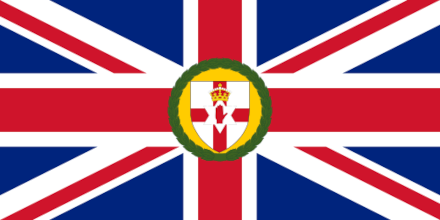
The office of the Governor of Northern Ireland is established on 9 December 9, 1922 under Letters Patent to “do and execute in due manner as respects Northern Ireland all things which by virtue of the [1920] Act and our said Letters Patent of 27 April 1921 or otherwise belonged to the office of Lord Lieutenant at the time of the passing of the Irish Free State Constitution Act 1922.”
The Governor has possession of the Great Seal of Northern Ireland and is the successor to the Lord Lieutenant of Ireland in Northern Ireland, itself established on May 3, 1921. The official residence of the Governor of Northern Ireland is Hillsborough Castle in County Down. Following refurbishment of the Castle, James Hamilton, 3rd Duke of Abercorn, takes up residence in 1925. It remained the official residence until the abolition of the office of governor in 1973. Henceforth it has been the official residence of the Secretary of State for Northern Ireland.
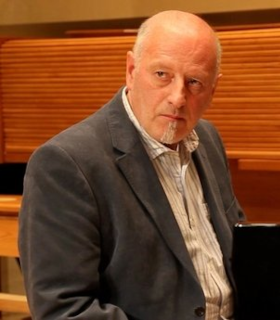
Doyle studies piano from the age of nine. After leaving school he attends the Royal Irish Academy of Music for three years, studying composing, during which time he is awarded two composition scholarships. He also studies at the Institute of Sonology at Utrecht University in the Netherlands and the Finnish Radio Experimental Music Studio on scholarships.
As a performer Doyle begins as a drummer with the groups Supply Demand and Curve and Jazz Therapy, playing free improvisatory and fusion music. He releases his first LP, Oizzo No, in 1975, and his second, Thalia, in 1978 on CBS Classics. Rapid Eye Movements (1981) is his third LP, and his attempt at a “masterpiece before the age of thirty.”
Doyle begins his magnum opus, Babel, in 1989, a 5-CD set that takes ten years to compose. Each track corresponds to a ‘room’ or place within an imagined giant tower city, a kind of aural virtual reality. It celebrates the multiplicity of musical language. One hundred three pieces of music are composed for it and he works with 48 collaborators. From 2002 to 2007 he works on the three-volume electronic work Passades. Twenty-seven albums of his music have been released. He has also composed scores for several films including Budawanny, Pigs and the documentary Atlantean by Bob Quinn.
In 2013 Doyle founds META Productions with opera director Eric Fraad, committed to exploring new forms of opera for the 21st century. Their first production is the electronic opera Heresy. Originally titled The Death by Fire of Giordano Bruno, a 40-minute ‘in development’ version is performed as part of a fully staged concert of his works at both the Kilkenny Arts Festival and in the Dublin Theatre Festival 2013. The two hour Heresy is presented as part of ‘Project 50’, a season of work celebrating 50 years of Project Arts Centre in November 2016. The opera is based on episodes from the life and works of Giordano Bruno. It is broadcast on RTÉ Lyric fm in September 2017 and released as a double album on Heresy records in 2018. Recent album releases are The Thousand Year Old Boy (2013), Time Machine (2015), Frail Things In Eternal Places (2016), and The Heresy Ostraca (2019).
Doyle founds the music theatre company Operating Theatre with Irish actress Olwen Fouéré. They produce many important site-specific productions, including Passades, Here Lies and Angel/Babel, all featuring his music as an equal partner in the theatrical environment. Operating Theatre performs in conventional and site-specific venues in Ireland, England, the Netherlands, France, Venezuela and the United States and releases several records. With Icontact Dance Company, he produces Tower of Babel – Delusional Architecture, featuring as much of Babel as he has composed by that point. This work is originally performed in a whole wing of the Irish Museum of Modern Art in 1992. Arguably his most famous theatre work is the music he wrote and performs on piano onstage for the Steven Berkoff version of the Oscar Wilde play Salome which plays in Dublin‘s Gate Theatre, in London‘s West End and on three world tours. The Irish Times notes that “his name is revered in the realm of theatre.”
Doyle’s works Four Sketches and All the Rage are awarded second and first prizes in the Dublin Symphony Orchestra composition competition in 1970 and 1974 respectively. He has won the Programme Music Prize (1997) and the Magisterium Award (2007) at the Bourges International Electro-Acoustic Music Competition in Bourges, France. He also receives the Irish Arts Council‘s Marten Toonder Award in 2000 in recognition of his innovative work as a composer. He is a member of Aosdána, and has recently been made Adjunct Professor of Music at Trinity College Dublin.
PresidentMichael D. Higgins confers the honour of Saoi on Doyle on August 16, 2019 by placing a gold torc around his neck. This is the highest honour of Aosdána that can be bestowed by fellow Aosdána members. No more than seven living members can be so honoured at one time. The Irish Times describes his album Chalant – Memento Mori as “a richly rewarding work that runs the full, glorious gamut of human emotion.” It is Album of the Week on March 30, 2012 in the same paper.
Michelle Smith de Bruin, Irish swimmer who achieves notable success in the 1996 Summer Olympics in Atlanta, becoming Ireland’s most successful Olympian to date, is stripped of her Irish swimming records on July 16, 1999, for tampering with a urine sample.
Smith wins three gold medals and a bronze medal at the 1996 Summer Olympics in Atlanta, making her Ireland’s most decorated Olympian. There is controversy at the games due to her qualifying for the 400m freestyle event at the expense of the then world-record holder Janet Evans, an American swimmer who finishes ninth in the preliminary swims with only the top eight advancing. Smith does not submit her qualifying time for the 400m freestyle event before the July 5 deadline but does so two days later with the Irish Olympic officials insisting they had been given permission to submit the qualifying time after the deadline.
Smith applies for the event after she arrives in Atlanta. After she qualifies at the expense of Evans, the US Swimming Federation, supported by the German and Netherlands swimming teams, challenge a decision to allow Smith to compete but are unsuccessful. At a later conference, Evans highlights that accusations of Smith doping had been heard by her around poolside. Smith later receives an apology from Evans as her comments lead to Smith being treated poorly by U.S. media.
Two years after the 1996 Summer Olympics, FINA bans Smith for four years for tampering with her urine sample using alcohol. She appeals against the decision to the Court of Arbitration for Sport (CAS). Her case is heard by a panel of three experienced sports lawyers, including Michael BeloffQC. Unusually for a CAS hearing, Smith’s case is heard in public, at her own lawyer’s request. FINA submits evidence from Jordi Segura, head of the International Olympic Committee (IOC) accredited laboratory in Barcelona, which says she took androstenedione, a metabolic precursor of testosterone, in the previous 10 to 12 hours before being tested. The CAS upholds the ban.
Smith is 28 at the time, and the ban effectively ends her competitive swimming career. She is not stripped of her Olympic medals, as she had never tested positive for any banned substances.
Smith’s experiences at the CAS have an effect beyond her swimming career. It is there that she develops an interest in the law. After officially announcing her retirement from swimming in 1999, she returns to university, graduating from University College Dublin with a degree in law. In July 2005 she is conferred with the degree of Barrister at Law of King’s Inns, Dublin. While a student at the King’s Inns she wins the highly prestigious internal Brian WalshMoot Court competition. Her book, Transnational Litigation: Jurisdiction and Procedure, is published in 2008 by Thomson Round Hall.
Smith has always denied using illegal performance-enhancing drugs. In 1996, she releases her autobiography, Gold, co-written with Cathal Dervan. She lives in Kells, County Kilkenny with her husband, Erik de Bruin, and their two children.
Campbell is born into a Catholic and Irish nationalist family from County Down. He is educated at St. Malachy’s College, Belfast. After working for his father he teaches for a while. He travels to Dublin in 1902, meeting leading nationalist figures. His literary activities begin with songs, as a collector in Antrim, County Antrim and working with the composer Herbert Hughes. He is then a founder of the Ulster Literary Theatre in 1904. He contributes a play, The Little Cowherd of Slainge, and several articles to its journal Uladh edited by Bulmer Hobson. The Little Cowherd of Slainge is performed by the Ulster Literary Theatre at the Clarence Place Hall in Belfast on May 4, 1905, along with Lewis Purcell’s The Enthusiast.
Campbell moves to Dublin in 1905 and, failing to find work, moves to London the following year where he is involved in Irish literary activities while working as a teacher. He marries Nancy Maude in 1910, and they move shortly thereafter to Dublin, and then later to County Wicklow. His play Judgement is performed at the Abbey Theatre in April 1912.
Campbell takes part as a supporter in the Easter Rising of 1916, doing rescue work. The following year he publishes a translation from Irish of the short stories of Patrick Pearse, one of the leaders of the Rising.
Campbell becomes a Sinn FéinCouncillor in Wicklow in 1921. Later in the Irish Civil War he is on the Republican side, and is interned in 1922-23. His marriage breaks up, and he emigrates to the United States in 1925 where he settles in New York City. He lectures at Fordham University, and works in academic Irish studies, founding the University’s School of Irish Studies in 1928, which lasts four years. He is the editor of The Irish Review (1934), a short lived “magazine of Irish expression.” The business manager is George Lennon, former Officer Commanding of the County WaterfordFlying Column during the Irish War of Independence. The managing editor is Lennon’s brother-in-law, George H. Sherwood.
Campbell returns to Ireland in 1939, settling at Glencree, County Wicklow. He dies at Lacken Daragh, Enniskerry, County Wicklow on June 6, 1944.





 seamus dubhghaill