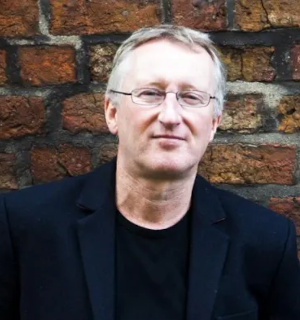
Bateman attends Bangor Grammar School leaving at the age of 16 when he is hired by Annie Roycroft to join the County Down Spectator as a “cub” reporter, then columnist and deputy editor. A collection of his columns is published as Bar Stool Boy in 1989.
Bateman has been writing novels since his debut, Divorcing Jack, in 1994. Divorcing Jack wins a Betty Trask Award in the same year and is adapted into a 1998 film starring David Thewlis. Several of his novels feature the semi-autobiographical Belfast journalist, Dan Starkey.
Bateman’s book Murphy’s Law is adapted from the BBC television series Murphy’s Law (2001–2007), featuring James Nesbitt. He explains on his website that “Murphy’s Law was written specifically for James Nesbitt, a local actor who became a big TV star through Cold Feet. The ninety-minute pilot for Murphy’s Law on BBC One was seen by more than seven million people, and led to three TV series, on which I was the chief writer.”
Bateman’s eight-part series Scúp is written in English and translated into Irish. It is produced by Stirling Productions and BBC Northern Ireland. A second series has since been commissioned.
Campbell’s books, mostly collections of humorous pieces that were originally published in newspapers and magazines, include A Long Drink of Cold Water (1949), A Short Trot with a Cultured Mind (1950), An Irishman’s Diary (1950), Life in Thin Slices (1951), Patrick Campbell’s Omnibus (1954), Come Here Till I Tell You (1960), Constantly in Pursuit (1962), How to Become a Scratch Golfer (1963), Brewing Up in the Basement (1963), Rough Husbandry (1965), The P-P-Penguin Patrick Campbell (1965), All Ways on Sundays (1966), A Bunch of New Roses (1967), an autobiography My Life and Easy Times (1967), The Coarse of Events (1968), Gullible Travels (1969), The High Speed Gasworks (1970), Waving All Excuses (1971), Patrick Campbell’s Golfing Book (1972), Fat Tuesday Tails (1972), 35 Years on the Job (1973), and The Campbell Companion (1987). Many of his books are illustrated by Quentin Blake.
Campbell is married three times, first in 1941 to Sylvia Alfreda Willoughby Lee, whom he divorces in 1947. He then marries Chery Louise Munro in 1947. The two divorce in 1966, the year he marries Vivienne Orme.
Campbell speaks with a stammer, but nevertheless delights television audiences with his wit, notably as a regular team captain on the long-running show Call My Bluff, opposite his longtime friend, Frank Muir. Muir notes that “When he was locked solid by a troublesome initial letter he would show his frustration by banging his knee and muttering ‘Come along! Come along!'” Some of his funniest short stories describe incidents involving his stammer. He stands six feet five inches tall, and several of his funniest pieces deal with the problems faced by a man of his build in merely finding shoes or clothes that fit him. He also makes regular appearances in That Was The Week That Was.
Campbell lives for many years in the South of France, commuting to England for his television work and continuing to produce his weekly column in The Sunday Times, which he drops in 1978.
In 1972 a period of illness leads to the discovery that Campbell had suffered an undetected heart attack some years previously and has a permanent heart weakness. An attack of viral pneumonia in 1980 exacerbates this condition, and he dies suddenly on November 9, 1980 while talking to a nurse at University College Hospital, London. He is succeeded as the 4th and last Lord Glenavy by his novelist brother Michael.
After finishing his schooling at fifteen, O’Herlihy follows his grandfather into journalism and secures a job in the reading room of The Cork Examiner. He is only seventeen years-old when he subsequently becomes sub-editor of the Evening Echo, a position he holds for five years. He also graduates to the positions of news, features and sports reporter.
In the early 1960s O’Herlihy begins his broadcasting career when he starts to do local association football reports from Cork for Radio Éireann. In 1965, he makes his first television broadcast in a programme commemorating the sinking of the RMS Lusitania off the Cork coast. After three years O’Herlihy is asked to join RTÉ’s current affairs programme 7 Days to add the required field-reporting skills to the studio-based interviews. The programme has a reputation for its hard-hitting investigative reporting, and he reports on many varying stories from illegal fishing in Cork to the outbreak of the crisis in Northern Ireland. In November 1970, the 7 Days programme comes into controversy when O’Herlihy reports a story on illegal money lending. The report is unconventional as it is one of the first television pieces to use hidden cameras, it claims the government is not responding to illegal moneylending. A tribunal of inquiry follows, and O’Herlihy is forced to move away from current affairs.
Following this controversy, while O’Herlihy is not sacked as he has fifteen months left on his contract with RTÉ, he is moved to the RTÉ Sports department. There he works under Michael O’Hehir, who dislikes him and his broadcasting style. In spite of this O’Herlihy fronts RTÉ’s television coverage of the Olympic Games that year. He also becomes involved in the production of various sports programmes.
O’Herlihy is not long in the RTÉ Sports department when he becomes a regular presenter for such programmes as Sunday Sport and Sports Stadium. In 1978 he becomes RTÉ Soccer host alongside Eamon Dunphy and, in 1984, Johnny Giles joins the panel and Liam Brady follows in 1998. Since 1974 O’Herlihy becomes RTÉ’s chief sports presenter for such events as all Olympic Games until 2012, FIFA World Cups until 2014, UEFA European Football Championships until 2012 and European and World Track and Field Championships. He hosts RTÉ highlights of the Ryder Cup in 2006 when it is at the K Club in County Kildare and continues to present coverage of Ireland’s soccer internationals for RTÉ, along with Dunphy, Giles and Brady.
O’Herlihy hosts RTÉ’s coverage of rugby union in the 1980s and early 1990s. However, when RTÉ attains the rights to cover the English Premier League in 1992, Tom McGurk takes over as host of RTÉ’s coverage of rugby union. O’Herlihy covers the Premier League, Irish Internationals and The Champions League before dropping the Premier League in 2008. He continues to cover the Olympic Games and International Athletic Championships such as the European and World Athletics. He presents the first Rugby World Cup on RTÉ television in 1987 and, with Jim Carney, co-presents the first edition of The Sunday Game in 1979.
In 2012, while covering Chloe Magee‘s progress at the 2012 Summer Olympics O’Herlihy remarks that badminton was once considered “a mainly Protestant sport.” RTÉ subsequently receives a number of complaints, and while Magee criticises the remarks, the argument is made that the incident inadvertently reflected a complex historical reality.
O’Herlihy presents RTÉ Sport‘s coverage of the 2010 FIFA World Cup, his ninth FIFA World Cup. He fronts 18 European Championships and FIFA World Cups for RTÉ, the last of which comes in 2014. This proves to be the final tournament with O’Herlihy at the helm. He retires at its conclusion and dies the following year.
O’Herlihy attends the 12th Irish Film & Television Awards on Sunday, May 24, 2015. He dies peacefully in his sleep at his home the following day at the age of 76 nearly a year after his retirement. He is survived by wife Hillary and daughters Jill and Sally. Giles, Brady and Dunphy appear on The Late Late Show in tribute later that week. At the time of his death O’Herlihy is working on a sports version of Reeling in the Years, which RTÉ immediately cancels.
Richards is born to John William Richards, a lawyer, and Adelaide Roper, suffragist who had chained herself to the railings in St. Stephen’s Green. She goes to school at Alexandra College, Dublin, and after that she attends a finishing school in Paris. Though her family is not in the arts, her godmother is Beatrice Elvery. Shes attends Elvery’s salons with her parents as a child. She meets W. B. Yeats when she is sixteen. Her niece, Geraldine Fitzgerald, daughter of her sister, Edith Catherine Richards, is also one of Ireland’s pre-eminent actresses.
Richards’s acting career starts while attending the Dublin drama league and she is asked at short notice to replace Eileen Crowe in Juno and the Paycock, playing the role of Mary Boyle in the Abbey Theatre production. Richards gets the role of Nora Clithero in the 1926 production of The Plough and the Stars, Seán O’Casey‘s next production. This role means that she ends up with police protection for the duration of the run due to the disturbances the play engenders. Another important role is to take on playing the lead in The Player Queen by Yeats. Maire O’Neill had previously made the role her own and Yeats had let no one perform the part since then so taking on such a challenge is intimidating. Richards continues to take on leading roles with the Abbey Theatre but in 1926 she also begins to direct.
On December 28, 1928, Richards marries playwright Denis Johnston in St. Anne’s Church in Dublin. She tours the United States with the Abbey players in 1932 and with the Irish Players in the mid 1930s. A role in 1938 in Molly Keane‘s Spring Meeting starring Gladys Cooper and A. E. Matthews takes her to Broadway in New York City. War in Europe breaks out while the run is still going on and Richards is advised to stay in the United States. However, by then she has two children, producer Micheal and novelist Jennifer Johnston, so she returns to Dublin. There she runs her own theater company at the Olympia Theatre with Nigel Heseltine. Her marriage to Johnston, broken in 1938, ends with divorce in February 1945.
In 1961 Ireland launches its first television service, Raidió Teilifís Éireann. Richards is one of the first producers, recommended to the station by Hilton Edwards. She is one of the few women in the new station. The first Irish play produced during the opening week is directed by her and she is nominated for a Best Actress award in another production, Inquiry at Lisieux. She works as producer on a wide number of programs for the station including documentaries, soap operas and religious programming. Both Tolka Row and The Riordans are produced by her as well as Denis Johnston’s The Moon on the Yellow River, George Bernard Shaw‘s Arms and the Man and John Millington Synge‘s Riders to the Sea.
Richards retires from her RTÉ career in the early 1970s though she continues to raise funds for the Gate Theatre through the Edwards–MacLiammóir Playhouse Society. In 1983, for her 80th birthday, the Abbey puts on a party for her which includes a special rendition of “Nora” from The Plough and the Stars. Richards is the last living member of the original 1926 cast. The song is repeated at her funeral in 1985. She died in Ballybrack, County Dublin, on January 19, 1985. Her funeral is held in St. Anne’s Church in Dublin and she is cremated in Glasnevin Cemetery.
Watson scores his first World Championship point in the 1974 Monaco Grand Prix, while driving for Goldie Hexagon Racing. He goes on to score a total of six points that season, driving a customer Brabham BT42-Ford modified by the team. He fails to score Championship points the following year, driving for Surtees Racing Organisation, Team Lotus and Team Penske. At the 1975 Spanish Grand Prix he has the chance to score his first win. He is in second position, behind Mario Andretti, until he has to stop in the pits for checks after his car starts to suffer vibrations. Andretti retires later, and after rejoining the race Watson finishes in eighth, his best Championship result in 1975. In non-Championship races he fares somewhat better, taking second place in the Race of Champions at Brands Hatch, and fourth at the BRDC International Trophy race at Silverstone.
Watson secures his first World Championship podium with third place at the 1976 French Grand Prix. Later that season comes his first victory, driving for Penske in the Austrian Grand Prix having qualified second on the grid. After the race he shaves off his beard, the result of a bet with team owner Roger Penske.
In the third race of the 1977 Formula One season, the South African Grand Prix, he manages to complete the race distance, scores a point, and takes his first ever fastest lap. His achievements are overshadowed, however, by the deaths of driver Tom Pryce and a track marshal, Jansen Van Vuuren. His Brabham-Alfa Romeo lets him down throughout the season but, despite this, he gains his first pole position in the Monaco Grand Prix and qualifies in the top ten no fewer than 14 times, often in the first two rows. Problems with the car, accidents, and a disqualification leads him to race the full distance in only five of the 17 races. The closest he comes to victory is during the French Grand Prix, where he dominates the race from the start only to be let down by a fuel metering problem on the last lap which relegates him to second place behind eventual winner Mario Andretti.
In 1978, Watson manages a more successful season in terms of race finishes, even out-qualifying and out-racing his illustrious teammate Niki Lauda on occasion. He manages three podiums and a pole, and notches up 25 points to earn the highest championship placing of his career to that point.
For 1979, Watson moves to McLaren where he gives them their first victory in over three years by winning the 1981 British Grand Prix and also securing the first victory for a carbon fibre composite monocoque F1 car, the McLaren MP4/1. Later in the 1981 season, the strength of the McLaren’s carbon fibre monocoque is demonstrated when he has a fiery crash at Monza during the Italian Grand Prix. He loses the car coming out of the high speed Lesmo bends and crashes backwards into the barriers. Similar accidents have previously proven fatal, but Watson is uninjured in an accident he later recalls as looking far worse than it actually was. After James Hunt‘s abrupt retirement after the Monaco Grand Prix in 1979, he is the only full-time competitive British F1 driver up until the end of his career.
Watson’s most successful year is 1982, when he finishes third in the Drivers’ Championship, winning two Grands Prix. In several races he achieves high placings despite qualifying towards the back of the grid. At the first ever Detroit Grand Prix in 1982, he overtakes three cars in one lap deep into the race on a tight, twisty track that is difficult to pass on. Working his way from 17th starting position on the grid, he charges through the field and scores a victory in the process. He goes into the final race of the season at Caesars Palace with an outside chance of the title, but he finishes five points adrift of Keke Rosberg and level on points with Didier Pironi.
A year later in 1983, Watson repeats the feat of winning from the back of the grid at the final Formula One race in Long Beach, another street circuit, starting from 22nd on the grid, the farthest back from which a modern Grand Prix driver had ever come to win a race. His final victory also includes a fight for position with teammate Niki Lauda, who had started the race 23rd, though Watson ultimately finishes 27 seconds ahead of his dual World Championship winning teammate.
At the end of the 1983 season, however, Watson is dropped by McLaren and subsequently retires from Formula One. Negotiations with team boss Ron Dennis reportedly break down when he asks for more money than dual World Champion Lauda is earning, citing having won a Grand Prix in 1983 where Lauda did not. Dennis instead signs Renault refugee Alain Prost for comparatively little. Watson does return for one further race two years later, driving for McLaren in place of an injured Lauda at the 1985 European Grand Prix at Brands Hatch, in which he qualifies 21st and places seventh in the race.
In 1984 Watson turns to sports car racing, notably partnering Stefan Bellof to victory at the Fuji 1000 km during Bellof’s 1984 Championship year. He is also part of the driver lineup for Bob Tullius‘ Group 44 Jaguar team at the 1984 24 Hours of Le Mans driving an IMSA spec Jaguar XJR-5 powered by a 6.0 litre V12 in the IMSA / GTP class. In what is Jaguar’s first appearance at Le Mans since 1959, he briefly takes the lead toward the end of the first hour when the faster Porsche 956s and Lancia LC2s pit. Driving with American Tony Adamowicz and Frenchman Claude Ballot-Léna, they fail to finish the race due to engine trouble though they are classified in 28th place.
After retiring from active racing, Watson works as a television commentator for Eurosport, the BBC, Sky Sports’ Pay Per View, BSkyb, runs a race school at Silverstone and manages a racetrack. He also becomes the first man to ever test a Jordan Formula One car in 1990. He currently provides expert commentary on the GT World Challenge Europe alongside regular Blancpain television commentator David Addison.
(Pictured: John Watson at the 1982 Dutch Grand Prix)
O’Reilly is born on May 14, 1929, in Granard, County Longford, one of six children of James P. O’Reilly, shopkeeper and musician, and Catherine O’Reilly (née Donegan). The family moves to Dublin when he is nine years old. He is educated at the Christian Brothers school in James’s Street, where he excels at Gaelic football and develops an interest in drama and music. Toward the end of his schooldays, he begins to participate in athletics, particularly the high jump, and is coached by Jack Sweeney, a leading athletics coach.
Always a man of many talents and interests, after leaving school O’Reilly combines working in the insurance business with an athletics career with Donore Harriers and evening drama classes. He wins several Irish titles, including the high jump, javelin, and decathlon, and sets a national record in the high jump. In 1954 he wins the British AAA Championships high jump title, beating the Commonwealth champion into second place, and setting a championship record of 6 ft. 5 in. (1.96 m). As a result, he secures a United States athletics scholarship to the University of Michigan, Ann Arbor, where he takes a degree in liberal arts, majoring in speech and drama. While at Michigan he improves his Irish record to 6 ft. 7 in. (2.007 m). His athletic career, however, is dogged with bad luck. He is selected to compete in the high jump at the European Athletics Championships in Bern, Switzerland, in 1954 but fractures an ankle in practice and fails to advance beyond the qualifying round. Although he competes at international level for ten years (1952–62), he is unlucky to never take part in the Olympic Games. A victim of sporting politics in 1952, as an NCAA athlete he is not entitled to compete. He is selected for the 1956 Summer Olympics in Melbourne but is unable to attend when, at the last minute, his club cannot provide the finance for him to attend. Earlier that year he wins the Big Ten Conference high jump title.
On leaving Michigan O’Reilly moves to New York City, where he embarks on an acting career with the Irish Players, but he returns to Dublin in 1959, where, after brief spells working as a teacher and for an advertising agency, he applies to Ireland’s new television station for a position. He is looking for an acting job but ends up being offered a position as a presenter, joining Teilifís Éireann in 1961 as an announcer/interviewer. His relaxed and unobtrusive style appeals to viewers and his light entertainment show, The Life of O’Reilly, is the most popular programme on Irish television in the day, eclipsing even a fledgling The Late Late Show. It is as a sports presenter and commentator, however, that O’Reilly is primarily remembered, as he becomes the face of sport on RTÉ Television for many years. He attends five Olympic Games as a broadcaster, from Mexico in 1968 to Los Angeles in 1984, commentating on athletics and gymnastics. The first presenter of RTÉ’s flagship Saturday afternoon sports programme Sports Stadium in 1984, he continues to present it over its fourteen-year life, co-presenting the final programme in December 1997. He also is the regular presenter of RTÉ’s Wimbledon Championships tennis coverage for many years, the sports results on news broadcasts on TV and radio, and Sunday Sport on RTÉ Radio, as well as commentating on individual sports such as ice-skating.
Although sports presenting is a natural progression for an athlete with his talents, O’Reilly’s real love is the arts. He continues to act, playing the part of Detective Inspector Michael Roarke in the classic children’s film Flight of the Doves (1971) with Ron Moody and Willie Rushton. He is also an accomplished singer and songwriter, and writes and performs his own one-man show, Across the Spectrum, comprising his own poems and songs in 1992. As well as a book of poems, The Great Explosion (1977), he releases a number of albums and tops the charts with his own song, “The Ballad of Michael Collins,” in 1981. He has a great admiration for Michael Collins, and this leads to his becoming the first non-political figure to give the oration at the annual Collins commemoration at Béal na Bláth, County Cork, in 1981. He also writes the song “Let the Nations Play” (1985), inspired by the boycotts of the Olympic games of 1980 and 1984, and the song is adopted as an anthem of the international Olympic movement.
Tall and slim in build, O’Relly is affable, modest, and self-deprecating in character. His relaxed style is no mere public affectation. He often exasperates colleagues by turning up just in time for broadcasts, and his ability to ad-lib is important in a live television environment. He once describes himself as “a champion high jumper who could enunciate properly and keep my hair neatly combed” (The Irish Times, April 7, 2001). Despite the disappointments in his sporting career, he maintains that his other interests more than compensated. In relation to the Olympics he is quoted as saying, “If you asked me whether I’d have preferred to win a medal or have written the song, I’d honestly say I would have preferred to have written the song” (Longford Leader, April 6, 2001).
O’Reilly lives in Ranelagh, Dublin, and is married twice. He meets his first wife Linda Herbst (née Kuhl) in New York in the late 1950s. His second marriage is to Johanna Lowry. He has four children. After a lenghty illness, he dies on April 1, 2001, in St. Vincent’s Hospital, Fairview, Dublin. He is buried at Mount Venus cemetery, Rathfarnham.
(From: “O’Reilly, Brendan” by Jim Shanahan, Dictionary of Irish Biography, http://www.dib.ie, October 2009)
Irish rock band U2 records the video for “Where the Streets Have No Name” on the rooftop of the Republic Liquor store in downtown Los Angeles on March 27, 1987, at a time when MTV still shows videos and U2 is unquestionably the biggest band in the world. The video shows police advising the U2 crew that they will shut down the performance due to crowd safety.
It takes place on the rooftop of the Republic Liquor store at 7th and Main. The location is now Margarita’s Place, a Mexican restaurant that still draws tourists. The impromptu performance is an homage to the Beatles final concert, as depicted in the film Let It Be. As lead vocalist and primary lyricistBono says at the time, “It’s not the first time we’ve ripped off the Beatles.
The video shows the police about to shut down the show at any moment with one cop heard saying, “You’re drawing people in here from Orange County and all over the goddamned place. We’re shutting this location down.” According to band manager Paul McGuinness, the confrontation is overly dramatized. The band is hoping to get shut down by the authorities to garner publicity, but the police let them play.
The video is directed by Meiert Avis and produced by Michael Hamlyn and Ben Dossett and goes on to win a Grammy Award for Best Performance Music Video. Hamlyn is almost arrested following a confrontation with the police, according to an interview with Uncut magazine. Avis later says that “getting busted was an integral part of the plan.”
Bass guitaristAdam Clayton later says, “The object was to close down the streets. If there’s one thing people in L.A. hate, it’s streets closing down, and we’ve always felt bands should shake things up. We achieved it because the police stopped us filming. Were we worried about being arrested? Not at the time.”
The performance actually is not quite as impromptu as it appears. Prior to filming, a week is spent reinforcing the roof of the liquor store to ensure it will not collapse if fans swarmed onto it, according to Wikipedia. A backup generator is also put on the roof so shooting can continue if the authorities shut off the power on the primary generator. They also rebuild the sign for The Million Dollar Hotel, which can be seen in the background, as an added draw in case no one shows up.
The performance attracts about 1,000 people, not the 30,000 predicted in the radio clips at the beginning of the video. The audio is actually a studio recording, although the band plays four versions of the opening track hit from their 1987 album The Joshua Tree.
(From: “Flashback Monday: U2 Performs On A Roof In Downtown L.A.” by Sharon Knolle, LAist of Southern California Public Radio, laist.com, September 22, 2013)
Bowman works mostly as a freelance journalist. He co-presents a radio show, The Rude Awakening, on Dublin’s FM104 with Scott Williams, George Hellis and Margaret Callanan for two years between 1993 and 1994 before joining the Sunday Independent newspaper as a columnist. He later presents television programmes on RTÉ, such as the quiz show Dodge the Question.
Bowman dies in a fall at his home on Fitzgerald Street in Harold’s Cross, Dublin, on March 6, 2000. He is found lying in the kitchen near the foot of the stairs. His death is believed to be the result of a fall down the stairs or from a stool, which is found nearby.
TaoiseachBertie Ahern says that he is deeply saddened on learning the news of Bowman’s death. His thoughts and prayers he says are with his family at this very sad time.
The leader of the Labour Party, Ruairí QuinnTD, expresses his shock and sadness on hearing of the death. He says that Bowman was without doubt one of the bright lights of Irish journalism. He extends his deepest sympathies to Bowman’s son, Saul, and to his parents John and Eimer.
The Fine Gael leader, John Bruton, says that few people he knew brought a smile to the face of anyone they met more readily. He says that his infectious good humour and iconoclastic attitude to life conveyed itself to all with whom he came into contact. He adds that Bowman will be missed for many years to come.
The editor of the Sunday Independent, Aengus Fanning, says that Bowman was one of the most brilliant journalists of his generation.
Bowman is survived by his parents, his sister Emma, his brothers Abie and Daniel and his only son Saul Philbin Bowman.
David Kelly, Irish actor who has regular roles in several film and television works from the 1950s onwards, dies on February 12, 2012, in Goatstown, Dublin, following a short illness. One of the most recognisable voices and faces of Irish stage and screen, he is known for his roles as Rashers Tierney in Strumpet City, Cousin Enda in Me Mammy, the builder Mr. O’Reilly in Fawlty Towers, Albert Riddle in Robin’s Nest, and Grandpa Joe in the film Charlie and the Chocolate Factory (2005). Another notable role is as Michael O’Sullivan in Waking Ned.
One of Kelly’s first television appearances is on RTÉ in O’Dea’s Your Man (1964) in which he plays the part of Ignatius opposite Jimmy O’Dea. He goes on to become a familiar face on British television with the BBC comedy Me Mammy, opposite Milo O’Shea and Anna Manahan. He goes on to often-memorable guest roles on such series as Oh, Father! and Never Mind the Quality, Feel the Width, and particularly during the 1970s with a long-running role as the one-armed dishwasher Albert Riddle in the Man About the House spin-off Robin’s Nest. He also has a regular long running role alongside Bruce Forsyth in both series of the comedy Slinger’s Day from 1986 to 1987, and, in 1991, he appears in the first series of the BBC sitcom 2point4 Children as the cafe-owner Paddy.
Kelly gains some of his greatest recognition in 1975, playing inept builder Mr. O’Reilly on the second episode of Fawlty Towers (“The Builders”).
Kelly is in the voice cast of The Light Princess, a partly animated, hour-long family fantasy that airs on the BBC in 1978.
In Ireland, Kelly may be most famous for his portrayal of the character “Rashers” Tierney in the 1980 RTÉ miniseries Strumpet City, which stars Peter O’Toole, Cyril Cusack and Peter Ustinov. He goes on to have starring roles in television shows such as Emmerdale Farm in the 1980s and Glenroe in the 1990s, as well as playing the grandfather in Mike Newell‘s film Into the West (1992).
Following his appearance as Michael O’Sullivan in the 1998 film Waking Ned, Kelly plays roles in such films as Tim Burton‘s Charlie and the Chocolate Factory (2005), in which he plays Grandpa Joe, and Agent Cody Banks 2: Destination London (2004). He plays title character Frank Kovak in the mystery film The Kovak Box, in a rare villainous role. In 2007, he appears in Stardust, which features Robert De Niro and Michelle Pfeiffer, and which is also his final film. He also does extensive radio work, including a guest appearance on the BBC Radio 4 series Baldi.
Kelly is married to actress Laurie Morton, who survives him, along with children David and Miriam. He dies at age 82 after a short illness on February 12, 2012. The Irish Times refers to him as the “grand old man of Irish acting.” A Catholic funeral mass takes place on February 16, 2012, at the Church of the Miraculous Medal, in his hometown of Dublin. He is cremated at Mount Jerome Cemetery and Crematorium.
Jimmy Magee, Irish sports broadcaster known as The Memory Man, is born on January 31, 1935, in New York City. He spends over half a century in sports broadcasting, and presents radio and television coverage of the Olympic Games since 1968 and the FIFA World Cup since 1966. By the time of his retirement he is the longest-serving sports commentator in the English-speaking world.
Magee is born to Patrick (Paddy) Magee and his wife Rose (née Mackin). The family returns to Ireland shortly after his birth. He and his three siblings are subsequently raised in Cooley, County Louth. As a child he is influenced by the sports commentary of the legendary Gaelic games broadcaster Michael O’Hehir. He recalls commentating as a seven-year-old for his next-door neighbour on a variety of imaginary games that the young Magee is also playing in. He also speaks of making up his own radio commentary in a field at a young age.
After being educated locally, Magee secures a full-time clerical post with Dundalk, Newry and Greenore Railway. While still working at the Railway he begins his broadcasting career. He starts out as a reporter for the Radio Éireann programme Junior Sports Magazine. Other contributors on the programme are Jim Tunney and Peter Byrne, former football correspondent with The Irish Times. On leaving his Railway job, he presents a number of sponsored radio programmes before concentrating on sport. He is a producer, presenter and script writer for Radio Éireann’s sponsored programmes in the 1950s and 1960s.
Magee and his wife Marie are married on October 11, 1955, and have five children: Paul, a soccer player with Shamrock Rovers F.C. (winning the League of Ireland Cup in 1977), who died of motor neuron disease, in May 2008, Linda (b. 1959), June (b. 1961), Patricia (b. 1962), and Mark (b. 1970).
Magee’s column or quiz appears in every single publication of the Sunday World since the first edition in 1973.
Magee is also a staple of RTÉ’s coverage of the Olympic Games. Beginning at the 1968 Summer Olympics in Mexico City, he attends the eleven subsequent Olympic games as a commentator with RTÉ. In 2012, he commentates on the boxing for RTÉ at the 2012 Summer Olympics in London, including Katie Taylor‘s gold medal-winning fight. At the 2016 Summer Olympics, he provides commentary on the football.
From 1987 to 1998 Magee hosts Know Your Sport, a sports-themed quiz show, along with George Hamilton. His broadcasting career also sees him provide commentary for over 200 international football games, 30 European Cup finals, multiple Tour de France cycle races, World Athletic Championships and boxing. He also narrates numerous videos on sport in general such as The Purple and Gold, Meath Return to Glory, etc.
A freelancer, Magee works for Channel 4 in 1994 and signs for UTV in 1995 on a three-year contract where a lifetime ambition of commentating on All-Ireland Finals is achieved. He commentates on three finals in both hurling and football.
Magee launches his memoir, Memory Man, in 2012. Some of his one-liners in commentaries have become famous or infamous, what are affectionately known in the broadcasting industry as Colemanballs after the famed commentating clangers of BBC broadcaster David Coleman.
In the emotionally trying year of 1989, Magee’s mother and wife die within months of each other, Marie dying at the young age of 54.
Magee dies on September 20, 2017, after a short illness. Many tributes are made to him including TaoiseachLeo Varadkar who says, “His commentaries were legendary and based on a breadth of sporting knowledge that was peerless.” RTÉ Head of Sport Ryle Nugent says, “It’s hard to put it into words, the man meant an inordinate amount to so many people, I think he was the soundtrack to many generations.”
In 1972 Magee wins a Jacob’s Award for his radio sports commentaries. In 1989, he is the subject of a special tribute show on The Late Late Show. At the 2012 Summer Olympics in London, the International Olympic Committee presents him with a replica of its torch.



 seamus dubhghaill