seamus dubhghaill

Promoting Irish Culture and History from Little Rock, Arkansas, USA


Leave a comment

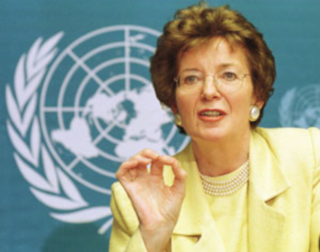
OHCHR Mary Robinson Criticises U.S. for Violating Human Rights

mary-robinson

On August 30, 2002, the United Nations High Commissioner for Human Rights, Mary Robinson, criticises the United States for violating human rights in its war on terrorism and of trying to scale back plans to save the world’s poorest people.

Robinson becomes the United Nations High Commissioner for Human Rights on September 12, 1997, following her nomination to the post by Secretary-General of the United Nations Kofi Annan and the endorsement of the General Assembly.

She assumes responsibility for the UN human rights programme at the time when the Office of the High Commissioner and the Centre for Human Rights are consolidated into a single Office of the High Commissioner for Human Rights (OHCHR).

As High Commissioner, Robinson gives priority to implementing the Secretary-General’s reform proposal to integrate human rights into all the activities of the United Nations. During her first year as High Commissioner, she travels to Rwanda, South Africa, Colombia and Cambodia, among other countries. In September 1998, she becomes the first High Commissioner to visit China and signs an agreement with the Government for OHCHR to undertake a wide-ranging technical-cooperation programme to improve human rights in that country. She also strengthens human rights monitoring in such conflict areas as Kosovo in the Federal Republic of Yugoslavia. Her term of office expires in 2002 after sustained pressure from the United States leads her to declare she is no longer able to continue her work.

Robinson comes to the United Nations after a distinguished, seven-year tenure as President of Ireland. She is the first Head of State to visit Rwanda in the aftermath of the 1994 genocide there. She is also the first Head of State to visit Somalia following the crisis there in 1992, and receives the CARE Humanitarian Award in recognition of her efforts for that country.

Before she is elected President of Ireland in 1990, Robinson serves as Senator for 20 years. Born on May 21, 1944 in Ballina, County Mayo, she is called to the bar in 1967 and two years later becomes the youngest Reid Professor of Constitutional Law at Trinity College, Dublin. In 1973, she becomes a member of the English Bar (Middle Temple). She becomes a Senior Counsel in 1980, and serves as a member of the Advisory Commission of Inter-Rights (1984-1990) and as a member of the International Commission of Jurists (1987-1990).

Educated at Trinity College, Robinson holds law degrees from the King’s Inns in Dublin and from Harvard University. She has been awarded numerous honorary degrees, medals and prizes from universities and humanitarian organizations around the world. In July 2009, she is awarded the Presidential Medal of Freedom, the highest civilian honour awarded by the United States, by U.S. President Barack Obama.


Leave a comment

German Bombing of the Shelburne Co-op

campile-bombing

German aircraft bomb a creamery at Campile, County Wexford, a small village located fourteen kilometres outside the town of New Ross, on August 26, 1940 killing three women.

Ireland remains officially neutral during World War II. However, on August 26, 1940, the German Luftwaffe bombs Campile in daylight. Three women are killed – Mary Ellen Kent (30), her sister Catherine Kent (26), both from Terrerath, and Kathleen Hurley (27) from Garryduff. Four German bombs are dropped on the creamery and restaurant sections of Shelburne Co-op on that day. The railway is also targeted by the bombers. The 20-minute ordeal terrorises the peaceful village and leaves behind a trail of devastation. The attack has never been fully explained, although there are numerous theories as to why the bombing occurred.

One theory is that the German pilots were lost and had mistaken the southeast coast of Wexford for Wales. It is also suggested that butter boxes emblazoned with the Shelburne Co-op name were discovered by the Nazis a few months earlier following the evacuation of Dunkirk and that the bombing was in retaliation for supplying foodstuffs to the Allied armies.

However, Campile historian John Flynn, who wrote a book to mark the 70th anniversary of the disaster, argues that the bombing was a message from Adolf Hitler to Taoiseach Éamon de Valera warning him to keep his promise on Ireland’s neutrality.

On the occasion of the 50th anniversary of the bombing, a plaque is erected on the co-op walls in memory of the three women.

The local Harts bar and lounge contains many artifacts relating to the bombing. The description and history related to each artifact can be found in an old leather-bound book kept underneath the counter in the adjoining sweet shop.


Leave a comment

Brian Keenan Released by Islamic Jihad

brian-keenan

Brian Keenan, Northern Irish writer, is released by the Islamic Jihad Organization on August 24, 1990 after having spent 52 months as a hostage in Beirut, Lebanon. His works include the book An Evil Cradling, an account of the four and a half years he spends as a hostage.

Keenan is born into a working-class family in East Belfast on September 28, 1950. He leaves Orangefield High School early and begins work as a heating engineer. However, he continues an interest in literature by attending night classes and in 1970 gains a place at the University of Ulster in Coleraine. Other writers there at the time included Gerald Dawe and Brendan Hamill. In the mid 1980s he returns to the Magee College campus of the university for postgraduate study. Afterwards he accepts a teaching position at the American University of Beirut, where he works for about four months.

On the morning of April 11, 1986 Keenan is kidnapped by the Islamic Jihad Organization. After spending two months in isolation, he is moved to a cell shared with the British journalist John McCarthy. He is kept blindfolded throughout most of his ordeal, and is chained by hand and foot when he is taken out of solitary.

The British and American governments at the time have a policy that they will not negotiate with terrorists and Keenan is considered by some to have been ignored. Because he is travelling on both Irish and British passports, the Irish government makes numerous diplomatic representations for his release, working closely with the Iranian government. Throughout the kidnap they also provide support to his two sisters, Elaine Spence and Brenda Gillham, who are spearheading the campaign for his release. He is released from captivity to Syrian military forces on August 24, 1990 and is driven to Damascus. There he is handed over by the Syrian Foreign Ministry to the care of Irish Ambassador, Declan Connolly. His sisters are flown by Irish Government executive jet to Damascus to meet him and bring him home to Northern Ireland.

An Evil Cradling is an autobiographical book by Keenan about his four years as a hostage in Beirut. The book revolves heavily around the great friendship he experiences with fellow hostage John McCarthy, and the brutality that is inflicted upon them by their captors. It is the 1991 winner of The Irish Times Literature Prize for Non-fiction and the Christopher Ewart-Biggs Memorial Prize.

Keenan returns to Beirut in 2007 for the first time since his release 17 years earlier, and describes “falling in love” with the city.

Brian Keenan now lives in Dublin.


Leave a comment

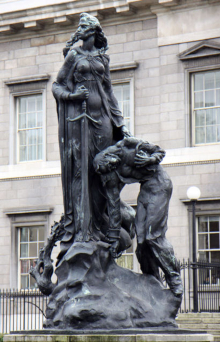
Death of Yann Renard-Goulet, Sculptor & Breton Nationalist

yann-goulet-custom-house-memorial

Yann Renard-Goulet, French sculptor, Breton nationalist and war-time collaborationist with Nazi Germany who headed the Breton Bagadou Stourm militia, dies in Bray, County Wicklow on August 22, 1999.

Goulet is born in Saint-Nazaire, France on August 20, 1914. Before World War II, he is a member of the Breton National Party and a former member of the French Section of the Workers’ International (SFIO). His artistic career begins at the École nationale supérieure des Beaux-Arts, where he studies art and architecture, and learns sculpture with Auguste Rodin‘s assistant, Charles Despiau. His works in France include bas-reliefs shown at the Exposition International de Paris (1938), and the monument to the youth of the French empire in Lille (1939). He is part of the Breton artistic movement Seiz Breur.

Goulet’s involvement in Breton nationalism leads to accusations that he had orchestrated the destruction of the Monument to the Breton-Angevin Federation at Pontivy on December 18, 1938, by Gwenn ha du, the nationalist terrorist group. He is detained, but then released.

In 1939, he is sent to Strasbourg to study the art of sabotage. He participates in the beginning of World War II fighting for France, and is captured by the Germans on June 11, 1940, while blowing up a bridge on the Aisne with friends from a French corps.

Later in the war, Goulet joins the assault section of Bagadou Stourm, Breton nationalist stormtroopers allied to the Germans. He also collaborates with the pro-Nazi nationalist newspaper L’Heure Bretonne. In 1941 in Paris, he becomes head of Bagadou Stourm and the “Youth Organizations” of the Breton National Party. The promotion of Bagadou Stourm officers is named “Patrick Pearse” to commemorate the 25th anniversary of the 1916 Easter Rising against British rule in Ireland.

After the liberation of France, Goulet travels with his wife and children to Ireland, and is sentenced to death as a Collaborationist by a French court in his absence. He acquires Irish citizenship in 1952 and becomes an art professor.

Goulet is commissioned to create public works commemorating the Irish Republican Army (IRA) and other republicans, including the Custom House Memorial (Dublin), the East Mayo Brigade IRA Memorial, the Republican Memorial (Crossmaglen), and the Ballyseedy Memorial (Kerry). He exhibits regularly at the Royal Hibernian Academy, eventually becoming the RHA Professor of Sculpture. He is also made a member of Aosdána in 1982.

Towards the end of the 1960s, Goulet claims to have taken the reins of the Breton Liberation Front (Front de Libération de la Bretagne, or FLB) and to have been behind all their attacks.

In 1969 Goulet becomes secretary general and chair of the Comité National de la Bretagne Libre and publishes the communiques of the FLB. In 1968, the head of police in Bray congratulate him on organising the previous day’s attack on the CRS barracks in Saint-Brieuc.

Goulet died at Bray, County Wicklow, on August 22, 1999, two days after his 85th birthday.

(Pictured: Custom House Memorial in Dublin by Yann Renard-Goulet, 1957)


Leave a comment

Death of Keyboardist Lou Martin

lou-martin

Louis Michael “Lou” Martin, piano and organ player from Belfast, dies in Bournemouth, Dorset, on August 17, 2012. He is most famous for his work with the London-based band Killing Floor and with fellow Irish musician Rory Gallagher.

Martin is born in Belfast on August 12, 1949. He starts learning the piano at the age of six and joins his first professional band, Killing Floor, in April or May 1968. In 1969 Martin and Stuart McDonald are recruited by 17-year-old Darryl Read who forms a band for Emperor Rosko‘s brother, Jeff Pasternak, called Crayon Angels. Read assembles the band and plays drums while Rosko acts as manager. Martin later leaves Killing Floor to play alongside Gallagher, and is featured on several of Gallagher’s albums, including Blueprint, Tattoo, Irish Tour ’74, Against the Grain, Calling Card, Defender and Fresh Evidence. He also plays rhythm guitar on one track, “Race the Breeze” from Blueprint.

After leaving Gallagher’s band, Martin and drummer Rod de’Ath form Ramrod, after which Martin plays with Downliners Sect and Screaming Lord Sutch. He also tours with Chuck Berry and Albert Collins.

Martin plays in the Nickey Barclay band in London in the 1980s, alongside Barclay on keyboards, with John Conroy and Dave Ball on lead guitar. The band plays across London on the blues rock circuit during the 1980s at venues such as The White Lion, Putney, The Star and Garter on Lower Richmond Road, The Golden Lion, Fulham and the Cartoon, Croydon.

Killing Floor releases an album in 2004 named Zero Tolerance, on which Martin participates.

After a period of illness including cancer and a number of strokes, Lou Martin dies peacefully in a hospital in Bournemouth, Dorset, at the age of 63, on August 17, 2012.


Leave a comment

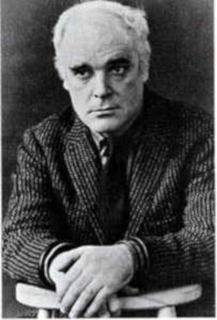
Death of Patrick McGee, Actor & Director

patrick-mcgee

Patrick George McGee, Northern Irish actor and director of stage and screen known professionally as Patrick Magee, dies from a heart attack at his flat in Fulham, London on August 14, 1982. He is known for his collaborations with Samuel Beckett and Harold Pinter, as well as creating the role of the Marquis de Sade in the original stage and screen productions of Marat/Sade. He also appears in numerous horror films and in two Stanley Kubrick films, A Clockwork Orange and Barry Lyndon.

McGee is born into a middle-class family in Armagh, County Armagh, Northern Ireland on March 31, 1922. He is the first born of five children and is educated at St. Patrick’s Grammar School, Armagh.

McGee’s first stage experience in Ireland is with Anew McMaster’s touring company, performing the works of William Shakespeare. It is here that he first works with Pinter. He is then brought to London by Tyrone Guthrie for a series of Irish plays. He meets Beckett in 1957 and soon records passages from the novel Molloy and the short story From an Abandoned Work for BBC Radio. Impressed by “the cracked quality of Magee’s distinctly Irish voice,” Beckett requests copies of the tapes and writes Krapp’s Last Tape especially for the actor. First produced at the Royal Court Theatre in London on October 28, 1958, the play stars McGee and is directed by Donald McWhinnie. A televised version is later broadcast by BBC Two on November 29, 1972.

In 1964, McGee joins the Royal Shakespeare Company, after Pinter, directing his own play, The Birthday Party, specifically requests him for the role of McCann. In 1965 he appears in Peter Weiss‘s Marat/Sade, and when the play transfers to Broadway he wins a Tony Award. He also appears in the 1966 RSC production of Staircase opposite Paul Scofield.

McGee’s early film roles include Joseph Losey‘s The Criminal (1960) and The Servant (1963), the latter an adaptation scripted by Pinter. He also appears as Surgeon-Major James Henry Reynolds in Zulu (1964), Séance on a Wet Afternoon (1964), Anzio (1968), and in the film versions of Marat/Sade (1967) and The Birthday Party (1968). He is perhaps best known for his role as the victimised writer Frank Alexander, who tortures Alex DeLarge with Ludwig van Beethoven‘s music, in Stanley Kubrick’s film A Clockwork Orange (1971). His other role for Kubrick is as Redmond Barry’s mentor, the Chevalier de Balibari, in Barry Lyndon (1975).

McGee also appears in Young Winston (1972), The Final Programme (1973), Galileo (1975), Sir Henry at Rawlinson End (1980), The Monster Club and Chariots of Fire (1981) but is most often seen in horror films. These include Roger Corman‘s The Masque of Red Death (1964), and the Boris Karloff vehicle Die, Monster, Die! (1965) for AIP; The Skull (1965), Tales from the Crypt (1972), Asylum (1972), and And Now the Screaming Starts! (1973) for Amicus Productions; Demons of the Mind (1972) for Hammer Film Productions; and Walerian Borowczyk‘s Docteur Jekyll et les femmes (1981).

Patrick McGee dies from a heart attack at his flat in Fulham, London on August 14, 1982, at the age of 60, according to obituaries in The Herald and The New York Times. On July 29, 2017, a blue plaque is unveiled in Edward Street, Armagh to mark Patrick McGee’s birthplace.


Leave a comment

Passport Requests Increase Following UK Brexit Vote

irish-passport

According to statistics released by the Department of Foreign Affairs on August 6, 2016, in the first full month since the United Kingdom‘s decision to leave the European Union, applications for Irish passports from people living in Great Britain increase by 73% and by 63% from those in Northern Ireland over the same period the previous year.

In July 2015 there are 4,242 applications submitted by people in Great Britain compared to 7,321 in July 2016. Meanwhile 6,638 passport requests are submitted from Northern Ireland.

Within in a day of the Brexit vote there is a surge in online interest in Irish passports and moving to Ireland. While the UK as a whole vote to leave the EU in the referendum, Northern Ireland votes to remain by a majority of 56 percent to 44 percent. The Department of Foreign Affairs says there is “an increase in queries in respect of entitlements to Irish passports” the very next day. The year-on-year figures for January show a 20 percent increase in applications prior to the vote.

Google Trends says UK searches for “getting an Irish passport” jump more than 100% after the Brexit result comes through. And while the data analysts do not reveal the exact number of searches for information on the Republic of Ireland‘s citizenship rules, they say most interest is shown in Northern Ireland with the normally unionist heartland of Holywood, County Down, taking top spot.

Sinn Féin repeatedly says that Northern Ireland must not be “dragged out of Europe.” Up to this point the British government dismisses calls from its representatives and others for a border poll in Irish unity.


Leave a comment

Birth of Gay Byrne, Radio & Television Presenter

CREATOR: gd-jpeg v1.0 (using IJG JPEG v80), quality = 90

Gabriel Mary “Gay” Byrne, veteran Irish presenter of radio and television for several decades and affectionately known as Uncle Gay, Gaybo or Uncle Gaybo, is born in Rialto, Dublin on August 5, 1934. His most known role is as the first host of The Late Late Show over a 37-year period spanning 1962 until 1999.

Byrne attends Rialto National School and a number of other schools for short periods. Subsequently, he is educated by the Irish Christian Brothers at Synge Street CBS.

When he is young, Byrne is inspired by the broadcaster Eamonn Andrews, who has a successful career on British television. In 1958 he moves over to broadcasting when he becomes a presenter on Radio Éireann. He also works with Granada Television and the BBC in England. At Granada, Byrne becomes the first person to introduce the Beatles on television when they make their small screen debut on local news programme People and Places. In 1961, Telefís Éireann, later Radio Telefís Éireann and now Raidió Teilifís Éireann, is established. Byrne works exclusively for the new Irish service after 1969. He introduced many popular programmes, with his most popular and successful programme being The Late Late Show.

On July 5, 1962, the first episode of The Late Late Show is aired on Irish television. Originally the show is scheduled as an eight-week summer filler. The programme, which is still broadcast, has become the world’s second longest running chat show. The show has much to do in shaping the new Ireland that emerges from the 1960s. Byrne presents his last edition of The Late Late Show on May 21, 1999, where he is presented with a Harley-Davidson motorcycle by Bono and Larry Mullen, Jr. Pat Kenny succeeds him as presenter in September 1999.

From 1973 until 1998, Byrne also presents The Gay Byrne Hour, later The Gay Byrne Show when it expands to two hours, on RTÉ Radio 1 each weekday morning.

Byrne does not completely retire in 1999 and continues to feature occasionally on radio and television after leaving The Late Late Show and The Gay Byrne Show, presenting several other programmes, including Who Wants to Be a Millionaire?, The Meaning of Life and For One Night Only on RTÉ One and Sunday Serenade/Sunday with Gay Byrne on RTÉ lyric fm. He launches Joe Duffy‘s autobiography Just Joe in Harry’s Bar in October 2011.

In 1988, Byrne is presented an honorary doctorate in literature from Trinity College, Dublin. In 2006 he is elected Chairman of Ireland’s Road Safety Authority, a public body given the task of improving road safety in the Republic of Ireland. Since retiring he has become the “Elder Lemon of Irish broadcasting.”

On a November 21, 2016 live radio broadcast Byrne reveals that he is to begin treatment for prostate cancer and that the cancer may have also spread to his lower back. He tells listeners he will be taking a break of just one week before returning to work, however, he continues to recover from treatment and he has not yet been back on air.


Leave a comment

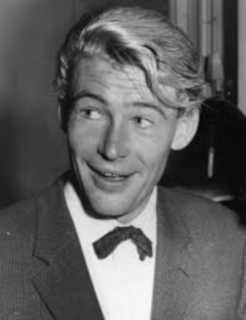
Birth of Peter O’Toole, Stage & Film Actor

peter-o-toole

Peter Seamus O’Toole, British stage and film actor of Irish descent, is born on August 2, 1932, in Leeds, Yorkshire, England. Some sources give his birthplace as Connemara, County Galway. Records from the General Registry Office in Leeds confirm that O’Toole is born in the north England town in 1932.

O’Toole grows up in Leeds and is educated at the Royal Academy of Dramatic Art in London. He is a reporter for the Yorkshire Evening Post in his teens and makes his amateur stage debut at Leeds Civic Theatre. After serving two years in the Royal Navy, he acts with the Bristol Old Vic Company from 1955 to 1958 and makes his London debut as Peter Shirley in George Bernard Shaw’s Major Barbara (1956). He appears with the Shakespeare Memorial Company at Stratford-upon-Avon, Warwickshire, England, in 1960 in highly praised performances as Shylock in The Merchant of Venice and as Petruchio in The Taming of the Shrew, and he plays the lead in Hamlet for the inaugural production of the Royal National Theatre in London in 1963. A prominent film star by this point in his career, he continues to appear on stages throughout the world to great acclaim. He is named associate director of the Old Vic in 1980.

O’Toole makes his motion picture debut in Kidnapped in 1960 and two years later becomes an international star for his portrayal of T.E. Lawrence in David Lean’s epic Lawrence of Arabia (1962). In 1964 he plays Henry II of England in Becket, and he has the title role in Lord Jim (1965). He appears as Henry II again in The Lion in Winter (1968), a film notable for the witty verbal sparring matches between O’Toole and costar Katharine Hepburn. The Ruling Class (1972), a controversial black comedy that has become a cult classic, casts O’Toole as a schizophrenic English earl with a messiah complex.

Personal problems contribute to a decline in his popularity during the 1970s, but he makes a strong comeback in the early 1980s with three well-received efforts. He portrays a duplicitous and domineering movie director in The Stunt Man (1980), and his performance as the Roman commander Lucius Flavius Silva in the acclaimed television miniseries Masada (1981) is hailed as one of the finest of his career. His most popular vehicle during this period is My Favorite Year (1982), an affectionate satire on the early days of television, in which he plays Alan Swann, a faded Errol Flynn-type swashbuckling screen star with a penchant for tippling and troublemaking.

O’Toole subsequently maintains his status with fine performances in such films as the Oscar-winning The Last Emperor (1987), the cult favourite Wings of Fame (1989), and Fairy Tale: A True Story (1997), in which he portrays Sir Arthur Conan Doyle. Notable screen roles in the 21st century included King Priam in the historical epic Troy (2004), an aging romantic in Venus (2006), the voice of a haughty food critic in the animated Ratatouille (2007), and a priest in the historical drama For Greater Glory (2012). In addition, in 2008 he portrays Pope Paul III in the TV series The Tudors.

In 1992 O’Toole publishes a lively memoir, Loitering with Intent: The Child. A second volume, Loitering with Intent: The Apprentice, appears in 1996. He is nominated for an Academy Award eight times — for Lawrence of Arabia, Becket, The Lion in Winter, Goodbye, Mr. Chips (1969), The Ruling Class, The Stunt Man, My Favorite Year, and Venus — but never wins. In 2003 he is awarded an honorary Oscar. He receives an Emmy Award for his performance as Bishop Pierre Cauchon in the television miniseries Joan of Arc (1999).

O’Toole dies on December 14, 2013, at Wellington Hospital in St. John’s Wood, London, at the age of 81. His funeral is held at Golders Green Crematorium in London on December 21, 2013, where his body is cremated in a wicker coffin. His ashes are planned to be taken to Connemara, Ireland. They are being kept at the residence of the President of Ireland, Áras an Uachtaráin, by President Michael D. Higgins, an old friend of O’Toole. His family has stated their intention to fulfill his wishes and take his ashes to the west of Ireland.


Leave a comment

Birth of John B. Keane, Irish Playwright & Novelist

john-b-keane

John Brendan Keane, Irish playwright, novelist and essayist, is born in Listowel, County Kerry on July 21, 1928.

Keane is the son of a national school teacher, William B. Keane, and his wife Hannah Purtill. He is educated at Listowel National School and then at St. Michael’s College, Listowel. He works as a chemist’s assistant for A.H. Jones who dabbles in buying antiques. He has various jobs in the United Kingdom between 1951 and 1955 working as a street cleaner and a bartender and lives in a variety of places including Northampton and London. It is while he is in Northampton that he is first published in an unnamed women’s magazine for which he receives £15.

After returning from the UK, Keane is a pub owner in Listowel from 1955 where he writes plays for the local theatre company and sponsors, from 1971, the annual Listowel Writers’ Week. He marries Mary O’Connor at Knocknagoshel Church on January 5, 1955 and they have four children: Billy, Conor, John and Joanna.

His first play, Sive (1959), is initially rejected by the Abbey Theatre in Dublin but goes on to win the amateur All-Ireland Drama Festival. Later plays include The Field (1965), which is released in a bowdlerized film version in 1990, and Big Maggie (1969), which is produced on Broadway in 1982. In 1998 Keane is honoured with a medal from the Abbey for his contribution to Irish theatre.

Keane is an Honorary Life Member of the Royal Dublin Society from 1991, serves as president of Irish club of PEN International and is a founder member of the Society of Irish Playwrights as well as a member of Aosdána. He is named the patron of the Listowel Players after the Listowel Drama Group fractures. He remains a prominent member of the Fine Gael party throughout his life, never being shy of political debate.

John Keane dies of prostate cancer on May 30, 2002, in Listowel at the age of 73.

Keane’s nephew is the investigative journalist Fergal Keane. His son John is a journalist with the Kilkenny People while his son Billy regularly writes a column for the Irish Independent.