seamus dubhghaill

Promoting Irish Culture and History from Little Rock, Arkansas, USA


Leave a comment

The Bombing of Nelson’s Pillar

nelsons-pillar-bombing

A powerful explosion destroys the upper portion of Nelson’s Pillar in Dublin in the early morning hours of March 8, 1966, bringing Nelson’s statue crashing to the ground amid hundreds of tons of rubble. All that is left of the Pillar is a 70-foot-high jagged stump. The pillar is seen by many as an anachronistic monument to English occupation of Ireland, especially as 1966 is the 50th anniversary of the 1916 Easter Rising.

Nelson’s Pillar is a large granite column capped by a statue of Horatio Nelson, built in the centre of what is then Sackville Street (later renamed O’Connell Street) in Dublin. It is completed in 1809 when Ireland is part of the United Kingdom. Its remnants are later destroyed by the Irish Army.

The decision to build the monument is taken by Dublin Corporation in the euphoria following Nelson’s victory at the Battle of Trafalgar in 1805. The original design by William Wilkins is greatly modified by Francis Johnston, on grounds of cost. The statue is sculpted by Thomas Kirk. From its opening on October 29, 1809, the Pillar is a popular tourist attraction, but provokes aesthetic and political controversy from the outset. A prominent city centre monument honouring an Englishman rankles as Irish nationalist sentiment grows, and throughout the 19th century there are calls for it to be removed or replaced with a memorial to an Irish hero.

During the Easter Rising in 1916 an attempt is made to blow up the pillar, but the explosives fail to ignite due to dampness. It remains in the city as most of Ireland becomes the Irish Free State in 1922, and the Republic of Ireland in 1949. The chief legal barrier to its removal is the trust created at the Pillar’s inception, the terms of which gave the trustees a duty in perpetuity to preserve the monument. Successive Irish governments fail to deliver legislation overriding the trust. Although influential literary figures such as James Joyce, William Butler Yeats and Oliver St. John Gogarty defend the Pillar on historical and cultural grounds, pressure for its removal intensifies in the years preceding the 50th anniversary of the Rising, and its sudden demise is, on the whole, well received by the public. Although it is widely believed that the action is the work of the Irish Republican Army (IRA), the police are unable to identify any of those responsible.

After years of debate and numerous proposals, the site is occupied in 2003 by the Spire of Dublin, a slim needle-like structure rising almost three times the height of the Pillar. In 2000 a former republican activist gives a radio interview in which he admits planting the explosives in 1966, but after questioning him the Gardaí decides not to take action. Relics of the Pillar are found in Dublin museums and appear as decorative stonework elsewhere, and its memory is preserved in numerous works of Irish literature.


Leave a comment

Bill Whelan Receives IMRO Lifetime Achievement Award

bill-whelan

Taoiseach Bertie Ahern presents Irish composer and musician Bill Whelan with the IMRO Lifetime Achievement Award at Dublin Castle on March 2, 2001. Such big names as The Corrs, Brian Kennedy, Jean Butler, Jim Sheridan, Paul McGuinness and Moya Doherty join him to celebrate the award.

Whelan is best known for composing a piece for the interval of the 1994 Eurovision Song Contest. The result, Riverdance, is a seven-minute display of traditional Irish dancing that becomes a full-length stage production and spawns a worldwide craze for Irish dancing and Celtic music and also wins him a Grammy Award. It is released as a single in the United Kingdom in 1994, credited to “Bill Whelan and Anúna featuring the RTÉ Concert Orchestra.” It reaches number 9 and stays in the charts for 16 weeks. The album of the same title reaches number 31 in the album charts in 1995. He also composes a symphonic suite version of Riverdance, with its premiere performed by the Ulster Orchestra on BBC Radio 3 in August 2014.

Whelan is a native of Limerick and is educated at Crescent College, University College Dublin and the King’s Inns. While he is best known for his Riverdance composition, he has been involved in many ground-breaking projects in Ireland since the 1970s. As a producer he has worked with U2 (on their War album), Van Morrison, Kate Bush, The Dubliners, Planxty, Andy Irvine & Davy Spillane, Patrick Street, Stockton’s Wing and fellow Limerickman Richard Harris.

In theatre, Whelan receives a Laurence Olivier Award nomination for his adaption of Gilbert and Sullivan‘s H.M.S. Pinafore. He writes original music for fifteen of William Butler Yeats‘s plays for Dublin‘s Abbey Theatre and his film credits include Dancing at Lughnasa (starring Meryl Streep), Some Mother’s Son, Lamb (starring Liam Neeson) and the award-winning At the Cinema Palace.


Leave a comment

Birth of Poet John Montague

john-montague

Irish poet John Montague is born on Bushwick Avenue at St. Catherine’s Hospital in Brooklyn, New York City, New York, on February 28, 1929. His father, James Montague, an Ulster Catholic, from County Tyrone, had come to the United States in 1925.

Life in New York is difficult during the Great Depression, so John and his two brothers are shipped back to Ireland in 1933. The two eldest are sent to their maternal grandmother’s house in Fintona, County Tyrone, but John is sent to his father’s ancestral home at Garvaghey, then maintained by two spinster aunts.

John studied at University College Dublin in 1946. Stirred by the example of other student poets he begins to publish his first poems in The Dublin Magazine, Envoy, and The Bell, edited by Peadar O’Donnell. But the atmosphere in Dublin is constrained and he leaves for Yale University on a Fulbright Fellowship in 1953.

A year of graduate school at University of California, Berkeley convinces Montague that he should return to Ireland. He settles in Dublin working at the Irish Tourist Office. In 1961 he moves to Bray, County Wicklow. A regular rhythm of publication sees his first book of stories, Death of a Chieftain (1964) after which the musical group The Chieftains is named, his second book of poems, A Chosen Light (1967), Tides (1970).

All during the 1960s, Montague continues to work on his long poem, The Rough Field, a task that coincides with the outbreak of the Northern Ireland civil rights movement. A Patriotic Suite appears in 1966, Hymn to the New Omagh Road and The Bread God in 1968, and A New Siege, dedicated to Bernadette Devlin which he reads outside Armagh Jail in 1970.

In 1972, Montague takes a teaching job at University College Cork, at the request of his friend, the composer Seán Ó Riada, where he inspires an impressive field of young writers including Gregory O’Donoghue, Seán Dunne, Thomas McCarthy, William Wall, Maurice Riordan, Gerry Murphy, Greg Delanty and Theo Dorgan.

Montague settles in Cork in 1974 and publishes an anthology, the Faber Book of Irish Verse (1974) with a book of lyrics, A Slow Dance (1975). Recognition is now beginning to come, with the award of the Irish American Cultural Institute in 1976, the first Marten Toonder Award in 1977, and the Alice Hunt Bartlett Award for The Great Cloak in 1978.

In 1987, Montague is awarded an honorary doctor of letters by the State University of New York at Buffalo. He serves as distinguished writer-in-residence for the New York State Writers Institute during each spring semester, teaching workshops in fiction and poetry and a class in the English Department of the University at Albany. In 1998, he is named the first Irish professor of poetry, a three-year appointment to be divided among Queen’s University Belfast, Trinity College Dublin, and University College Dublin. In 2008, he publishes A Ball of Fire, a collection of all his fiction including the short novella The Lost Notebook.

John Montague dies at the age of 87 in Nice, France on December 10, 2016, after complications from a recent surgery.


Leave a comment

UCC Students Protest Henry Kissinger Visit

kissingers-arrival-in-dublin

Former United States Secretary of State Henry Kissinger visits University College Cork (UCC) on February 27, 2002 where he is confronted by more than 400 angry students protesting his presence.

The protesters chant and wave banners bearing the slogan “The Milosevic of Manhattan” prior to the arrival of the 56th U.S. Secretary of State, who was in office during the controversial administration of Richard Nixon. Kissinger says he is pleased to discover that even in Ireland people are not indifferent to him. However, he denies being a war criminal claiming it is an insult to human intelligence for protesters in Cork to compare him with Slobodan Milošević.

“These people are throwing around allegedly criminal charges without a shred of real evidence. I don’t know who they represent but I wish their knowledge equalled their passion.”

Kissinger, who is visiting the university to deliver a speech at an MBA Association of Ireland business conference, says he has never replied to derogatory remarks in the media. He adds, “I consider them (the accusations) fundamentally beneath contempt. They are based on distortions and misrepresentations.”

The focus of Kissinger’s address is on United States foreign policy particularly in aftermath of the September 11, 2001 terrorist attacks.

Kissinger says the international scene is experiencing an extraordinary period of change for which there is no historical precedent. One of the biggest challenges facing the U.S. administration, he says, is to bring countries together to prevent the spread of biological and chemical weapons.

Kissinger’s visit is condemned by human rights organisations who claim he flouted international law in his dealings with Bangladesh, Chile and East Timor. Cork Sinn Féin councillor Jonathan O’Brien tells an earlier council meeting that Kissinger is not welcome in the city, and calls on UCC to cancel his invitation.


Leave a comment

The 1947 Blizzard

blizzard-of-1947

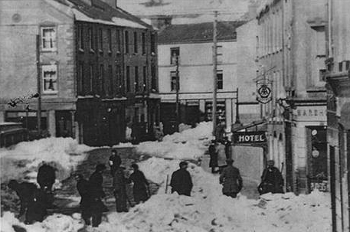
The worst blizzard in living memory hits Ireland on February 25, 1947. The penetrating Arctic winds had been blowing for several weeks. Munster and Leinster had been battling the snows since the middle of January.

On the evening of February 24, a major Arctic depression approaches the coast of Cork and Kerry and advances northeast across Ireland. By morning, Ireland is being pounded by the most powerful blizzard of the 20th century. The winter of 1946-1947 is the coldest and harshest winter in living memory. Temperatures rarely rise above freezing and the snows that have fallen across Ireland in January remain until the middle of March.

Worse still, all subsequent snowfall in February and March simply piles on top of all that has previously fallen. There is no shortage of snow that bitter winter. Of the fifty days between January 24 and March 17, it snows on thirty of them.

“The Blizzard” of February 25th is the greatest single snowfall on record and lasts for almost fifty consecutive hours. It smothers the entire island in a blanket of snow. Driven by persistent easterly gales, the snow drifts until every hollow, depression, arch and alleyway is filled and the Irish countryside becomes a vast ashen wasteland.

Everything on the frozen landscape is a sea of white. The freezing temperatures solidify the surface and it is to be an astonishing three weeks before the snows begins to melt.

(Pictured: Snow drifts on Main Street, Boyle, County Roscommon, February 1947)


Leave a comment

Birth of Playwright Tom Murphy

thomas-murphy

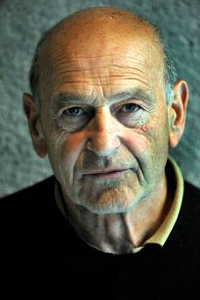
Tom Murphy, Irish playwright who has worked closely with the Abbey Theatre in Dublin and with Druid Theatre, Galway, is born in Tuam, County Galway on February 23, 1935.

Murphy attends the local Archbishop McHale College and later becomes a metalwork teacher. He begins writing in the late 1950s, saying, “In 1958, my best friend said to me, why don’t we write a play? I didn’t think it was an unusual question, because in 1958 everyone in Ireland was writing a play.” His second play, A Whistle in the Dark, is written in his Tuam kitchen on his free Friday and Saturday nights. It is entered into a competition for amateur plays, which it wins, and is eventually performed at the Theatre Royal Stratford East in London in 1961. It causes considerable controversy both there and in Dublin when it is later given its Irish premiere at the Abbey having initially been rejected by its artistic director.

Though Murphy is religious as a boy, education by the Christian Brothers leaves him largely irreligious. His 1975 play The Sanctuary Lamp is produced in the Abbey Theatre and receives a hostile reception due to its anti-Catholic nature, with theatregoers walking out and much negative criticism in the media.

Considered by many to be Ireland’s greatest living playwright, a title also often given to Brian Friel prior to his death in 2015, Murphy is honoured by the Abbey Theatre in 2001 by a retrospective season of six of his plays. His plays include the historical epic Famine (1968) which deals with the Irish Potato Famine between 1846 and spring 1847, the anti-clerical The Sanctuary Lamp (1975), The Gigli Concert (1983) and for many his masterpiece, the lyrical Bailegangaire and the bar-room comedy Conversations on a Homecoming (both 1985).

Murphy’s work is characterised by a constant experimentation in form and content from the apparently naturalistic A Whistle in the Dark to the surreal The Morning After Optimism and the spectacularly verbal The Gigli Concert. Recurring themes include the search for redemption and hope in a world apparently deserted by God and filled with suffering. Although steeped in the culture and mythology of Ireland, Murphy’s work does not trade on familiar clichés of Irish identity, dealing instead with Dostoyevskian themes of violence, nihilism and despair while never losing sight of the presence of laughter, humour and the possibilities of love and transcendence.


Leave a comment

UK Foot-and-Mouth Disease Outbreak

banbury-foot-and-mouth-notice

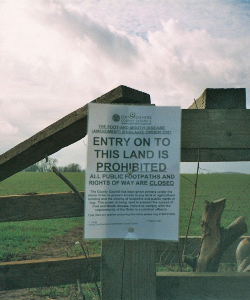
On February 21, 2001, Ireland’s multi-billion-pound livestock industry goes on full alert for signs of foot-and-mouth disease after the first outbreak in the United Kingdom in twenty years is confirmed in pigs. This epizootic sees 2,026 cases of the disease in farms across most of the British countryside. Over 6 million cows and sheep are killed in an attempt to halt the disease. By the time the disease is halted in October 2001, the crisis is estimated to have cost the United Kingdom £8bn (US$16bn).

The first case of the disease to be detected is at Cheale Meats abattoir in Little Warley, Essex on February 19, 2001, on pigs from Buckinghamshire and the Isle of Wight. Over the next four days, several more cases are announced in Essex. On February 23, a case is confirmed in Heddon-on-the-Wall, Northumberland, from where the pig in the first case had come. This farm is later confirmed as the source of the outbreak and the owner, Bobby Waugh of Pallion, is convicted of failing to inform the authorities of a notifiable disease, and later of feeding his pigs “untreated waste.”

Several cases of foot-and-mouth are reported in Ireland and mainland Europe, following unknowing transportation of infected animals from the UK. The cases spark fears of a continent-wide pandemic, but these fears prove unfounded.

Ireland suffers one case in a flock of sheep in Jenkinstown, County Louth in March 2001. A cull of healthy livestock around the farm is ordered. Irish special forces snipe wild animals such as deer capable of bearing the disease in the area.

The outbreak greatly affects the Irish food and tourism industry. The 2001 Saint Patrick’s Day festival is cancelled, but later rescheduled two months later in May. Severe precautionary measures are put into place throughout Ireland since the outbreak of the disease in the UK, with most public events and gatherings cancelled, controls on farm access, and measures such as disinfectant mats at railway stations, public buildings and university campuses. The 2001 Oireachtas Rince naa Cruinne, or Irish Dance World Championships, is cancelled as a result of these measures. Causeway 2001, an Irish Scouting Jamboree is also cancelled. Three matches involving the Ireland national rugby union team in the 2001 Six Nations Championship are postponed until the autumn.


2 Comments

Deportation of Joe Doherty

joseph-doherty

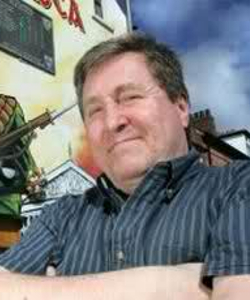
Joe Doherty, a volunteer in the Belfast Brigade of the Provisional Irish Republican Army (IRA) who escapes during his 1981 trial for killing a member of the Special Air Service (SAS) in 1980, is arrested in the United States in 1983 and is deported to Northern Ireland by the U.S. government on February 19, 1992. A first season episode of Law & Order entitled “The Troubles” is based on his case.

The trial of Doherty and the other members of their four-man active service unit nicknamed the “M60 gang” begins in early May 1981, on charges including three counts of murder. On June 10, Doherty and seven other prisoners, including Angelo Fusco and the other members of the IRA unit, take a prison officer hostage at gunpoint in Crumlin Road Gaol and ultimately escape in waiting cars. Two days after the escape, Doherty is convicted in absentia and sentenced to life imprisonment with a minimum recommended term of thirty years.

Doherty escapes across the border into the Republic of Ireland, and then travels to the United States on a false passport. He lives with an American girlfriend in Brooklyn and New Jersey, working on construction sites and as a bartender at Clancy’s Bar in Manhattan, where he is arrested by the FBI on June 28, 1983. He is imprisoned in the Metropolitan Correctional Center in Manhattan, and a legal battle ensues with the British government seeking to extradite him back to Northern Ireland. Doherty claims he is immune from extradition as the killing of Royal Irish Constabulary Captain Herbert Westmacott was a political act. In 1985 federal judge John E. Sprizzo rules Doherty cannot be extradited as the killing is a “political offense.” Doherty’s legal battle continues as the United States Department of Justice then attempts to deport him for entering the country illegally.

Doherty remains in custody at the Metropolitan Correctional Center and attempts to claim political asylum, and on June 15, 1988, Attorney General Edwin Meese overturns an earlier ruling by the Federal Board of Immigration Appeals that Doherty can be deported to the Republic of Ireland and orders his deportation to Northern Ireland. In February 1989 new Attorney General Dick Thornburgh chooses not to support the decision made by his predecessor and asks lawyers for Doherty and the Immigration and Naturalization Service to submit arguments for a review of the decision and Doherty’s claim for asylum. By this time Doherty’s case is a cause célèbre with his sympathisers including over 130 Congressmen and a son of then President of the United States George H. W. Bush. In 1990 a street corner near the Metropolitan Correctional Center is named after him.

In August 1991, Doherty is transferred to a federal prison in Lewisburg, Pennsylvania, and on January 16, 1992, the Supreme Court of the United States overturns a 1990 Federal Appeals Court ruling by a 5-to-3 decision, paving the way for his deportation. On February 19, 1992, Doherty is deported to Northern Ireland, despite pleas to delay the deportation from members of Congress, Mayor of New York City David Dinkins, and the Cardinal Archbishop of New York, John Joseph O’Connor.

Doherty is returned to Crumlin Road Gaol before being transferred to HM Prison Maze. He is released from prison on November 6, 1998, under the terms of the Good Friday Agreement. After his release Doherty becomes a community worker specialising in helping disadvantaged young people. In 2006, he appears in the BBC television show Facing the Truth opposite the relatives of a soldier killed in the Warrenpoint ambush.


Leave a comment

Death of Denis “Dinny” Lacey

dinny-lacey

Denis “Dinny” Lacey, Irish Republican Army (IRA) officer during the Irish War of Independence and anti-Treaty IRA officer during the Irish Civil War, dies at Glen of Aherlow, County Tipperary on February 18, 1923.

Lacey is born on May 31, 1889 in the village of Attybrick, near Annacarty, County Tipperary. He joins the Irish Volunteers in 1913 and is sworn into the secretive Irish Republican Brotherhood (IRB) in 1914. He is introduced to the IRB by Seán Treacy. During the War of Independence (1919–1921) he is selected to command an IRA flying column of the 3rd Tipperary Brigade, in September 1920. The flying column mounts two successful ambushes of British forces – killing six British soldiers at Thomastown near Golden, and four Royal Irish Constabulary (RIC) men at Lisnagaul in the Glen of Aherlow.

In April 1921, following another ambush of British troops near Clogheen, he captures RIC inspector Gilbert Potter, whom he later executes in reprisal of the British hanging of republican prisoners.

In December 1921, Lacey’s unit splits over the Anglo-Irish Treaty. He opposes the Treaty and most of his men follow suit. He takes over command of the 3rd Tipperary Brigade as Séamus Robinson is appointed to commanded the anti-Treaty IRA’s Second Southern Division. In the ensuing civil war (June 1922-May 1923), he organises guerrilla activity in the Tipperary area against Pro-Treaty Irish Free State forces.

Denis Lacey is killed in an action against Free State troops at Ballydavid, near Bansha in the Glen of Aherlow on February 18, 1923. He is 33 years old at the time of his death. Over 1,000 Free State troops drawn from Cahir, Cashel, Clonmel, and Tipperary, under the command of General John T. Prout, with the intention of breaking up Lacey’s guerrilla unit, converge on the Glen where he and four other men from his column are billeted. Lacey and one of his men are killed and others are captured. Two National Army soldiers are killed in the action.

A memorial in Annacarty commemorates Lacey’s war service and subsequent death in action.


Leave a comment

Birth of Footballer Jimmy Keaveney

jimmy-keavney

James Keaveney (Séamus Ó Géibheannaigh), retired Gaelic footballer, is born in Whitehall, Dublin on February 12, 1945. His league and championship career with the Dublin GAA senior team spans sixteen seasons from 1964 to 1980. He is widely regarded as one of Dublin’s greatest-ever players.

Keaveney’s first sporting interest is in soccer, however, he is later introduced to Gaelic games by his Belfast-born father. He is educated at St. Joseph’s Secondary School in Fairview, Dublin where he favours hurling over Gaelic football.

Keaveney first plays competitive Gaelic games at underage levels with the St. Vincent’s GAA club before later joining the club’s senior team. Between 1964 and 1981 he wins ten county football championship medals, however, the highlight of his club career is the winning of an All-Ireland medal in 1976. He also wins two Leinster Senior Club Football Championship medals and three Dublin Senior Hurling Championship medals.

Keaveney makes his debut on the inter-county scene when he is selected for the Dublin minor and under-21 teams, however, he ends his underage career without success. He makes his senior debut during the 1964-1965 league. Over the course of the following sixteen seasons, he wins three All-Ireland medals, beginning with a lone triumph in 1974, followed by back-to-back championships in 1976 and 1977. He also wins seven Leinster medals, two National Football League medals and is named Footballer of the Year in 1976 and 1977. He plays his last game for Dublin in February 1980.