seamus dubhghaill

Promoting Irish Culture and History from Little Rock, Arkansas, USA


Leave a comment

Birth of Peter Boyle, Irish American Actor

peter-boyle

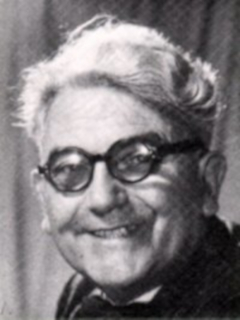
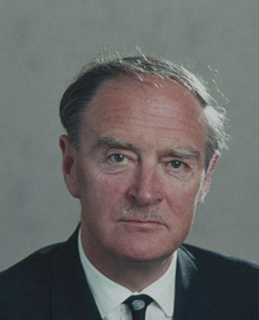
Peter Lawrence Boyle Jr., Irish American character actor and comedian, is born on October 18, 1935, in Norristown, Pennsylvania. He is most noted for his role as Frank Barone on the sitcom Everybody Loves Raymond and the comical monster in Mel Brooks‘s film spoof Young Frankenstein (1974).

Boyle is born to Alice (Lewis) and Francis Xavier Boyle. His paternal grandparents are Irish immigrants, and his mother is of mostly French and British Isles descent. He eventually moves to Philadelphia, where his father is a sought-after local TV personality and children’s show host. Following a solid Catholic upbringing, he is a sensitive youth and joins the Christian Brothers religious order at one point while attending La Salle University in Philadelphia. He leaves the monastery after only a few years when he “lost” his calling.

Bent on an acting career, Boyle initially studies with guru Uta Hagen in New York. The tall, hulking, prematurely bald actor wannabe struggles through a variety of odd jobs as a postal worker, waiter and bouncer while simultaneously building up his credits on stage and waiting for that first big break. Things start progressing for him after appearing in the national company of The Odd Couple in 1965 and landing TV commercials on the sly. In the late 1960s Boyle joins Chicago‘s The Second City improv group and makes his Broadway debut as a replacement for Peter Bonerz in Paul Sills’ Story Theatre (1971).

Boyle gains acclaim for his first starring role, playing the title character, a bigoted New York City factory worker, in the 1970 movie Joe, directed by John G. Avildsen. The film’s release is surrounded by controversy over its violence and language. The role leads to major notoriety, however, and some daunting supporting parts in T.R. Baskin (1971), Slither (1973) and as Robert Redford‘s calculating campaign manager in The Candidate (1972). During this time his political radicalism finds a visible platform after joining Jane Fonda and Donald Sutherland on anti-war crusades, which also includes the anti-establishment picture Steelyard Blues (1973). This period also sees the forging of a strong friendship with former Beatle John Lennon.

Destined to be cast as monstrous undesirables throughout much of his career, Boyle plays a monster of another sort in his early film days, and thus avoids a complete stereotype as a film abhorrent. His hilarious, sexually potent Frankenstein’s Monster in the cult Mel Brooks spoof Young Frankenstein (1974) sees him in a sympathetic and certainly more humorous vein. His creature’s first public viewing, in which Boyle shares an adroit tap-dancing scene with “creator” Gene Wilder in full Fred Astaire regalia, is a show-stopping audience pleaser. Late 1970s filmgoers continue to witness him in seamy, urban settings with brutish roles in Taxi Driver (1976) and Hardcore (1979). At the same time, he addresses several TV mini-movie roles with the same brilliant darkness such as his Senator Joe McCarthy in Tail Gunner Joe (1977), for which he receives an Emmy nomination, and his murderous, knife-wielding Fatso in the miniseries remake of From Here to Eternity (1979).

While the following decade finds Boyle in predominantly less noteworthy filming and a short-lived TV series lead as remote cop Joe Bash (1986), the 1990s bring him Emmy glory for a guest role in an episode of The X-Files (1993). Despite a blood clot-induced stroke in 1990 that impairs his speech for six months, he ventures on and caps his enviable career on TV wielding funny but crass one-liners in the “Archie Bunker” mold on the long-running sitcom Everybody Loves Raymond (1996). A major Emmy blunder has him earning seven nominations for his Frank Barone character without a win, the only prime player on the show unhonored. He survives a heart attack while on the set of Everybody Loves Raymond in 1999 but manages to return full time for the remainder of the series’ run through 2005.

Following a superb turn as Billy Bob Thornton‘s unrepentantly racist father in the sobering Oscar-winner Monster’s Ball (2001), the remainder of Boyle’s films are primarily situated in frivolous comedy fare such as The Adventures of Pluto Nash (2002), The Santa Clause 2 (2002), Scooby-Doo 2: Monsters Unleashed (2004), and The Santa Clause 3: The Escape Clause (2006), typically playing cranky curmudgeons.

Boyle dies of multiple myeloma and heart disease at NewYork-Presbyterian Hospital on December 12, 2006. He is interred at Green River Cemetery in Springs, New York. At the time of his death, he has completed his role in the film All Roads Lead Home and is scheduled to appear in The Golden Boys. The end credits of All Roads Lead Home include a dedication to his memory.

Leave a comment

First Production by the Gate Theatre Company

gate-theatre

The Gate Theatre Company of Dublin produces its first play, Henrik Ibsen‘s Peer Gynt, in the Peacock Theatre on October 13, 1928.

The Gate Theatre is founded in 1928 by Hilton Edwards and Micheál Mac Liammóir. During their first season, the company presents seven plays, including Eugene O’Neill‘s The Hairy Ape and Oscar Wilde‘s Salome. Their productions are innovative and experimental, and they offer Dublin audiences an introduction to the world of European and American theatre as well as classics from the modern and Irish repertoire. It is at the Gate that Orson Welles, James Mason, Geraldine Fitzgerald and Michael Gambon begin their prodigious acting careers.

The company plays for two seasons at the Peacock Theatre and then on Christmas Eve 1929, in Groome’s Hotel, a lease is signed for the 18th Century Rotunda Annex, the “Upper Concert Hall,” the Gate’s present home, with Johann Wolfgang von Goethe‘s Faust opening on February 17, 1930.

In 1931, the newly established Gate Theatre runs into financial difficulties and Edward Pakenham, 6th Earl of Longford and Christine Longford, Countess of Longford provide financial support. The Longfords work with Edwards and MacLiammóir at the Gate until 1936, then a split develops, and two separate companies are formed and play at the Gate Theatre for six months each. The companies also tour for six months until the death of Lord Longford in 1961.

During this period Edwards and MacLiammóir (Gate Theatre Productions) run shows in Dublin’s Gaiety Theatre and tour productions to Europe, Egypt and North America.

From the 1980s onwards the Gate Theatre, under the directorship of Michael Colgan, cements its international relationship, touring plays around the world for audiences from Beijing to New York. The theatre establishes unique relationships with leading contemporary playwrights including Samuel Beckett, Harold Pinter and Brian Friel. The first ever Beckett Festival is produced, presenting all 19 of the stage plays over a three-week period. The first ever festival of Pinter’s plays follows, along with many premieres and productions of Friel’s work including the acclaimed production of Faith Healer with Ralph Fiennes which wins a Tony Award on Broadway.

With the generous support of funders, the fabric of the building is restored and renovated under the guidance of Ronnie Tallon and Scott, Tallon Walker Architects. This includes the provision of a new wing, which incorporates a studio space, The Gate Studio, for rehearsals and workshops, offering practitioners an opportunity to develop and nurture creativity.

On April 3, 2017, Selina Cartmell becomes Director of the Gate Theatre. As a freelance artist, she has directed a diverse range of work from Greek tragedy and Shakespeare to international work and contemporary Irish drama. In 2004, she establishes Dublin-based Siren Productions, a multi-award-winning company conceived to innovate the classics and create relevant and dynamic new work, integrating theatre, dance, visual arts, architecture, film and music. Her productions have been nominated for thirty-five theatre awards, winning ten, including three for best director.


Leave a comment

Death of Padraic Fallon, Poet & Playwright

padraic-fallon

Padraic Fallon, Irish poet and playwright, dies on October 9, 1974, in Aylesford, England.

Fallon is born in Athenry, County Galway on January 3, 1905. His upbringing and his early impressions of the town and the surrounding landscape are intimately described in his poetry. After passing the civil service exams in 1923 he moves to Dublin to work in the Customs House. In Dublin he becomes part of the circle of George William Russell (Æ) who encourages his literary ambitions and arranges for the publication of his early poetry. He forms close friendships with Seumas O’Sullivan, editor of The Dublin Magazine, the poets Austin Clarke, Robert Farren, F.R. Higgins and Patrick McDonagh, and later the novelist James Plunkett.

In 1939, Fallon leaves Dublin to serve as a Customs official in County Wexford, living in Prospect House, near Wexford with his wife, Dorothea (née Maher) and his six sons. During this time, he becomes a close friend of the painter Tony O’Malley.

Fallon’s early poetry, short stories and literary criticism are published in The Dublin Magazine and The Bell. He is a regular contributor to Raidió Éireann in the 1940s and 1950s, serving variously as a journalist, scriptwriter and literary critic. A number of his short stories and early dramatic pieces are broadcast by the station during the 1940s. The first of his verse plays for radio, Diarmuid and Gráinne, is broadcast by Raidió Éireann in November 1950. This is followed by The Vision of Mac Conglinne (1953), Two Men with a Face (1953), The Poplar (1953), Steeple Jerkin (1954), The Wooing of Étain (1954), A Man in the Window (1955), Outpost (1955), Deirdre’s King (1956), The Five Stations (1957), The Hags of Clough (1957), The Third Bachelor (1958), At the Bridge Inn (1960) and Lighting up Time (1961).

Three plays adapted from Irish mythology, Diarmuid and Gráinne, The Vision of Mac Conglinne and Deirdre’s King, receive particular contemporary critical acclaim. The landscape, mythology and history of Ireland, interwoven with classical themes and religious symbolism, are frequent themes in his poetry and dramatic works. A number of Fallon’s radio plays are later broadcast on BBC Third Programme and, in translation, in Germany, the Netherlands, and Hungary. The play The Seventh Step is staged at The Globe Theatre in Dublin in 1954. A second one, Sweet Love ’till Morn, is staged at the Abbey Theatre in 1971. He also writes dramatic pieces for television such as A Sword of Steel (1966) and The Fenians (1967), the latter produced by James Plunkett. In a number of his plays and radio dramas he cooperates with contemporary composers providing incidental music, an example being The Wooing of Étain (1954) with music by Brian Boydell.

Fallon retires from the Civil Service in 1963, returning to Dublin before moving to Cornwall in 1967 to live with his son, the sculptor Conor Fallon and his daughter-in-law, the artist Nancy Wynne-Jones. He and his wife return to Ireland in 1971. He spends his last years in Kinsale. He is visiting his son Ivan Fallon in Kent at the time of his death.

While Fallon’s poetry had previously appeared in The Dublin Magazine, The Bell, The Irish Times and a number of anthologies, his first volume of collected poetry, Poems, incorporating a number of previously unpublished poems, is not produced until 1974, months before his death. Three volumes of his poetry, edited by his son, the journalist and critic Brian Fallon, are published after his death: Poems and Versions in 1983, Collected Poems in 1990, and A Look in the Mirror and Other Poems in 2003. In 2005, three of his verse plays, The Vision of Mac Conglinne, The Poplar, and The Hags of Clough, are published in a single volume. A selection of his prose writings and criticism edited by Brian Fallon, A Poet’s Journal, is published in the same year.


Leave a comment

Death of Liam Cosgrave, 6th Taoiseach of Ireland

liam-cosgrave

Liam Cosgrave, politician who serves as Taoiseach from February 1973 to July 1977, dies at the age of 97 in Tallaght, Dublin on October 4, 2017. He is the longest-lived Taoiseach, dying at the age of 97 years, 174 days.

Born in Castleknock, Dublin on April 13, 1920, Cosgrave is the son of William Thomas Cosgrave, the first President of the Executive Council and head of the government of the Irish Free State during the first 10 years of its existence (1922–32). He is educated at Castleknock College, Dublin, studies law at King’s Inns and is called to the Irish bar in 1943. In that same year he enters Dáil Éireann (the lower house of the Oireachtas, the Irish parliament), and he retains his seat until his retirement from politics in 1981.

In 1948, when the first inter-party government replaces Éamon de Valera’s Fianna Fáil regime, which had been in power for the previous 16 years, Cosgrave becomes Parliamentary Secretary to the Taoiseach and to the Minister for Industry and Commerce. It is a short-lived administration, going out of power in 1951 after three years of rule. But in a second inter-party government (1954–57), he becomes Minister for External Affairs and leads the first Irish delegation to the United Nations General Assembly in 1956.

Cosgrave succeeds James Dillon as leader of the Fine Gael party in 1965. Eight years later, as leader of a coalition government in which Fine Gael combines forces with the Labour Party, he becomes Taoiseach. He and British Prime Minister Edward Heath are the main participants in the intergovernmental conference at Sunningdale in December 1973 that gives birth to Northern Ireland’s first, though short-lived, power-sharing executive (1973–74). A devout Roman Catholic, he is intensely conservative on social issues and shocks his cabinet colleagues by voting against his own government’s bill on liberalizing the sale of contraceptives in 1974. The National Coalition is defeated in the 1977 Irish general election, largely on the economic issues of inflation and unemployment.

Cosgrave retires at the 1981 Irish general election. In 1981, he retires as Dáil Deputy for Dún Laoghaire to be replaced by his son, Liam T. Cosgrave. He reduces his involvement in public life but makes occasional appearances and speeches.

Liam Cosgrave dies on October 4, 2017, at the age of 97 of natural causes. He had been at Tallaght Hospital for several months prior to his death there. His funeral is held on October 7, 2017, after which he is interred alongside his father at Inchicore‘s Goldenbridge Cemetery.


Leave a comment

Death of Archbishop Luciano Storero

Michael Sullivan US Ambassado

Archbishop Luciano Storero, former Apostolic Nuncio in Ireland and Archbishop of the Titular See of Tigimma, dies in Dublin on October 1, 2000.

Storero is born in Pinasca, Italy on September 26, 1926. He is ordained into the priesthood on June 29, 1949. On November 22, 1969, he is appointed Titular Archbishop of Tigimma and the same day is appointed an Apostolic Delegate. He is appointed Apostolic Nuncio on December 24, 1970, to the Dominican Republic. He serves as Pro-Nuncio to Gabon and Cameroon from 1973. He is the Apostolic Nunciature to India from 1976 to 1981. He also serves as Apostolic Nunciature to Venezuela from 1981. On November 15, 1995, he is appointed the tenth Apostolic Nunciature to Ireland. He remains in that position until his death.

It is reported in the United States in January 2011, as Nuncio to Ireland in 1997, Storero signed a two-page letter that warns the Irish bishops against implementing a policy “that included ‘mandatory reporting’ of suspected abusers to civil authorities.” The policy, which had been approved by the Irish bishops, put the Irish church in opposition to Storero and the Vatican.

That opposition is not reversed at least until Cardinal Joseph Aloisius Ratzinger (the future Pope Benedict XVI) is put in charge of the Congregation for the Doctrine of the Faith by Pope John Paul II in 2001. At that time the Vatican begins to tip the balance in canon law in favour of the victims. “But has [the Pope] done enough?” asks a report earlier in 2011 on the Irish television network RTÉ. “The Vatican has yet to acknowledge its contribution in creating the problem in the first place … [when] they put the reputation of the Church and the avoidance of scandal over the concerns for the victims [under Storero and before].”

Luciano Storero dies of cancer at Mater Private Hospital in Dublin on October 1, 2000. His remains are removed from the hospital to the St. Mary’s Pro-Cathedral in Dublin where Requiem Mass is celebrated at noon on October 3, 2000, before being transferred to Dublin Airport under Army escort for transport to Italy where he is interred in his hometown of Pinasca.


Leave a comment

Closing of the Magdalene Laundries

magdalene-laundries

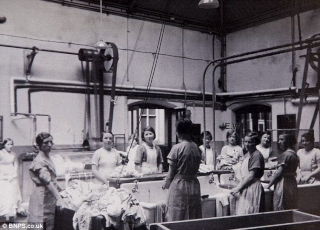
The last of the Magdalene Laundries in Ireland, also known as the Magdalene Asylums, closes on September 25, 1996.

The Magdalene Laundries are institutions usually run by Roman Catholic orders, which operate from the 18th to the late 20th centuries. They are run ostensibly to house “fallen women,” a term primarily referring to prostitutes in the late 18th century. By the end of the 19th century, Magdalene laundries are filled with many different kinds of women, including girls who are “not prostitutes at all”, but either “seduced women” or women who have yet to engage in sexual activity.

Several religious institutes establish even more Irish laundries, reformatories and industrial schools, sometimes all together on the same plot of land, with the aim to “save the souls primarily of women and children.” Examples are Sisters of Our Lady of Charity of Refuge and the Congregation of the Sisters of Mercy, who run the largest laundries in Dublin. These large complexes become a massive interlocking system, carefully and painstakingly built up over a number of decades. Consequently, Magdalene laundries become part of Ireland’s “larger system for the control of children and women.”

An estimated 30,000 women are confined in these institutions in the 19th and 20th centuries. It is unknown how many women resided in the Magdalene institutions after 1900. Vital information about the women’s circumstances, the number of women, and the consequence of their incarceration is unknown. Due to the religious institutes’ “policy of secrecy,” their penitent registers and convent annals remain closed to this day, despite repeated requests for information.

In Dublin in 1993, the Sisters of Our Lady of Charity sell part of the land in their convent to a property developer to cover money lost in share dealings on the stock exchange. This leads to the discovery of 133 corpses in a mass grave. The Sisters arrange to have the remains cremated and reburied in another mass grave at Glasnevin Cemetery, splitting the cost of the reburial with the developer who had bought the land. It later transpires that there are 22 more corpses than the sisters had applied for permission to exhume. In all, 155 corpses were exhumed and cremated.

Discovery of the mass grave leads to media revelations about the operations of the secretive institutions. A formal state apology is issued in 2013, and a £50 million compensation scheme for survivors is set up by the Irish Government. The religious orders which operate the laundries have rejected activist demands that they financially contribute to this programme.


Leave a comment

Birth of Martin Fay of The Chieftains

martin-fay-1

Martin Joseph Fay, Irish fiddler and bones player and co-founder of the Irish traditional music ensemble The Chieftains, is born in Cabra, Dublin on September 19, 1936.

The Chieftains are credited with reviving worldwide interest in traditional Celtic music. Fay performs as the group’s fiddler and bones player for some 40 years.

Fay develops an early interest in the violin and takes music lessons at the Municipal School of Music in Dublin. He joins the orchestra of the Abbey Theatre during his teen years and is introduced to Irish folk music by the theatre’s musical director Sean O’Riada.

It was through O’Riada’s folk band, Ceoltóirí Chualann, that Fay meets the other original Chieftains members, Paddy Moloney, Seán Potts, and Michael Tubridy. The foursome releases their first album, Chieftains 1, in 1964. The Chieftains perform on local radio and television programs and in pubs throughout the British Isles, but it is not until the 1970s that they begin touring overseas.

The Chieftains gain international acclaim when their music is used in the Academy Award-winning soundtrack for the film Barry Lyndon (1975). In 1989, The Chieftains are officially designated Ireland’s musical ambassadors. Although the quartet’s membership changes over the years, Fay records more than 30 albums with The Chieftains.

In 2001, Fay decides to stop touring with The Chieftains, limiting his appearances with the group to events in Ireland. He subsequently retires in 2002. After a lengthy illness, he dies at the age of 76 in Cabra on November 14, 2012.


Leave a comment

State Funeral for Thomas Kent

thomas-kent-funeral

A state funeral for Thomas Kent takes place on September 18, 2015, 99 years after his execution following the 1916 Easter Rising. Thousands of people line the route from Collins Barracks in Cork to the Church of Saint Nicholas, Castlelyons, County Cork for the funeral mass.

Kent is executed after a gun battle with members of the Royal Irish Constabulary (RIC) who come to arrest him and his brothers on May 2, 1916, during the aftermath of the Easter Rising. During the ensuing fight, head constable William Rowe is killed, and Kent’s brother Richard later dies of his wounds. He is executed by firing squad on May 9, 1916, in the Military Detention Barracks, Cork and is buried in an unmarked grave on the grounds.

Apart from Roger Casement, Kent is the only one of the sixteen men executed after the Easter Rising to be executed outside Dublin. In June 2015, his remains are exhumed, and DNA testing confirms their identity.

A ripple of applause breaks through the crowd when the funeral cortege arrives at the church near where Kent was born and raised. The church is unable to accommodate all the visitors, so a marquee is set up on the grounds of the church.

President Michael D. Higgins is in attendance along with Taoiseach Enda Kenny, Tánaiste Joan Burton, Fianna Fáil leader Michéal Martin and Sinn Féin President Gerry Adams. The diplomatic corps is represented by British ambassador Dominick Chilcott, U.S. ambassador Kevin O’Malley and the Papal Nuncio Archbishop Charles Brown. The extended Kent family is represented mostly by the relatives of Edmund and William Kent, Thomas Kent’s brothers.

Kent’s funeral “writes the final chapter in a long ordeal for the Kent family,” the Bishop of Cloyne William Crean tells the congregation. Delivering the funeral eulogy, Cmdt. Gerry White says Thomas Kent was once known only for being the man who gave his name to Kent Station in Cork. “Today, however, all that is changed. Today, because of the recent discovery of his remains, Thomas Kent has once again become someone who is very much in the present. Today, members of Óglaigh na hÉireann, the Irish Defence Forces, will render the military honours that were denied him 99 years ago. Today, he will no longer be the ‘Forgotten Volunteer.’ Today, after 99 years, Thomas Kent is finally coming home.”

Thomas Kent’s life is represented by a picture of the family home, rosary beads, a pioneer pin and a leabhair gaeilge representing his interests in life. He is buried in the graveyard at Castlelyons. Taoiseach Enda Kenny gives the funeral oration.

(From: “State funeral for executed 1916 rebel Thomas Kent” by Ronan McGreevy and Éanna Ó Caollaí, The Irish Times, September 18, 2015 | Pictured: The remains of Thomas Kent as they are carried into St. Nicholas’ Church, Castlelyons, County Cork, photograph by Alan Betson)


Leave a comment

Birth of Charles Haughey, Taoiseach of Ireland

CREATOR: gd-jpeg v1.0 (using IJG JPEG v62), quality = 90

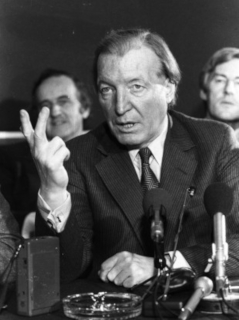
Charles James Haughey, Fianna Fáil leader and Taoiseach of Ireland, is born in Castlebar, County Mayo on September 16, 1925.

Haughey is the third of seven children of Seán Haughey, an officer in the original Irish Republican Army (IRA), and Sarah McWilliams, both natives of Swatragh, County Londonderry. He attends University College Dublin, studying law and accounting. While making a fortune, apparently in real estate, he marries Maureen Lemass, the daughter of future Taoiseach Seán Lemass on September 18, 1951. After several attempts he enters Dáil Éireann (the lower house of the Oireachtas, the Irish parliament) in 1957 as a member of the Fianna Fáil party for the Dublin North-East constituency. He becomes Minister for Justice in 1961 and later Minister for Agriculture and Minister for Finance.

In 1970 Haughey is twice tried for conspiracy to use government funds to procure arms for the outlawed IRA. The first trial is aborted, and he wins acquittal in the second. Dismissed from the government, he remains in the Dáil and gains strong support among his party’s grass roots. When Fianna Fáil is returned to office in 1977, he is made Minister for Health and Minister for Social Welfare. On the resignation of party leader Jack Lynch in 1979, he is elected party leader and becomes Taoiseach. In June 1981 his government falls, but he returns to power briefly in 1982. He becomes Taoiseach again after elections in February 1987, though his government lacks a majority in the Dáil. When Fianna Fáil forms a government with the Progressive Democrats in July 1989, thereby eschewing the party’s traditional rejection of coalition rule, he is made Taoiseach for a fourth time.

Haughey’s first two terms in office are marked by deteriorating relations with Great Britain, a declining economy, and deep divisions within Fianna Fáil. Despite the controversies that plague his government, the charismatic Haughey remains party leader after losing office for a second time in late 1982. During his later terms, he successfully mounts a fiscal austerity program to address Ireland’s financial crisis. In 1992 he resigns and retires after being implicated in a phone tapping scandal of two journalists. He denies the allegations. He remains out of public life until 1997, when an official tribunal of inquiry determines that he had received large sums of money from a prominent businessman while Taoiseach. The Dáil then establishes another tribunal to investigate his financial affairs, and many other irregularities are uncovered. He eventually agrees to pay €6.5 million in back taxes and penalties.

Haughey dies at the age of 80 from prostate cancer, from which he had suffered for a decade, on June 13, 2006, at his home in Kinsealy, County Dublin. He receives a state funeral on June 16. He is buried in St. Fintan’s Cemetery, Sutton, Dublin, following mass at Donnycarney. The then Taoiseach Bertie Ahern delivers the graveside oration. The funeral rites are screened live on RTÉ One and watched by a quarter of a million people. The funeral is attended by President Mary McAleese, the Taoiseach, Bertie Ahern, members of the Oireachtas, many from the world of politics, industry and business. The chief celebrant is Haughey’s brother, Father Eoghan Haughey.


Leave a comment

Death of Noel Cantwell, Soccer Player & Cricketer

noel-cantwell

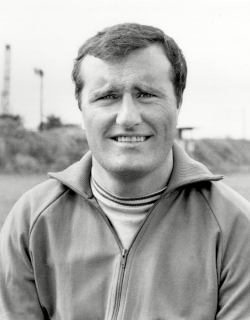
Noel Euchuria Cornelius Cantwell, soccer player and sometime cricketer, dies of cancer on September 8, 2005. Born in Cork, County Cork on February 28, 1932, he is educated at the Roman Catholic Presentation Brothers College there.

Cantwell plays as a full-back for Western Rovers, Cork Athletic F.C., West Ham United F.C. and Manchester United F.C. While at West Ham, he features in the London XI side that competes in the 1955–58 Inter-Cities Fairs Cup final on May 1, 1958. He captains the Hammers to winning the Division Two championship in the 1957–58 season and thereby leads the club into the topflight for the first time since 1932.

In November 1960, Cantwell joins Manchester United for £29,500 which at the time is a record for a full-back. He helps the club win the 1965 and 1967 league titles and captains United when winning the 1963 FA Cup Final, just as his fellow countryman Johnny Carey had done in United’s previous FA Cup win 15 years earlier. He also serves as Chairman of the Professional Footballers’ Association.

Cantwell wins 36 full International caps for the Republic of Ireland national football team, typically playing at left full-back and on several occasions at centre-forward. He makes his debut against Luxembourg in October 1953 with his final appearance coming away to Turkey in February 1967. He scores 14 goals including 5 from penalties and also captains the Republic on several occasions including a match against England at Wembley Stadium.

In his first managerial role at Coventry City F.C. he has the onerous task of following Jimmy Hill who had taken the club into the Football League First Division for the first time in their history. He narrowly keeps the Sky Blues in the top in his first two seasons before taking them to a sixth-place finish in 1969–70, earning them qualification for the Inter-Cities Fairs Cup, a year before it was replaced by the UEFA Cup.

Cantwell departs from Highfield Road on March 12, 1972, to take charge of the New England Tea Men in the United States, but within seven months is back in English football as manager of Peterborough United F.C. He helps Peterborough win the Football League Fourth Division title in his first full season as manager, before leaving on May 10, 1977, for a second spell with the Tea Men. This time he spends a year in the United States.

Cantwell returns to Peterborough on November 19, 1986, for a second spell as manager, remaining in this role until he becomes general manager on July 12, 1988. He is general manager at London Road for a year until he quits football to become licensee of the New Inn at Peterborough, where he remains for 10 years until he retires in 1999. He also is landlord of the Bull and Swan in Stamford, Lincolnshire.

Cantwell also plays cricket for Cork Bohemians Cricket Club and Ireland as a left-handed batsman and a right-arm medium bowler. He plays five times for Ireland making his debut in what is his sole first-class match versus Scotland at Edinburgh in 1956, scoring 31 and 17. His last match for Ireland is against Lancashire in July 1959.

Cantwell dies on September 8, 2005, from cancer at the age of 73, leaving a widow and two children. His former teams each hold a minute of silence for him before their next matches.